
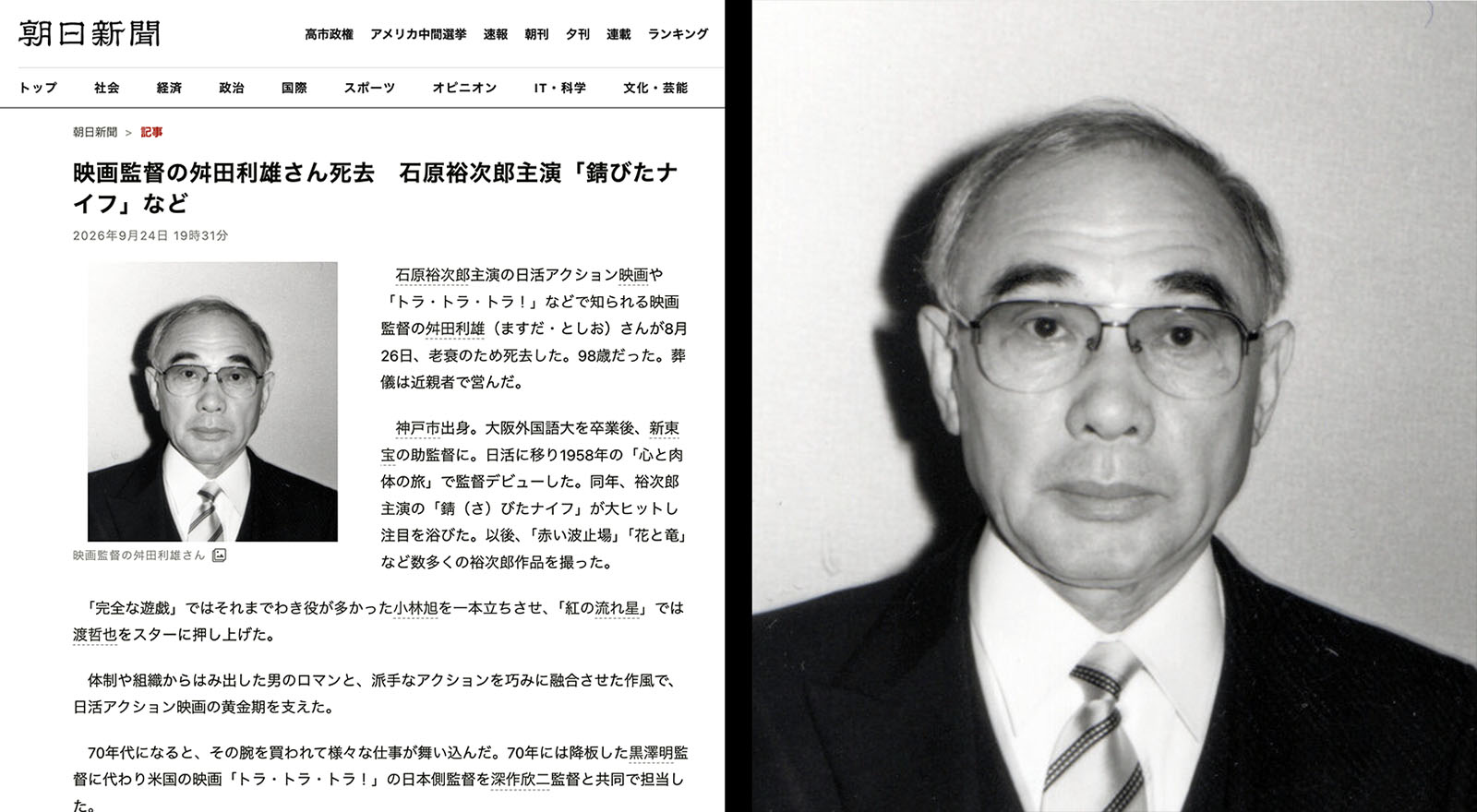
Film Director Toshio Masuda Passes Away; Known for Rusty Knife Starring Yujiro Ishihara
Published at Asahi.com, September 24, 2026. See the original post here
Film director Toshio Masuda, known for Nikkatsu action movies starring Yujiro Ishihara and the film Tora! Tora! Tora!, passed away from old age on August 26. He was 98 years old. A funeral service was held for close family members.
A native of Kobe, Masuda became an assistant director at Shintoho after graduating from Osaka University of Foreign Studies. He later moved to Nikkatsu and made his directorial debut in 1958 with Journey of Body and Soul. That same year, he garnered significant attention when Rusty Knife, starring Yujiro Ishihara, became a massive hit. He went on to direct numerous films starring Ishihara, including Red Pier and Flowers and Dragons. He established Akira Kobayashi, previously often cast in supporting roles, as a leading man with The Perfect Game, and propelled Tetsuya Watari to stardom with Red Shooting Star.
He underpinned the golden age of Nikkatsu action films with a style that skillfully blended flashy action sequences with the romanticism of men who lived outside the bounds of the establishment and organized society.
In the 1970s, his talents were highly sought after, leading to a wide range of projects. In 1970, he stepped in to replace Akira Kurosawa, co-directing the Japanese segments of the American film Tora! Tora! Tora! alongside Kinji Fukasaku.
He demonstrated his versatility across various genres, working on projects ranging from the Space Battleship Yamato animated feature film series to live-action films such as The Battle of Port Arthur, Prophecies of Nostradamus, and Ah, The Tower of Lilies.
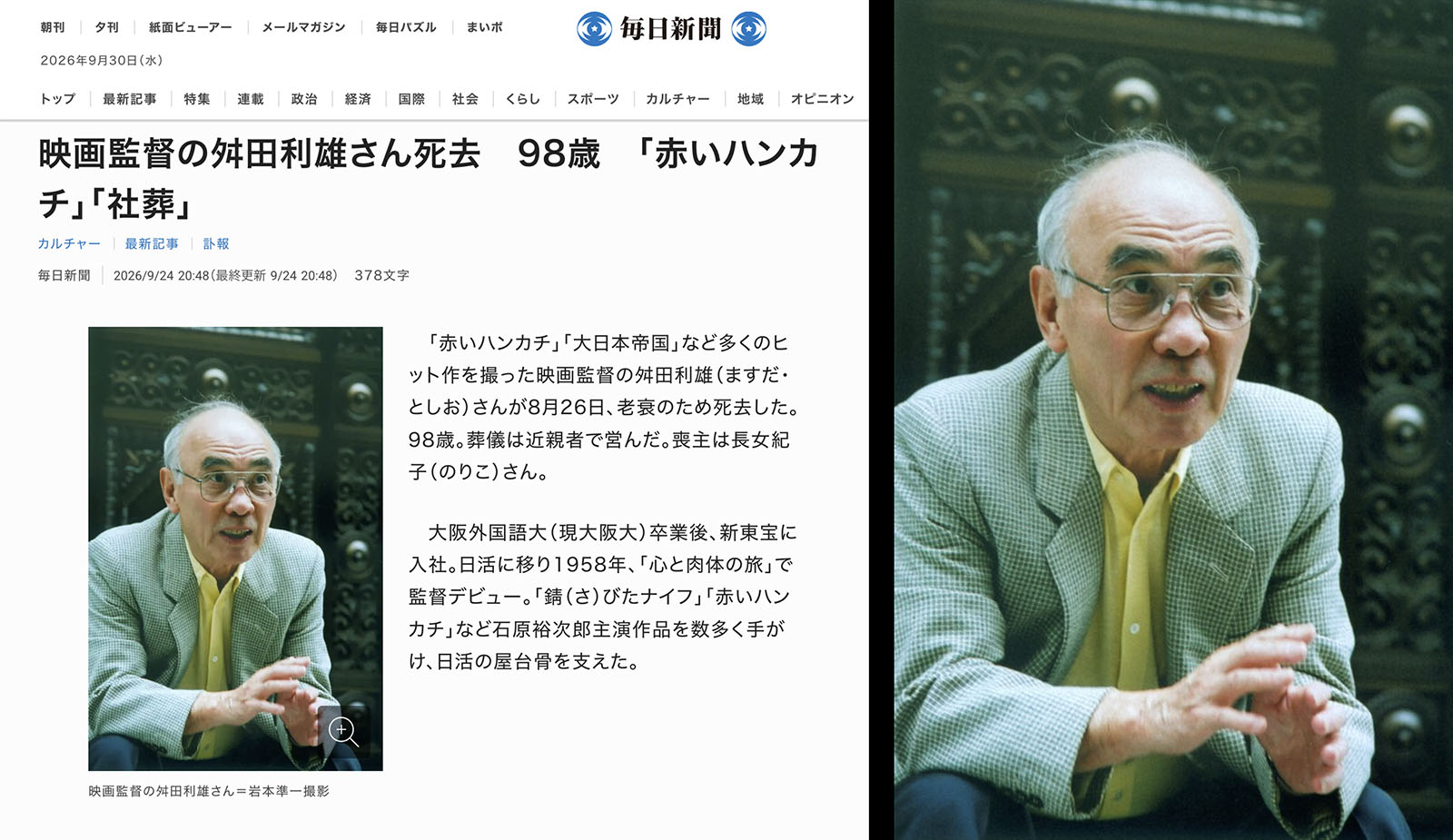
Film Director Toshio Masuda Dies at 98; Known for Red Handkerchief and Company Funeral
Published at Mainichi Shimbun, September 24, 2026. See the original post here
Film director Toshio Masuda, known for numerous hits such as Red Handkerchief and The Great Japanese Empire, passed away from old age on August 26. He was 98. A funeral service was held for close family members, with his eldest daughter, Noriko, serving as the chief mourner.
After graduating from Osaka University of Foreign Studies (now Osaka University), he joined Shintoho. He later moved to Nikkatsu, where he made his directorial debut in 1958 with Journey of Body and Soul. He was a pillar of Nikkatsu Studios, directing numerous films starring Yujiro Ishihara, such as Rusty Knife and Red Handkerchief.
In addition to serving as the Japanese director for the Hollywood film Tora! Tora! Tora!, he was active across a wide range of genres. His filmography included major action epics like the war movies The Battle of Port Arthur and The Great Japanese Empire; the animated film Space Battleship Yamato; the teen idol movie High-Teen Boogie; and the romance Angel with One Wing. He won the Best Director award at the 1989 Mainichi Film Awards for Company Funeral, a film depicting a succession struggle within a major newspaper company. In 1999, he was awarded the Order of the Rising Sun, 4th Class (Gold Rays with Rosette).
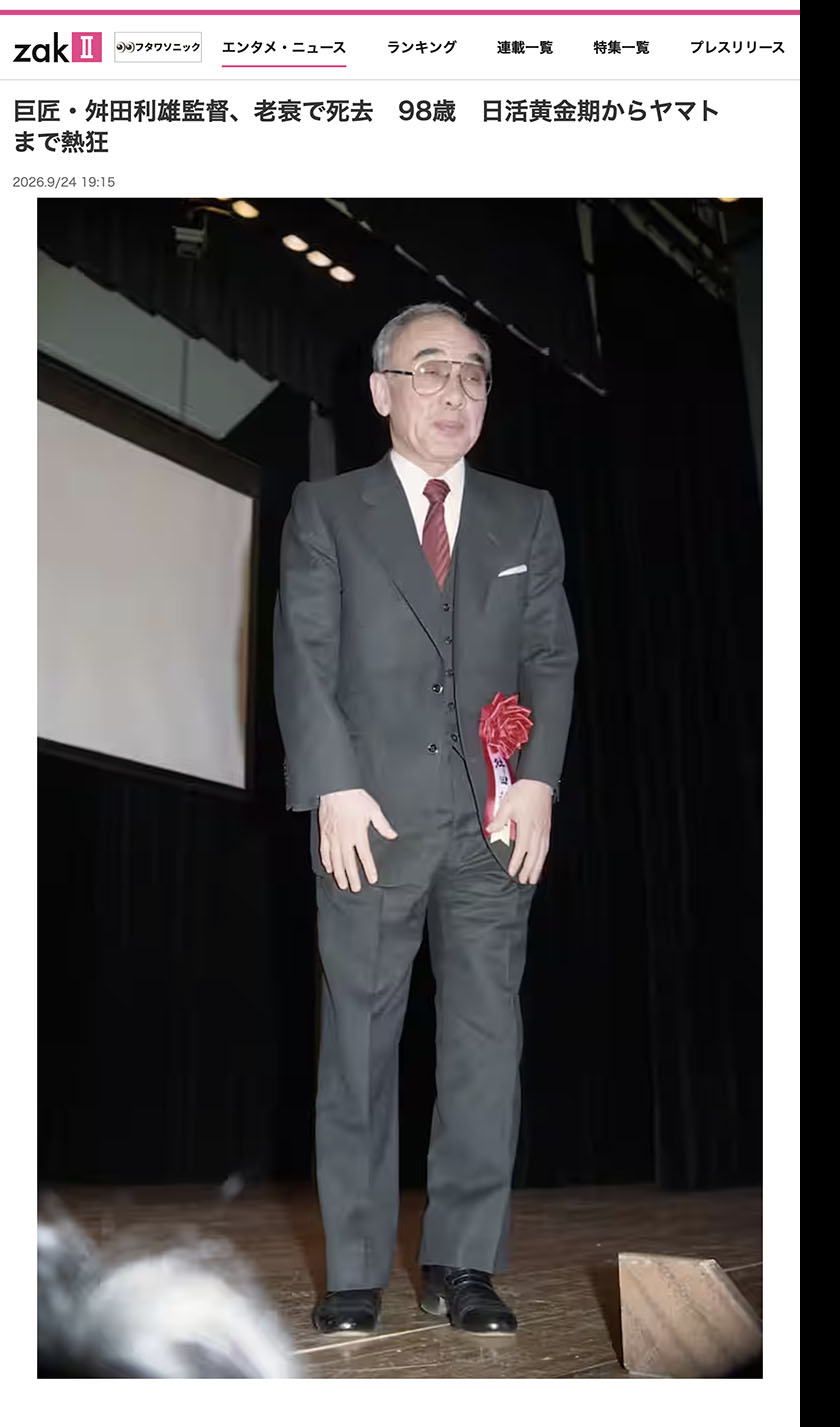
Legendary Director Toshio Masuda Dies of Old Age at 98; A Career Spanning Nikkatsu’s Golden Age to Yamato
Published at ZakZak, September 24, 2026
See the original post here
Film director Toshio Masuda, who released numerous blockbuster entertainment films across various genres, such as The Red Handkerchief and Hill 203, passed away from old age at a hospital in Tokyo on August 26. He was 98 years old. Throughout his life, he worked on over 80 films and was a rare hit-maker who led the Japanese film industry with an unwavering commitment to pure entertainment.
From Nikkatsu’s Golden Age to the World Stage: The Career and Masterpieces of Director Toshio Masuda
Born in Kobe, Hyogo Prefecture, in 1927, Director Masuda graduated from the Department of Russian Language at Osaka University of Foreign Studies (now Osaka University) and joined Shintoho in 1950. He transferred to Nikkatsu in 1954, where he worked as an assistant director under filmmakers such as Kon Ichikawa and Umetsugu Inoue before making his directorial debut in 1957 with Journey of Body and Soul (released in 1958).
Shortly after his debut, he achieved a massive hit with Rusty Knife (1958), starring Yujiro Ishihara, and instantly rose to the status of a top director. He continued to direct films starring Akira Kobayashi and Tetsuya Watari, playing a pivotal role at the forefront of Nikkatsu’s most lucrative genres, including “mood action” films and the Wataridori (Migratory Bird) and Burai (Outlaw) series.
His exceptional talent transcended borders; in 1970, he was selected as the Japanese-side director for the Hollywood blockbuster Tora! Tora! Tora!, which depicted the attack on Pearl Harbor. Despite bearing the heavy responsibility of taking over for director Akira Kurosawa, he flawlessly managed massive crowds and complex aerial action sequences, earning high acclaim internationally.
After going freelance, he remained active across various genres at studios like Toei and Toho. His work on the 1989 film Company Funeral won him the Best Director award at both the Mainichi Film Awards and the Blue Ribbon Awards. He also received prestigious honors within the Japanese film industry, including the Medal with Purple Ribbon in 1993 and the Order of the Rising Sun, Gold Rays with Rosette in 1999.
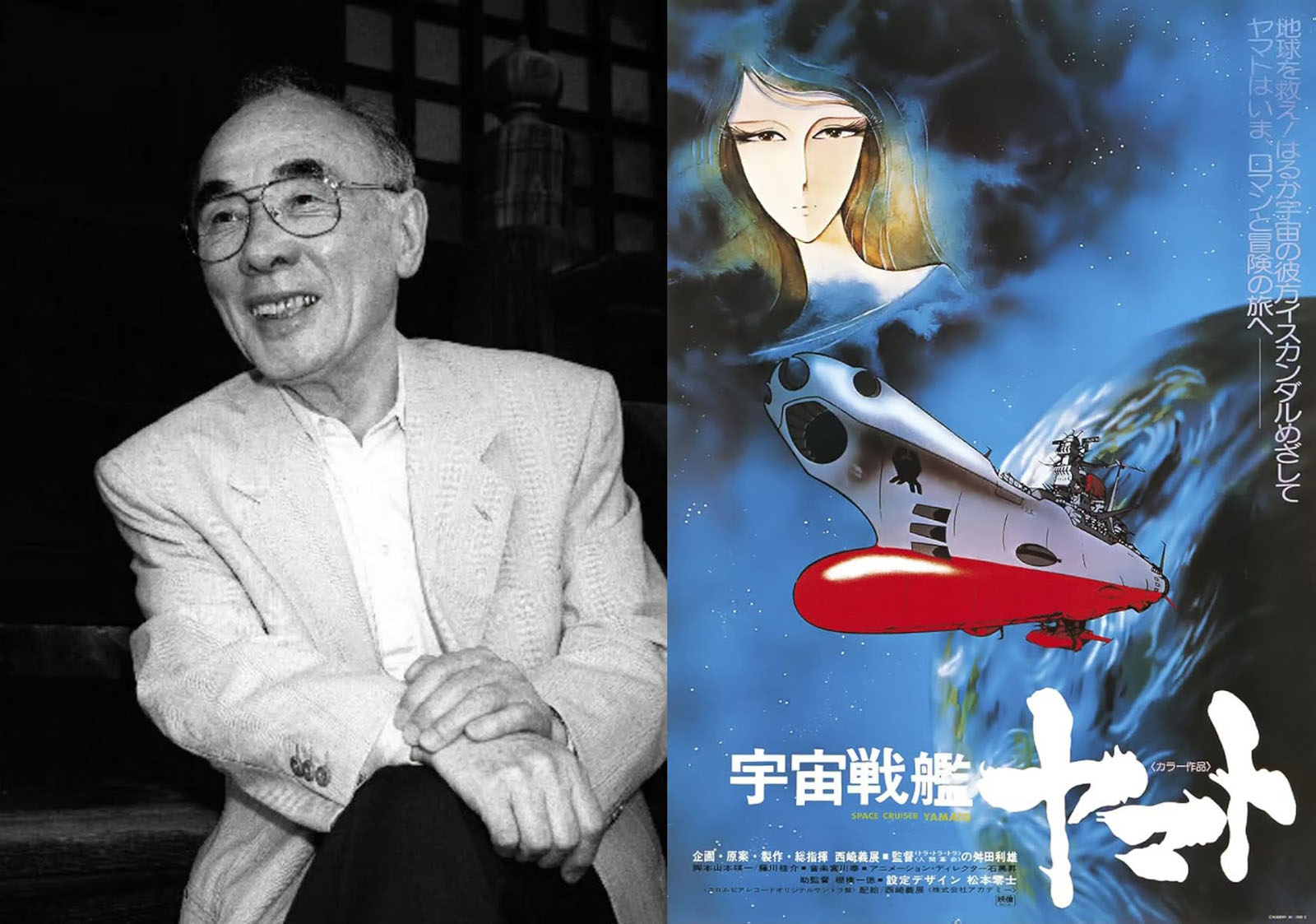
The Space Battleship Yamato Phenomenon and the Introduction of Live-Action Directing Techniques
Among his many notable works, a unique and monumental achievement in Director Masuda’s career is the Space Battleship Yamato series, which sparked an unprecedented anime boom in Japan during the late 1970s.
Although the 1974 TV anime series had struggled with low ratings, Director Masuda was recruited by producer Yoshinobu Nishizaki to helm the 1977 theatrical film adaptation. Despite having no prior experience directing anime, he poured his expertise in “live-action filmmaking techniques designed to move audiences” into condensing the 26-episode TV series into a 130-minute film. In doing so, he elevated the work beyond the confines of mere “children’s anime” into a profound “sci-fi human drama” capable of captivating middle schoolers, high schoolers, and adults alike, ultimately transforming Yamato into a massive social phenomenon.
He played a pivotal role as both director and screenwriter for the 1978 feature film, Farewell to Space Battleship Yamato. The film depicts a harrowing struggle against the formidable White Comet Empire, featuring the successive deaths of Yamato crew members and culminating in a shocking finale where Susumu Kodai launches a suicide attack, ramming Yamato itself into the enemy’s colossal battleship. The plot elements of “risking one’s life for love” and “a heroic demise for a noble cause” reflected a highly cinematic and emotional directorial style, one that would later characterize Toei’s epic war films, such as Hill 203 (1980).
Behind the scenes, the production was marked by fierce clashes between the top figures involved: Producer Nishizaki, who sought to pursue romanticism, and Director Masuda, who prioritized cinematic realism and narrative coherence. Yet, it was precisely this uncompromising tug-of-war that infused the film with a unique intensity. The result was a massive success, setting records among Japanese films of the era with 2.1 billion yen in distribution revenue and an audience of four million.
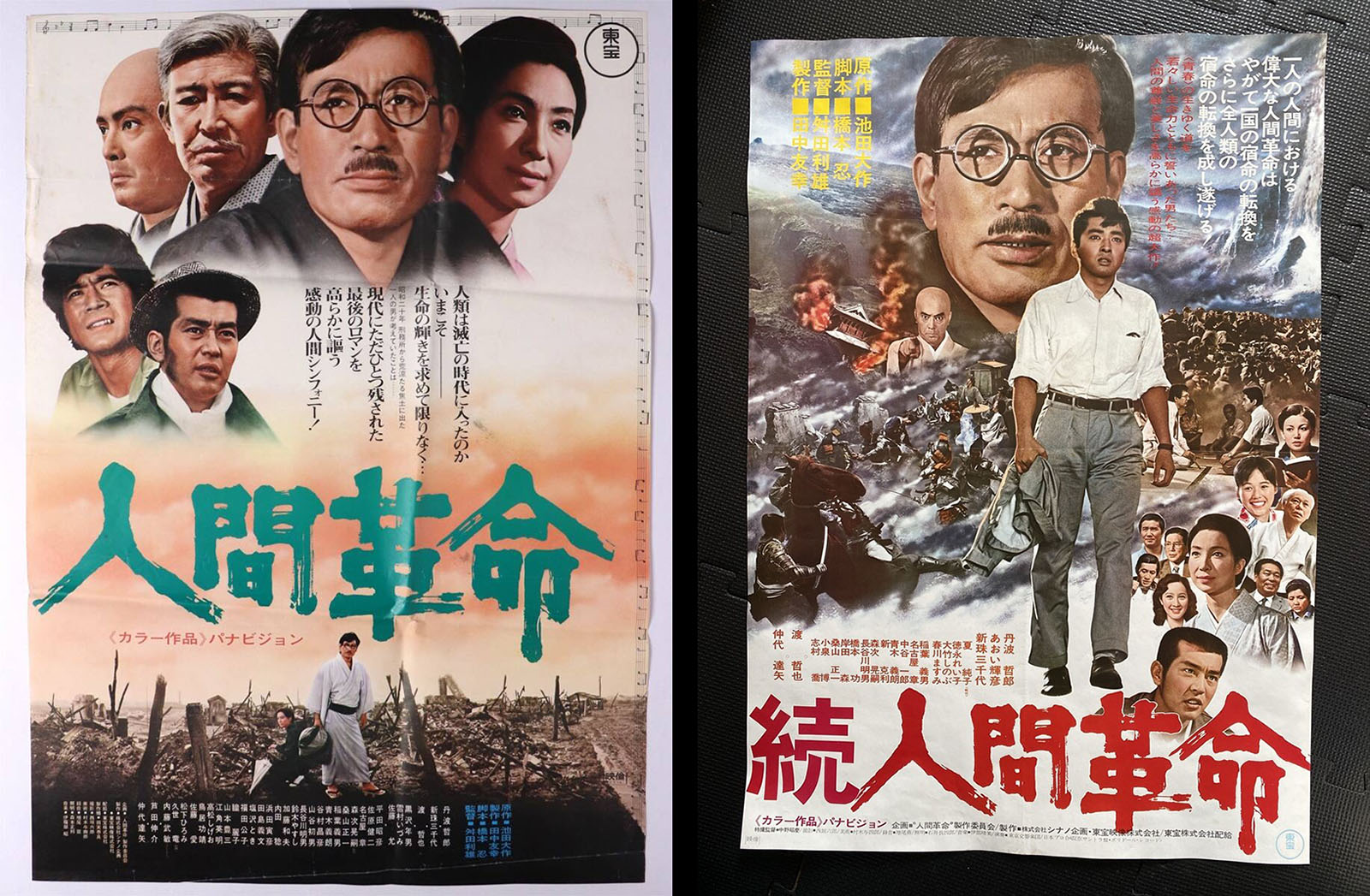
The Smash Hit The Human Revolution: Elevating the Material to Top-Tier Entertainment
Another prime example of Director Masuda’s exceptional skill is found in the films The Human Revolution (1973) and its sequel, The Human Revolution II (1976). Based on the novel of the same name by Daisaku Ikeda, then-president of Soka Gakkai, and chronicling the life of the organization’s second president, Josei Toda, the project dealt with themes that were inherently steeped in religion. However, Director Masuda brilliantly reimagined the material as a first-rate epic entertainment, a powerful human drama.
The production assembled the elite of the Japanese film industry at the time. The crew featured top-tier talent, including screenwriter Shinobu Hashimoto (known for his work with Akira Kurosawa), composer Akira Ifukube (of the Godzilla series), and special effects director Teruyoshi Nakano. The cast was equally impressive, featuring a lineup of major stars: Tetsuro Tamba, who commanded the screen in the lead role, was joined by Shinsuke Ashida, Tatsuya Nakadai, Michiyo Aratama, and Tetsuya Watari, an actor with whom Masuda shared a long-standing professional bond. As a result, the 1973 original film became a massive hit, generating 1.3 billion yen in distribution revenue against a production budget of 350 million yen. It ranked second in box-office performance among Japanese films that year, surpassed only by Japan Sinks, and once again demonstrated that Director Masuda was a true “master craftsman” capable of captivating audiences regardless of the subject matter.
RELATED READING