Solving local agricultural challenges with lasers and drones, Awanext’s vision for the future of weed control
Published at Monthly Kosen, September 2, 2026. See the original post here
The “Awanext” team from Anan National College of Technology (Anan KOSEN) won the Grand Prize in the Prototype Category at the 3rd KOSEN Entrepreneur Summit, co-hosted by the National Institute of Technology (KOSEN) and Monthly Kosen.
The team proposed “KaLas,” a system that combines drones and lasers to remotely eliminate weeds in areas such as steep slopes. Born from a familiar agricultural issue, the idea evolved into a concrete business plan through repeated interviews with farmers and various experiments.
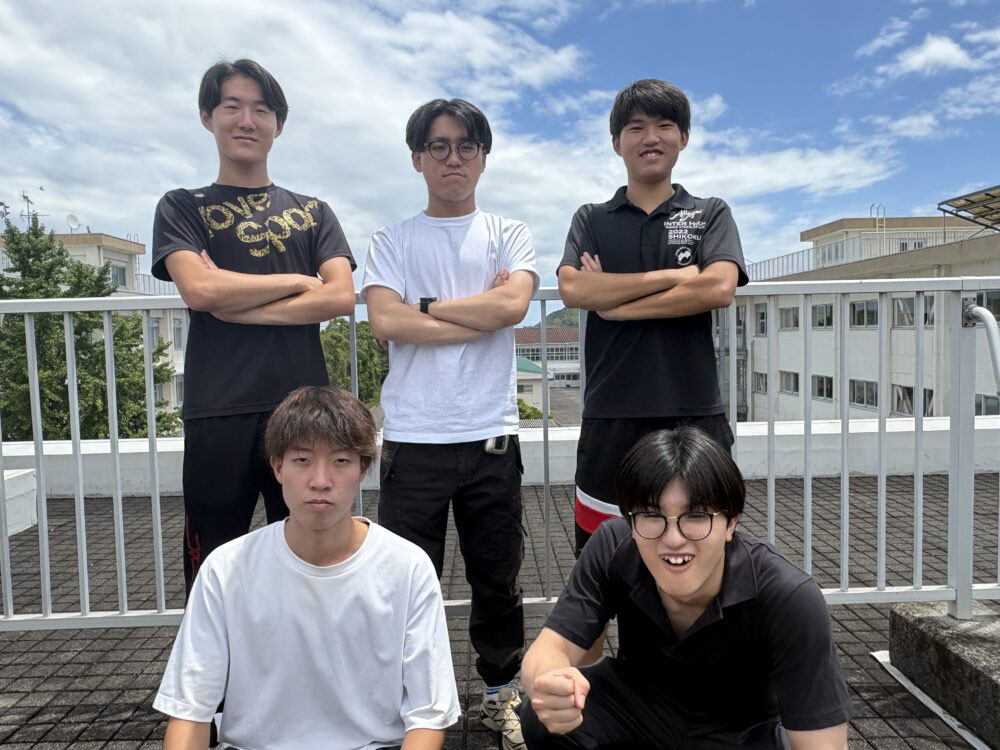
We spoke with five 5th-year students from the Department of Creative Engineering (Electrical Course), Shota Minami (Team Leader; back row, right), Takumi Goto (Laser Experimentation; back row, left), Akihiro Shinohara (Laser Experimentation; front row, left), Ryunosuke Shigemura (Business Planning; back row, center), and Itsuyasu Matsumae (Documentation; front row, right), about the development process and the lessons they learned through the summit.
“We never thought it would be us.” The surprise of winning the Grand Prize
Interviewer: First, please tell us your honest reactions to winning the Grand Prize in the Prototype Category at the 3rd KOSEN Entrepreneur Summit.
Minami: The presentations from the other teams were all incredibly polished, so we never imagined we would be the ones chosen. At first, we were mostly just surprised, but a sense of accomplishment gradually set in.
Shigemura: When our name wasn’t called for the Excellence Award, I thought, “It’s not happening this time.” I was truly surprised when we were finally called up for the Grand Prize.
Shinohara: I was surprised the moment I found out we’d won, but the joy gradually sank in afterward.
Goto: I feel that the aspects we prioritized, such as heatstroke prevention and feasibility, were recognized and appreciated.
Matsumae: I was overwhelmed by the other teams’ presentations, but I was happy that the merits of our own initiative came across and were recognized.
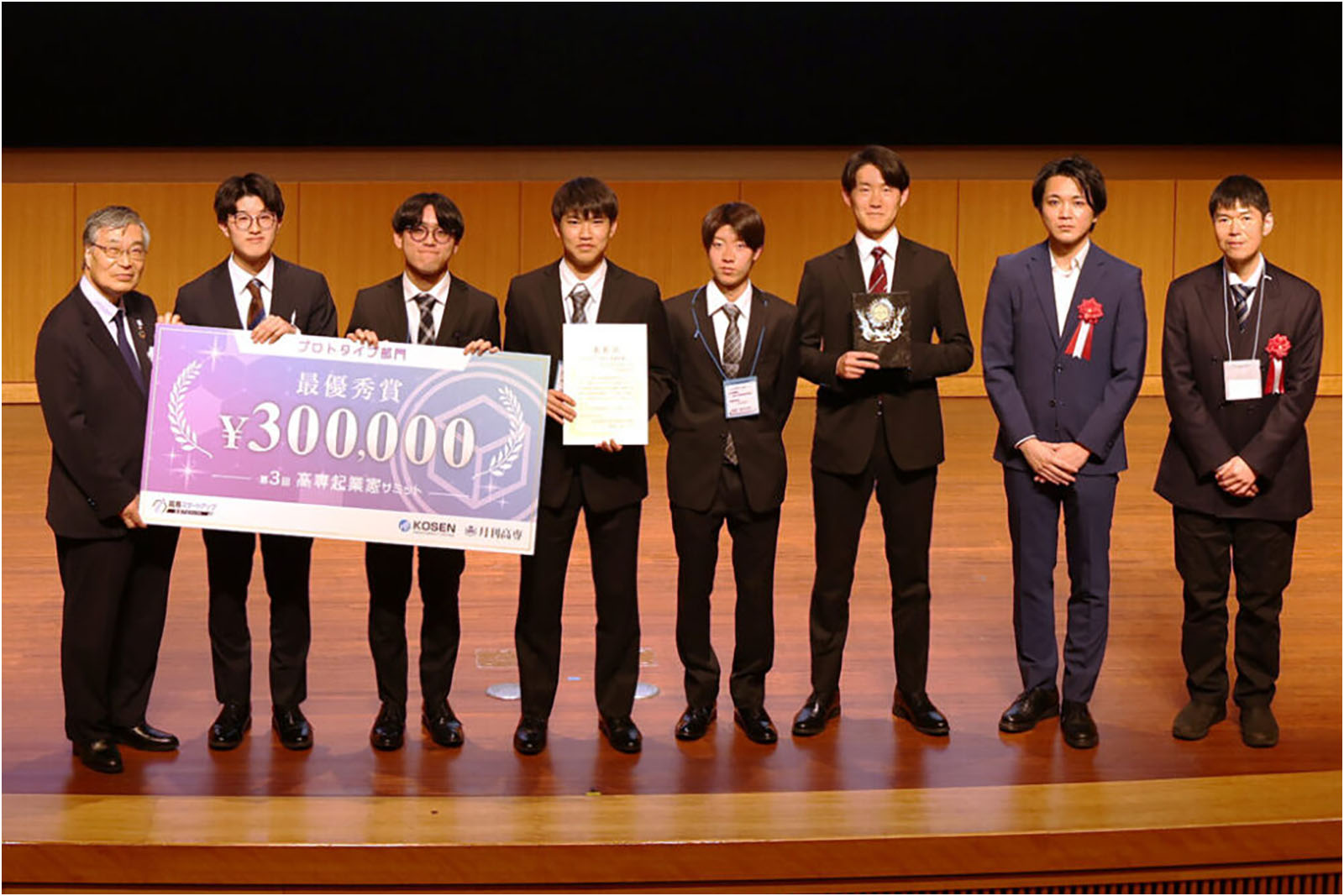
Anan National College of Technology’s “Awanext” team upon winning
the Grand Prize in the Prototype Category (2nd to 6th persons from the left).
Interviewer: What kind of business plan is “KaLas”?
Minami: “KaLas” is a system where a laser emitted from a ground-based unit is reflected and scanned by a scanner mounted on an aerial drone, targeting weeds identified by an AI camera. We aim to enable remote weeding even on steep slopes that are difficult for people to access. While conventional laser weeders use high-output lasers, we tested a low-output method that kills weeds over the course of several days.
A key feature is that it minimizes fire risks and potential damage to the drone itself. In the future, we hope to roll this out as a shared-use service for municipalities, agricultural cooperatives (JA), railway companies, and others.
Interviewer: What was the background behind choosing weeding as your theme?
Minami: It started with my grandparents farming on a steep slope. Mowing grass in the summer carries life-threatening risks, such as heatstroke and falls. Furthermore, with the aging population and a shortage of agricultural workers becoming serious issues, I wondered if we could use our technology to solve these problems. Since my laboratory worked with lasers, we initially envisioned a handheld laser-based weeding device. However, farmers pointed out that a handheld tool wouldn’t change the fact that they had to work under the scorching sun, nor would it solve the safety risks associated with working on slopes.
That made us realize we had been prioritizing the technology, specifically our desire to use lasers, without fully considering the end-users’ perspective. We went back to the drawing board to figure out how to perform weeding without requiring people to go out into the field.
Interviewer: How did the concept of using a drone to reflect the laser beam come about?
Goto: At first, we considered mounting the laser unit directly onto the drone, but weight and maintenance issues posed challenges. Then, I saw a scene in Space Battleship Yamato featuring a “Reflector Satellite Cannon”, a weapon that redirects a laser beam using a satellite-based reflector, and the idea struck me: “Why not fire the laser from the ground and reflect it in mid-air?”
Shigemura: My initial reaction was simply, “That’s interesting.” But as we explored the idea further, we saw the potential to solve the exact challenges that had been holding us back.
Minami: We had previously considered various concepts, including handheld units, drone-mounted systems, and ground-based rovers. I got goosebumps the moment I realized that the reflection method could solve all those issues at once.
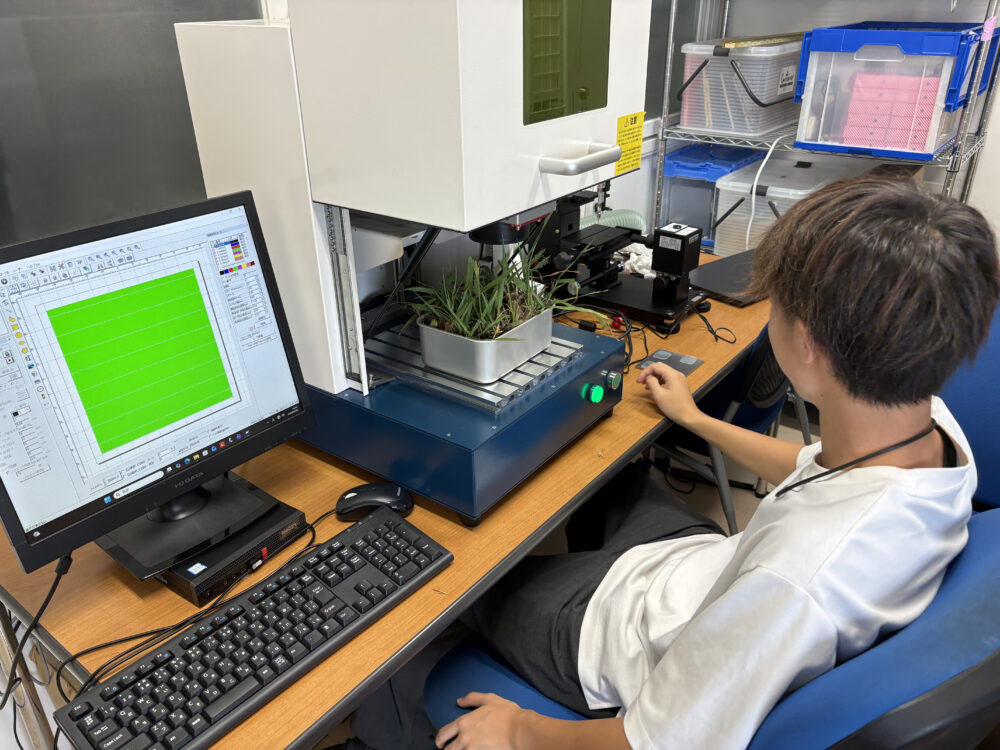
Setup for the experiment to kill weeds using laser irradiation.
Bringing technology to society: A team effort defined by trial and error
Interviewer: What kind of verification did you conduct during the weeding experiments using low-power lasers?
Goto: Together with Shinohara, I irradiated collected weeds with the laser and observed the changes over the course of two or three days. Since the results weren’t immediate, we had to be diligent in keeping records.
Shinohara: If the power output was too high, safety became an issue. If it was too low, the weeds wouldn’t wither. We repeatedly conducted experiments and made improvements, constantly adjusting the power output and irradiation time. I believe the experience I gained at the technical college, analyzing the causes of failure and using those insights to make improvements, proved valuable during this process.
Interviewer: Mr. Shigemura, I understand you were responsible for compiling the business plan and handling the image recognition AI.
Shigemura: My role was to organize the technologies and ideas proposed by the team members and integrate them into a cohesive system. Since there were dozens of ideas, ranging from major concepts to minor details, I prioritized them based on whether they were practical for field use and feasible with current technology.
Regarding image recognition, I began experimenting with plant identification after using relevant tools in class. I feel that the technology I encountered in my coursework directly contributed to solving real-world problems.
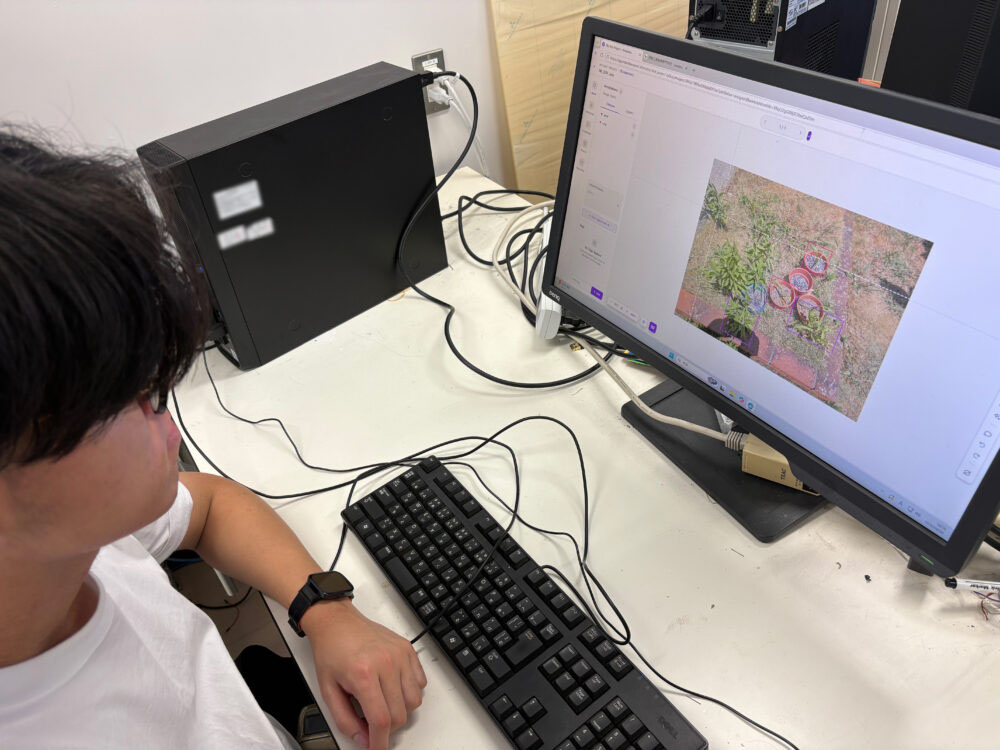
Annotating (labeling) images for AI training. Crops are enclosed in purple rectangles and weeds in red rectangles.
Interviewer: Mr. Matsumae, you were responsible for creating the presentation materials used for the actual event. What kind of approach did you take?
Matsumae: The biggest challenge was organizing the information within a limited amount of space. I asked every team member what they absolutely wanted to convey, then carefully considered what to keep and the best order of presentation to effectively communicate the system’s mechanics and appeal.
For the poster, I focused on ensuring the big picture was understood at a glance. For the pitch deck, I focused on creating a narrative flow that would make the audience want to see the next slide. I continued making revisions right up until the deadline.
Interviewer: Mr. Minami, what did you keep in mind while serving as the leader?
Minami: The team members were friends before they were project colleagues. Because of that, it was difficult to reach a conclusion without damaging our relationships when our opinions clashed. I made a conscious effort to first listen to everyone’s perspectives, organize the merits and challenges, and then find a solution that everyone could agree on.
Interviewer: I hear you struggled not only with the technical development, but also with formulating the business plan.
Minami: At first, I thought that simply creating interesting technology and conveying its appeal would be enough. However, when mentors and professors asked questions like “Who will buy it and at what price?” or “How will you generate a profit?” I couldn’t answer them.
That’s when a technical staff member at our school, who had prior experience working at a venture company, stepped in to help. They taught us the fundamentals of identifying a target market and structuring a revenue model. I learned that to bring technology to society, you have to address the specific problems users face and devise a system that ensures the business remains sustainable.
Goto: At the summit, we received questions from corporate representatives and students from other schools, which made us realize there were safety issues and regulatory hurdles we hadn’t yet considered. On the other hand, a representative from a railway-related company told us, “Technology like this would be a huge help for managing weeds along the tracks,” which showed us there was demand beyond just the agricultural sector.
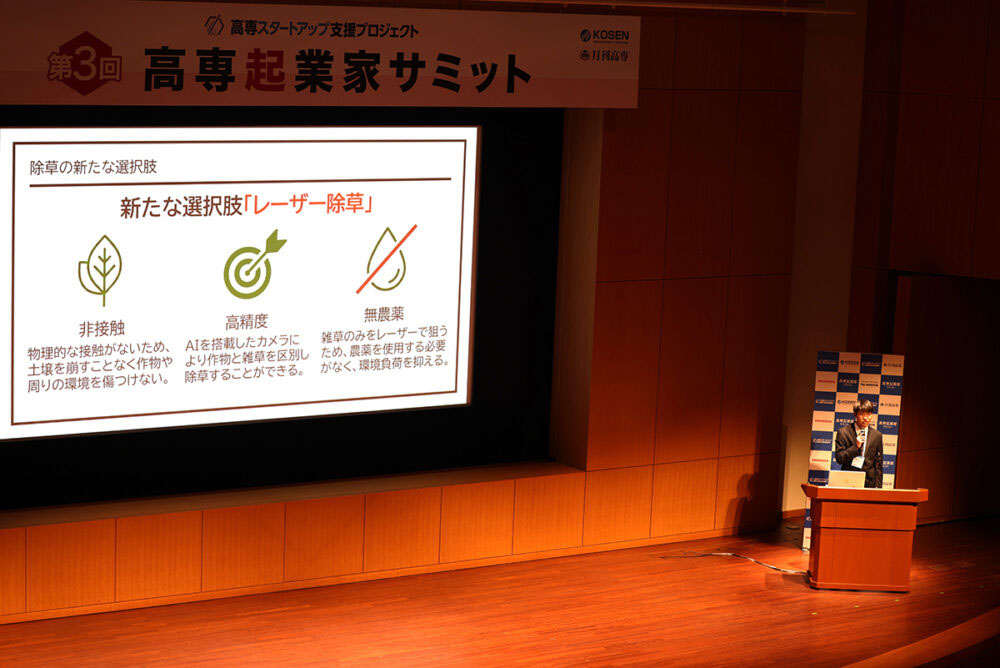
Minami giving the pitch
Aiming for practical application: Passing “KaLas” on to the next generation
Interviewer: What left the biggest impression on you during the summit?
Minami: Taking the stage for our pitch. I was nervous at first, but seeing the judges nodding as they listened made me feel like I was successfully conveying our passion.
Shigemura: Listening to presentations from about 40 teams and seeing how each was tackling a different set of challenges was striking. In particular, the presentation by “Neighbors Net” from Okinawa KOSEN, which won the top prize in the startup category, was impressive. Not only was the content excellent, but the way they communicated it was so clear that I was naturally drawn in.
Goto: Explaining our “Reflective Satellite Cannon” idea to corporate representatives during the poster session. It was exciting to talk with people who were familiar with Space Battleship Yamato and to share the interesting concepts behind our idea directly with them.
Matsumae: I was amazed at how students from technical colleges across the country had fleshed out their ideas to the point of feasibility. There were so many high-quality projects, and I was inspired by their drive and initiative.
Shinohara: What struck me was that, despite the large number of participating teams, there was almost no overlap in the content of the presentations. Each team had its own unique character, and I was impressed by the breadth of creativity shown by the technical college students.

Interviewer: What progress has “KaLas” made since the 3rd Kosen Entrepreneur Summit?
Minami: We have finished the prior art search for our patent application and are currently preparing the formal procedures. A patent attorney told us there is a 60–70% chance of securing a patent, which reaffirmed the uniqueness of our technology.
We have also welcomed two new members from the advanced course specializing in image recognition AI, as well as two fourth-year students from the regular course. Bringing “KaLas” to practical application requires AI capable of accurately distinguishing between weeds and crops, as well as improved precision in drone-based reflection and tracking control. However, all the initial members are fifth-year students who will enter the workforce after graduation. Therefore, we are establishing a system to pass on our technology and know-how to younger students so that development can continue in the long term.
Interviewer: How do you plan to develop “KaLas” in the future?
Minami: Our first goal is to obtain a patent. At the same time, we aim to integrate AI-based weed recognition, drone control, and laser irradiation into a single, highly precise system.
After that railway company representative approached us at the summit, we realized there is potential to use our technology not only in agriculture but also in infrastructure sectors, such as along railway tracks. Moving forward, we plan to collaborate with companies and conduct repeated field trials with farmers and at local infrastructure sites in Tokushima Prefecture.
There are still challenges to address, such as legal regulations regarding the use of lasers outdoors. Even so, I hope that the technology originated by students will be passed on to those who come after us and evolve into a business that addresses challenges such as heatstroke during agricultural work and the maintenance of local infrastructure.

Interviewer: How do you intend to apply this experience in the future?
Minami: I plan to work for a company in a technical field similar to this one. I want to engage in product development not only by focusing on the fascinating aspects of the technology but also by considering what customers truly need.
Shigemura: Through this experience, I learned the importance of simply taking action. Moving forward, I want to maintain an attitude of proactively seeking out new experiences.
Goto: I realized that to convey my ideas effectively, I need to tailor my explanations to the other person’s perspective. I want to develop the ability to communicate technical concepts and ideas clearly.
Matsumae: I learned how to work effectively within a team and the importance of listening to others’ opinions. I hope to become someone who can make proposals with confidence while also incorporating feedback from those around me and checking for any oversights.
Shinohara: I want to maintain an attitude of taking on challenges without fearing failure. Through this experience, I truly realized that even failures can pave the way for future challenges.

Interviewer: Finally, do you have a message for technical college students currently taking on challenges, or for junior high students considering enrolling in a technical college?
Minami: You don’t need to look for a massive problem to solve right from the start. We began with something close to home, our grandparents’ farming work. I hope you observe the difficulties people around you face and find something you feel driven to solve using your own technical skills.
Shigemura: Even if you come up with a great idea, it won’t take shape if you only keep thinking about it. I encourage you to consider how to make it a reality and simply take the first step, just give it a try.
Goto: A technical college offers an environment where you can work on various projects with the same group of peers for five years. There are many summits and competitions specifically for technical college students, allowing you to pursue both club activities and specialized technical projects.
Matsumae: There are many lessons you can only learn through actual experience. Technical colleges offer so many opportunities to take on challenges. I believe this broadens your horizons and enriches your life.
Shinohara: I want to convey that it’s better to just give something a try and think about it as you go, rather than overthinking things beforehand and becoming paralyzed by hesitation. Also, for junior high students interested in making things, I highly recommend participating in the various activities available at a technical college.