
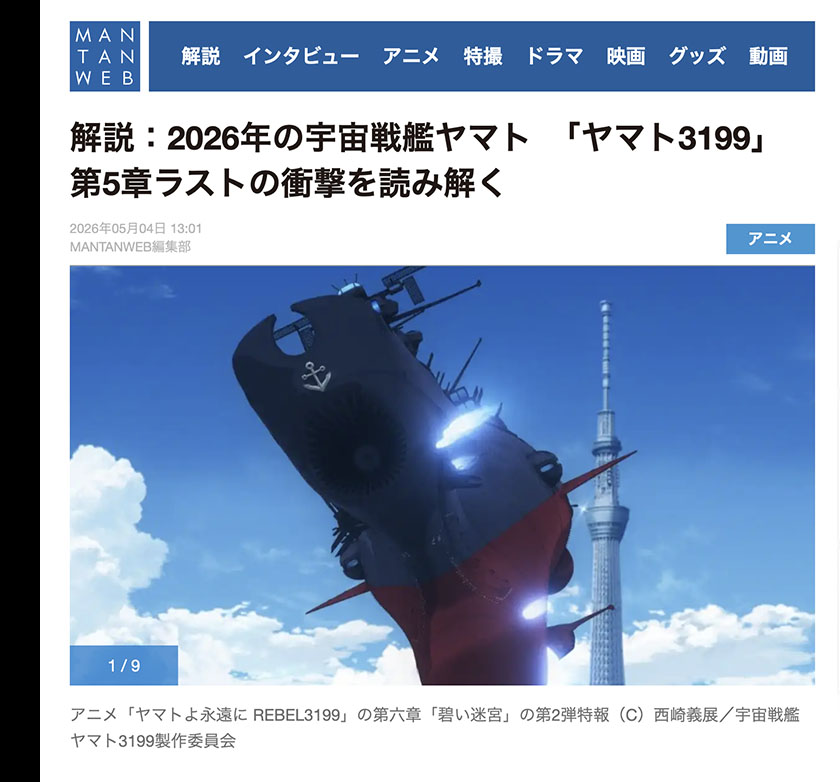
Deciphering the Shocking Climax of Yamato 3199, Chapter 5
by Mitsuru Anima
Published at Mantan Web, May 4, 2026. See the original post here
The latest installment in the remake series of the popular anime Space Battleship Yamato, titled Be Forever Yamato, REBEL 3199, has become a hot topic following the “shocking climax” featured in Chapter 5, which began screening on February 20. The main visual for Chapter 5 bore the tagline: “In the final minute, everything changes.” That tagline proved to be no exaggeration. indeed, everything was completely overturned. Here, we offer an explanation of the “shocking climax” of Chapter 5.
Inspired by Be Forever Yamato
In the year 2207 AD, an invasion of Earth begins at the hands of Dezarium, an enemy Yamato first encountered two years prior. Claiming to be Earthlings from approximately one thousand years in the future, the Dezarians are advancing a plan to “reset the future by starting over from the past.” In order to verify the veracity of the history recounted by them, Yamato sets course for a “space-time nexus,” a junction connecting the future with the present day.
In Chapter 5, Yamato successfully reaches this space-time nexus. Traversing a spatiotemporal nexus, the crew arrived not in the distant future, some 1,000 years hence, but in Tokyo of the year 2026 — roughly 200 years in the past. This “shocking twist ending” served as the dramatic conclusion. The visual of Yamato drifting through the skies above Tokyo left a profound and lasting impression.
Yamato 3199 is a reimagining of the original works Be Forever Yamato and Yamato III, reconstructed through a fresh interpretive lens. While the project draws inspiration specifically from Be Forever Yamato, General Director Harutoshi Fukui explained his vision during an interview:
“This concept was part of the plan from the very beginning. I felt that if we could pull this off, then 3199 would be a viable project. It’s not as if there’s no basis for it in the original material. In the original Be Forever, the setting was Earth 200 years in the future (or rather, the planet Dezarium disguised as Earth). This time, however, we decided to flip that premise on its head and set the story 200 years in the past.”
Initially, screenwriter Hideki Oka objected to the idea, warning, “You’d be better off dropping this. It’s going to end up as a cheap gimmick.”
Director Naomichi Yamato also appeared somewhat perplexed, admitting, “When I first heard the idea, I wasn’t sure if we could actually pull it off.”
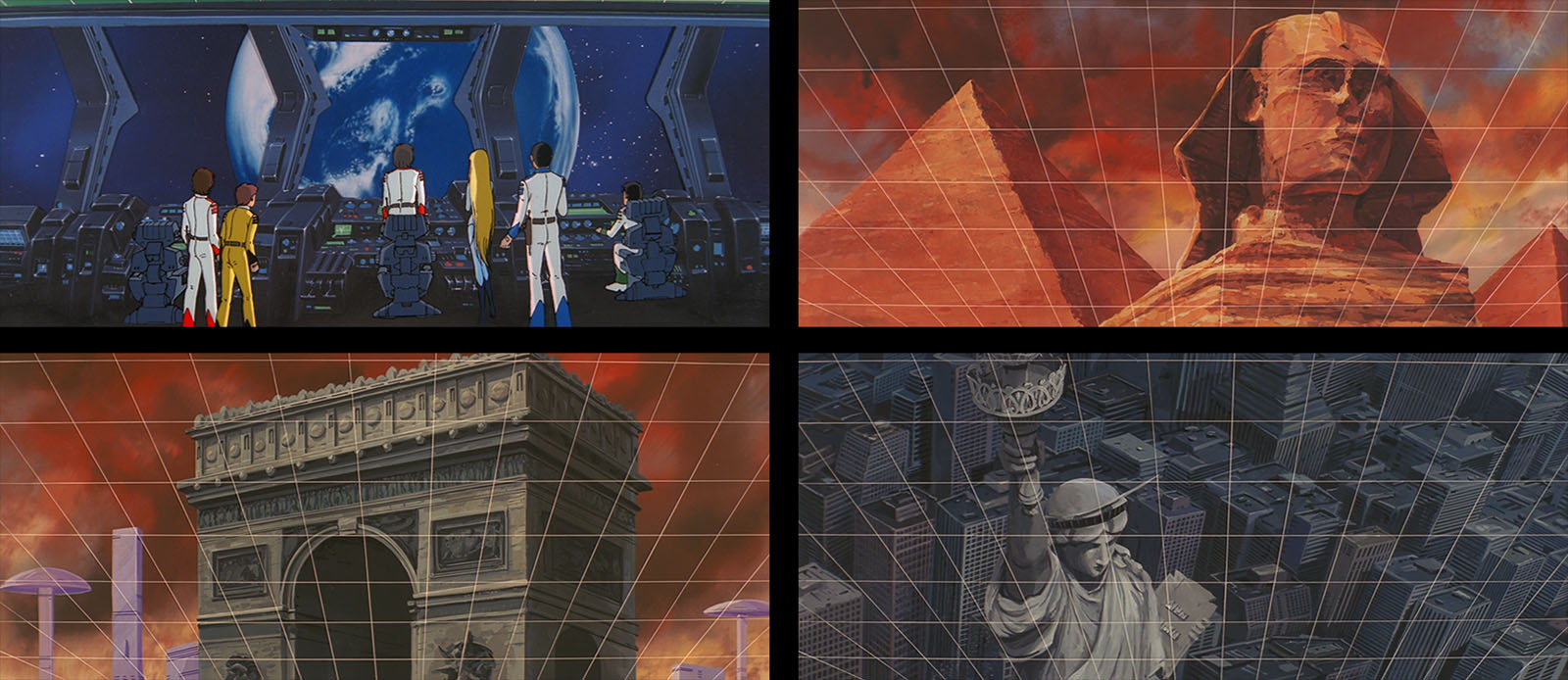
Fukui, however, remained steadfast in his conviction: “I will ensure, absolutely, that it doesn’t come across as a cheap gimmick. I’m fully fired up about this now. It fits perfectly with the core themes of the series. It all comes back to the original work, after all. In Be Forever Yamato, seeing landmarks like the Sphinx or New York City made us believe we were looking at Earth 200 years in the future. There was something fascinating about the way the Earth we know, our reality, seemed to exist on a continuum with the world of Yamato. That sense of continuity may very well have been the underlying inspiration for this approach.”
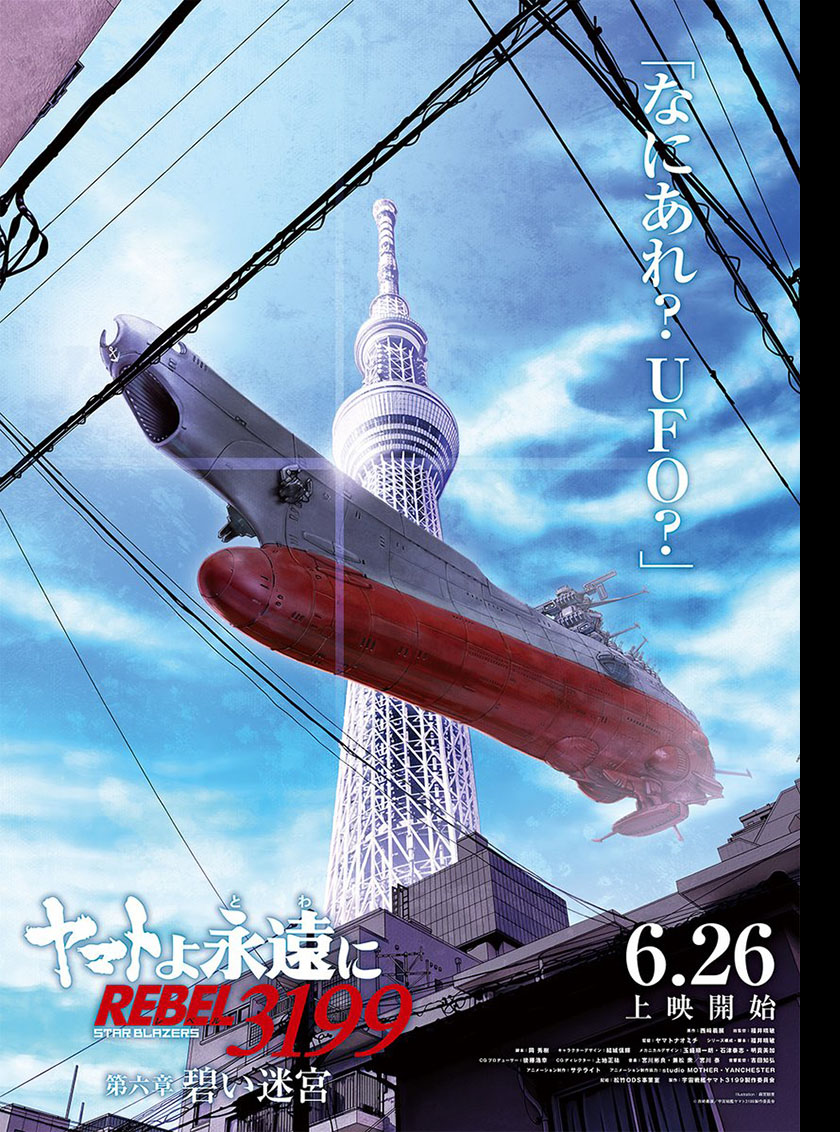
Yamato 3199: Existing on a Continuum with the Present Day
It is also worth reflecting on Fukui’s remark that this concept “fits perfectly with the core themes of the series.”
The Dezarians claim to be the descendants of Earthlings from roughly 1,000 years in the future, and they attempt to “guide” the people of Earth using rhetoric that sounds plausible and convincing. By employing simple, accessible language to stir up emotions, they lead an anxious populace to believe, “This is the person who can truly bring about change.” In doing so, they incite anti-Garmillas sentiment among the masses, triggering a wave of discrimination and exclusionary movements directed against the Garmillas people.
While one may sense something unsettling about Dezarium, the feeling of being buffeted by a deluge of information, to the point where one can no longer discern what constitutes the truth, mirrors a history humanity has repeatedly enacted throughout the ages. Indeed, it appears to reflect the very issues humanity is grappling with in the present day. In this sense, Yamato 3199 may well serve as a mirror reflecting the state of our society.
Yamato‘s crew stands in opposition to Dezarium. however, a trailer for Chapter 6, The Azure Labyrinth, set to premiere on June 26, reveals that the crew’s demeanor appears strangely altered upon their arrival in Tokyo, 2026. Ryusuke Domon, in particular, seems to succumb to the very same temptation driving Dezarium’s agenda: the urge to “alter history,” believing that “if Yamato were to set course for Planet Garmillas in this specific era, we could change the future.”
Mr. Fukui remarked, “Up until now, Yamato‘s crew has always stood on the side of righteousness, but now they begin to lose their way. Were they to find themselves in the exact same position as Dezarium, they might very well commit the exact same acts. The inherent frailty of human nature is beginning to surface.”
Justice, it seems, is a precarious and fragile thing. By causing Yamato to materialize in the Tokyo of 2026, despite the series being a work of fiction, Yamato 3199 may be attempting to strongly underscore the notion that its narrative remains inextricably linked to our own contemporary reality. This, arguably, constitutes the very “central theme” of the work.
It has been announced that Yamato 3199 will span a total of seven chapters. Given that “everything was turned upside down” at the conclusion of Chapter 5, one might naturally harbor some anxiety as to whether the story can truly be brought to a close within just two remaining chapters. However, regarding the series’ future trajectory, Mr. Fukui offered reassurance: “It will reach a proper conclusion. I simply ask that you stay with us until the very end.” With these words, he firmly emphasized that the series would indeed conclude as planned, within the full scope of seven chapters.
By orchestrating Yamato’s sudden appearance in the Tokyo of 2026, the narrative’s continuity with our own modern era has been rendered all the more explicit. All eyes are now fixed on the unfolding events, eager to see how the creators will ultimately bring this bold narrative trajectory to a landing.