
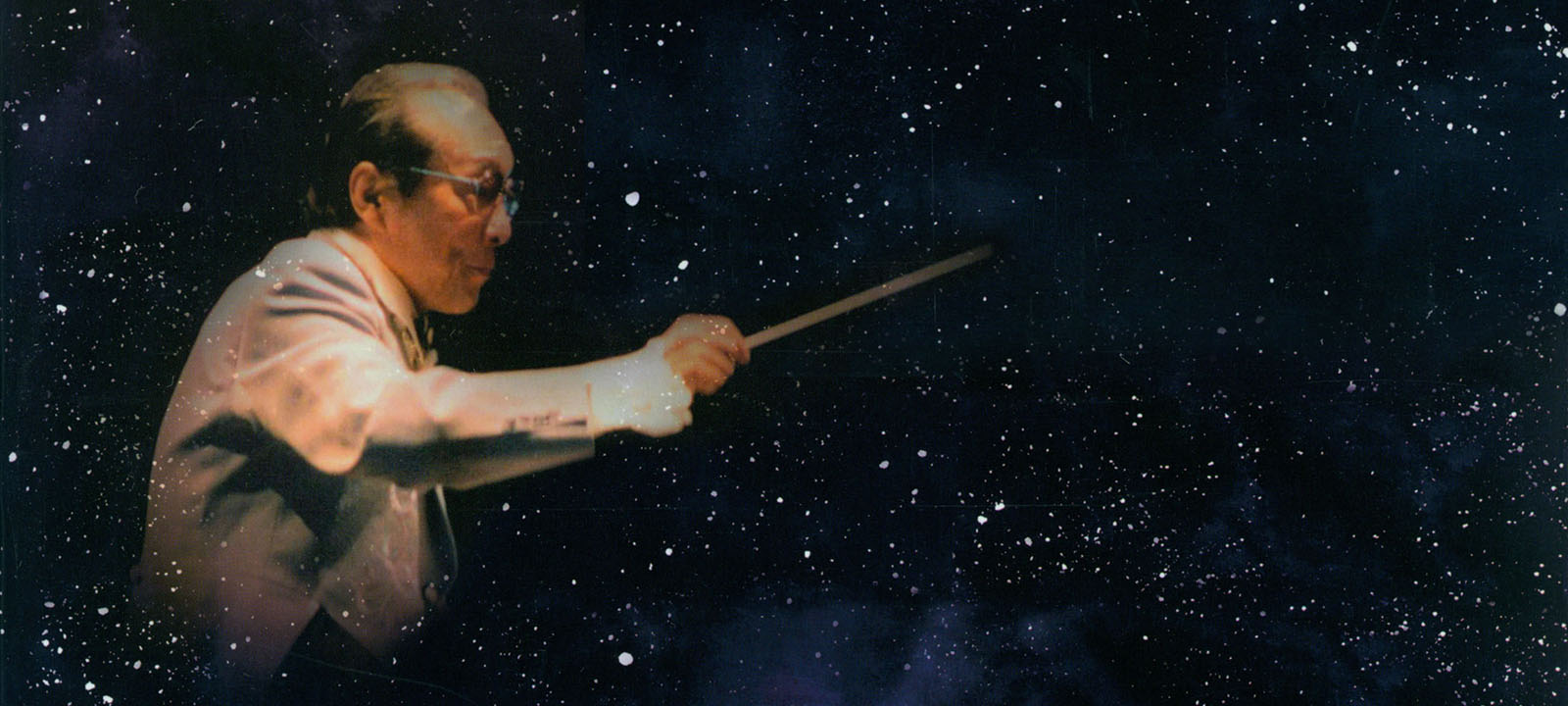
Published at the Musicman website, 2001
The subject of this installment of Musicman’s “Relay Interview” series is the composer Hiroshi Miyagawa, whom Mr. Goro Kobayashi reveres as a “father figure.” [Translator’s note: “relay interview” referred to the fact that each interview subject recommended the next subject.]
Whether as the mentor who nurtured the duo The Peanuts, the music director for the Crazy Cats’ films and Space Battleship Yamato, or simply as a messenger delivering music into the living rooms of ordinary households, it is no exaggeration to say that there is not a single Japanese person who has not, at some point, encountered the music of “Sensei” Miyagawa.
The secret behind the compositional artistry of this man, who has produced a multitude of masterpieces over a career spanning more than 40 years, may very well lie in his own warm and amiable personality. As he shared one fascinating anecdote after another, our delightful conversation ran well past its scheduled time.
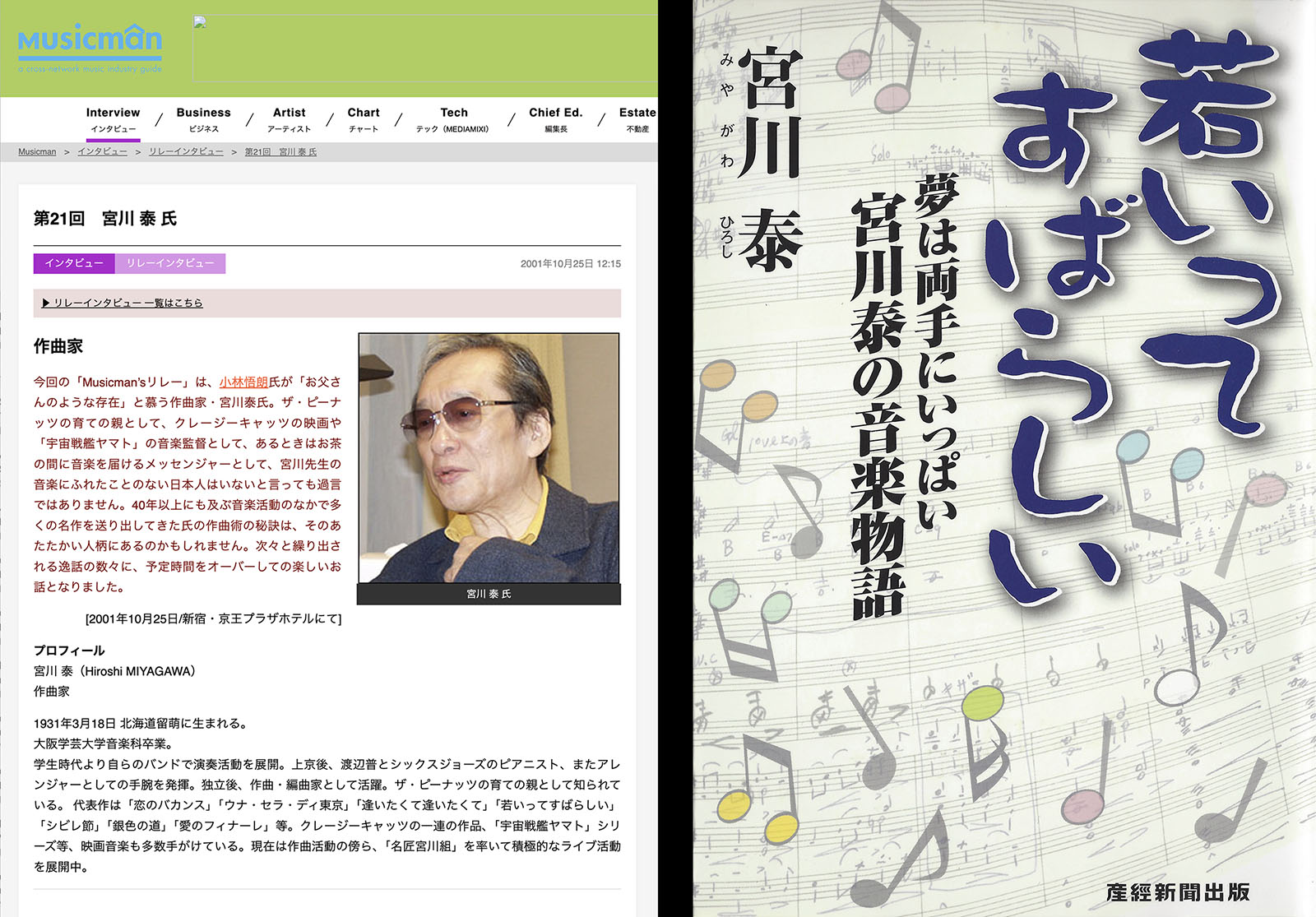
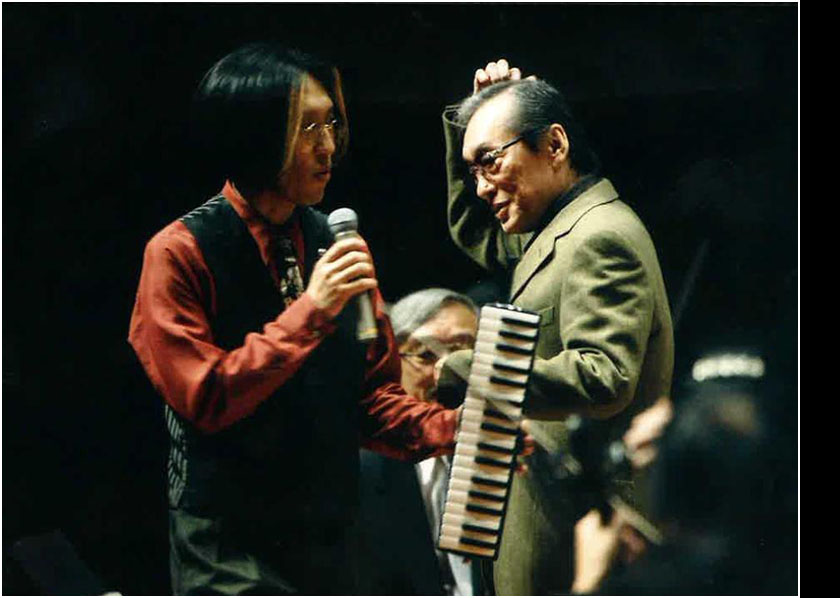
Photos with captions were published in Hiroshi Miyagawa’s autobiography “It’s Wonderful to Be Young” (Sankei Shimbun, 2007)
PROFILE
Born on March 18, 1931, in Rumoi, Hokkaido. Graduated from the Department of Music at Osaka University of Liberal Arts.
Began performing professionally with his own band while still a university student.
After moving to Tokyo, he demonstrated his exceptional talents as both a pianist and an arranger for Shin Watanabe & the Six Joes. Upon establishing his independence, he went on to build a highly successful career as a composer and arranger. He is widely recognized as the mentor who nurtured the musical duo The Peanuts.
His representative works include Koi no Vacance (Vacation of Love), Una Sera di Tokyo (One Night in Tokyo), Aitakute Aitakute (Longing to See You), Wakai tte Subarashii (It’s Wonderful to Be Young), Shibire-bushi (Numbness Song), Gin-iro no Michi (The Silver Road), Ai no Finale (Love’s Finale), and many others.
He has also composed numerous film scores, including the entire series of films starring Crazy Cats, as well as the Space Battleship Yamato series.
Currently, alongside his work as a composer, he leads the ensemble Meisho Miyagawa-gumi (The Master Miyagawa Ensemble) and remains actively engaged in live performance tours.
Interview conducted October 25, 2001 at the Keio Plaza Hotel, Shinjuku
Interviewers: Takuya Yashiro, Publisher of Musicman / Masahiko Yamaura
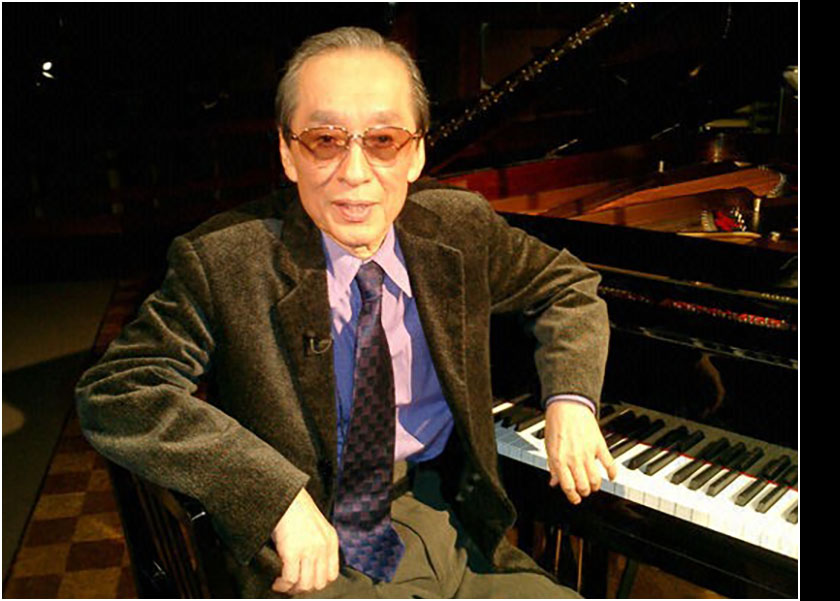
1. Bedtime Lullabies: A “Live Performance” by Mom!?
Mr. Miyagawa, I imagine you have a wealth of anecdotes to share. Today, however, I’d like to ask you to simply pick out and share just the most entertaining highlights from your repertoire.
Well, the thing is, I’ve actually already told most of those stories elsewhere. My memory isn’t what it used to be, so I really only have about one “funny story” per person in my entire repertoire. I’ve even talked about them on TV before. You know, that show that airs on Sunday mornings.
You mean Haran Banjo?
Yes, yes, that’s the one. When I appeared on that show, I ended up telling quite a few of my funny stories. And before that, there was that other show, the one where people just talk and talk. Tetsuko no Heya. When I appeared on that one, twice, actually, I pretty much used up all my best material. And Haran Banjo goes to the trouble of actually producing little dramatic reenactments of your stories, doesn’t it? So after I appeared on that show, people started coming out of the woodwork asking things like, “You went to my middle school, why didn’t you give our school a shout-out?” (Laughs)
That’s a tough spot to be in, what are you supposed to say to that?
Well, I actually have a younger brother. His name is Takeru Miyagawa. He’s seven years my junior and is still an active professional drummer to this day. Apparently, when I appeared on that show, Haran Banjo I think it was, he went around telling all his friends to watch it. He told them, “My big brother is going to be on TV, so you have to tune in!” The thing is, during the broadcast, I didn’t mention my brother, not a single word. I just completely forgot! I talked about other relatives and family members, but when it came to my own brother, the one person I really should have mentioned, I totally spaced on it. When my brother saw that, he called me up and said, “Hey, I watched the show. That was just plain mean! You didn’t say a single thing about me!” (Laughs)
Apparently, his friends started calling him up, asking things like, “Are you really Miyagawa-san’s brother?” (Laughs) I mean, on a show like that, it’s practically standard procedure to talk about your siblings. The fact that I didn’t say a word made them suspicious. They were all teasing him, saying things like, “You’re not his brother at all, are you? You’re a total fraud!” (Laughs) He got teased so mercilessly that he lost face with his friends, so he begged me to call them up and vouch for him. It seems he was genuinely crushed that people doubted his story.
It would be impossible to cover every single detail of an entire lifetime in one conversation, after all.
No, honestly, I’ve been incredibly absent-minded ever since I was a kid. It’s a total disaster. I forget nine out of ten things. (Laughs) I’ll forget what I was just talking about. I can’t even remember people’s names sometimes. So, I’m sure I’ll end up spouting a bunch of half-baked stories today, but please forgive me if I get any of the facts wrong!
(Laughs) Speaking of your brother, I understand you come from a very musical family…
My mother actually started teaching the koto, the Japanese zither, back when I was still in kindergarten. Oh, wait…I think she started out playing just as a hobby, and only became a teacher later on. My father, on the other hand, earned his teaching license, a shihan title in a specific school of practice, relatively early on, and played the shakuhachi flute, while my mother played the koto. So, I was constantly playing it.
This was the world of traditional Japanese music.
That was when I learned Haru no Umi (The Sea in Spring). Michio Miyagi’s composition, Haru no Umi, was unusually sophisticated for an original piece of traditional Japanese music, and modern for its time. At least it felt that way back then. There were even people releasing records of it performed on violin or piano. Listening to the work of someone with such exquisite taste really left a lasting impression on me.
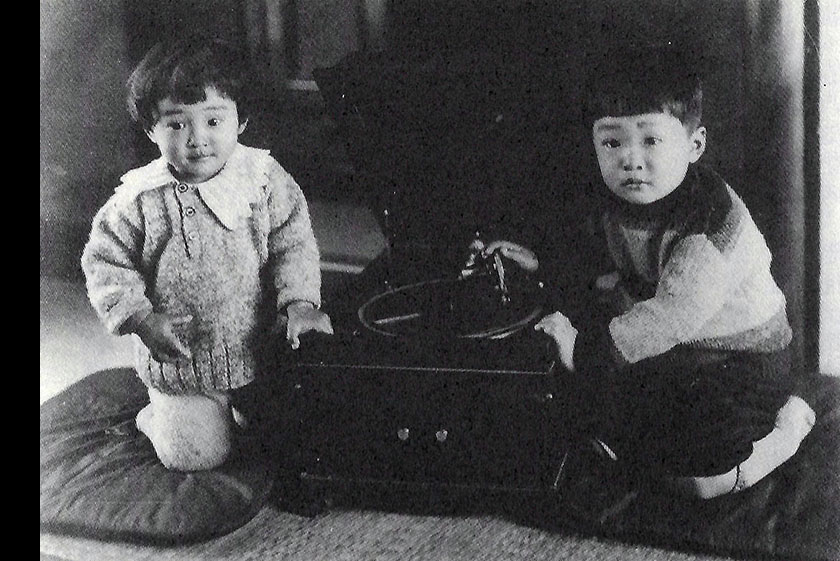
With my younger sister Junko, our father’s
gramophone between us. I was 4 years old.
Apparently, out of all her many siblings, my mother was the only one who was allowed to attend a girls’ school. I hear she faced a lot of nasty remarks and bullying from her siblings because of it, but she went anyway, and even after she graduated and married my father, she never quite shed that “girls’ school student” persona. So at night, after saying, “All right everyone, good night!” and turning off the lights, she’d wait about ten minutes and then she’d start singing girls’ school songs, tunes like Najika wa shiranedo (For Reasons Unknown, A.K.A. Lorelai). (Laughs)
So you got a live concert every single night!
Exactly! We’d be saying things like, “Oh, Mom, give it a rest!”
How many siblings do you have? Did all of you end up pursuing careers in music?
I’m the eldest son. I have one younger sister, though she didn’t go into music, and then a younger brother after her. My siblings and I didn’t really get along very well. In fact, my brother and I didn’t really become close until we were middle-aged. Before that, we just didn’t interfere in each other’s lives, partly because we were living in different places. As for my sister, well, since my late mother’s older sister didn’t have any children of her own, my mom actually said, “All right then, I’ll give you my daughter,” and just handed her over to her sister! (Laughs) She really was quite eccentric, my mom. She actually just gave her away.
Things like that really did happen back in those days, didn’t they?
They certainly did. So, all in all, the musical environment I grew up in wasn’t bad at all.
2. His Future Was Supposed to Be as a Painter…Or So He Thought!? From Art Student to Music Student, and On to Professional
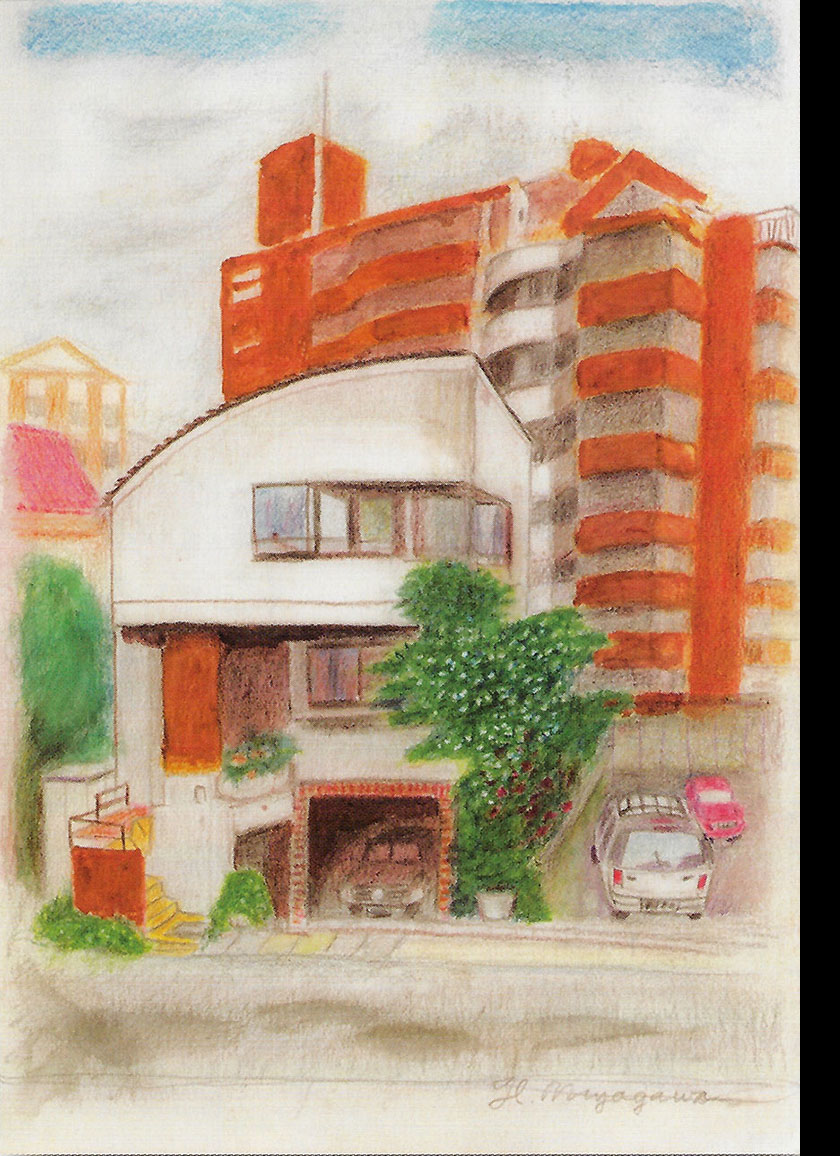
Painting 1 (2005): I tried drawing the house next door to mine,
and since it’s right next door I can go and see it
all the time, so it ended up being my best work.
We belong to the post-Beatles generation, the one raised on rock and pop. But in our minds, your generation, and that whole scene surrounding it, represented the very first wave of “hip” young musicians in Japan. I’m thinking of figures like the Hachidai Nakamura Quintet or Seiji Hiraoka. Those guys were, in a sense, Japan’s original musicians.
Yeah. Jazz had actually been around since before the war. Apparently, even during the war itself, people would secretly get together with friends to play. Once the war ended, the Occupation Forces’ radio stations started broadcasting, and just like that, jazz exploded onto the scene. Literally overnight, the day after we lost the war. I remember thinking, “What magnificent music this is!”
And that’s when a whole host of musicians emerged to answer the call.
When the war ended, I was attending junior high school in Kyushu. Later, I transferred to a school in Osaka, and that’s when I started listening to the Occupation Forces’ radio broadcasts every single day. Before long, even though I hadn’t even graduated from junior high yet, I formed a sort of “light music” band. We started getting invited to play at parties all over town. We’d learn new songs on the fly, perform them, and provide accompaniment for dancing. I was doing that right through the end of my junior high years.
After that, I went on to university, and I actually excelled in both music and art! (Laughs) My friends from back then would all say things like, “I was absolutely convinced you was going to become a painter.” That’s how good I was at drawing. When I did pencil sketches, they’d turn out absolutely stunning. I could take a photograph, say, of the sunken battleship Yamato, and reproduce it with incredible skill. People used to tell me, “If you want war paintings done right, Miyagawa’s your man!” (Laughs) So, naturally, I enrolled in art school.
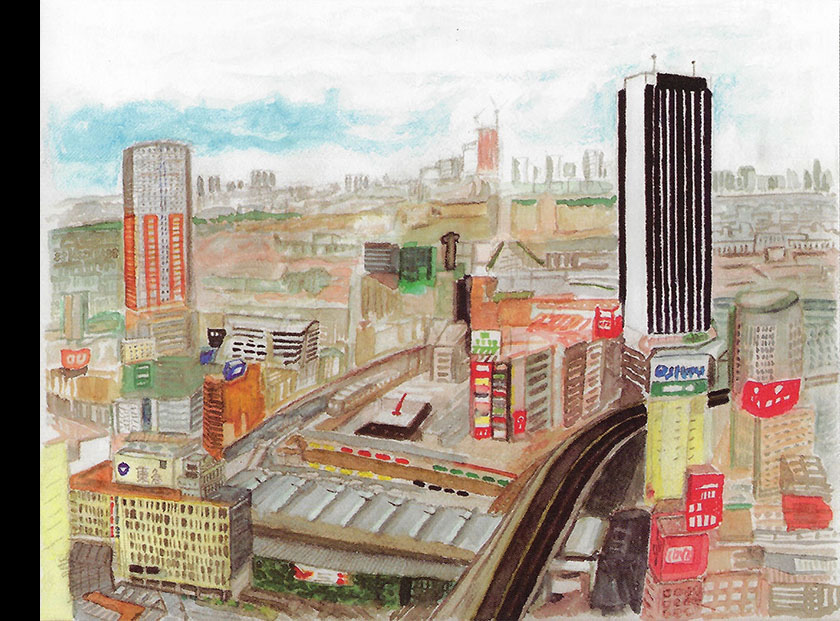
Painting 2 (2006): A view from my regular hotel, the Shibuya
Tokyu Cerulian Tower, looking toward Shibuya station
and Aoyama. All that’s left is to paint the cars on the
highway (unfinished).
Do you still have any of those pieces?
That’s the thing, none of them survived. I attended an art school in Kyoto for about a year and a half, but since I was playing piano at a cabaret every night, I didn’t actually do a single bit of art studying. Instead, I’d just spend my days goofing around, playing on the rickety old piano sitting in the school’s auditorium.
Is that how you learned to play the piano?
Yep, that’s exactly how I learned. I never touched a single Beyer exercise book or anything like that. So, my finger technique was actually a complete sham, honestly! (Laughs) To this day, I still can’t play fast scales.
So you were entirely self-taught.
Exactly. That’s why I could listen to a piece of music and play it immediately, without even needing to look at the sheet music.
Wow!
I was just naturally dexterous. It was the same with drawing. I was good at realism, at copying exactly what I saw, but when it came to creating something original, something with my own personal style, I was absolutely hopeless. I spent a year and a half at an art school, where I enrolled in the Crafts and Design Department, essentially a track focused on illustration. Naturally, you can’t get anywhere in that field without a strong sense of individuality. I eventually realized, “Oh man, I’m never going to make it.”
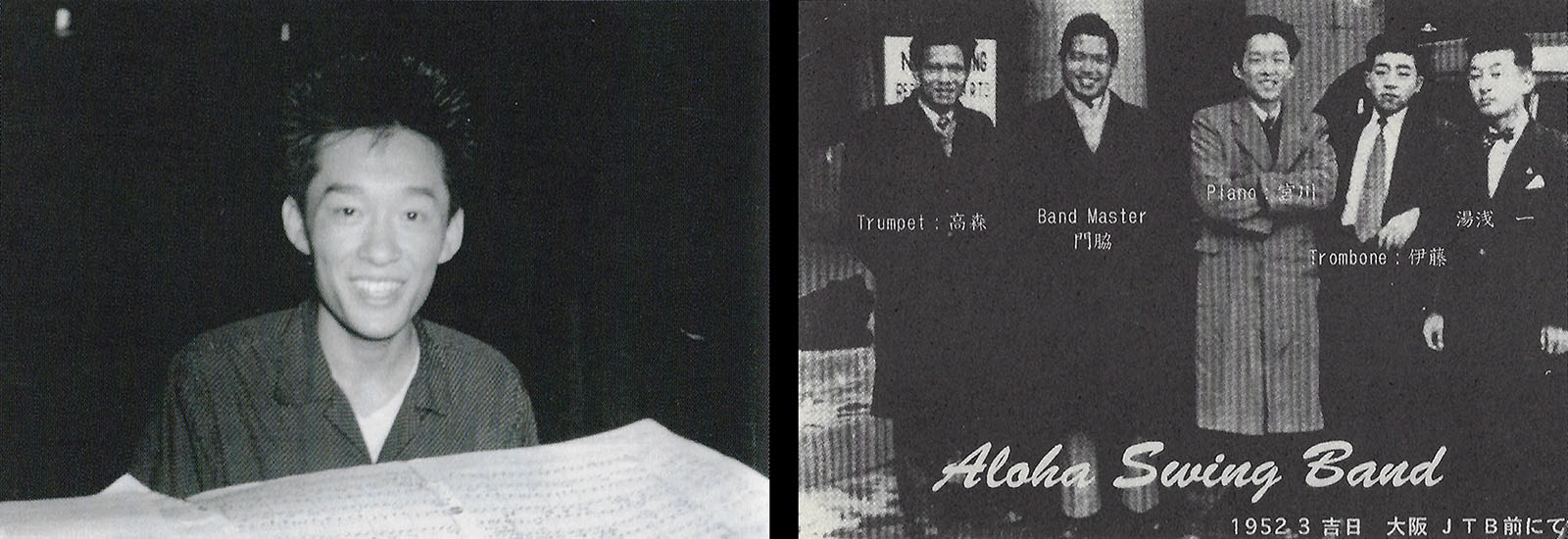
LEFT: This is me when I was 24. I had acne back then.
RIGHT: This is the “Aloha Swing Band” I was in during my student days. I’m the one in the middle (March 1952).
The most famous classmate I had back then was the artist who drew the “Uncle Torys” character for Suntory. What was his name again? It’s completely slipped my mind. I’ve remembered it all this time, too. We weren’t particularly close during our school days, but we became friends later on through class reunions and such. It was something like Ryohei. Ah! Ryohei Yanagihara. He went on to become a top-tier illustrator.
After that, I took the entrance exam for Osaka Gakugei University (now Osaka Kyoiku University), because they had this thing called a “Specialized Music Department.” The university’s predecessor was a normal school, a teacher-training college, which, as you know, is a place for training elementary school teachers. But within that framework, they offered a special track specifically for training music teachers for junior high schools, so that’s the program I enrolled in. Even then, though, I was still playing piano at a cabaret! (Laughs)
So it wasn’t exactly a school for “gifted musical prodigies,” per se, more a place where you received formal, academic musical training?
Exactly. We were supposed to be studying things like harmony and music theory, but since I was already playing jazz, I actually knew more about harmony than what was written in the textbooks. I thought to myself, “What’s the point of wasting my time on this stuff?” So I kept playing piano at the cabaret, went to play gigs at the Occupation Forces’ camps, and little by little, I really started to fall in love with it.
Eventually, the university administration told me, “That’s enough. You need to leave. You’re expelled.” So I just said, “Okay,” and dropped out. (Laughs) It was a four-year university program, but I’d been there for six years and still hadn’t made any progress, I hadn’t earned enough credits to graduate. It looked like it would take me seven or eight years to finish at that rate. My homeroom teacher finally pulled me aside and said, “I’m ashamed to have a student like you. Won’t you please just leave?” So I left.
Then I headed to Tokyo and joined the band of a true genius named Seiji Hiraoka. And just like that, I became a professional musician.
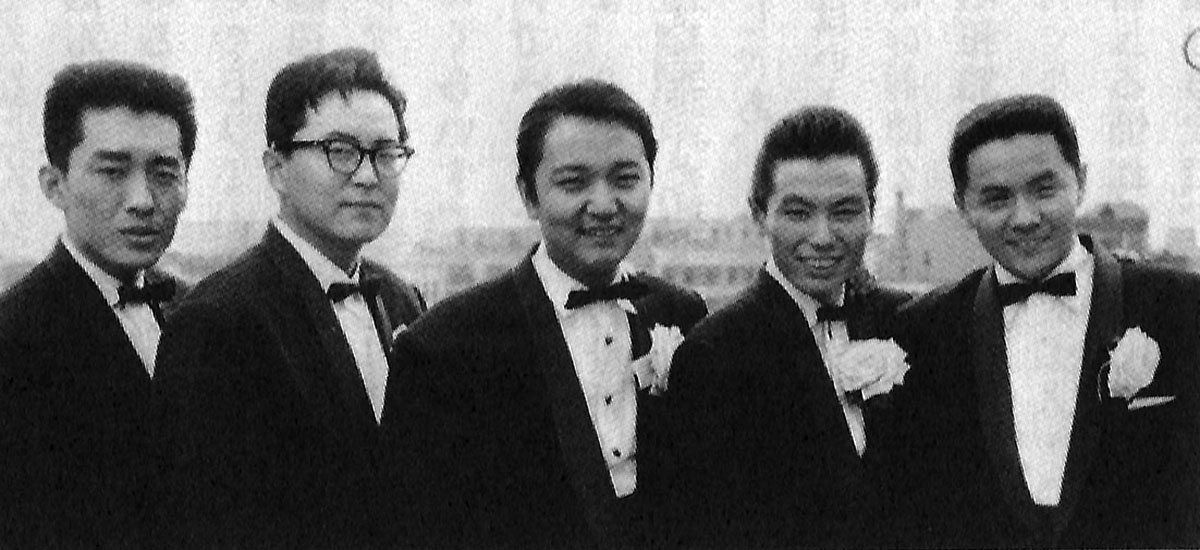
The first group I joined after moving to Tokyo was the Seiji Hiraoka Quintet.
From left: Hiroshi Miyagawa, Koboku Toya, Jimmy Takeuchi, Naruse Shohei, Hiraoka Seiji (1957).
That’s incredible. Everything happened so smoothly, one step after another! Did you face any obstacles on your way to becoming a pro?
Well, the timing was just right, and the era was on my side. Everything went very smoothly. Nowadays, the overall skill level has gone up significantly, and there’s a tremendous number of jazz musicians out there, isn’t there? Back then, however, there weren’t nearly as many of us. Plus, the pay was great. When I got married, my wife was working a regular office job. I think her monthly salary back then was somewhere in the ten-thousand-yen range. My monthly income, on the other hand, was 30,000 yen, three times what the average office worker was making! And I was still just a kid back then, too.
3. A Jazz Musician’s Pay: Three Times That of an Office Worker! The Glorious “Six Joes” Era
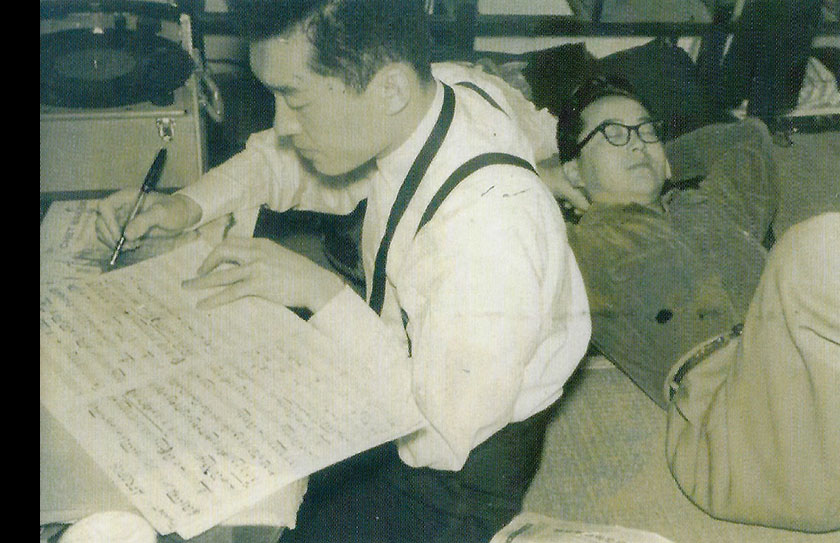
While the other members were napping or playing poker in the dressing room, I was busy arranging music all by myself every day. Backstage with the Seiji Hiraoka Quintet (Nichigeki Theater, 1958).
Back then, the world of musicians was one where everyone would hop between several cabarets in places like Ginza in a single night, where bundles of cash were being tossed around left and right…isn’t that right?
Exactly, exactly. Around that time, after I’d moved up to Tokyo, left Mr. Hiraoka’s band, and started performing with my own group, there was this high-end establishment called the Marunouchi Club. I believe the owner was Chinese? We’d get paid our wages every single night. We’d start around 7 PM and play until about 2 AM. Then, around 2:30 AM, absolutely dead tired, we’d go to the boss and ask, “Boss, how’s our daily pay looking for today?” and he’d reply, “Hmm…well, we didn’t have any customers come in today, so…nothing for you tonight!” (Laughs) Then again, on other nights he’d say, “We had a decent turnout today, so here, take this; it covers yesterday’s pay as well!” It came to about 700 or 800 yen per person, I think I got around 900 yen. He never gave us a full 1,000 yen.
But in today’s money, that would be something like 20,000 or 30,000 yen, wouldn’t it?
Considering it was for a single night, and just having a single drink at that place cost a pretty penny back then…oh, but I suppose you’re right. It probably would amount to about that much. And since we were working something like twenty-odd days a month, that would come to 600,000 to 700,000 yen. You certainly can’t make that kind of money nowadays. These days, if you can pull in 400,000 or 500,000 yen from a single club gig, that’s considered doing pretty well, isn’t it?
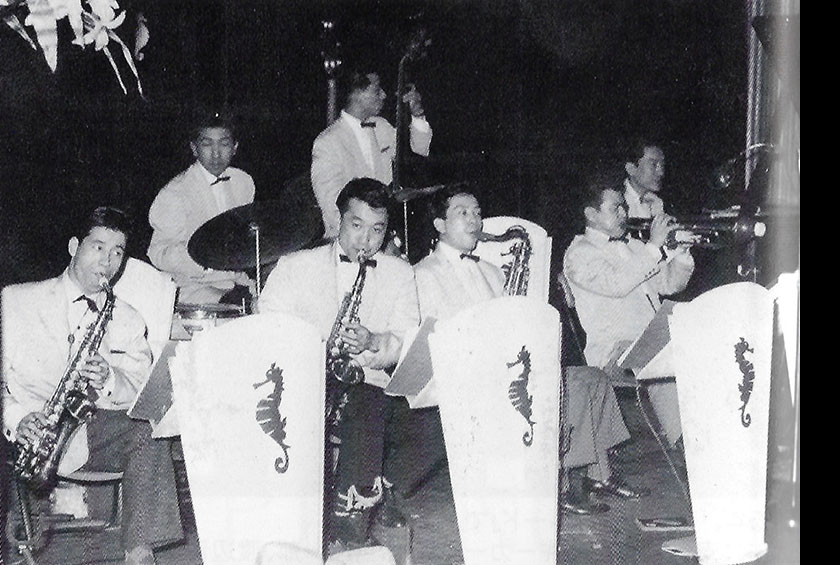
I also briefly performed with my own band, Hiroshi Miyagawa Seventet. I’m playing the piano at the far right (1958).
Actually, that kind of work doesn’t really exist anymore, does it?
That’s true.
There used to be so much of it back in the day. Musicians really lived it up in style, didn’t they?
Oh, absolutely. Musicians were flashy back then. Whether it was drinking, chasing women, or the clothes they wore, everything was stylish. Even with our hairstyles, we’d go all the way to the Yamano Beauty School in Yoyogi just to get our hair ironed straight and styled to hang down over our foreheads. If you overdid that, though, you’d end up scorching your hair!
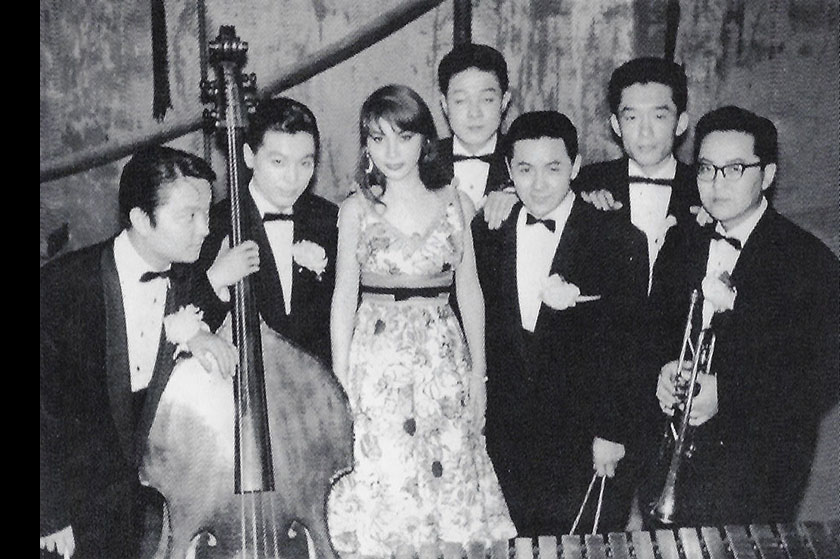
The Seiji Hiraoka Sextet at the Nichigeki Theater in 1958.
I’m the second person from the right. The woman in the
center is Michiko Hamamura.
That’s the “Iron Perm” look! (Laughs)
It wouldn’t hold for very long, and it did a real number on our hair, but we went right on doing it anyway! I just thought it looked cool. Well, it really was a great era.
That’s the chain of events that eventually led to bands like Hajime Hana’s making their debut, right? Did your connection with them stem from a long-standing relationship?
Shortly after I moved to Tokyo, I joined Watanabe Productions.
You joined Nabe-Shin’s band?
No, actually, I joined Hiraoka’s band first. But it wasn’t really all that interesting, to be honest. (Laughs) So I quit and started a band of our own. A dance hall called Mocambo opened up around Hamacho. It was opening night, but there were only four or five customers there, just sitting in silence, listening, and I remember thinking, “Is this place even going to make it?” We were playing there when [pro wrestler] Rikidozan showed up, completely drunk, and started making a ruckus, shouting, “Play this! Play that!” Our drummer at the time was Jimmy Takeuchi. He was a hot-blooded guy, so when he complained about the shouting, Rikidozan snapped, “What did you say, punk?!” and punched him right in the face. (Laughs) Rikidozan, of all people!
It’s never a good idea to go around roughing up civilians! (Laughs)

Shin Watanabe and the Six Joes in 1958.
From left: Hiroshi Miyagawa, Shoichiro Matsumiy,
Shin Watanabe, Tetsuo Takeuchi, Hachiro Ando, Jimmy Takeuchi.
That place went under in no time flat. (Laughs) Anyway, eventually Yui Yamazaki, who was with Shin Watanabe and the Six Joes, decided to quit, and that’s how I got poached to take his spot. Our drummer, Jimmy Takeuchi, had actually been poached by them even earlier than I was. So Shin asked me, “Hey, Miya, wanna come join my band?” and I said, “Yeah, absolutely!” and signed on. The remnants of my old band were apparently pretty crestfallen after that, but they kept plugging away at their gigs regardless. They were actually my junior high school classmates, you know.
But then, even in the Six Joes, Hidehiko Matsumoto ended up quitting, and naturally, the band’s popularity started to wane. By that time, though, we were already working with [female singing duo] The Peanuts.
It was that early on? Was this around 1963? Was Shin Watanabe already serving as the company president by then?
Yeah, he was handling presidential duties, too, though he didn’t really step into the full-blown spotlight as the “President” until a bit later on. That was back when Watanabe Productions was still located in Hibiya.
Shin actually told me to take charge of The Peanuts’ training. And let me tell you, those two girls had absolutely incredible instincts. Since they were twins, their vocal timbres matched perfectly. They had a natural sense of rhythm, and they were young, bursting with fresh energy. I told them, ‘You could become stars in no time.’ And so I took them under my wing. It turned out to be a great learning experience for me, too, after all, I had to handle the musical arrangements myself. Then, The Hit Parade TV show was launched [in 1959]. I pitched The Peanuts to the producers there, and bam, I turned them into instant stars.”
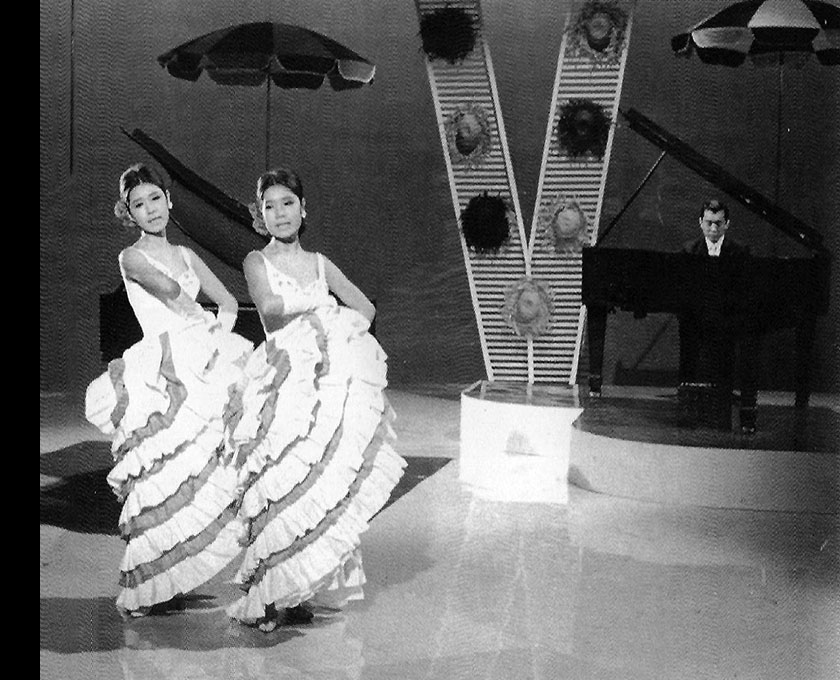
The Peanuts became a huge hit, and I became extremely busy.
4. Meeting The Peanuts…The Beginning of a Brilliant Career as a Composer
The Peanuts actually figure quite early on in your career, don’t they?
Yeah, I hadn’t even been with the Six Joes for a full year yet. Oh, wait, that was back when Hidehiko Matsumoto was still in the group. So, I suppose The Peanuts joined right around the time I was on the verge of leaving? My bandleader basically told me, “I’m leaving them in your hands, make sure you do a good job.”
Does that mean you’ve been playing the role of the “Great Master” for about forty years now? (Laughs)
Well, I wouldn’t go so far as to call myself a “Great Master.” (Laughs) But I suppose that’s how it worked out. As for the very first original song I composed, not a cover, but a true original, I took that “Hey! Hey! Oh! Whoa! Whoa! Whoa!” style that was popular in rock & roll at the time and turned it into: “Don’t look baaaack…Hey! Hey! Eh!” (from the song Furimukanaide, [Don’t Look Back] 1962). I was essentially mimicking the early style of rockabilly. I could mimic just about anything, you see.
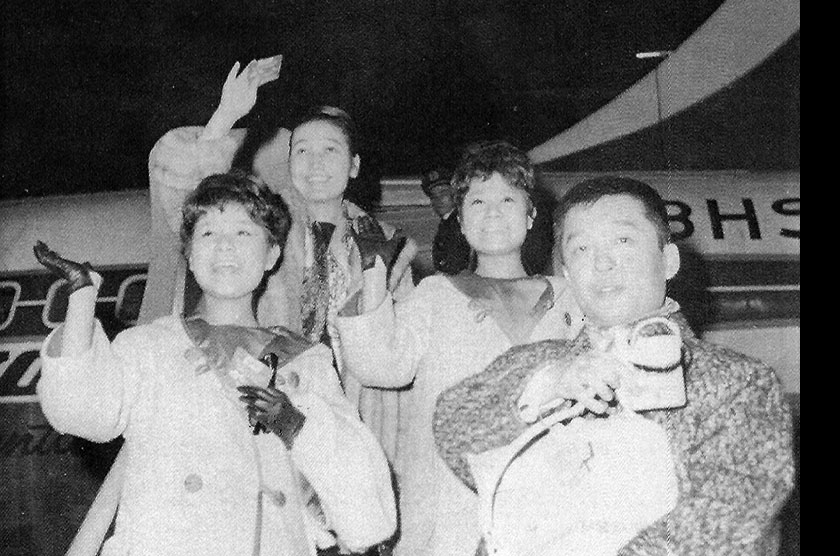
In December 1963, we traveled to Europe to perform on the
Caterina Valente Show. The person behind The Peanuts is
Misa Watanabe, wife of Shin Watanabe (at Haneda airport).
Since I had a background in jazz, I was already performing music that was far more sophisticated than that stuff. I thought to myself, “Is this what American pop music is all about?” and the song just flowed right out of me. Then, when we put it on The Hit Parade, it shot straight to the top of the charts. That gave me a real boost of confidence. I realized, “Hey, I’ve actually got a knack for composing!” (Laughs) I believe it was the very next year that I wrote Koi no Vacance (Vacation of Love, 1963). I went on to write a few more songs, and I started gaining some recognition for my work. However, with giants like Hachidai Nakamura dominating the scene at the time, it was still quite a struggle to really break through.
Did you have any interactions with Hachidai Nakamura?
We were at the same agency, Watanabe Productions, but he was such a massive senior figure in the industry that he was practically in a league of his own. He was truly on a different plane, way up in the clouds. Mind you, I had achieved a fair bit of success myself by then, and I was starting to gain recognition among industry insiders.
So, let’s talk about the 1963 Japan Record Awards. You know how there are various categories? The very first award I received was the Arrangement Award for Koi no Vacance. There simply weren’t any particularly outstanding arrangements produced that year. However, the arrangement for Koi no Vacance had a distinct jazz flavor, something that was virtually unheard of in the Japanese pop scene at the time, and that’s precisely why I was given the Arrangement Award.
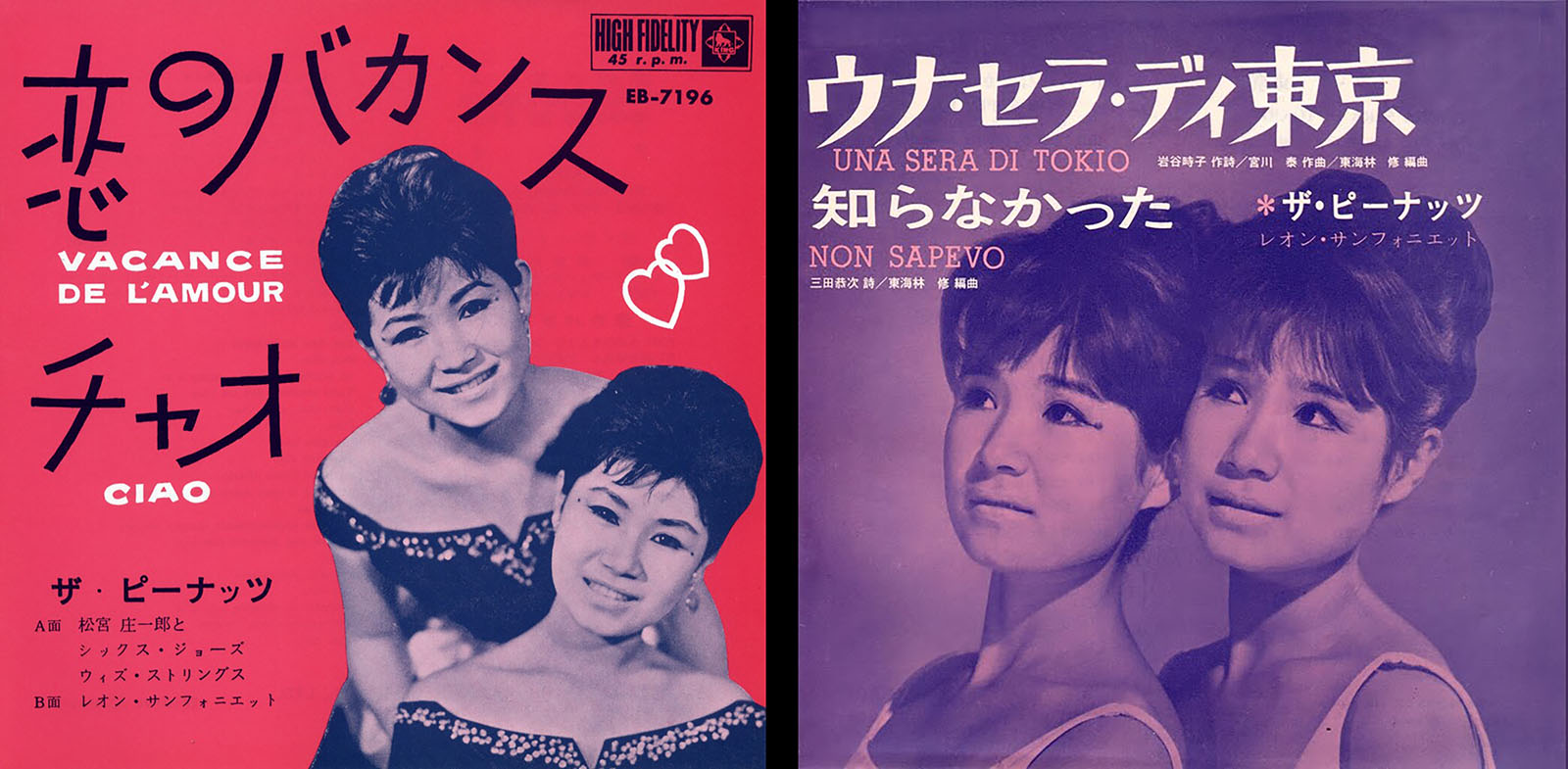
The following year, 1964, I was incredibly prolific. I produced a slew of hits, including Una Sera di Tokyo (One Night in Tokyo). This time around, the committee couldn’t find a suitable candidate for the Composition Award. So, they basically said, “Hey, that Miyagawa guy from last year has been churning out hit after hit, let’s just give it to him! Yeah, that’s what we’ll do.” And just like that, they handed the award to me. It was almost comical!. (Laughs)
First came the Arrangement Award in ’63, followed by the Composition Award in ’64. Naturally, I thought to myself: “Well, the only thing left now is the Grand Prix, the Japan Record Award itself!” (Laughs) I worked my tail off. I really gave it everything I had. But no matter how hard I tried, I just couldn’t seem to land it! (Laughs) I suppose that’s what happens when you let desire get the better of you. You start thinking, “If I do it this way, surely it’ll be a hit,” or you delude yourself into thinking you’ve mastered the “secret formula” for success. You tell yourself, “That particular melody worked because I crafted it this way,” or “For this song, the arrangement, the harmonies, the rhythm, would be much better if I tweaked them like this.”
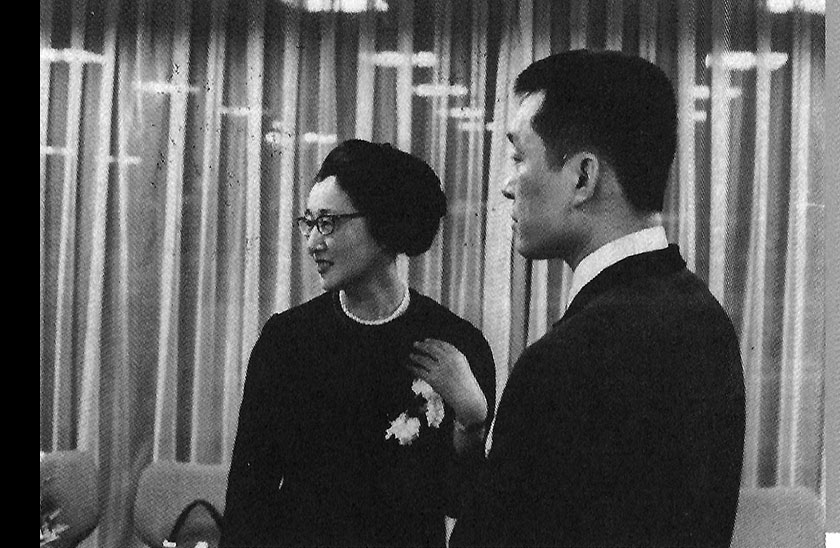
With Tokiko Iwatani at the Japan Record Awards party for
Una Sera di Tokyo in 1964. The venue was the Tokyo Kaikan.
Since I came from a jazz background, I naturally possessed a level of technical proficiency in those areas that surpassed most people working in the worlds of enka or mainstream pop. Whenever I applied those jazz techniques to my musical arrangements, everyone would marvel at how sophisticated and brilliant they sounded. So, in that sense, the arranging side of things came quite easily to me.
However, composing music is a completely different story. It requires pure inspiration, a great set of lyrics to work with, and, crucially, the ability to sing well yourself. You need to be the kind of person who can belt out a tune at the top of their lungs anywhere, anytime, even after having a few drinks, and who simply possesses a deep, genuine love for singing. Without those qualities, you simply cannot write songs.
You see, Japan has an incredibly high number of composers who got their start as nagashi, itinerant street singers. Toru Funamura, Minoru Endo…they all followed that exact path. Because of that background, they possess an innate understanding of what makes a song “click” with the public, what the masses are truly looking for. Technical musical theory aside, when it comes to that side of the craft, connecting with the audience, those guys are absolutely unrivaled.
That’s a sentiment that holds true for contemporary music as well, isn’t it?
Yeah, but with music today, well, there are plenty of people who’ve graduated from proper music schools, and there’s a mountain of manuals and reference materials available. And the gear we have now is so good, the sound quality is incredible, that you can listen to excellent music anytime you want, and you can create it instantly.
Basically, the piano used to be the core instrument. Then, at a certain point, the acoustic guitar had its heyday. After that, the electric guitar took center stage, and even now, it’s still all about the guitar, isn’t it? We went from playing acoustic guitars in the folk scene to the electric guitar hitting you with that powerful, driving sound, and then evolving to produce all sorts of different tones. That became the mainstream trend worldwide, didn’t it? And since the Japanese love to imitate things…Japanese pop music underwent a rapid transformation, roughly from the late 60s through the 70s and into the early 80s. That was the era when the Japanese pop scene produced some truly great songs.
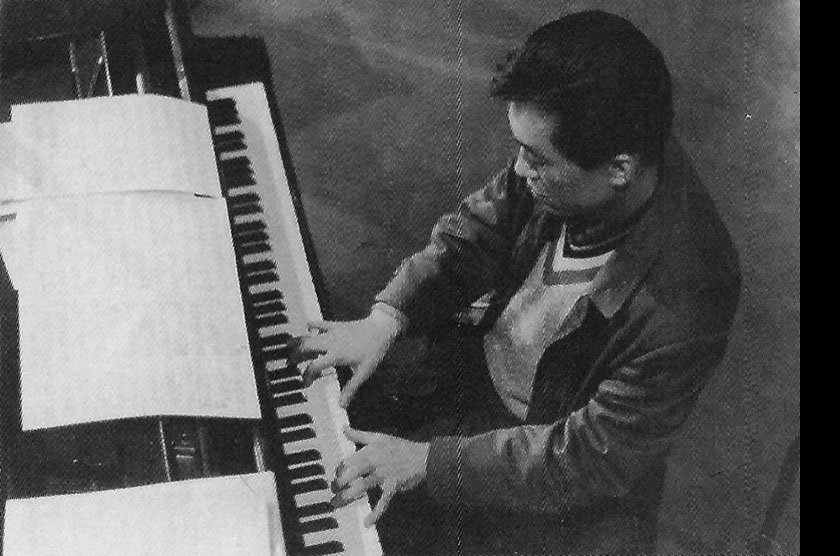
When I wasn’t sleeping, my days consisted of either
writing sheet music or playing the piano.
When I listen to the hits from back then now, I find myself thinking, “Wow, the Japanese really are amazing.” It might have looked like we were just mimicking others, but we were actually crafting genuinely well-made Japanese songs. We were essentially dressing them up in “Western-style kimonos”, embellishing them with foreign flair, and making those songs huge hits here in Japan. And everyone loved them, the middle-aged housewives, the salarymen, the young kids, everyone. Jazz, on the other hand, followed a completely different path. People were working incredibly hard at it, but for some reason, jazz just couldn’t seem to catch on and really take root. Though, of course, we have plenty of top-tier jazz musicians in Japan now.
I suppose the 1950s must have been the absolute peak for jazz in Japan. After that, the country really shifted its focus toward pop music.
That’s true. Still, even today, there are plenty of incredibly talented jazz musicians here in Japan.
In terms of technical skill, they’re all absolutely incredible, aren’t they?
Oh, they’re amazing. But you know, back in the Swing Era, the 1920s and 30s, you could almost say that the primary function of jazz was to provide accompaniment for social dances like the Foxtrot. It went hand-in-hand with the dancing, that rhythmic cha-cha beat…
That’s how it stayed connected to the general public.
Exactly. Jazz existed because of the dancing. But then came Modern Jazz, and you simply couldn’t dance to it anymore. It was just too complex. , So you ended up heading in a more intellectual direction, and in doing so, you parted ways with the masses.
So you ended up heading in an intellectual direction, and in doing so, you parted ways with the masses.
That’s why everyone ends up broke and struggling, drinking heavily, grumbling constantly, ruining their health, turning to drugs…that’s the downward spiral they fall into, isn’t it? The more they study and delve into it, the deeper they get stuck in an inescapable rut.
5. The Evolution of Modern Jazz…The Appeal of the “George Shearing Sound”
I played jazz back during the Swing Era, too. In fact, when I first moved to Tokyo, modern jazz was just starting to take off. The very first group in Japan to pioneer modern jazz was Hachidai Nakamura’s Six Joes, performing what came to be known as the “George Shearing Sound.” It featured piano, vibraphone, and guitar, those three instruments creating the core sound. Plus, of course, drums and bass. The piano took center stage, while the vibraphone and guitar handled the entire melody line. The guitar played exactly one octave below the vibraphone, and the piano filled in all the crucial harmonic notes in the space between them. That specific kind of sound simply hadn’t existed in modern jazz up until that point.
George Shearing, being British, had moved to America. While he could certainly imitate the styles he found there, he hadn’t yet managed to forge a truly unique identity of his own. That was when a famous critic named Leonard Feather offered him a piece of advice. He suggested, “Instead of a full big band with five saxophones playing a unison line, why not have the piano play that same line? Then, have the vibraphone and guitar play the parts underneath it in that same rhythmic style, da-da-da-da-da, da-da-da-da-da?”
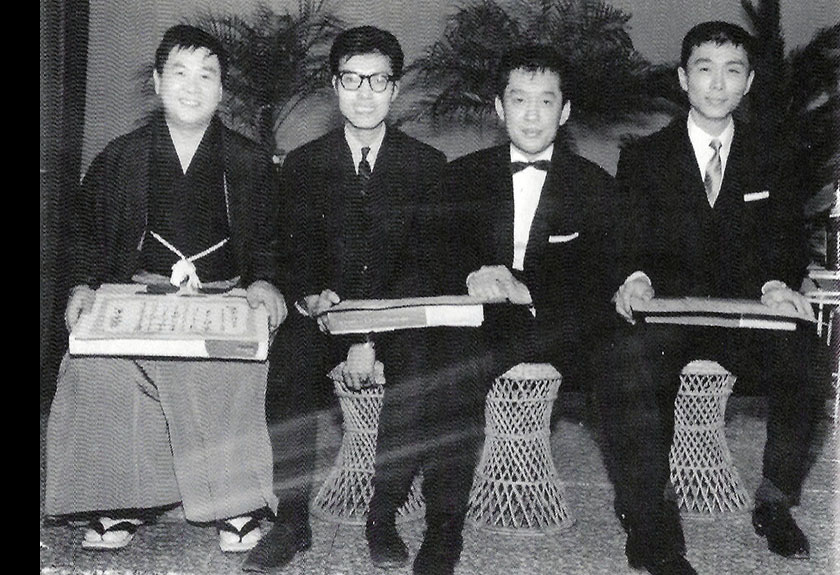
The year-end party for Shabon Dama Holiday in 1965.
From left: Kei Tani, choreographer Hidetaka Koido, myself,
and scriptwriter Hiroshi Kono.
Since George Shearing was blind, you see, he was deeply moved by this suggestion. He kept saying, “Thank you, thank you!” He gave it a try, and it turned out to be a massive success. While modern jazz was generally becoming increasingly complex and difficult to grasp, this particular sound pioneered by George Shearing was somewhat commercial in nature, accessible and easy for anyone to enjoy. It had a chamber-music quality to it, never jarring or loud, but rather elegant and stylish. And the way he took familiar tunes that everyone already knew and gave them a subtle, clever twist was just incredibly chic. That sound took the world by storm.
Everyone in Japan started imitating it, too. I certainly played it often myself. However, for a certain period, for reasons known only to himself, George Shearing developed a fondness for Latin music. He steered his signature sound in a Latin direction, playing almost exclusively Latin tunes, and in doing so, he ended up alienating his audience. Consequently, his popularity took a nosedive. Nevertheless, he staged a comeback around the 1980s, and quite a few George Shearing records were released during that time. I imagine he hasn’t put anything out recently, though. Given his advanced age, things are likely getting a bit precarious for him now.
Now, Shin Watanabe, the leader of the band Six Joes, decided to adopt that “George Shearing Sound.” He was able to do so because he had Hachidai Nakamura in the band; with Nakamura on vibes and Hidehiko Matsumoto on tenor sax, they could lay down a delicate melodic line over the accompaniment. It felt like a fresh, new sound at the time. Yet it remained fundamentally a faithful recreation, a copy, of George Shearing’s style. They toured the entire country with this act, but they soon realized that the “sound” alone wasn’t enough. They needed Hidehiko Matsumoto’s solo spotlight, his “one-man show.” It was thanks to his explosive, virtuosic playing that the band as a whole achieved such immense popularity.
Having witnessed all of that firsthand, I still find myself unable to play overly complex, “difficult” jazz today. After all, ever since my days in Osaka, I’ve been studying and honing that specific style, the “George Shearing Sound.”
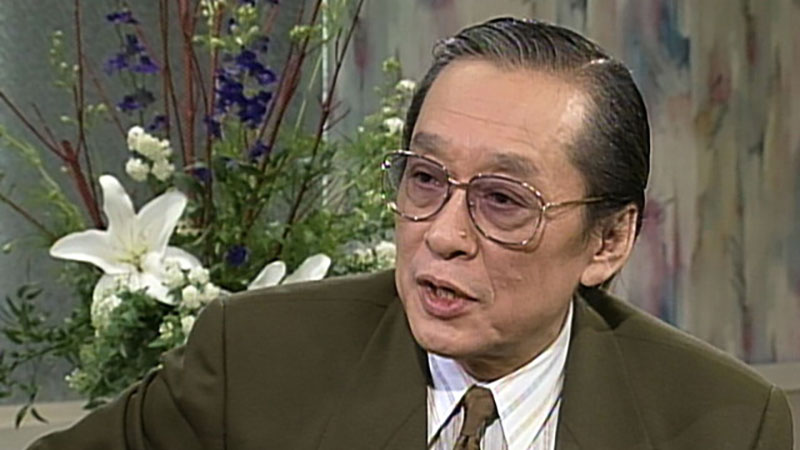
6. Recreating an Era!? “Club Shinchugun” (The Occupation Forces Club)
Speaking of which, there’s a jazz newspaper called Jazz World, and every year they host an event titled “Club Shinchugun,” which translates to “The Occupation Forces Club.” I’m not entirely sure why they chose that name, “Occupation Forces,” but I imagine the idea was to bring together musicians who used to play in the actual Occupation Forces clubs back in the day and have them perform together once again.
Some years after Shin Watanabe passed away, around the time of one of his memorial services, the president of Jazz World approached his widow, Misa Watanabe. He said, “I’d love to recreate that atmosphere once more, to let everyone hear the sound of Shin-san’s Six Joes again. Could you please lend us your support?” Misa-san was absolutely delighted by the proposal. She replied, “Oh, I’m certain my husband would have been absolutely thrilled by that idea!” and with that enthusiastic response, the event was officially set in motion.
The surviving members of the Six Joes all gathered together. I was on piano, of course. Uchida, the president of that newspaper company, played the vibes. And the guitar was handled by the veteran Shungo Sawada. As for drums, Jimmy Takeuchi couldn’t make it because he was feeling unwell, so the number one guy, Takeshi Inomata, stepped in to play for us. And for the bass…well, we actually did have an original member available. That was Akihira Naruse. I had played alongside him back in our Six Joes days. So, the bassist, the pianist, and the vibraphonist were the three of us who were still active professionals.
Anyway, we held a recital recently, and we decided to stage it at a rather large venue. (Tokyo Kosei Nenkin Kaikan, September 8, 2001). Now, the thing is, this kind of music sounds best when heard in a small, intimate salon, maybe for an audience of around a hundred people. But since we were playing in a large hall, the electric instruments were cranked up to full volume, and naturally, the piano couldn’t afford to be drowned out, so its volume had to go up as well.
Were the instruments miked?
Yeah, everything was miked, so the resulting sound ended up being absolutely massive. It wasn’t the “George Shearing Sound” anymore, not by a long shot! (Laughs) It just turned into this huge, amorphous wall of noise. On the day of the performance, Misako Watanabe came up to us and said, “Thank you all for doing this for my late husband,” and she gave everyone a monetary gift of appreciation.
Since we received those gifts before the performance even started, we were all deeply moved and ended up throwing ourselves into the music with every ounce of our energy. But that very earnestness backfired on us, resulting in that overpowering volume. There wasn’t even a trace of the “George Shearing Sound” left, it was just too loud! (Laughs)
After the show was over, Misako looked completely crestfallen. I imagine she was thinking, “Maybe I shouldn’t have given them those gifts after all, considering how that turned out.” (Laughs) Once things had wrapped up, she asked me, “Um…is this really how it’s supposed to sound?” I replied, “Well, actually, yes. Even George Shearing’s current band plays with that kind of loud, amplified sound these days.” To that, she simply responded, “Oh, I see…”
She wore this puzzled expression on her face, as if to ask, “Was that really okay?” So, whenever we had a sound engineer who wasn’t familiar with George Shearing, I’d say something like, “Apparently, he was a huge star on the piano,” and then I’d turn up the volume on the piano. That would make the piano sound absolutely massive. And naturally, thinking, “Wow, the guitar sounds a bit small now,” the engineer would turn that up, too. Once both the guitar and piano were cranked up, the drums would inevitably end up pounding away at full blast, too.
And that’s how things would spiral completely out of control! (Laughs)
Yeah. I really felt bad about putting Misa-san through that. So, we decided to give it another shot sometime, do a do-over somewhere else. For next year’s performance, I’ve made a mental note: I absolutely have to make sure we don’t keep cranking up the volume like that! Yeah, that was quite an incident. (Laughs)
7. Shin Watanabe, Legendary Producer and Musician
Returning to your own story for a moment, after nurturing The Peanuts, your next major project was The Crazy Cats, right? I assume that meant your film work really started to pick up?
Yes, my work in film really increased. I had actually done some film work back when The Peanuts were appearing in movies, too. But with The Crazy Cats, there was this incredible figure named Tetsuaki Hagiwara…
I’m actually a huge fan of his myself! Tetsuaki Hagiwara is, of course, very famous as the Crazy Cats’ composer, but you don’t really see his name credited on many other projects, do you?
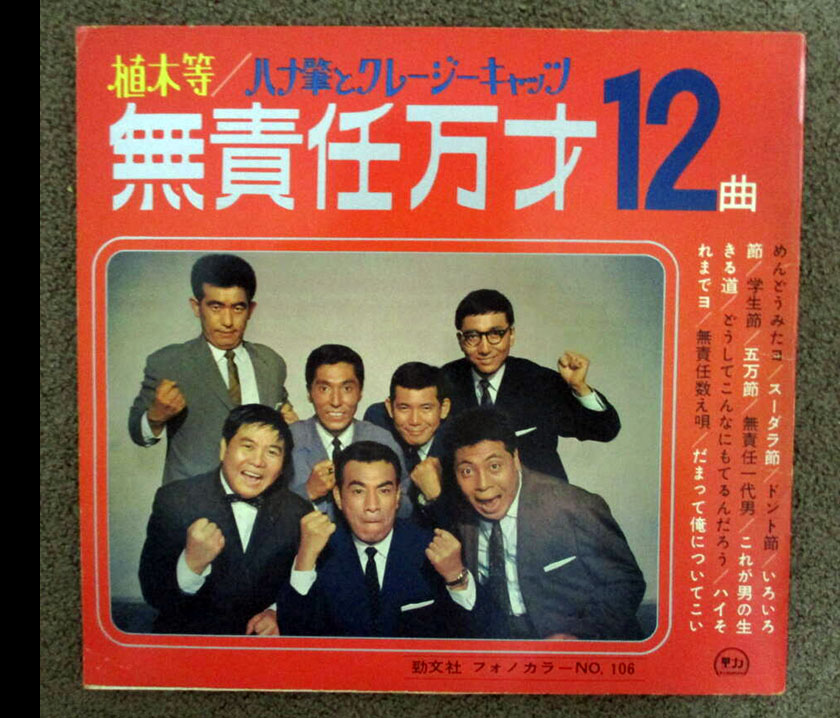
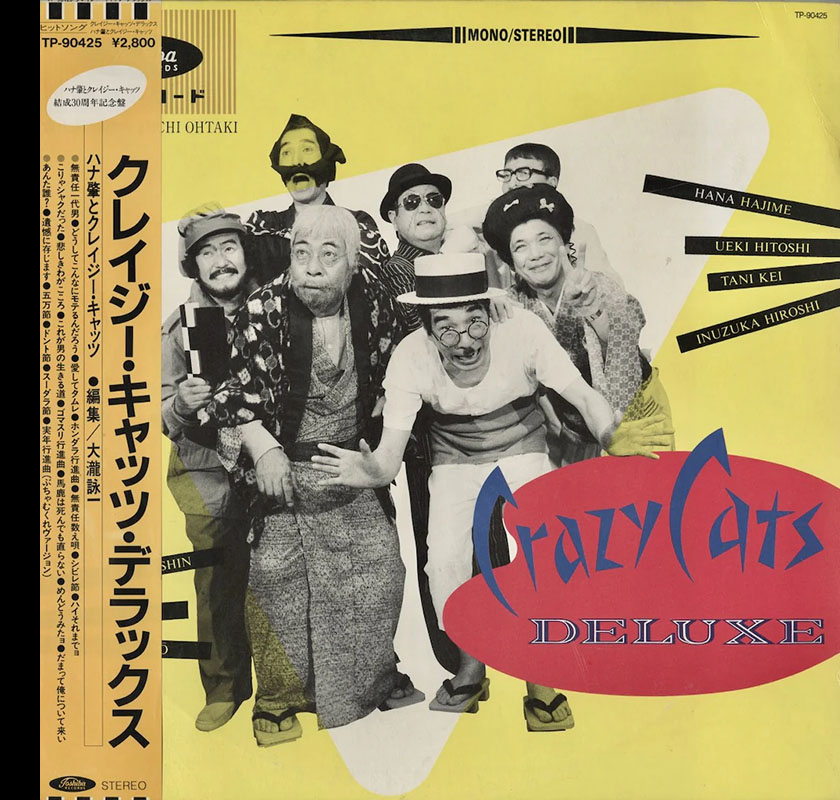
Crazy Cats
He was a man who had received rigorous, formal training, a true senior master in the field. He wrote the original Sudara-bushi (Sudara Song), and it became such a massive hit that he was subsequently tasked with writing dozens more songs. While they all shared a similar vibe, being “cut from the same cloth,” so to speak, not a single one was a mere copy of another. Each was a unique composition.
Many of them were incredibly innovative, weren’t they?
Yes, innovative, and just magnificently crafted.
But, as you mentioned, you don’t really see his name credited on works for other artists.
That’s because he was kept constantly busy at Watanabe Productions, churning out one song after another, endlessly. I eventually started handling the musical arrangements myself, so I began attending the songwriting meetings. The lyrics were written by Yukio Aoshima, of course. Aoshima-san would bring in his drafts, and we’d hold our meetings at Shin Watanabe’s private residence. Of course, Ueki-san (Hitoshi Ueki) would show up too, naturally curious about what kind of song we were working on this time.
Then, Aoshima-san would read the lyrics aloud for everyone to hear. And let me tell you, when he reads them, it’s absolutely hilarious. He’d act it out, too, miming the motions of drinking as he recited lines like, “Just meant to have a quick drink…” It was just outrageously funny. Then, President Watanabe would step in and say things like, “Yeah, I get that part, but it feels a little too repetitive. Could you tweak it just a bit?” After that, Hagiwara-san would come back with a melody, usually bringing three different versions: A, B, and C. We’d work on them while singing them through, constantly receiving feedback from the President and the others, suggestions like, “Could you make that part sound a little more, well, earthy?”
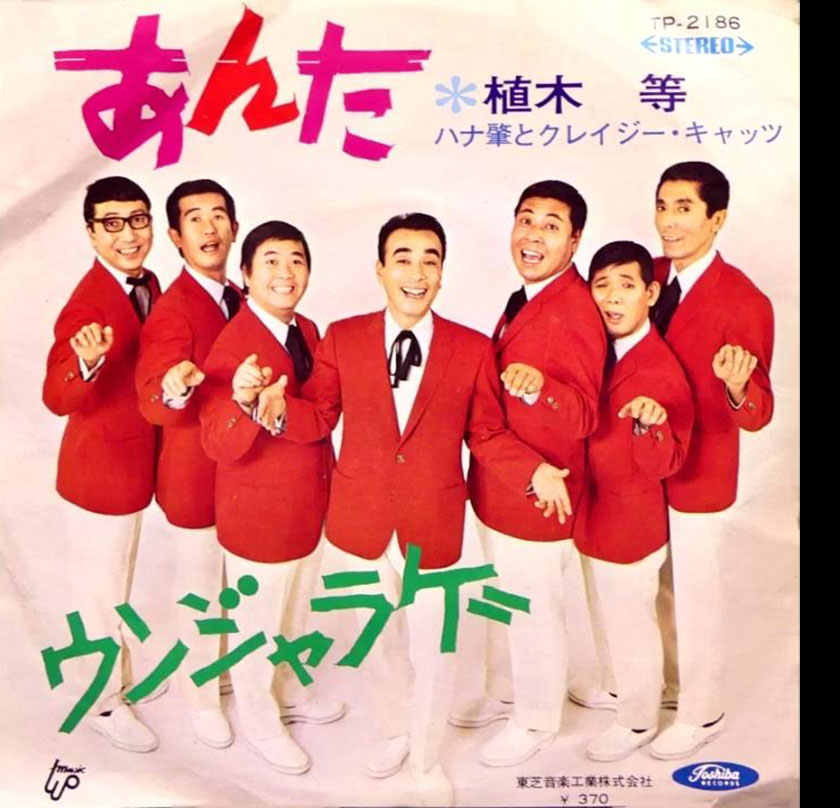
So Nabe-Shin was essentially the producer, then?
Oh, absolutely. He was right there at the very forefront, leading the charge. That went for all the songs, even the ones I composed myself. If Shin Watanabe gave it his OK, then that was it, it was done. He was truly incredible.
Speaking of my own experiences, I remember when I wrote Koi no Vacance. Once I’d finished it, they said, “All right, let’s hear it, play it for us.” So, I played the accompaniment I’d written, a slow, rock-ballad style arrangement. But the President immediately stopped me. “Miyagawa-chan, wait a minute, isn’t that the exact same style as that song Paul Anka wrote?” I replied, “Well…yes, it is.” He shot back, “You can’t just copy someone else like that! You need to create something in your own style.” He told me, “Try rewriting it with a four-beat bass line, just like the way I always play it.” So, I did exactly as he instructed, and when I played it back, everyone agreed: “Ah! That version really captures the right vibe!” And he just smiled and said, “See? I told you so!”
That’s amazing! For people of my generation, the image of Nabe-Shin is less that of a “musician” and more that of a “corporate president”, someone you wouldn’t expect to be getting involved in the actual musical details. I guess I had it all wrong!
Exactly. He really was something else. That’s why I always made sure to listen to what he had to say. There were quite a few songs where that kind of back-and-forth happened.
So, everyone really came together and worked under Nabe-Shin’s direction.
Yeah…though, I suppose there were times when that worked out well, and times when it didn’t. It didn’t always work out for the best! (Laughs) On those occasions, if I said, “Even though you’re the president, here’s what I think we should do,” he’d retort, “Huh? You want to give it a shot? Can you take full responsibility?” And I’d end up backing down. “Uh…actually, I’ll just do exactly what you say, Mr. President…” That was just the kind of atmosphere we had back then.
Well, today’s theme is “Things We Can Only Say Now” after all! (Laughs)
I’m sure there were times when we followed the president’s orders to the letter and ended up failing. I don’t specifically remember any instances, though. I’m not sure if this counts as something I can only say now, but back then, there were so many employees, people we looked up to as truly excellent directors and managers, who ended up leaving the company, one by one. Many of them went on to start their own companies. And almost all of them were successful. I believe there’s even one guy who became the president of a record label.
It really was a treasure trove of talent. It must have been a fantastic “school” for professional development.
The president passed away relatively young, you know. So, I imagine he must have felt an immense sense of frustration and regret. He was truly a remarkable man. Even when he knew his illness was terminal, that he didn’t have much time left, he always wore a smile and never let anyone see his suffering. He was the very embodiment of the samurai spirit.
That said, figuring out which projects would become hits and which wouldn’t was a completely separate issue. Things went well at first, but eventually, perhaps inevitably, we reached a point where we couldn’t quite maintain that same freedom to create whatever we wanted. As staff members began leaving one after another, the president never tried to stop them or beg them to stay. Instead, he’d simply say, “Oh, really? Well, go out there and give it your all!” and send them off with his blessing and watch how successful they all became.
Even now, whenever we hold a Watanabe Productions alumni reunion, everyone gathers together, reminiscing, “Man, those really were the good old days!” To which someone inevitably retorts, “The ‘good old days’? You’re the one who left back then!” (Laughs) They really are just a great bunch of guys.
There certainly are a lot of incredible people who got their start at Watanabe Productions, aren’t there?
Oh, absolutely. They’re a great bunch, and a lot of them are incredibly sharp and quick-witted, too.
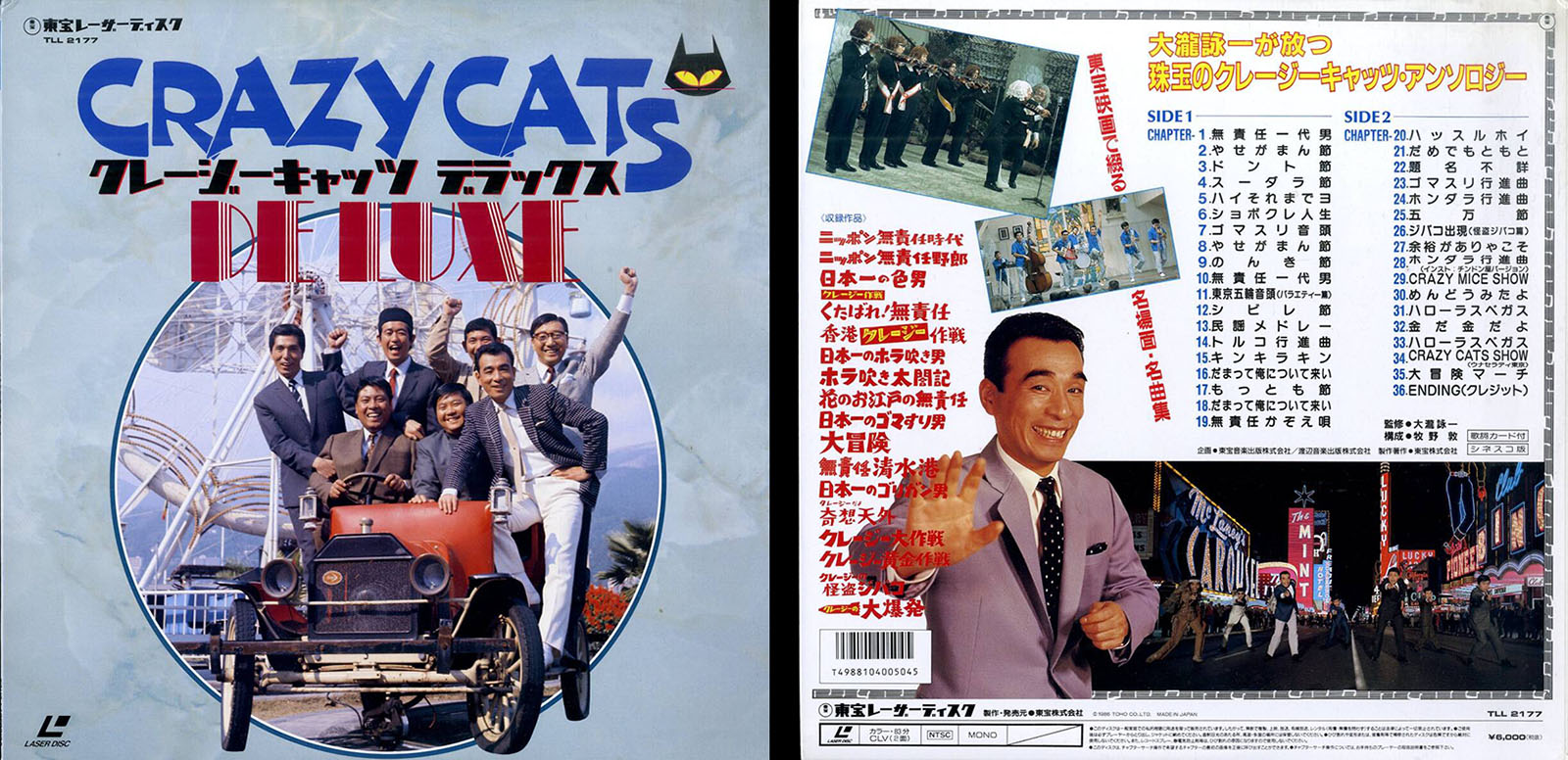
8. The Legendary Crazy Cats! The Real Reason He Missed Out…?!
There were certainly a lot of funny people around back then. You even used to perform comedy skits yourself, didn’t you? Is it true that you actually wanted to join the Crazy Cats yourself? (Laughs)
That’s right! (Laughs) Even though I was already a member of the Six Joes at the time, Hajime Hana made a joke: “Hey, Miya-chan, you know how Eitaro [Ishibashi] and Senri Sakurai are the two pianists? Well, Eitaro is a bit sickly, so how about you come join us? Senri Sakurai would be the first piano, and you’d be the second…” I’d say things like, “Oh, come on, stop teasing me!” but deep down, I was absolutely thrilled. (Laughs) I was so incredibly happy, just over the moon.
I rushed home and told my wife: “Hey! You won’t believe this! Hana-chan just asked me to join the Crazy Cats! He said Eitaro might have to take some time off, so he wants me to come in as the second pianist. This is the absolute best! What do you think? Should I join?” And she just said, “Don’t be ridiculous. Why would you join such a vulgar band?” So, that was that, I didn’t join. (Laughs)
(Laughs) So, you actually might have ended up joining them!
Yeah. Deep down, I really wanted to.
But you decided against it because your wife was opposed to the idea.
Exactly. She said, “I told you, don’t join such a vulgar band. Anyway, are you going to eat the stuffed green peppers I made, or not? What are you going to do?” She was completely indifferent to the whole thing. It’s pretty funny, isn’t it? (Laughs)
It sounds like you’re quite a pushover when it comes to your wife! (Laughs) Were you and Hana-san roughly the same age?
Oh, he was quite a bit older than me.
So, you really were happy about the offer after all.
Yeah. I really was.
That combination of music and comedy really aligns with your true nature, doesn’t it?
I suppose so. After all, I’ve always loved making people laugh. But you know, the act of making people laugh, of getting them to smile and feel happy, ultimately stems from a place of self-interest. I’m a coward. I can’t fight, and I certainly don’t have a thick skin. That’s why I rarely, if ever, stand up to people or push back against them. I try to hold back as much as possible, to be gentle, ever so gentle, and yet, I still feel compelled to be entertaining. Somewhere along the line, I just fell in love with making puns and performing gags. I really, truly wanted to join the Crazy Cats.
I imagine the members of the Crazy Cats were cut from the same cloth, weren’t they?
I suppose so. We were indeed the same breed…
There used to be a genre known as “novelty music,” didn’t there? Internationally, you had figures like Spike Jones. Here in Japan, there was Toriro Miki…
Miki-san was certainly one of them. And someone like Kei Tani, who actually set out to mimic Spike Jones’s style note-for-note, was incredibly skilled at it. After all, back then, that was the only model they had to go by. What makes it so remarkable is that these were world-class musicians, absolute masters of their craft, who chose to engage in this kind of work. In Japan, there was often a prevailing attitude that the music itself didn’t really matter; that as long as you were cracking puns and performing gags, that was enough. But because those guys’ musicianship was truly exceptional, their gags landed with even greater impact.
The Crazy Cats operated on that very same philosophy, didn’t they?
9. The Compositional Genius of Tetsumasa Hagiwara
After Sudara-bushi was completed, the very first time I heard it performed live was during a Crazy Cats show at the Koma Theater in Osaka. That was the first time I actually witnessed them performing it in front of an audience. To my surprise, the Osaka crowd went completely silent. Nobody laughed while the song was playing, simply because they had never heard anything like it before. Then, the song reached its final flourish, “…and that’s just how it went!” and ended. There was a brief, pregnant pause…followed by an explosion of applause. It wasn’t the sound of laughter, but rather a thunderous ovation.
I was deeply moved in that moment. Here was a comedy troupe, one that, generally speaking, spent most of its time spouting utter nonsense, performing this piece of music, and the audience listened in rapt silence only to erupt in applause the moment it concluded. I was absolutely astonished. I remember thinking to myself: “What an incredible piece of music this is.”
You truly witnessed a remarkable moment.
With those kinds of comedic songs, and this is true for almost all Japanese songs, really, we rarely use the notes “Fa” and “Ti” from the standard Do-Re-Mi-Fa-Sol-La-Ti-Do scale. Instead, we compose using a scale that goes Do-Re-Mi-Sol-La-Do-La-Sol-Mi-Re-Do. “Fa” is a note found in Western musical scales, but it’s a sound that doesn’t really exist in traditional Japanese music. The progression tends to skip straight from “Mi” to “Sol”. we have “Ti,” but “Fa” is missing.
However, in that song, Sudara-bushi, specifically in the lines Do-Do-Sol-Do-Do-Sol-Re-Mi-Mi-Re-Do-Re-Sol-Sol (“I only meant to have a quick drink…”) and Re-Re-Do-Re-Re-Sol-Sol-Mi-Fa-Mi-Re-Do (“…but before I knew it, I was bar-hopping”), that is the only place where the note “Fa” appears.
Is that so?!
Aside from that one spot, “Fa” never appears again, not a single time. Yet, there it is, just that one isolated instance. That’s what makes it so brilliant. I don’t think Mr. Hagiwara calculated it that way intentionally. It probably just turned out that way naturally. He likely felt that it gave the piece a more stylish, sophisticated flavor. If it were me, I don’t think I would have written it like that. I probably would have just stuck to a typical, standard Japanese-style melody. Plus, once I’d used “Fa” that one time, since it introduces a Western flavor, I would have been tempted to keep using it throughout the rest of the song! (Laughs)
And yet, it still doesn’t appear again?
Nope, it absolutely never comes back. I was truly astonished when I realized that.
I’ve always considered him a genius, too…but that’s an incredible story.
Oh, and then there’s that other song, the one that goes, Ta-ra-la-la-ta-ra…”You said this and that, and I got all fired up…”, what was that one called again?
That’s the one! It’s called Kore ga Otoko no Ikiru Michi (This Is a Man’s Way of Life).
Is that the title? I wonder if it turned out that way because the lyrics were written first? They likely decided at the outset to start with a melancholic, minor-key bluesy vibe. Then, as the song builds momentum, right around the line “..You said this and that, and I got all fired up…”, it shifts into an upbeat 8-beat rhythm. As a listener, you get that feeling of, “Here it comes! Here comes the energy!” “Ah, it’s Hitoshi Ueki! This is it!” That’s the vibe, and it shifts into a twist dance rhythm.
Then it builds up with a sudden surge of energy, culminating in a final musical break. That break is absolutely essential. It’s followed by the line, “And that’s the end of that!” The brilliance of that musical structure is simply astounding!
Then, in the second verse, the mood shifts again, this time to anger: “You’re messing with me! You’re messing with me! You’re messing with me! You bastard!” And right after that comes the kicker: “It just makes me want to cry…”, the ultimate finishing blow! There isn’t a single weak spot anywhere. It never falters. It’s absolute perfection. The way that song was constructed was truly unprecedented. And to think, it’s a comedy song!
It really is something unlike anything else in history, before or since.
I truly believe it was incredibly innovative.
And yet, it never won any awards, did it?
I don’t think it won anything at all. Of course, Sudara-bushi is a great song too, but for me, this one really stands out…another song that’s just delightfully absurd and hilarious, thanks, once again, to the lyrics by Yukio Aoshima, is one called Hondara-Bushi (Hondara Song) It goes: “No matter what I do, Hondara ga hoi! If I try that, Hondara ga hoi-hoi! I keep trying and trying, Hondara, hodara ga hoi-hoi! So I just give up and do nothing, Hondara ga hoi-hoi!…”
How many times does the word “Hondara” even appear in that? And then it finishes with: “Hondarara~ Hondarara~ Hondalaratta hoi-hoi~!” I mean, where else in the world do you find a song like that?! (Laughs) It’s just so gloriously terrible! (Laughs) Aoshima wrote this atrociously silly song, and he was still singing it even after he became the Governor of Tokyo! You’ve got to be kidding me! (Laughs)
That really is a bit questionable! (Laughs)
It really does make you wonder, is it appropriate to have lyrics like that framed and hanging on the wall in your office? (Laughs) I can’t remember if it was actually in the Governor’s office or not, but I have a distinct memory of seeing the lyrics to that song displayed in a frame somewhere. Maybe I’m just imagining it? (Laughs) I’ve never actually been inside the office myself, after all. I actually went and blurted it out during a live show or something. (Laughs) I said, “The Hondara-bushi song is hanging up in the Tokyo Governor’s office!” I wonder if that was a bad idea. I’d feel terrible, and have to apologize, if it turned out to be a lie. But that’s just the image I have in my head. Even without seeing the actual picture, it just pops right into my mind.
10. Interactions with Keisuke Kuwata, A New Interpretation of Itoshi no Ellie?!
Another song that conjures up a vivid image for me is Keisuke Kuwata’s Itoshi no Ellie (My Beloved Ellie). I actually wrote about this in my book on composition, but whenever I listen to it, I just can’t help but picture a sunset sky in my mind. Ellie is Keisuke’s younger sister, you see, and she has a disability that affects one of her legs. Keisuke absolutely dotes on her. I picture him, the big brother, sitting her down beside him on the grassy embankment at sunset and playing the song for his sister, who struggles with her leg.
So, that’s just a personal fantasy of yours, then? (Laughs)
That’s the specific image, that fantasy, that appears in my head. And that is the image I want to capture in music. Every single time I hear that song, that specific image inevitably comes into view. There are actually quite a few songs like that, songs that, for some mysterious reason, always conjure up a specific visual image.
So, in your estimation, those would qualify as true masterpieces, wouldn’t they? Speaking of which, you’ve actually worked with Mr. Kuwata before, haven’t you? (On the track Kokoro wo Komete Hanataba wo [A Bouquet of the Heart], included on the 1996 album Young Love.)
Yes, just that one track. He asked me to do it because he knew that string arrangements were my specialty. I actually went all the way to his studio to meet him in person, and he sang the melody for me with such earnestness and passion. The lyrics hadn’t been written yet, he just sang the melody, so I took that and built the arrangement around it. I threw myself into the work completely, and when I was finished, Mr. Kuwata was absolutely delighted with the result. He told me, “Let’s work together again in the future,” which really got my hopes up! But honestly, I was just deeply moved by the whole experience. The fact that Keisuke Kuwata went out of his way to meet with me just for that one single song…
Now, now, you’re being far too humble, Mr. Miyagawa! (Laughs) On the contrary, Kuwata actually holds you in very high esteem.
Oh, absolutely, he truly had an immense amount of respect for me. On that particular record (Young Love), there’s actually only one track where strings are used extensively.
So, that is truly the quintessential “Miyagawa sound,” isn’t it?
Exactly. That’s why I feel a deep sense of gratitude toward him.
He is truly a composer of rare genius, isn’t he?
I mean, just look at TSUNAMI, was it last year that it was a massive hit? He’s been writing songs continuously for decades now, yet he’s still able to compose a piece like that, a song with such intricate nuances and such dramatic shifts in pitch. The fact that he can still write a song like that is simply astounding.
The song playing right now, Shiroi Koibito-tachi (White Lovers), is incredible as well.
Oh, that one! How on Earth does Kuwata manage to create something like that?
It makes you wonder: how is he still able to write songs like that, even at this stage of his career? (Laughs)
Seriously! You know, I’ve actually come to a realization recently: for most of my career, I stuck too rigidly to established formulas. American pop music, and American popular songs in general, are all built on patterns. They follow the AABA structure. That’s the fundamental basis of it all.
That’s certainly true. In older songs, the song structure is always very clearly defined.
The A-section often consists of four phrases. Sometimes it ends right there, but usually the melody repeats once more. Then comes the B-section, the mood shifts completely, and then it goes back to the A-section. That structure gives the piece a real sense of elegance and balance.
That may have been the case in the past, but nowadays, it feels much more complex, something like A → B → C → D → E, with a final, emphatic ending section labeled F.
That’s true. These days, the classic AABA form is practically non-existent. You could almost say it’s never used anymore. Melodies simple enough to fit that structure just don’t exist anymore. They’ve all been exhausted. That’s why melodies now often feature unexpected twists and turns. Plot twists, in a musical sense. I think that’s how music manages to keep evolving. Personally, I never received any formal training in music theory. But when I look back at the pieces I’ve composed over the years, they all follow that AABA pattern. I remember thinking, “Oh man, this just won’t cut it anymore.”
Well, if the melodic content itself is strong enough, that structure can certainly still work. But since everything has essentially been exhausted by now…
Of course it’s been exhausted! You have the seven notes of the “Do-Re-Mi-Fa-Sol-La-Ti-Do” scale. Even if you include the semitones in between, that’s only twelve distinct notes. The possibilities within a twelve-tone musical system have essentially already been mapped out, after all. Composers have been working with them for decades!
In the past, composers might physically rearrange the sheet music to experiment with swapping the A-section and B-section. But nowadays, thanks to digital editing tools, you can do that instantly and effortlessly.
11. 2002: New Yamato Project Launches!?
By the way, I’d like to ask you a bit about Yamato. Had you already been composing film scores prior to your work on Yamato?
Yes, I had. I started out working on that series starring Mr. Ueki. I tried to teach myself the craft of film scoring back then, but listening to those pieces now…well, they sound pretty amateurish! (Laughs) I find myself wondering, “Why on Earth did I write a piece like that?”
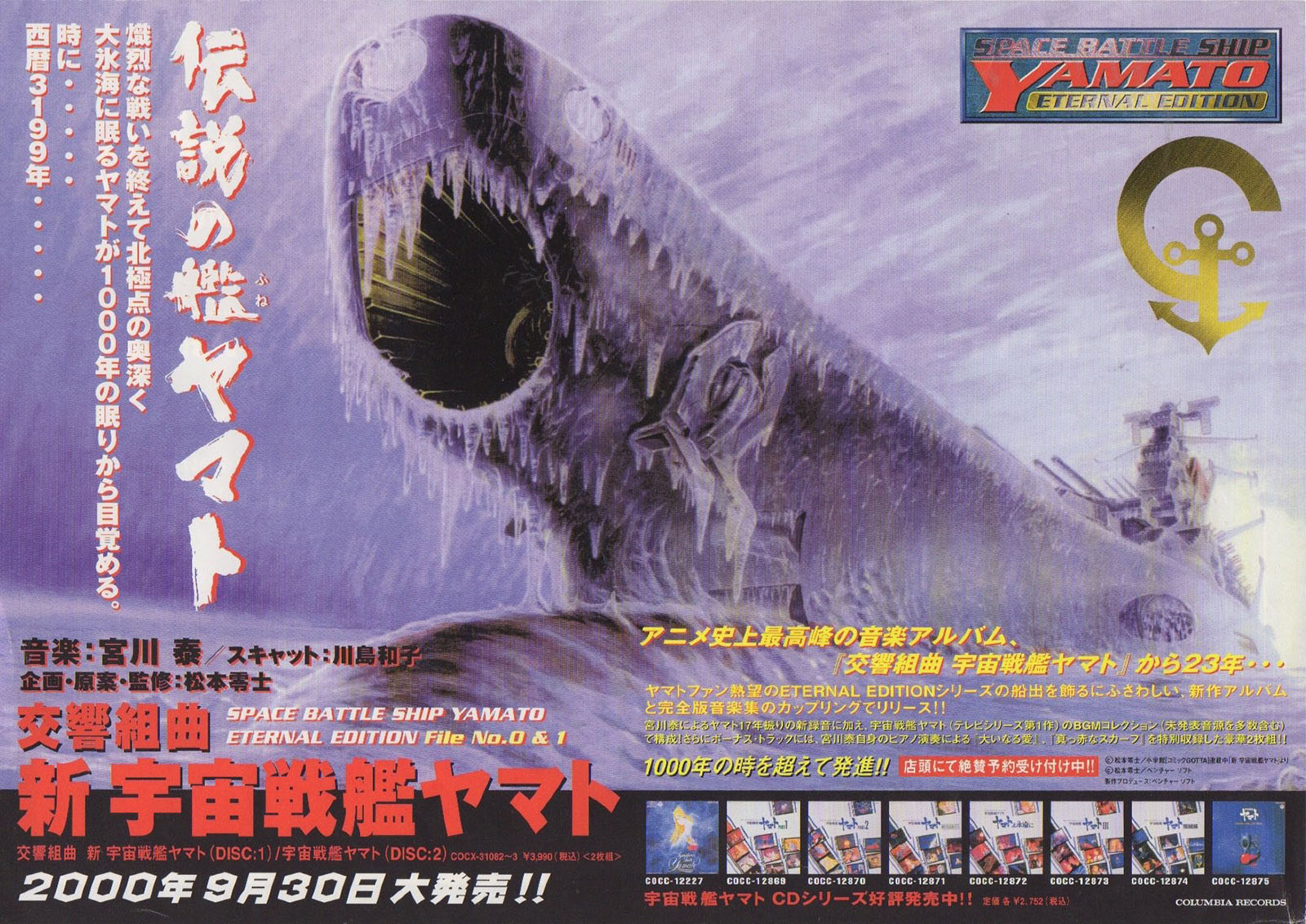
Actually, right now, a project titled New Space Battleship Yamato has quietly gotten underway. Technically, we really should have started by now, and it seems like things are inching forward little by little, but I wonder if we’ll actually begin full-scale production next year. I’ve been told to go ahead and stockpile any musical ideas that come to mind in the meantime. It’s been slow going, though.
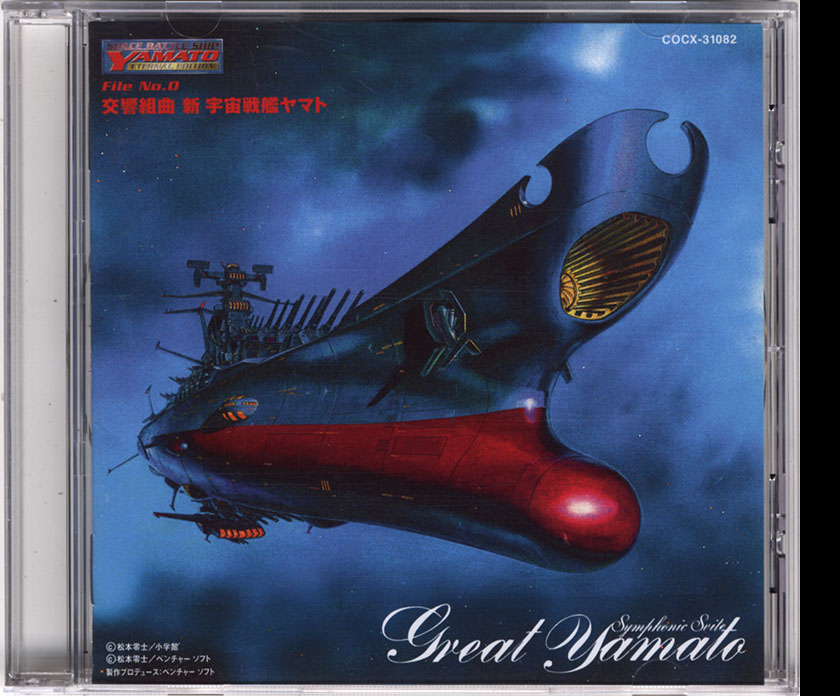
That said, I did manage to finish four tracks over the last year, and they’ve actually already been released. But the story is set in the year 3000 AD, that’s a thousand years in the future, isn’t it? And since it’s set a millennium from now, I can’t even begin to imagine what the music of that era would sound like.
The plan is to bring in a whole new team of staff members for this project. Apparently, the conversation went something like, “Okay, but what about the music?” followed by, “Well, for that, it simply has to be Mr. Miyagawa.” So, Leiji Matsumoto himself called me directly and asked me to take the job. I was absolutely thrilled. I thought, “All right! I’m back in the game!” But…when I really stopped to think about it, across the six or seven Yamato works produced so far, we’ve pretty much exhausted every musical possibility there is. Especially toward the end of the run, it was a real struggle. I couldn’t stray too far from the established Yamato musical style, yet I couldn’t just churn out warmed-over rehashes of what we’d already done.
That must be a difficult balancing act.
It certainly is. And on top of that, I’m doing it all by myself this time around. (Editor’s Note: The producer from the original series is not involved in the current Yamato production.) Still, turning it down would have felt like a personal affront.
You simply have to stick with Yamato until the very end.
If Yamato were taken away from me, I’d have nothing left. But as long as Yamato is there…even now, fans tell me how much they enjoy it. When someone asks me to sign a record and says, “I used to listen to this every day with tears streaming down my face,” it fills me with joy, and I think to myself, “All right! I’m definitely doing the next one, too!”
It was quite groundbreaking at the time to compose music for an anime in the form of a full-scale symphony, wasn’t it?
That was actually the idea of the producer we had back then.
Speaking of Mr. Matsumoto, I understand he was recently commissioned to create a music video for Daft Punk, the French techno duo. He was specifically chosen by a group from overseas to produce a promo video for the club scene, and he actually went ahead and did it!
At this rate, I wonder if Yamato will ever actually get made.
Well, that project has actually already wrapped up.
But it kept getting delayed, and delayed, and delayed!
I suppose the Yamato series remains a significant presence for you, doesn’t it?
You know, whenever I look at the Yamato records, I think to myself, “Man, I really gave it my all back then.” There are a few tracks where I feel, “This is actually pretty good for me, how on Earth did I come up with something like this?” Though, of course, there are also heaps of tracks where I just think, “Oh, look, I wrote the exact same thing again.” (Laughs)
[Translator’s note: the New Yamato project discussed here was to be an anime version of Leiji Matsumoto’s Great Yamato manga. In advance of this, Hiroshi Miyagawa was engaged to write “mood music” for the story. It was titled Symphonic Suite Great Yamato, and released on Volume 0 of the Yamato Eternal Edition CD series in 2000. The anime version did not materialize. Read all about Great Yamato here.]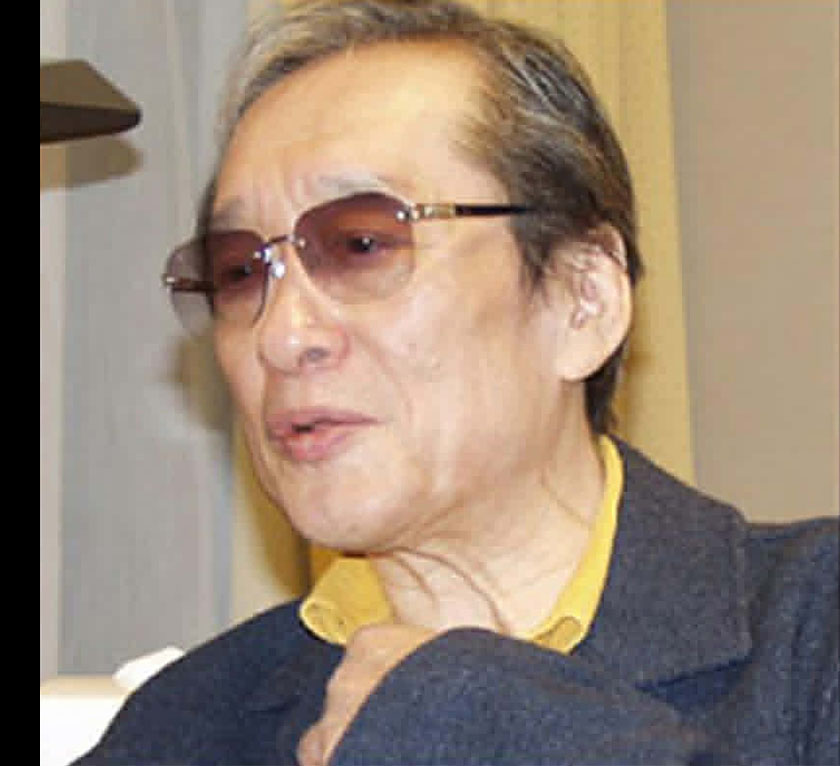
12. Hiroshi Miyagawa’s Top 5 Musical Favorites…?
Do you have a personal “Top 3” list of your own compositions that you’d recommend?
Right now, I’m absolutely in love with the song Wakai tte Subarashii (It’s Wonderful to Be Young). You know, there’s a show on NHK that airs on Tuesdays called Kayō Concert (Popular Song Concert), and it’s been running for ages. For a show dedicated to traditional Japanese pop songs, it possesses an exceptionally refined musical sensibility. It’s really quite interesting.
Anyway, not long ago, they solicited requests from viewers for songs to feature in an “encore broadcast”, and the overwhelming favorite, by a massive margin, was Wakai tte Subarashii (originally performed by Michiru Maki in 1965). Mind you, this is a show dedicated to traditional songs, whereas Wakai tte Subarashii leans much more toward the “pop” genre. They even had a young singer named Asami Hayashi perform it. When you watch the video, she sings it incredibly well, it’s absolutely spot-on. It was so well-received that, apparently, the episode’s viewership ratings actually hit 20 percent. That’s just how much energy and excitement the show generated.
When I heard they were doing an encore broadcast of it, and I did listen to it, I was struck by the fact that, for a program primarily focused on enka music, this particular song ended up being the undisputed number one choice for an encore performance. It made me realize just how deeply the song resonates with the show’s core audience, the middle-aged and elderly fans of traditional pop. The lyrics are gentle and kind; the title itself, “It’s Wonderful to Be Young”, is so direct and straightforward. And ultimately, the message is simply about embracing a youthful spirit, no matter your age.
What other songs are among your favorites?
As for the others…well, I like Koi no Vacance because it was the first one I ever wrote. I also like the Yamato theme. It still sounds great to me whenever I hear it today. And then, I really love Aitakute Aitakute (I Miss You So Much, Mari Sono, 1965). I like Una Sera di Tokyo as well, but that song is, essentially, a textbook example of a formulaic composition, isn’t it? Koi no Vacance falls into that category, too. They both follow the AABA form. On a more sophisticated note, I personally feel that Ai no Finale (Love’s Finale, The Peanuts, 1968) is an absolutely wonderful piece. Yeah.
What about Gin-iro no Michi (The Silver Road, The Peanuts, 1966)?
Hmm…I believe that came out a little while after folk music had started gaining popularity. I’ve forgotten the exact details, but I collaborated with a writer named Shigeru Tsukada to create it for a monthly program. I think it was on NHK or something similar. It’s a folk song, and since you can’t really compose folk music on a piano, I wrote it on the guitar. I could play the guitar a little bit, you see. The thing is, I could only play in A minor, so I was strictly limited to that key. Anything else was too difficult for me. So, (miming the act of playing the guitar) I went, ” Bunchaka-bunchaka…Tooi, tooi…” and thought, “Oh, hey, this actually seems like it’s going to work!” (Laughs) You could never compose something that way if you were working on a piano.
(Laughs) That happens a lot, doesn’t it? Everyone does it. When you hit a creative wall, you might pick up a shamisen or something just to shake things up! (Laughs)
That’s probably true. When I’m at the piano, I inevitably find myself focusing on chords. I tend to prioritize using harmonies to make the melody sound beautiful rather than focusing on the rhythm. Consequently, I get a bit ambitious and start thinking, “I need to use some really sophisticated chords here.” But on the guitar, since, as I mentioned, I can only play basic three-chord progressions, all I really have to work with is that “bunchaka-bunchaka” strumming pattern. Yet, as I was playing it, that melody, “Tooi, tooi…“, just naturally emerged on its own.
So, it’s a song that could only have been created because you were playing the guitar.
Exactly, it’s the only one of its kind. I’ve never written anything else like it. And the best part was, it came together completely effortlessly. Well, that really is a great song, isn’t it?
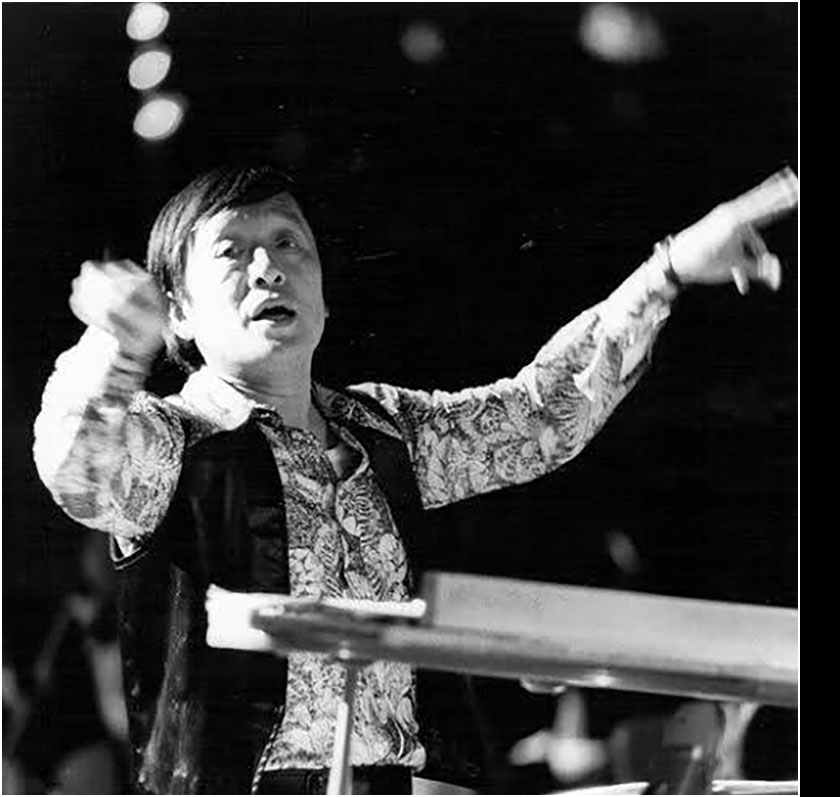
13. Two Great Rivals!?
Hachidai Nakamura vs. Taku Izumi
Speaking of which, Hachidai Nakamura’s song Ashita ga Arusa (Tomorrow Will Come) saw a revival recently, didn’t it? Back in those days, I remember thinking, “Oh, I’d really like to write a song like that myself.” And as it turned out, I happened to be working on one just like it at the time. It wasn’t an exact copy, and the melody was completely different, but the spirit behind it was exactly the same.
When I performed it on a popular TV show, it just took off, and suddenly everyone was singing it. It got to the point where, even at my own concerts, that song would end up being the finale. I suppose that’s the appeal, songs that everyone can happily hum along to and sing together; bright, cheerful songs. With enka music, even if you call it “cheerful,” it’s a slightly different kind of cheerfulness. The kind of Japanese-style pop songs I write aren’t particularly difficult or complicated, either.
It seems like a lot of composers wrote songs in that vein. Taku Izumi, for instance…
Taku Izumi was actually a major rival of mine. Well, speaking of rivals, the classic rivalry was really between Hachidai Nakamura and Taku Izumi. A few years back, Ei Rokusuke and I put on a show at Suntory Hall where we selected ten songs from each of those two masters and offered up commentaries on them, mostly just to get a few laughs from the audience.
Oh, that sounds like fun! (Laughs)
When I did the research for that show, I realized something: when you think of Hachidai Nakamura, the titles that immediately come to mind are Ue o Muite Arukō (Let’s Walk Looking Up), Kuroi Hanabira (Black Petals), Konnichiwa Akachan (Hello Baby), Sekai no Kuni kara Konnichiwa (Hello from the Nations of the World), and Tōku e Ikitai (I Want to Go Far Away). You can easily list six or seven hits, but it’s actually quite difficult to come up with a full “Top 10” list right off the top of your head.
With Taku Izumi, on the other hand…well, ten songs aren’t nearly enough to contain his body of work! In that sense, Hachidai Nakamura was a graduate of a prestigious music conservatory, a true intellectual who had a solid background in jazz. Taku Izumi, however, was a completely different story. He was a man who had struggled and toiled through all sorts of manual labor. He even worked as a dump truck driver at one point, to get where he was.
You could say Nakamura was “slick” or “smart,” while Izumi was “sweaty” and “gritty.” And his music reflects that, too. It has a certain down-to-earth quality to it. Ultimately, I think that’s exactly what makes it so great. Despite his somewhat rough-and-tumble image, he performed in a great many musicals, pieces like Miagete Goran Yoru no Hoshi wo (Look Up at the Stars at Night). You know, even with that particular song…initially, I didn’t think much of it myself. (Laughs) But lately, when I hear it, I find it’s actually quite good. Maybe it’s just because I’ve gotten older, but I’ve really come to feel, “Yeah, that’s a great song.” (Laughs)
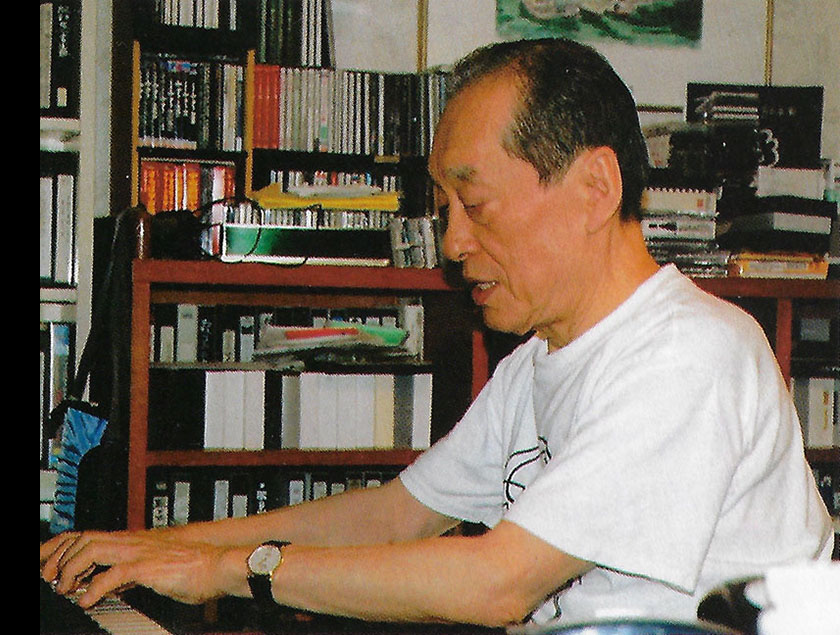
14. The Appeal of Yuki Koyanagi
I suppose it’s my own fault for not listening to much music by young artists…but unless something is truly exceptional, I rarely find myself thinking, “Ah, this is good.” For instance, a song might start, and I’ll think, “That’s a cute melody…but the singing is terrible.” At that point, I’m unlikely to keep listening. Or sometimes the singing is technically excellent, but I find the song itself boring. I suppose I shouldn’t approach it with that kind of mindset. I really ought to try to immerse myself in the excitement and enthusiasm that young people feel, to let go of the minor details and simply listen with the attitude: “This is the music of today’s youth.”
No, there’s no need to force yourself to do that.
But when I’m listening alone, I inevitably end up viewing it through that critical lens. However, do you remember when Yuki Koyanagi sang Kimigayo (the Japanese National Anthem) in her own unique style? (November 3, 2000, Opening Ceremony of the All-Stars 2000 Japan-U.S. Baseball Series). I was truly moved by that performance. I thought to myself, “Wow, someone like this has finally emerged!”
I might get scolded for saying this, but I felt right then and there that this version would make Kimigayo a song for the whole world. It is such a revered anthem, after all. There’s a prevailing sentiment that one must never treat it as a joke, sing parody lyrics, or act frivolously with it. It’s a piece of music that demands that level of solemnity.
And it’s not just in Japan that it is treated with such gravity. I truly believe it’s a song the entire world can take pride in, a magnificent composition unlike any found in any other nation. It wasn’t just her sheer audacity in daring to sing it in such an unconventional way that impressed me. It was the fact that it actually sounded good. When it’s performed in the traditional gagaku style, the public image of the song tends to become rigid and fixed. Consequently, the various musical elements inherent in the composition had remained dormant and unexplored for all this time.
Those musical elements had essentially been “sealed away.”
But she unsealed them. She let them burst forth in a powerful, gospel-style crescendo. I was truly moved.
So, you clearly hold Yuki Koyanagi in high regard as a vocalist.
That’s right. I actually serve as a judge for the “Yusen Taisho” awards. (Editor’s Note: Yuki Koyanagi won the Grand Prize at the 2000 Japan Yusen Taisho.) I just attended a planning meeting for this year’s ceremony two or three days ago, and…well, almost all of the songs were by young artists. From top to bottom, every single one. Apparently, when you compare the numbers to enka songs, the ratio is something like eight to one. So, while there are around 100 pop songs in the running, there are only about 11 or 12 enka songs. That’s just how vast the disparity is.
Most of the songs by young artists tend to sound quite similar. They’re cute and fresh, and they work well as pure entertainment, but on the enka side, I get the sense that the genre just can’t seem to break free from its old traditions. There are so many songs about a woman getting her heart broken, drinking alcohol, and getting completely drunk. But a song about a woman sitting alone, drinking in lonely sorrow after a breakup, that kind of theme just doesn’t resonate with young people today.
After all, it’s not exactly unusual for women to drink alcohol these days.
Exactly. So, while those themes don’t really fit the current social landscape, that “flavor”, that specific atmosphere, still lingers in the music. Furthermore, there are issues with the singers’ vocal techniques, specifically how they apply vibrato, and the lyrics leave something to be desired as well.
Speaking of lyrics, Tetsuro Hoshino, a true legend in the industry, recently wrote some incredibly fresh lyrics. The vocal group Bonnie Jacks is going to sing it, I’ve composed the music, and we’re scheduled to record it soon. It’s truly something special. The lyrics Hoshino-san wrote aren’t typical enka fare at all. They’re actually quite whimsical. The title is Santa Claus Who Caught a Cold. That doesn’t sound like an enka song, does it? That’s why I thought to myself: “Hoshino-san really is an incredible artist to be able to write lyrics like that.” I personally feel I’ve composed a really good piece of music, too, though whether or not it turns out to be a hit…well, who knows?
I’m just so thrilled that a great veteran like Tetsuro Hoshino would allow me the privilege of composing music for his work. That’s why I really want this to be a hit. I want to keep composing as much as I can and keep getting opportunities to work on projects like this.
He seems to be in excellent health, doesn’t he?
Oh, actually…I’m the one who feels energized thanks to him!
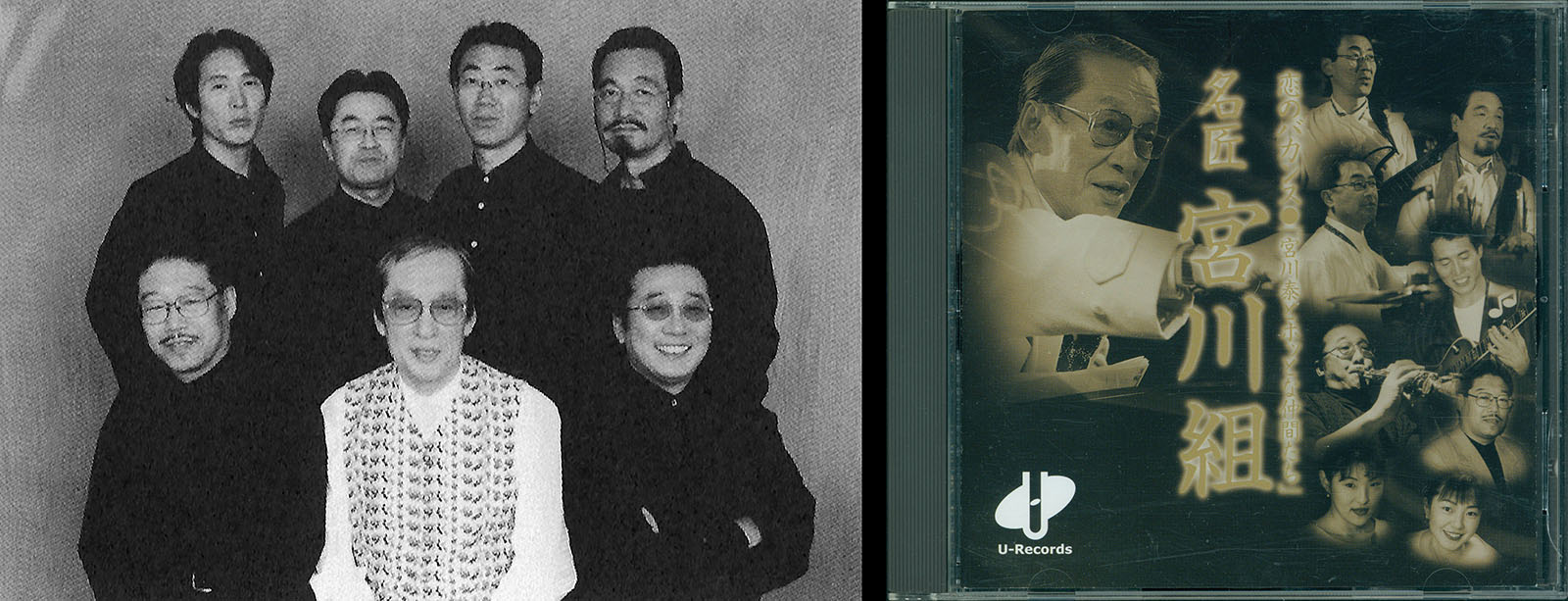
“Master Craftsman Miyagawa-gumi.”
Front row from left: Hajime Kamishiba (piano), Hiroshi Miyagawa (master craftsman), Makoto Hirahara (saxophone).
Back row from left: Kiyoshi Hagiya (guitar), Yasushi Ichihara (drums), Masaaki Ito (bass), and Miho Ishiyama (percussion).
15. The Magician of Sound; Musical Collaborations with His Son, Akira Miyagawa
You’re still active with the renowned “Miyagawa-gumi” ensemble, aren’t you? You perform live quite often.
Yes, it’s a gathering of “samurai,” after all, so it’s truly an incredible group.
How often do you hold these live performances?
We used to do them a bit more frequently, but the schedule slowed down a little last year and the year before that. So we’ve all been putting our heads together to figure things out and keep it going. Since we have a show once a month in Tokyo, that adds up to twelve performances a year.
That sounds like a very busy schedule.
Well, actually, my own personal workload has dropped off significantly. Also, I recently underwent eye surgery, so from now on, I really need to be careful and take better care of my eyes. I can’t really be writing out intricate musical scores anymore. For the time being, at least through the end of this year, I plan to take it easy. I’m thinking I’ll look into starting some new projects come next year.
Is this “new project” still a secret?
It’s not a secret! I’m just wondering if any new projects will actually come my way! (Laughs)
It’s not just your younger brother. Your son Akira is also a musician, isn’t he? Do you ever have musical interactions or collaborations as father and son?
Yes. Akira, once arranged and conducted an entire concert program for the Osaka Philharmonic Orchestra all by himself. That was several years ago. It was very well-received at the time. The audience absolutely loved it. On stage, I said to them, “Oh, thank you all so much for enjoying this so thoroughly! It looks like we’ll simply have to do this again next autumn!” and the audience erupted in thunderous applause. So we held another concert that autumn, and ever since then, we’ve been doing two concerts a year (the “Osaka Philharmonic Pops Concerts”).
Before we knew it, the shows started drawing huge crowds, and now the tickets sell out every single time. There are no guest singers, mind you, it’s just the orchestra. Usually, a pops concert would feature vocalists. But in this case, it’s entirely the Osaka Philharmonic. Akira handles all the arrangements, acts as the host, and conducts the orchestra. It’s a very understated, no-frills approach, yet people still flock to see it.
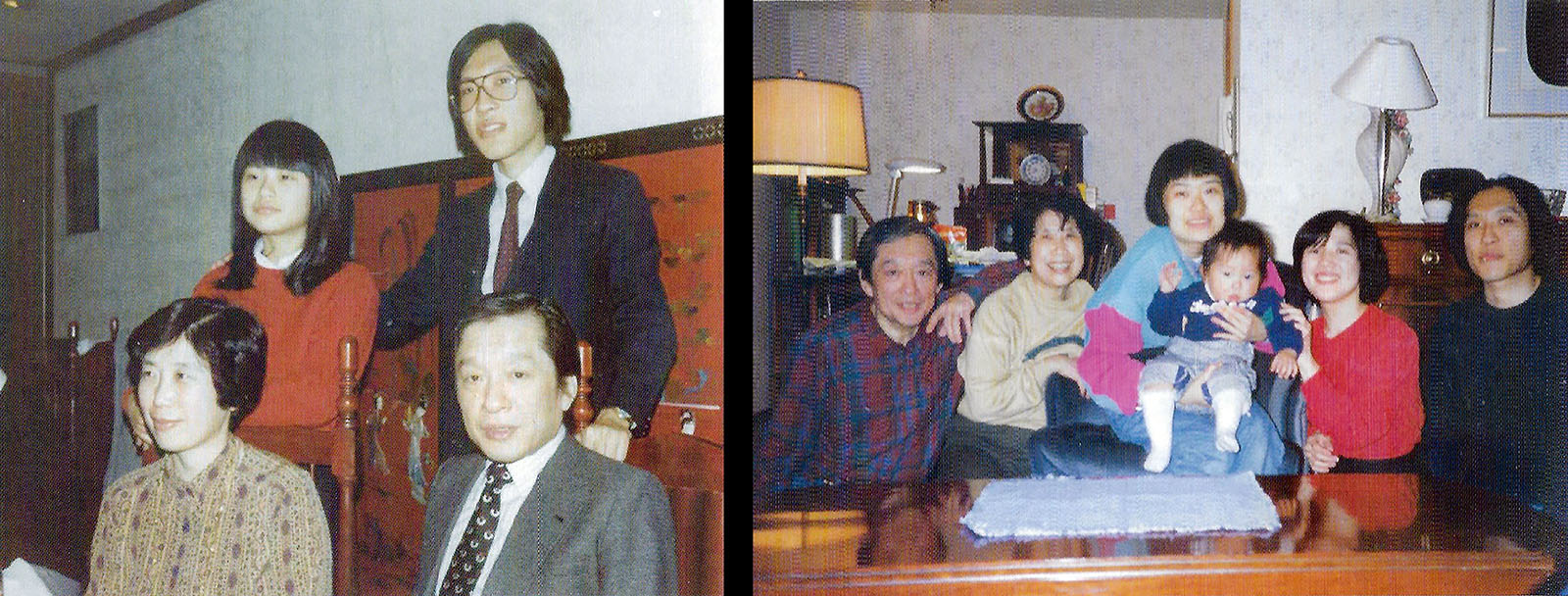
LEFT: The Miyagawa family gathered for the birthday of my wife’s father (Hideo Takura). In the back, on the left is my eldest daughter Naoko. On the right is my eldest son Akira (1981).
RIGHT: I took this photo at the request of my wife’s friend in Italy, who asked me to send a family photo. The baby being held by Akira, his wife, and their eldest daughter Nahoko, is my granddaughter Chiko. Taken at their home in Komazawa, 1991.
Just recently, on October 7, 2001, he announced, “This time, I’m going to perform some of my father’s songs,” and actually featured them in his set, so I went to go hear him play. He did Koi no Vacance, Una Sera di Tokyo, and…what was the third one again? I really shouldn’t be forgetting my own songs! (Laughs) (Editor’s Note: The third song was Wakai tte Subarashii.)
He performed them using his own signature arrangements, very much in his own style. As I listened, I found myself thinking: “Hmm, I certainly wouldn’t have written it this way. So this is the kind of world he envisions? I wonder how he arrived at this particular soundscape?” It revealed a creative world, a sensibility, that I myself had never explored before. I actually think that’s a good thing, in a way. You see, my generation tends to stick strictly to established formulas. We studied books, like those by Henry Mancini, to learn exactly what “pop music” is supposed to be. Consequently, we don’t really possess much in the way of truly unique, individualistic flair, though we certainly have our own little quirks and mannerisms.
Speaking of which, people often refer to you as “Japan’s Henry Mancini,” don’t they? (Laughs)
(Laughs) Well, I really do love Henry Mancini. Back when his book on musical arrangement was first published, a friend of mine told me, “You really ought to study this.” That was back when I was living in Osaka, so it feels like ages ago now.
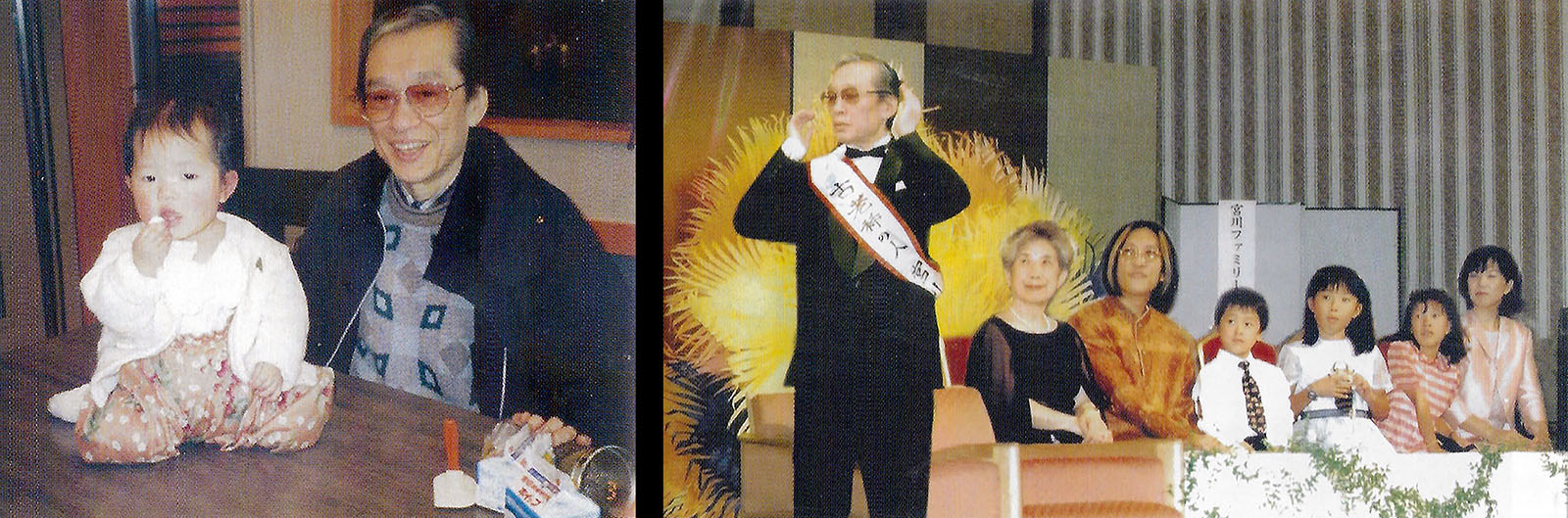
LEFT: My granddaughter Chiko’s first birthday. I was starting to feel like a proper grandfather.
RIGHT: 500 guests gathered to celebrate my 70th birthday at the “70th Birthday Celebration.” My grandchildren in the middle are (from left to right) Daisuke, Chiko, and Yasutoshi (Keio Plaza Hotel, September 2001).
How do you like to spend your time when you’re off work?
I’ve actually lost all my hobbies lately. I don’t do the things I used to, like painting or building plastic models anymore. Even the thought of picking up a paintbrush just feels like too much of a chore these days.
Do you do anything to stay healthy?
For years, up until about ten years ago, I used to go skiing every single winter. But I stopped going after my health took a turn for the worse. I’m hoping to make it out at least once this year, though. Aside from that, I just drink, and occasionally, if I happen to have some cash on hand, I’ll head to a club in Ginza to shoot the breeze and talk nonsense. I just drink until I reach that perfect, pleasant buzz, that moment where I think, “Ah, this is the perfect time to head home.” And then, I leave.
Now that is the way an adult should enjoy himself!
Well, you know, basically, I just can’t chase after girls anymore. Back in the day, I used to run around with women. But lately it’s just a no-go.
(Laughs)
Oh, I really went wild back then. I’ve done so much wrong that I can barely look my wife in the eye anymore. Even though she knows everything I did, all the bad things, she never gets angry. Instead, she just gets crestfallen. She’ll go quiet and look sad for about a week. But once that week is up, she’ll say, “All right, that’s over!” and bounce right back to her cheerful self. She really is a wonderful wife.
You two sound like a lovely couple! (Laughs) Thank you so much for your time today, it’s been a pleasure.
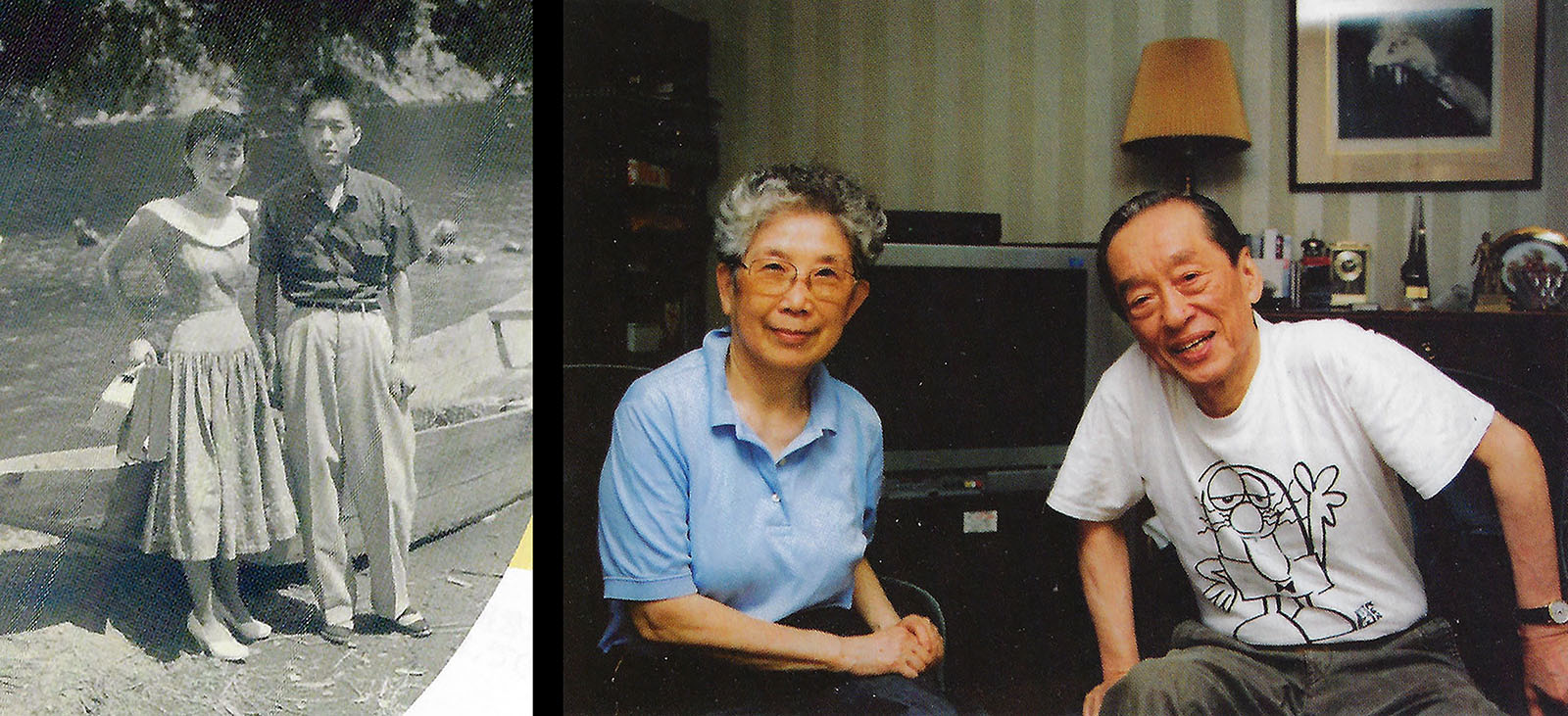
LEFT: Hiroshi Miyagawa and Reiko Takura on a date by the Uji River in Kyoto, just before their wedding (1956).
RIGHT: Approximately 50 years later, Hiroshi Miyagawa and his wife Reiko relax at home (July 2005).
Hiroshi Miyagawa states that what a composer needs most is “inspiration, good lyrics, and a deep love for song.” Now past his 70th birthday, he remains an active force in the industry. Though his tone was often jocular, his lively conversation radiated an unshakable confidence in his own work and career. With the launch of a new Yamato project slated for 2002, we look forward to seeing this titan of the music world continue to achieve even greater success.
Special thanks to friend-of-the-website Minoru Itgaki
RELATED LINKS
Cosmo DNA’s tribute to Miyagawa (with autobiography excerpt)