
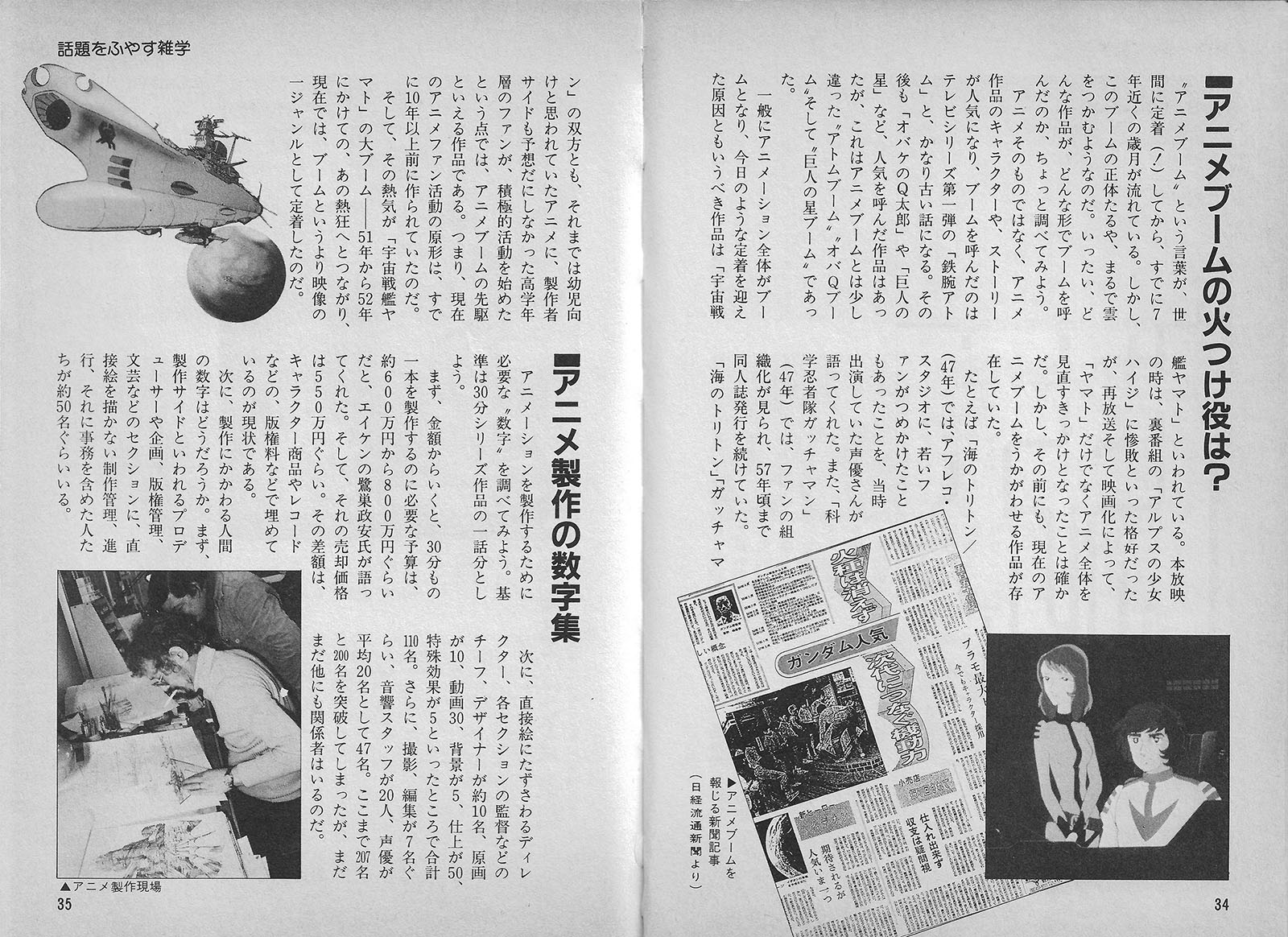
Who sparked the anime boom?
Nearly 7 years have passed since the term “anime boom” became commonplace. However, the true nature of this boom remains shrouded in mystery. Let’s take a closer look at what kind of works sparked this boom and in what form.
It wasn’t a single anime itself, but the characters and storylines of the anime works that became popular and sparked a boom, which began with the first TV series, Astro Boy, quite a long time ago. After that, there were other popular works such as Obake no Q-Taro and Star of the Giants, which sparked an Astro Boy boom, a Q-taro boom, and a Star of the Giants boom. However, this was a little different from the anime boom.
Generally speaking, the work that is considered the cause of the boom in anime as a whole and its establishment as it is today, is Space Battleship Yamato. When it was first broadcast, it was soundly defeated by the competing program, Heidi Girl of the Alps, but through reruns and a movie adaptation, it certainly served as a catalyst for reevaluating not only Yamato, but anime in general.
However, even before that, there were works that foreshadowed the current anime boom. For example, for Triton of the Sea (1973), young fans gathered at the studio to share their thoughts with the voice actors. Also, fans organized around Science Ninja Team Gatchaman and continued publishing doujinshis until around 1975.
Both Triton of the Sea and Gatchaman can be considered pioneers of the anime boom, since older elementary school-aged fans, who the creators never anticipated, actively engaged with anime that had previously been thought of as being for young children. In other words, the prototype of current anime fan activities was already created more than ten years ago.
That enthusiasm led to the massive boom for Space Battleship Yamato – the frenzy that raged from 1975 to 1980 – and now it has become established not just as a trend, but as a distinct genre of film.
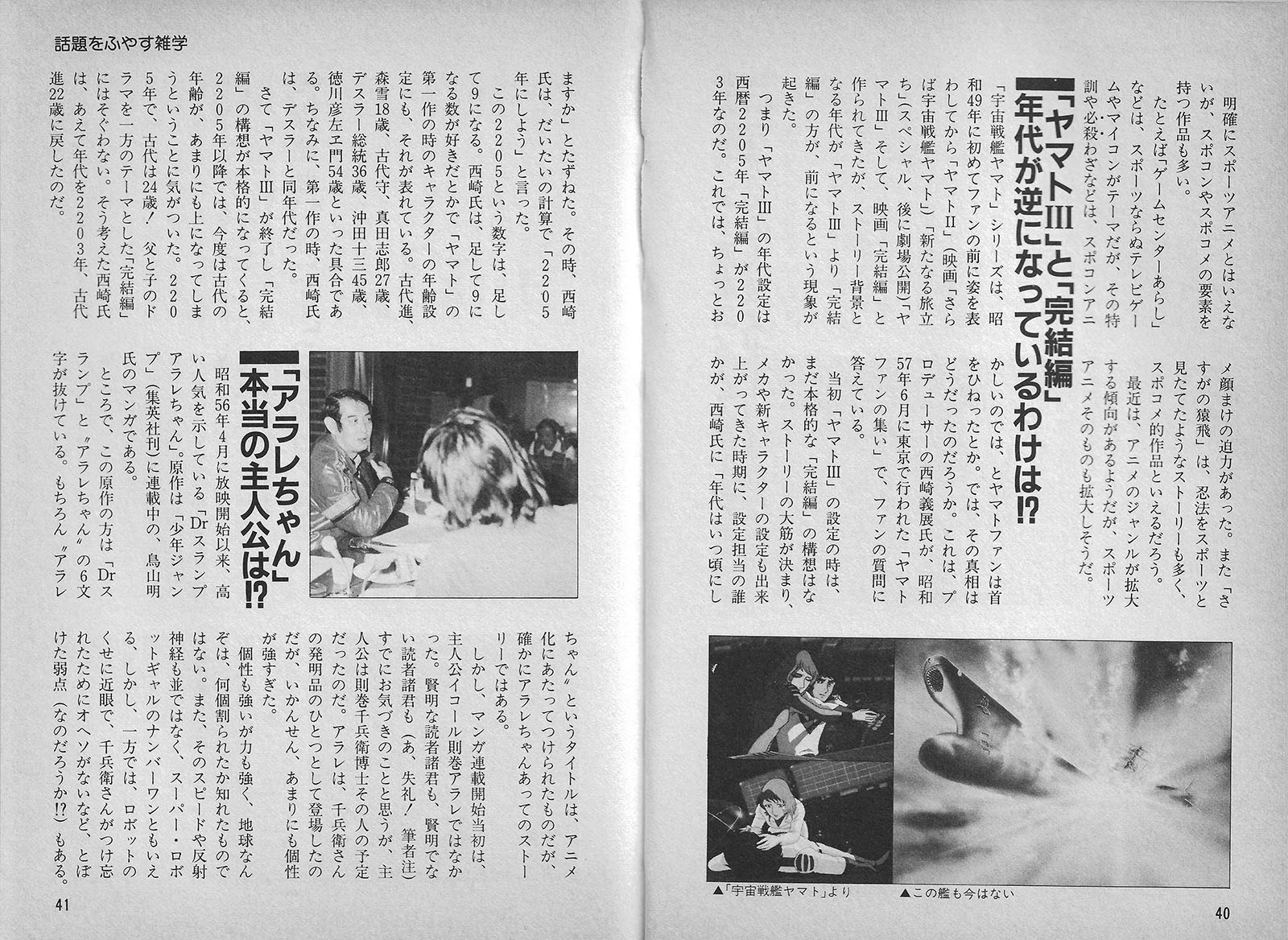
Why are the years reversed in Yamato III and The Final Chapter?
The Yamato series first appeared before fans in 1974, and has since produced Farewell to Yamato, Yamato 2, The New Voyage, Be Forever, Yamato III and The Final Chapter. However, a phenomenon occurred where the time period in which the story is set in The Final Chapter is earlier than that of Yamato III.
In other words, the setting for Yamato III is 2205, while The Final Chapter is set in 2203. This left Yamato fans scratching their heads, wondering if something was a mess. What was the truth behind this? It was revealed when Producer Yoshinobu Nishizaki answered a question from a fan at the Yamato fan gathering held in Tokyo in June 1982.
Initially, when Yamato III was being conceived, there was no plan for a full-fledged Final Chapter. Once the general outline of the story was decided, and the designs were completed for mecha and new characters, someone in charge of the design asked Mr. Nishizaki, “What time period should it be?” At that time, based on rough calculation, he said, “Let’s make it 2205.”
The number 2205 adds up to nine. Apparently, Mr. Nishizaki likes numbers that add up to nine, and this is reflected in the ages of the characters in the first Yamato series. Susumu Kodai and Yuki Mori are 18 years old. Mamoru Kodai and Shiro Sanada are 27 years old, General Dessler is 36 years old, Juzo Okita is 45 years old, and Hikozeamon Tokugawa is 54 years old. Incidentally, when the first film was made, Nishizaki was the same age as Dessler.
After Yamato III had finished and the concept for The Final Chapter was beginning to take shape, it became clear that if the story was set after 2205, Kodai would be far too old. In 2205, Kodai would be 24 years old! This wouldn’t fit with The Final Chapter, which would have a father/son drama as one of its themes. With this in mind, Nishizaki deliberately set the year back to 2203, when Susumu Kodai was 22 years old.
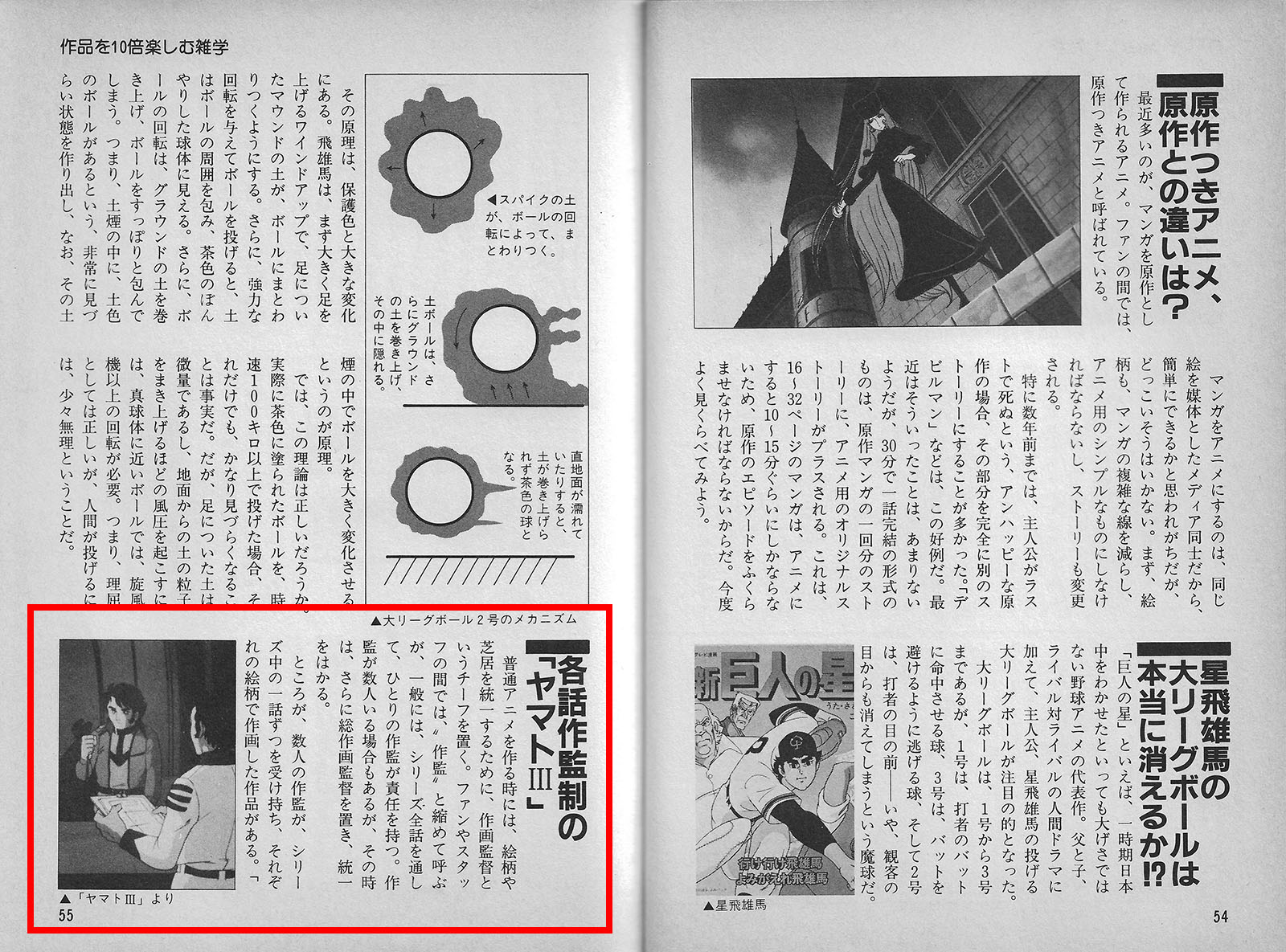
Yamato III had different animation directors for each episode
Normally, when creating an anime, a chief animation director is appointed to ensure consistency in art style and acting. Fans and staff often shorten this to “animation director,” but generally, one animation director is responsible for the entire series. In some cases, there may be several animation directors, in which case a chief animation director is also appointed to ensure consistency.
However, there is a series where several animation directors each handled one episode, creating the animation in their own unique style. That series is Space Battleship Yamato III.
In the fan club magazine, producer Nishizaki explained its purpose. The members included Kenzo Koizumi, who also serves as the chief animation director, and others, such as Takeshi Shirato, Shinya Takahashi, Toyoo Ashida, and Kazuhiko Udagawa. Their roles differed from those of chief animation directors, and animation directors in other works.
In Yamato III, the animation director was responsible for unifying the artwork and directing the scenes in a single episode. The system involved Mr. Koizumi directing the entire series, while each episode’s animation was handled by its respective animation director starting with layout. As a result, the mood of the animation differs slightly from episode to episode, but the advantage of allowing the individuality of each animation director to be fully expressed outweighed the drawbacks.
This was because each member, including Mr. Koizumi, possessed the talent to serve as a chief animation director for feature films or an entire series.
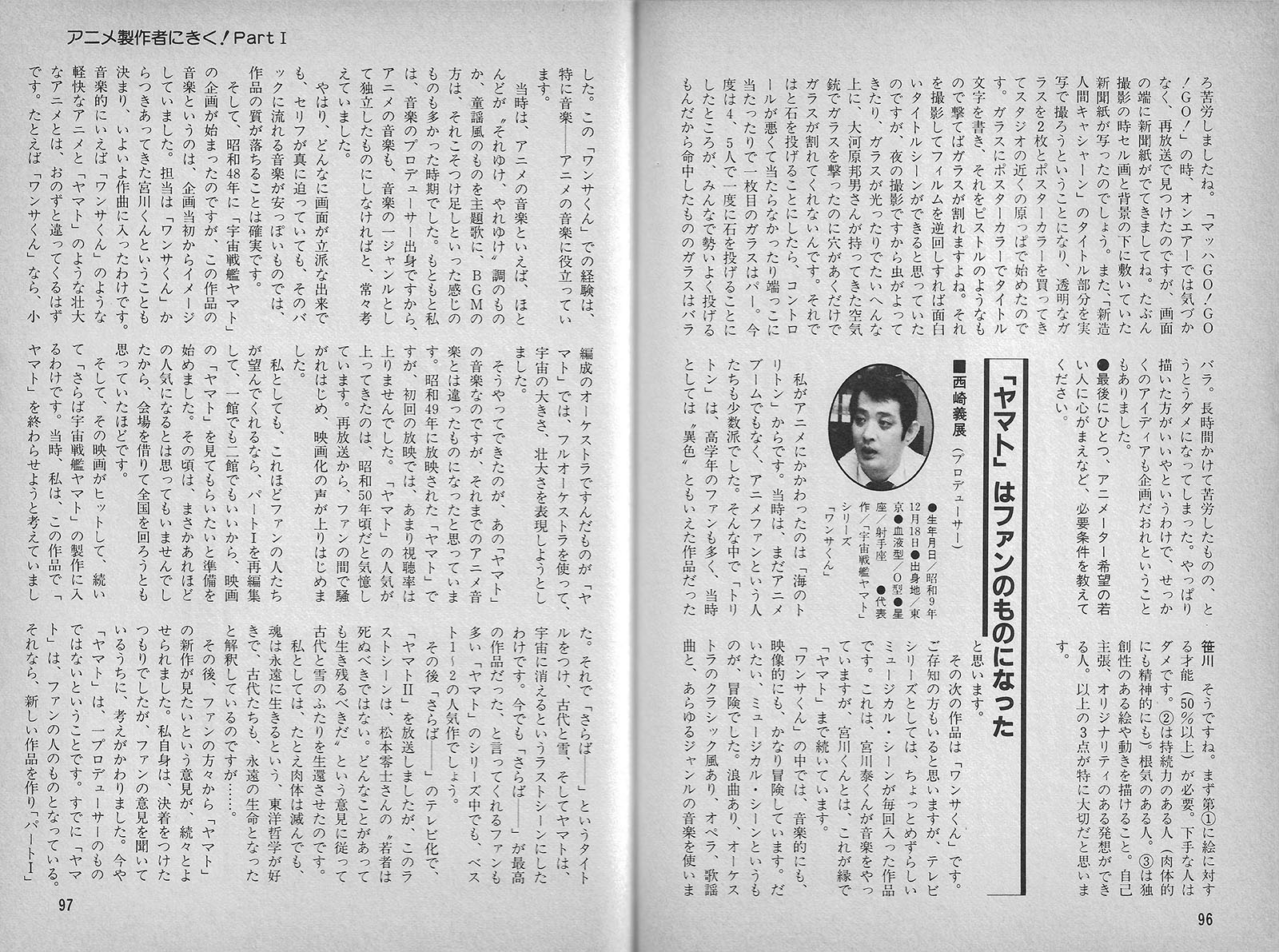
Yamato has become the property of the fans
Producer Yoshinobu Nishazaki
Date of birth: 1934, December 18.
Representative series: Space Battleship Yamato, Wansa-kun
My involvement with anime began with Triton of the Sea. At the time, there wasn’t an anime boom, yet, and anime fans were a minority. In that context, Triton had many fans among older elementary school students, and I think it was a rather unusual work for its time.
My next project Wansa-kun. Some of you may know it, but it was a TV series that was a bit unusual in that it included musical scenes in every episode. Hiroshi Miyagawa was in charge of the music for this, and my collaboration with him lead us to our work on Yamato.
We took quite a few risks in Wansa-kun, both musically and visually. The musical scenes in particular were a real adventure. We used music from all genres: traditional Japanese narrative singing, classical, orchestral pieces, opera, and pop songs. This experience has been especially useful for music, especially in animation.
Back then, anime music was mostly either upbeat nursery rhymes, or simple, childlike songs used as theme songs, with background music often feeling like an afterthought. As someone who originally came from a music producer background, I’ve always believed that anime music should be established as an independent genre of music.
No matter how impressive the visuals or how compelling the dialogue, if the background music is cheap, the overall quality of the work will inevitably suffer.
The planning for Space Battleship Yamato began in 1973, and I had envisioned the music for this work from the very beginning of the project. It was decided that Mr. Miyagawa, who I had worked with on Wansa-kun, would be in charge, and so we finally began composing. Musically speaking, a lighthearted anime Wansa-kun and a grand anime like Yamato are naturally going to be different. For example, Wansa-kun could be done with a small orchestra, but for Yamato, we used a full orchestra to try and express the vastness and grandeur of space. That’s how the music for Yamato was created, and I think it was different from anime music up until then.
Yamato was first broadcast in 1974, but the initial viewership ratings weren’t very high. I remember that Yamato‘s popularity started to rise around 1975. It began to be talked about among fans during reruns, and calls for a movie adaptation started to come in. From my perspective, seeing how much the fans wanted it, I started preparing to re-edit Part 1 and show the movie version in at least one or two theaters. At the time, I never imagined it would become so popular, so I even considered renting venues and touring the country.
Then, after that movie became a hit, we started production on Farewell to Yamato. At the time, I was thinking of ending the series with this film. That’s why I titled it Farewell, and made the final scene one in which Kodai, Yuki, and Yamato disappear into space. Even now, many fans say that it was the best film in the series, and it’s probably one of the top one or two most popular films in the Yamato series.
Later, we aired Yamato 2, the TV adaptation of Farewell. In that final scene, we followed Leji Matsumuto’s opinion that “young people should not die. They should survive, no matter what,” and had Kodai and Yuki return alive.
Personally, I like Eastern philosophy, which holds that even if the body perishes, the soul lives on forever, and I interpret Kodai as having attained eternal life.
After that, we received a steady stream of requests from fans who wanted to see a new Yamato film. I thought I had settled the matter, but after listening to their opinions, my thinking changed. Yamato no longer belonged to just one producer. Yamato already belonged to the fans. So I decided to create a new film to express what I couldn’t fully say in Part 1 and Farewell. That’s how we created The New Voyage, Be Forever, Yamato III, and last year’s Final Chapter.
In The Final Chapter, since it is truly the end of Yamato, I wanted to depict the love between Kodai and Yuki, the end of Yamato, and in a sense a new beginning. Yamato was originally a story about a father figure, Okita, and young people like Kodai. To put an end to this story, just as children eventually surpass their parents, Kodai, and Yuki must also surpass Okita. That’s why we brought Okita back to life and depicted Kodai and Yuki’s marriage – a new beginning.
Furthermore, the battleship Yamato symbolizes a long period of peace by fading away. A world where battleships like Yamato are no longer needed – isn’t that what Yamato itself, which fought so hard, would have wanted? To save Earth, Yamato transformed itself into a ball of energy and sank into the currents of water from Aquarius. If it could speak, I believe it would say, “Don’t wake me again. Let me sleep in peace.”
And so, the Yamato series has truly reached its final scene. Yamato, which I have loved, and which has been supported and loved by fans, has come to an end. Based on the experience I gained from Yamato, I intend to challenge myself with a new work once again.
(Excerpted and reorganized from the Yamato Fan Club official magazine)
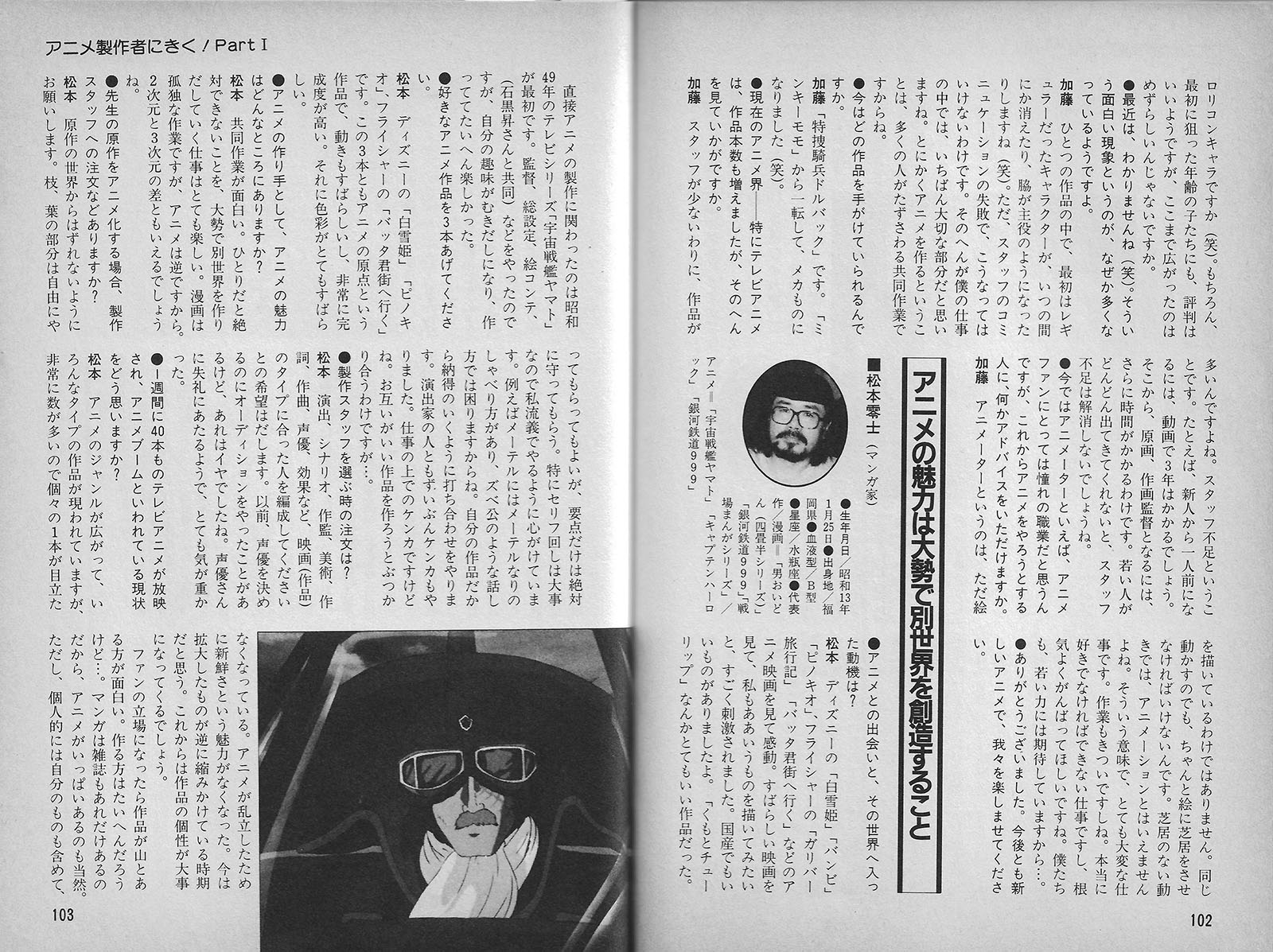
The appeal of anime lies in the creation of a different world by a large group of people
Leiji Matsumuto, manga artist
Date of birth: January 25, 1938
Representative works, manga: Otoko Oidon, Galaxy Express 999
Representative works, anime: Space Battleship Yamato, Captain Harlock, Galaxy Express 999
What was your motive for encountering anime and entering that world?
I was deeply moved by animated films, like Disney’s Snow White, Bambi, and Pinocchio, and Fleischer’s Gulliver’s Travels, and The Grasshopper Goes to Town. Seeing such wonderful films really inspired me to want to draw something like that myself. There were some good Japanese works too. Clouds and Tulips was a really great piece. My first direct involvement in anime production was on the 1974 TV series Space Battleship Yamato. I worked as a director, overall designer, and storyboard artist in collaboration with Noboru Ishiguro, and it was incredibly fun to create, since it allowed my personal interests to shine through.
Please list three of your favorite anime works.
Disney’s Snow White and Pinocchio. Oh, and Fleischer’s The Grasshopper Goes to Town. All three of these are considered the origins of animation, with fantastic movement and a very high level of completion. Plus, the colors are absolutely stunning.
As an anime creator, what do you find appealing about anime?
Collaborative work is fun. It’s really enjoyable to create a different world with a large group of people, something that would be absolutely impossible to do alone. Manga is a solitary process, but anime is the opposite. You could say it’s the difference between two dimensions and three dimensions.
When your original work is adapted into an anime, what requests or suggestions do you have for a production staff?
Please make sure you stay true to the original world of the story. You can do as you like with the branches and leaves. I’m fine with them doing that, but I absolutely want them to stick to the essentials. The delivery of the lines is especially important, so I try to do it in my own style. For example, Maetel has her own way of speaking, and it wouldn’t work if she spoke like a slut. Because it’s my work, I have meetings to make sure I’m satisfied. I’ve had quite a few arguments with directors, too. Arguments about work, of course. We clash because we’re both trying to create a great work.
What are your requirements when selecting a production staff?
I request that the staff be assembled with people who are suited to the type of film work, including director, screenwriter, animation director, art director, lyricist, composer, voice actors, sound effects, etc. I once held auditions to choose voice actors, but I didn’t like that. It felt disrespectful to the voice actors, and it weighed heavily on my mind.
What do you think of the current situation where as many as 40 anime series are broadcast on TV every week, leading to what’s being called an anime boom?
The anime genre has expanded, and many different types of works are appearing, but there are so many of them that individual works are becoming less noticeable. Because there are so many anime, the appeal of freshness has been lost. I think we are now in a period where what has expanded his conversely starting to shrink. From now on, the individuality of each work will become important. From a fan’s perspective, creating the work is more interesting. It’s tough for the creators, though. There are plenty of manga in magazines, and lots of anime, but personally, I’m getting a little tired of my own work. I’d like to keep it going for 5 to 6 years.
I heard that you were working on a theatrical production for the summer of 1985. What kind of production are you planning to create in the future?
I can’t talk about the film yet, since nothing is clear. Personally, the kind of anime I’d like to make is a wild dream, but I’d like to make something that isn’t constrained by time or money. Something fairytale like, depicting a world like The Adventures of Maya the Bee. And also, utterly tasteless gags. I’d like to make something that will make parents everywhere furious.
What are the future trends in the anime industry? What kind of works do you think we’ll see?
My work will likely focus more on events in my personal life. It’s become something like a girl’s manga. Not current manga, but more like older styles. Anime adaptations also tend to follow the trends of the manga world. One direction for future works will likely be one where works with a warm mood are well-received.
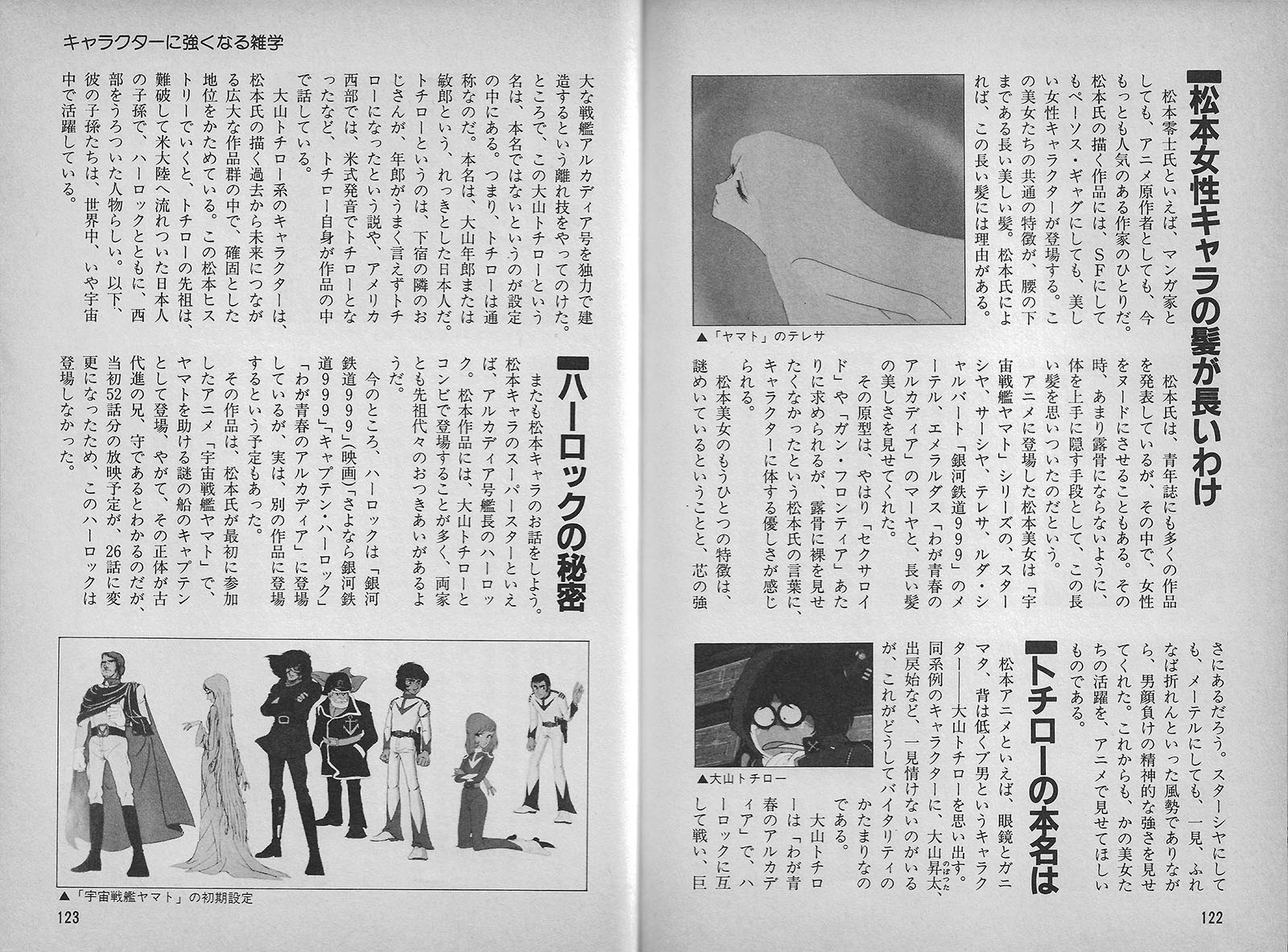
Why Matsumoto’s female characters have long hair
Leiji Matsumoto is one of the most popular manga artists and anime writers today. His works, whether science-fiction, pathos, or comedy, feature beautiful female characters. A common feature of these beauties is their long, beautiful hair below the waist. According to Matsumoto, there’s a reason for this long hair.
He has published many works in youth magazines, and in those works, he sometimes has female nudes. He says that he came up with the idea of long hair as a way to cleverly concealed the body so that it wouldn’t be too explicit.
Matsumoto’s beautiful actresses who have appeared in anime include Starsha, Sasha, Teresa, and Ruda from the Yamato series, Maetel and Emeraldas from Galaxy Express 999, and Maya from My Youth in Arcadia, all showcasing the beauty of their long hair.
The prototype of this can be traced back to works like Sexaroid and Gun Frontier, but Matsumoto’s words that he didn’t want to show explicit nudity reveal a gentleness toward the characters.
Another characteristic of Matsumoto’s beauties is their mysterious nature and inner strength. Both Starsha and Maetel, while appearing fragile and easily broken, display mental strength that rivals that of men. We hope to see more of these beauties in action in anime in the future.
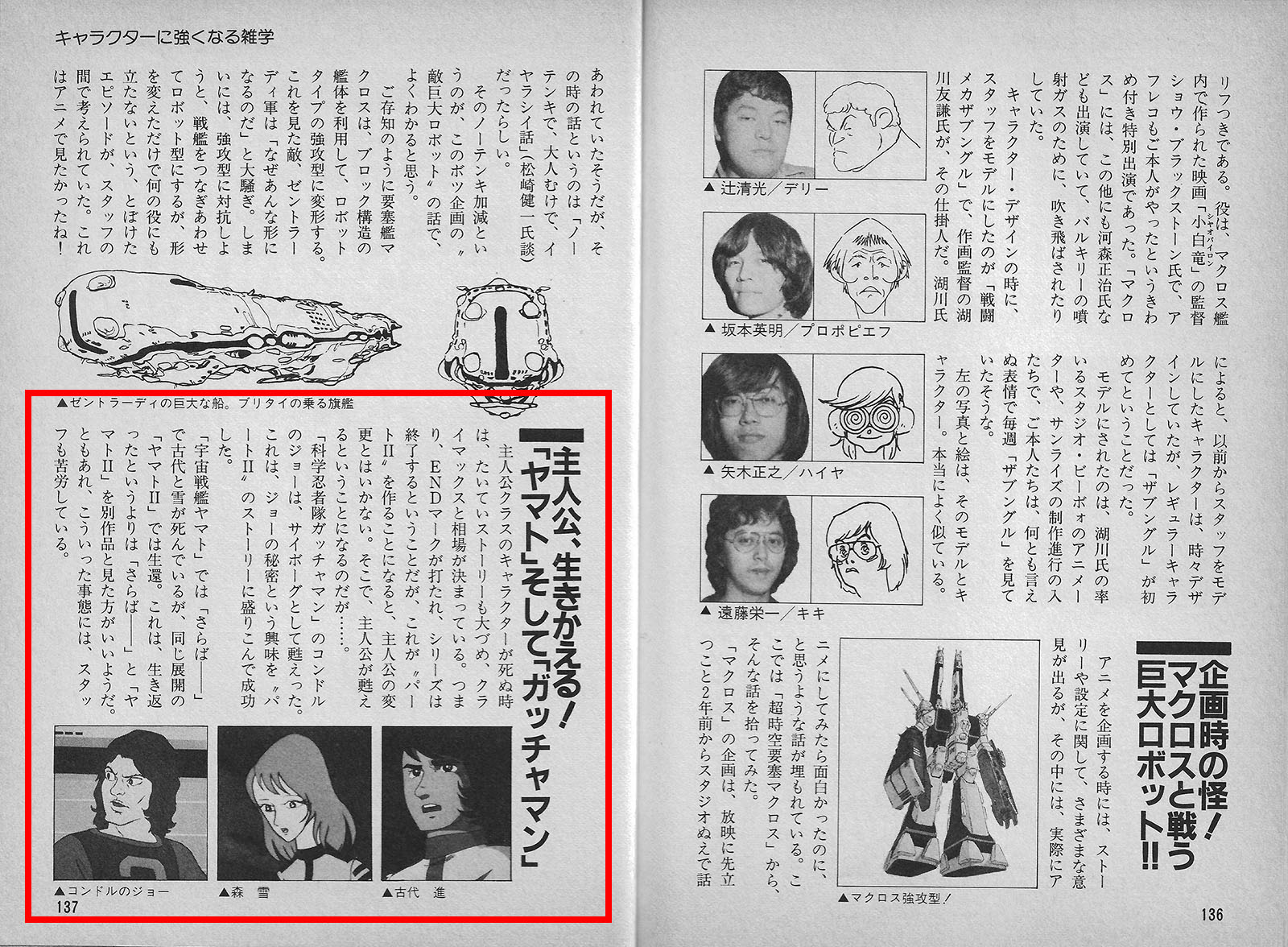
The protagonist comes back to life! Yamato and Gatchaman
When a main character dies, it usually means the story is nearing its climax. In other words, the “end” mark is placed, and the series ends. However, if a Part 2 is to be made, the protagonist cannot be changed. Therefore, the protagonist must be resurrected.
Condor Joe from Science Ninja Team Gatchaman was resurrected as a cyborg. This successfully incorporated the intriguing mystery of Joe’s secret into the story of Part 2.
In Space Battleship Yamato, Kodai and Yuki die in Farewell to Yamato, but they survive in Yamato 2, which follows the same plot. It seems better to view Farewell and Yamato 2 as separate works rather than saying they were brought back to life. In any case, the staff must have had a hard time with this situation.
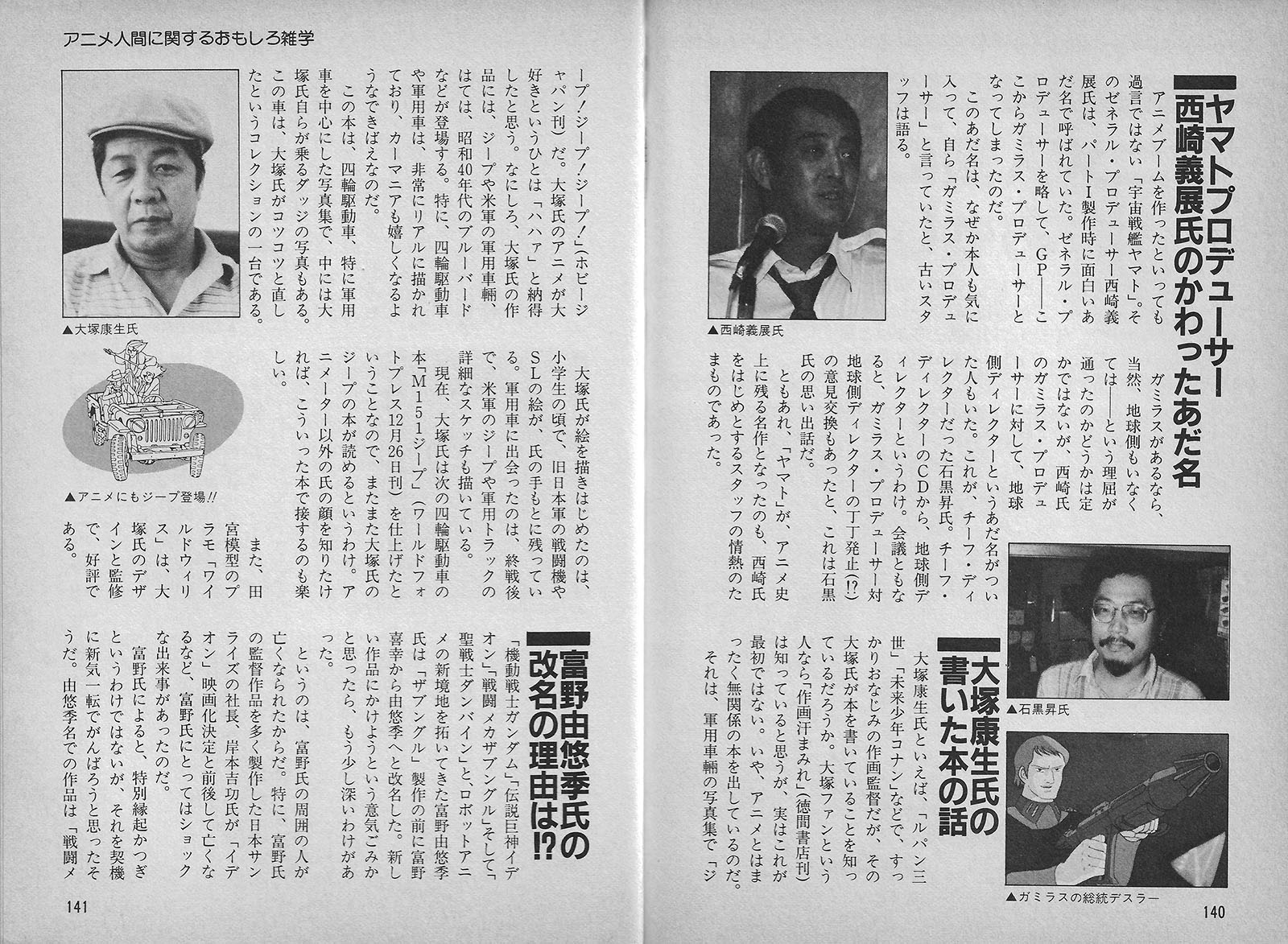
The unusual nickname of Yamato producer Yoshinobu Nishizaki
It is no exaggeration to say that Space Battleship Yamato sparked the anime boom. Its general producer, Yoshinobu Nishizaki, was known by an amusing nickname during the production of Part 1. The title “General Producer” was abbreviated to “GP,” which, through a play on words, evolved into “Gamilas Producer” (referencing the show’s antagonist race, the Gamilans).
Longtime staff members recall that Nishizaki didn’t mind the nickname at all. In fact, he even referred to himself as the “Gamilas Producer.”
It is unclear if the logic was simply that if there was a Gamilas side, there naturally had to be an Earth side, but a counterpart nickname emerged to match Nishizaki’s: “Earth-side Director.” This title was given to Chief Director Noboru Ishiguro. The “CD” in Chief Director was reinterpreted to stand for “Earth-side Director” (Chikyu-ga Director).
Ishiguro later recalled that meetings often featured spirited, heated exchanges of opinion between the “Gamilas Producer” and the “Earth-side Director.” In any case, the fact that Yamato became a masterpiece that left its mark on anime history was a testament to the passion of the staff, led by Nishizaki.
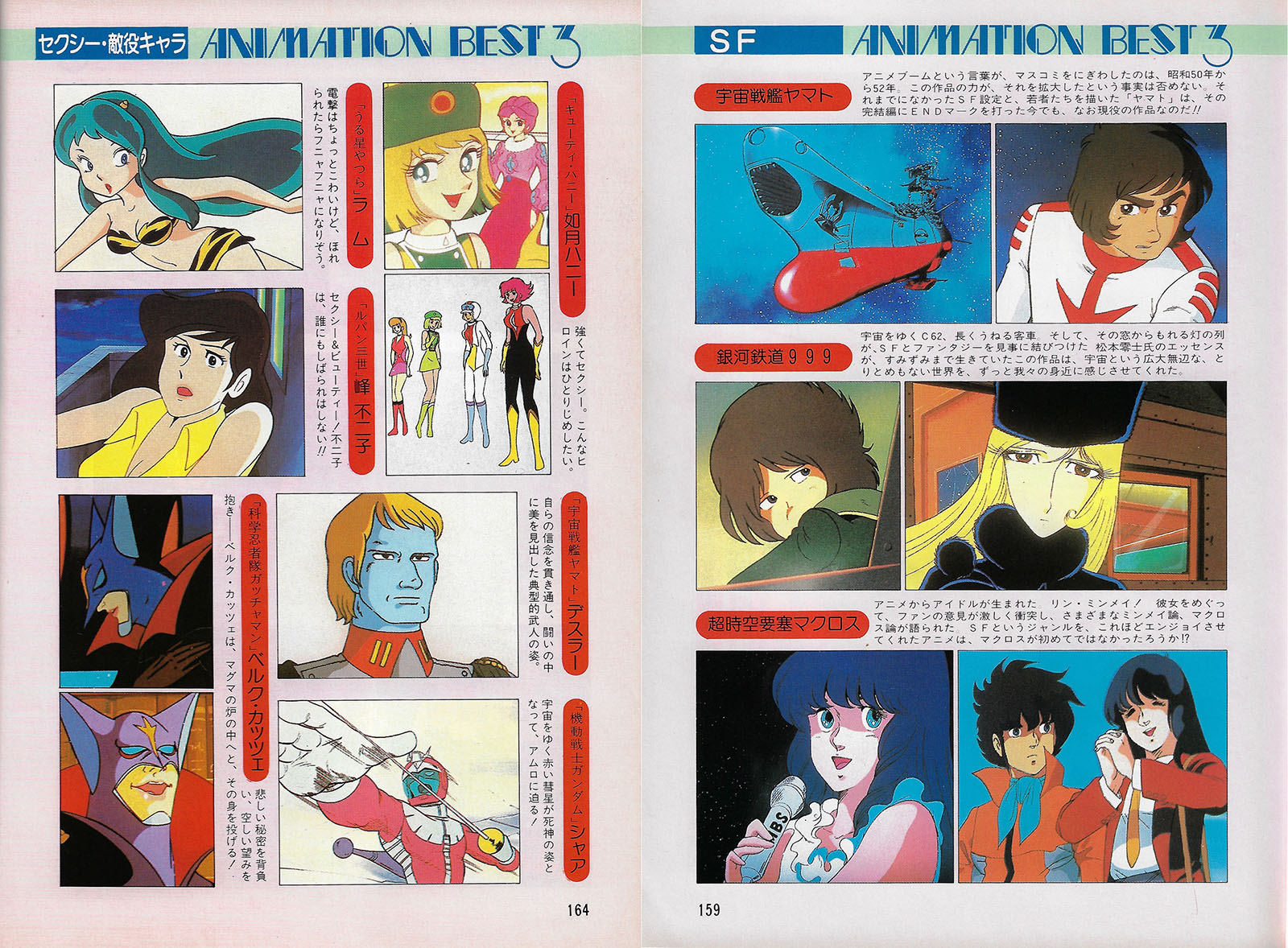
Yamato and Dessler score in the SF and Villain Character polls.
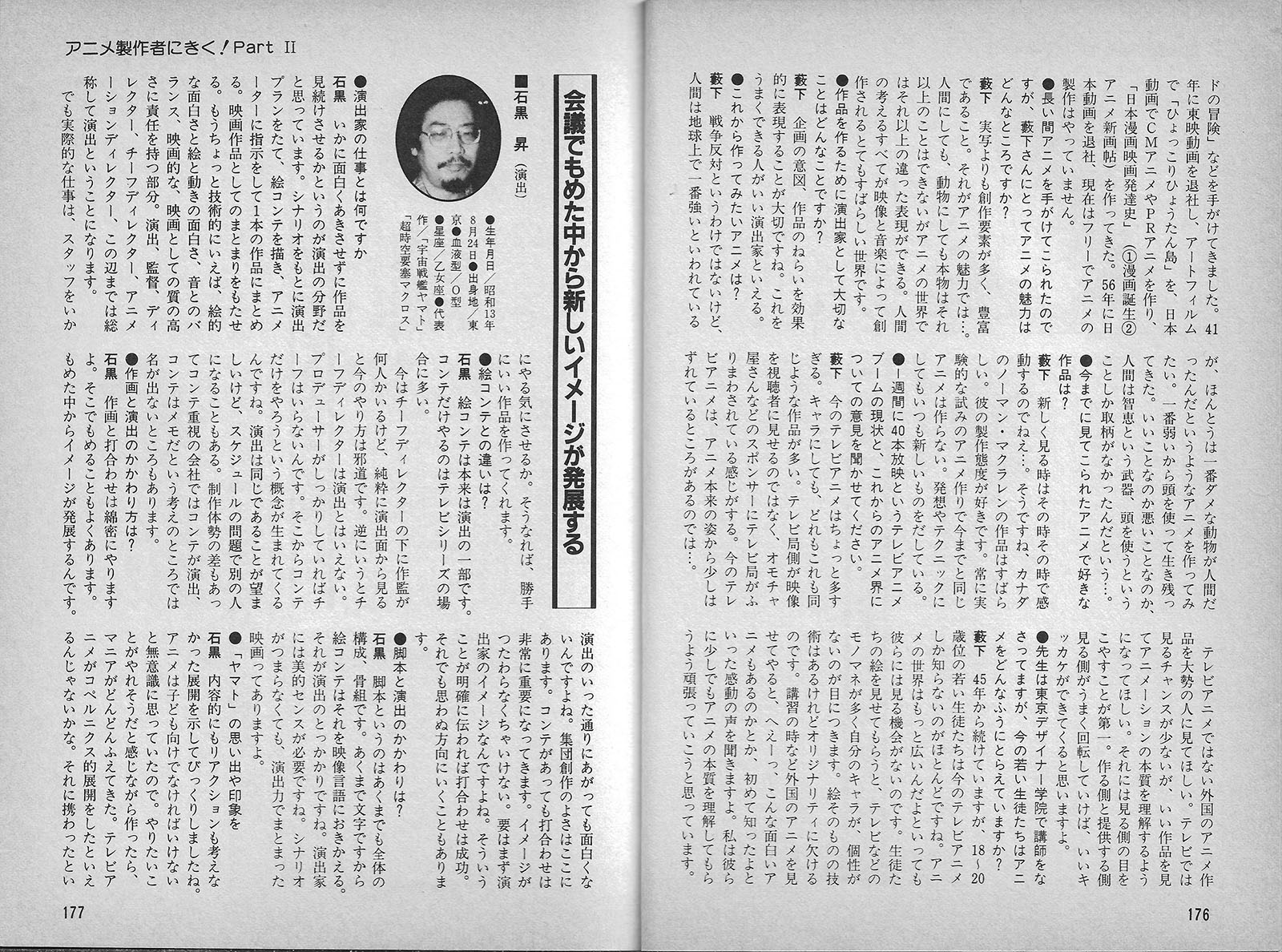
New ideas can emerge from disagreements during meetings
Noboru Ishiguro, director
Date of birth: 1938, August 24
Representative works: Space Battleship Yamato, Super Dimensional Fortress Macross
What is the job of a director?
I believe the field of directing is about how to make the work interesting and engaging so that viewers keep watching without getting bored. Based on the script, you can create a directing plan, draw storyboards, give instructions to the animators, and put it all together into a single work. You give it cohesiveness as a film.
To put it more technically, they are responsible for the appeal of the visuals and movement, the balance with sound, and the high-quality of the film as a whole. Director, chief director, animation director – these are all collectively referred to as directing. But the real job is how to motivate the staff. If you can do that, they’ll create great work on their own.
What’s the difference between this and a storyboard?
Storyboards are essentially part of the directing process. Doing only storyboards is more common in TV series.
Currently, there are several animation directors under the chief director, but from a purely directorial standpoint, this current method is unorthodox. Conversely, the chief director cannot be considered a director. If the producer is competent, there’s no need for a chief storyboard artist. That’s where the idea of having someone focus solely on storyboarding comes from.
Ideally, the same person should direct, but scheduling issues sometimes mean someone else takes over. There are also differences in production structures. In companies that prioritize storyboards, the storyboard artist is the director, while in companies where storyboards are considered memos, the storyboard artist’s name might not even be mentioned.
How are animation and directing related?
We have very thorough meetings with the artist and staff. We often have disagreements during those meetings. Ideas develope from disagreements. It’s not interesting if the final product is exactly as the director instructed. That’s the beauty of collaborative creation. Even with storyboards, meetings are extremely important. The image has to be conveyed. In short, it’s the director’s image that matters most. If that’s clearly communicated, the meeting is a success. Even so, things can sometimes go in unexpected directions.
What is the relationship between the script and the directing?
A script is merely the overall structure, the framework. It’s just text, so storyboards translate that into a visual language. That’s the starting point for directing. Directors need an aesthetic sense. There are films that are well structured, even if the script is boring, thanks to the director’s skill.
Memories and impressions of Yamato
I was surprised by the plot developments, both in terms of content and the reactions it elicited. I had unconsciously thought that anime had to be for children. But when I started making it, feeling like I could do what I wanted, the number of fans started to grow rapidly. I think you could say that it was a Copernican revolution for TV anime. Being involved in that is something I will never forget.
Regarding Macross
There are many reasons for this coming to be. I meticulously prepared this situation. Or rather, I realized there were limits to what I could do as an animator, so I restrained myself when working with a group, but I still had to create a space where I could say 100% of what I wanted to say. So I created Artland as my workspace, and five years later, after thinking that I wanted to make it my production space someday, the Macross project came along.
Talented young people like Haruhiko Mikimoto and Ichiro Itano came together, and I was able to team up with Anime Friend and Tatsunoko. Macross was the first time all of that bore fruit. The biggest achievement with Macross was being able to put into practice the idea that my way of thinking was correct to a certain extent. I intend to continue forging ahead on this path. I think so. It’s tiring, though.
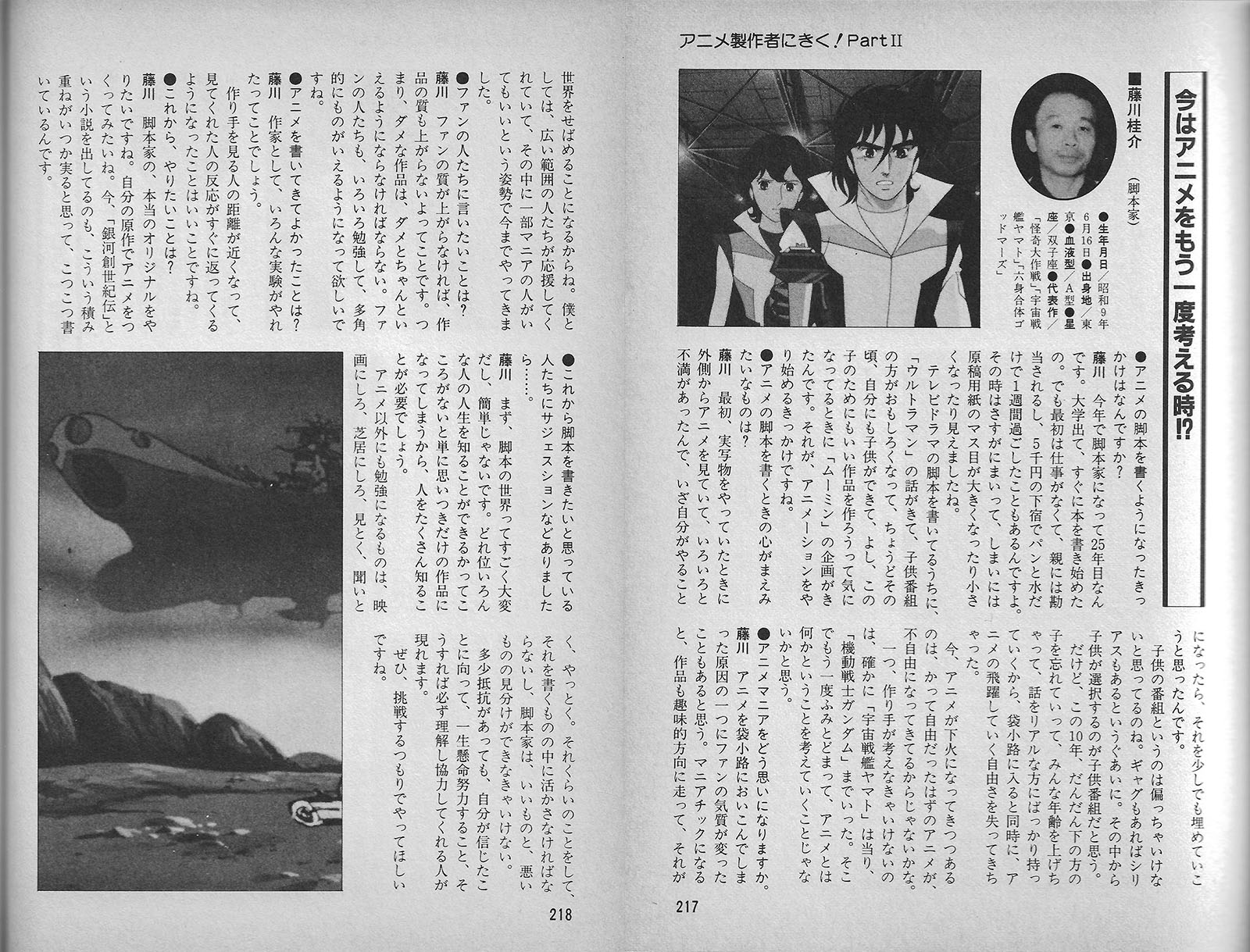
Now is the time to rethink anime!
Keisuke Fujikawa, screenwriter
Date of birth: 1934, June 16
Representative works: The Great Mystery Operation, Space Battleship Yamato, God Mars
What got you started writing anime scripts?
This year marks my 25th year as a screenwriter. I started writing books right after graduating from university. But at first, I had no work, my parents disowned me, and I even spent a week living in a ¥5000 boarding house on just bread and water. I was really down then, and eventually the squares on the manuscript paper started to wobble.
While I was writing scripts for TV dramas, I got an offer for Ultraman, and I started to find children’s programs more interesting. Around that time, I also had a child of my own, and I thought, “OK, I’ll make a good work for this child” when the Moomin project came along. That’s how I started working in anime.
What kind of mindset do you have when writing anime scripts?
When I first started working on live-action projects, I was watching anime from the outside and had a lot of complaints, so when I got the chance to work on one, I wanted to try and fill in those gaps as much as possible. I believe children’s programs shouldn’t be biased. They should have both comedy and serious content. I think children’s programs are something that children can choose from among those options.
But over the past ten years, we’ve gradually forgotten about the younger characters. Everyone’s getting older, and we’ve been focused too much on realism, which has led us into a dead end and caused us to lose the freedom to soar as we do with anime.
I think the reason anime is declining in popularity now is because it’s becoming less free. One thing creators need to consider is that Yamato was certainly a hit, and now we’ve reached Mobile Suit Gundam. I think it’s time to pause and consider what anime truly is.
What are your thoughts on anime maniacs?
I think one of the reasons anime has ended up in a dead end is that the temperament of fans has changed. When it becomes too niche, the works themselves tend to go in a hobbyist direction, and that narrows the world. As for me, I’ve always maintained the stance that it’s fine to have a wide range of people supporting anime, even if there are some maniacs among them.
What do you want to say to your fans?
What I mean is that if the quality of the fans doesn’t improve, the quality of the works won’t improve either. In other words, fans need to be able to say that a bad work is bad. I hope that fans will also study various things and be able to comment from multiple perspectives.
What’s the best thing about writing anime?
As a writer, I’ve been able to experiment with various things. It’s a good thing that the distance between creators and viewers has shortened, and feedback from viewers comes back immediately.
What do you want to do from now on?
Mr. Fujikawa really wants to create something original. He wants to make an anime based on his own original work. Right now, he’s published a novel called Galaxy Genesis Legend, and he believes that this kind of effort will bear fruit someday.
What are your suggestions for people who want to start writing a screenplay?
First of all, the world of screenwriting is extremely difficult and not easy to get into. You need to be able to learn about the lives of many different people, otherwise your work will just be an arbitrary idea, so you need to get to know a lot of people.
Besides anime, you should also watch, listen to, and experience other things that are educational, whether it’s movies or plays. You have to do that much, and then incorporate it into your writing. A screenwriter must be able to distinguish between good and bad.
Even if you face some resistance, if you work hard toward what you believe in, people who understand and cooperate with you will surely appear. I definitely want you to try it with the intention of taking on the challenge.
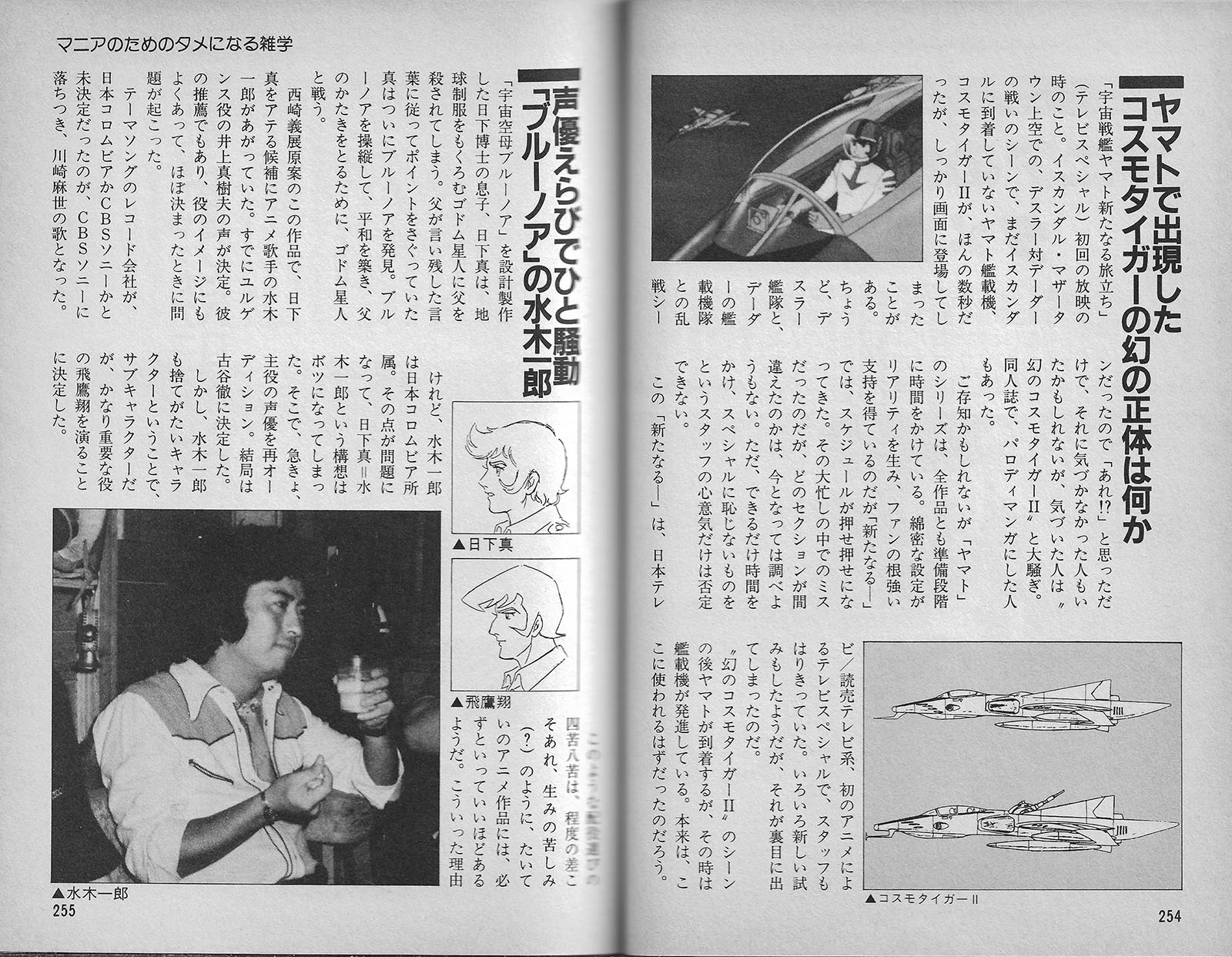
What is the true identity of the elusive Cosmo tiger that appeared in Yamato?
During the first broadcast of the TV special Space Battleship Yamato, The New Voyage, in the scene of the battle between Dessler and Deda above Iscander’s Mother Town, Yamato’s aircraft, the Cosmo Tiger II, appears on screen for just a few seconds before we see it actually arriving on Iscandar.
The chaotic battle between Dessler’s fleet and Deda’s fleet was so eye-catching that some people might not even noticed. But those who did notice made a big fuss about it being the “phantom Cosmo Tiger II”. There was also someone who made a parody manga of it in a doujinshi.
As you may know, every installment of the Yamato series has been meticulously planned and prepared. The detailed designs create a sense of realism, and have earned it a strong following among fans, but with The New Voyage, the schedule was running very tight. The mistake occurred amidst this hectic schedule, but it’s impossible to determine now which department made the error.
However, one cannot deny the staff determination to take as much time as possible to create something worthy of a TV special. This was the first anime TV special on the Nippon Television/Yomiuri TV network, and the staff was very enthusiastic. They apparently tried many new things, but this one backfired.
After the scene with the “phantom Cosmo Tiger II,” Yamato arrives, but at that time its aircraft are already taking off. This was probably where the scene was originally intended to be used.
A commotion over the selection of voice actor, Ichiro Mizuki in Blue Noah
Makoto Kusaka, the son of Dr. Kusaka, who designed and built the Space Carrier Blue Noah, has his father killed by the Godom aliens who plot to conqueror Earth. Following his father’s last words, Makoto searches for the location and finally discovers the Blue Noah. He pilots the Blue Noah to build peace and fight against the Godom aliens to avenge his father.
In this work, based on an original concept by Yoshinobu Nishizaki, anime singer Ichiro Mizuki was considered as a candidate to voice Makoto Kusaka. Mizuki’s recommendation, along with his good fit for the character, meant that the role was almost finalized when a problem arose.
The record label for the theme song was undecided, with options being Nippon Columbia or CBS Sony, but they ultimately settled on CBS Sony, and the song was sung by Mayo Kawasaki. However, Ichiro Mizuki was affiliated with Nippon Colombia. This became a problem, and the idea of having him voice Makoto Kosaka was scrapped. So they hastily held audition for the main voice actor. In the end, Toru Furuya was chosen.
However, it was hard to pass up the idea of Ichiro Mizuki playing a character, so it was decided that he would play the role of Sho Hiyaka, a supporting character, but a very important one. Such struggles in casting, to varying degrees, are almost always present in anime productions, much like the pain of creation.
In any case, the process of selecting voice actors was difficult, but once it started, the teamwork was excellent, and things went smoothly. Unfortunately, however, the viewership ratings did not rise as much as expected, ending with less than 10%. Nevertheless, this experience significantly boosted Ichiro Mizuki’s skills as a voice actor.
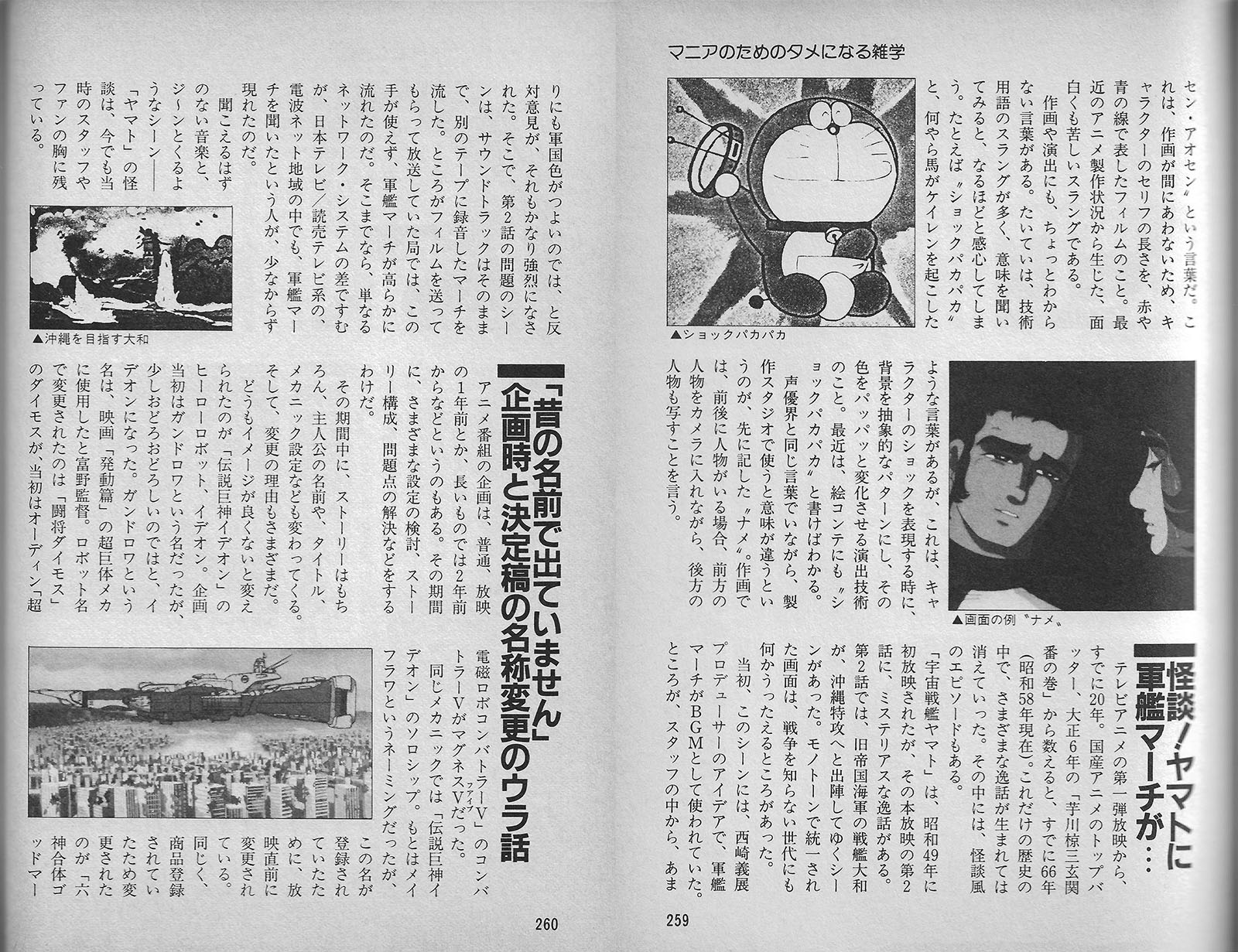
A ghost story! The Battleship March plays in Yamato…
It’s already been 20 years since the first TV anime series was broadcast. If you count from the very first Japanese anime in 1917, it’s already been 66 years. Throughout this long history, various anecdotes have been born and then faded away. Among them are some ghost story-like episodes.
Space Battleship Yamato was first broadcast in 1974, and there is a mysterious anecdote about the second episode of that broadcast. In this episode, there was a scene of the Imperial Japanese Navy Battleship Yamato setting out for a suicide mission to Okinawa. The visuals resonated with a generation that did not experience war.
Initially, producer Yoshinobu Nishizaki suggested using the Battleship March as background music for this scene. However, some staff members strongly objected, arguing that it was too militaristic. Therefore, for the problematic scene in Episode 2, the original soundtrack was used, but the march was recorded on a separate tape.
However, some stations received the film for broadcasting in which the Battleship March was played. Up to that point, it could simply be attributed to differences in network systems, but even within the Nippon Television/Yomiuri Television network area, a considerable number of people reported hearing the Battleship March.
Music that shouldn’t be audible, and a deeply moving scene that touches your heart. The ghost stories from Yamato still resonate with the staff and fans of that time.