
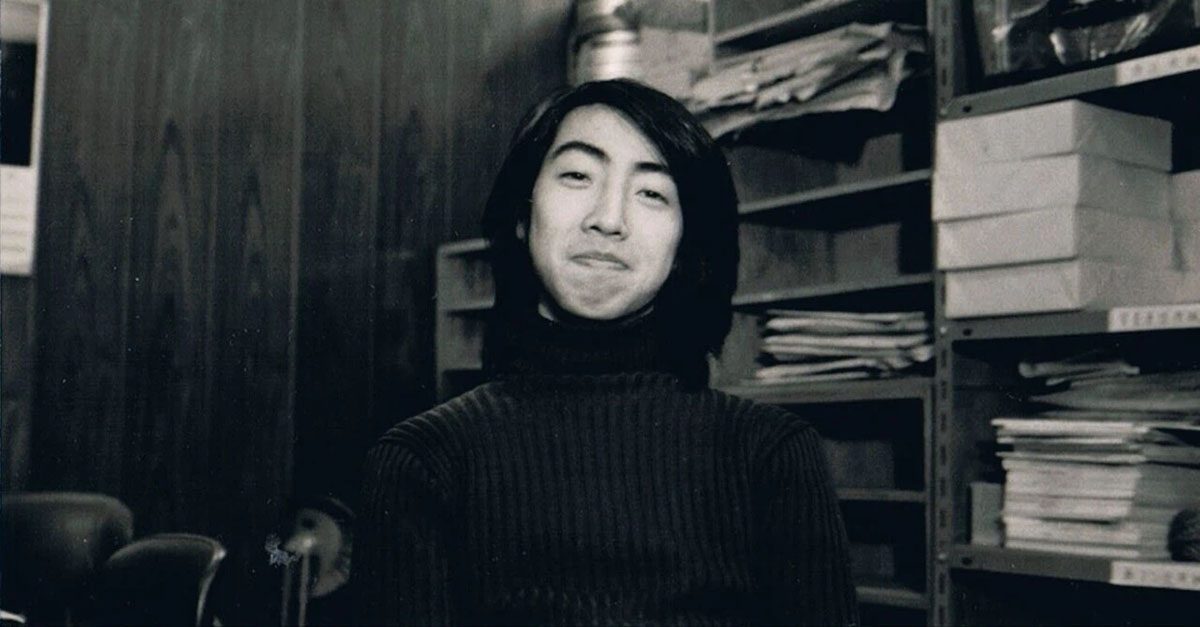
From the Back Alleys of Animation: An Interview with Kazuyoshi Hirose
Part 3: Zero Tester and Space Battleship Yamato
Published at NOTE blog by Yasushi Yamashita on March 16, 2026. See the original post here
Find Part 1 here and Part 2 here
Yasushi Yamashita profile:
I work on the restoration of films and animation, produce Blu-rays, and assist with theatrical releases. I also write about movies and music for magazines and websites. Additionally, I’m the father of two children with disabilities. My co-authored book with my wife is Budget World Tour for Two (Kodansha), and my solo work is After the Rain, Haruko: The Story of a Child with Hydrocephalus and Her Father (Shobunsha).
Zero Tester: Protect the Earth!
Yamashita: We left off last time at the point where you were 16 years old and had just started doing coloring work at Sunrise. Was that something you did on a daily basis, like a regular commute?
Hirose: Exactly.
Yamashita: So, you were essentially employed there. Did you receive a salary as well?
Hirose: Well, calling it a “salary” is a bit generous. In an era when the average person was earning around 150,000 yen, I was making, was it 50,000 yen a month? Or maybe 55,000? It was something in that ballpark. Since I was still just a 16-year-old kid, I was treated as an apprentice. I had essentially bypassed the standard career path to jump straight into the production floor, so I figured, “Well, that’s just the way it goes.”
That said, I had just dropped out of my high school’s design program. the fact that I was getting hands-on training and earning 50,000 yen felt like a huge win, I was practically shouting, “Hooray!” Plus, I assumed that eventually, once I got assigned to a full series of my own, my pay would go up accordingly. Though, as it turned out, that never actually happened.
Yamashita: Speaking of coloring work, you had previously worked part-time as a subcontractor for Tokyo Movie, right? When you started doing it properly at Sunrise this time around, did you receive any formal instruction?
Hirose: No, not really, at least not regarding the technical aspects. Back when I was working on Star of the Giants, they once asked me, “Hey, want to give coloring a shot just for practice?” I did it, only to find out later, by watching the actual broadcast, that they had used my work in the final cut! Because of experiences like that, I had already built up a certain level of confidence in myself, thinking, “I’ve got this. I know how to do it.” I was already proficient in both tracing and painting.
So, my very first assignment at Sunrise was Zero Tester: Protect the Earth! (1973–74. the title for episodes 1–39 was simply Zero Tester). My senior colleagues taught me the workflow for the “Color Specification” role. First, I would sit in on the meetings between the episode director and the key animators, just listening in on their discussions about the animation layout. Once those meetings wrapped up, I would head over to the external finishing studio. There, while reviewing the storyboards together, I would explain specific details, pointing out scenes that required special visual effects, or noting where the color palette needed to shift because the scene took place at night. I learned the ropes by observing this entire process firsthand as we worked through several episodes.
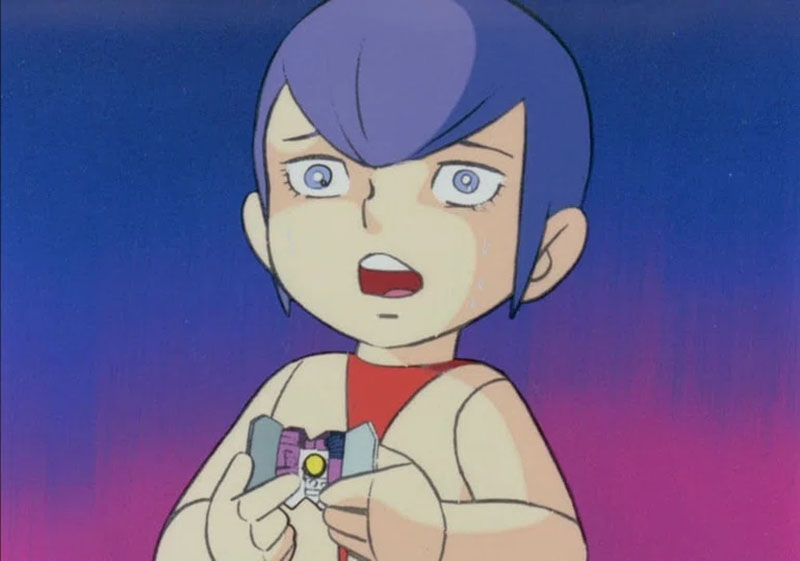
From Zero Tester: Protect the Earth! Episode 61: “The Secret of Yuki, the Robot Boy” (Aired November 25, 1974)
Chief Director: Ryosuke Takahashi | Screenplay: Soji Yoshikawa | Storyboard, Direction, Animation Supervision: Yoshikazu Yasuhiko
Art Director: Jiro Kono | Produced by: Kansai TV / Soeisha | Animation Production: Sunrise Studio
Some time passed, and there’s a process called “color testing” where you determine the color schemes for guest characters, and eventually, a senior colleague told me, “Hey, why don’t you give it a shot?” So, I was tasked with coloring a guest character. I protested, saying, “But I’ve never done this before!” but the senior insisted, “Just cram every single color you can think of into it, that’s all you have to do.” Thinking to myself, “Huh? If I use every color, won’t it look totally hideous?” I went ahead and colored it exactly as he instructed…and sure enough, the result was truly hideous! (Laughs)
The people around me reacted with, “What on earth is this? It looks terrible!” Then, one of the production coordinators, who was kind enough to offer some advice, stepped in and said, “No, no, that’s not right. Just try coloring it using the specific colors you like, the ones that come to your mind when you look at this character. You don’t need to use every single color in the spectrum.”
Realizing, “Oh, so that’s how it works!” I went back and redid the coloring. When Mr. Yasuhiko [Yoshikazu] saw the revised version, he actually went so far as to mention that senior colleague by name and say, “Hirose’s version is much better than [Senior Colleague’s]!” However, when that senior colleague heard this, he got completely offended. He sulked, declaring, “Fine! I have absolutely nothing left to teach Hirose,” and, true to his word, he really did stop teaching me anything at all from that day forward.
Yamashita: What an incredibly petty person! (Laughs.)
Hirose: Well, I was still a complete newbie at the time, so once that senior stopped guiding me, I lost my sense of the proper workflow and pacing, and my work started getting bogged down at various stages.
Originally, we had a fantastic production schedule where the final, completed masters were delivered three weeks prior to the broadcast date. But toward the end of the series run, the episodes I was in charge of started running into major delays. I couldn’t finish the coloring in time, and for the very first time in the show’s history, we were forced to record the voice acting using only the rough line drawings instead of the finished animation. Things got so hectic that even the episode director in charge, Mr. Yasuhiko, pitched in to help paint the animation cels.
The episode right before the finale involved a storyline where the characters leave Earth, travel into space to visit an alien planet, and then return to Earth, meaning the same character’s color palette had to change about five times within a single episode. In response to this, the president of the subcontracting studio handling our finishing work stormed in, absolutely furious, and shouted, “Are you trying to kill us?!” He then took the cels, which had already been fully painted, and shredded them to ribbons with a pair of scissors. He stuffed the scraps into a cut bag, then deliberately scattered them all over the floor right in front of me. Everyone there froze in shock.
His complaint boiled down to the fact that there were simply too many specifications requiring “shadows.” After all, adding shadows effectively doubles the amount of work required for painting. Back then, even if shadows were clearly indicated in the in-between animation drawings, subcontractors would often skip them without permission or simply ignore fundamental instructions. I’d try to say, “Hey, that’s not my fault!” but the guy was so enraged he wouldn’t listen to a word I said.
Despite all that drama, I went ahead and changed the specification for the protagonist’s helmet visor, which was originally just supposed to be a standard painted surface, to an airbrush effect so that the background would show through it. This ended up creating even more work for our special effects artist, Mr. Michiaki Doi. (Of course, I did get prior approval from the director, the production team, and the special effects department first.) In any case, it reached a point where it became clear we simply wouldn’t make the deadline. we were completely backed into a corner with nowhere left to turn.
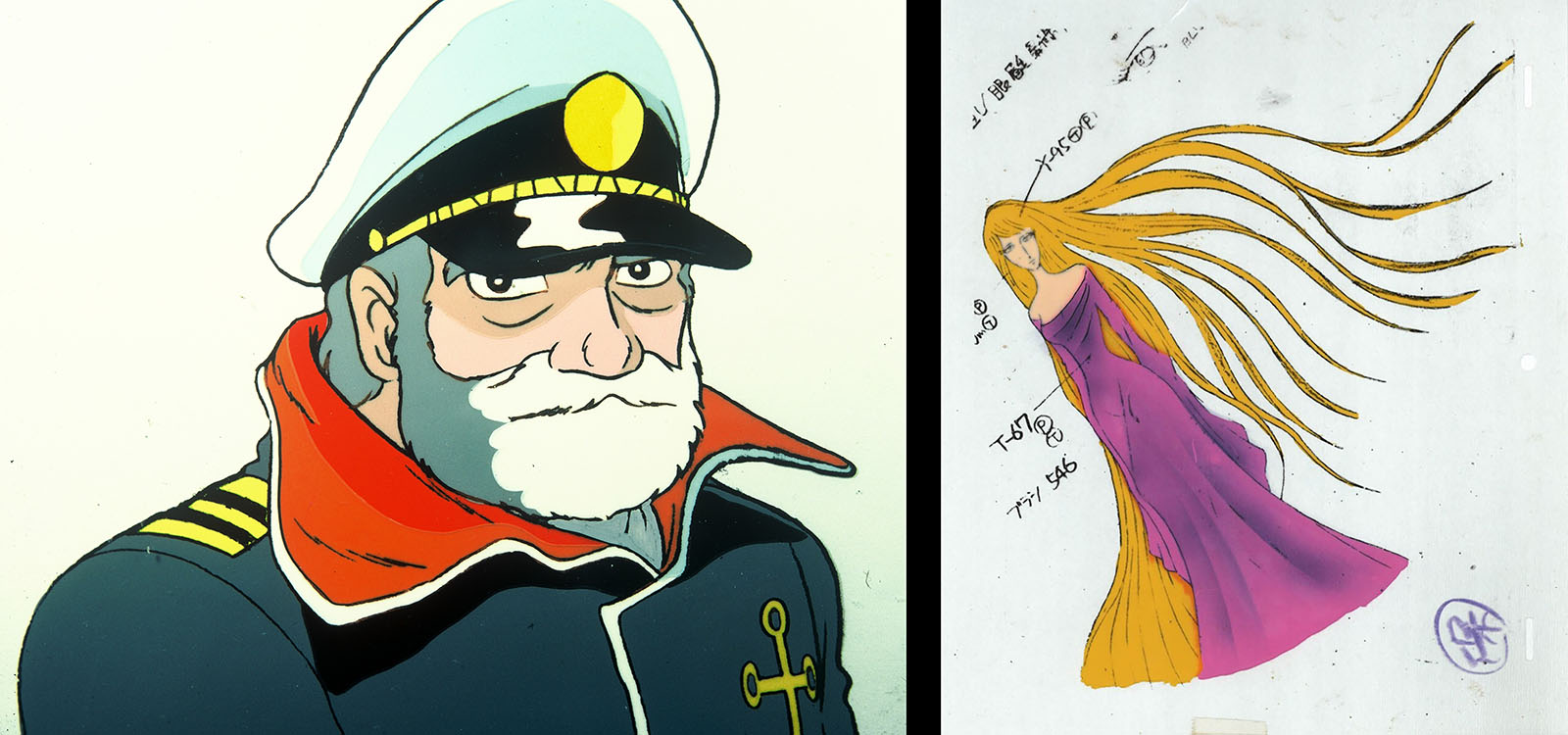
Space Battleship Yamato
Yamashita: Even so, during that period when you were just starting out at Sunrise, you were also involved with Space Battleship Yamato (1974–75), weren’t you?
Hirose: As for Yamato, right from the start of its broadcast run, I used to drop by the studio to watch the filming sessions after I’d finished my shift at Sunrise. The filming took place at Mushi Production, which was located in Fujimidai, just a stone’s throw away from Kami-Igusa, where Sunrise was based.
Late one night, Kinuyo Nozaki, who was a production coordinator at Office Academy, asked me, “Hey, you’re always hanging around here. what exactly do you do?” When I replied, “I work in the finishing department at Sunrise,” her eyes suddenly lit up with intense interest. “Are you free?” they asked. I replied, “Well, if you’re asking, then yes, I suppose I am.” At that, they grinned slyly and said, “Come along with me for a moment.”
Apparently, they had “mountains of things they wanted done, every single day.” I asked, “Isn’t that just work? How much are you going to pay me?” but they just waved it off: “No, no, never mind the money. If you come, you get to eat a steak bento box.” I thought, What on earth is that all about? but since I hadn’t been getting any decent meals around that time, I figured it would be a good way to get some nutrition. Sure enough, a custom-ordered steak bento, catered by a restaurant near Sakuradai Station, was prepared for me every single night. I found myself thinking they were sparing no expense, impressed by the sheer extravagance of it all.
Yamashita: You’ve been based along the Seibu Ikebukuro Line ever since your days at Mushi Production, haven’t you?
Hirose: Academy had rented out several floors of an apartment building in Sakuradai to serve as the studio for Space Battleship Yamato, and they took me to one of those rooms. I had just started working on touch-ups for animation cels that had been rejected during the camera check, shots that couldn’t be filmed as-is since they were deemed “NG” (no good). Someone appeared, holding something out to me. It was a bento box featuring a single, massive steak. It really was quite thick (at least, that’s how it seemed to me back then, when I was a penniless kid). I thought to myself, Now this is the real deal. Since I was going through a period where I truly wasn’t getting enough to eat, I immediately said, “All right then, I’ll be here every day!” (Laughs)
Back then, I was still commuting all the way from Kamata to Kami-Igusa. however, if I stayed working late into the night, I’d miss the last train and wouldn’t be able to get back to Kamata. Consequently, my daily routine turned into a sort of circuit: from Academy or Mushi Pro straight to Sunrise for my next shift. I’d work on Zero Tester at Sunrise during the day, then head over to Academy at night to do touch-up work on Yamato.
As for the work on Zero Tester, aside from that chaotic scramble right before the final episode that I mentioned earlier, the workload leading up to that point was actually quite light. We’d start around noon and be finished by 3:00 PM or so. Once work wrapped up, the entire staff, at least the ones who drank, would just spend the rest of the time getting absolutely wasted.
Our senior staff member in charge of color specification would hit 3:00 PM, grab his washbasin, and head straight to the public bathhouse located just a few doors down. Perhaps because Zero Tester was his directorial debut, or maybe simply because he was a heavy drinker (being a minor at the time, I couldn’t say for sure), the director would gather with the staff members who were old enough to drink as soon as the bars opened, and he’d pick up the entire tab himself.
As for me, I’d head to the studio, the “Academy,” as we called it, in the late afternoon. there, I’d hang out and shoot the breeze with folks like Noboru Ishiguro and Kazunori Tanahashi, and whenever retakes were called for, I’d set about fixing the animation cels. Incidentally, both Mr. Ishiguro and Mr. Tanahashi were already familiar faces to me, since we’d previously crossed paths at Sunrise.
Yamashita: How exactly did you go about fixing the coloring?
Hirose: It really depended on the specific case. For tiny details, spots so small that you wouldn’t notice if you simply painted over them, we’d just do exactly that. Paint right on top. However, if the area was large, painting over it would result in uneven patches and build up too much thickness.
Stacking the cels on top of one another would then cause them to stick together, creating a whole new set of headaches. Consequently, the standard procedure was to fix the image from the back of the cel. The paint used for cels was a water-soluble vinyl-based paint. it dissolved in water, but once it dried, it cured into a vinyl-like film, which meant that if you wet it again, the paint would peel right off.
Yamashita: Oh, really? That’s fascinating. I’m actually currently working on a brochure for a retrospective screening of films by the French animation director René Laloux. One of his works, Gandahar (1987), was actually produced at a studio in North Korea. I came across some archival material stating that, in North Korea, they would routinely reuse animation cels once filming was complete.
For instance, if a retake was required during filming, the original artwork on the cel would have already been erased, forcing them to start the entire process, from inking to coloring, all over again from scratch. I’d been wondering ever since: how on earth did they manage to strip the paint off the cels?
Hirose: Apparently, back during the era of Astro Boy (1963–66), that was a perfectly standard practice. (Though, to be fair, the cels used back then were much harder and thicker than the ones we used later on.) Also, if you had to film a cel that had been scratched or damaged, you needed to be extremely careful with the lighting to ensure the scratches didn’t catch the light and create unwanted reflections. It really required a specific set of technical skills.
The same went for the ink lines: if you inked them too heavily using a broad-nibbed kabura pen, the nib would gouge into the cel surface and leave permanent scratches. However, if you applied a lighter touch using a fine-nibbed maru pen, the ink would lift off cleanly without leaving any lasting damage behind.
To return to the previous point: if the paint had been applied in such a way that it didn’t overlap with any other painted areas, you could simply wet that specific spot, and that section alone would peel right off cleanly. However, if the paint overlapped with areas painted in a different color, you couldn’t isolate and peel off just that specific color. in those cases, you have to scrape it off using a bamboo spatula, though that did depend on the specific pigments used.
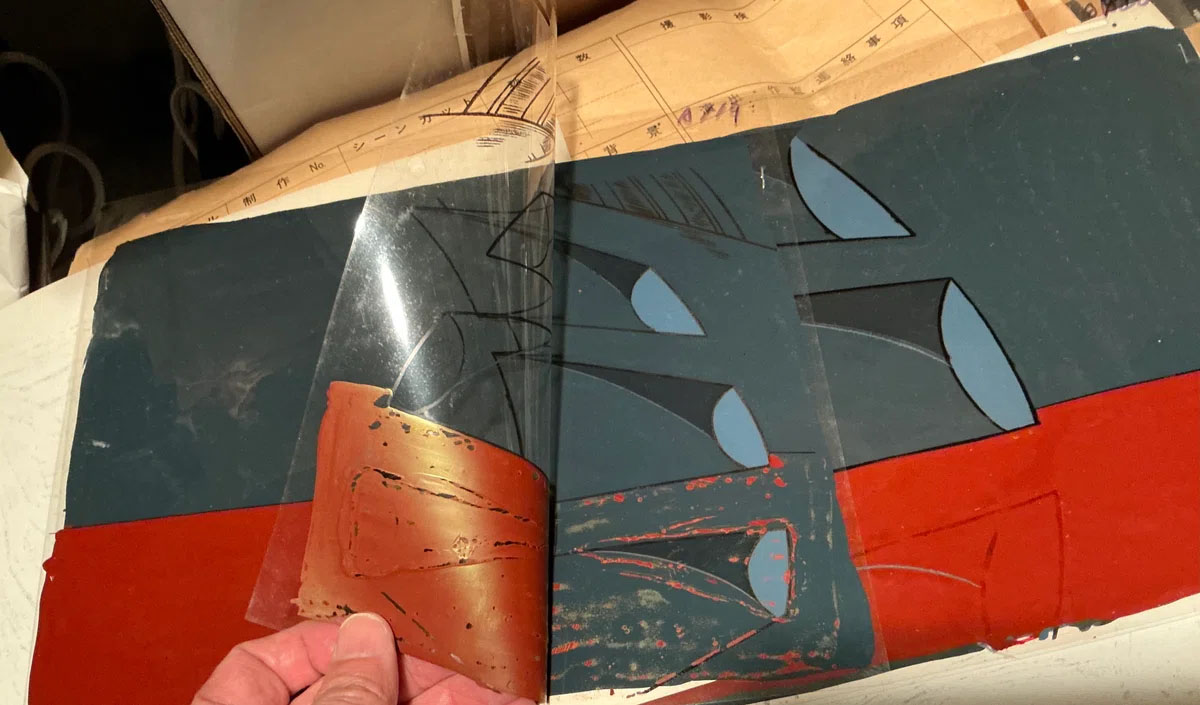
One method of correction is “overlaying.” You simply place a fresh cel sheet over the specific area that needs fixing.
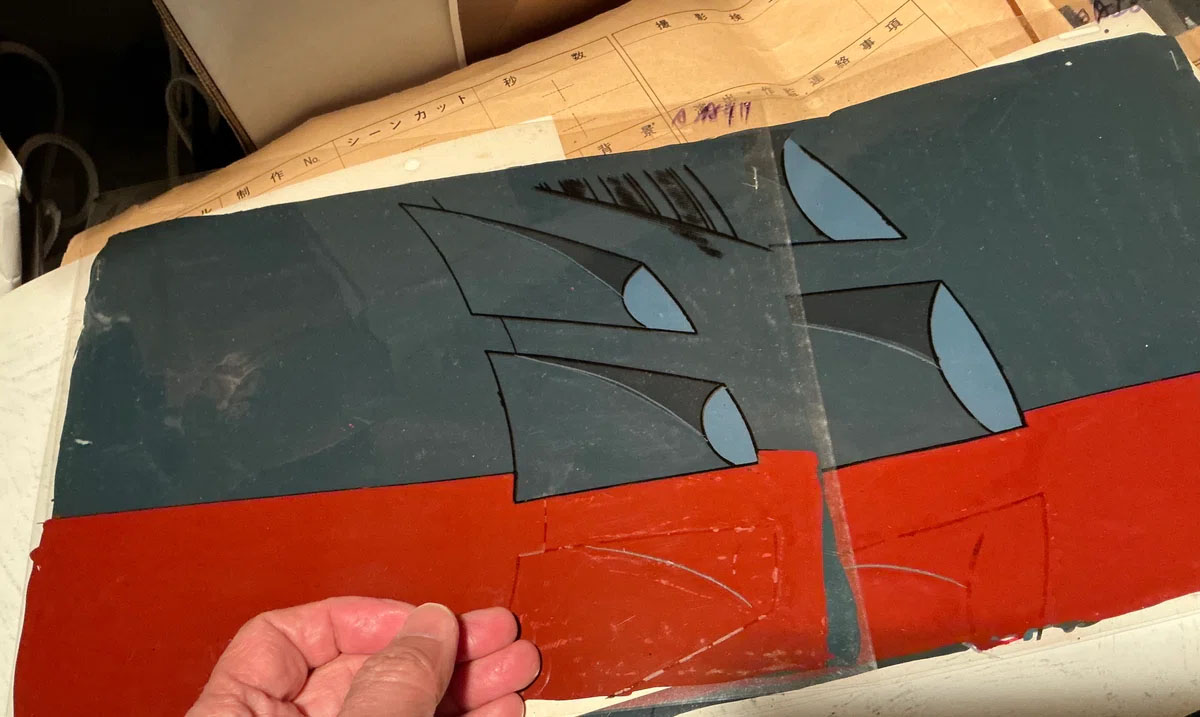
The downside is that the corrected section, which now sits one layer closer to the camera, will appear slightly brighter than the surrounding areas when filmed.
Yamashita: Wow, I had absolutely no idea!
Hirose: All sorts of issues could arise when working with cel paint. Since the colors were created by mixing various pigments together, the exact shade could vary from one production batch (or “lot”) to another. Even if you thought you were applying the exact same color, if you happened to use paint from different batches within a single shot, the colors would visibly “jump” or shift when you watched the final footage. We even had instances where the paint would separate during the drying process, resulting in a blotchy, uneven finish.
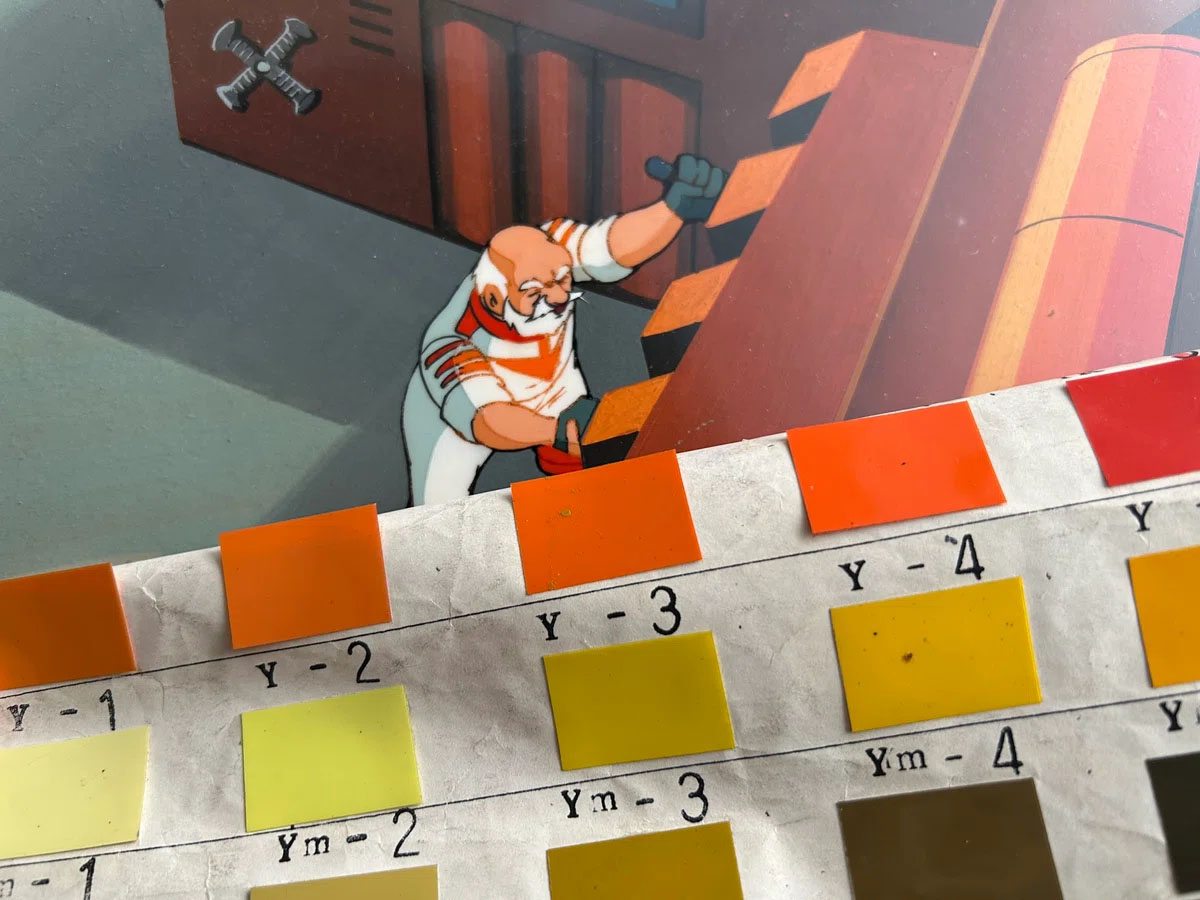
Reference: A method for checking the color consistency between the background and the cel animation.
With Yamato, we were constantly pressed for time. as soon as the painting was finished, the cels had to be rushed straight to the filming stage. The problem was, the paint hadn’t dried yet. We’d try using hair dryers, but even if the surface of the paint dried, the inside would often remain soft and squishy. We even resorted to truly ridiculous measures, like taping the cels to the windows of the car transporting them from Sakuradai to the filming studio, hoping the wind from the drive would dry them! But, of course, they never really dried.
In animation filming, you’d place the cel sheet over the background painting, and just before snapping the shutter, you’d press down on the entire stack with a sheet of glass. You’d have to do this. otherwise, the cels might buckle or lift slightly, casting unwanted shadows onto the background. However, if the paint wasn’t fully dry, there was a risk that it would squish out and smear, ruining the background. So we had to be extremely careful, constantly adjusting and moderating the pressure we applied with that glass plate.
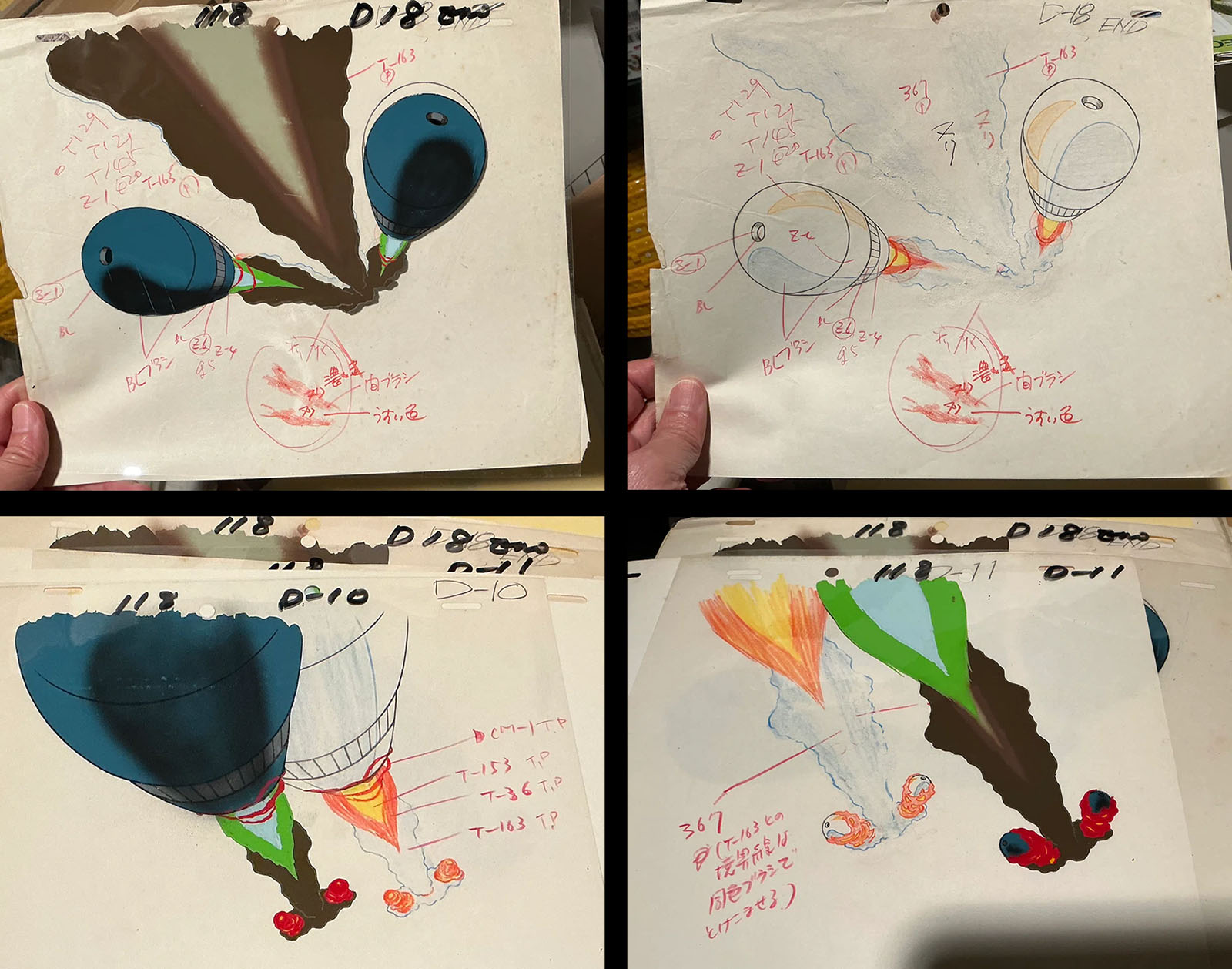
These specific production notes were not created by Hirose himself, but they represent actual instructions used during production. “T” stands for Tracing (inking), “P” stands for Painting (coloring), and “Brush” refers to airbrushing. “TP” indicates work handled by the Finishing Department, while “Brush” indicates work handled by the Special Effects Department.
As you can probably tell just by watching it, the space in Yamato is pitch black. That made the actual filming process an absolute madhouse. Any speck of dust or debris on the animation cels just popped right out. Moreover, given our tight production schedule, we simply didn’t have the luxury of carefully brushing away every bit of dust. Our priority was to shoot as many frames as possible, so we often just left the dust exactly where it was.
The fact that other anime series depict outer space using lighter shades of blue is, from the standpoint of minimizing visible dust, actually the correct approach. Yamato, however, went and made it dark. While this did create some beneficial effects, making the laser beams appear brighter, for instance, and causing the soft gradients painted with airbrushes to look like actual glows, it ultimately created significant production hurdles given our tight schedule.
Speaking of which, I actually watched the broadcast of the first episode of Yamato at Sunrise. Tatsuo Shibayama, the producer of Yamato, just happened to drop by Sunrise on the day the first episode aired. He looked absolutely ashen. We were all deeply impressed by the episode, saying things like, “It was really well-animated, it turned out great!” and “The animators must have had a grueling time with the artwork.” Hearing this seemed to bring him a faint sense of relief, and he headed home.
However, about thirty minutes later, he came back. When I asked, “Hey, what happened?” he replied, “Well…my car fell into a ditch.” It turned out he had parked his car right next to the Waseda University sports grounds nearby, but while trying to pull out, he had dropped his front wheels into a ditch, and apparently, he’d been struggling all by himself to get it out ever since. He must have been utterly exhausted. So, we all went over there and helped him lift the car out.
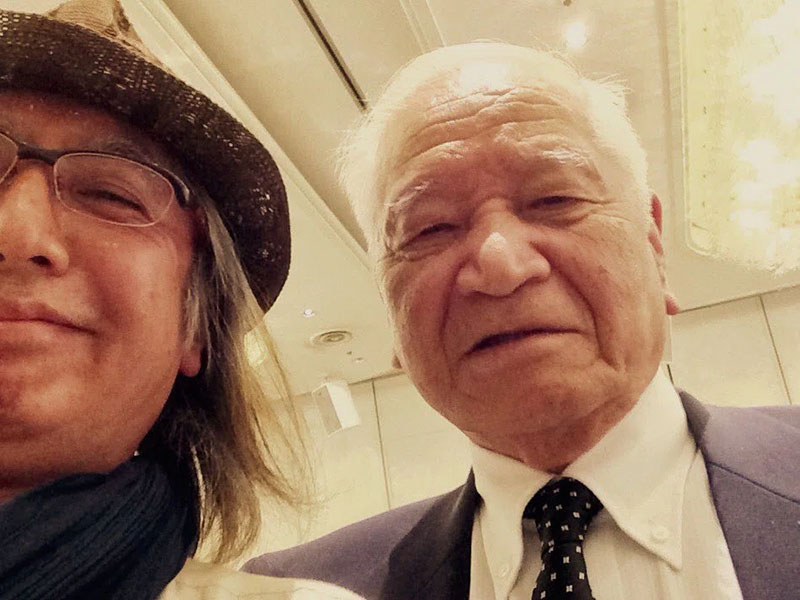
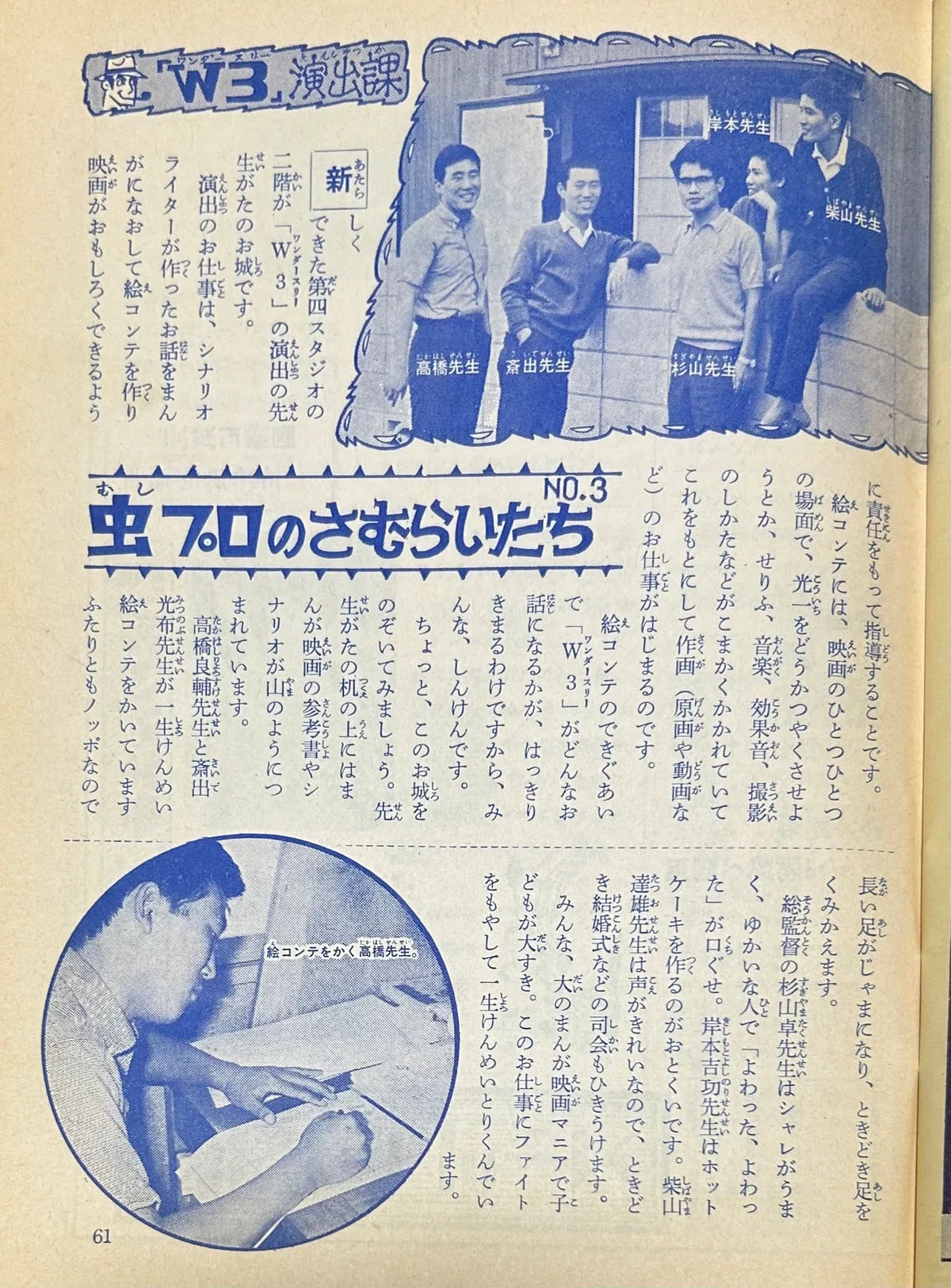
Tatsuo Shibayama during his time as a director. From Tetsuwan Atom Club, Issue No. 16 (November 1965), published by the Mushi Pro Fan Club. Excerpted from the feature “The Samurai of Mushi Pro.”
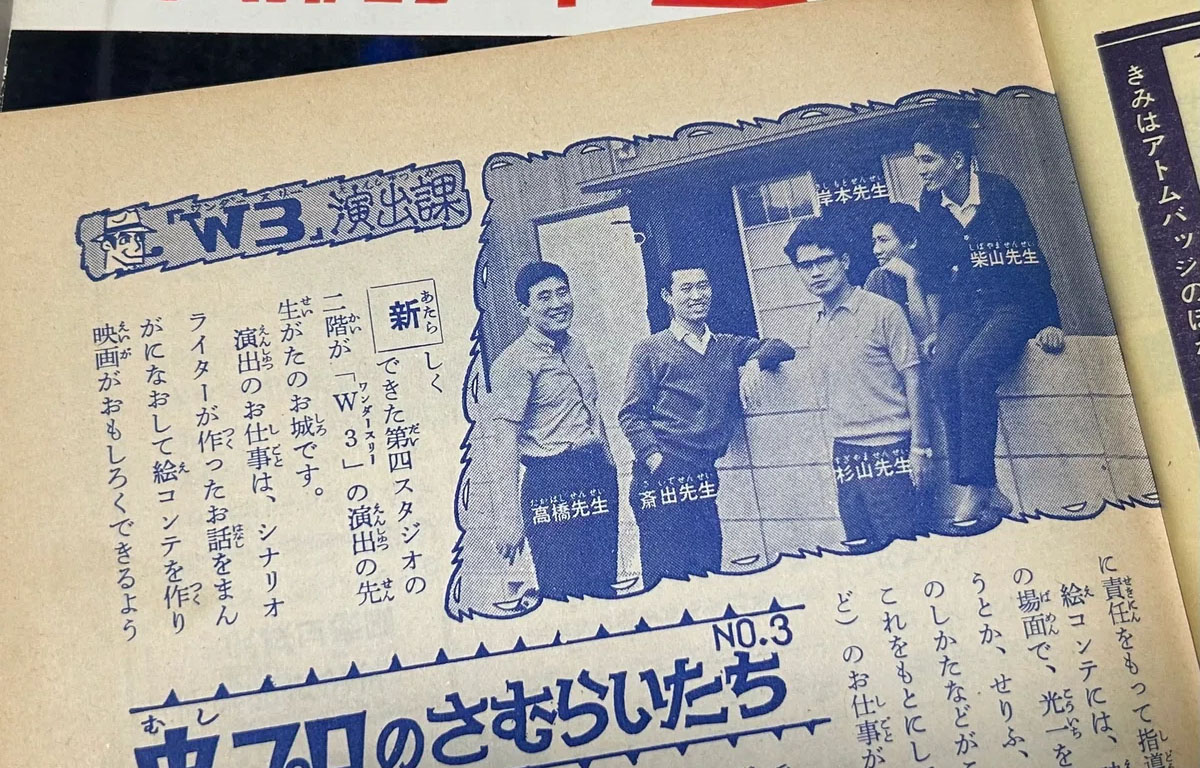
From right to left: Tatsuo Shibayama (far right), Yoshinori Kishimoto (second from right, founder and president of Sunrise Studio), and Ryosuke Takahashi (far left). All of them were directors on Wonder 3.
Both Mr. Shibayama and Mr. Kishimoto were working as directors at the time, and, in fact, they were all screenwriters as well. While compiling these footnotes, I learned that Tatsuo Shibayama had passed away three years ago. (I was left speechless.)
And so, I found myself shuttling back and forth between Sunrise and Academy, mostly just to get my hands on those steak bento boxes. Eventually, however, it was officially decided that Sunrise Studio would handle the entirety of Episode 21 of Yamato as a full-scale subcontracting job. Production on Zero Tester had just wrapped up, so the staff on the studio floor had some time on their hands.
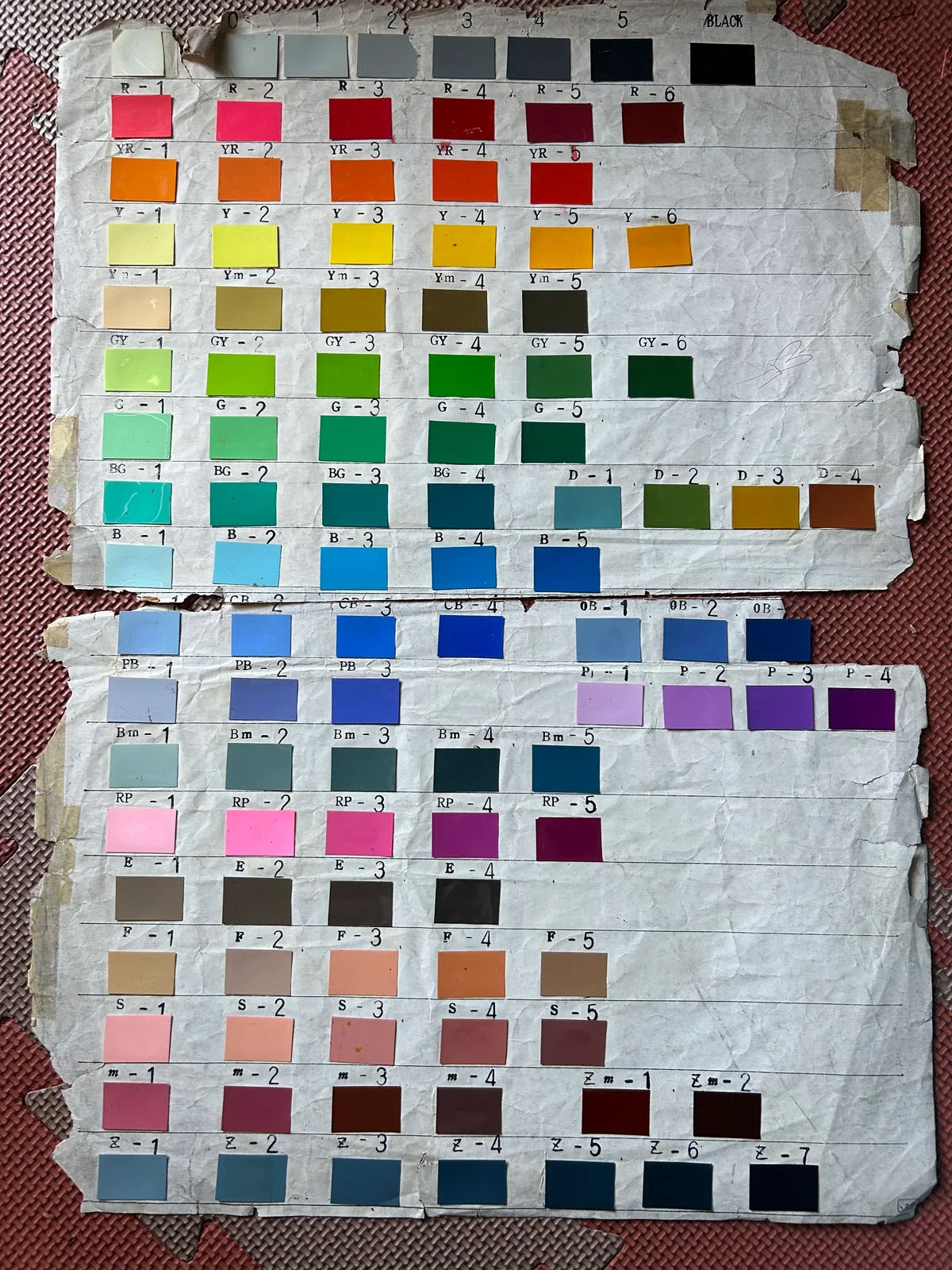
The actual color chart used for Space Battleship Yamato. It features 105 colors. Some people prefer using charts where the individual color swatches are larger strips of paper. The chart used for Zero Tester: Protect the Earth! consisted of only about 80 colors, and mostly muted, muddy tones at that. Since the paints selected for Yamato offered such vivid, brilliant color reproduction, I made sure to keep and preserve this specific chart rather than throwing it away. The cardboard backing is just a photocopy, though, so it’s in pretty rough shape now…
I only found this out later, but even back when we were working on Zero Tester, Mr. Yasuhiko was already drawing storyboards for Yamato, at a rate of about every other episode. Of course, he was working strictly under a project-specific contract for Zero Tester. He wasn’t a full-time employee of Sunrise, so he was free to take on other work.
Mr. Yasuhiko’s desk was situated right behind mine. occasionally, I’d notice he had disappeared, and it turned out he had simply stepped out to work on Yamato. He would often leave his light table switched on, so whenever I noticed it, I’d turn it off. One day, Mr. Yasuhiko caught me doing this and scolded me, though he was laughing as he did it: “So you’re the one who’s been going around doing unnecessary things!” He wanted to maintain the pretense, the fiction, that he was still physically present at Sunrise: “I’ve just stepped away for a moment and will be right back.” As if to say, “I just happen to be away from my desk right now,” you know? (Laughs)
One evening, during an art direction meeting for Yamato Episode 21 with Art Director Hachiro Tsukima, Leiji Matsumoto failed to show up at our scheduled time. (We had more or less anticipated that might happen, of course…) We ended up waiting for him for several hours in Sakuradai. I figured the trip from Oizumi-gakuen to Sakuradai wouldn’t take very long, but I was being naive! (Laughs)
Our meeting was originally scheduled for the evening, but he didn’t show up until around two in the morning, still wearing his coat. He said, “Sorry I’m late,” and then pull a bottle of whiskey out of one pocket, then pull another bottle out of an inner pocket, and yet another out of a different pocket until the entire desk was absolutely covered in bottles! (Laughs.)
After going through that sort of “ritual,” our actual meeting finally began. Once we’d finished discussing all the various points we needed to hash out, Mr. Matsumoto and Mr. Tsukima suddenly started bickering. They were arguing over the color of Yuki Mori’s outfit, specifically, how it appeared in two different episodes! One would insist, “That’s my call to make!” while the other would retort, “No, I’m the one who decides!” As a 17-year-old kid watching this, I remember thinking, “Are these really grown adults?” and just laughing at the absurdity of it all. But looking back now, I realize that both of them were actually still only in their thirties.
Yamashita: Mr. Matsumoto was actually that deeply involved in the production of the original TV series?
Hirose: Years later, when the lawsuit between Matsumoto and Yoshinobu Nishizaki broke out, some of the key staff members who sided with Nishizaki made various claims about the production. However, the truth is that Mr. Matsumoto was the one revising the scripts, correcting the storyboards, and essentially performing the duties of a director.
I once stood by and watched as Mr. Ishiguro erased some of the written notes in a storyboard drawn by Mr. Matsumoto, only to then use a pencil to write in his own revisions. He was writing with a pencil that had a completely blunt tip, and the resulting squiggly, illegible handwriting was absolutely identical to Mr. Matsumoto’s! I couldn’t help but burst out laughing. They looked exactly alike! (Laughs)
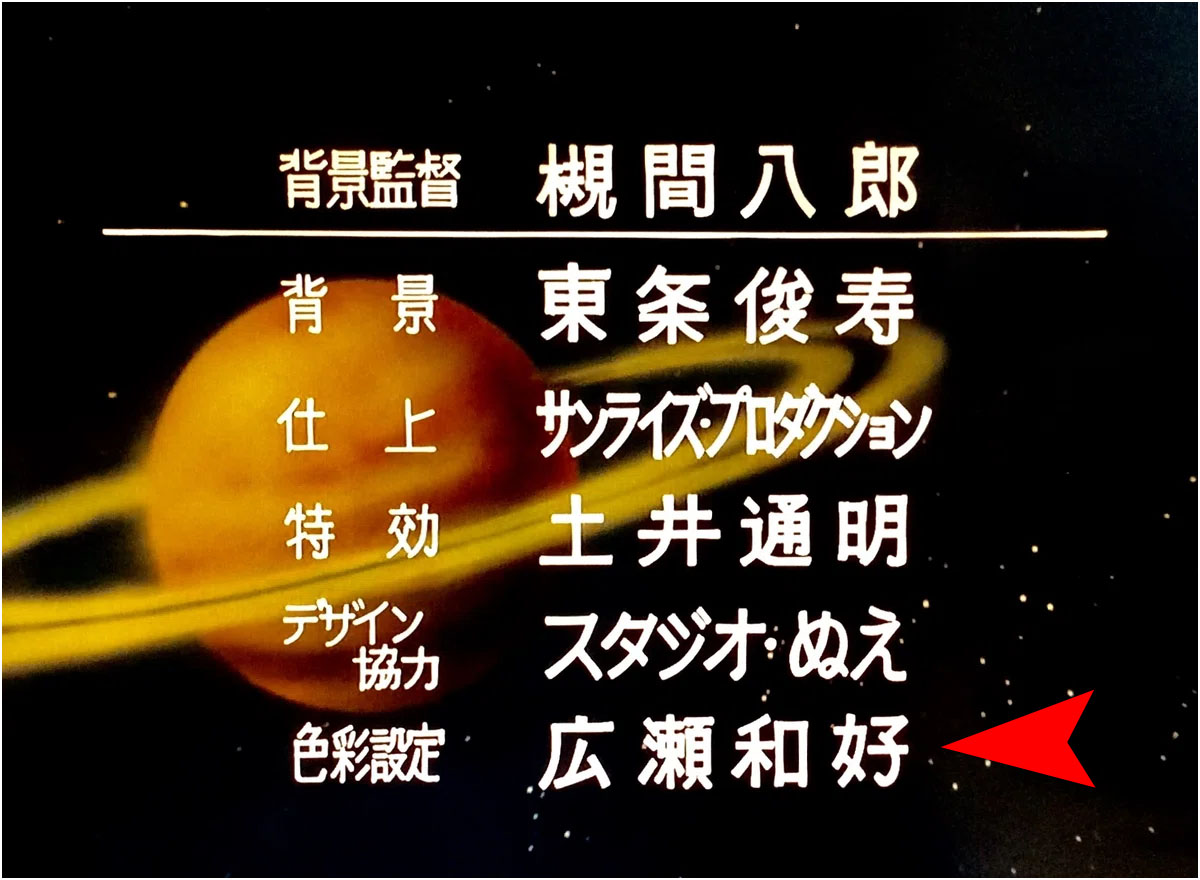
Space Battleship Yamato was the very first production where I was officially given an on-screen credit. I had previously handled the “Finishing Inspection” duties for Episodes 61, 63, and 65 of Zero Tester: Protect the Earth! However, despite my requests to the producer, my name was never actually listed in the credits for that series. Of the three episodes I worked on, two (Episodes 61 and 65) were collaborations with Mr. Yasuhiko (who handled the Storyboards, Direction, and Animation Supervision). Since there is a ten-year age gap between us, Mr. Yasuhiko would have been 27 years old at the time.
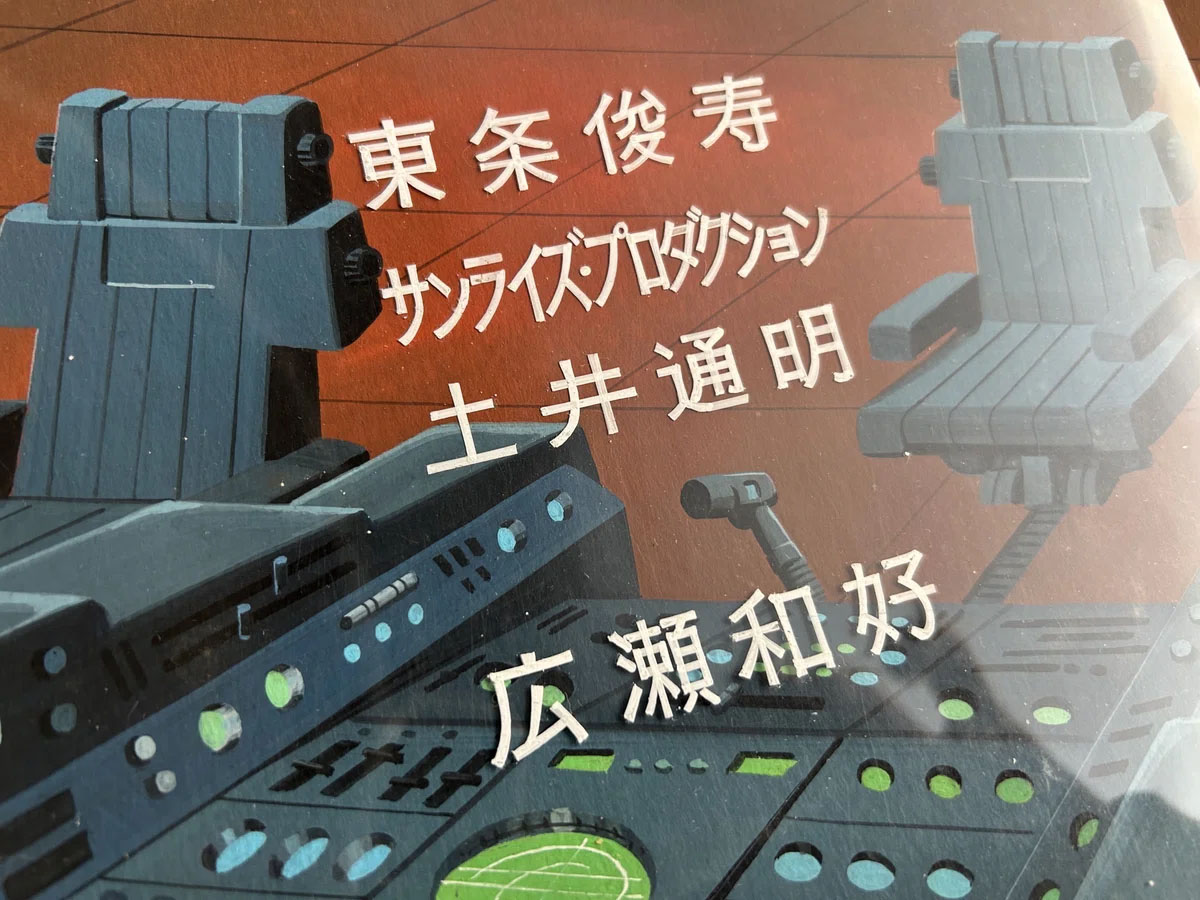
A photograph I requested and received as a keepsake immediately after the credits sequence had been filmed. The nameplate section, which changes with every installment, is handwritten, one by one, for each individual piece.