
Mecha Designer Junichiro Tamamori’s Love for the Original Work and His Design Philosophy
by Mitsuru Anima
Published at Mantan Web, October 25, 2026. See the original post here
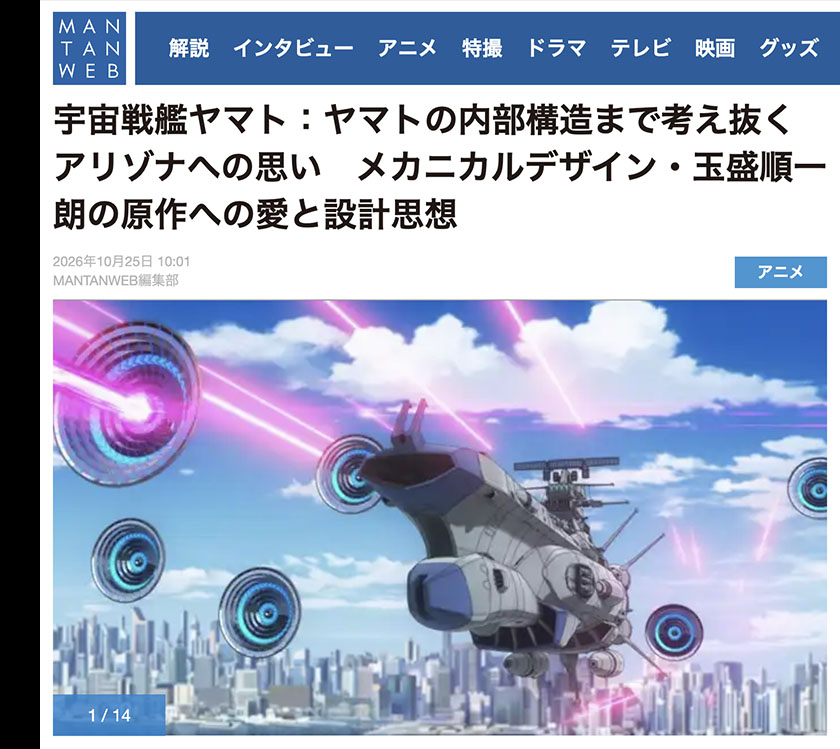
Junichiro Tamamori serves as a mecha designer for the remake series of the popular anime Space Battleship Yamato. He has been involved since the first installment, Yamato 2199, where he worked on designs including the Yamato itself. For the latest entry in the remake series, REBEL 3199, he has once again taken on the design of key mechanical elements, such as Arizona.
As a boy, he was captivated by the original Yamato series, which left a profound impact on him. While working as a product designer, he remained active in Yamato-related fan projects, a dedication that eventually led to his appointment as a designer for the remake series, fulfilling a long-held dream. We spoke with Tamamori about his passionate devotion to Yamato and his approach to the mecha designs for REBEL 3199.
The “Omnidirectional Radar Room” Was Already Envisioned During the Production of 2199
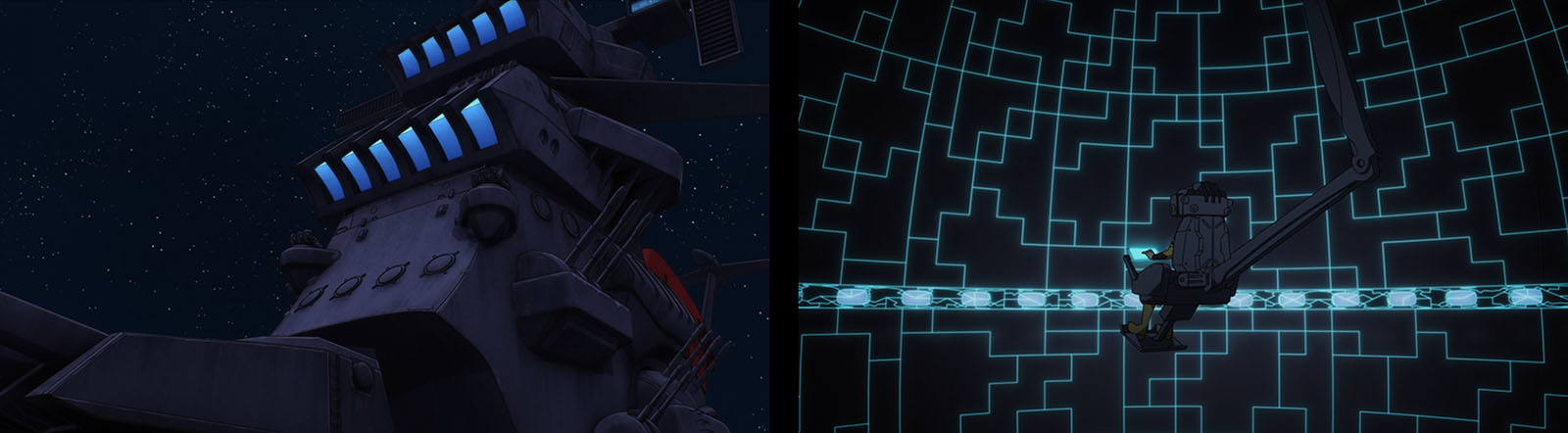
In May 2025, a remark made by Tamamori during a “Yamatalk” screening event for REBEL 3199 Chapter 3 (focusing on mechanical design) came as a surprise. The third chapter introduced a new piece of equipment: the “Omnidirectional Radar Room.” This feature, which first appeared in the original Be Forever Yamato (the inspiration for REBEL 3199), is positioned in the REBEL 3199 version of the ship directly beneath the second bridge, between decks 5 and 6.
Tamamori explained that he conceived the concept and dimensions for the spherical radar room. When the topic of its location came up, he noted, “It’s positioned to cut through decks 5 and 6. I had actually left that space open back during the production of 2199, figuring that if a spherical radar room were to be included, this would be the logical spot for it. Out of respect for the original work, it was something that simply had to be done.”
Although the spherical radar room was an add-on feature in the original series, Tamamori anticipated its inclusion, and even mapped out its internal structure, as far back as when he first designed the ship for 2199.
“If you look at the books and journals released around the time of Yamato III, you can find diagrams of Yamato‘s internal structure. When we began working on the remake series, I thought, ‘If a spherical radar room were to appear in the future, this would be the most natural place to house it,’ so I made sure to account for the necessary framework and structural layout in advance.”
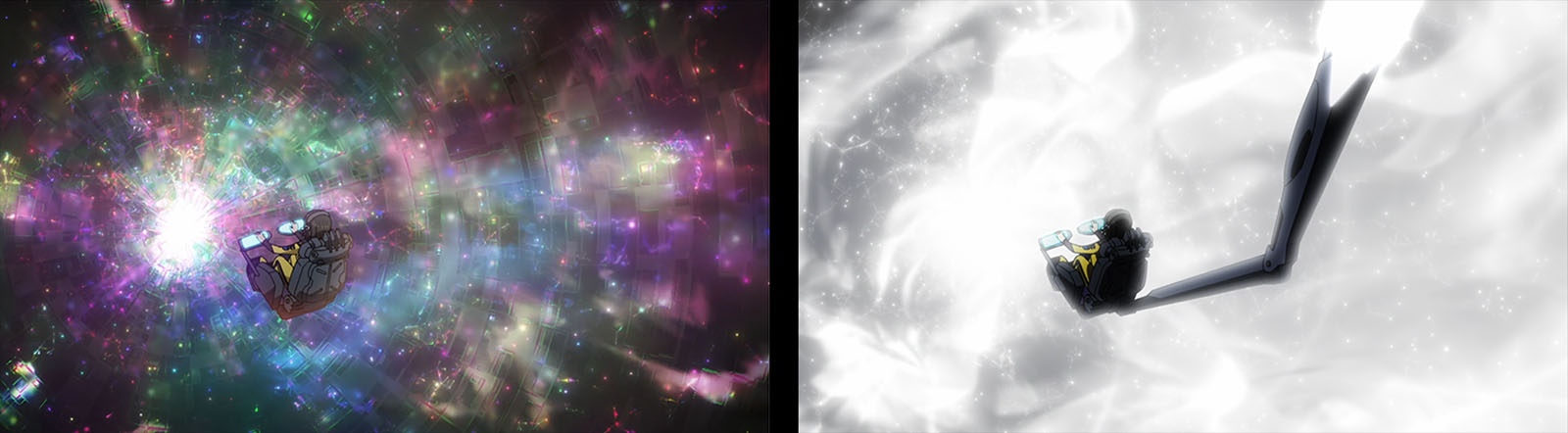
“At the time, there was no decision to remake Be Forever, so I wasn’t specifically asked to design the ship with a spherical radar room in mind. It was simply the result of pursuing a design with an inherent, logical structure. Personally, though, I did harbor a hope that we would eventually remake Be Forever as well.”
Tamamori’s words are filled with love and respect for Yamato. With his background as a product designer, his approach to design is rooted in both a logical, functional mindset and a deep affection for the source material.
“Since we also consider the potential for creating physical models, such as plastic kits, my experience as an industrial designer has likely proven quite useful. Even for mecha that will be animated using 3DCG, the design will fall apart if the underlying ‘structural frame’, the skeleton and internal configuration, isn’t properly established. Think of it like a human figure: you need a solid foundation, such as a skeleton and muscles, which then supports the outer armor and final design. Because Yamato is a massive structure, I pay meticulous attention to the design to ensure that, when scaled down, it doesn’t lose its integrity or end up looking small.”
The designs are solidified by combining hand-drawn sketches with the use of 3D software.
“Looking back at 2199, everything began with hand-drawn blueprints. I would carefully check the proportions, scan the drawings, and then import them into 3D software to build a rough three-dimensional model. I produce a vast number of hand-drawn sketches. Rather than relying solely on mental visualization, I find it essential to draw things repeatedly, letting my hands ‘learn’ the forms until the shapes become intuitive.”
Presenting a design for a new generation
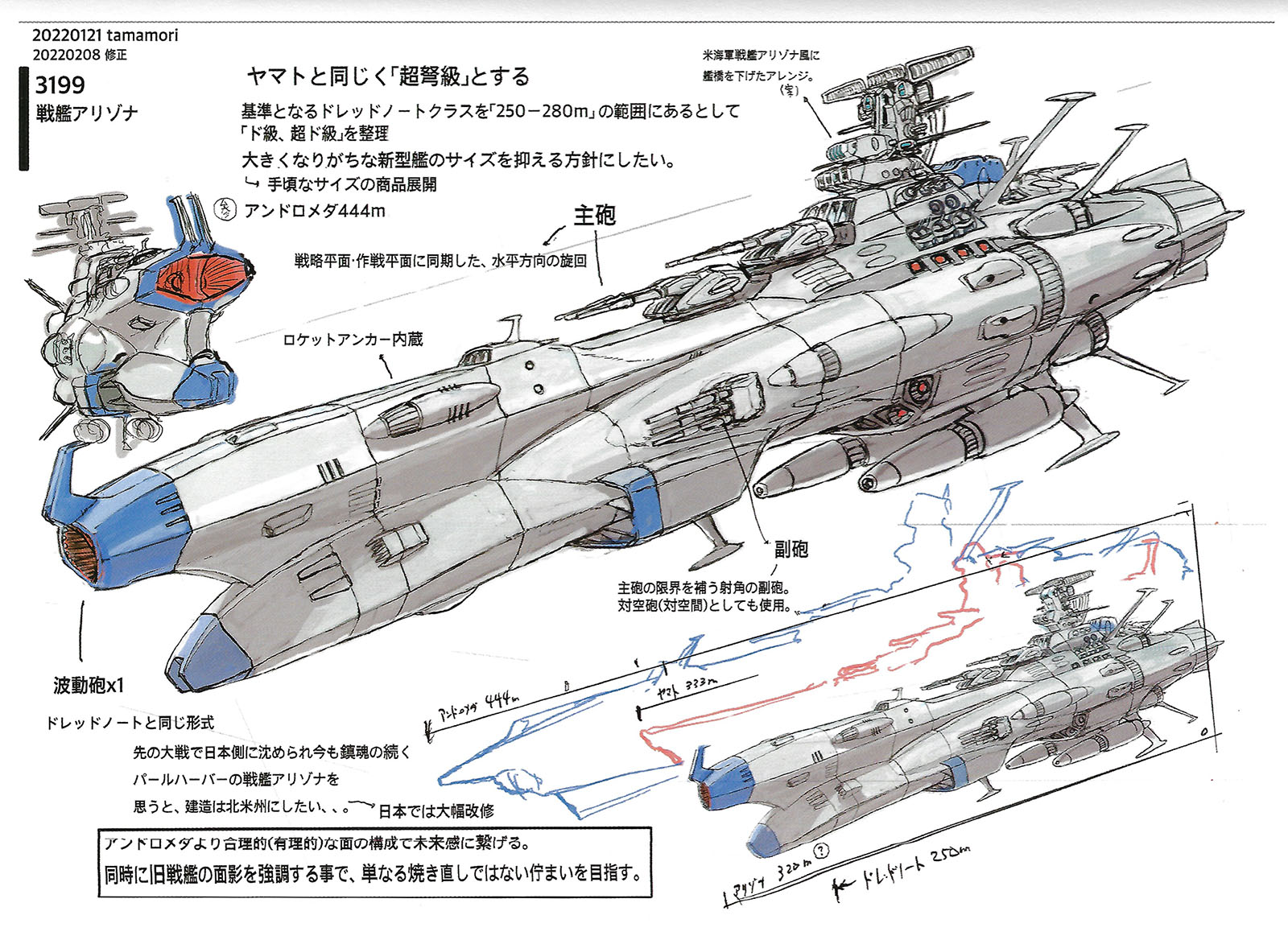
In 3199, the appearance of Arizona, designed by Tamamori, has also become a topic of discussion. Arizona is an Earth Defense Force space battleship that previously appeared in Yamato III. In 3199, the initial construction of Arizona took place at a North American space naval shipyard. It was then transported to the ‘New Capital’, partly as a test run, where it is currently undergoing outfitting at the Nanbu Heavy Industries shipyard.
“In the original work, Arizona was established as having been built in the United States. However, in 3199, it is depicted as having been fitted with its weaponry in Japan, which came as a surprise to me. While the story portrays the crew of the Yamato as exclusively Japanese, that doesn’t mean other people weren’t out there. Just as a foreign scientist appeared in Yamato III, there must have been various groups of people living their lives all across the globe. Given the dynamic premise of the original, in which the battleship Yamato is converted into a space battleship, it seemed only natural to assume that, while Yamato was being constructed on Earth in the year 2199, the Americans were simultaneously building Arizona as an escape vessel.”
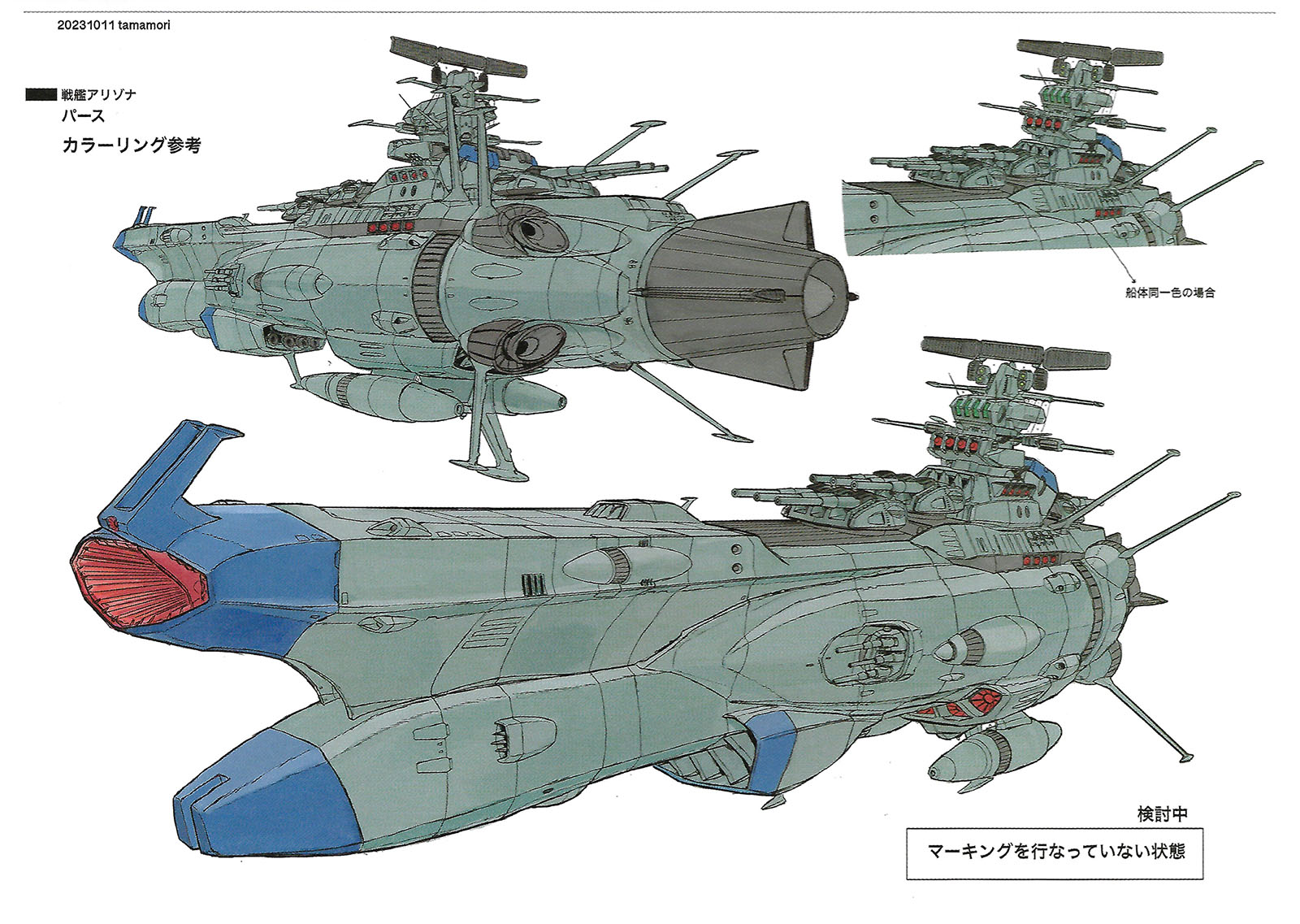
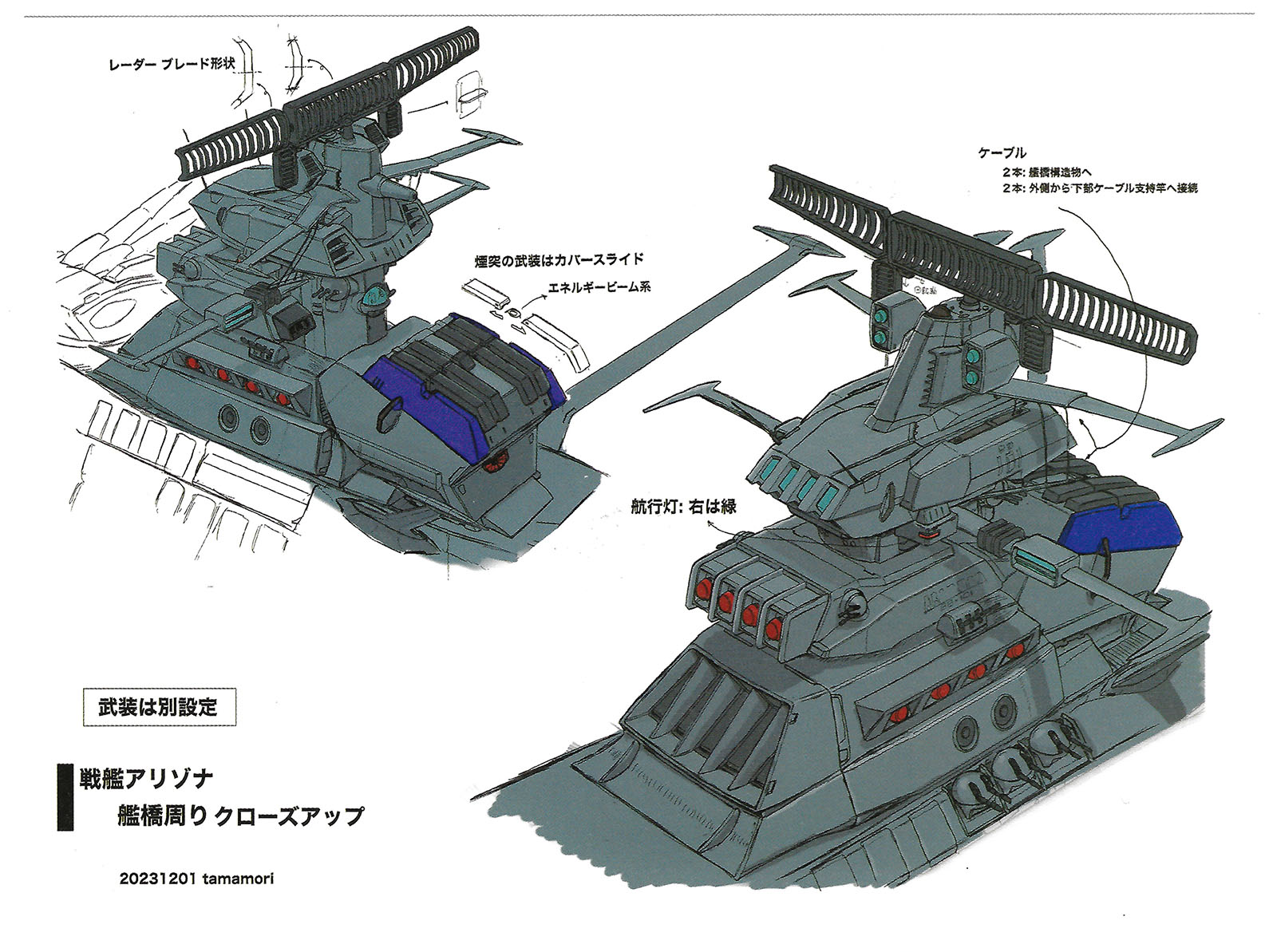
Arizona was designed based on the settings from both the original work and 3199. Tamamori’s personal passion for Yamato is woven into the design of Arizona.
“While the finalized design sketches for Arizona from the original work, bearing Yutaka Izubuchi’s signature, are the most well-known, it appears that designs by Katsumi Itabashi also exist. This suggests a process of significant trial and error during production. Consequently, rather than simply recreating the finalized design with a modern aesthetic, I took into account what both designers likely intended to express. Moving beyond a mere reproduction of the past, I decided to adapt the design for a new generation.”
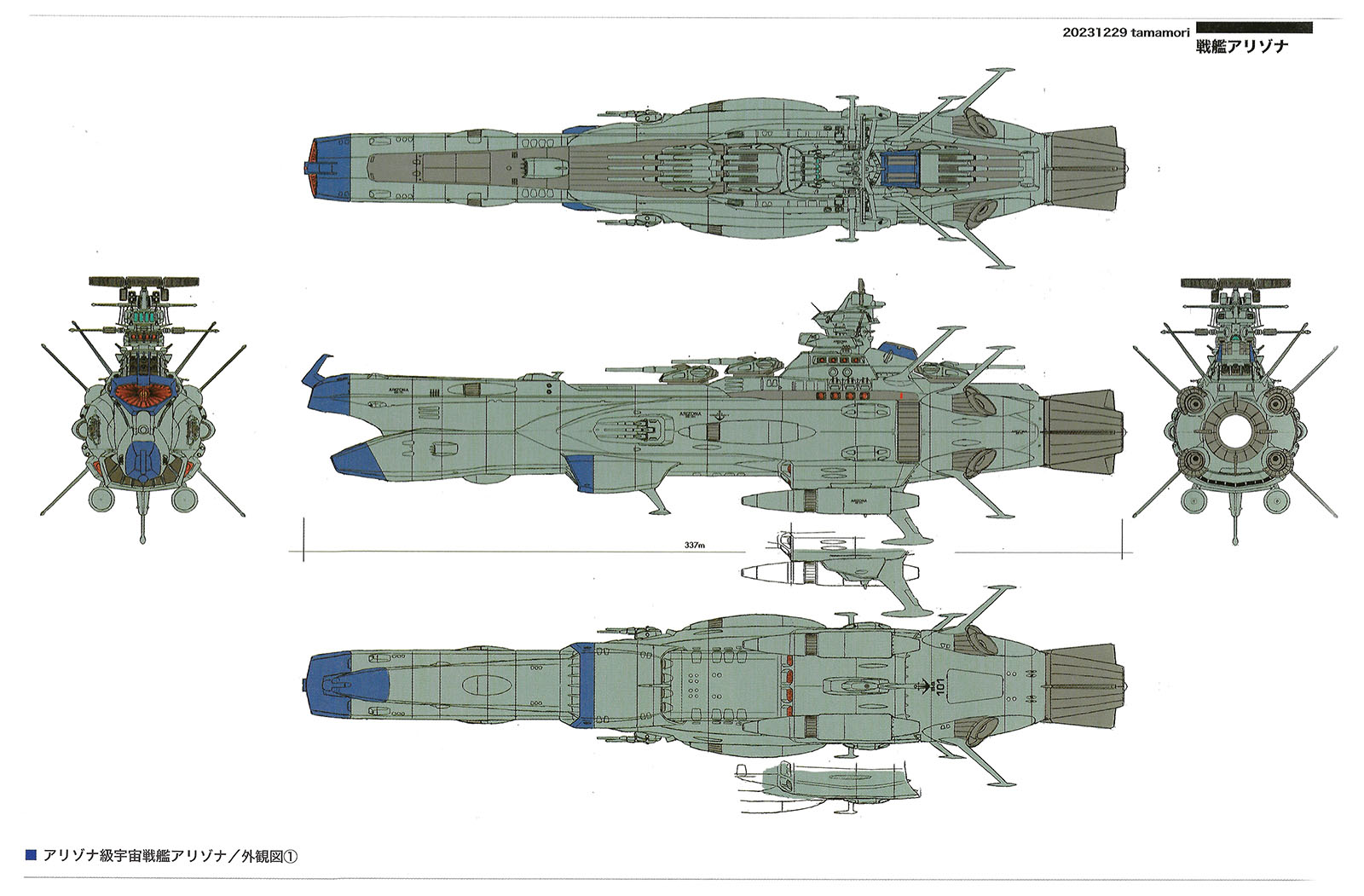
“Children who grew up watching 2199 alongside their parents have now become adults themselves. I wanted to offer a mecha design that appeals not only to the nostalgia of long-time fans but also to this new generation. The key feature for this new-generation design lies in the form of the main gun turrets. The overall look and the detailing of various components give it a special, distinct presence, elevating it beyond a standard mass-produced vessel. I also incorporated design elements and gimmicks that allow for customization, giving model kit builders the flexibility to configure it as different mass-produced variants.”
The appearance of “spatial magnetic plating” (a defensive barrier) as part of Arizona‘s armament in the teaser for Chapter 7 has also become a hot topic.
“Although I wasn’t the one who designed that specific feature, I was aware of the concept, that the Asuka-class ships would employ a mechanism to deploy a protective barrier. However, this idea was fleshed out only after I had finished my work on Arizona‘s design. When I was later shown the development materials for the plastic model kit, I was genuinely surprised, ‘So that’s how it turned out!’ The idea of deploying optical devices to create a defensive wall, in addition to firing the main guns, is visually striking and, in my opinion, a fantastic concept.”
Though Arizona did not see much action in the original work and ultimately vanished, it remains a ship that continues to be cherished by fans.
“To be honest, I didn’t have that strong an attachment to it back then (laughs). When Yamato III was airing, I was busy with things like cram school and the Boy Scouts, so I couldn’t watch every episode as it aired. We didn’t get a home VCR until two years later. It wasn’t until much later, after reading books like the Roman Album series, that I realized, ‘Wow, what a cool ship this is!’ In the series itself, it sinks without ever really getting a chance to shine. However, through my interactions with fans and fellow creators, I learned that many people hold a deep affection for Arizona and truly wish it had been given a more prominent role. It was precisely because I encountered such passionate feelings from these fans and mentors that I was able to revisit Arizona for this project.”
The Impact of Space Battleship Yamato
Tamamori has been captivated by Space Battleship Yamato since he was a child.
“I was in elementary school when the original series aired. Back then, information about anime wasn’t as readily available as it is today, but I would hear things from friends who had older siblings. It felt like I was getting a glimpse into the world of the older kids, a bit like trying to act more grown-up, and I was completely hooked.”
“I have a particularly vivid memory of the episode featuring the floating continent. I was so struck by the sight of a round rocket engine nozzle on the stern, the realization that adding a round nozzle can turn any ship into a spacecraft, that I clearly remember drawing a huge picture of Yamato on the classroom blackboard with my friends the very next day.”
Even as a child, he was fascinated by details and structural design, an interest that continues to shape his work today.
“One of the compelling aspects of Yamato is that the interior of the ship serves as a living space for humans. I was deeply drawn to the camera work and the staging, which conveyed a vivid sense of three-dimensional space. Later, I pored over detailed reference books until they were worn to tatters. When I revisited the vast collection of design sketches from the original series as an art student, I was struck by the realization: ‘Such an incredible depth of design work was happening behind the scenes!'”
Even after embarking on a professional career in product design, his passion for Yamato remained undiminished.
“While working in industrial design, I continued to create my own illustrations and design concepts for Yamato. Influenced by my interest in the stories of Yukio Mishima and Kohei Tsuka, I began an experiment: rather than jumping straight into drawing, I would first describe the space and the situation in writing. For instance, I might write a text description, such as ‘maintenance crew from the Earth fleet, having reached the outer reaches of the solar system, are working together to service the ships’, then create sketches based on that, and return to the text again, repeating this cycle. By using text as a kind of ‘design specification,’ I could expand upon my vision before translating it into actual designs. This text-based approach became a vital form of training for my current design process.”
Tamamori’s designs are logical, yet they seamlessly integrate the passion and sense of wonder he has nurtured since boyhood. It is precisely this fusion that gives his work its unique, compelling, and overwhelmingly persuasive quality.
“There was a time when it was quite difficult to get hold of Yamato plastic models or books. I even felt a sense of crisis, a fear that the brilliance of Yamato might eventually be forgotten. That’s part of why I continued my own personal research. I have always felt a strong desire to preserve the science-fiction aesthetic established by the great creators of that era, Leiji Matsumoto and his peers, and pass it on to the next generation.”
Space Battleship Yamato never truly ends. Tamamori and his colleagues, having inherited this passionate vision, are now working to pass the baton to the generation that follows.
“When the remake series began with 2199, I never imagined it would continue for this long. I am truly grateful to have been able to work with the mecha designs of Yamato for such an extended period. It would be fascinating to see not just the main story, but perhaps some short spin-off works that focus on other ships or characters within the Yamato universe. I would love to see some side stories set within the vast world of Yamato someday.”