
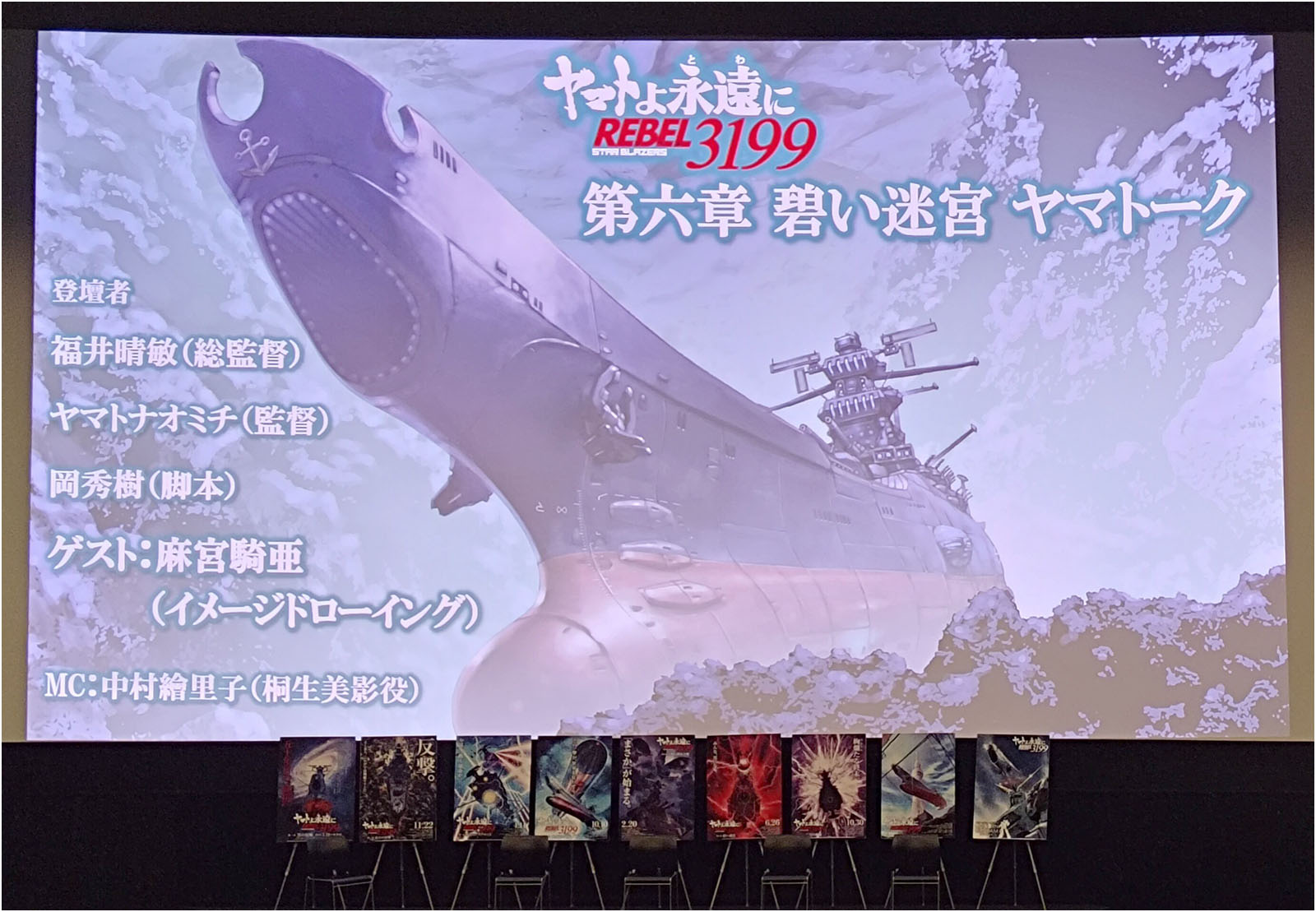
Photo posted on Twitter by cfap2220
REBEL 3199 Chapter 6 Yamatalk official report
Published at the official website. See the original post here
■ Date/Time: July 21 (Tue), 20:55–21:40 Stage greeting held after the screening
■ Venue: Shinjuku Piccadilly
■ Speakers: Kia Asamiya (Image Drawings)
Harutoshi Fukui (Chief Director)
Naomichi Yamato (Director)
Hideki Oka (Screenplay)
Eriko Nakamura (Moderator / Voice of Mikage Kiryu)
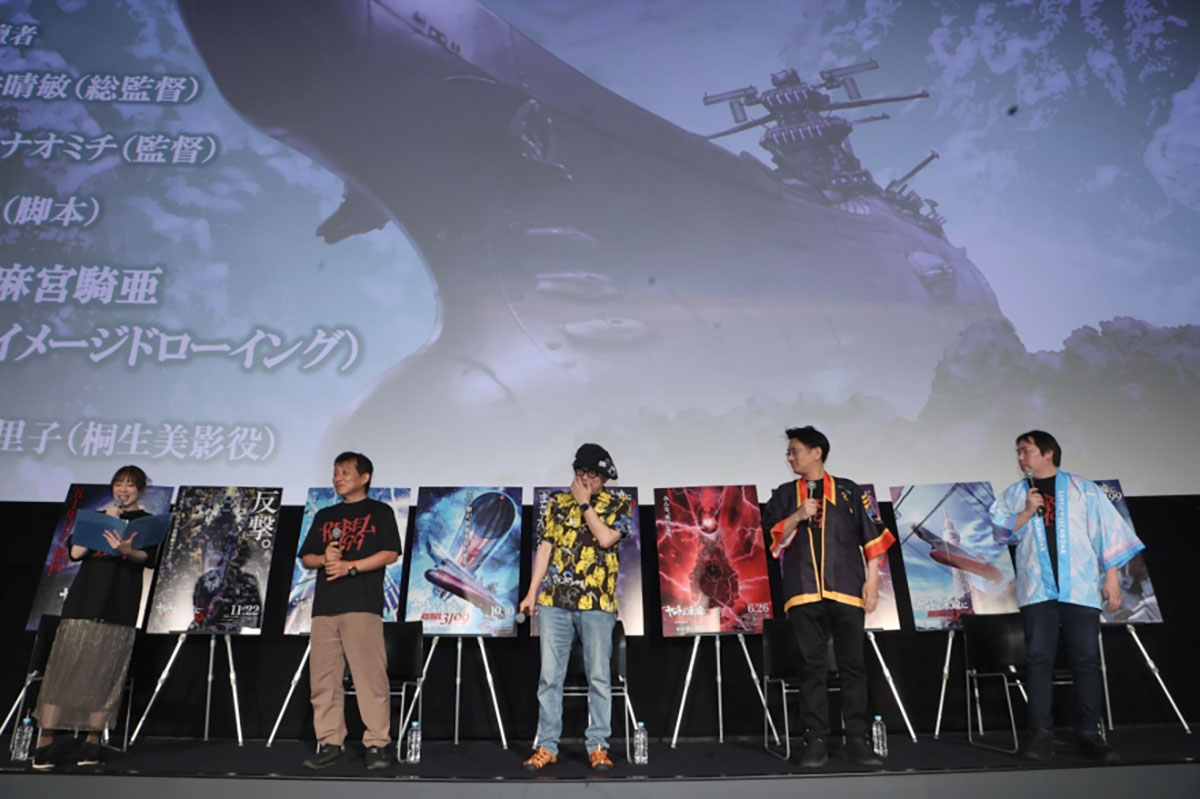 L to R: Eriko Nakamura (MC), Hideki Oka (scriptwriter), Kia Asamiya (guest),
Naomichi Yamato (director), Harutoshi Fukui (general director)
At the start of the event, posters were impressively lined up on stage featuring the teaser visuals for Chapters 1 through 7, all created by Kia Asamiya. The moderator, Eriko Nakamura, was momentarily captivated by the sheer impact of the display, remarking, “It’s breathtaking…”
Coincidentally, the event took place on July 21st, the same date Yamato appears in the skies above Shinjuku Piccadilly in Chapter 6. Chief Director Fukui addressed the audience, asking, “I imagine some of you visited the ‘sacred sites’ today to mark the occasion. I hope you managed to avoid heatstroke.” Smiling, he revealed, “Actually, this is my favorite day of the year because it’s the day summer vacation begins. Things have changed now that we have ‘Marine Day,’ but back in the day, school summer break always started on July 21st. I felt that if we were going to choose a glorious day for Yamato to make its appearance, this was the perfect choice.”
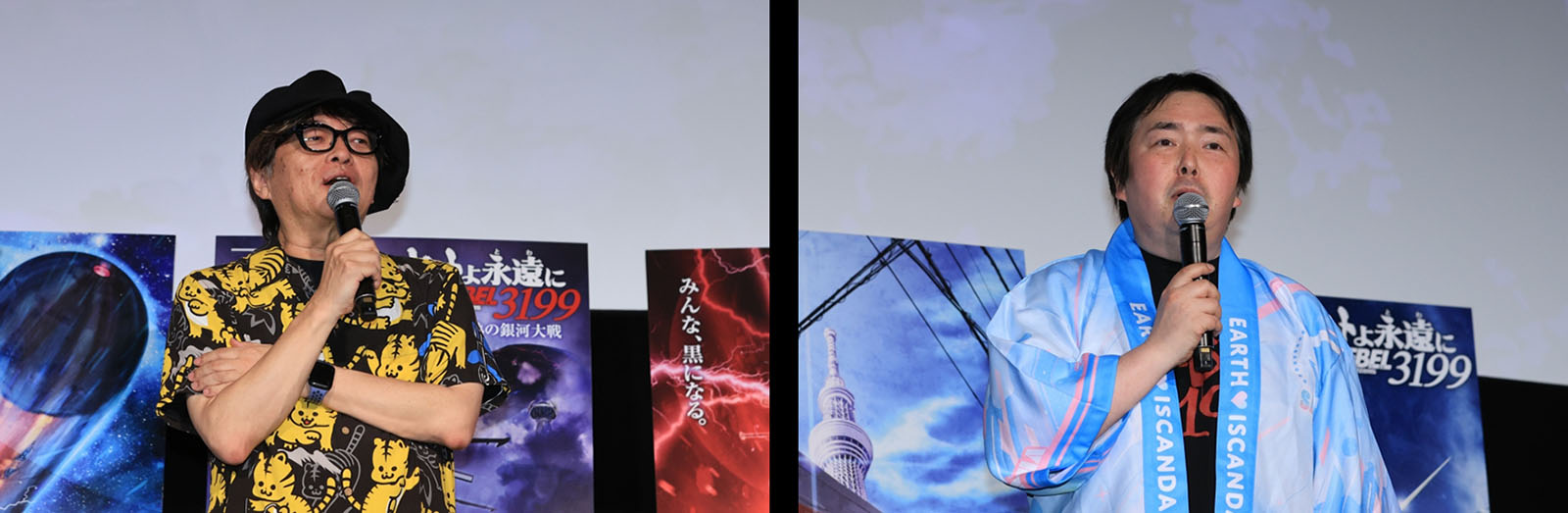 Kia Asamiya and Harutoshi Fukui
The guest for the day’s Yamatalk was manga artist and illustrator Kia Asamiya, who has worked on concept art and other visuals for the series. “I’ve finished the teaser visual for the final chapter (Chapter 7), so my work on 3199 is completely wrapped up. This might actually be my last job on the project,” Asamiya remarked.
When Chief Director Fukui teased him by saying, “You never know what might happen down the line,” Asamiya revealed his enduring love for the franchise, replying, “Well, if it’s work for Yamato, I’d certainly do it.”
Regarding the creative process behind the teaser visual, Asamiya revealed, “I draw everything based on instructions from Mr. Fukui, things like ‘make it look something like this.'”
Chief Director Fukui immediately responded, “But what he delivers every time is about fifteen times richer than what I had in mind,” demonstrating the absolute trust he places in the artist.
The event offered a chance to delve into the behind-the-scenes details of the concept art created by Asamiya himself. The discussion began with the teaser visual for the momentous first chapter. While Chief Director Fukui’s instruction was simply to “create a visual that follows the style of the original work’s poster,” Asamiya incorporated his own unique touches.
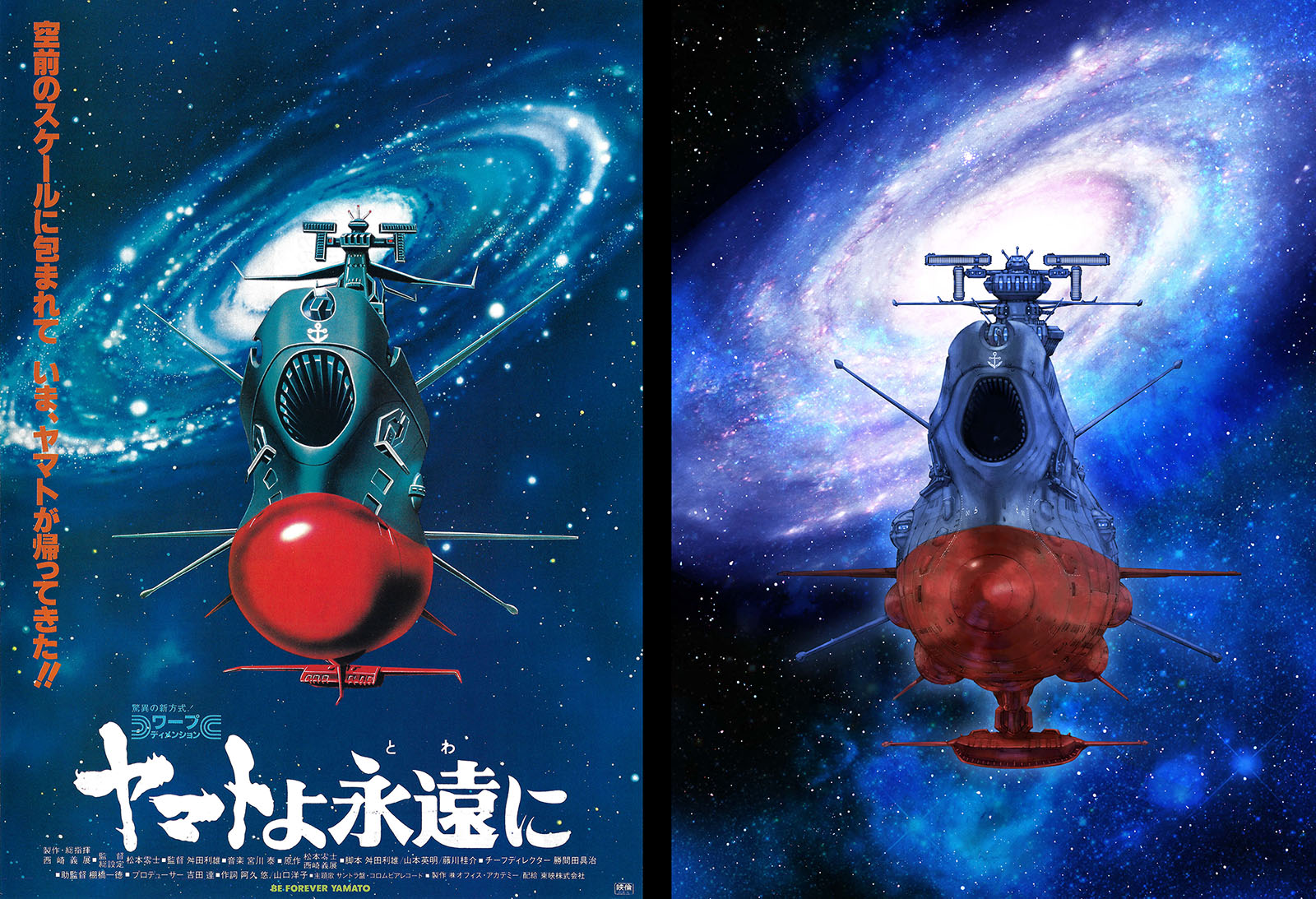
“Actually, Yamato‘s first bridge and the third bridge located beneath it are slightly misaligned,” Asamiya revealed. “Normally, they should form a straight vertical line from the main elevator, but if you look closely at the poster for the original Be Forever Yamato, you can see they are offset. Matching that detail was a little secret pleasure of mine.” He added proudly, “In fact, Hideaki Anno even praised this poster, telling me it was fantastic,” a remark that drew an enthusiastic reaction from the audience.
While the mecha in the actual film are rendered entirely in CG, Asamiya’s illustrations are all hand-drawn. His process involves scanning a finished drawing, rendered with a mechanical pencil, and then processing it in Photoshop. Oka expressed his admiration, noting, “It’s amazing to have the original hand-drawn art remain. In another fifty years, you could hold a comprehensive exhibition of the entire collection.”
Chief Director Fukui also recalled the impact he felt when he first saw the completed visual. “I thought it might not work at first,” he said with a smile. “From a 3D consistency standpoint, the image doesn’t quite add up. Viewed from that low angle, the first bridge shouldn’t be visible at all. We’ve grown accustomed to modern CG workflows, yet the request was essentially, ‘We want you to draw it, even if it means bending the rules of reality.’ I felt Asamiya-san was the only one who could pull that off, and he delivered this piece on the very first try. I was truly delighted.”
The second piece selected was the teaser visual for Chapter 2, featuring the striking tagline “Counterattack.” Asamiya held a special attachment to this particular image. “Actually, I had just undergone cataract surgery around that time. I couldn’t use my eyes for several months, and this poster was the first time I drew Yamato after recovering. So, on a personal level, I really resonated with that theme of a ‘counterattack.'”
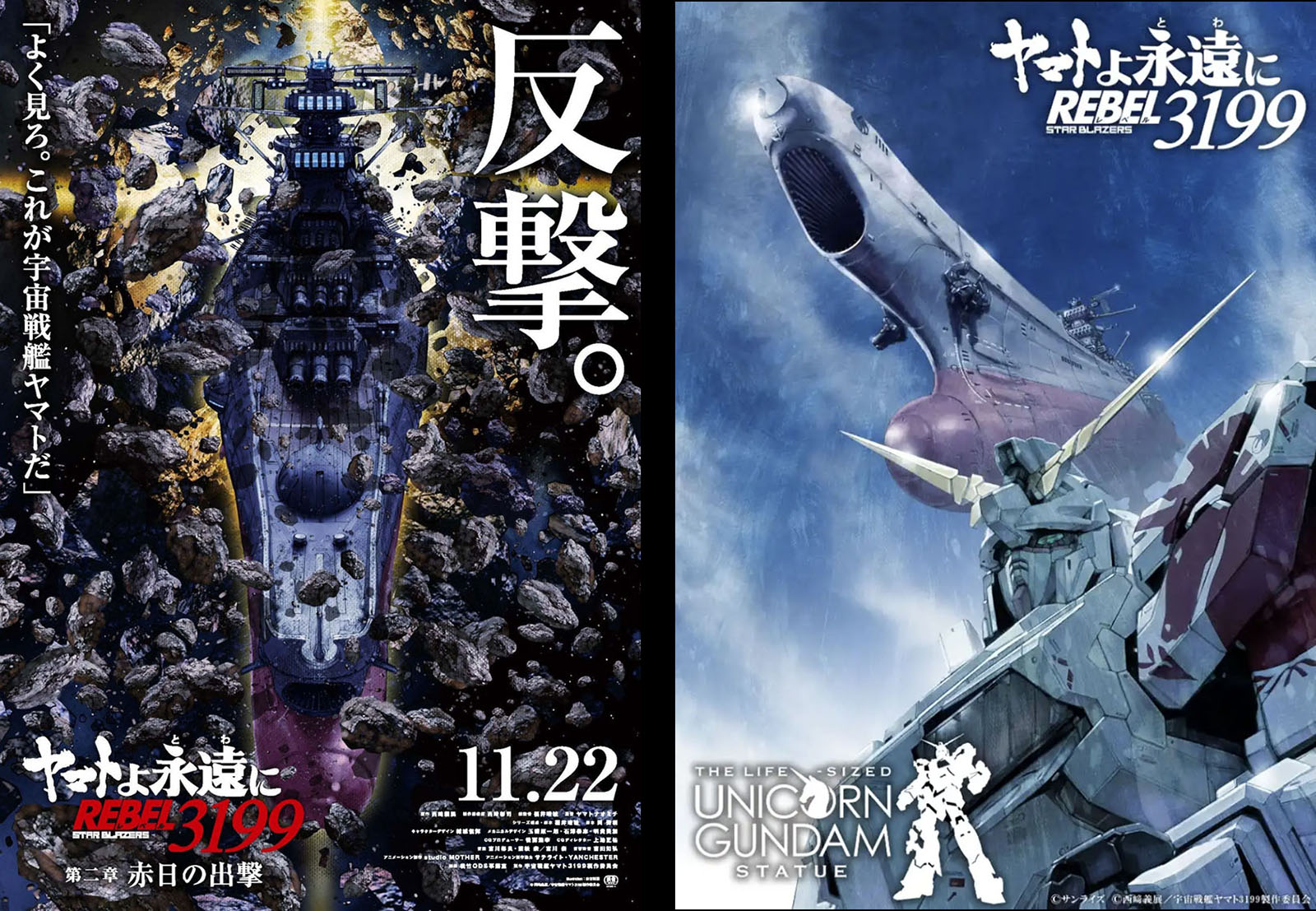
Then he revealed something that surprised the audience: “There was also a massive mistake in the poster initially: the first bridge only had four windows. No one had noticed it, but I spotted the error while making adjustments to the asteroids. I hurriedly drew in an extra window to fix it.”
The event also covered the story behind a collaboration visual featuring the life-sized Unicorn Gundam statue in Odaiba, which appears in the film. “I actually went to Odaiba to do the research for this one,” Asamiya said with a laugh. He also explained that the statue currently on display features new decal markings in preparation for its grand finale at the end of August, noting, “This version includes those markings.”
Furthermore, storyboards Asamiya created for the production were also unveiled. “Basically, I just read the script and draw the images exactly as I picture them in my head. When I’m deeply involved as a core staff member, I might tweak the script, but when I’m brought in as a guest to handle storyboards, I make a conscious decision to stick to the script as written,” Asamiya explained.
Oka responded with genuine appreciation: “Both Fukui-san and I grew up watching anime, so when we’re writing the script, we already have images in our minds, like how the camera work might look. We write while thinking, ‘This should have the taste of Final Yamato‘ or ‘This leans more toward the Resurrection style.’ But when Asamiya-san works on it, the result is completely different from what we imagined. It feels like a sudden leap into modern anime style. That was a really pleasant surprise.”
Director Yamato also shared a dilemma unique to working with Asamiya’s storyboards: “We proceed by discussing which scenes to select. So, while I want to use as much of his work as possible, it’s truly painful when we have to cut parts to fit the runtime.”
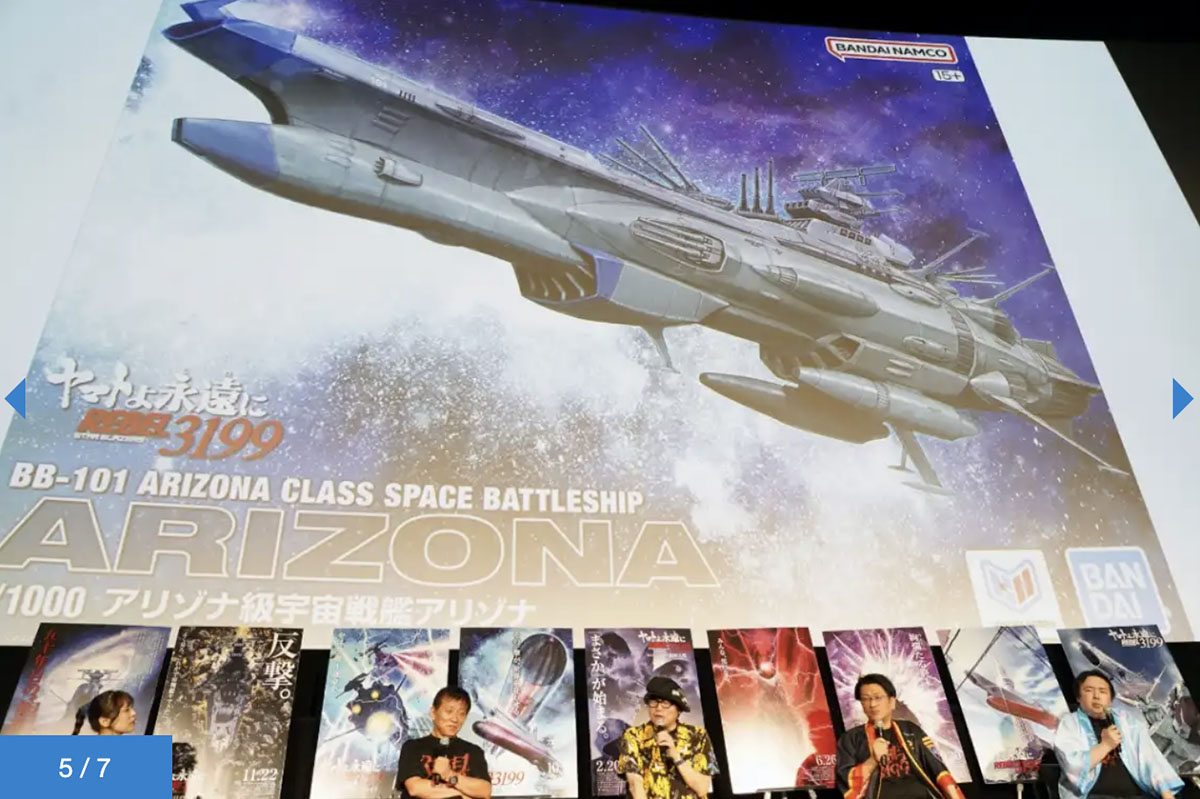
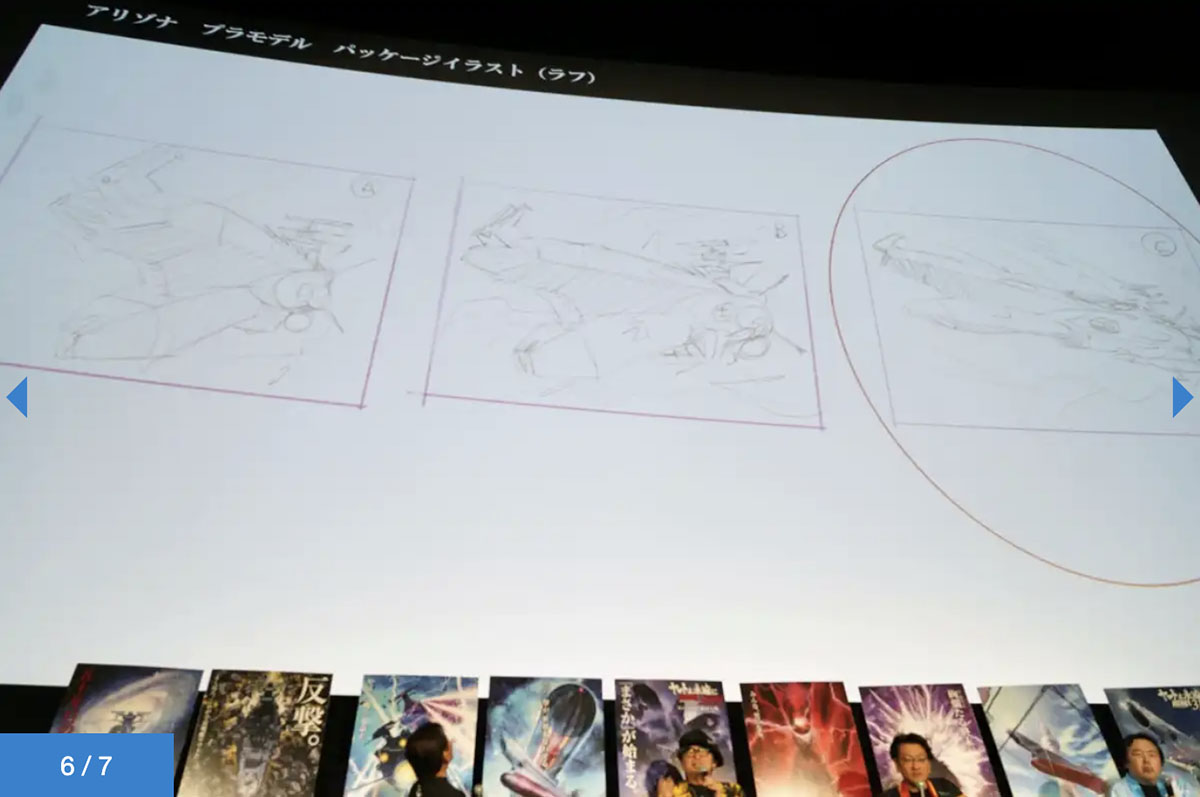
The conversation then shifted to the package art for the 1/1000 Arizona plastic model. The audience listened with keen interest as the story behind the artwork unfolded: despite a request for a “classic angle,” Asamiya deliberately proposed a rough sketch that paid homage to the weighty, iconic illustrations created by Studio Nue artists like Kazutaka Miyatake and Naoyuki Katoh, a concept that was ultimately adopted.
Amidst this, Asamiya dropped a bombshell confession that brought the house down. “Actually, about a year ago, I realized that it’s better to use a ruler when drawing a battleship’s main guns,” he blurted out, sending the audience into peals of laughter. “I’ve hated using rulers ever since my days as an animator. I’ve always drawn freehand. I also discovered something else: when it comes to a battleship’s main guns, once you create one, you can just copy and paste it.”
Then, toward the end of the event, the words “Major Announcement” flashed on the screen, sending the excitement in the venue to a fever pitch. The crowd erupted when it was revealed that an Asamiya art book titled Complete Works Art Archive: Wadatsumi, featuring illustrations related to Space Battleship Yamato, was officially in production.
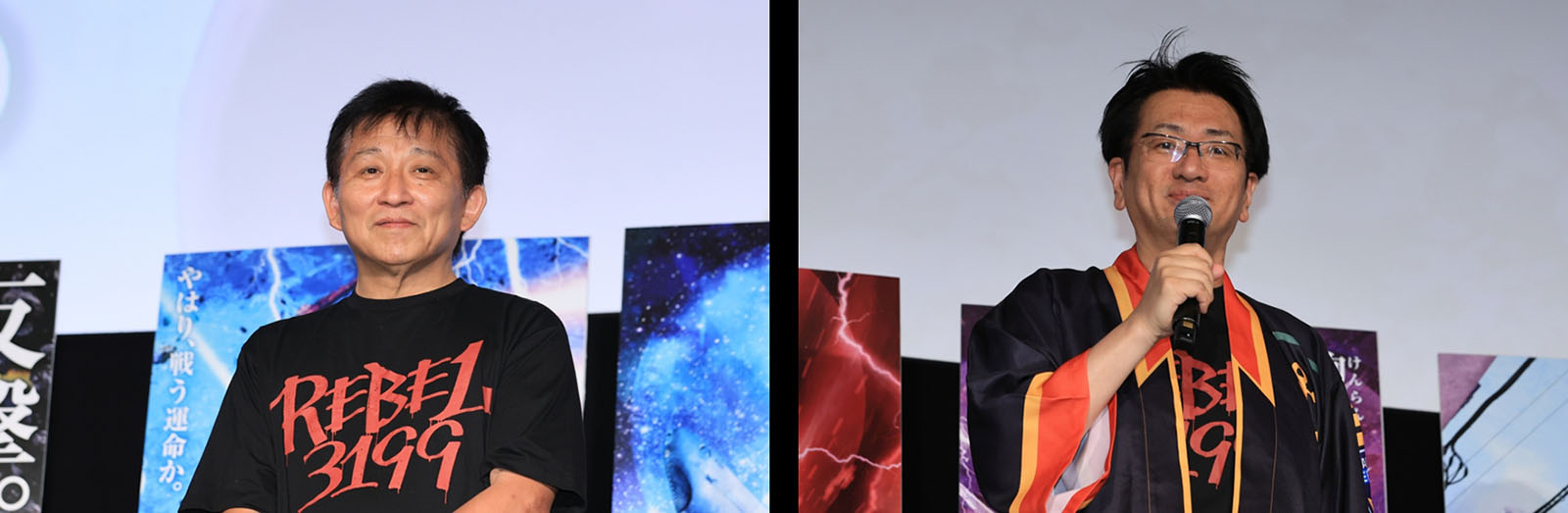
Hideki Oka and Naomichi Yamato
“I never imagined I’d be able to release an art book dedicated solely to Yamato,” Asamiya said. “It’s going to be a collection that packs in as much of my Yamato work as possible, original drawings, rough sketches, layouts, and more. I don’t know exactly when it will be released yet, but we’re looking into making it a truly deluxe edition.” He concluded with a message to the fans: “I’m so glad I could be the first to tell you all today that this art book is happening. Please get home safely, remember, the event isn’t over until you’ve posted your impressions on Twitter!”
Chief Director Fukui also wrapped up the event, saying, “Unfortunately, it seems Yamato didn’t appear in the skies above us today, but I feel like it was present right here in this venue. The entire staff is pouring their all into producing Chapter 7, so we ask for your continued support.”
Additional coverage from Mantan Web:
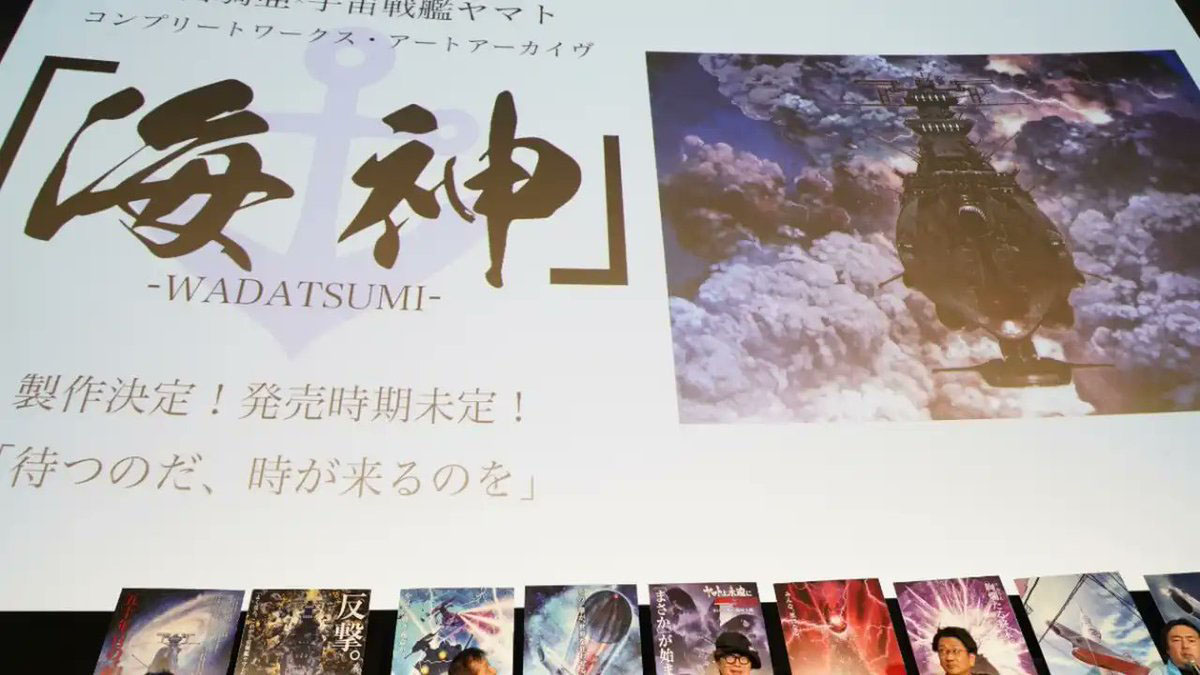
Kia Asamiya Art Book Wadatsumi Confirmed for Release – “We’re Trying to Pack Everything In”
See the original post here
It has been announced that an art book featuring Space Battleship Yamato illustrations by manga artist Kia Asamiya, known for works such as Silent Möbius and Steam Detectives, will be released. It is set to be titled Wadatsumi. Asamiya commented, “I’ve done a lot of work on Yamato, and I’m trying to pack it all in. I want to include as much as possible, such as rough sketches and original drawings from the 2199 ending, and I’d also like to release a super-deluxe special edition,” a statement that drew thunderous applause from the fans.
Asamiya has worked on image drawings, teaser visuals, and storyboards for Yamato 3199, and has also created package illustrations for plastic models.
Kia Asamiya Reveals His Commitment to Visuals, “Freehand Is Easier”
See the original post here
On July 21, a Yamatalk with artist Kia Asamiya revealed behind-the-scenes details regarding the creation of the Yamato 3199 teaser visuals and plastic model packaging art. Regarding the teaser visuals he has created so far, Asamiya said, “I basically draw them based on instructions from Mr. Fukui. I’m always anxious to see the reaction, but everyone is so kind, thank you!”
In response, Fukui expressed his appreciation for Asamiya’s work, noting, “What he delivers is always about fifteen times richer than what I imagined.”
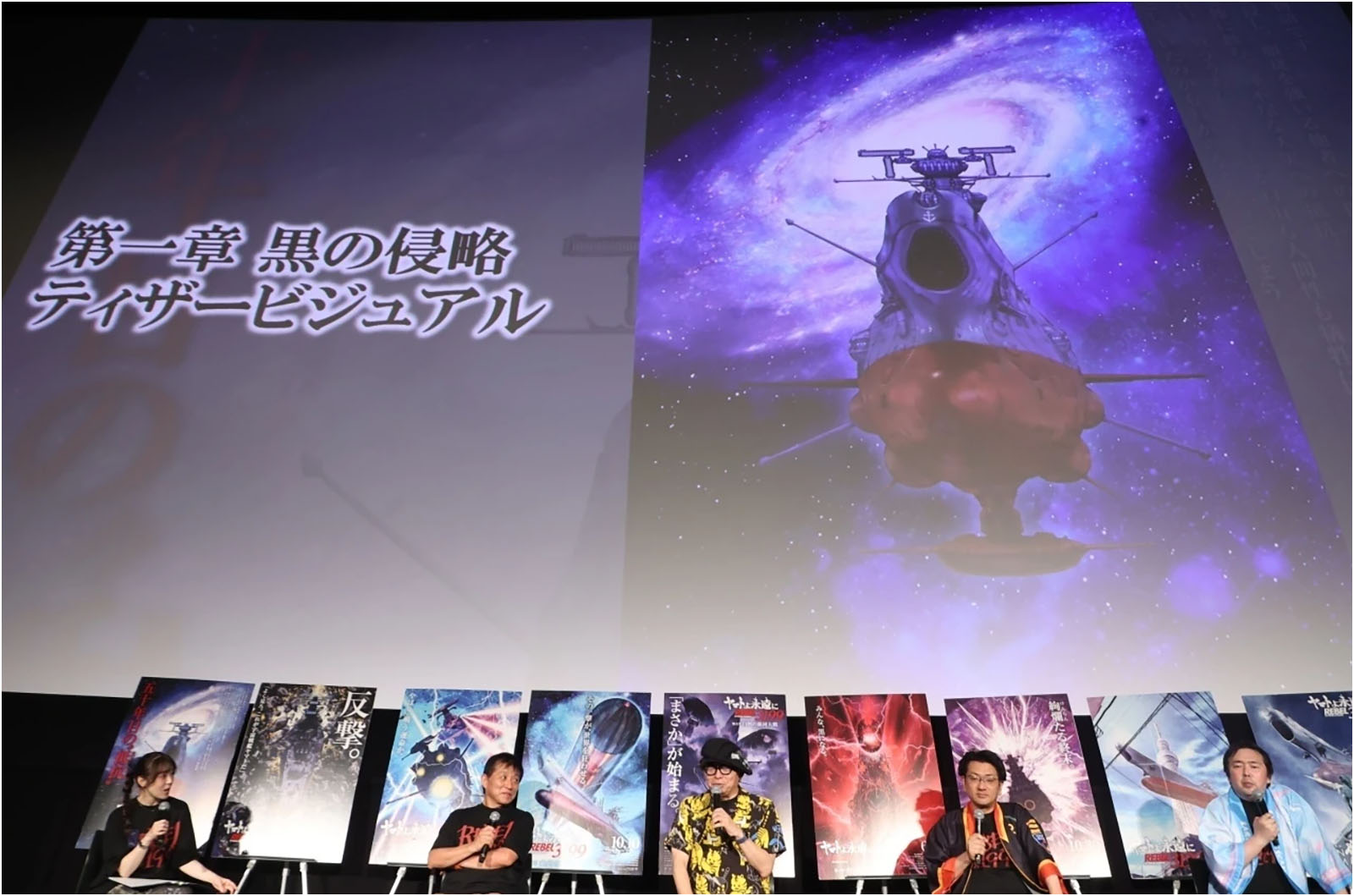
The event showcased the production process for the teaser visuals of Chapters 1 and 2. Discussing Chapter 1, Asamiya revealed, “The plan was to follow the style of Be Forever Yamato. It’s a specific detail I insisted on: the First Bridge and the Third Bridge are misaligned. That was intentional. The original design had that misalignment, and it’s a little secret pleasure of mine. Someone I know actually noticed it, Nobuyoshi Habara, to be exact.”
Although the mecha in Yamato 3199 are rendered using CG, Asamiya explained, “I basically draw them using a mechanical pencil. The mecha in the 2199 ending sequence were hand-drawn, too. I scan the drawings and add color in Photoshop.”
When Oka asked, “So you don’t use CG?” Asamiya replied, “I can’t. I actually started using CG quite early on, but I eventually decided that I prefer the analog approach,” highlighting his commitment to that style.
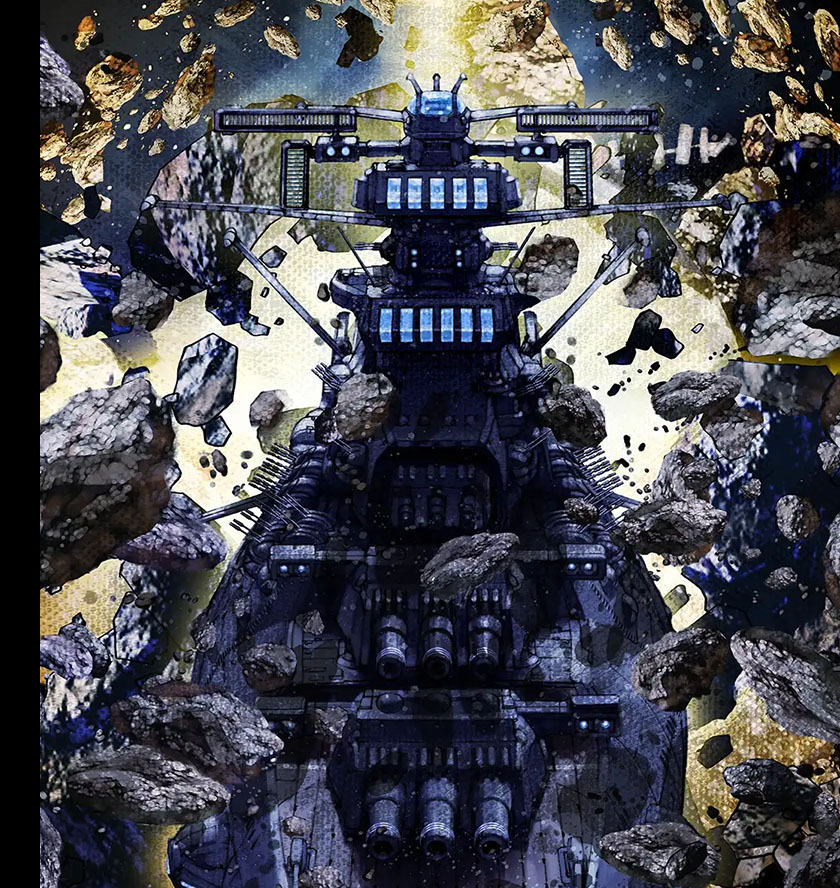
Regarding the teaser visual for Chapter 2, Asamiya shared a behind-the-scenes story: “I feel it turned out really well. There’s a tagline, ‘Counterattack’, and since I drew it after undergoing cataract surgery, it represented a personal ‘counterattack’ for me, too. There’s also the tagline, ‘Look closely. This is Space Battleship Yamato,’ but my sentiment was, ‘This is Asamiya’s Space Battleship Yamato.’ Initially, I was asked to revise it because there were too many asteroids. That’s when I realized I’d made a mistake. I had only drawn four windows on the bridge, not as an homage to the original, but simply by error. No one else noticed, but I hurriedly added the missing one. I used to create CG rocks using background-generation software, so for these asteroids, I took those base models and added hand-drawn details.”
Asamiya also created a collaboration visual featuring Yamato 3199 and the life-sized Unicorn Gundam statue. He reportedly visited the statue to study it before drawing the piece. Surprisingly, he notes that for any given visual, “the actual work takes about three days. I believe it shouldn’t take longer than that. My concentration wouldn’t hold out.”
Depicting Arizona from the “Classic Angle”
Asamiya handles not only visuals and concept art but also storyboards. When the script and storyboards he created for Episode 15 were projected on the screen, he explained his approach: “I read the script and draw exactly the image that comes to mind. When I come in as a guest artist, I basically don’t alter the script.”
Oka praised this work, saying, “When I write the script, I already have images of the camera work in mind. I’m a total traditionalist, thinking, ‘This part should lean toward Final Yamato and that part toward Resurrection,’ for instance, but what comes back is something completely different. It dives headfirst into modern anime styles, which both surprised and delighted me.”
When Mr. Fukui remarked, “When Mr. Asamiya handles the work, the final result surpasses the storyboards. Capturing those nuances on screen is difficult,” Mr. Asamiya smiled and replied, “I’ve actually retired as an animator. That said, I did work on a police robot series [Patlabor], though that was only because the great veteran Yutaka Izubuchi asked me to…”
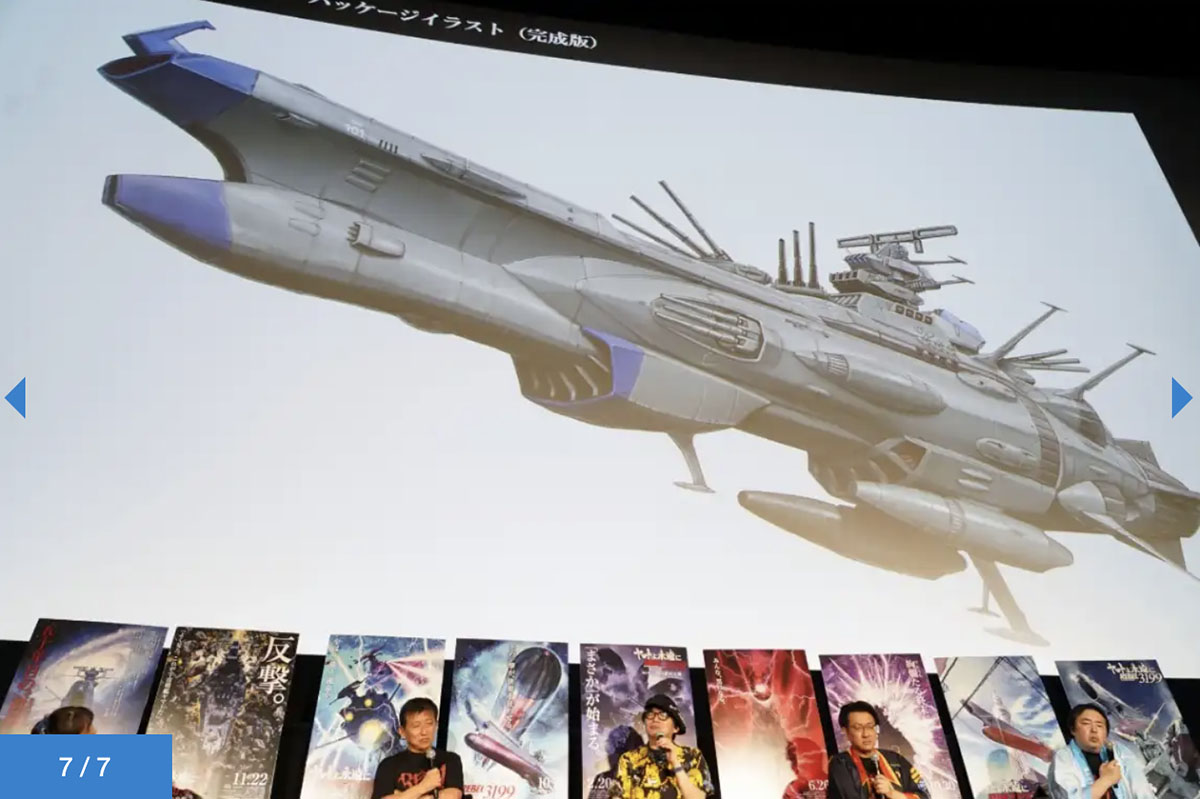
Rough sketches for the package art of the Arizona plastic model (Bandai Spirits), released in June, were also unveiled. Mr. Asamiya shared some behind-the-scenes details: “I submitted three rough concepts for them to choose from. They asked for a ‘classic, quintessential angle.’ I wanted to create an illustration with the same sense of solid, imposing weight found in the work of Studio Nue’s Kazutaka Miyatake and Naoyuki Katoh. I draw the line art using a mechanical pencil. It takes about half a day. I really want to convey that sense of hard, metallic solidity. Yamato illustrations by Miyatake and Katoh have such an incredible sense of solidity, it’s hard to believe they were drawn 50 years ago. I still have a long way to go before I can match that level of mastery.”
He also made a surprising admission: “I realized about a year ago that I should be using a ruler. Before that, I did everything freehand. Now I use a ruler for the main guns and antennas. It’s been 40 years since I started, but I’ve always disliked rulers since my days as an animator. Freehand is just easier. For the battleship’s main guns, I could just draw one and copy-paste it, I only realized that recently, too.”
It was also announced that an art book compiling Mr. Asamiya’s Yamato work will be released. Titled Wadatsumi (God of the Sea), the book aims to be comprehensive. “I’ve done a lot of work on Yamato, and I’m trying to pack it all in,” Mr. Asamiya said. “I want to include as much as possible, such as the rough sketches and original key animation drawings from Yamato 2199‘s ending sequence. I’d also like to release a super-deluxe special edition.”
His words were met with thunderous applause from the fans.
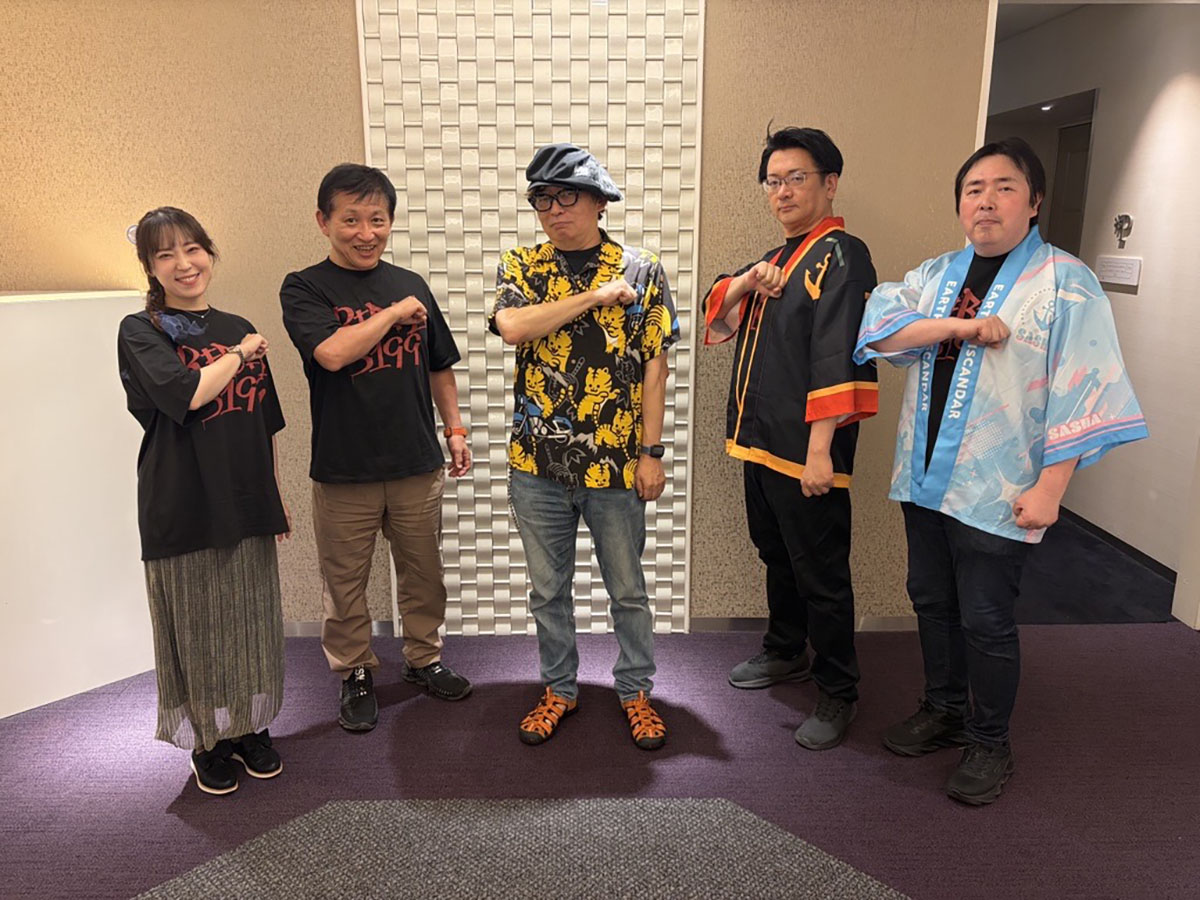
Backstage at the Shinjuku Piccadilly. Photo posted on Twitter by the Yamato Production Committee.