
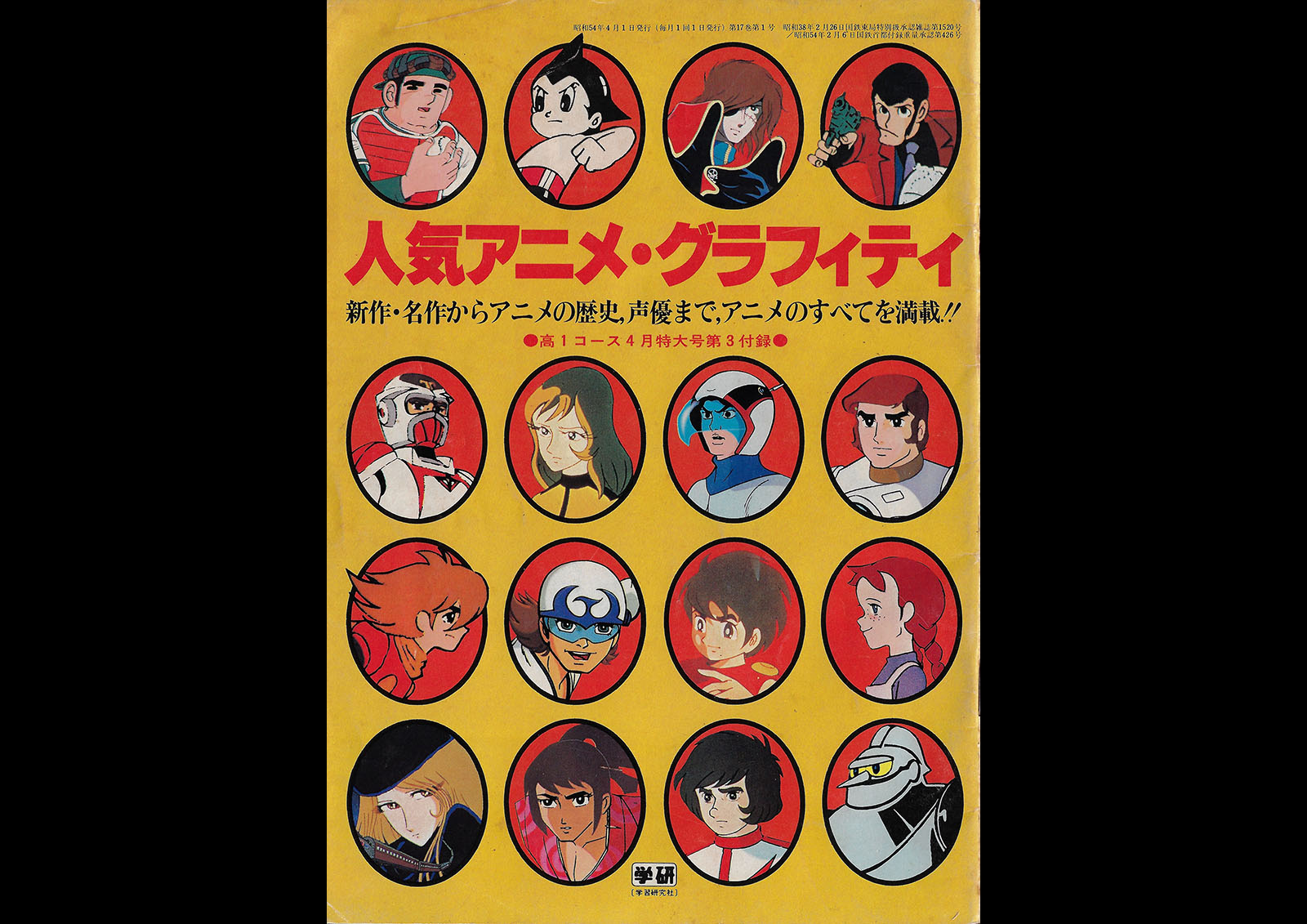
Popular Anime Graffiti
From new releases and classics to the history of anime and voice actors,
this is packed with everything you need to know about anime!
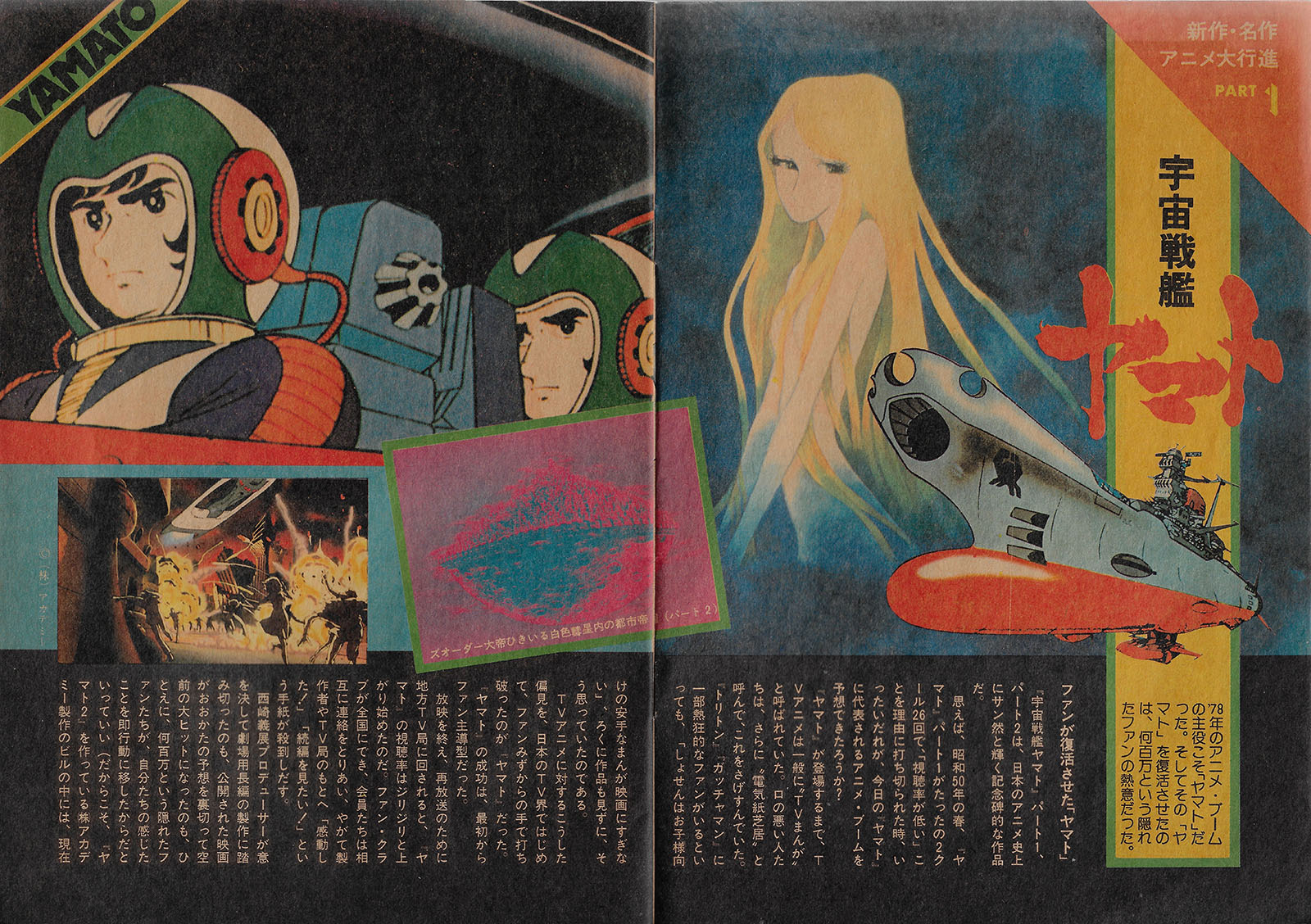
Space Battleship Yamato
The star of the 1978 anime boom was Yamato. And it was the passion of millions of hidden fans that brought Yamato back to life.
Yamato was revived by fans
Space Battleship Yamato Part 1 and Part 2 are monumental works that shine brilliantly in the history of Japanese animation.
Looking back, in the spring of 1975 when the Yamato series was canceled after only two arcs and 26 episodes due to “low viewership ratings,“ who could have predicted the anime boom exemplified by the Yamato that we see today?
Before the appearance of Yamato, TV anime was generally called “TV manga.“ Some cynical people even disparaged it by calling it “Electric picture show.“ Even though Triton and Gatchaman had some enthusiastic fans, “they were ultimately just for children,” they thought, or, “It’s nothing more than a cheap cartoon movie,” without even properly watching the film.
It was Yamato that first broke down this prejudice against TV anime in the Japanese television industry, thanks to the efforts of its fans.
The success of Yamato was fan-driven from the very beginning. After its initial broadcast ended, and it was moved to local TV stations for reruns, the viewership ratings began to steadily rise. Fan clubs sprang up all over the country, members contacted each other, and soon the producers and TV stations were flooded with letters, saying, “I was moved!” and, “I want to see a sequel!”
The reason producer Nishizaki decided to take the plunge and produce a feature film for theatrical release, and the reason the film defied most expectations and became an unprecedented box office hit, is entirely due to millions of hidden fans who immediately took action based on what they felt. (That’s why, currently inside the building where Academy Productions is making Yamato 2, a special room has been set aside for the fan club.)
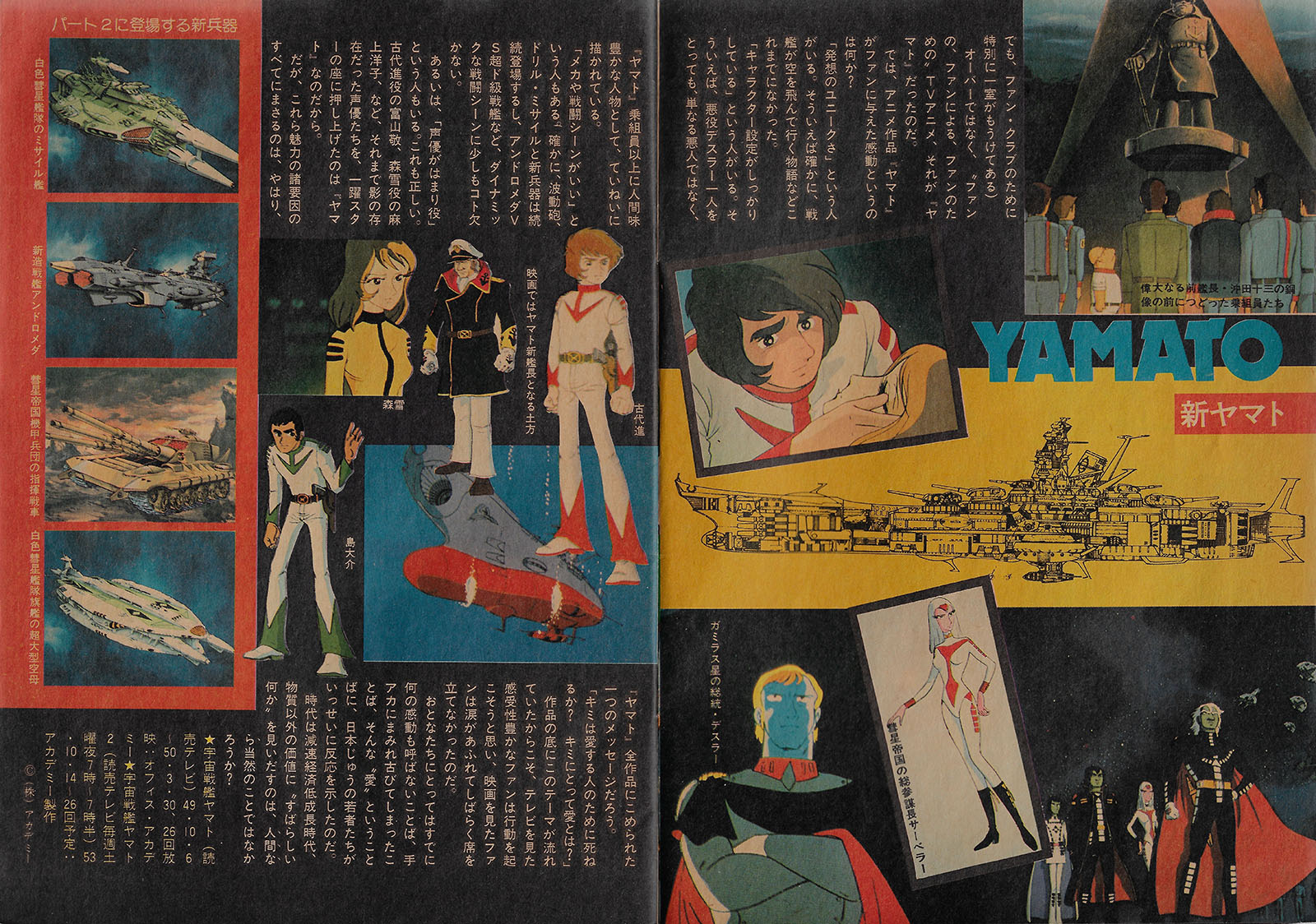
It’s not an exaggeration to say that Yamato was a TV anime made by fans, for fans, and about fans. What kind of emotional impact has it had on the fans?
Some people say it’s because of the uniqueness of the concept. And indeed, there’s never been a story before about battleships flying through the sky.
Some people say that the character development is solid. Come to think of it, even just considering the villain Dessler, he’s not just a simple bad guy. He is portrayed with great care as a more human character than even the crew of Yamato.
Some people say that the mecha and battle scenes are great. Indeed, new weapons, like the Wave-Motion Gun and drill missile keep appearing one after another, and there is no shortage of dynamic battle scenes, such as those in involving the Andromeda vs. the super dreadnought battleship.
Alternatively, some might say that the voice actors were perfectly cast. This is also true. It was Yamato that propelled voice actors like Kei Tomiyama (Susumu Kodai) and Yoko Asagami (Yuki Mori), who had previously been in the background, to stardom.
However, surpassing all of these attractive factors, is likely a single message embedded through throughout all the works in the Yamato series: “Would you die for the one you love? What does Love mean to you?”
This theme runs throughout the entire work, which is why sensitive fans who watched it on TV were inspired to take action, and fans who saw the movie were moved to tears and couldn’t leave their seats for a while.
For adults, the word “love” no longer evokes any emotion. It’s a word that’s become worn out and tainted by repeated use. Yet, young people all over Japan reacted to this word in unison.
In this era of a slowing economy and low growth, isn’t it only natural for humans to find something wonderful in values other than material possessions?
Illustrated report
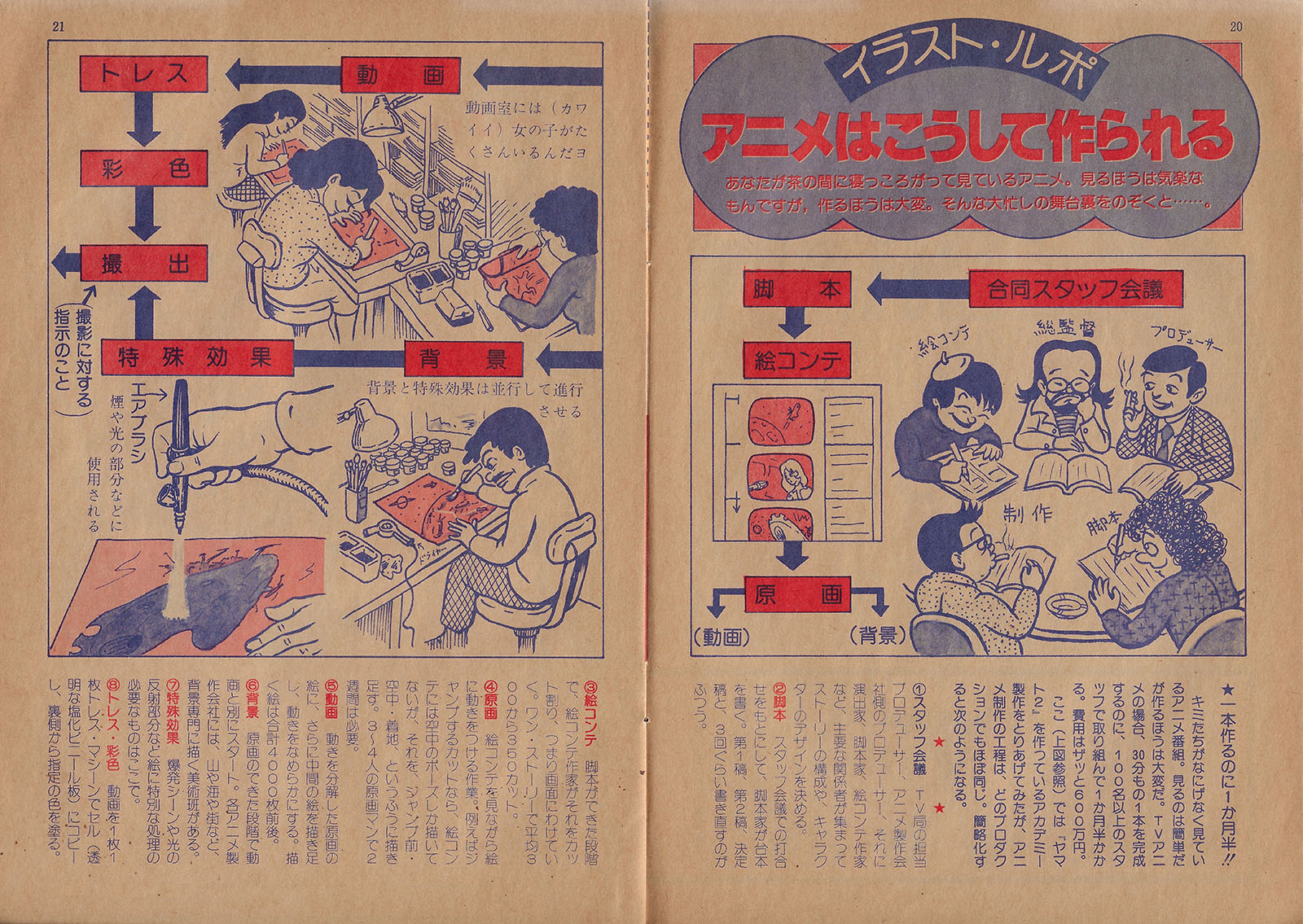
This is how anime is made
Illustrations by Mia Adachi
The anime you see while lying around in your living room is relaxing to watch, but it’s incredibly hard work to produce. Let’s take a peek behind the scenes of this hectic production…
It takes a month and a half to make just one!
The anime shows you casually see are easy to watch, but incredibly difficult to produce. For a TV anime, it takes over 100 staff members a month and a half to complete a single 30 minute episode. The cost is roughly 6 million yen.
In the diagram above, we have focused on Academy Productions, which is making Yamato 2, but the animation production process is almost the same at every production company. Simplified, it looks like this:
1. Staff meeting
Key personnel, including the TV station producer, the animation company’s producer, the director, scriptwriter, storyboard artist, and other key individuals, gather to decide on the story structure and the character designs.
2. Script
Based on discussions at staff meetings, the screenwriter writes the script. It’s common to rewrite it about three times: a first draft, a second draft, and a final version.
3. Storyboards
Once the script is complete, a storyboard artist divides it into shots, or frames. On average, one complete storyboard consists of 300 to 350 shots.
4. Genga (animation layouts)
The process of adding movement. For example, in a jumping shot, the storyboard only shows the pose in the air. But key animators add the pre-jump and the landing. This requires 3 to 4 weeks.
5. Douga (inbetweens)
The movement is broken down into original drawings, and then intermediate drawings are added to make the movement smoother. The total for one episode is approximately 4000 drawings.
6. Backgrounds
Backgrounds start separately from the animation once the genga are complete. Each animation production company has an art team that specializes in drawing backgrounds, such as mountains, seas, and cities.
7. Special effects
Explosion scenes, lights, and anything that requires special processing in the image, such as reflective areas, is handled here.
8. Tracing and coloring
Each frame of the animation is copied onto a cell (transparent vinyl sheet) using a tracing machine, and the specified colors are painted on the back. Although it’s a mass production process, it’s relatively simple, despite requiring a lot of manpower, so it is often outsourced.
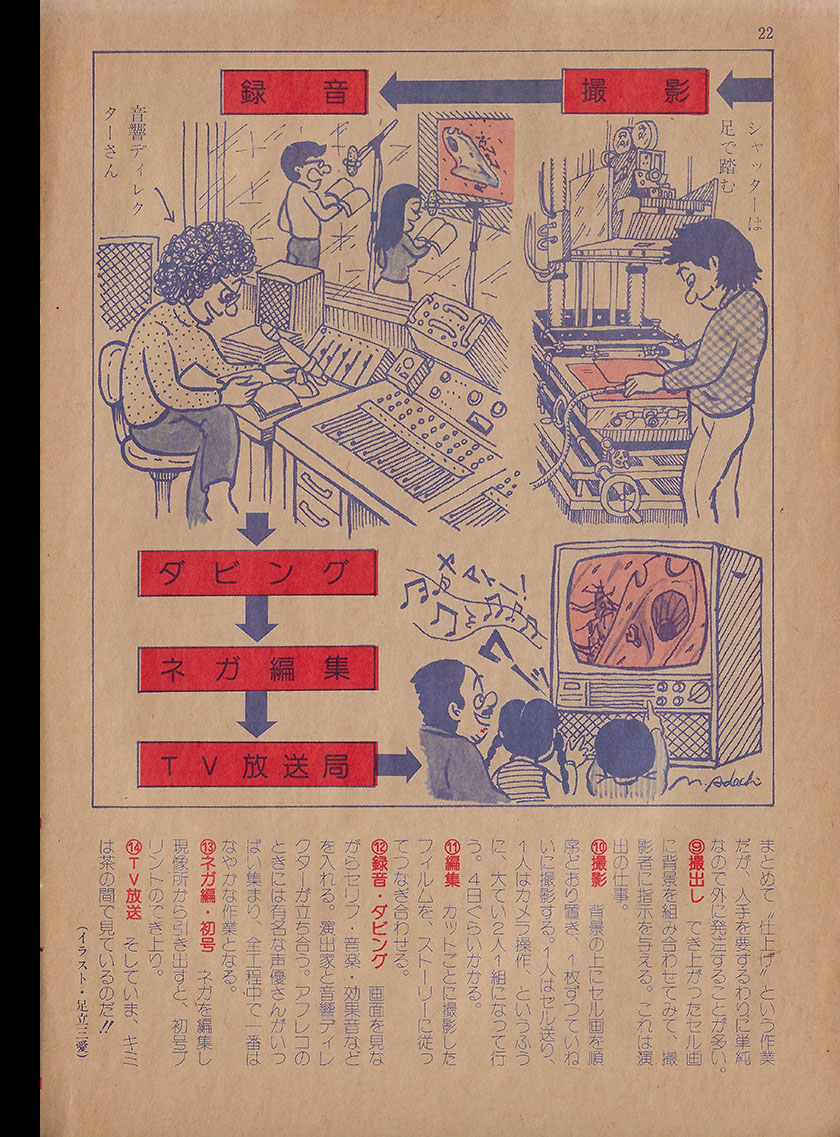
9. Timing
Before the animation cells are shot, the background is combined with the cells, and timing instructions are given to the cameraman. This is the director’s job.
10. Photography
The animation cells are placed in order above the backgrounds and carefully filmed one by one. This is usually done in pairs, with one person feeding the cells and the other operating the camera. One episode takes about four days.
11. Editing
The film, shot cut by cut, is pieced together according to the story.
12. Recording and dubbing
Dialogue, music, and sound effects are added while watching the screen. The director and sound director are present. Many famous voice actors gather for the dubbing session, making it the most glamorous part of the entire process.
13. Negative processing, printing
After editing, the negatives are made. After retrieving them from the processing lab, the first print is ready.
14. TV broadcast
And now you’re watching it in your living room!!
From a 4.5 to tatami mat room to the vast universe
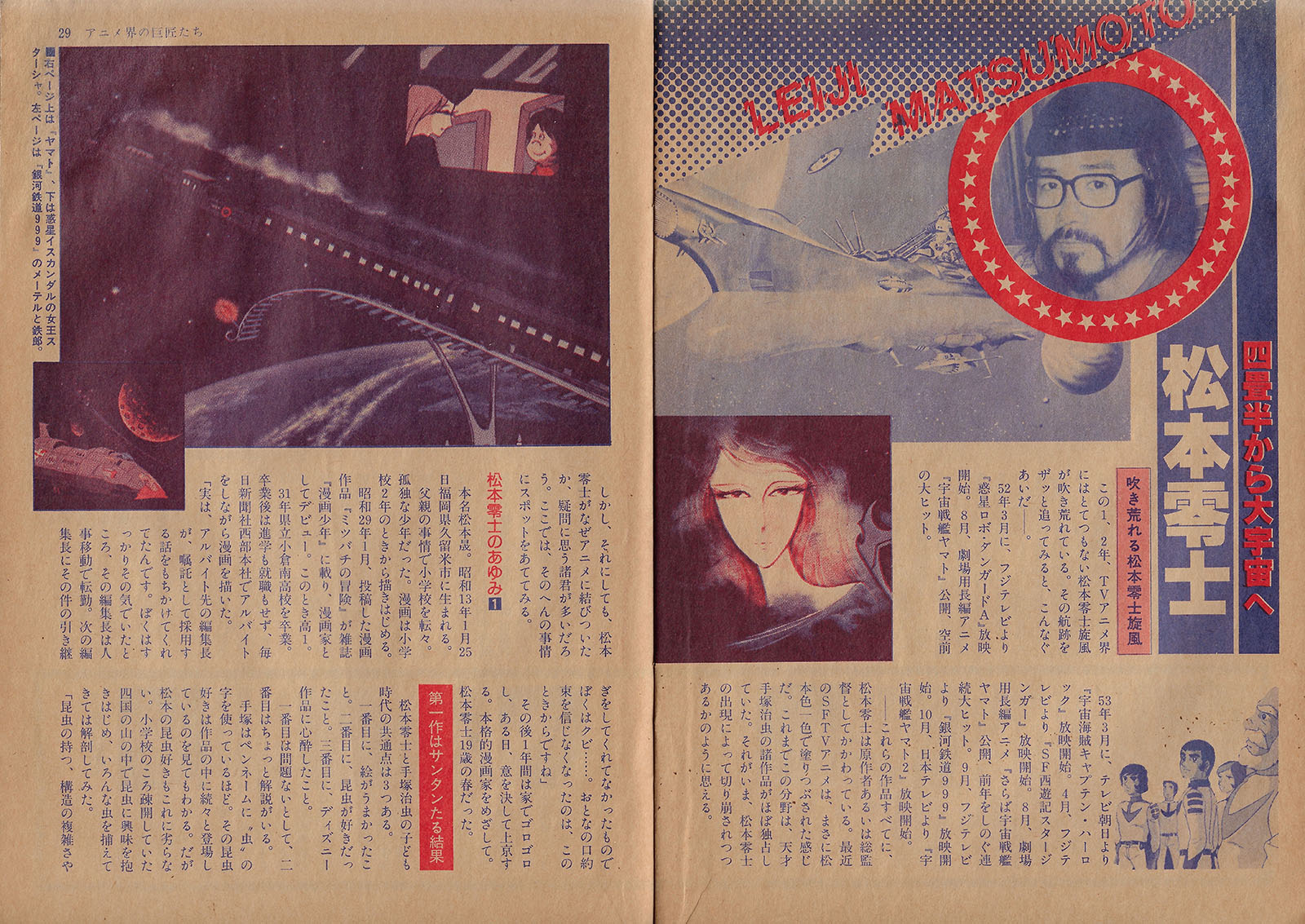
Leiji Matsumoto
The Matsumoto whirlwind is raging
For the past year or two, a tremendous Leiji Matsumoto whirlwind has been raging in the world of TV anime. Here is a quick look at its trajectory.
In March 1977, the animated series Planet Robo Danguard Ace got a record breaking start on Fuji television. In August, the feature-length Space Battleship Yamato opened to the public and was a huge hit.
In March 1978, TV Asahi began airing Space Pirate Captain Harlock. In April, Fuji TV began airing SF Journey to the West Starzinger. In August, the feature length, animated film Farewell to Yamato was released, becoming another major hit that surpassed the previous year’s success. In September, Fuji TV began airing Galaxy Express 999. In October, Nippon television began airing Space Battleship Yamato 2.
Leiji Matsumoto is involved in all of these works as either the original author or the general director. Recent sci-fi TV anime seems to be completely dominated by Matsumoto’s style. Until now, this field was almost entirely monopolized by the works of the genius Osamu Tezuka. But now it seems that this is being broken down by the emergence of Leiji Matsumoto.
However, many of you are probably wondering why Leiji Matsumoto became involved with anime. Here, we’ll take a closer look at the circumstances surrounding that.
The life of Leiji Matsumoto [1]
His real name is Akira Matsumoto. He was born on January 23, 1938, in Kurume city, Fukuoka prefecture. Due to his father‘s circumstances, he changed elementary schools several times. He was a lonely boy.
He started drawing manga when he was in the second grade of elementary school. In January 1945, his manga The Adventures of a Honeybee, was published in the magazine Manga Shonen, marking his debut as a manga artist. He was in his first year of high school at the time.
He graduated from Kokura Minami prefectural high school in 1930. After graduation, he neither went on to higher education nor got a job, but instead worked part-time at the Mainichi Shimbun‘s Western Japan headquarters while drawing manga.
“Actually, the editor-in-chief at my part-time job offered me a contract position. I was totally set on it, but then that editor was transferred due to a personnel change. He handed the matter over to the next editor-in-chief. I was fired because they didn’t do their part. That’s when I stopped trusting the verbal promises of adults.”
After that, he spent a year lounging around at home, and then one day he made up his mind and moved to Tokyo. He aimed to become a full-fledged manga artist.
The first film was a flop
There are three things that Leiji Matsumoto and Osama Tezuka had in common during their childhood. First, they were good at drawing. Second, they loved insects. Third, they were captivated by Disney works.
The first one is fine, but the second one requires a bit of explanation.
Tezuka’s pen name was “Mushi.” His love for insects is evident in the numerous insects that appear in his works. But Matsumoto’s love for insects is no less. He began to take an interest in them while evacuated to the mountains of Shikoku during his elementary school years, and he would catch all sorts of insects and dissect them.
“I was amazed by the precision and structural complexity of insects when I took them apart.”
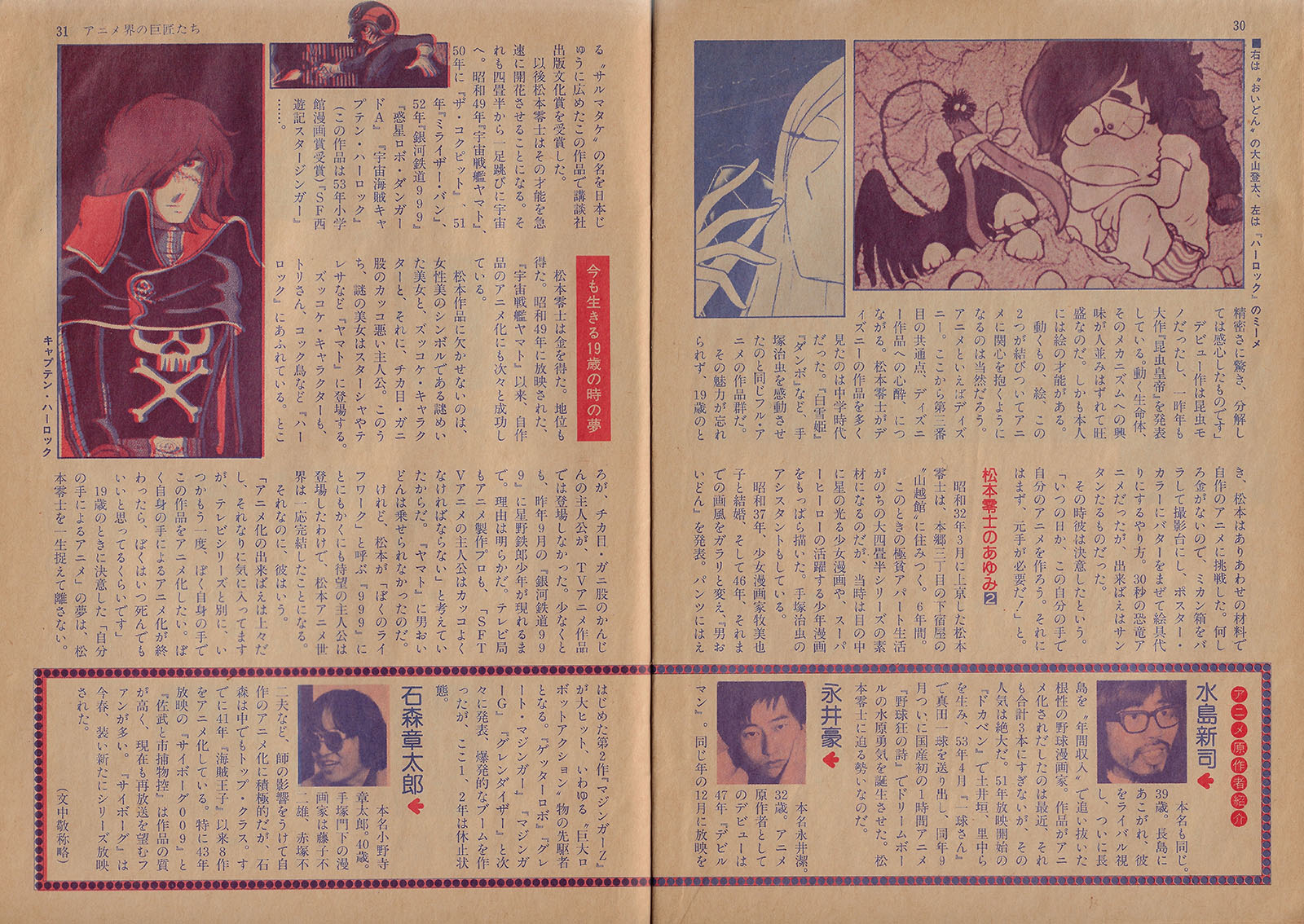
His debut work was about insects, and he also published the major work Insect Emperor the year before last. His interest in moving living things and their mechanisms is extraordinary. It’s only natural that the combination of his artistic talent and moving images would lead him to become interested in animation. Speaking of animation there is Disney. And here comes the third thing…
Leiji Matsumoto developed adoration for Disney works when he saw them in middle school. Snow White, Dumbo, etc., and was moved in the same way as Osamu Tezuka.
Unable to forget their charm, Matsumoto attempted to create his own animation when he was 10 years old, using whatever materials he had on hand. Since he had no money, he disassembled an orange crate to use as a shooting stand, and mixed butter with poster paint to use as cell paint. He made a 30 second dinosaur animation, but the result was…let’s just say it was terrible.
At that moment, he made a decision: “Someday, I will create my own animation with my own hands. But first, I need money!”
The life of Leiji Matsumoto [2]
Leiji Matsumoto moved to Tokyo in March 1957 and settled in the Yamakoshikan boarding house in Hongo. He lived there for six years.
His impoverished apartment life at this time would later become material for his manga, but at the time he mainly drew shojo manga featuring girls with stars in their eyes and shonen manga featuring superheroes. He also worked as an assistant to Osamu Tezuka.
In 1958, he married manga artist Miyako Maki, and in 1970 he drastically changed his style and published Otoko Oidon.
This work, which spread the name “Salmatake” throughout Japan, won the Kodansha Publishing Culture Award.
From then on, Leiji Matsumoto‘s talent would rapidly blossom. And it was a leap from a small room to outer space. His works included Space Battleship Yamato (1974), The Cockpit 1975, Miraizer Ban (1975), Galaxy Express 999, Planet Robo Danguard Ace, and Space Pirate Captain Harlock (1977). (This work won the Shogakukan Manga Aaward in 1978), SF Journey to the West Starzinger…
A dream I had when I was 19, which I still live by today
Leiji Matsumoto gained wealth. He also gained status. Since the airing of Space Battleship Yamato in 1974, he has had many successes in adapting his own works into anime.
Essential to Matsumoto’s works are the enigmatic beauty who symbolizes femininity, the bumbling characters, and the awkward, bow-legged protagonist. Of these, the enigmatic beauty appears in Yamato, such as Starsha and Teresa.
The bumbling characters are also abundant in Harlock, such as Tori-san and the Cook.
However, the main character with his distinctive wide eyes and bow-legged stance, never appeared in a TV anime series. At least not until the appearance of young Tetsuro Hoshino in Galaxy Express 999 last September. The reason is clear: both the TV stations and the anime production companies believe that “the main character of a super fantastic anime must be must be cool.” A man like Oidon couldn’t appear in Yamato.
However, the long awaited protagonist has finally appeared in 999, which Matsumoto calls “my life‘s work.“ His anime world has, in a sense, come to a close. Yet, he says: “the anime adaptation turned out great, and I’m quite happy with it, but aside from the TV series, I want to animate this work again someday with my own hands. Once I’ve finished my own anime adaptation, I feel like I can die happy.”
The dream of creating his own animation, which he decided upon at the age of 15, has stayed with Leiji Matsumoto for life.