
From the REBEL 3199 Chapter 5 program book: designer Mika Akitaka discusses his work on the Dezarium and Bolar mecha that populate the remake series with modernized concepts built on the foundation of past classics.
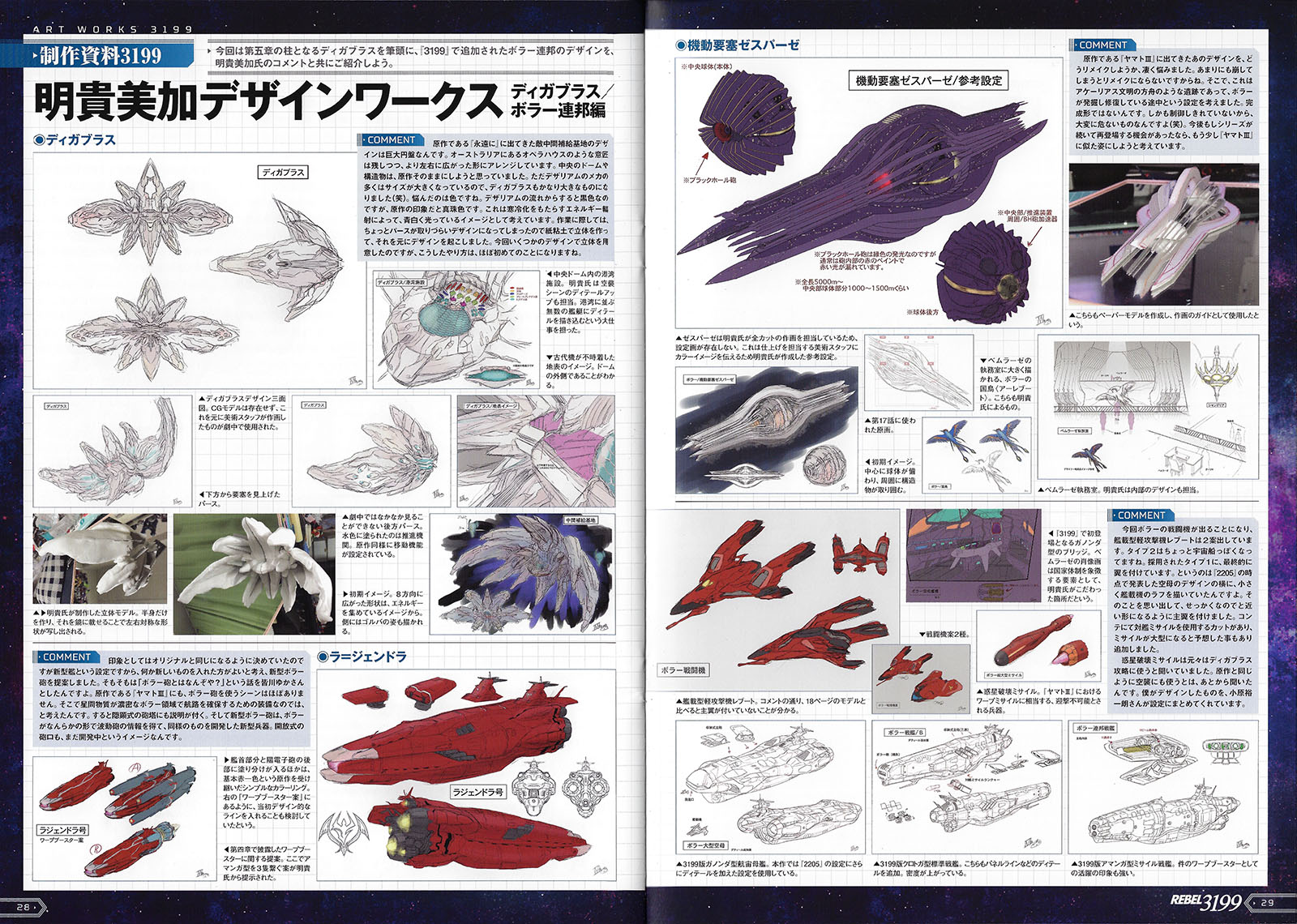
Mika Akitaka Design Works
From the movie program book
In this installment, we introduce the designs for the Bolar Federation, newly added in 3199, beginning with Dezarium’s Digablas, the central pillar of Chapter 5, accompanied by commentary from designer Mika Akitaka.
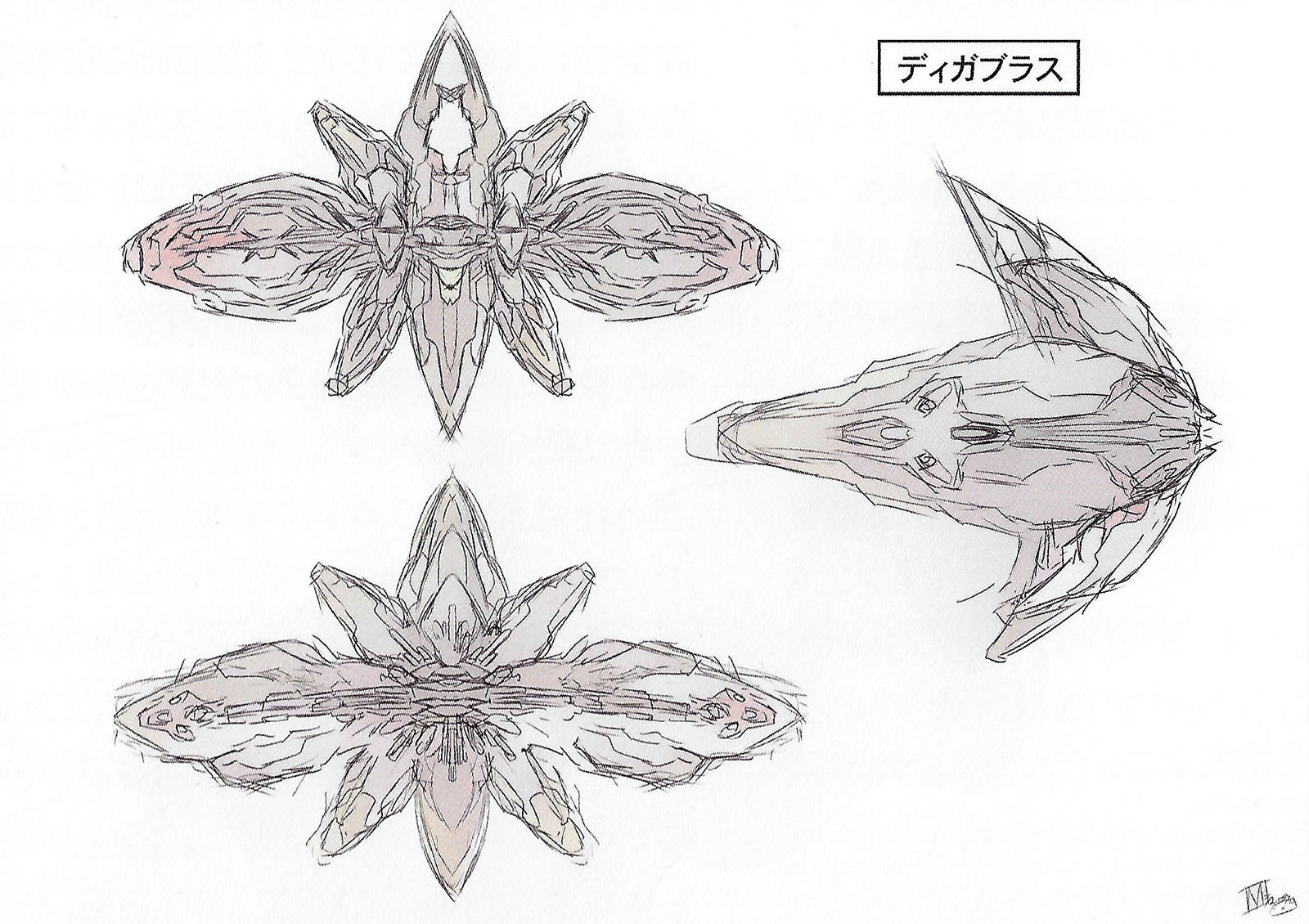
A three-view orthographic projection of the Digablas design. No 3D CG model was created for this asset; instead, the art staff produced the final animation drawings used in the series based directly on this reference sheet.
Digablas
COMMENT
The design for the enemy intermediate supply base that appeared in the original work, Be Forever Yamato, was that of a giant saucer. While retaining the aesthetic elements reminiscent of the Sydney Opera House in Australia, I arranged the shape to be wider and more expansive across the horizontal axis. I originally intended to keep the central dome and its internal structures exactly as they appeared in the original work. However, since many of the Dezarium mecha have grown significantly in size, the Digablas ended up becoming quite massive as well. (Laughs)
The biggest challenge was deciding on the color scheme. Following the general aesthetic of the Dezarium faction, it should have been black. Yet, the impression left by the original work was that of a pearlescent white. I ultimately conceived of it as glowing with a pale, bluish-white light, an effect caused by the energy radiation it emits, which is responsible for inducing the planetary deep-freeze.
During the production process, I found it difficult to generate the necessary design sketches (passes) because the shape was so complex. Consequently, I sculpted a three-dimensional prototype using paper clay and used that as the basis for the final design. Although I created physical models for several designs this time around, this particular approach, working from a physical prototype, was essentially a first for me.
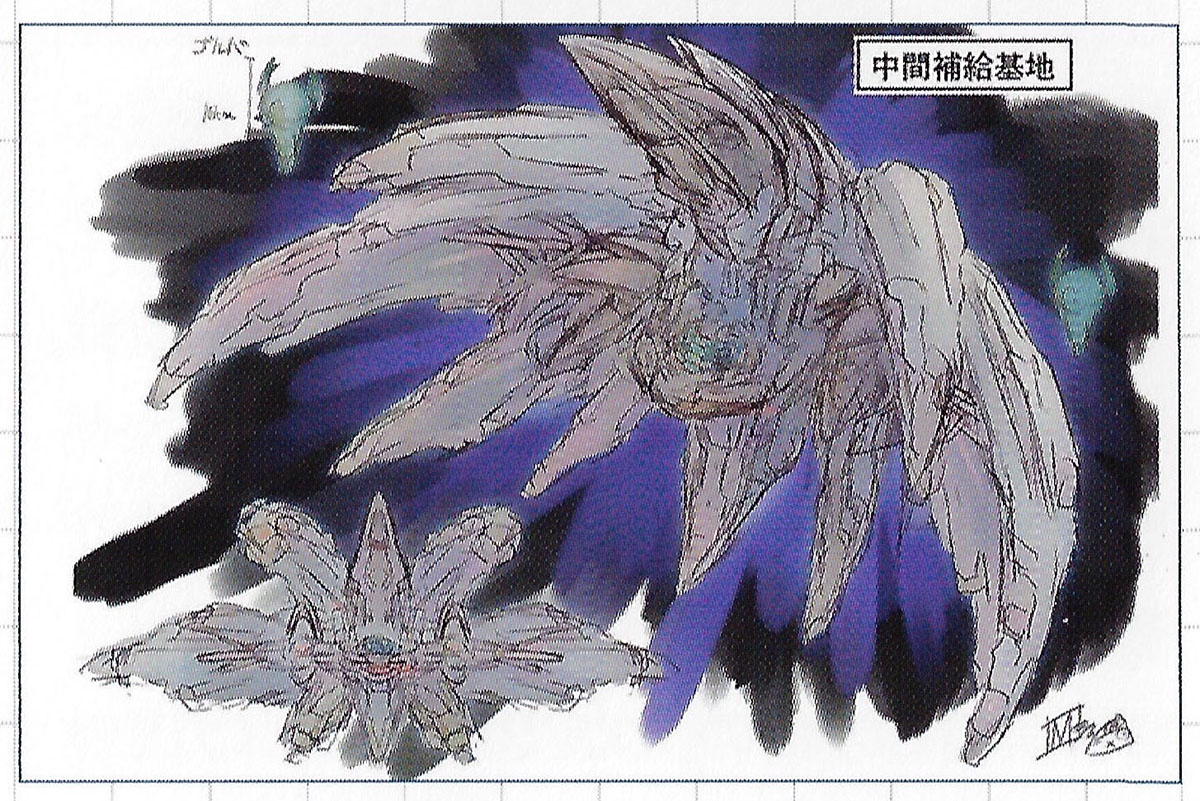
An early conceptual image. The design, radiating outward in eight directions, was intended to evoke the visual imagery of the structure actively gathering energy. A silhouette of the Goruba is also depicted alongside it.
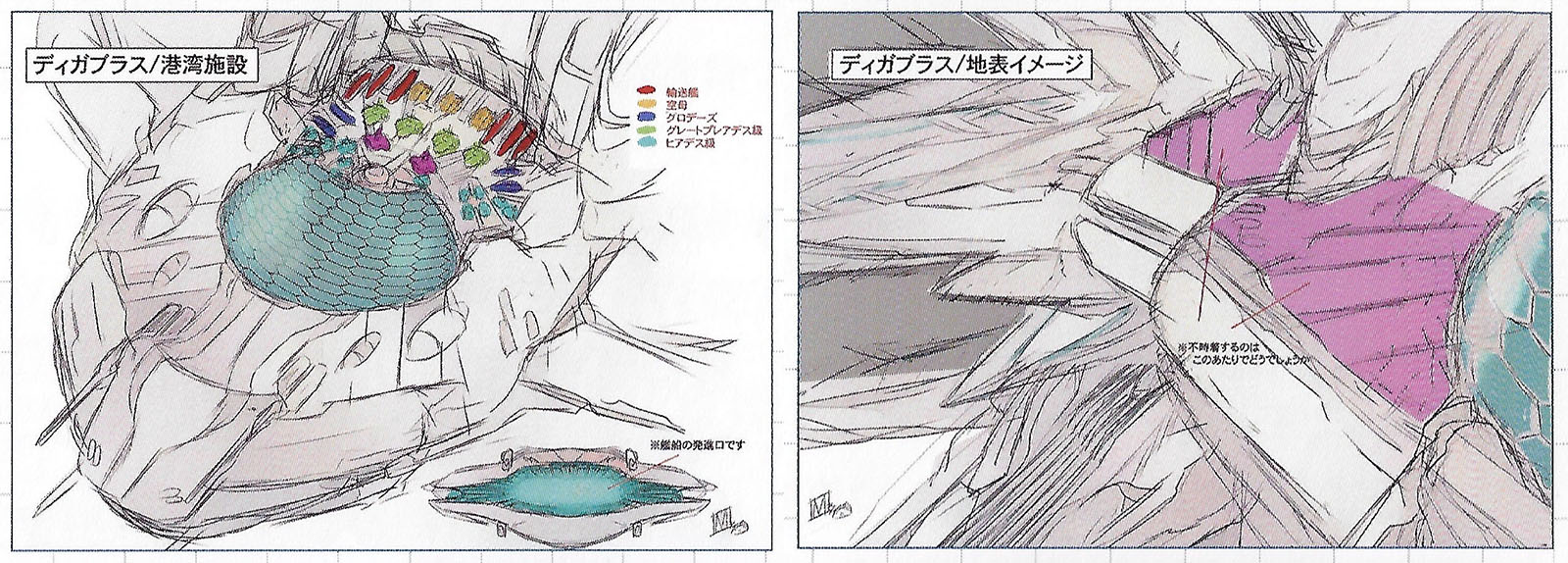
Left: The docking facilities located within the central dome. Mr. Akitaka was also responsible for detailing the “air raid” sequence. He undertook the monumental task of meticulously illustrating the fine details of the many warships lined up within the harbor.
Right: An illustration depicting the surface terrain where Kodai’s fighter lands, clearly showing that the scene takes place outside the dome structure.
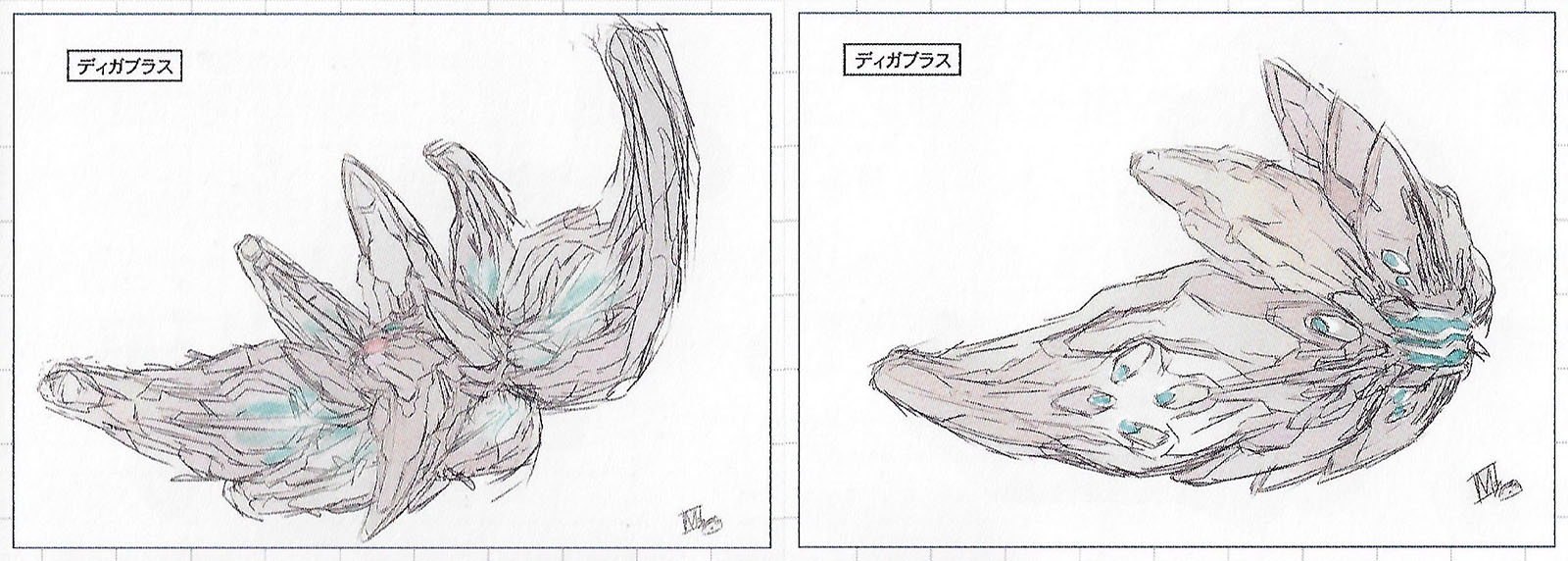
Left: A perspective sketch showing the fortress viewed from below.
Right: A rear-view perspective, a rare angle that is seldom glimpsed within the actual series. The light-blue sections represent the propulsion systems. Consistent with the original work, the fortress is designed to be capable of independent movement.
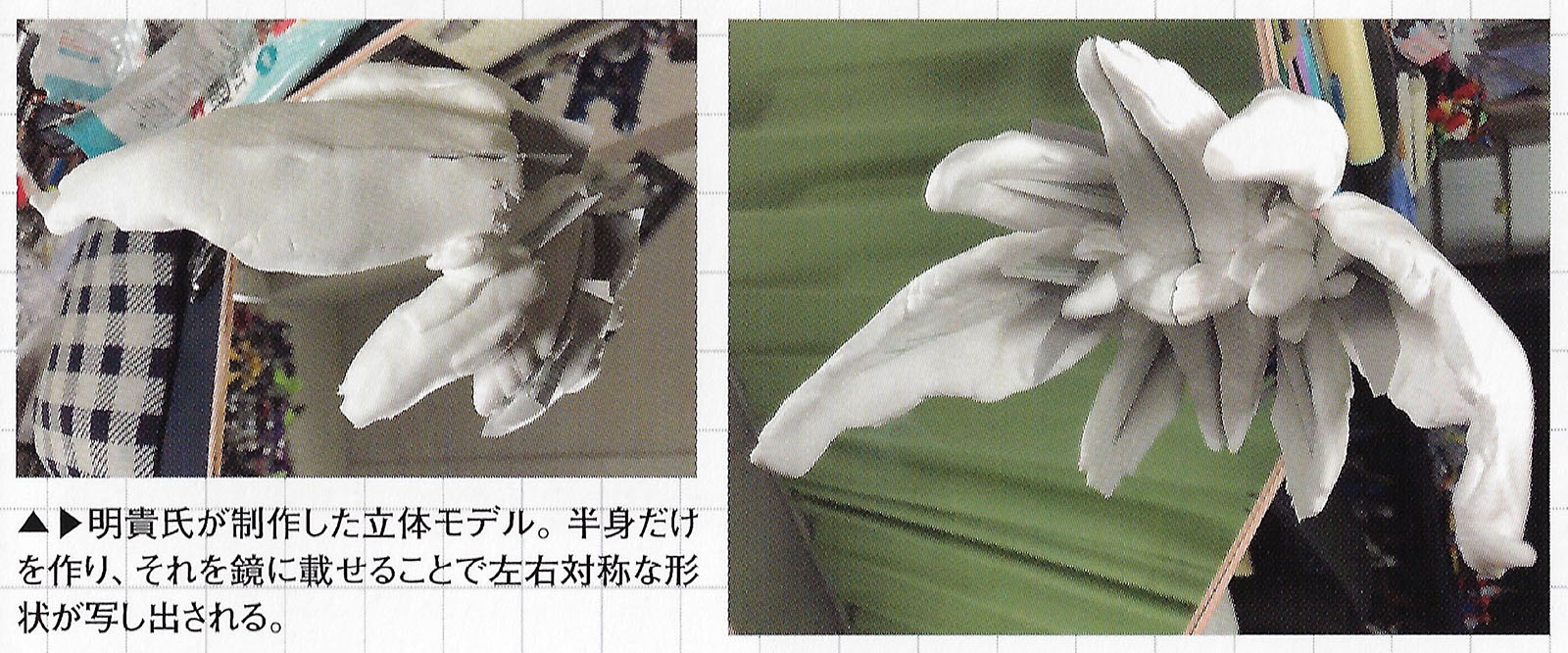
The physical prototype model created by Mr. Akitaka. He sculpted only one half of the structure; by placing it against a mirror, the reflection completed the other half, allowing him to visualize the full, symmetrical form.
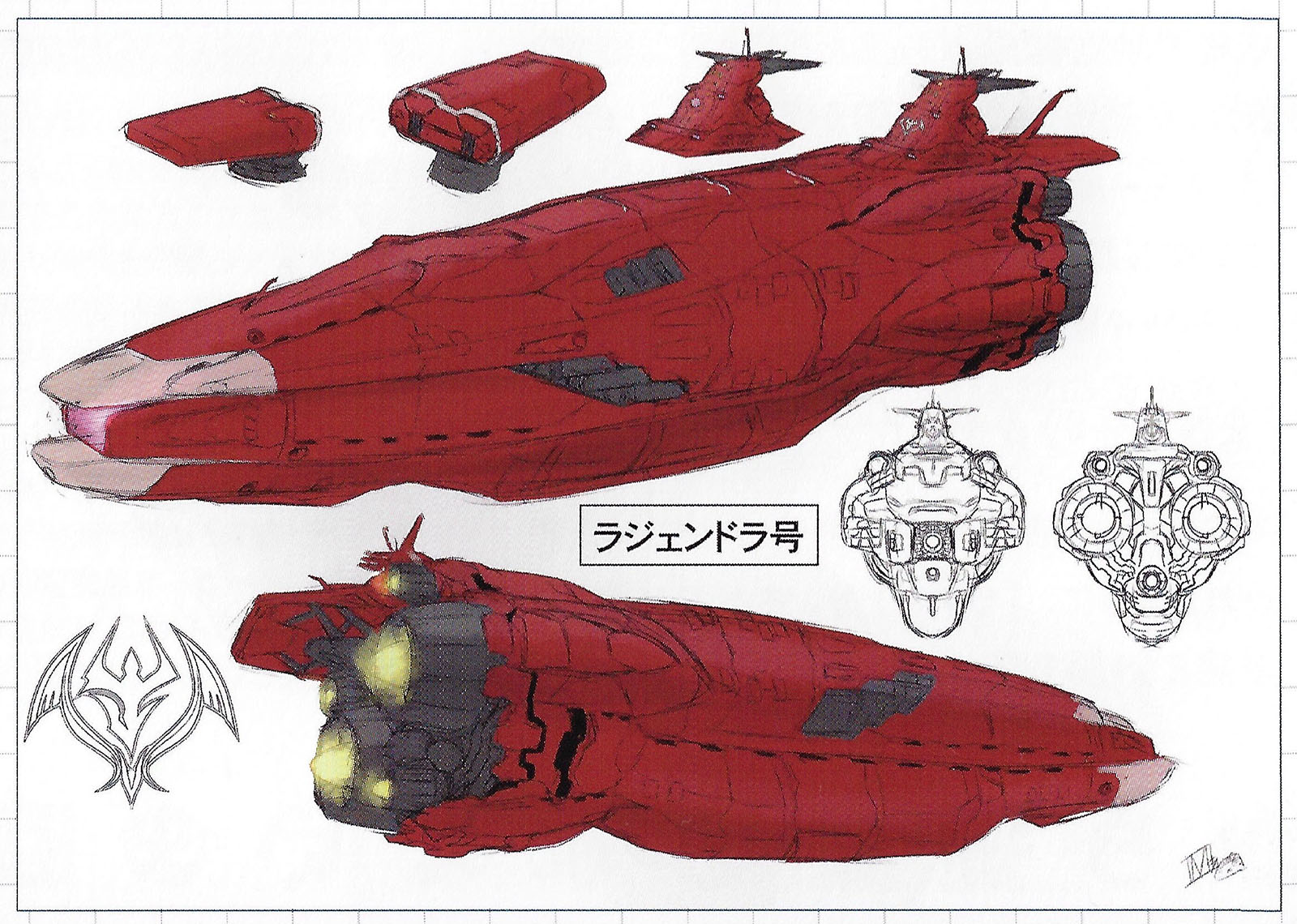
Aside from some distinct color separation on the bow section and the rear of the “Particle Cannon,” the coloring remains a simple, solid red, a faithful homage to the original Yamato III design. As indicated in the “Warp Booster Proposal” below, there was initially some consideration given to incorporating additional decorative design lines.
Ra-Jendora
COMMENT
My initial intention was to ensure that the overall aesthetic impression remained faithful to the original work. However, given that this is designated as a “new model” warship, I felt it would be beneficial to incorporate some novel elements. I proposed the inclusion of a new, advanced type of “Bolar Cannon.” It all started with a conversation I had with Yuka Minagawa: “What exactly is a Bolar Cannon?” After all, even in the original source material (Yamato III) there are almost no scenes depicting the actual use of a Bolar Cannon. That led us to hypothesize that it might be a piece of equipment designed to carve out a safe passage through the Bolar region, an area characterized by its extremely dense interstellar matter. This theory also provided a logical explanation for the retractable turret mechanism.
Furthermore, we conceived the “New Model Bolar Cannon” as a weapon developed by the Bolar themselves, a new system created after they somehow acquired intelligence regarding the Wave-Motion Gun and attempted to replicate it. The open-muzzle design is intended to convey the impression that the weapon is still very much in the developmental stages.
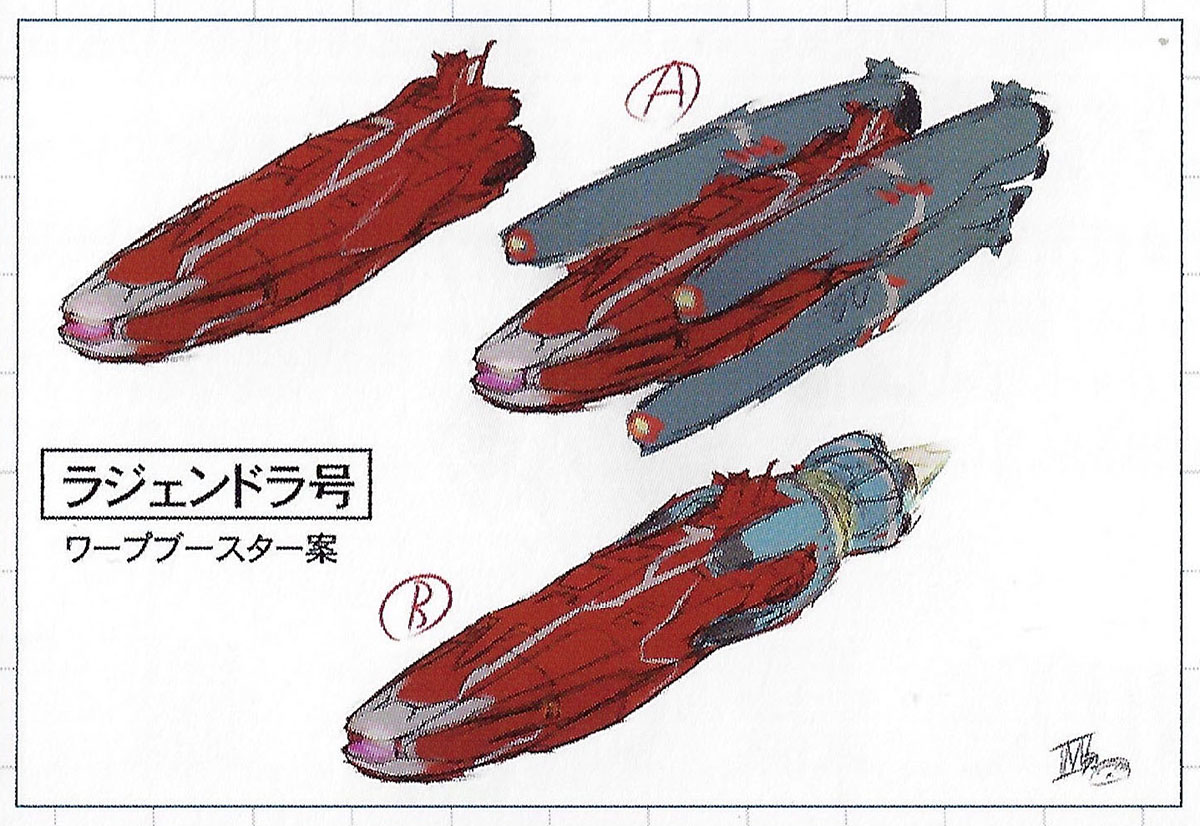
A proposal regarding the Warp Booster, presented during the fourth design meeting. It was here that Mr. Akita put forward the concept of linking three Amanga-class vessels together.
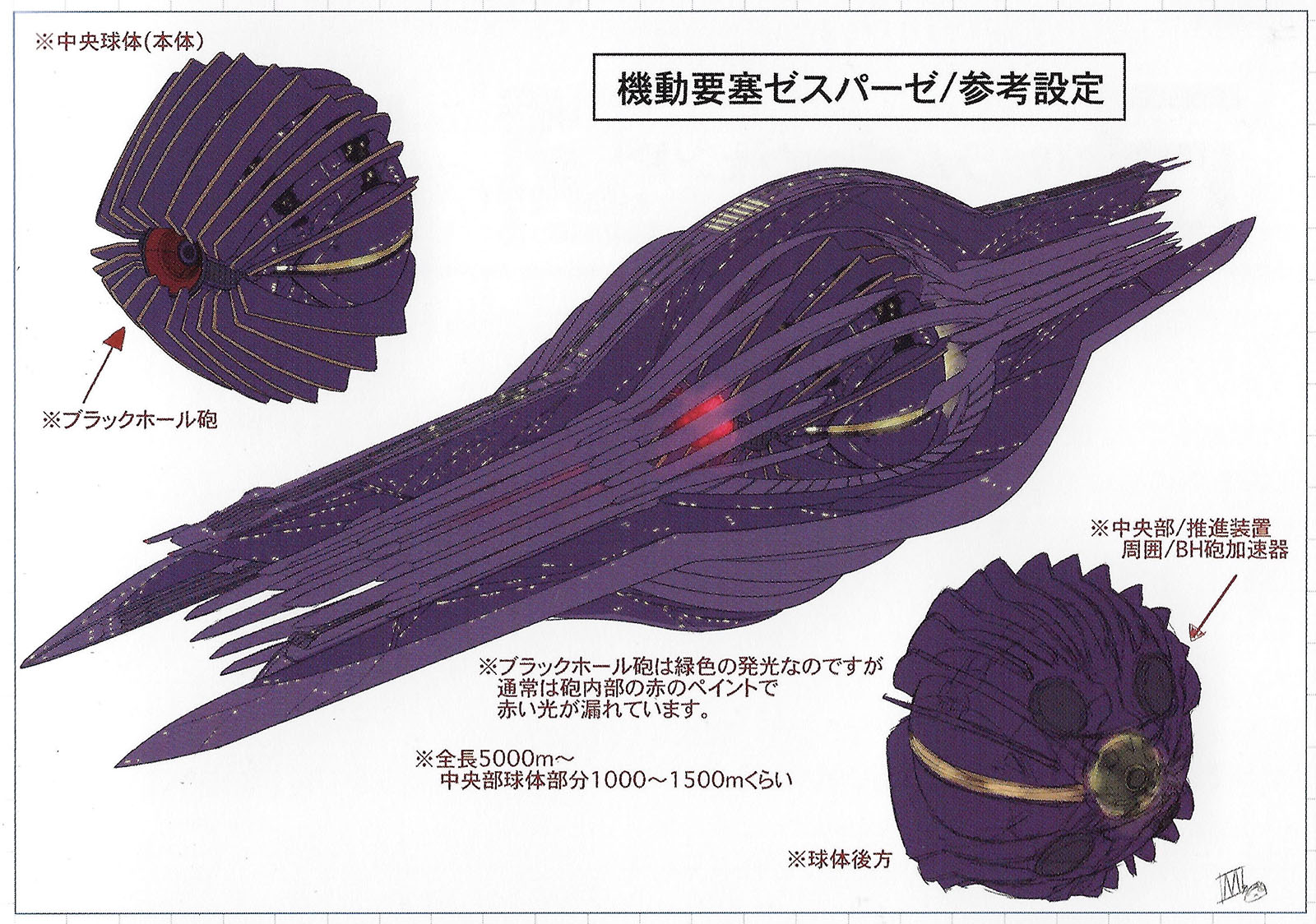
Since Mr. Akita personally handled the animation drawings for every single shot featuring the Zespaze, no formal “design sheets” (official blueprints) were ever created for the unit. The image shown here is a “reference design sheet” created by Mr. Akita solely to convey the intended color scheme to the art staff responsible for the final background painting.
Mobile Fortress Zespaze
COMMENT
I agonized for quite some time over how to go about remaking the design that originally appeared in Yamato III. After all, if you deviate too drastically from the source material, it ceases to be a “remake” in any meaningful sense. We settled on a backstory in which the Zespaze is actually an ancient relic, akin to an “ark” left behind by the Akerius civilization, that the Bolar have excavated and are currently in the process of restoring. In other words, it is not yet in its completed form.
Moreover, because the Bolar have not yet fully mastered its control systems, it remains an incredibly dangerous entity. (Laughs) Should the series continue in the future and present an opportunity for the Zespaze to make a return appearance, I plan to redesign it to look a bit more like its original Yamato III incarnation.
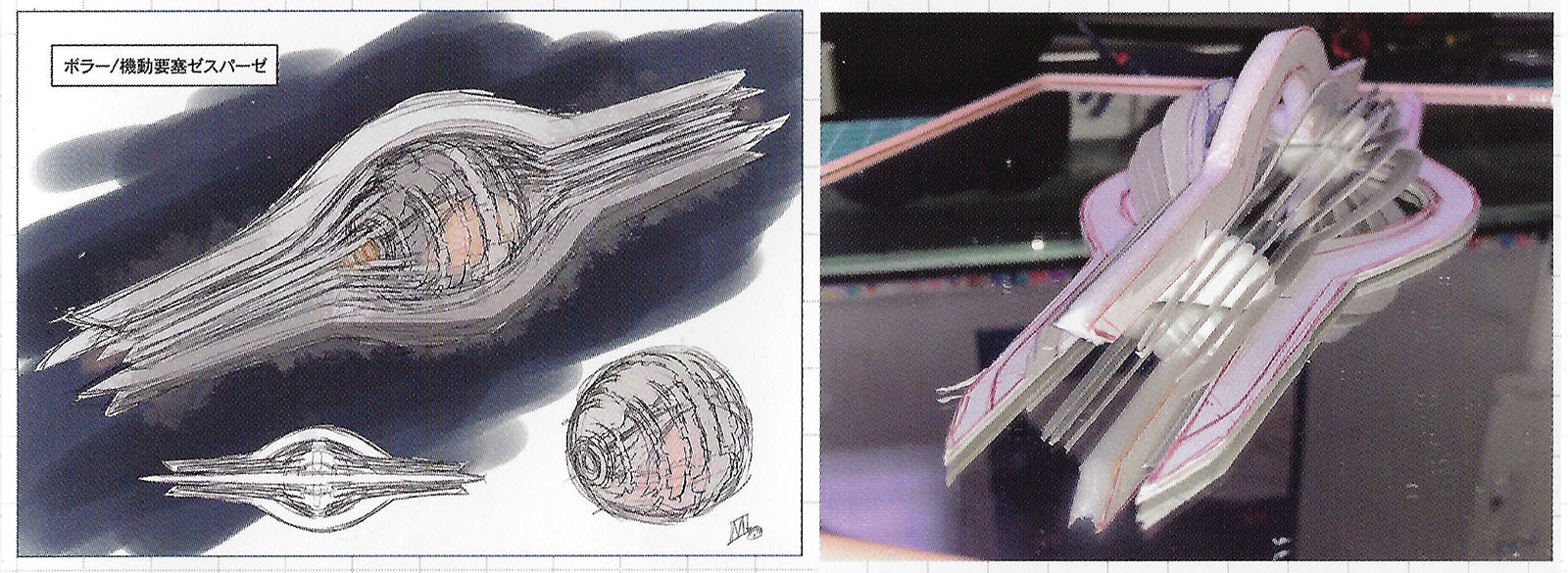
Left: An early conceptual sketch. The design features a central sphere surrounded by an array of structural components.
Right: Here, too, a paper model was constructed and utilized as a visual guide during the animation production process.
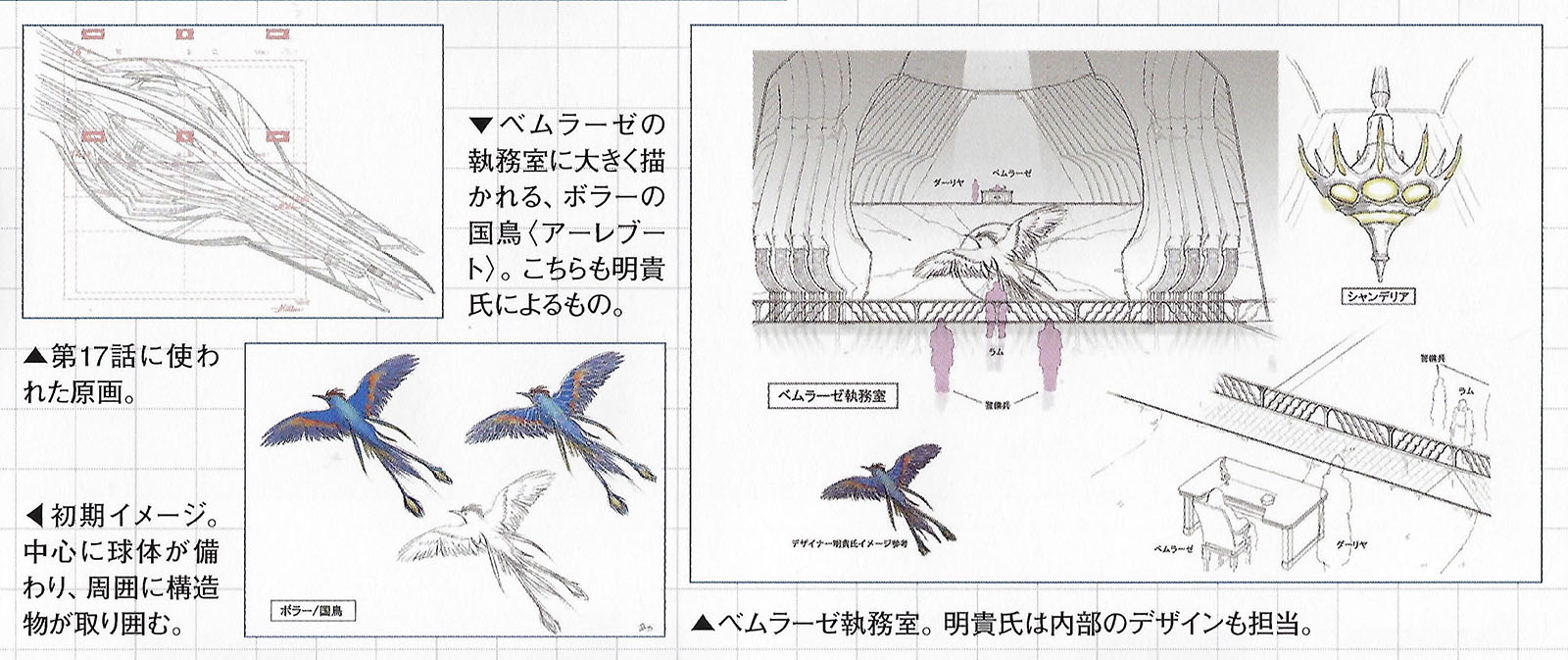
Upper left: An original animation keyframe used in Episode 17.
Lower left: The Bolar national emblem, the Arevut, prominently displayed within Bemlarze’s office. This artwork was also created by Mr. Akita.
Right: Bemlarze’s Office. Mr. Akita was also responsible for the interior designs.
Other Bolar Mecha
COMMENT
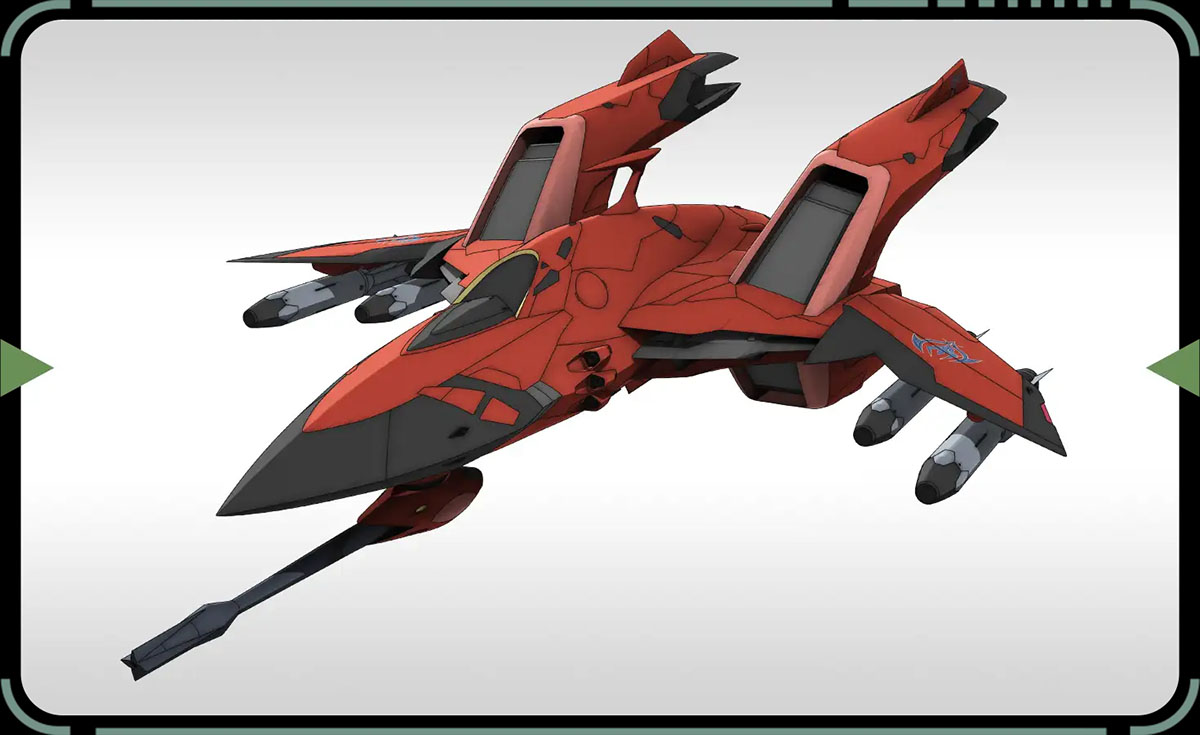
With the decision to feature Bolar fighter craft in this installment, I submitted two design proposals for the “Revut” version of the carrier-based light attack aircraft. Type 2 ended up looking a bit more like a standard spaceship. Ultimately, wings were added to Type 1, the version that was selected for production (above).
The reason for this is that, back when the carrier design for 2205 was first unveiled, I had sketched a rough concept for a carrier-based aircraft in the margins next to it. Remembering that sketch and thinking, “Why not?” I decided to add wings to the final design to bring it closer to that original concept. I also added them because the storyboards included a shot where the aircraft fires an anti-ship missile, and I anticipated that the missile itself would be quite large.
I was originally told that the Planet-Destroying Missile would be used specifically for the assault on Digablas. I only learned later, after the fact, that it would also be deployed for air raids, just as it was in the original series. Yuichiro Ohara took the designs I created and compiled them into the official production specifications.
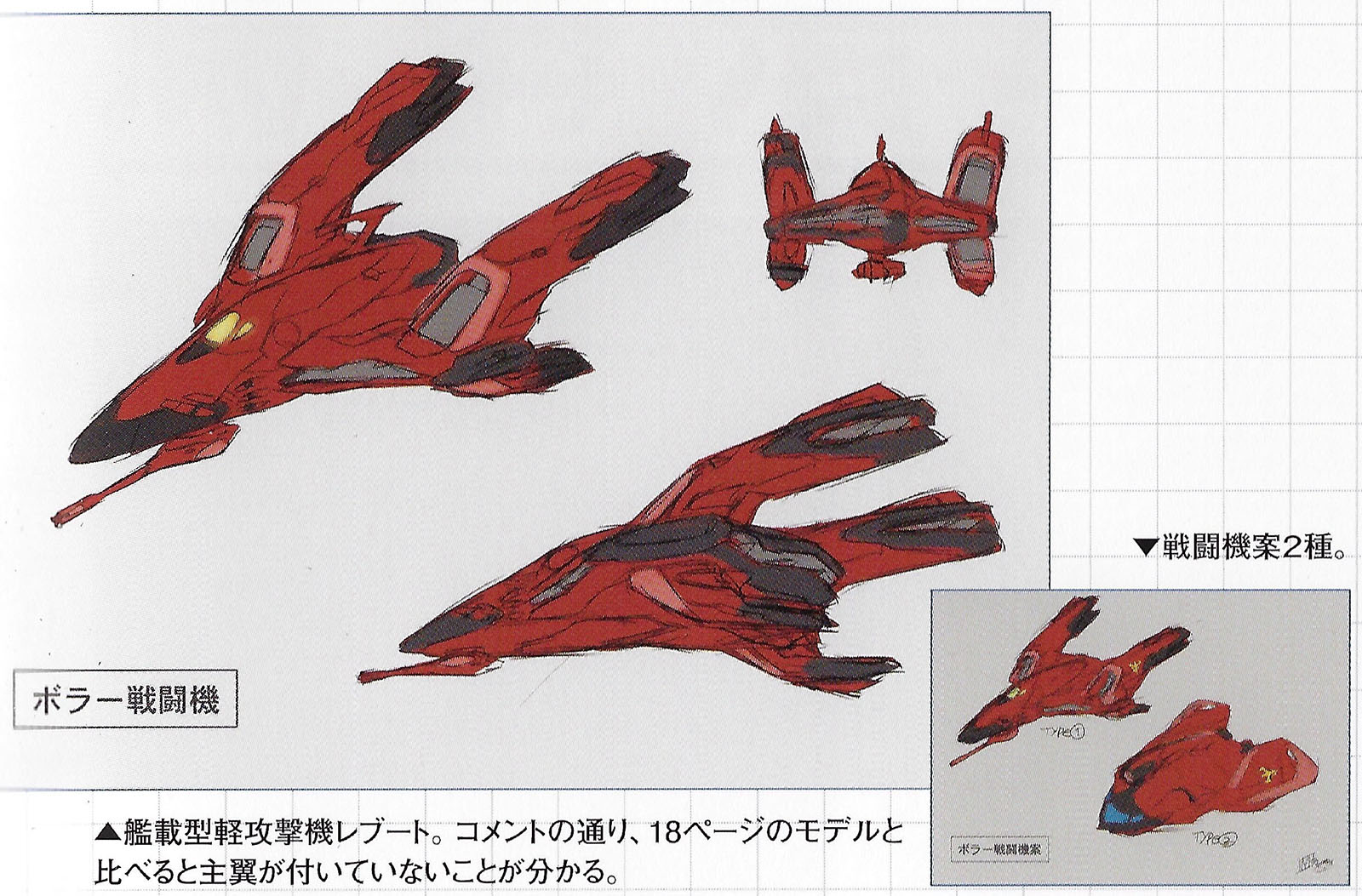
Left: The “Revut” version of the carrier-based light attack aircraft. As noted in the comment, a comparison with the model above reveals that this earlier iteration lacks the wings.
Right: Two types of fighters.
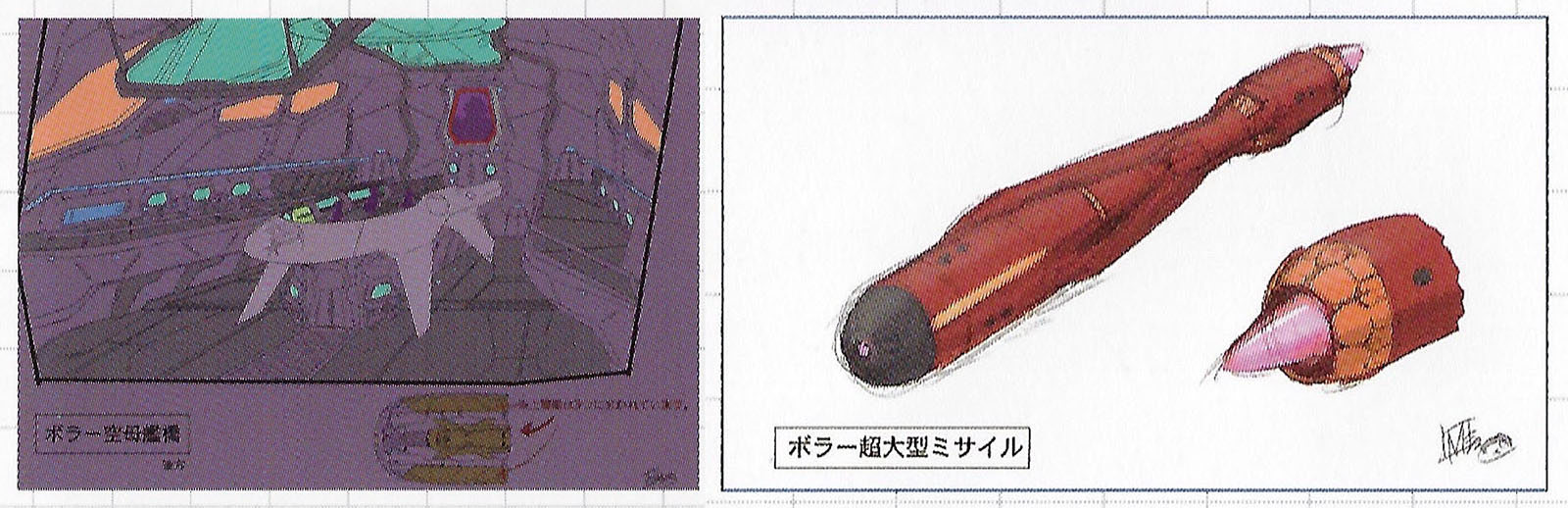
Left: The bridge of the Ganonda-class vessel, making its debut appearance in 3199. Mr. Akita placed particular emphasis on the portrait of Bemlarze, viewing it as a key visual element symbolizing the nation’s political regime.
Right: The Planet-Destroying Missile. This weapon serves as the 3199 equivalent to the “Warp Missile” featured in Yamato III, a weapon deemed impossible to intercept.
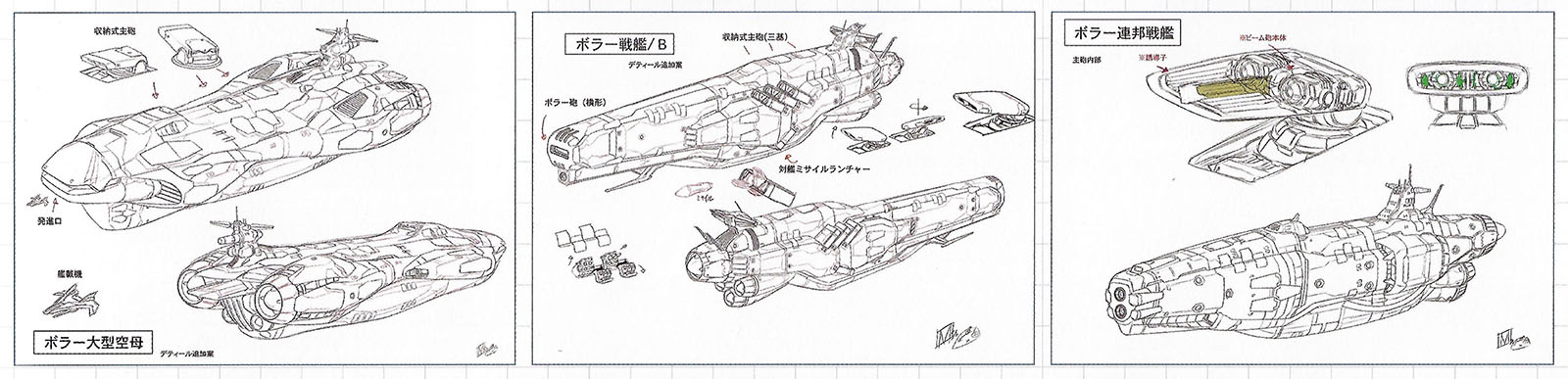
Left: The 3199 version of the Ganonda-class Space Carrier. For this production, the design specifications established in 2205 have been further refined with the addition of greater detail.
Center: The 3199 version of the Kurotoga-class Standard Battleship. This vessel, too, has received additional detailing, such as panel lines, resulting in a design with increased visual density.
Right: The 3199 version of the Amanga-class Missile Battleship. This vessel also leaves a strong impression due to its prominent role as the aforementioned “Warp Booster.”