
From the Chapter 5 program book: an incredible look into the specific creative choices of REBEL 3199, including the “forbidden” strategy of hiding Arizona and the chaotic brainstorming behind the highly expanded, 2-episode battle against Dezarium’s intermediate supply base Digablas.
Those Who Challenge 3199
Hideki Oka x Yuka Minagawa “This is How 3199 is Made!”
The story has entered its second half with Chapter 5. This time, we asked Hideki Oka (scriptwriter) and Yuka Minagawa (literature/concept management), who serve as advisors to General Director Harutoshi Fukui, to talk about how this story was born and how it was shaped.
Translated by Anton Mei Brandt
Hideki Oka Profile
Born in 1966 in Hiroshima Prefecture. After participating in Godzilla vs. Space Godzilla (1994) as an assistant director, he worked on many tokusatsu (special effects) productions as both an assistant director and director. His main directorial works include Magic Bullet Chronicles Ryukendo (2006), Tomica Hero: Rescue Force (2008), Ultraman Saga (2012), and BIMA Satria Garuda (2013). He co-wrote the scripts for Yamato 2202 (2017), Age of Yamato (2021), and Yamato 2205 (2021) alongside Harutoshi Fukui.
Yuka Minagawa Profile
Born in 1965, Debuted as a novelist in 1987. Known for original works like the Tea Party and Fortune Tarot series, as well as numerous anime and game novelizations. Her 2001 publication Mobile Suit Gundam Official Encyclopedia: GUNDAM OFFICIALS became a major topic of discussion. She joined the Yamato remake series starting with the novelization of 2202 and served as scriptwriter for the compilation film Age of Yamato (2021). She also provided conceptual research for 2205.
Lift quote: “At the end of the day, this work is being created by the writer, Harutoshi Fukui.” (Oka)
The Beginning of the Project
Interviewer: How did the production of Be Forever Yamato REBEL 3199 initially get moving?
Oka: It was one day back in 2018 when Mr. Fukui first told me, “I want to remake The New Voyage and Be Forever Yamato as a linked series.” That was quite a long time ago. (Laughs)
Interviewer: At what point was it decided to introduce elements from Yamato III?
Oka: That was the same day. At the same time, Mr. Fukui told me his policy that Yamato III would not be remade as a standalone project. In his mind, the remakes should be centered around feature-length theatrical films. We decided then that if that was the case, we should move up the introduction of Tasuke Tokugawa and the new Yamato III crew members like Domon.
At the time, I had no idea how Galman-Gamilas or the Bolar Federation would be utilized in a remake based on Be Forever, but I believe the decision to heavily include Yamato III elements was made that day. Years passed, and once the script work for 2205 was finished, a brainstorming session for 3199 was held at Mr. Fukui’s place. The only participants were Mr. Fukui, Ms. Minagawa, and myself. When was that exactly?
Minagawa: It was May 2020.
Oka: Right in the middle of the state of emergency during the pandemic. Ms. Minagawa kept detailed minutes of that meeting. Looking back at them…
Minagawa: You can see that Mr. Fukui’s vision was largely formed by that point. The flow of the first chapter (Episodes 1 and 2) was almost complete.
Oka: That’s right. The core sequence — the occupation, the escape, and Yamato departing from Icarus — was not to be changed. On the other hand, the major policy decided then was that the story of Yuki and the people left behind on Earth would be expanded much more than in the original, involving the Partisans. However, the specific details for Chapter 2 and beyond were still pretty much a blank slate.
Translator’s Note: Both Be Forever (1980) and REBEL 3199 (2024) refers to the rebels on Earth as “partisans,” utilizing the katakana reading of the same English word, as opposed to Japanese words like 反軍 (anti-military) or 反逆者 (rebel/traitors). This has been omitted in the official translation, where they prefer to use “guerillas” in their subtitles. Throughout both the classic and remade New Voyage (1979/2021) and Be Forever, English loanwords like “Great Emperor,” “Pleiades,” “Partisans” and the like are used with intent, hinting at Dezarium’s alleged Earthly origins. So, if ever you read another interview with the creators referring to the rebels as “partisans,” this is why.
Minagawa: That’s when I submitted a “box sequence” (scene breakdown) of the plot and scenes from the original Be Forever to Mr. Fukui. That was around August 2020. Based on that, we first decided on the rough distribution of events for each chapter.
Oka: While weaving in the Yamato III elements, right?
Minagawa: One thing I insisted on was that it would be absolutely strange if Alphon and Kodai never met. In the original work, they actually never meet face-to-face. But to make them work as rivals, there has to be a relationship. Kodai has to meet the “other man”. (Laughs) Since the Dezarium are essentially cyborgs, I suggested that if Alphon’s consciousness were put into a different body suited for space operations, he could come into contact with Kodai while still maintaining the story with Yuki.
Oka: From my side, I mentioned that I wanted to spend two episodes on the capture of the intermediate supply base to treat it as a proper combat drama. It was a meeting where everyone just shouted out, “I want to do this!”
Minagawa: At that time, it had been decided to ask Naomichi Yamato (who directed episodes of 2205) to direct 3199, but he hadn’t joined us yet.
Interviewer: How did you transition from there to concrete studio work?
Oka: Ms. Minagawa summarized that process simply in a post on Twitter, didn’t she?
Minagawa: Yes, this post: “Since the synopsis work for 3199 progressed during the pandemic, once Mr. Fukui’s basic concept (theme and rough plot) was done, Mr. Oka and I would gather at Mr. Fukui’s house or nearby to throw out ideas. Mr. Fukui used those as a reference to gradually build it up. Once a certain shape was formed, Director Yamato joined.”
“A bit later, around the end of the pandemic, we had production meetings at Bandai Namco with producers, designers, and staff to generate more ideas based on Mr. Fukui’s detailed concept notes. Then Mr. Oka started the first draft. I’ll likely have a chance to talk more about this in later chapters.”
Oka: That “a bit later” mentioned in the post…there was actually a full year where nothing progressed due to various circumstances.
Minagawa: After the draft composition was finished in January 2021, we had the work for the second half of 2205. From then until Mr. Fukui produced the document titled “The Eve of Yamato 3199” in December, there was almost no movement for a year.
Oka: The key is that year of no updates. Mr. Fukui thought through things in much finer detail based on the massive amount of ideas we had thrown out. Some proposed ideas were picked up partially, others were discarded, and some were kept in form but used in a completely different way. Through this process of “remodeling,” the vision itself transformed into something very concrete. During that period, we [Oka and Minagawa] did almost nothing. Mr. Fukui hammered it out alone, and by the time production restarted, the current backbone of the story was in place. To summarize the flow, the project went through four phases:
Phase 1: Mr. Fukui working on the themes alone. Phase 2: Everyone brainstorming ideas based on those themes. A draft was made, and I created a list of required settings (January 2021). Phase 3: The “blank year” where Mr. Fukui refined it alone.
Phase 4: 2022, when Director Yamato and the studio joined, and script and design work moved forward all at once.
What is the Role of Scriptwriter Hideki Oka?
Interviewer: Once you entered Phase 4, the scriptwriting work began, correct?
Oka: After the production meetings, Mr. Fukui’s “Original Story Composition Notes” would come out in stages. My role is to receive those first and organize them into a preliminary draft of the script.
Minagawa: During the meetings, Mr. Fukui gives everyone “homework.” And this is the important part: Mr. Fukui doesn’t necessarily bring a finished document to every meeting. Actually, there’s this “Top Secret Fukui Memo,” a tiny, doodle-pad-like notebook that no one else has seen, where he scribbles down in pencil everything that catches his interest. He explains things to us orally while looking at that.
Oka: It’s the true “Secret Fukui Memo.” It’s in his pocket throughout the entire production. Every now and then, he pulls it out and scribbles something. Even I’ve never read it.
Minagawa: If you try to peek, he hides it. (Laughs) Mr. Fukui talks about what he’s thinking while looking at those notes. He builds the story in the meeting by gauging our reactions and incorporating our opinions. Finally, Mr. Oka compiles all of that into a written document.
Oka: My job is to build the preliminary script draft using the information available at that moment. However, in parallel with that work, the “homework” he assigned to everyone returns to him. Naturally, Mr. Fukui incorporates those results into the final script draft that he handles personally. When that happens, everything simply won’t fit. (Laughs) We end up having to cut several elements…
Minagawa: For someone like me, I’m just throwing “balls” (ideas) however I like, but Mr. Oka is the one who has to make it all fit into a 30-minute episode.
Oka: If it absolutely won’t fit, we have to push it back to the next episode. But the further along we get, the more Mr. Fukui hits his stride, and the sheer volume of the story becomes insane. I mean, from Chapter 6 onward, the “Original Story Composition Notes” Mr. Fukui writes exceed the standard character count for a finished script. And that’s just the notes! Things are going to get wild in the upcoming chapters.
Yuka Minagawa’s Management of Concepts
Interviewer: Ms. Minagawa, you originally joined the project to organize the data for the Yamato remakes, right?
Minagawa: Originally, for the production of Age of Yamato, Mr. Fukui asked me to “organize things with Sanada as the central axis,” so I provided reference materials from 2199 and 2202. When I submitted those, I was invited to help with the script. Around that time, I joined 2205, and when 3199 started moving, I was asked to get even more deeply involved. That’s when I started contributing heavily to the story ideas.
Oka: In this production, the database of the past remake series that Ms. Minagawa built was utilized to its full extent during meetings. For example, if someone asked, “How was this part depicted in the original works?”, she could search for it down to the specific shot and project it on a screen so everyone could understand it before moving on to the next task.
Minagawa: Regarding the fine details of the script and direction — for instance, because the CG production companies have changed several times throughout the remake series — problems arise where we don’t know the specific effects used for certain mecha. So, at the request of the Line Producer, I compiled all those shots as reference material.
Oka: Being able to see that data instantly is vital because it allows everyone, including Mr. Fukui, to share the same mental image.
Minagawa: I believe creating such a database leads to production efficiency. I’ve always felt that even if the setting and worldview don’t all make it onto the screen, the world won’t feel real unless there is a logic behind what is not seen. To keep it from feeling hollow or thin, you need the whole picture. In that sense, even if it doesn’t fit into the main story, I want to follow up on the necessary concepts from the outside.
I’ve long believed that the image that is built up for a work includes its peripheral information. Between the program books, the “Mechanic Books” included with the Limited Edition Blu-rays, the descriptions on the official website, and the serialization in Hobby Japan, I think “Modern Yamato” is the sum of all that information forming a complete image, with the (anime) footage at the center.
Creating While Running
Minagawa: By Phase 4, when the production meetings were in full swing, the rough chapter divisions were already set. However, we hadn’t decided specifically what to do within them. There were still many blanks. We were short on content.
Oka: From there, it became a flow of everyone “running” while responding to Mr. Fukui’s requests for whatever was needed at the time.
Minagawa: For example, the war in Ukraine began in 2022. When I was asked for a draft on how to suppress a “New Capital,” I referenced Russian operations in Ukraine and Crimea. Stories about people accepting Dezarium and wearing “Com-Medals”… that kind of idea wouldn’t have emerged if we hadn’t lived through the COVID-19 pandemic.
Oka: Actually, the “Com-Medal” didn’t exist in the Chapter 1 stage. It first comes into focus in Chapter 2.
Minagawa: Mr. Fukui gave us a prompt: “Can we do something that symbolizes collective oppression or peer pressure?” When I looked at the Dezarium designs, I noticed, “Wait, these guys have something on their necks!”. (Laughs) When I checked, it was there in the 2205 designs too. I thought, “This is usable!” And that’s how the Com-Medal was born.
Oka: During the Chapter 1 stage, the word “Com-Medal” didn’t even exist. That process of things taking shape while we are “running” is a hallmark of the Fukui Team.
Translator’s Note: Though this may sound a tad bit alien to American readers, the COVID-19 pandemic and its public safety enforcement wasn’t as voluntary in countries outside the U.S. (barring exceptions like my own country of Sweden, where the vaccines remained voluntary until the very end). Countries like Japan were completely closed to the outside world for several years, becoming inaccessible to tourism between most of 2020~2023.
Certain anglosphere countries like the U.K. and Australia were downright brutal in their enforcement, with the latter remaining closed longer than Japan, sending government enforcers to ‘eliminate’ animals of any kind (including legally-owned pets) found outside for fear of infection spreading. One of the main reasons for former U.K. prime minister Boris Johnson resigning in disgrace was due to him and his cabinet being caught having open-air parties (without the proverbial com-medals – the covid mask) for summer while banning outdoor engagements for citizens and shuttering pubs, bars and other recreational facilities, all while, of course, enforcing mask usage.
I explain all this, not to say whether this or that was right or wrong, but to explain how social conditioning from the Japanese perspective may conjure the image of a covid mask. In general, Japan is a high-trust society, where everyone’s expected to adhere to their social roles and to mitigate risk of harm toward others without being told to. Doesn’t matter if it’s a simple cold, you’ll likely bring an extra mask with you as a social nicety, because you’ve been conditioned as a child to follow certain social rules.
Yes, these may benefit the whole of society in a wide variety of cases, but what happens if you decide to not play along? Ostracization. One such subject is politics, which is completely taboo to speak of with others in Japanese public (and often private) life, due to how uncomfortable confrontations can be.
Lift quote: “From the very, very beginning, the ending of this chapter was proposed by Mr. Fukui.” (Minagawa)
Interviewer: The term “Witch of Uralia” is another element that appeared in this work.
Oka: “Uralia” is a word that was used during the planning stages of the original New Voyage (1979).
Minagawa: When Mr. Fukui was making the synopsis for 2205 alongside 3199, he used it as the name for the true identity of the Dark Nebula Empire. At that time, it wasn’t a “Witch” yet, but the word “Uralia” was there. The concept was completely different from what it is now; I believe it was a civilization that had lost to Iscandar or something.
Translator’s Note: Uralia isn’t the only name first seen in The New Voyage planning stages. In Toshio Masuda’s script draft, the first mention of “Shalbart” as the “White Nebula” force fighting the “Dark Nebula” force of Uralia can be seen, hinting at what must have become the impetus for the light-dark parallel drawn between Iscandar and Dezarium by Mother Dezarium in 2205.
In the classic saga, the idea of “Uralia” (the Dark Star Cluster Empire / Dezarium) being at war with an unseen force off-screen (Shalbart) is referenced in The New Voyage (1979) by Meldarz, when he tells Dessler and Starsha that his forces are only here to gather Iscandarium and Gamilasium to aid in war with another civilization. By the time Be Forever (1980) was released, any reference of Dezarium being at war with someone other than Earth is completely gone.
You can read Toshio Masuda’s script treatment for The New Voyage here.
As for Fukui’s 3199 Proposal memo, you can read our translation of it here.
Oka: The idea was that a civilization that lost to Iscandar and retreated into another dimension was the origin of Dezarium. The assumption was that the Dezarium home planet was in that other dimension. As the project progressed, Mr. Fukui refined his thoughts until the Dezarium concept settled into its current form. I actually thought the word “Uralia” had completely vanished. So, when I read the line “That light is the light of Uralia!” in the Chapter 1 composition notes, I was shocked. I had no idea what it meant. (Laughs) I suspect even Mr. Fukui didn’t have it clearly worked out at that point.
Translator’s Note: No doubt this moment of revelation became Oka’s inspiration behind having Boroze exclaim “The light…of Uralia!” in Episode 1 of 3199, and onward in subsequent appearances. As of Episode 15, we now know what Boroze has known all along, his fears and awe made crystal clear.
Minagawa: When mysteries like that appear, we solve them with “wit” (tonchi). When Mr. Fukui throws prompts at us, we call it “solving the wit-riddle.”
Interviewer: So the word existed first, even before the reasoning behind the “cooling phenomenon” was established?
Minagawa: It’s “brute force” — the power to forcibly connect various elements. Mr. Fukui has that “brute force.” And both Mr. Oka and I have worked with that kind of force throughout our careers.
Oka: Once Ms. Minagawa proposed the properties of the “Light of Uralia,” which was originally just a word, and Mr. Fukui adopted it, the behavior of how it affects the Bolar fleet was decided. That’s how it takes shape.
Minagawa: To put it bluntly, the Fukui Team is incredibly high-spec. (Laughs) I’m a novelist with a significant career, and Mr. Oka is a film director. Since we’re both in Mr. Fukui’s “brain trust,” the team is bound to have a lot of “heavy-handed” creative power.
3199 is a Work by Harutoshi Fukui
Interviewer: So, that is how the work reaches completion.
Oka: We present ideas to pull various elements together, Mr. Fukui reorganizes them and writes the “Original Story Composition Notes,” I turn those into a preliminary script draft, and finally, Mr. Fukui polishes it into the final script. It really is a relentless “storm of catch-ball” to get this project finished. That being said, at the end of the day, 3199 is being created by the writer Harutoshi Fukui. We are merely providing “flash ideas.”
Minagawa: Mr. Fukui is the one choosing what he wants to do.
Oka: For example, even if the Arizona appears in Chapter 3, he doesn’t let it fly. That “restraint” is one of Mr. Fukui’s amazing qualities. When we were making the script for that chapter, there was a lot of back-and-forth about how much of the Arizona to show inside the dock, but we restrained ourselves and didn’t even show the bow. (Laughs)
Minagawa: Of course, there’s no way we’d let [mecha designer] Junichiro Tamamori’s drawings end there.
Oka: What I really feel is that this is truly a story created by Harutoshi Fukui. I feel that especially with 3199. After all, we didn’t even know who Maxim or Fleur were! (Laughs)
Minagawa: The idea of wanting characters on the Dezarium side, Ranbel and the “beautiful boy” (Isidore) in addition to Alphon…all of that came from Mr. Fukui.
Oka: It’s all Mr. Fukui. At first, I was confused, wondering why Ranbel and Maxim felt so “human.” Then the explanation came later that they feel human because they are “non-standard products”. (Laughs) I was surprised, but it made perfect sense.
Minagawa: This is a sensation only understood by creators who have built a story from zero and run with it to the end, but once the drama is established and the characters start moving, their autonomy, backgrounds, and personalities begin to construct the story automatically. If the author tries to forcibly bend that vector, it actually ends up feeling weird. So, you spin the tale along that vector as much as possible. I feel Mr. Fukui is someone who understands that theory. He has that kind of skill.
Oka: Being by his side, I get the sense that even Mr. Fukui doesn’t quite know how it will turn out. It’s a vague way to put it, but while he doesn’t “know,” he “sees” it. The path and the goal are clearly visible to him. I think his style of craftsmanship is to ask those around him for the logic and ideas needed to get there, and then build it up based on that.
Minagawa: I have the impression that what he wants to do is decided from the beginning, and he is heading straight toward it.
Oka: Actually, I didn’t understand it at first either, but at some point, I realized that the theme of the 3199 series is simply “〇〇.” When I told that to Mr. Fukui, he just went, “I see, huh~”. (Laughs)
“Conquering” That Famous Scene
Interviewer: Please tell us about the intermediate supply base, which is a highlight of this release.
Minagawa: If we just did Be Forever exactly as it was, the fans wouldn’t be satisfied. I’m certain of it. The original version of that scene is practically a work of art.
Oka: Even if we tried to replicate it, we honestly felt it wouldn’t be able to rival the original. So, we decided to use two episodes to make it a proper story with a clear strategy. I think of it as our “reply poem” to the original work.
Minagawa: Actually, at first, there were five Goruba units. We were thinking of a scene that combined the Goruba battle from the original and the capture of the supply base. However, due to the runtime, Mr. Fukui compressed the operation considerably, and since there were so many Gorubas, it settled into its current form.
Oka: Ms. Minagawa thought very meticulously about the strategy and tactics, and the flow was that Mr. Fukui would decide which of those to utilize.
Interviewer: You’ve developed a very detailed operation.
Minagawa: Initially, the order was to capture the base with a joint fleet of Galman and Earth forces. There was no mention of Bolar reinforcements yet.
Oka: In the finished product, the story proceeds on two fronts, real space and sub-space, but in Ms. Minagawa’s initial draft, the real-space battle was also split into capture operations from multiple directions.
Minagawa: It’s said that the capture of the intermediate supply base in the original was based on the image of Pearl Harbor, but if we’re centering it on a fleet, I thought of Leyte Gulf. Within that, I wanted to create highlights for the Deusula III and Keel Keeling. I wanted a development where the Deusula III would use its Instant Matter Transporter to warp the bridge of a Taygeta-class large transport ship (which had surfaced from sub-space nearby) and destroy it. While I suspected it might not fit [the runtime], I went wild with my ideas as a “willful offender”. (Laughs)
Translator’s Note: The Taygeta-class is 3199’s take on Dezarium’s massive transport ship. The name is undoubtedly taken from the Taygeta star, found in the Pleiades star system. It’s one of the biggest ships in the reboot so far, so picturing one being torn apart by Dessler’s SMITE system is imaginative for sure.
Interviewer: Even so, Dagon played an active role in a different way.
Oka: That turned out better than expected. The idea to use the Deusula III like that came from Mr. Fukui. When I read the Original Story Composition Notes and saw he was doing this with Dagon, I was delighted. It’s what you might call Mr. Fukui’s “theatrical strategy” perspective, the spirit of service where he wants to surprise and please the fans by having Dagon reenact a situation from The New Voyage. Beyond his authorship, Mr. Fukui has a producer’s perspective.
Interviewer: I was also surprised that the phrase “Be Forever Yamato” (Yamato yo Towa ni) actually appeared in the dialogue this time.
Oka: That was Mr. Fukui too. He really likes the [Bolar] word “Vyeshna.” I think he wants it to become a buzzword.
Translator’s Note: In Episode 17, Ram honors Yamato by saying “Vyeshna Yamato.” This befuddles Dessler, who asks the Duke to explain the meaning of this Bolar word, one often used to precede esteemed names like Bemlayze or Ra-Jendra. “May it last forever” (えいえんにあれ / eien ni are) is the best explanation he can offer. To which Desler follows up with namedropping 3199 itself, saying “Be Forever Yamato… huh?” (Yamato yo towa ni… ka?).
Unfortunately, this play on words was botched by the official translation, which opted to translate both lines as simply “Be Forever Yamato,” killing Dessler’s punchline AND ruining the delivery. 永遠に is most often read as “eien ni,” just like what Ram uses, but when Be Forever (1980) was made, the reading “towa ni” was specifically chosen, hence why you often see the hiragana for the reading (とわ) above 永遠 in the title.
Minagawa: We’ve actually built the Bolar language quite thoroughly, so it would be nice to have an opportunity to introduce it somewhere.
Oka: Actually, there was a lot of debate about how to handle the Galman-Garmillas and Bolar Federation at the end of this chapter. Should Yamato cross the space-time node as a lone ship? Is it okay for Hyuga not to go with them? What would happen to the story if Keel, the Deusula III or Berger on the Lambea went along? We discussed many things like that.
The True Identity of the “Unexpected”!?
Interviewer: This fifth chapter resulted in a development that, as the catchphrase says, “overturns everything in the last minute.”
Oka: Copying the “Unthinkable” from the teaser tagline “The ‘Unthinkable’ begins,” I don’t think anyone could have predicted this kind of “unthinkable.” That’s the fun of the riddles Mr. Fukui sets up.
Minagawa: Mr. Fukui is truly a natural. He proposed this twist from the very, very beginning. It was a revelation. I thought, “You’re doing this!?” I couldn’t have done it myself. From the bottom of my heart, I thought, “Harutoshi Fukui is amazing!! He’s a total natural!!” (Laughs) I never thought the story would take this turn. This alone made doing a remake of Be Forever worth it.
Oka: What’s more, I think everyone will be even more surprised by Chapter 6. We were surprised. When Mr. Fukui revealed the idea, from my position, I even tried to stop him, saying, “Maybe you shouldn’t…” But he said he was going to do it, so I said, “Well, go ahead then.” (Laughs)
Minagawa: I can’t say it yet, but I think there’s going to be an uproar when Chapter 6 is released. There were a lot of differing opinions! (Laughs)
Oka: Is this real? Or is it a daydream? If it is real, what on Earth is going to happen? Dezarium is trying to go back 1,000 years and start over, but if Yamato were in the same position…?! I want you to see the answer revealed in Chapter 6 with your own eyes.
Intermediate Supply Base Capture Operation — Strategy Proposal
This is (a portion of) the operational plan written by Ms. Minagawa in the summer of 2022. While there are differences in the settings and content compared to the final footage, we present this as a valuable document revealing the mid-production process. Notable major differences include:
The Power Source: The Intermediate Supply Base was set to be accompanied by two neutron stars serving as auxiliary power to suck energy from deep sub-space. This was the brainchild of designer Mika Akitaka. Since the concept of Goruba as a “battery” had not been established yet, the restoration of the Phase Field (defense function) was attributed to energy from these neutron stars. Additionally, at this stage, the name “Digablas” was still only a proposal.
Stealth: The base was covered in a dark gas cloud, making detection from the outside impossible. Therefore, “reconnaissance” was emphasized as the first phase of the operation. This served as the reasoning for why such a massive facility had remained undetected until now.
The Goruba Count: As mentioned in the interview, there were five Gorba units. Two of them were responsible for controlling the neutron stars.
The Command: Admiral Dietz was envisioned as the Supreme Commander of the Galman fleet. Talan was stationed aboard the Deusula III. There was also a plan to have Neredia take over as captain of the Lambea, returning Fomto Berger to the role of Air Group Commander so he could fight alongside Kodai.
The Drills: The Space Heavy Bomber DBG88k Galunt’s drill missiles were to be used for the continuous deployment of Wave-Motion Drilling Bullets.
The Reinforcements: The fleet rushing to the rescue in the latter half was only Ram’s fleet, not the full Bolar fleet.
Translator’s Note: This was first proper mention of Neredia in years, that being Berger’s sister-in-law from Ark of the Stars. Though she had a smudged cameo in 2202’s final episode and her voice actor is still presently voicing Yabu’s wife from 2205 onward, Neredia herself has remained conspicuously absent for a long time.
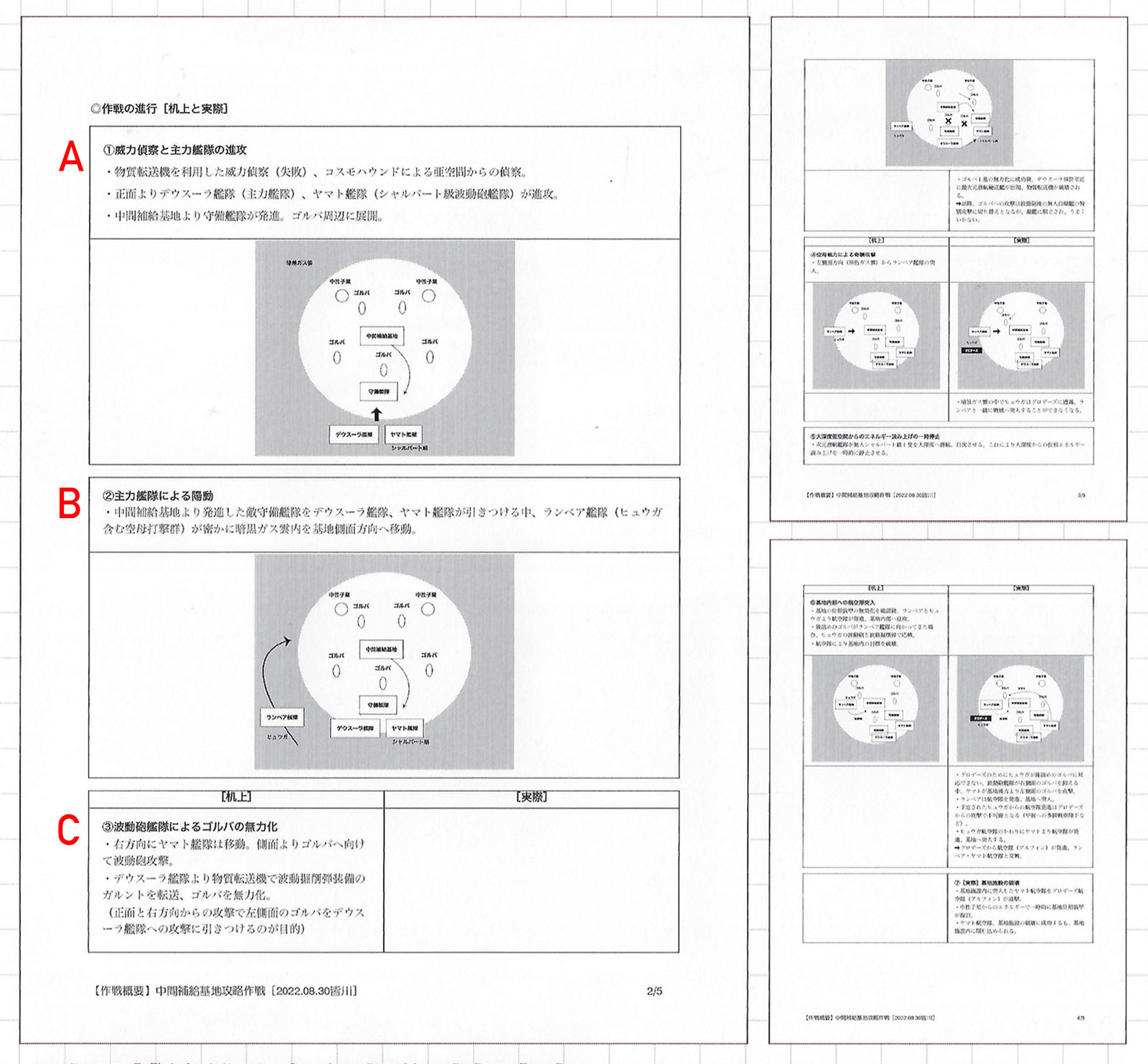
Phase 0: Progress of the Operation [Theory vs. Reality]
A: Armed Reconnaissance and Main Fleet Advance
Armed reconnaissance utilizing matter transporters (fails); reconnaissance from sub-space via the Cosmo Hound. The Deusula fleet (Gaidel’s fleet) and the Yamato fleet (Shalbart-class Wave-Motion Gun fleet) advance from the front. The garrison fleet launches from the Intermediate Supply Base. Gorubas deploy to the perimeter.
Translator’s Note: “Gaidel” is a major character on the Galman side in Yamato III, serving as the Commander of Galman-Gamilas incursion into our Solar System. He serves as Dagon’s supervisor, later taking command of the Yamato capture operation after Dagon is swallowed by a black hole, ultimately becoming the one and only classic era Yamato character to ever successfully capture Yamato. Gaidel is mentioned as a big priority character to bring back, as revealed in a 2205-related Yamatalk event. However, it appears he’s been completely supplanted by Dagon so far in 3199, and might possibly not even show up at this rate.
B: Diversion by the Main Fleet
While the Deusula and Yamato fleets draw away the enemy garrison fleet, the Lambea fleet (a carrier strike group including Hyuga) moves secretly through the dark gas cloud toward the flank of the base.
C: Neutralization of the Gorubas by the Wave-Motion Gun Fleet
The Yamato fleet moves to the right. They launch a Wave-Motion Gun attack from the flank toward the Gorubas.
The Deusula fleet uses matter transporters to warp in Galunt bombers equipped with Wave-Motion Drilling Bullets to neutralize the Gorubas. (The goal is to use attacks from the front and right to lure the Gorubas on the left flank into attacking the Deusula fleet.)