
Anime Frontline
Space Battleship Yamato
The Final Chapter
70mm, 6-Channel Super-Stereophonic
Sound Edition
Release approaching!
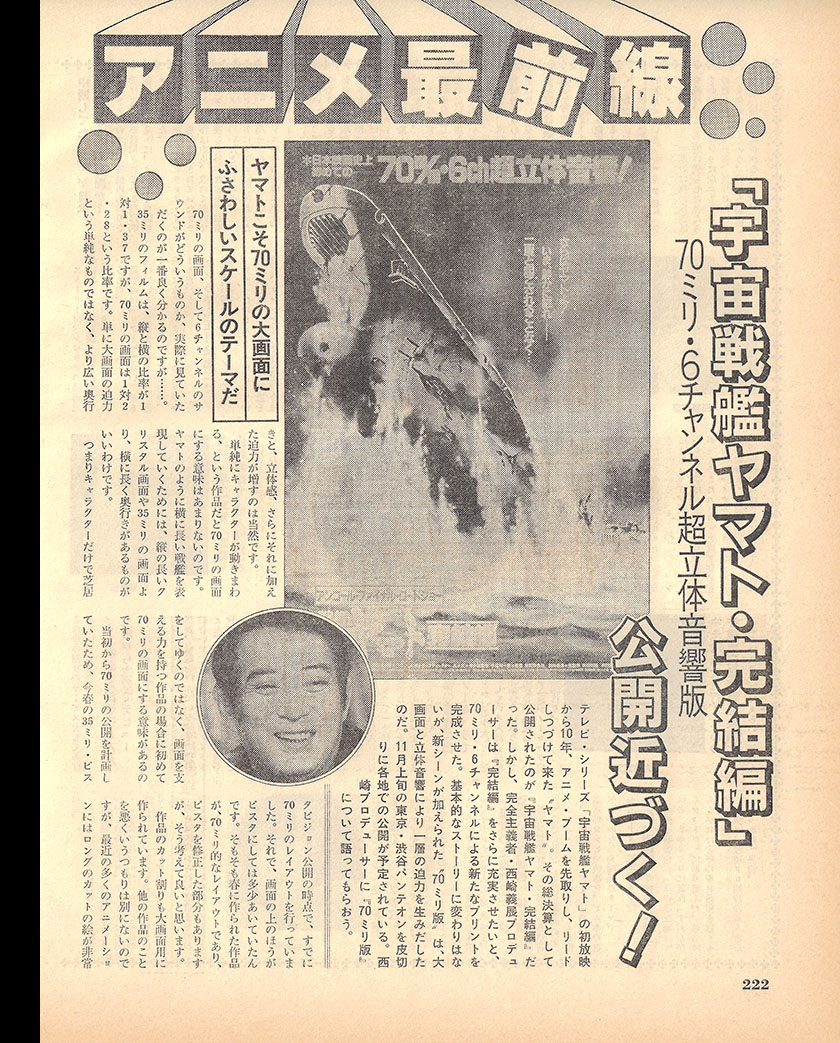
Ten years have passed since the initial broadcast of the TV series Space Battleship Yamato, a franchise that not only anticipated the anime boom but has continued to lead it ever since. The film Space Battleship Yamato, The Final Chapter was released as the grand culmination of this saga. However, the perfectionist producer Yoshinobu Nishizaki sought to further enrich The Final Chapter, ultimately completing a new print utilizing 70mm film and 6-channel sound. While the fundamental storyline remains unchanged, this “70mm Edition,” featuring newly-added scenes and harnesses the power of a massive screen and stereophonic sound to generate an even greater sense of intensity. Screenings are scheduled to take place across the country, beginning in early November at the Shibuya Pantheon in Tokyo. Let us now hear from Producer Nishizaki as he discusses this “70mm Edition.”
Yamato possesses a theme and scale truly worthy of the magnificent 70mm screen
The best way to truly understand what a 70mm screen and 6-channel sound are like is, of course, to experience them firsthand…
Standard 35mm film features an aspect ratio (height-to-width) of 1:1.37, whereas the 70mm screen boasts a ratio of 1:2.28. It is not merely a matter of the simple impact of a large screen. Naturally, it offers greater depth, a stronger sense of three-dimensionality, and an intensified visual power.
For works where the action consists simply of characters moving around, there is little point in utilizing a 70mm screen format. However, to effectively depict a horizontally-shaped vessel like Yamato, a broad and deep widescreen format is far more suitable than a taller “crystal” screen or a standard 35mm frame. In short, a 70mm screen is truly justified only for works that possess the visual strength to fill and sustain the frame; works that do not rely solely on character performances to carry the narrative.
Since a 70mm theatrical release was planned from the very beginning, the visual layouts for the 70mm version had already been finalized by the time of the initial 35mm VistaVision release this past spring. Consequently, the upper portion of the screen appeared somewhat empty, moreso than is typical for a standard VistaVision presentation. Fundamentally, the version produced in the spring was designed with a 70mm aesthetic in mind. Although certain sections were subsequently adjusted to fit the VistaVision format, it is accurate to regard the work as having been conceived primarily for 70mm.
The film’s shot composition was also specifically designed for a large-screen presentation. I do not intend to disparage other works, but many contemporary animated films feature very few long shots. To effectively convey the vastness of outer space, and to illustrate Yamato‘s position within that environment and the specific tactical situation at hand, a deliberate and appropriate approach to shot composition is absolutely essential. It is precisely because of this meticulous visual approach that Yamato possesses the inherent strength to fully hold its own on a massive 70mm screen.
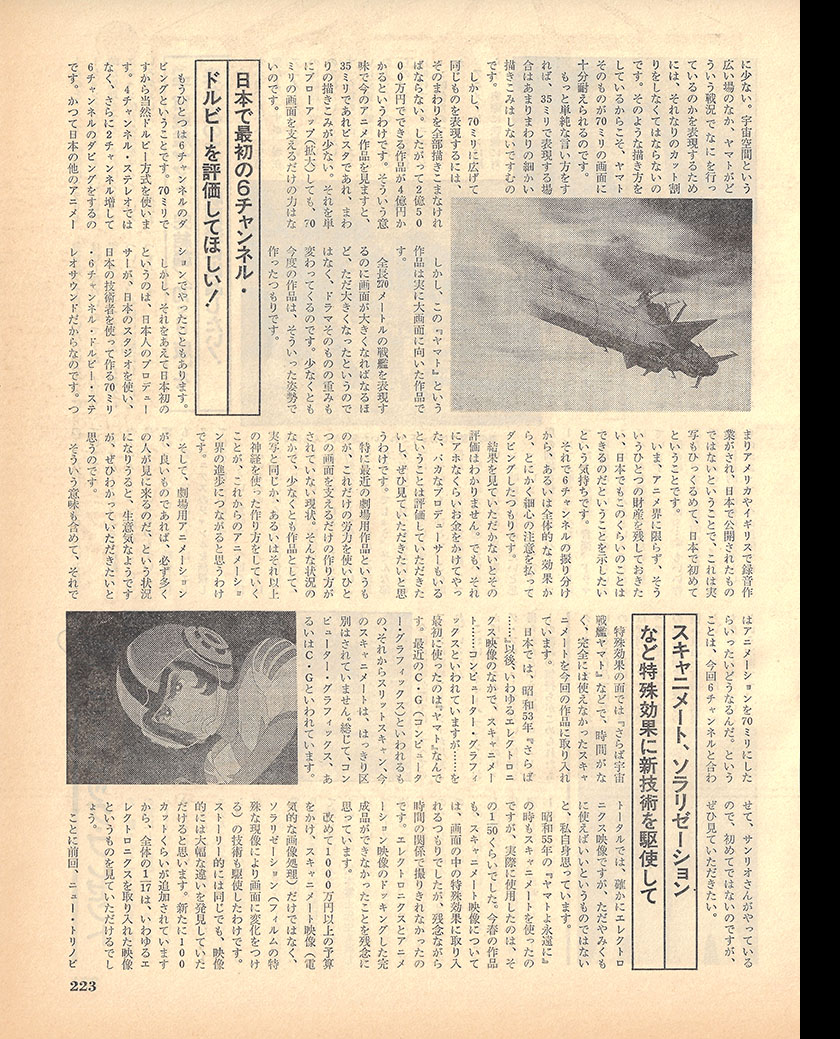
To put it more simply, when producing for a 35mm format, one can often get away with omitting a lot of fine detail in the background and surrounding environment.
However, to present that same content on a vast 70mm canvas, one is compelled to meticulously render every single detail of the surrounding environment. Consequently, a production that might cost between 200 and 500 million yen in 35mm format ends up costing upwards of 400 million yen. When examining current animated works through this lens, whether produced in 35mm or VistaVision, one observes a general lack of detailed background rendering. Simply “blowing up” (enlarging) such footage would not endow it with the visual substance required to effectively fill and sustain a 70mm screen.
This Yamato film, however, is a work that is truly and perfectly suited for the grandeur of the big screen.
Total Length: 270 meters. When depicting a massive battleship measuring hundreds of meters in length, the effect is not merely one of increased scale the larger the screen becomes. Rather, the very dramatic weight of the story itself takes on a different magnitude. At least with this latest production, that is precisely the mindset with which we set out to create it.
We want the world to recognize Japan’s very first 6-channel Dolby sound system!
Another key aspect of this project is our use of 6-channel sound mixing. Given that this is a 70mm film, it goes without saying that we have employed the Dolby sound system. We opted not for standard 4-channel stereo, but rather for a full 6-channel mix, adding two additional channels to the standard configuration.
This has been attempted in other Japanese animated works in the past, but the reason we’ve dared to proclaim this as a “first in Japan” is that this 70mm, 6-channel Dolby stereo soundtrack was produced by a Japanese producer, utilizing Japanese studios and Japanese sound engineers. In other words, unlike productions where the audio work is performed in the U.S. or the U.K. and subsequently released in Japan, this entire process took place domestically. This marks a historic first for Japan, encompassing not only animation but live-action cinema as well.
At this moment in time, and not just within the animation industry, I feel a strong desire to leave behind a legacy, a tangible asset for the future, and to demonstrate that “Japan, too, is capable of achieving a standard of this caliber.”
Consequently, from the precise allocation of the 6 channels to the overall sound design and effects, we have approached the mixing process with the utmost care and meticulous attention to detail. Of course, the true measure of our success cannot be determined until you’ve seen the final result for yourselves. Nevertheless, I hope you’ll at least appreciate the fact that there exists a “foolish producer” — myself — who was willing to pour an absurd amount of money into this endeavor. And, above all, I sincerely hope that you’ll come and experience it firsthand.
This is particularly relevant given the current state of theatrical animation, where productions all too often fail to invest the necessary effort and craftsmanship required to truly fill and support the magnitude of the cinematic screen. Amidst this landscape, I firmly believe that creating works such as this one, crafted at a meticulous level – equal to, if not exceeding, that of live-action cinema – is the key to driving the future progress of the animation industry.
Furthermore, and this may sound presumptuous, I want to convey a fundamental truth: if a theatrical animated feature is truly excellent, audiences will inevitably flock to see it in large numbers. I hope you’ll take this message to heart.
It is with all these sentiments in mind that we posed the question: “What happens when you bring animation to the 70mm format?” And that is precisely what we set out to answer with this 6-channel production. Since this project is being produced by Sanrio in conjunction with a TV broadcast, this isn’t exactly our first tryout. Nevertheless, I sincerely hope you’ll take the time to watch it.
We have harnessed cutting-edge technology to create special effects, including Scanimate and solarization
Regarding the visual special effects, we have incorporated “Scanimate” technology into this film, a technique we previously attempted to use in Farewell to Yamato, but were unable to fully implement due to a lack of time.
In Japan, following the release of Farewell in 1978, Yamato was actually the very first production to utilize Scanimate, a technology often referred to as “computer graphics” within the realm of what is broadly termed “electronic imagery.” Nowadays, there is no strict distinction made between what is called “modern CG” (computer graphics), “slit-scan” effects, or the Scanimate technology of that era. Collectively, they are all simply referred to as “computer graphics” or “CG.” While it is true that, in a broad sense, these all fall under the category of electronic imagery, I personally believe that one should not simply employ such techniques blindly or indiscriminately.
We did utilize Scanimate during the production of Be Forever Yamato in 1980, but in the end we were only able to incorporate about one-fiftieth of the footage we actually created. For this production, we once again intended to integrate Scanimate footage into the on-screen special effects for the spring release. Regrettably, however, we were unable to complete the filming as planned due to time constraints. I deeply regret that we could not deliver a finished product that fully realized the intended fusion of electronic imagery and traditional animation.
Consequently, we have once again allocated a budget exceeding 10 million yen to fully harness not only Scanimate technology (electronic image processing) but also “solarization,” a technique involving specialized film development processes to create unique visual effects. Although the underlying storyline remains the same, I believe you’ll discover significant visual differences in this new presentation. With the addition of a few extra cuts, roughly one-seventeenth of the total runtime now consists of visuals that incorporate electronic processing.
In particular, during the previous installment, specifically the Neutrino beam sequence, I had entertained various ideas: applying solarization effects to the footage, utilizing special processing, or employing slit-scan techniques. I must apologize to those who paid to watch the previous release; due to a lack of resources and technical limitations at the time, I was unable to fully realize those concepts. However, I believe I’ve now brought those previously unfinished elements to absolute perfection in this latest version.

We want to submit Space Battleship Yamato, The Final Chapter (70mm Version) to next year’s Cannes Film Festival!
As I contemplate the future, and this may sound terribly presumptuous, I cannot help but feel that the medium of animation currently stands at a crossroads. As we look toward future projects and on-screen visuals, what exactly constitutes the kind of animation that is truly suited for the coming era? And indeed, the era beyond that?
It is not limited to animation alone; I believe that the sensibilities of fans regarding visual media in general have undergone a profound transformation. Consequently, I have decided that, at least for the coming year, I will refrain from releasing any new works of my own. I believe my time to step back into the spotlight will be the year after that.
With that goal in mind, focusing on the three elements of future visuals, electronic techniques, and music, I intend to devote myself to a thorough study of these specific directions. Furthermore, in my next project, I aim to fully utilize the technical skills I have acquired, while certainly prioritizing the narrative and conceptual planning.
Animated imagery, a medium pioneered by Walt Disney, has undergone significant evolution in terms of both its content and its dramatic storytelling. Indeed, for the new generation of audiences, the very concept of visual media is inconceivable without incorporating the realm of electronics.
In that sense, the use of “Scanimate” effects in this particular film may, in certain instances, appear somewhat trivial. However, rather than presenting these electronic visuals in a raw, unadorned manner, I have chosen to employ them as a form of special effect. By doing so, I believe their impact is amplified at least twofold. I hope that audiences will find even these specific elements worth seeing.
One more thing…regardless of whether this film ultimately surpasses Farewell to Yamato or not, I intend to submit it to the Cannes Film Festival next spring. My plan is to rent a 70mm theater at Cannes and screen the film using a superimposed projection technique. My goal is to clearly demonstrate, at least within the context of Japan, the current capabilities of our 70mm animation in terms of visuals, music, and dramatic storytelling.
While Farewell was certainly an excellent film, from a purely technical standpoint it is not a work that would be considered ready for the international market today. This takes into consideration the advancements in animation and the visual/technological transformations that have taken place since 1978. Since I’ve worked with essentially the same core staff since then, I’ve decided to take The Final Chapter overseas as a testament to the cumulative technical expertise they have cultivated over the years.

Special Announcement!
The “Yamato Big Present” Campaign
For this theatrical release, a special gift awaits every fan who visits the cinema! This initiative serves as an expression of gratitude from Producer Nishizaki, who credits the Yamato fans for elevating him to his current stature as a “big-time producer” within the anime industry. The plan is to package a variety of Yamato merchandise into “lucky bags” and deliver them to the fans, accompanied by Producer Nishizaki’s heartfelt appreciation.
Additionally, there is a special project underway to auction off one of the two existing cutaway models of Yamato. The production cost for a single model (or “sectional model” as it is known) was a staggering 5 to 6 million yen. It features an intricate internal mechanism. When the lights are switched on, the muzzle of the Wave-Motion Gun glows and moves. Rumor has it that even the legendary Leiji Matsumoto himself is eager to get his hands on one. Although the exact format of the auction has yet to be officially determined, it will be fascinating to see whose hands this unique piece ultimately falls into. And for you — the very person reading this page right now — that opportunity could be yours!
Producer Nishizaki has stated that the remaining unit is intended for future display alongside other permanently preserved Yamato archival materials, to be unveiled whenever the long-awaited “Yamato Museum” finally becomes a reality.