
REBEL 3199 Chapter 5 is an All-Out War – The Impact of the “Last Minute”

Published at Mantan Web, February 19, 2026. See the original post here
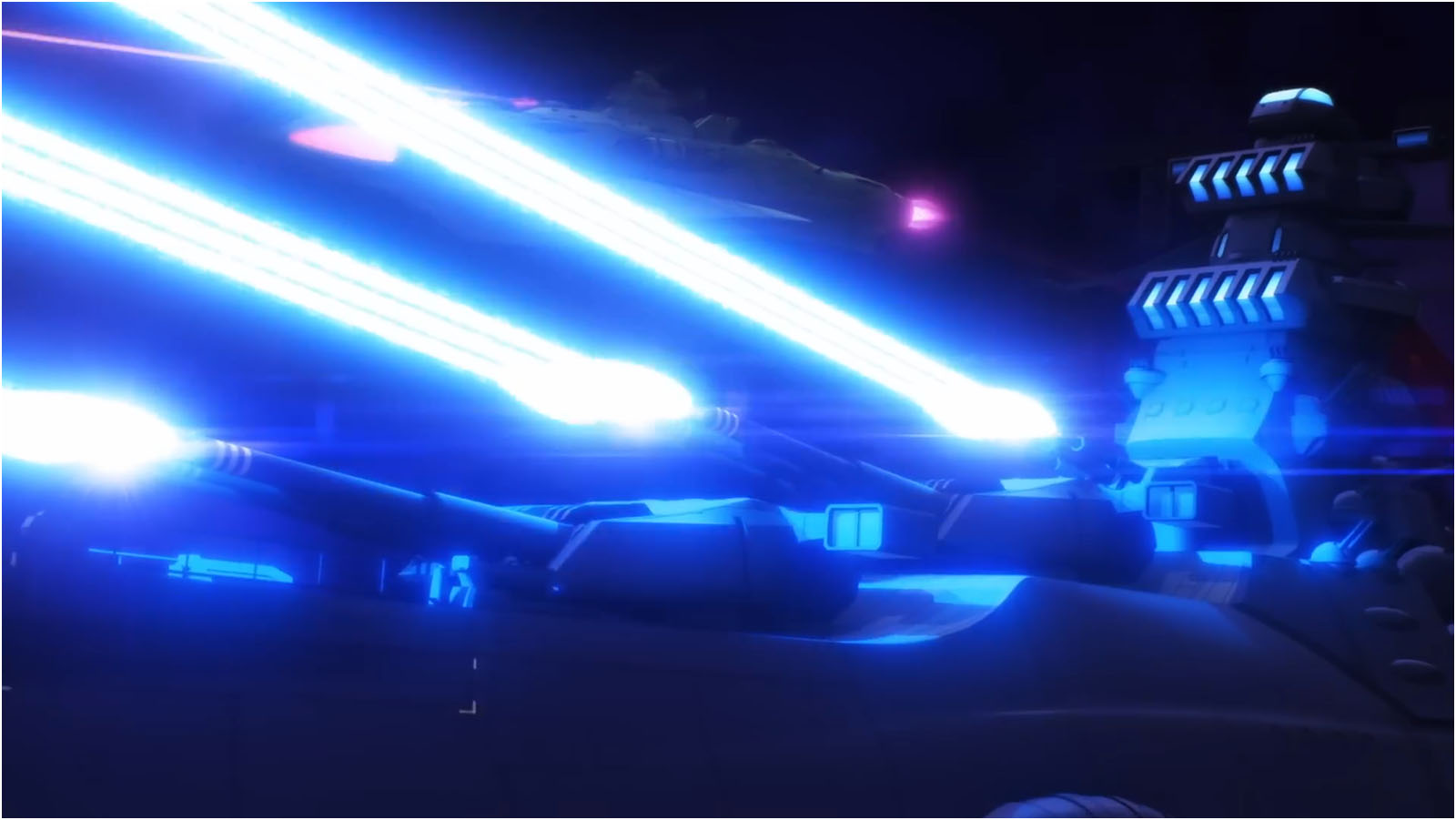
The fifth chapter of REBEL 3199, titled The Incandescent Galactic War, will premiere on February 20th. One of the highlights of Chapter 5 is the all-out battle between Yamato and the Galman-Garmillas combined fleet against the intermediate supply base, Digablas. The main visual, accompanied by the tagline In The Last Minute, Everything Changes, has also attracted attention. We spoke with General Director Harutoshi Fukui and Director Naomichi Yamato about Chapter 5.
The all-out battle is more spectacular than we imagined
Interviewer: The all-out battle is one of the highlights of Chapter 5.
Fukui: I was prepared for it to be difficult. However, the team behind this remake series understood what we were looking for and offered suggestions like, “We can do this much,” and “How about trying it this way?” It turned out to be even more spectacular than we initially expected.
Yamato: It exceeded our expectations. Even physically speaking, there were far more CG shots and ships than in the other chapters. It all came together thanks to the staff.
Fukui: Not only the CG staff, but the cinematography was also a big factor. The color of the beams and the scenes where the phase fields were deployed were actually done through cinematography. As I kept telling them to do more, they realized that this was what we were looking for.
Interviewer: Did you envision Chapter 5 being one of the highlights of the battle scenes from the beginning?

Fukui: It’s a highlight scene in the original work as well. However, the scene where the planet Dezarium emerges from the double galaxy left such a strong impression on me that I don’t remember much about what happened after that. (Laughs) I have a vague memory of what Yamato was doing before and after that. So, focusing on the battle scenes was something I had thought about before starting. Goruba is a connection to The New Voyage, but I thought it would be strange if Goruba, which was defeated with such difficulty, was then defeated easily. So this time I combined Goruba with the intermediate supply base.
Yamato: We positioned Gorubas flanking it on both sides.
Fukui: Working backward from Goruba’s size, we decided that the intermediate supply base would need to be at least 70 kilometers wide.
Yamato: It’s basically background art materials. Designer Mika Akitaka knew how it would look from various angles, so he gave instructions.

Combination! Doppelganger! Transformation!
Interviewer: Alphon is also a fascinating character. In Chapter 5, he confronts Kodai.
Fukui: In the original work, there wasn’t much information about him beyond his obsession with Yuki. Since there was an intelligence department setting, I tried to make use of that. Dezarium is conducting ruthless intelligence ops on Earth, but I portrayed him as someone with a sense of shame. He becomes a man who purely seeks “love.” Killing Kodai would eliminate an obstacle, but he’s beginning to realize that “love” means “making the other person happy even at the cost of sacrificing oneself.” He’s come to think that Kodai being alive is probably what makes Yuki happy. Only when fighting Kodai is he freed from his scheming. Since Yamato is also a story of conflict, he does take on a protagonist-like role in that sense.
Interviewer: From Chapter 4 onward, the spotlight has also been on Ram.
Fukui: Ram is popular, after all. For our generation, the release of a plastic model of the Rajendora made an impression. We decided from the planning stage that we would give the Rajendora a special role to really showcase it. Bolar (the Federation) was barely featured in the original work, but we thought we could show them well through that.

Interviewer: The Witch of Uralia, created by Takayuki Taketani, also makes an appearance.
Fukui: I asked him to do it. Sccriptwriter Hideki Oka had met him, so he introduced me to him. Taketani-san is amazing, as always. The design makes it look like it “smells.” It really expresses the disgusting nature of the Dezarium beyond its surface.
Yamato: It’s hard to animate, though. (Laughs) We expressed it through background art.
Interviewer: What was particularly difficult about producing Chapter 5?
Yamato: The quantity, of course, but also the range of expression. If it was just a continuous string of action, people would get bored. There’s also combining, doppelgangers, and transformations. We thought about how to present it logically, and put it all together to the best of our ability.
Throwing a stone only to hit your own head
Interviewer: 3199 seems to depict a problem facing humanity: being overwhelmed by information and losing track of what is true.
Fukui: Some people have said, “this work is like throwing a stone and hitting your own head,” and I feel that the message it’s trying to convey is clear. In a social media society, peer pressure and cult-like behavior occur all the time. It’s precisely because it’s fiction that it can be portrayed from a slightly detached perspective.
Many anime and films today are designed to avoid offending people, avoid rebuttals, and prevent viewers from fighting with each other after watching, but we’re trying to move away from that. Anime was originally a medium that could delve into areas that live-action films can’t. It’s layered to the point that it’s almost excessive. Before the COVID-19 pandemic and the era of social media, people might have said, “Humans aren’t this stupid.” Now, it’s become “If you throw a stone, it’ll hit your own the head.”
Interviewer: Social media is convenient, but…
Fukui: In the age of social media, we’ve somewhat gone back to the days of old-fashioned water cooler conversations. You can choose which water cooler conversations to join, and there are countless groups that believe that what’s said there represents the truth of the world. Everyone is anxious. That’s why they follow people who declare something to be “the truth.” It’s easier that way. Perhaps many people don’t want to think about how they should live or what society is like. Many people just follow what’s decided for them, and this is what’s happening in both Japan and the US.
Interviewer: Nowadays, people look things up online, but sometimes the information online is wrong.
Fukui: I want young people today to realize that we live in extremely uncertain times.
Interviewer: The tagline, “Everything changes in the last minute,” has also become a hot topic.
Fukui: It was a concept from the beginning. I thought that if we could do this, we could do 3199. But I can’t say any more at this point.