
As we look into the early years of Yamato‘s legacy era, the first anime we run into is the most notorious of Yoshinobu Nishizaki’s post-Yamato project: Odin, Photon Space Sailor Starlight. Released as a feature film in 1985, it turned into a box office bomb. How did it get there? This series will track it from start to finish and maybe find out.
We begin with the information that was published during its 1984 development phase, as reported in the pages of the official Yamato Fan Club magazine…
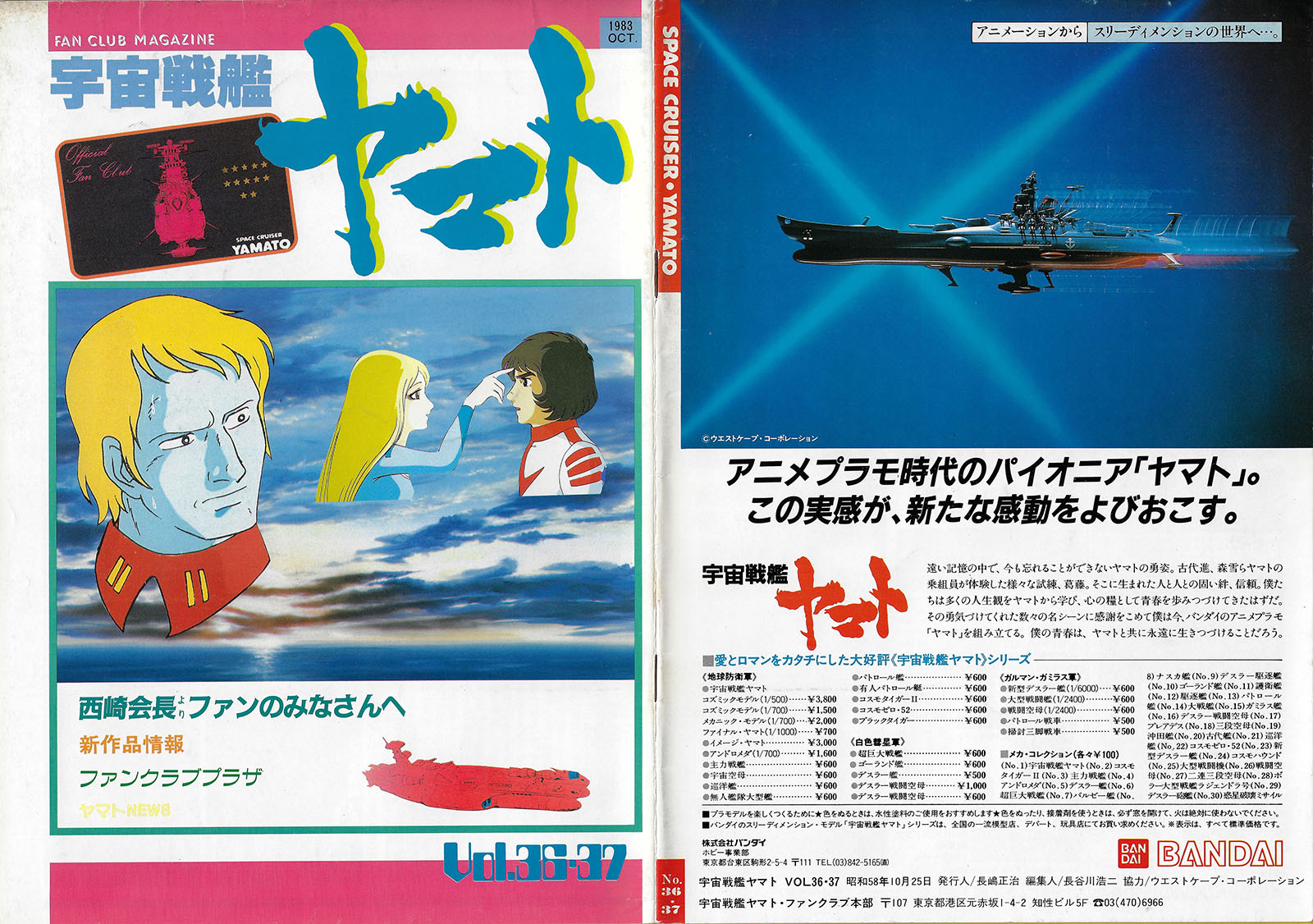
May 1984: Fan club magazine 36/37 (double issue)
The bulk of this issue was filled up with a Nishizaki essay that introduced a new slate of projects. Odin was chief among them, and the first to enter pre-production. However, the actual title was still in the future.
Read the entire essay here. Below are the portions that pertain only to this project…
New plan for 1985 to 1987
Now, let me tell you about my production plans for the period from 1985 to 1987. First, in terms of anime, there is a work tentatively titled Space Sailor Starship. I will explain this in more detail later, but like Yamato, it is a story about young people traveling through space. The fact that a ship travels through space is the same as in Yamato, but the content will be depicted from a different perspective. However, it goes without saying that the spirit that flows through it at its core will be the same as in Yamato.
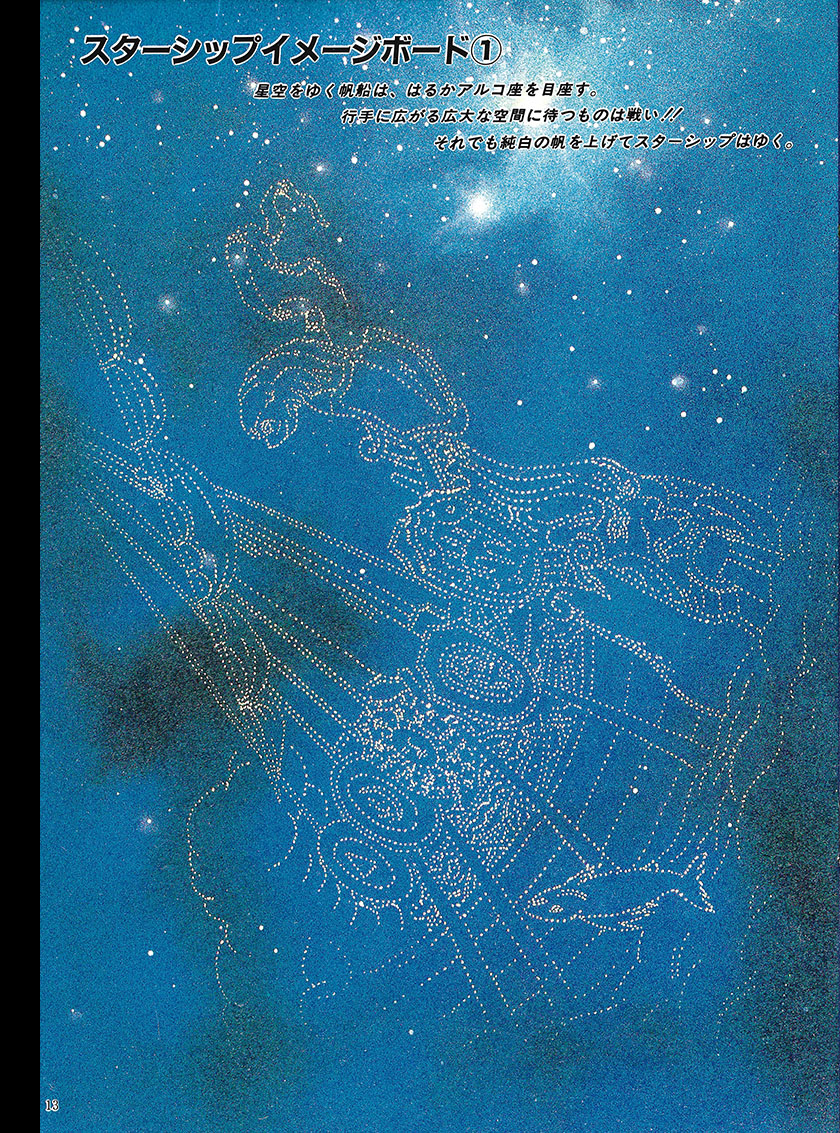
Starship image board 1
The sailing ship sails through the starry sky, its sights fixed on the distant constellation Arco. A battle awaits in the vast open space ahead! Nevertheless, the Starship sails on, is pure white sails raised.
New Starship
Starship is a story about boys and girls who travel through the starry sky aboard an anti-gravity spaceship. Like Yamato, this anime features boys and girls as the main characters, who forge their own future with hopes and dreams.
In the past, in Europe, crossing the Strait of Gibraltar from the Mediterranean Sea to the Atlantic Ocean was a turning point. Crossing the Cape of Good Hope at the southern tip of the African continent opened up a route to the Indian Ocean. Crossing the Strait of Magellan opened up a route to the Pacific Ocean. These also proved that the Earth is round, marking the beginning of the Age of Discovery.
Similarly, the voyage of Starship will usher in an era of great voyages beyond the solar system in the near future of 2090.
In today’s world, where science-fiction is prevalent, we tend to think of the solar system as very small, but in reality, it is a truly vast space. Even navigating within it is still not entirely free, and venturing beyond it will undoubtedly require an even greater scientific and spiritual leap.
The story of Starship is set in the near future, about 100 years from the present. At that time, humanity has only just managed to establish a living space as far as Mars, and is exploring routes to even more distant places beyond Jupiter. Conventional spacecraft do not use liquid fuel rockets like those of today, but rather laser navigation. This involves emitting lasers from planets or space stations along the route.
Imagine a light-powered sailing ship where a laser beam is directed at the ship’s sails to generate thrust. In this context, Starship appears as a groundbreaking anti-gravity space sailing ship.
Starship is truly the protagonist of this work. Imagine a ship with elegant sails unfurled between the stars. However, these sails are not for catching light, but rather plates that emit anti-gravity particles. In other words, it’s a never-before-seen mechanical marvel, with super-scientific mechanisms hidden within the style of an ancient ship.
Starship is built in a space dock located at a gravitational equilibrium point called a Lagrange point, and is headed to Jupiter for a test voyage. However, an unexpected accident occurs, resulting in the loss of experienced astronauts and other scientists, leaving the ship to be operated by just over 20 boys and girls. It is, in a sense, a space version of Two Years’ Vacation.
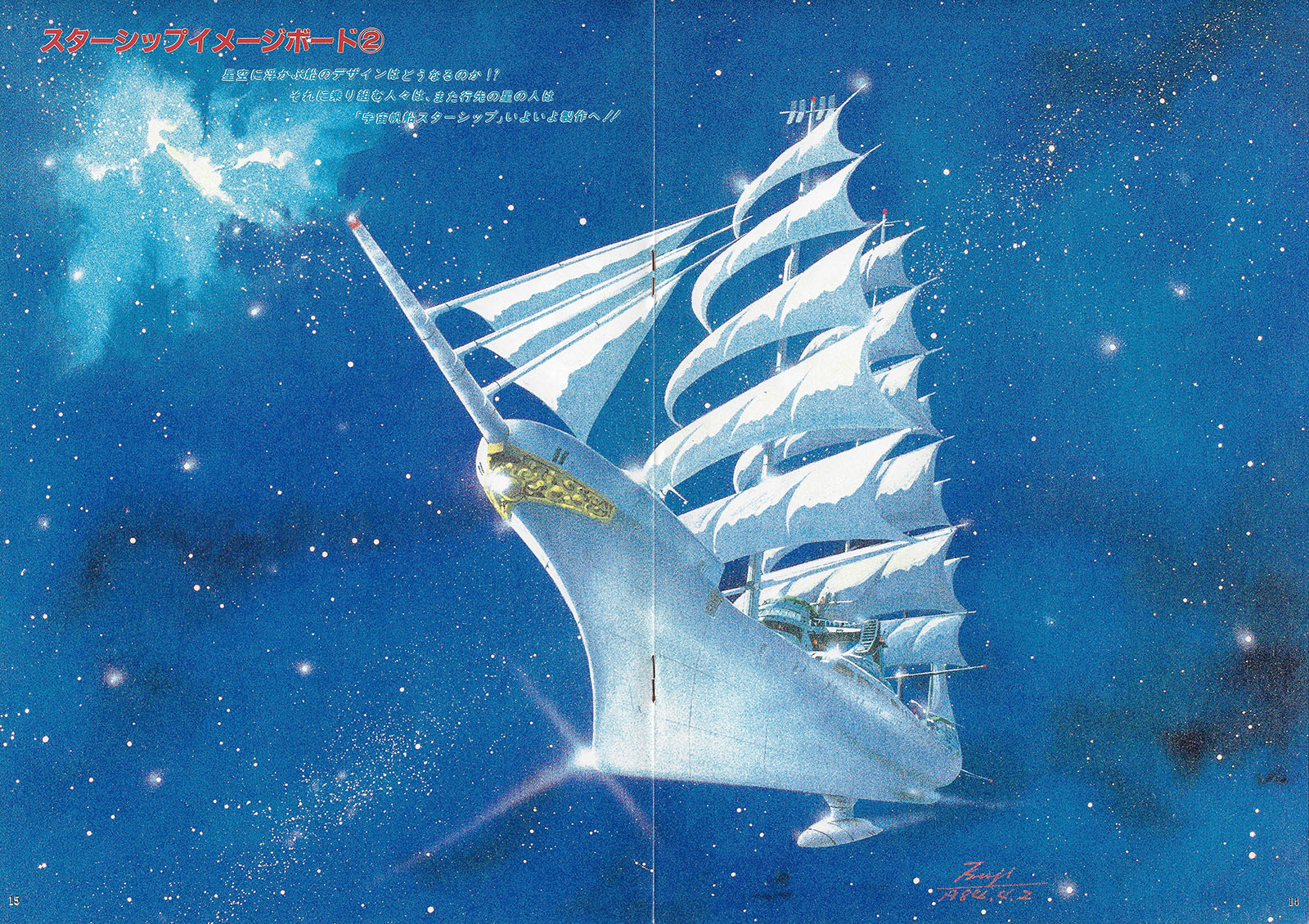
Starship image board 2
What will the design of the ship floating in the starry sky look like? The people who board it, and the people of the destination star? The Starship spaceship is finally going into production!
Starship, carrying these boys and girls, takes off into the outer reaches of the solar system, using a groundbreaking new navigation method. Its destination is among the constellations twinkling in the night sky. There is the constellation known since ancient times as Rialgo, shaped like a sailing ship, which contains the Canopus solar system. It is 180 light years away, a mind-bogglingly vast distance compared to the solar system. Thus, Starship sets sail into a new frontier of outer space as humanity’s first manned interstellar spacecraft.
This is where the story of Starship begins, but of course many different episodes will unfold from there. We plan to put a lot of effort into both characters and the mecha, so please look forward to it.
Starship and its boys and girls face mysteries as their voyage depends on their success, and at times they are forced to engage in battle.
Millions of years ago, a species of ape rose to the occasion, standing on two legs and using its free forelimbs to hold tools. That was the origin of science and technology, and thus the human species was born. Since then, it can be said that humanity has evolved alongside the development of science and technology. If humanity is something that constantly challenges itself within the vast expanse of space and time, then just how far will humanity go? This story is a grand science-fiction anime that depicts humanity’s progress through the anti-gravity sailing ship Starship and the boys and girls who coincidentally become its crew. Just like with Yamato, we ask for your support.
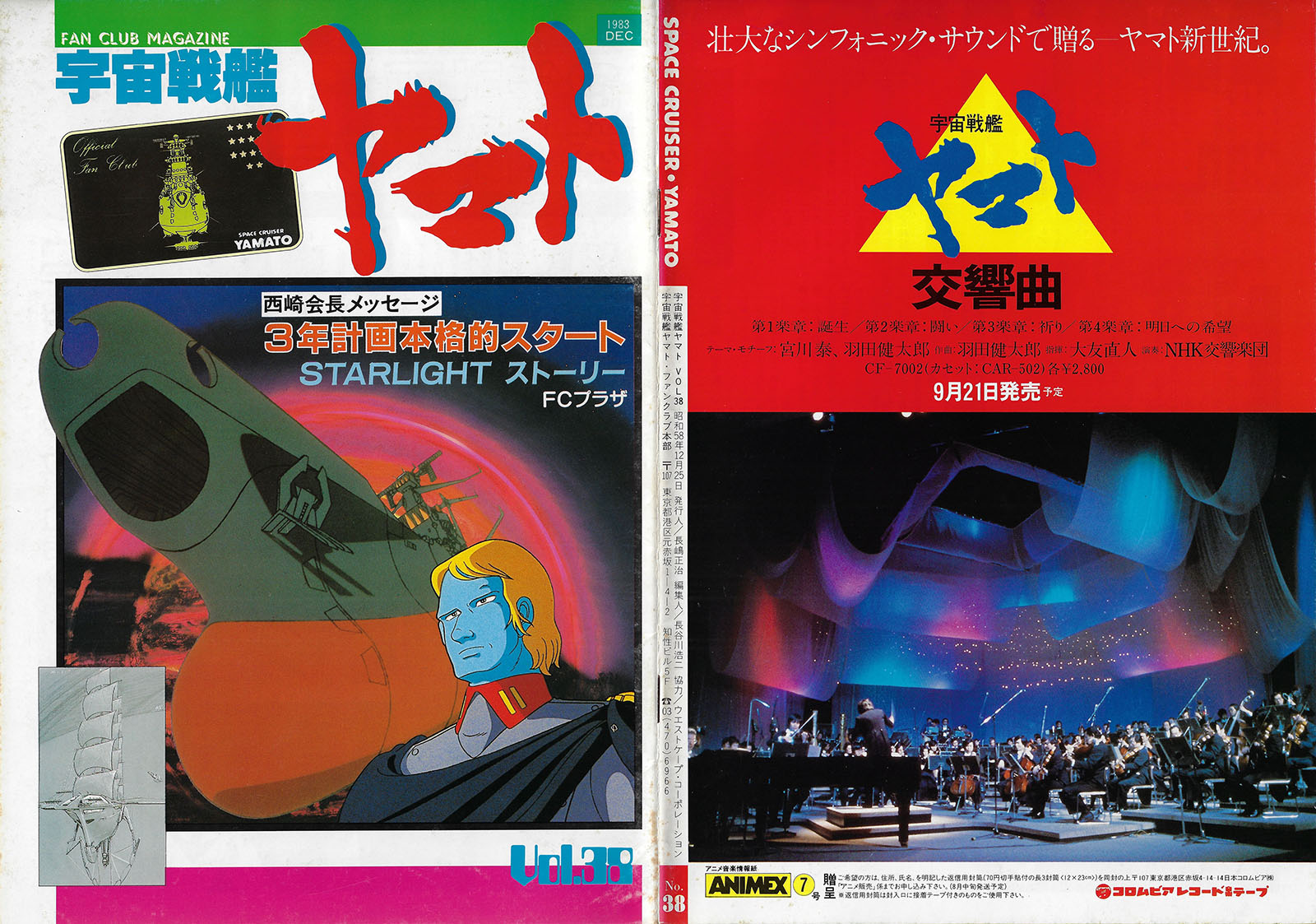
Summer 1984: Fan club magazine 38

Photon Sailing Ship Starlight
The hot weather continues every day, but how are all the fan club members doing? As I mentioned in the previous issue, my three-year production plan, which began in 1984 and continues into 1985, has already started, and the details of each project, including the content and staff, are being finalized.
First, in August 1985, Photon Sailing Ship Starlight – previously mentioned under the working title Space Sailor Starship in the last issue, is scheduled to be released by Toei.
Starlight is a sailing ship that can fly by controlling anti-gravity and also navigate by receiving photons on its sails. While Yamato was an armed battleship, Starlight is built as an unarmed merchant ship and test vessel. Of course, since it is an action drama, there are battle scenes, but not in the form of main gun against main gun like in Yamato. It’s planned to be a unique action film, incorporating innovative, sci-fi ideas.
The story centers around students from a space merchant marine school, who board the Starlight for their graduation voyage, and a beautiful girl who ends up on board due to an accident. Their journey is reminiscent of the voyages of adventurers across the Atlantic and Pacific oceans during the Age of Discovery, and ultimately leads to humanity’s first contact with extraterrestrial intelligent life. More details will be revealed in this issue, including brainstorming sessions and design sketches, but I am confident that the adventurous spirit of these 22nd century youths into the unknown and their romantic thoughts about the vast universe will surely stir something in you as well.
The staff is familiar from Yamato. The film is directed by Toshio Masuda and Eiichi Yamamoto, with a screenplay by Hideaki Yamamoto and Kazuo Kasahara. The character designs and overall settings are by Satomi Mikuriya, the popular manga artist behind The Torn Passport. All the staff members are currently putting their full effort into the story and concept design.

LEFT SIDE:
Starlight preliminary draft announced!
This is a character drawn by Satomi Mikuriya She is a student at a merchant marine school who boards the Starlight. She is a charming girl, and the heroine.
RIGHT SIDE:
Starlight takes our dreams on a journey into space, but what awaits us there…?
Anti-gravity space sailing ship
setting off on a test voyage
The time is the latter half of the 21st century. A powerful laser network has been spread throughout the solar system, and light-wave spacecraft are frequently traveling between them.
At this time, anti-gravity particles are discovered as a groundbreaking energy source for humankind, and the Japan Aerospace Exploration Agency immediately begins construction of a test anti-gravity spacecraft in a dock at a colony located at a Lagrange point (a point of gravitational equilibrium) between the Earth and the moon. This is the Starlight (provisional name).
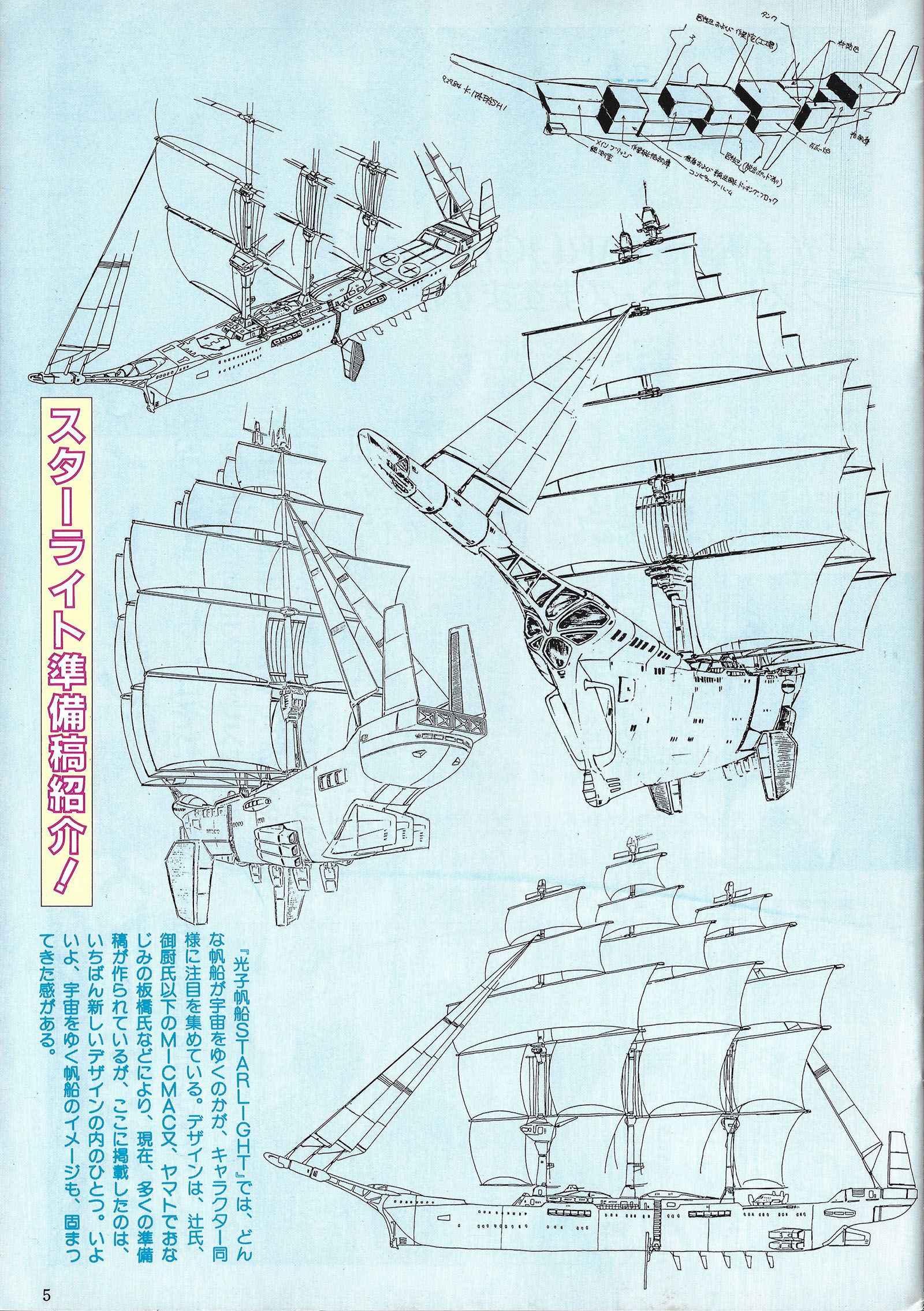
Coincidentally, the Starlight resembles a medieval sailing ship. However, its sails aren’t for propulsion. By controlling anti-gravitons produced by the engine, the ship’s speed can be altered by manipulating the amount and angle of the sails. As a test ship, the Starlight also has other backup features, such as the ability to fly by receiving photons.
The day of launch for the test voyage arrives. The crew consists of the captain and other veteran adults, including scientists, as well as about 20 outstanding students graduating from the space merchant marine school that year. This serves as a graduation voyage in preparation for the coming era of anti-gravity ships.
With the whole world watching, Starlight leaves the Lagrange point and approaches the moon with the blue Earth behind it. Eventually, it spreads its anti-gravity sails to their fullest extent and slowly lands at the moon base, where it is greeted with an enthusiastic welcome from the inhabitants
On an asteroid
Encounter with a mysterious machine
Although things go well on the moon, when Starlight begins its full-scale journey to Mars, various unknown flaws emerge, leading to crises. It seems that anti-gravity propulsion is still far from being a reality for humanity.
Meanwhile, around the same time, a series of strange incidents occurs near the asteroid belt, in which spacecraft are disappearing one after another. When the space development agency investigates, they discover than an asteroid-shaped unmanned combat mecha, believed to be from outside the solar system, has gotten mixed in with the disappearances. A space patrol fleet is immediately dispatched to eliminate the enemy, but they are attacked and wiped out.
An urgent order comes in to Starlight, while working on repairs at the Martian base. The order is to rush to the asteroid belt between Mars and Jupiter, then investigate and dismantle combat mecha.
As Starlight approaches, another solar system ferry, unaware of the restricted area, enters the problematic airspace and is attacked and destroyed. Those who manage to flee in escape capsules are adrift and rescued by Starlight. Among them is a girl of mystical beauty.
Starlight scientists and veteran crew members board small boats and begin their investigation. The combat mecha is indeed created by intelligent life outside our solar system. In other words, it’s proof that there are other humans in the universe besides those on Earth.
When they begin dismantling it, an unexpected accident occurs: the combat mecha explodes.
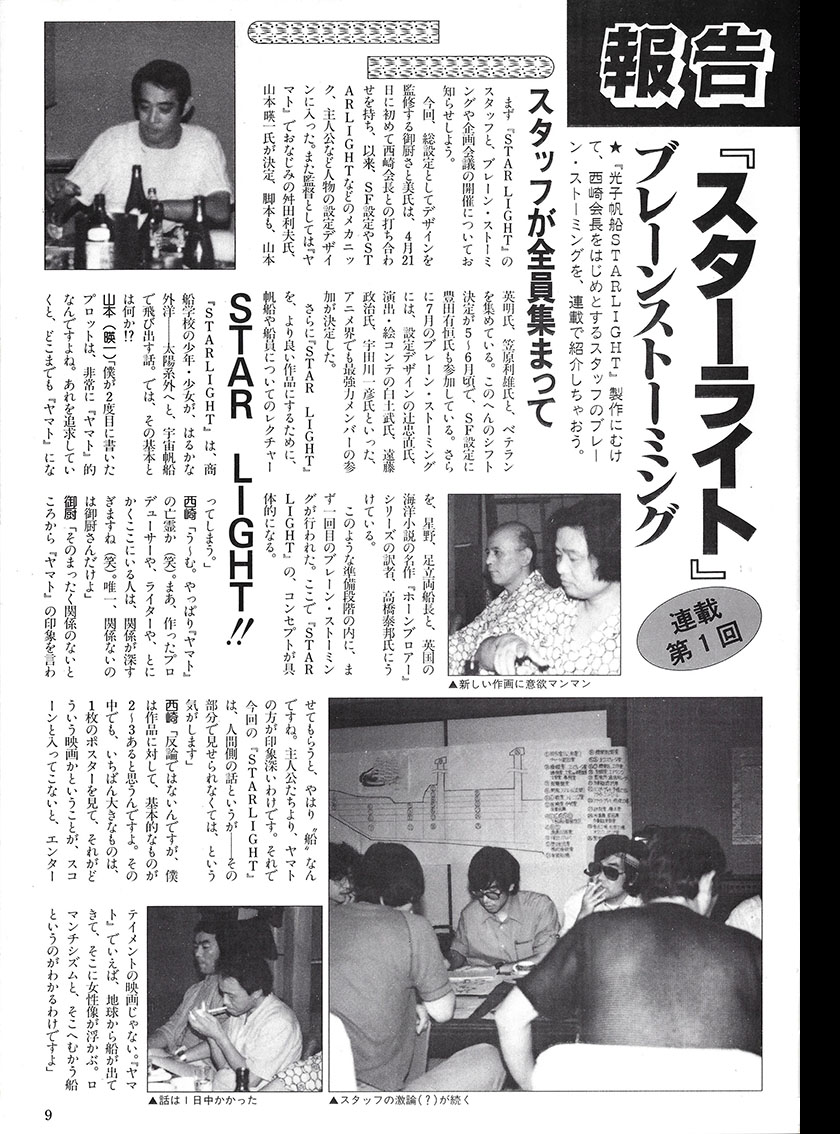
Starlight brainstorming part 1
In this series, we’ll introduce the brainstorming sessions of Chairman Nishizaki and the staff as they work toward the production of Photon Sailing Ship Starlight.
All the staff gathers together
First, let me tell you about the staff of Starlight and the brainstorming and planning meetings we’ve been holding.
Satomi Mikuriya, who is overseeing the overall design for this project, had his first meeting with Chairman Nishizaki on April 22, and since then has been working on the sci-fi concepts, the mecha such as Starlight, and designs for the main characters. Toshio Masuda and Eiichi Yamamoto, both well known for their work on Yamato, have been confirmed as directors. The script will be written by veterans, Hideaki Yamamoto and Kazuo Kasahara. These shifts were decided around May and June, with Aritsune Toyota also participating in the sci-fi concepts.
Furthermore, the brainstorming session in July feature the participation of some of the strongest members in the anime world, including concept, designer Tsuji Tadanao and directors and storyboard artists Takeshi Shirato, Masaharu Endo, and Kazuhiko Udagawa.
Furthermore, in order to make Starlight an even better work, they received lectures on sailing ships and sailors from captains Hoshino and Adachi, as well as from Yasukuni Takahashi, the translator of the classic British Maritime novel series, Hornblower.
During this preparatory stage, the first brainstorming session took place. This is when the concept for Starlight became more concrete.
Starlight!!
Starlight is a story about boys and girls from a merchant marine school who set sail on a spaceship into the far reaches of the open ocean beyond the solar system. So what are the basics of it?
Eiichi Yamamoto: the second plot I wrote was very much like Yamato. If I pursued that further, it would just become Yamato no matter what.
Nishizaki: hmm. I guess it’s the ghost of Yamato after all. (Laughs) Well, the producers who made it, the writers, and everyone here are all very deeply involved. The only one who wasn’t involved is Mikuriya-san.
Mikuriya: if I were to give my impression of Yamato from a completely unrelated perspective, it would definitely be the ship. Yamato is more memorable than the main characters. So this time with Starlight, although it’s a story from the human side, I feel that we have to show that aspect.
Nishizaki: I’m not trying to argue, but I think there are two or three basic things that are essential to a work of art. And among those, the most important one is if you can’t immediately grasp what kind of movie it is just by looking at the poster, then it’s not an entertaining movie. In the case of Yamato, a ship leaves Earth, and a female figure appears on it. You can see the goal and the ship heading toward it.
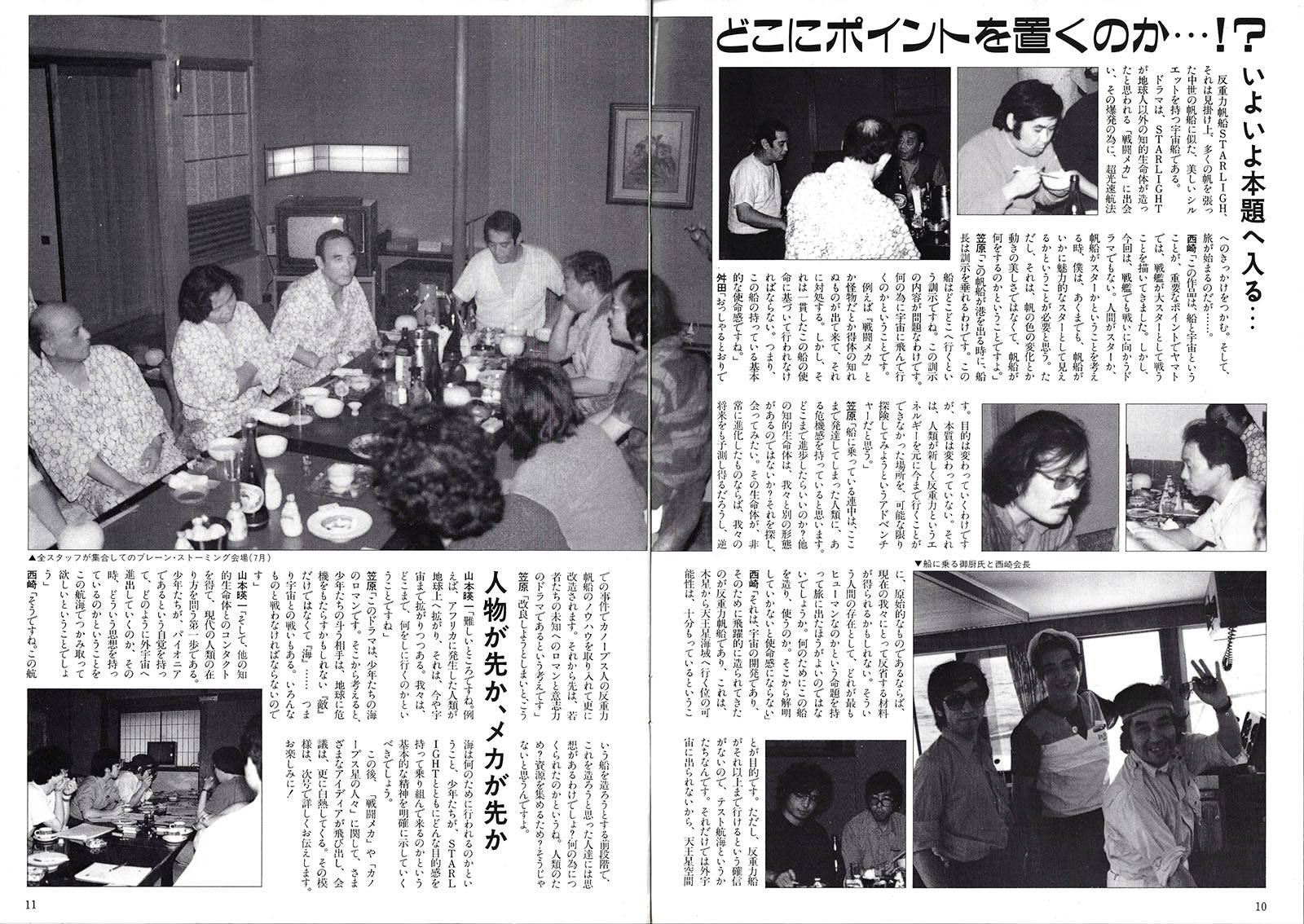
Where should we focus our attention…?
Now, let’s get down to business…
The anti-gravity sailing ship Starlight is a spaceship with a beautiful silhouette that outwardly resembles a medieval sailing ship. The story begins when Starlight encounters a “combat mecha” that appears to have been created by an intelligent life form other than humans, and its explosion gives them a clue to faster than light travel. And so their journey begins…
Nishizaki: in this work, ships and space are important points, and in Yamato, we depicted battleships as the big stars fighting each other. However, this time, it’s neither a battleship nor a story about heading into battle. When considering whether the stars are humans or sailing ships, I believe it’s essential that the sailing ship itself appears as a captivating star. However, that’s not about the changing colors of the sails, or the beauty of their movement, but rather what the sailing ship actually does.
Kasahara: when this sailing ship leaves port, the captain gives a speech. This is a directive stating where the ship is going. The problem lies in the content of this directive. What is the purpose of flying into space? For example, things like combat, mecha, monsters, or other known entities might appear, and we have to deal with them. However, this must be done in accordance with the consistent mission of the ship. In other words, it’s the fundamental sense of mission that this ship embodies.
Masuda: you’re absolutely right. The objective may change, but the essence remains the same. It’s an adventure in which humanity, using the new energy of anti-gravity, tries to explore as many places as possible that it has never been able to reach before.
Kasahara: I think the people on board the ship have a sense of crisis about humanity’s advanced state. How far should we progress? Are there other intelligent lifeforms that are different from us? They want to find them and meet them. If that life form is highly evolved, it may even be able to predict our own future, and conversely, if it is primitive, it may provide material for us to reflect on in the present. As for the existence of humans, shouldn’t we embark on this journey with the question of what quality of ours is the most human? What is the purpose of building and using this ship? Unless we clarify that first, it won’t feel like a mission.
Nishizaki: That is space development. To that end, anti-gravity sailing ships have been developed at an astounding pace, capable of traveling from Jupiter to the Uranus region. The goal is to demonstrate that it has sufficient capability. However, since there is no certainty that the anti-gravity ship can go beyond that, it is in the form of a test voyage. Because it cannot go into outer space with just that, the know-how of the Canopus anti-gravity sailing ship from the incident in Uranus space will be incorporated and further modified. From there on, the idea is that it will be a story of the romance and willpower of young people as they venture into the unknown.
Kasahara: whether we improve it or not, in the preliminary stages of trying to build a ship like this, the people who decided to build this must have had an ideology, right? What was it made for? For the sake of humanity? To gather resources? I’m not sure.
Which came first, the people or the mecha?
Eiichi Yamamoto: that’s a difficult question. For example, humanity originated in Africa, and spread across the globe, and now it’s even expanding into space. The question is, how far will we go, and what will we do?
Kasahara: this is a story of boys’ dreams of the sea. From that perspective, the enemies these boys are fighting against may bring a crisis to Earth. But that’s not all. There’s also the sea. In other words, the battle against space. We have to fight against all sorts of things.
Eiichi Yamamoto: and this is the first step in questioning the way of modern humanity, by making contact with other intelligent life forms. The boys are pioneers with that awareness in mind. The message is that you should use this voyage to grasp how you will venture into outer space, and what kind of mindset they will have at that time, right?
Nishizaki: That’s right. This voyage should clearly demonstrate the fundamental spirit behind sailing, including the purpose of the sea, and the sense of purpose that the boys bring with them as they embark on this adventure with Starlight.
After this, various ideas regarding combat, mecha and the people of Canopus were thrown around, and the meeting became even more heated. We’ll tell you more about it in the next issue. Stay tuned!
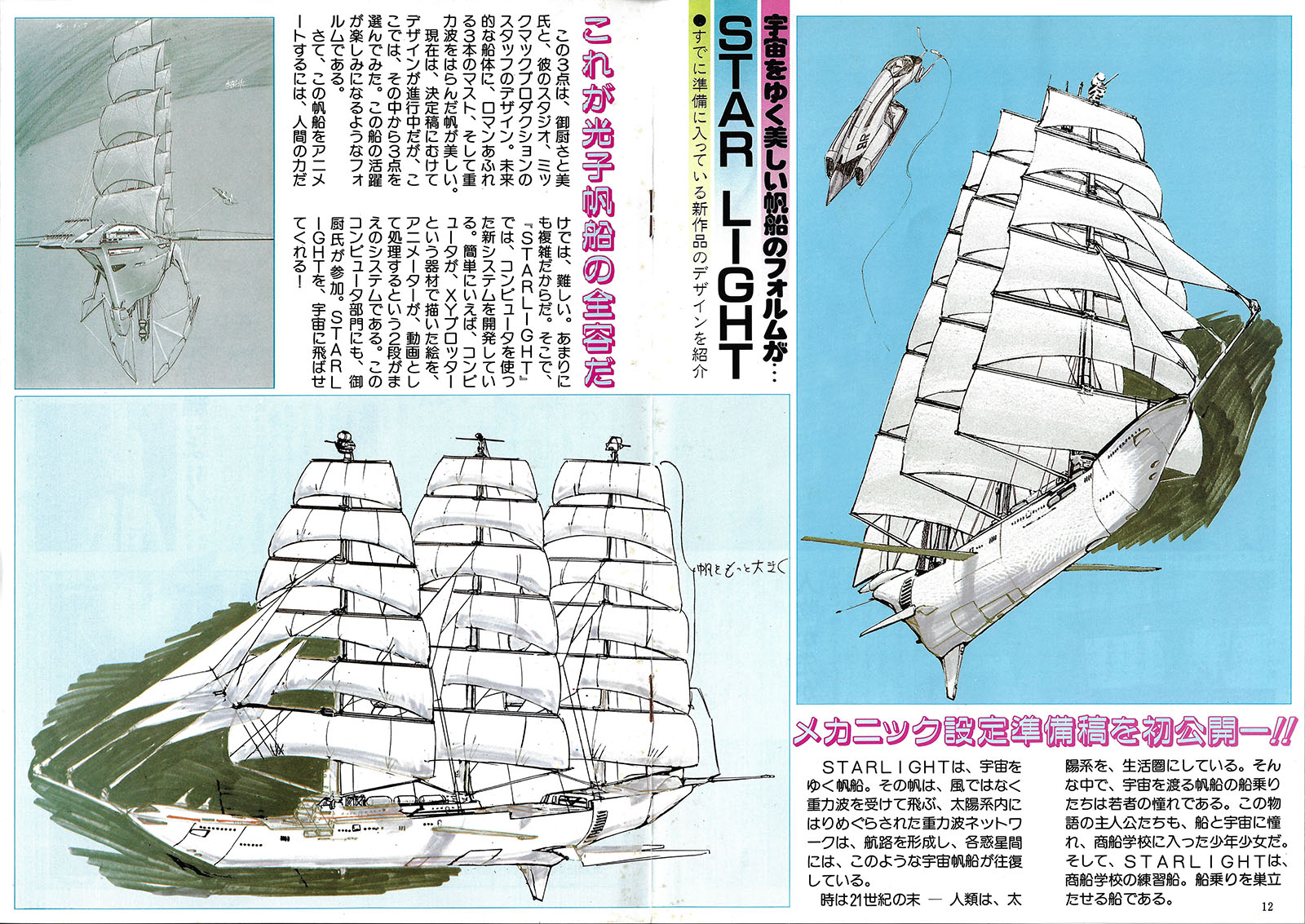
The beautiful form of a sailing ship traveling through space…
STARLIGHT
Introducing the design for our new project, which is already in the preparation stage
RIGHT SIDE:
First look at the preliminary draft of the mechanic design!
Starlight is a spaceship that travels through space. Its sails are propelled not by wind, but by gravitational waves. A gravitational wave network that stretches throughout the solar system forms a route, and such spaceships travel back and forth between planets.
It is the end of the 21st century. Humanity has made the solar system its living space. In this context, sailors on spaceships are the object of youthful aspiration. The protagonists of this story are boys and girls who yearn for ships and space, and have entered a merchant marine school. And Starlight is a training ship for the school, a ship that graduates sailors.
LEFT SIDE:
This is the complete picture of the Photon sailing ship
These three elements were designed by Satomi Mikuriya and the staff of his studio, Micmac Productions. The futuristic hull, the three romantic masts, and the sails imbued with gravity waves are all beautiful. Currently, the design is in progress toward the final version, but here we have selected three of the designs. Their forms make us look forward to seeing this ship in action.
Now, animating the sailing ship would be difficult with human power alone. It’s simply too complex. That’s where Starlight comes in. We are developing a new system using computers. Simply put, it’s a two-stage system where a computer draws an image using a piece of equipment called an XY plotter, and then animators process it as animation. Mr. Mikuriya is also participating in this computer division. He’ll be helping to launch Starlight into space!
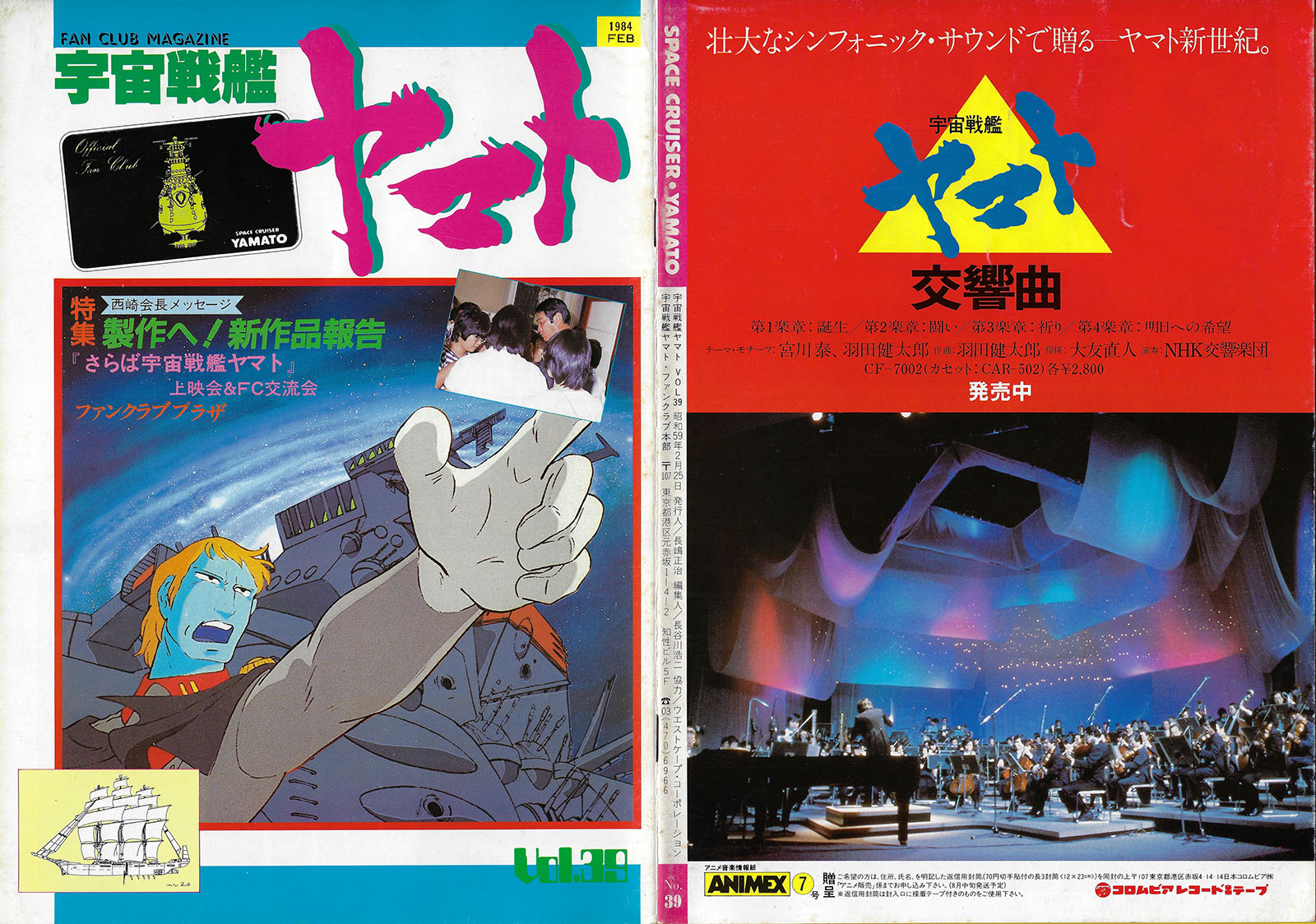
Fall 1984: Fan club magazine 39
Introducing the Starlight draft!
In Photon Sailor Starlight, the question of whether a sailing ship will travel through space is attracting as much attention as the characters themselves. The design is being handled by Micmac, including Mr. Tsuji and Mr. Miura, as well as Mr. Itabashi, familiar from Yamato, and many preliminary designs are currently being created. This is one of the newest designs. It feels like the image of a spaceship sailing through space is finally taking shape.
Brainstorming for Photon Sailboat Starlight is going more smoothly than ever!
A new story of the cosmic ocean, Starlight begins!
Starlight brainstorming part 2
The Starlight, a large sailing ship that soars through space, will show us a new story of the universe
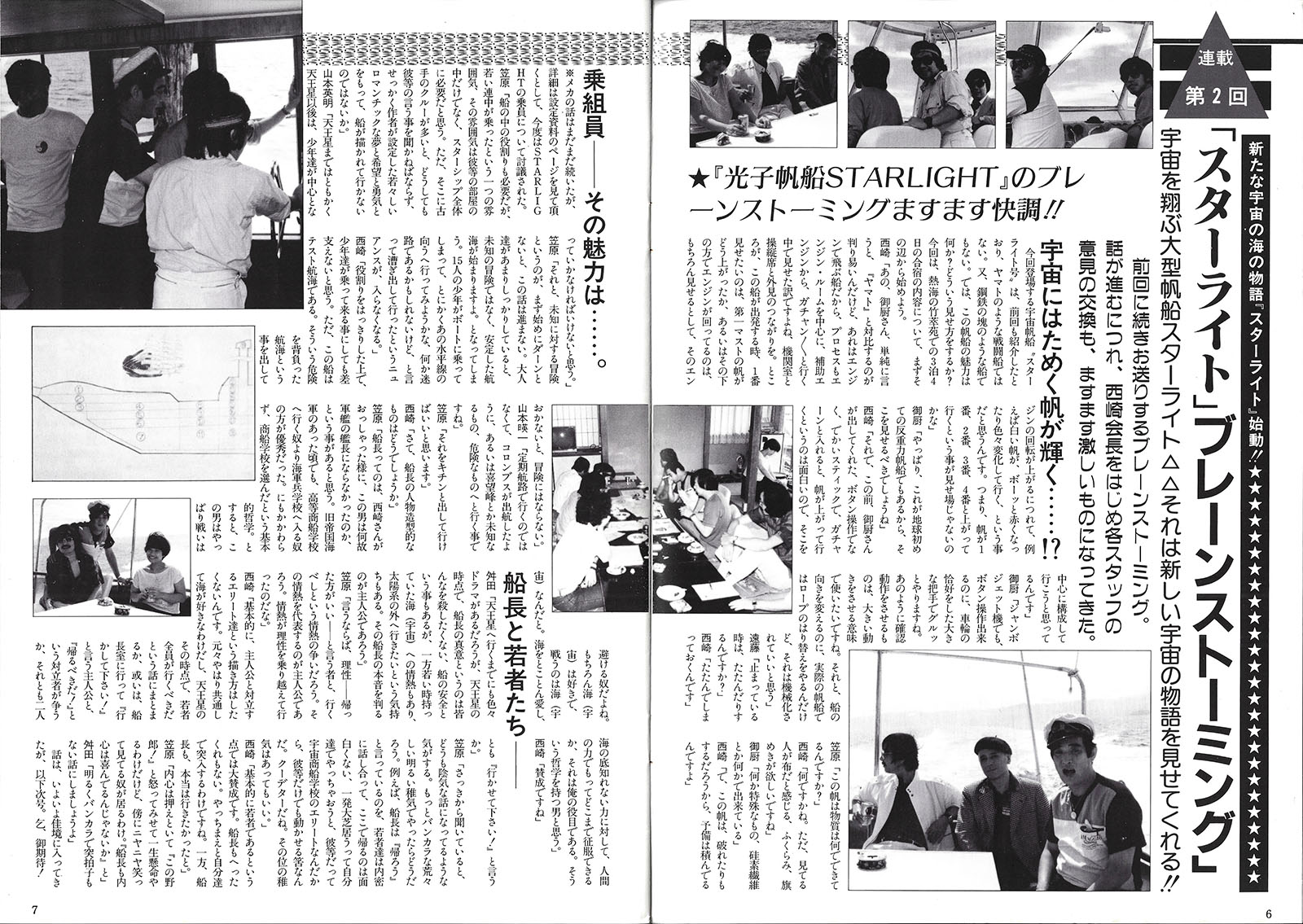
This is a continuation of our brainstorming session from last time. As the discussion progressed, the exchange of opinions among chairman Nishizaki and the staff became increasingly heated.
Sails fluttering in space are shining brightly…!?
As I mentioned last time, the space sailing ship Starlight is not a battleship like Yamato. Nor is it a ship that is a hunk of steel. So, what is the appeal of this sailing ship? How will it be presented? This time, let’s start with that, by discussing the content of the 4-day, 3-night training camp at Takekuen in Atami.
Nishizaki: well, Mikuriya-san, to put it simply, it’s easiest to understand by comparing it to Yamato, but that’s a ship that flies with engines, so the process was shown mainly in the engine room, from the auxiliary engines with a clang, showing the connection between the engine room, the bridge, and the exterior. However, when this ship launches, what we want to show most is how the sails on the first mast are raised, or how the engine is running beneath it.
Of course, it’s meant to be shown, but I think the highlight is how, as the engine speed increases, the white sails, for example, gradually turned red and change in various ways. In other words, the highlight is probably seeing the sails go up in order from first, second, third, and fourth positions.
Mikuriya: This is also the first anti-gravity sailing ship on earth, so we should definitely showcase that.
Nishizaki: The other day, Mikuriya-san showed us something interesting. Instead of using buttons, you use a big stick. And when you push it, the sails go up. I’m thinking of building the game around that.
Mikuriya: even on a jumbo jet, although you can operate it with buttons, you use a large handle that looks like a wheel to turn it around. There’s a reason why things like that require a confirmation action to be performed with a large movement. I’d like to use it for that. Also, on real sailing ships, you have to change the direction of the ship by changing the ropes, but that can be mechanized. I think that would work.
Endo: When it’s stopped, would you fold it up or something?
Nishizaki: They’d fold it up and put it away.
Kasahara: What material is the sail made of?
Nishizaki: What is it? I just want it to have that swelling and fluttering quality that makes the viewer think it’s some kind of fabric.
Mikuriya: Something special. Silicon fiber. It’s made of something like that.
Nishizaki: And since this sail might get torn, we’ll have a spare on board.
The appeal of the crew…
The discussion about mecha continued, but for details, please refer to the concept materials page. Next, the crew of the Starlight was discussed.
Kasahara: While roles within the ship are necessary, I think the atmosphere is created by having young people on board. That atmosphere is needed not only in their rooms, but throughout the entire ship. However, if there are many older crew members, you inevitably have to listen to what they say. Wouldn’t it be a shame if the ship wasn’t depicted with the youthful romantic dreams, hopes, and courage that the author has so carefully set out?
Hideaki Yamamoto: Up to Uranus, that’s one thing, but beyond Uranus, I think the boys have to take the stage.
Kasahara: Also, the story can’t progress unless there’s a big sense of adventure into the unknown right from the start. If the adults are too strict, it won’t be an adventure into the unknown, but rather a stable voyage. The nuance of 15 boys getting into a boat and rowing off toward the horizon, even if it’s a maze, will be lost.
Nishizaki: I think it would be fine to have the boys on board, provided their roles are clearly defined. However, this ship is on a test voyage. If we don’t emphasize that it’s dangerous, it won’t be an adventure.
Eiichi Yamamoto: instead of going on regular shipping routes, it’s about going to the unknown, to dangerous places, like when Columbus set sail, or to the Cape of Good Hope.
Kasahara: I think we should make sure to express that properly.
Nishizaki: Now, what about the characterization of the captain?
Kasahara: As Mr. Nishizaki said, why didn’t this man become the captain in a war? I think that’s the case. Even back when the imperial Japanese navy existed, those who went to the Naval Academy were considered more capable than those who went to the higher merchant marine school. Yet this captain chose the merchant marine school, which reflects his fundamental philosophy. If that’s the case, then this man is definitely someone who avoids war. Of course, he loves the sea (space) and he believes that the battle is fought against the sea. He loves the sea to the fullest, and his role is to see how far humanity can conquer the unfathomable power of the sea. I think he’s a man with that kind of philosophy.
Nishizaki: I agree.
The captain and the young men
Masuda: there will be a lot of drama leading up to the trip to Uranus, but once they reach Uranus, the captain’s true intentions are that he doesn’t want to kill anyone, and the safety of the ship is a concern. But at the same time, hen still has the same passion for the sea that he had when he was younger, and he wants to go beyond the solar system. The protagonist will be the one to understand the captain’s true feelings.
Kasahara: if I were to describe it, it would be a struggle between reason (those who say it’s better to go back) and passion (those who say they must go on). The protagonist represents that passion. Passion ultimately overcomes reason.
Nishizaki: basically, I don’t want to portray the protagonist as an elite, who is in conflict with the captain. After all, they all love the sea, so at that point at Uranus, they all agree that they should go. Or the protagonist goes to the captain‘s cabin and says, “Let me go!“ while his opponent says, “We should go back!“ And they argue, or they both say, “Let us go!“
Kasahara: from what I’ve been hearing so far, it seems like the conversation has turned rather gloomy. How about we try something more boisterous, rough, cheerful, and childlike? For example, the captain could say, “Let’s go home.“ The young people, after hearing this, secretly discuss among themselves that it wouldn’t be fun to go home now, and decide to put on a big show and do it themselves. After all, they’re the elite of the space merchant marine school, so they should be able to make it happen on their own. A coup d’etat, that is. It’s OK to have that kind of childishness.
Nishizaki: basically, I’m all for it because they’re young people. There’s no captain or anything like that. They just charge in on their own, saying, “Let’s do it!” On the other hand, the captain actually wants to go, too.
Kasahara: He keeps it to himelf and pretends to be angry, saying, “You bastards!” and works hard, but there’s someone nearby grinning and watching him. “I bet the captain is secretly happy about it.”
Masuda: let’s make it a bright, boisterous, and outrageous story.
The story is finally reaching its climax, to be continued in the next issue. Stay tuned!