
The goodwill of nine years and the intense labor of the last few months all came to fruition when Final Yamato made its theatrical premiere. But the struggle to get it there went right up to the last minute with just as much suspense as anything seen on screen. Here’s how this milestone month unfolded…
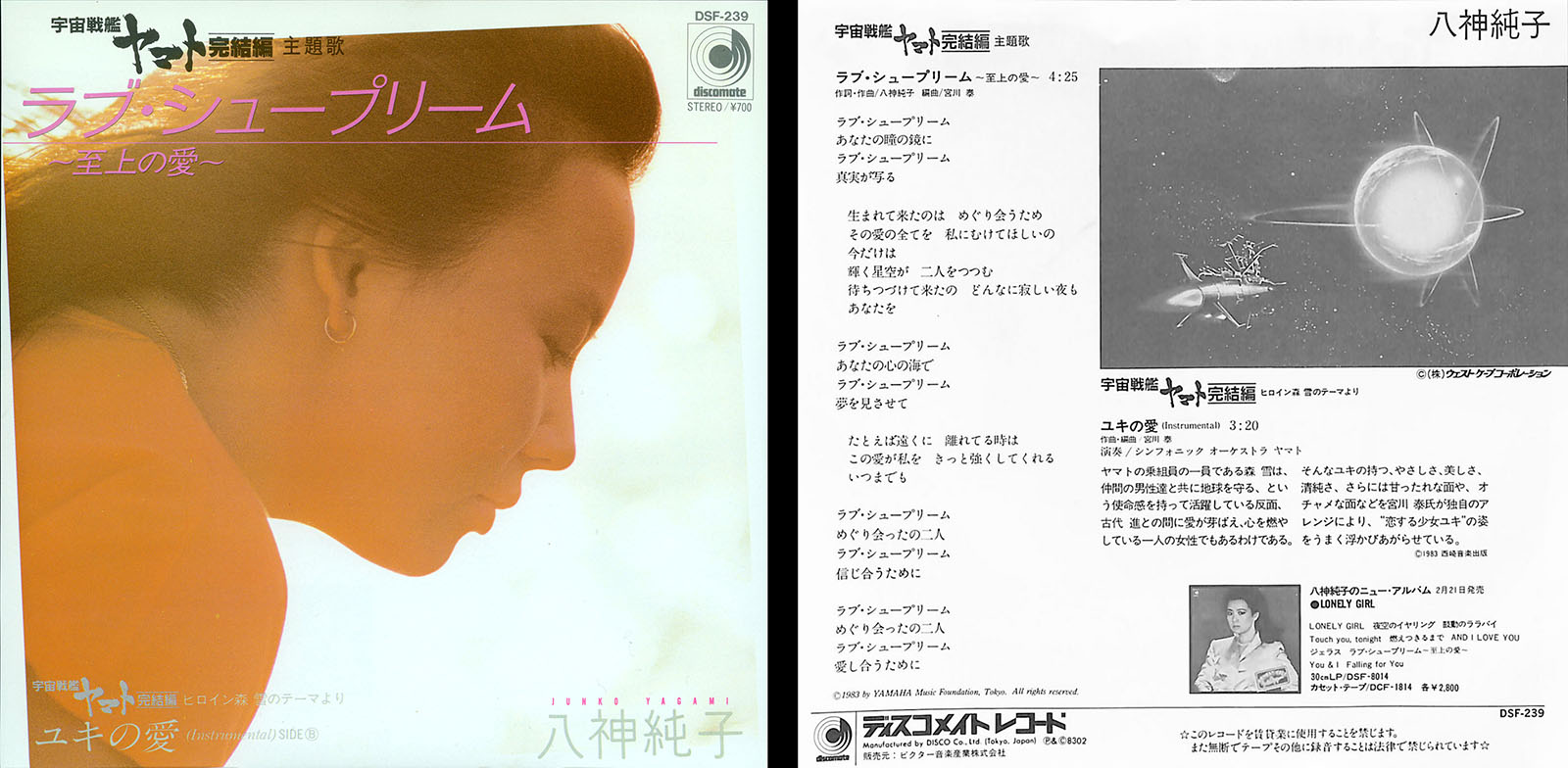
March 1: Love Supreme single
One of the very few Yamato songs by women, this was written for the love scene in the Final Yamato epilogue. It beautifully expresses Yuki’s comfort and happiness at completing her growth to womanhood. Written and performed by Junko Yagami, it first appeared on her album Lonely Girl, released just over a week earlier.
The B side contained an instrumental from the soundtrack titled Love of Yuki.
Read more about this single and find translated lyrics here

March 1: Space Battleship Yamato ’83 single
This updated version of the classic opening theme starts with bridge sound effects leading into a slow-tempo first verse, then both verses at full speed. It perfectly recaptures the spirit of the original with gusto and determination from Isao Sasaki. The background vocal was provided by Kazuko Kawashima, who had also participated from the beginning.
The A side was heard during the end credits of Final Yamato. The B side contained a karaoke version. The opposite side of the insert sleeve offered a compressed timeline of Yamato‘s ten-year history. The first entry (dated October 1973) read: “During the planning process of creating a story that would evoke a sense of grand romance, the idea of a heroic battleship flying in the sky was born.”
Read more about this single here

March 1: Animec Vol. 28
All but one of the monthly anime magazines would be published before the premiere, so it was everyone’s last shot at promoting Final Yamato. Animec was the first out of the gate with a single page containing the following text:
Yamato is finally coming to an end!! This epic work has walked alongside the history of anime, and many people have entered the anime world through Yamato. Yes, Yamato is a monument of love in the anime world. And with this final installment, we are sure to be surprised even more than the previous one with new and unimaginable twists.
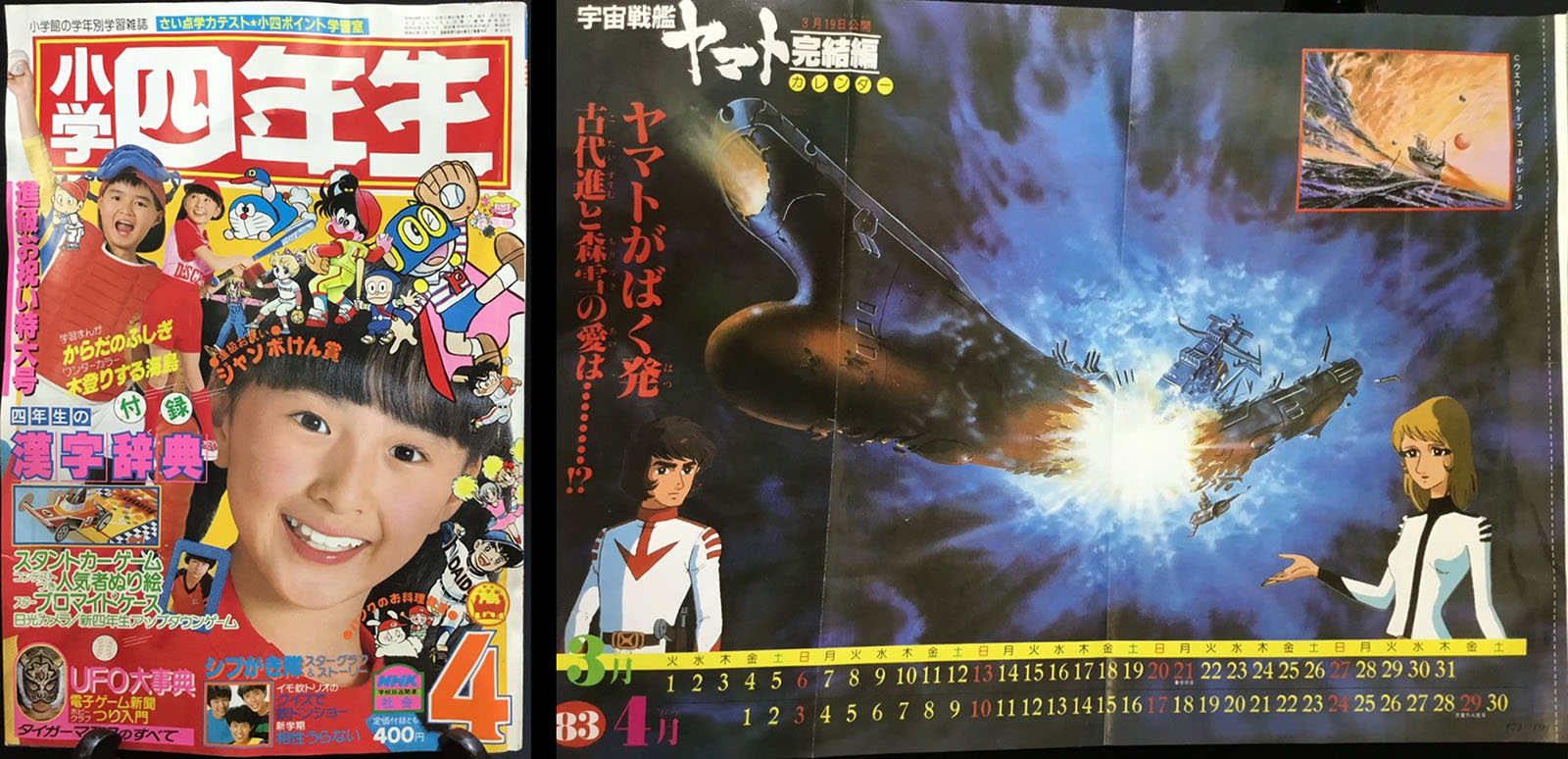
March 1: Fourth Grader, April issue
Shogakukan’s magazine for elementary students opened with a March/April calendar that made sure NO 4th graders were unaware that Yamato was going to explode.
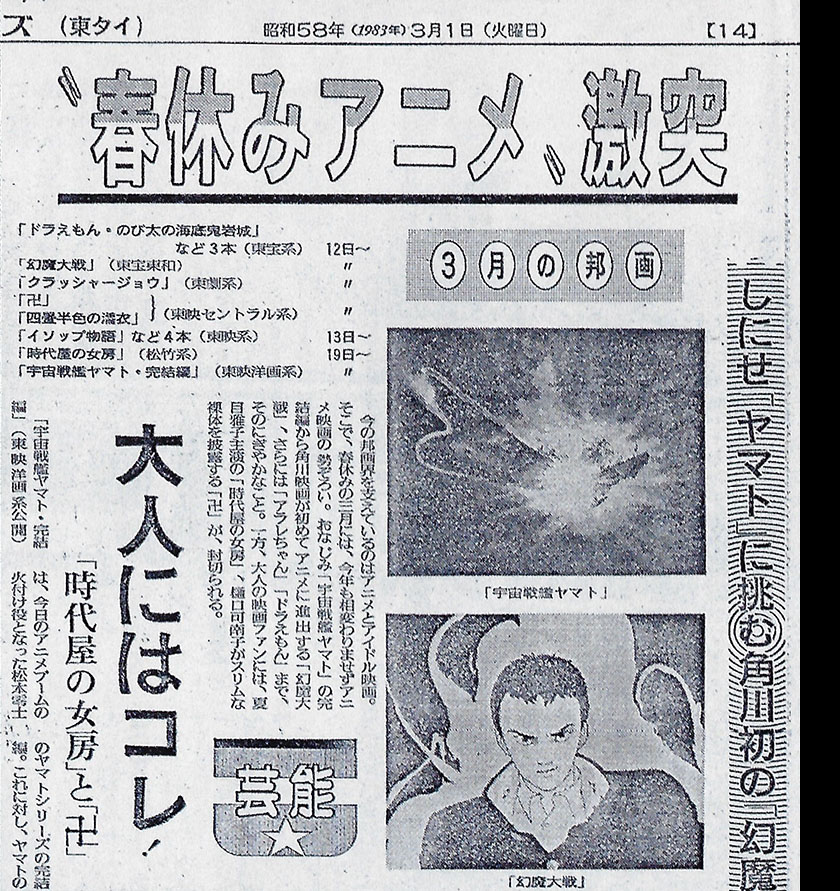
March 1: Tokyo Times article
The first of many newspaper articles throughout the month kept the drumbeat going for the “Spring Break Anime Battle” that commanded the attention of the entertainment world. The arrival of three high-profile anime movies in close proximity would put some theories to the test in an expensive marketing experiment.
Read what this article had to say about it here

March 2: Be Forever Yamato rerun (Nippon TV)
As we saw in the previous reports for 1983, Yamato was all over the place on TV in a coordinated effort to raise awareness and sell movie tickets. Some of those broadcasts were not well documented at the time, but this second broadcast of Be Forever was well publicized in movie magazines.
Although the commercial breaks extended the runtime by 30 minutes, part of the movie was still cut for broadcast length, specifically the dynamic attack on the Dark Nebula supply base.

March 3 & 4: Yomiuri Shimbun [newspaper] coverage
For two days in a row, Yomiuri was on the Yamato beat. On the 3rd they ran a new article about the “Spring Break Anime Battle” and on the 4th they invited Yoshinobu Nishizaki himself to contribute a column in their “Key Issues” series, titled The Spirit of Yamato.
Read both articles here

March 5: Daily Sports article
This newspaper covered an interesting meeting-of-the-minds between Yoshinobu Nishizaki and singer Toshihiko Takamizawa of the rock group The Alfee. What makes it interesting? The Alfee launched the same year as Yamato, and the two were destined to meet in the distant future year 2009.
Read the article here
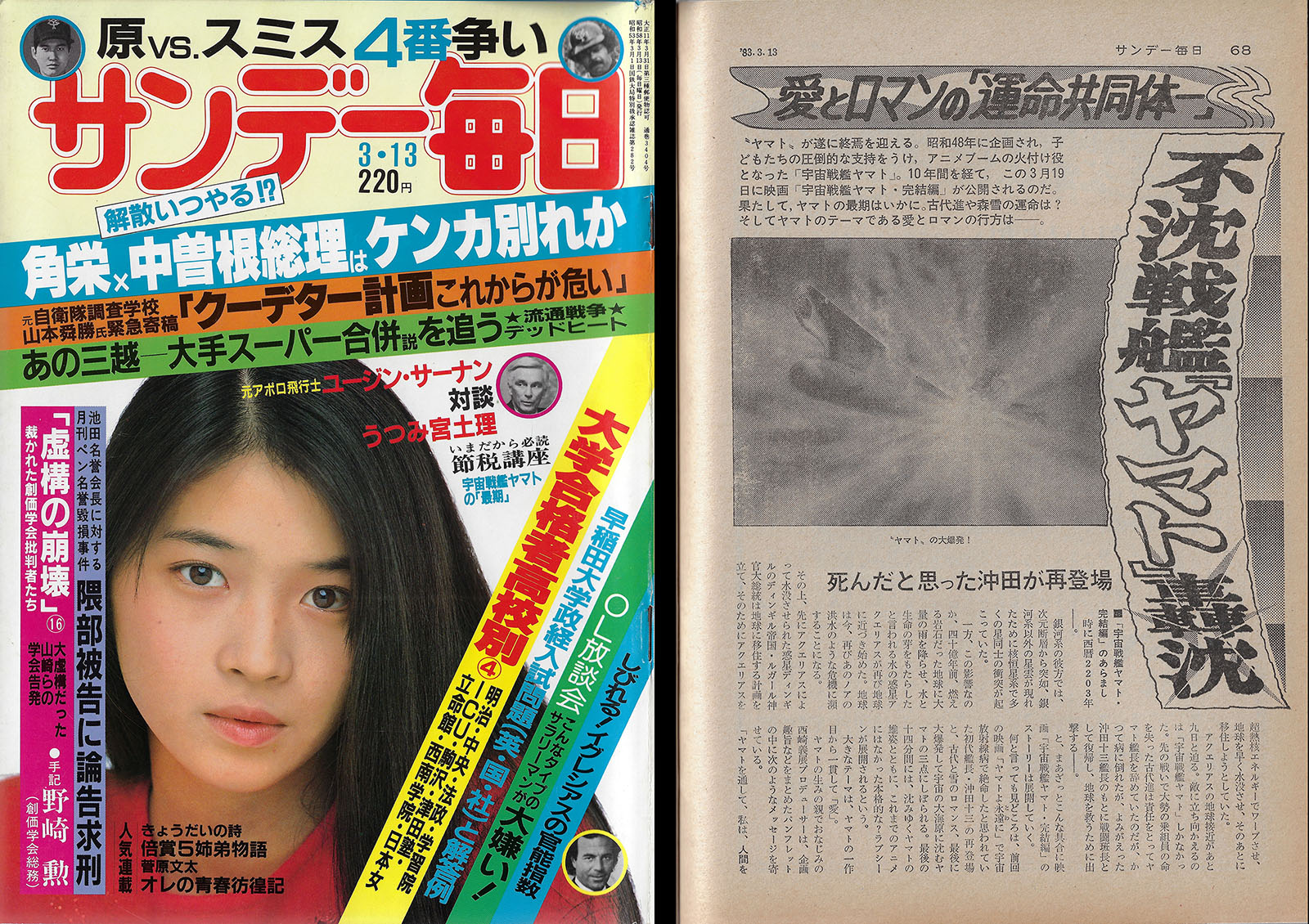
March 6: Sunday Mainichi, March 13 issue
The weekly magazine of the Mainichi Shimbun was up next with Final Yamato coverage in a 3-page article that took a candid walk through Yoshinobu Nishizaki’s personal history and asked fans what they were expecting from the new movie. “Cautious optimism” was the theme.
Read it here
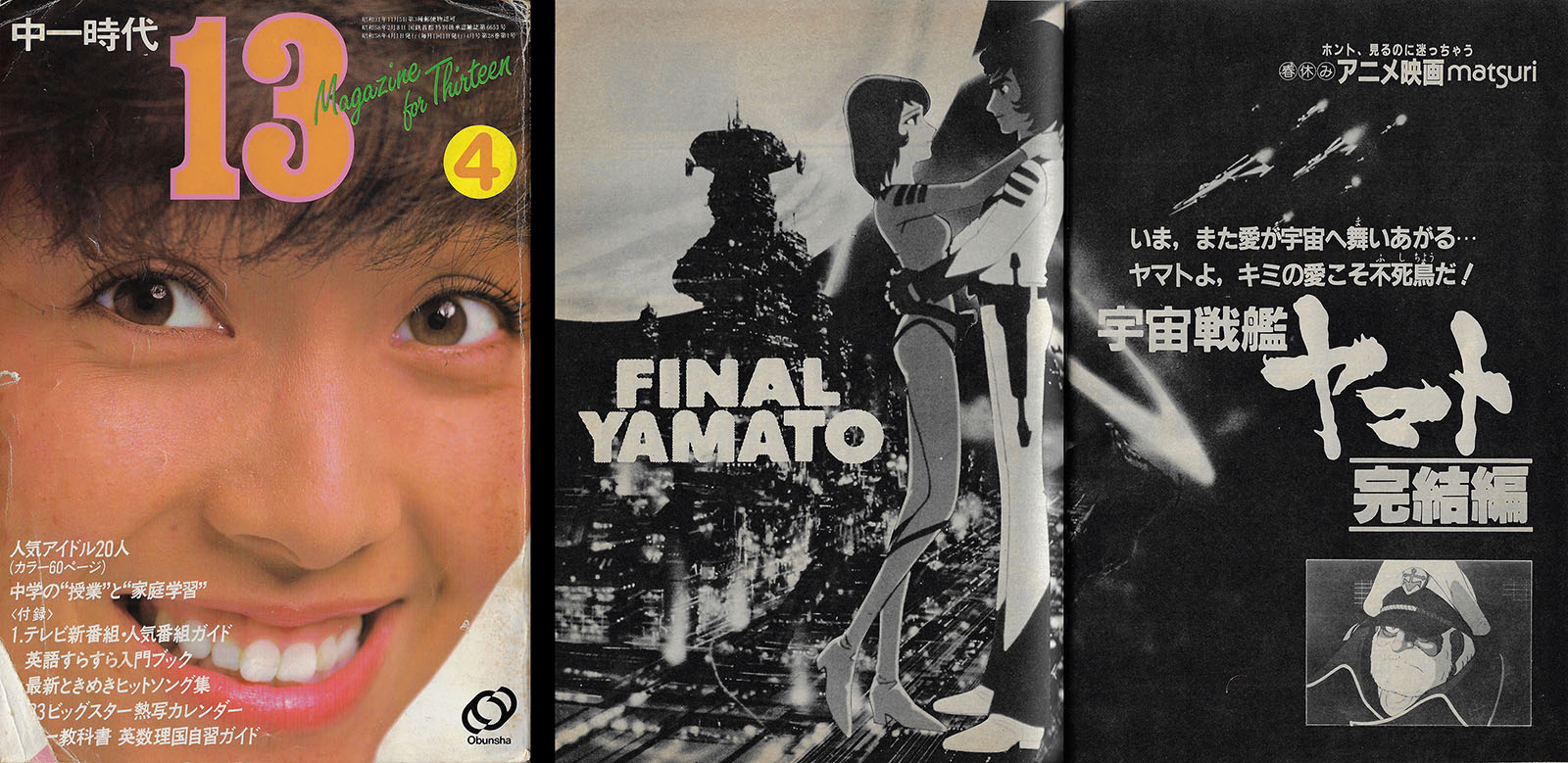
March 9: Middle 1st Age 13, April issue
Obunsha’s student digest for 7th graders had gotten a major overhaul (and a slight name change) since the last time it appeared in this record. The new graphic approach extended to the interior, which included an unusually lavish 12-page Final Yamato presentation.
See the pages here
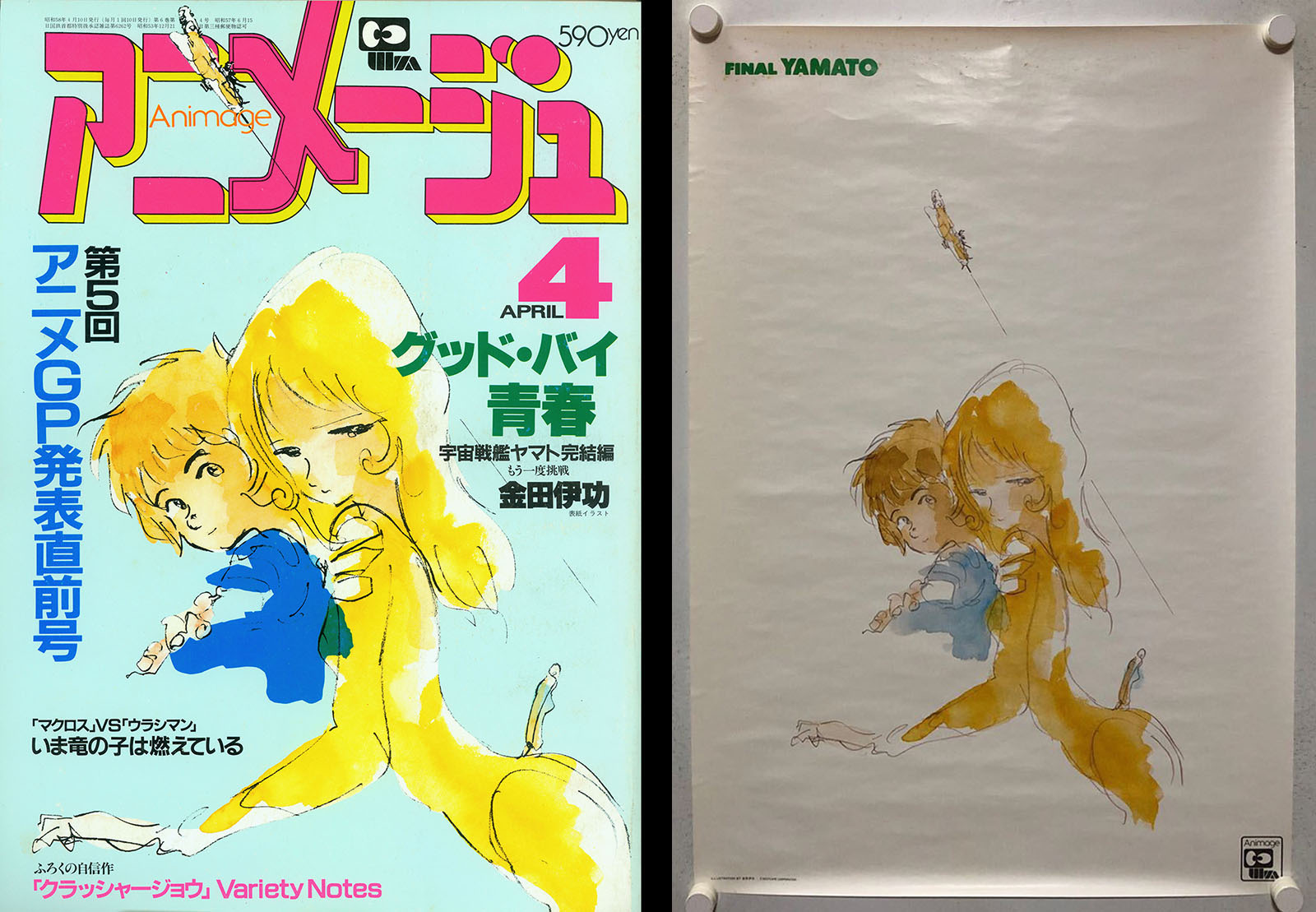
March 10: Animage Vol. 58
This was the only magazine to sport a Final Yamato cover in March, using artwork by Yoshinori Kanada. Animage was now big enough to have its own music label that released Final Yamato records and a high-profile line of novels (named “AM Juju”) with a 2-part Final Yamato adaptation illustrated by Kanada. The cover image (accompanied by the headline “Goodbye Youth”) was derived from those illustrations, and posters were made with the same art.
Animage‘s 4-page Final Yamato article broke the trend by forgoing story information and instead presenting a roundup of short interviews with staff veterans.
Read it here
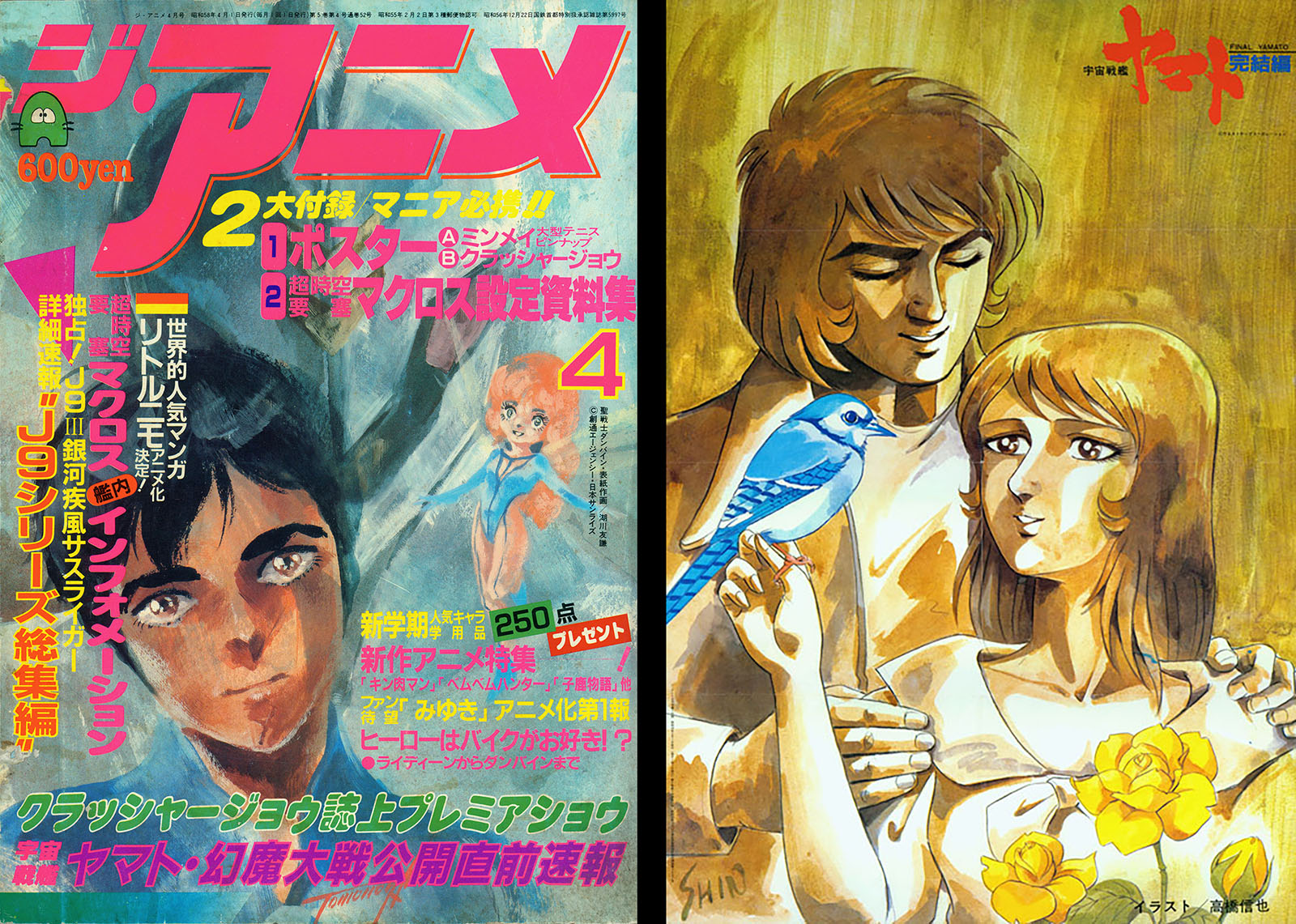
March 10: The Anime Vol. 41
A large-format The Anime special on Final Yamato would be published in April, but this was the last time a Yamato article would appear in the magazine. They said farewell with an exclusive poster by character designer Shinya Takahashi, six color pages on the film with heavy-duty spoilers, and a 5-page interview with longtime Yamato veteran Eiichi Yamamoto.
Read it all here
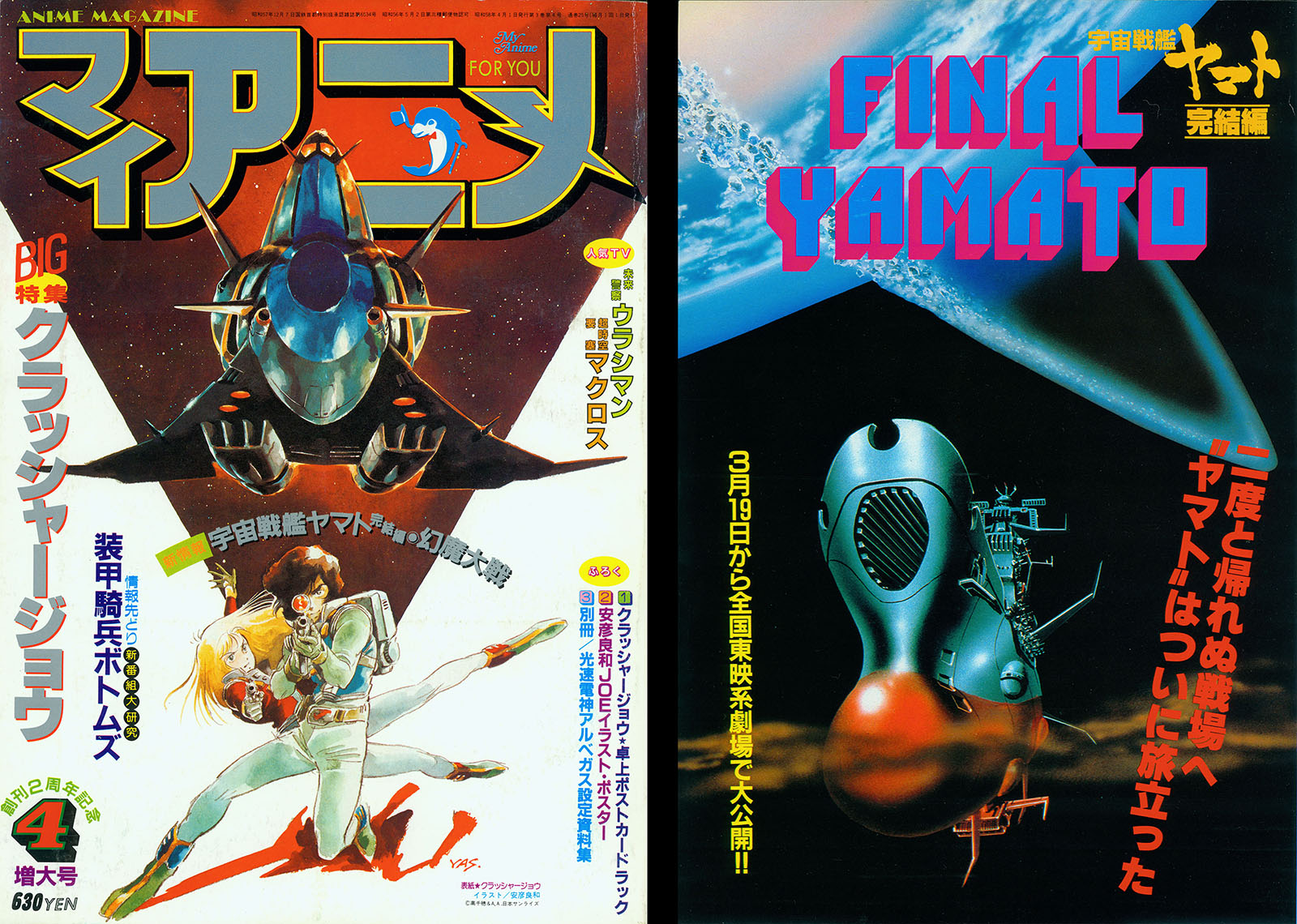
March 10: My Anime, April issue
This issue marked My Anime‘s 2nd anniversary. Yamato had a presence in the magazine right from the start, with the Yamato III anime comics commencing in its first issue (March 1981). Since this month’s Final Yamato article would bring that presence to a close, they packed all the spoilers they could muster into a lavish ten pages.
Read it here

March 10: Animedia, April issue
A 4-page Final Yamato article offered a review of the major story points with a focus on character drama.
Read it here
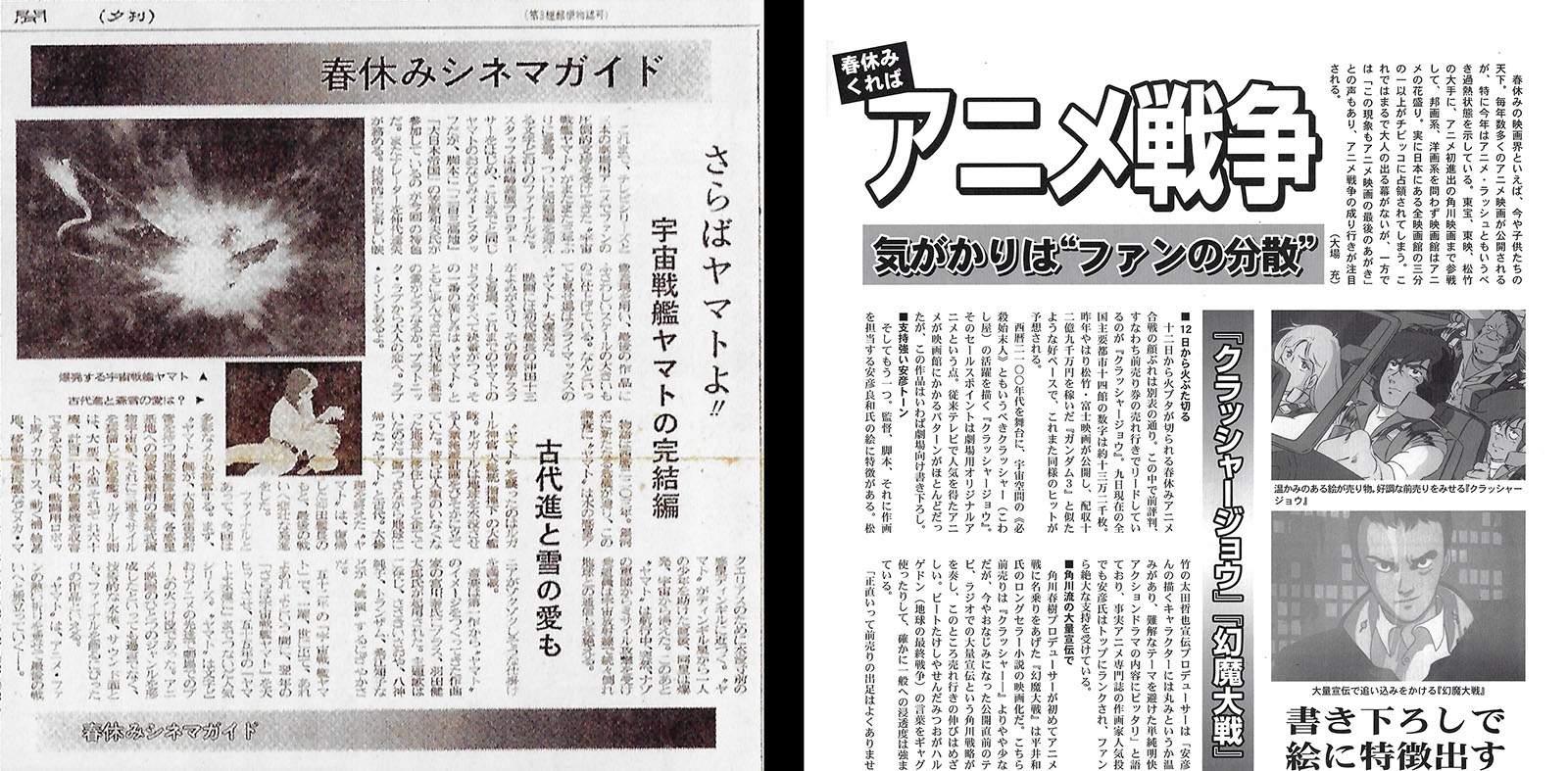
March 10 & 11: Newspaper articles
With March 12 fast approaching, the “Spring Break Anime Battle” was finally about to begin. Harmagedon and Crusher Joe would both premiere on that day and officially get things moving. Two newspapers took one more opportunity to remind everyone who was competing and what the stakes were.
Read the Tokyo Times article here
Read the Hochi Shimbun article here
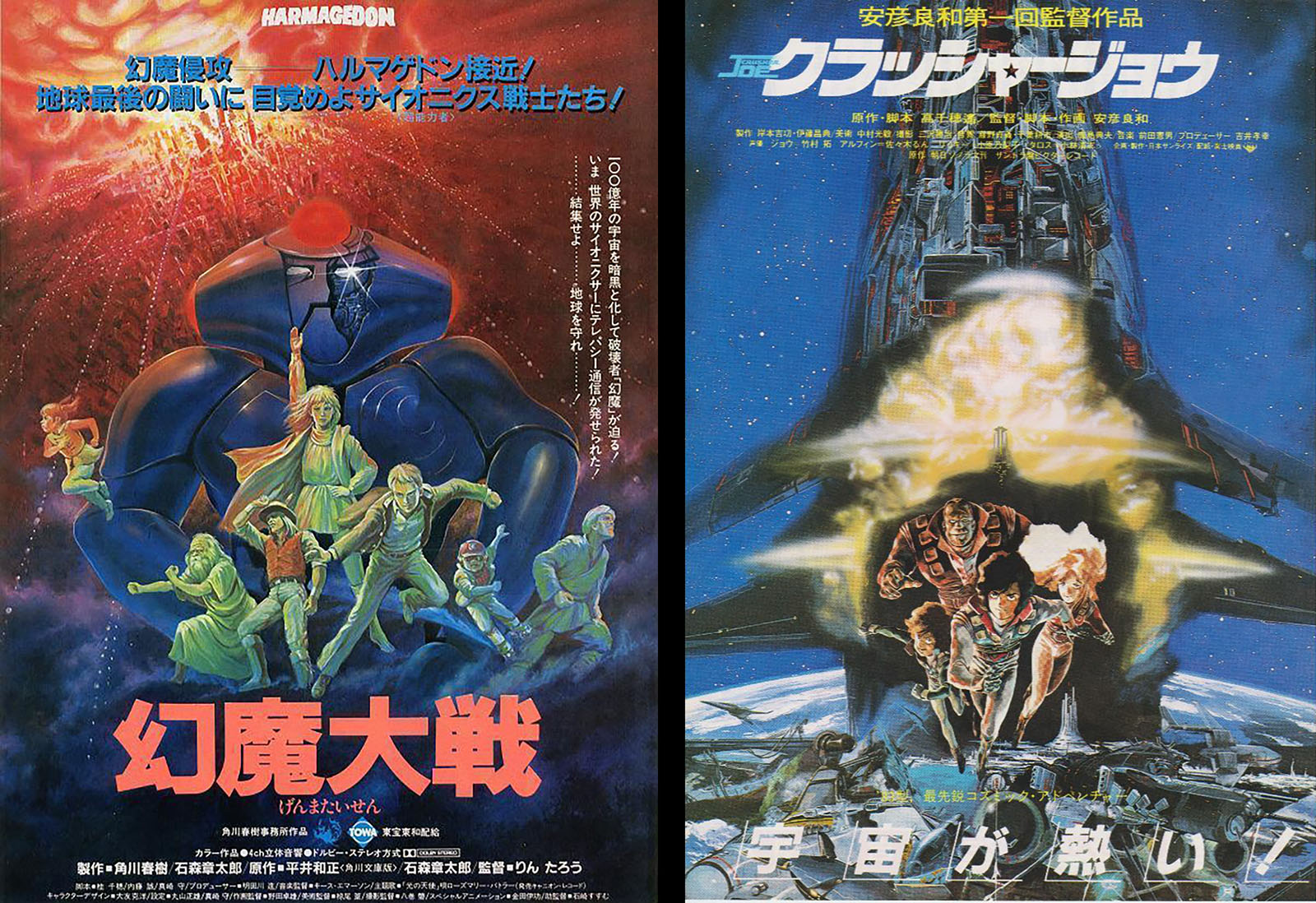
March 12: Movie fight!
As promised, Harmagedon and Crusher Joe both premiered on the same day, kicking off a highly-anticipated competition that would set new trendlines for anime in theaters. Final Yamato was originally announced to premiere on this day as well, but was pushed back a week for reasons that have yet to emerge from the soup of history.
As we’ll soon see, this decision was definitely the right one for Nishizaki and company.
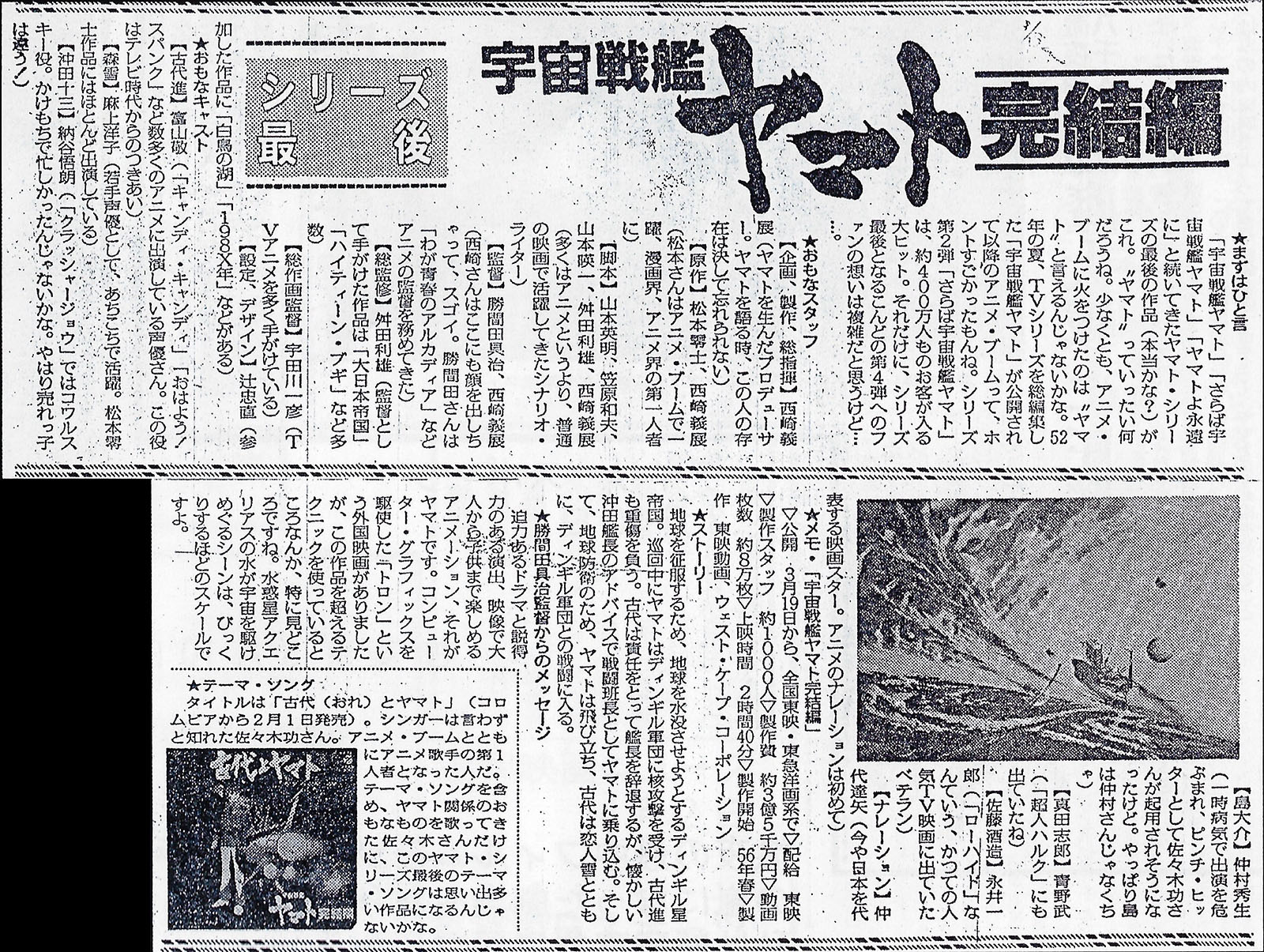
March 13: Weekly KuriKuri article
As we saw in the previous report, KuriKuri was a newspaper for teenagers, sent to subscribers of the Mainichi Shimbun. In the last week before the premiere, they ran a short article touching on the basic points of what the film represented.
Read the article here
March 14: Television/Radio Age magazine
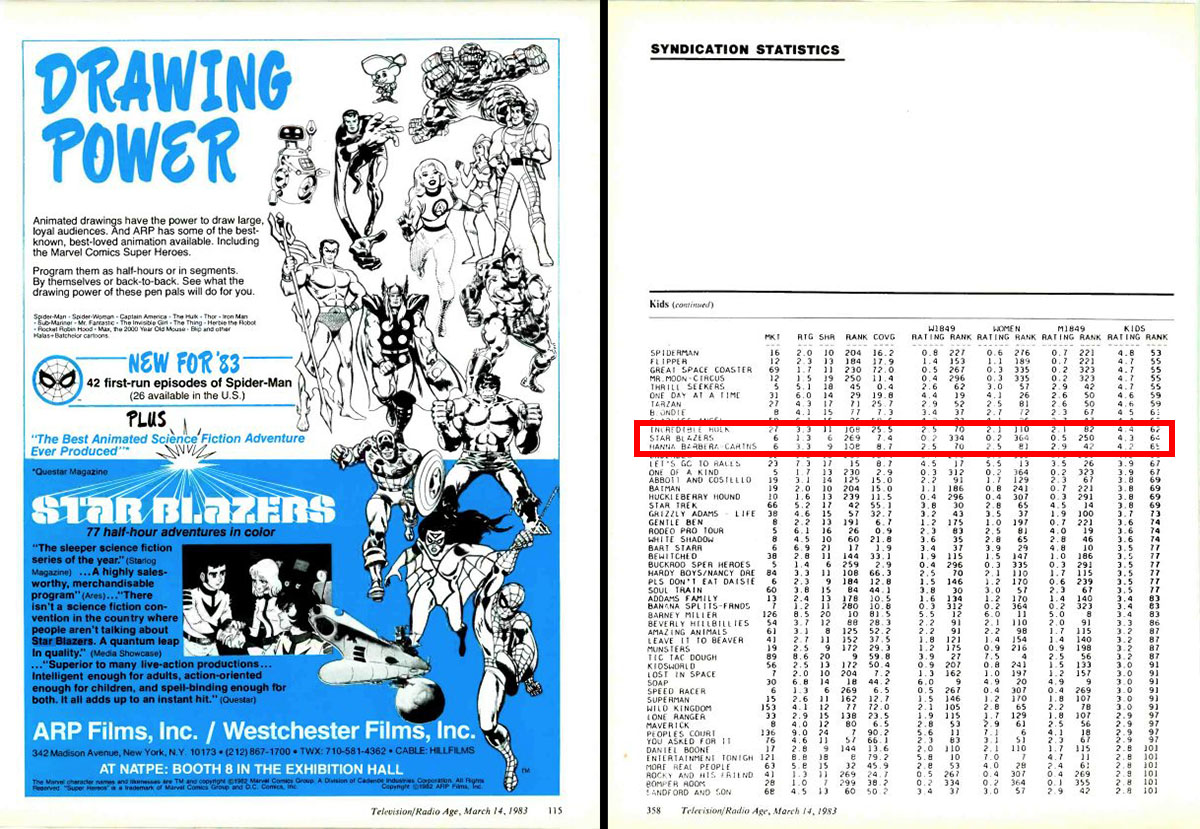
The ad shown above left was a co-op between two companies: ARP Films and Westchester Films. Westchester was the rights holder for Star Blazers at this time, and was actively soliciting the expanded package of 77 TV episodes, which would include Yamato III. The series hadn’t been dubbed yet, since syndication fees had to be collected from broadcasters to fund that effort.
The endorsements in the ad read as follows:
“The sleeper science-fiction series of the year.” (Starlog magazine)
“A highly sales-worthy, merchandisable program.” (Ares)
“There isn’t a science-fiction convention in the country where people aren’t talking about Star Blazers. A quantum leap in quality.” (Media Showcase)
“Superior to many live-action productions…intelligent enough for adults, action-oriented enough for children, and spell-binding enough for both. It all adds up to an instant hit.” (Questar)
Elsewhere in the magazine was a page devoted to syndication statistics (above right). Star Blazers beat or tied everything on the list in the adult women’s demographic and landed in the upper half of the adult men’s demographic, but scored low with children.

March 15: Novelizations
With four different Final Yamato novelizations in play, each consisting of two volumes, it was probably inevitable that two would be released on the same day. However, in an apparent attempt to maximize confusion, these two came from the same publisher (Shueisha) but were written by two authors.
Above we have volume 2 of the Cobalt Library Edition, adapted by Ken Wakasaki. This was the first one to conclude the story, four days before the movie premiere. The last chapter ended with the destruction of Aquarius and no epilogue. Consequently, it lacked the much-hyped love scene between Kodai and Yuki.
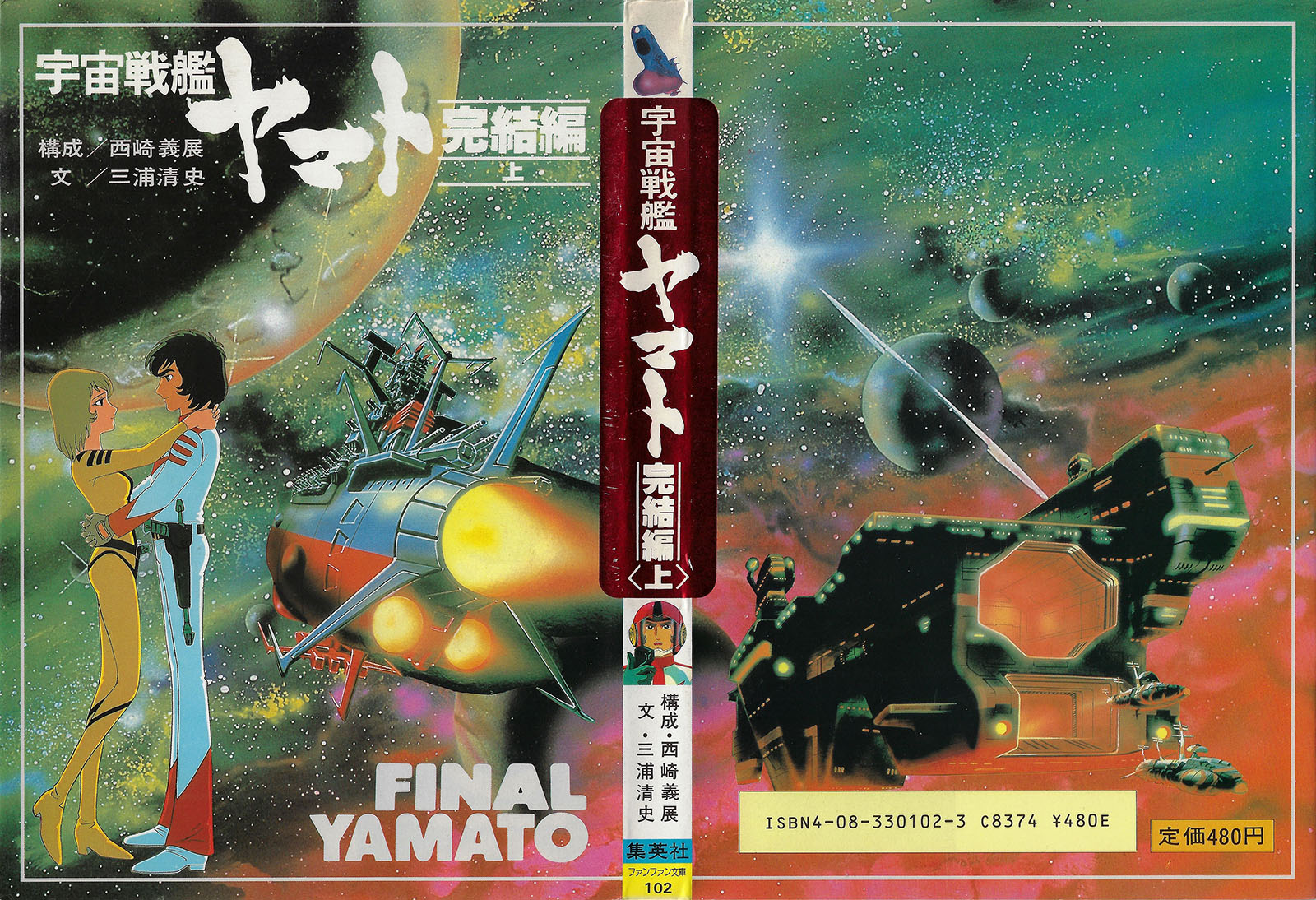
At the same time, fans could pick up volume 1 of the Fanfan Library Edition, written by Kiyoshi Miura. This was the fourth and last novelization, geared toward younger readers with 32 pages of color stills and lots of black and white art interspersed with simplified text.
The story also went farther than the first three novelizations. Whereas all the other “Part 1s” finished with Yamato‘s launch from Earth, this one concluded with Lugal II’s invasion force being driven out of the solar system. The last scene is of Kodai and Yuki returning together on the Cosmo Zero.
March 15: Space Battleship Yamato Grand Festival
The 1978 concert tour had six stops. The Festival in Budokan was performed only twice. The last concert of the production years went on just once. With just four days left before the premiere of Final Yamato and the animation staff going full-tilt to meet that deadline, the Space Battleship Yamato Grand Festival was held at the Kousei Nenkin Hall in Shinjuku, Tokyo.
Attendees were those who had either won a ticket lottery or received a postcard by mail. As a result, no one had to camp overnight as they had at past Yamato events. By start time, the venue was packed with over 2,000 fans. Prior to the curtain going up, the lobby was a frenzy of buying and selling. Fans scooped up posters and records and put in reservations for forthcoming videotapes, which would be released while the film was still in theatres. Naturally, Final Yamato merchandise was at a premium.
Everyone had taken their seats by 4:30, and the tension rose as backstage rehearsals delayed the show by another 15 minutes…
But then the curtains rose!
Read all about it here
March 17: Newspaper ad
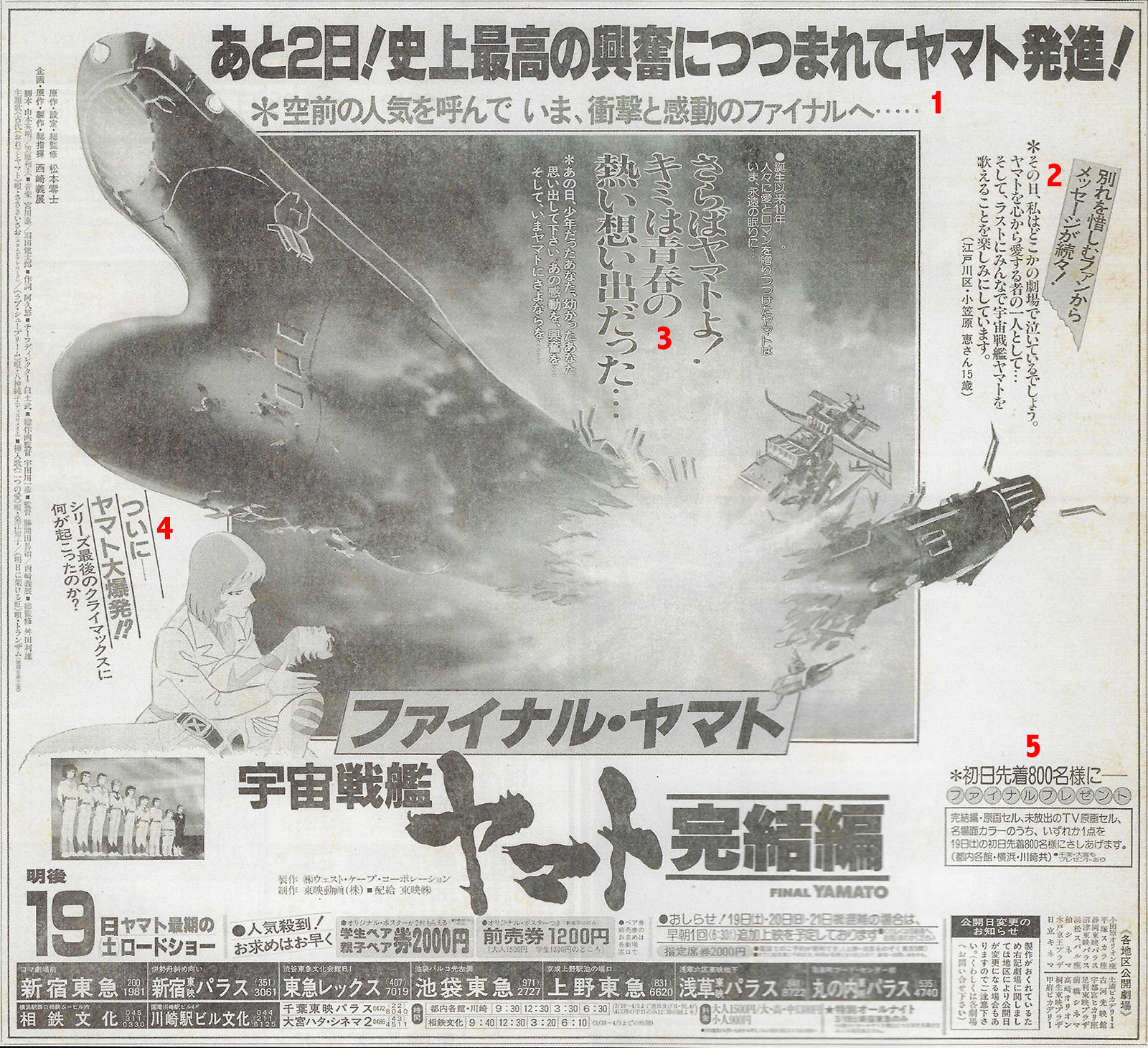
This was last new ad to appear before the big day, placed in a Tokyo newspaper with theater listings in the Tokyu chain. The text reads as follows:
1. Only 2 days left! Yamato launches with the greatest excitement ever!
* Now, with unprecedented popularity, it’s heading for a shocking and moving finale…
2. Messages pour in from fans, sad to see them go!
* On that day, I will be crying in a theater somewhere. As someone who truly loves Yamato…I am looking forward to singing Space Battleship Yamato with everyone at the end. (Megumi Ogasawara, Edogawa Ward, 15 years old)
3. Ten years since its birth. Yamato, who gave people love and romance, now goes to its eternal rest.
Farewell, Yamato! You were a passionate memory of my youth…
* Please remember the time when you were a child. The excitement and emotion. And now, say goodbye to Yamato.
4. Finally – Yamato explodes!?
What happens in the climax at the end of the series?
5. For the first 800 people on the first day
The first 800 people to arrive on opening day (Saturday the 19th) will receive one of the following items: a cel from The Final Chapter, an unreleased cel from the TV series, or a color version of a famous scene. (All theaters in Tokyo, Yokohama, and Kawasaki.)
March 18: Newspaper coverage
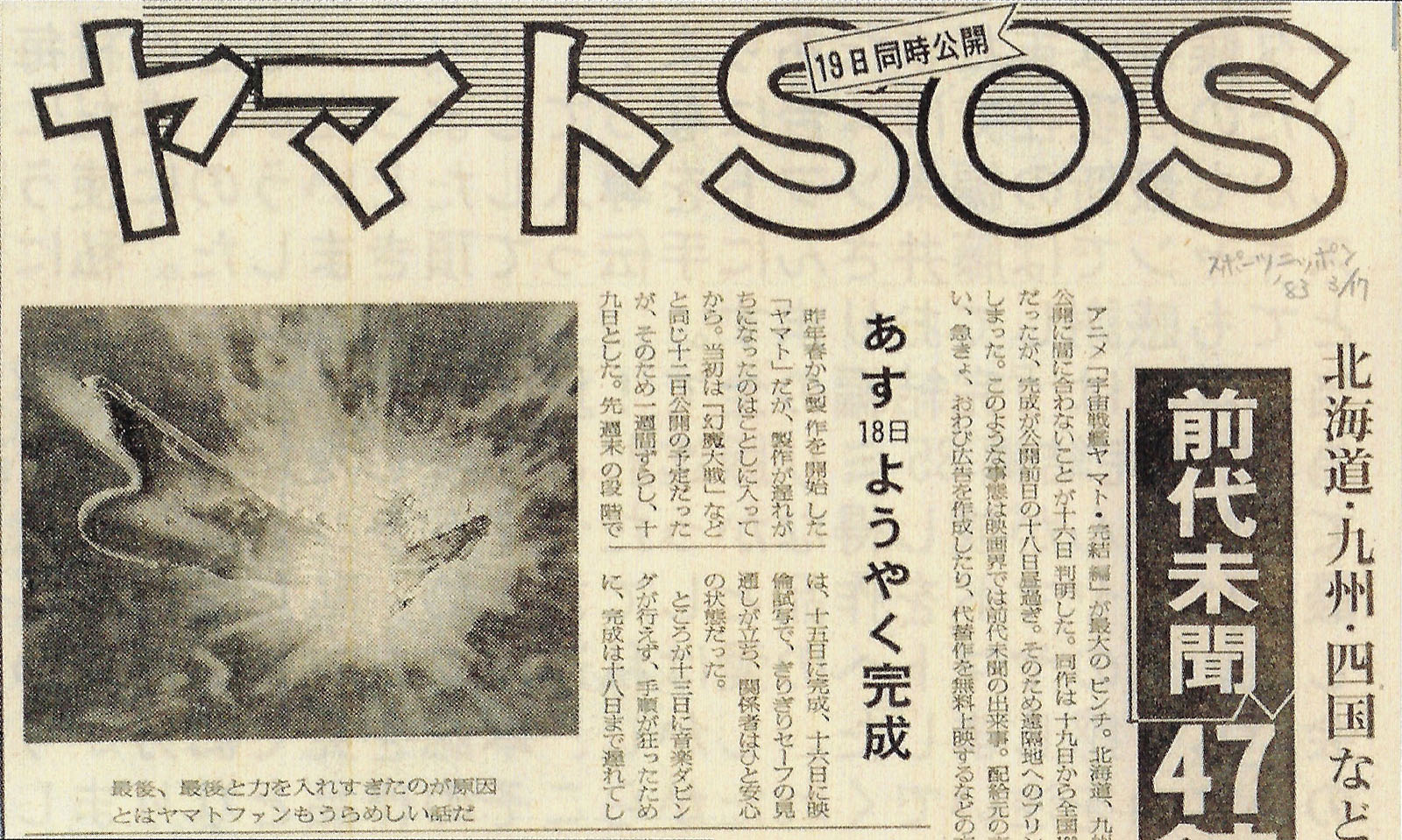
Despite all the bombast in the media, desperation behind the scenes hit an all-time high when the post-production machine started to break down. Due to a variety of factors (both personal and technical), time had run out to make all the prints of Final Yamato that were needed. As a result, theaters in outlying areas weren’t going to get their copy on time.
Two newspapers picked up this unusual story; read the articles here
March 18-20: Star Blazers room at NY Luna Con ’83
From the book Watching Anime, Reading Manga by Fred Patten (Stone Bridge Press, 2004):
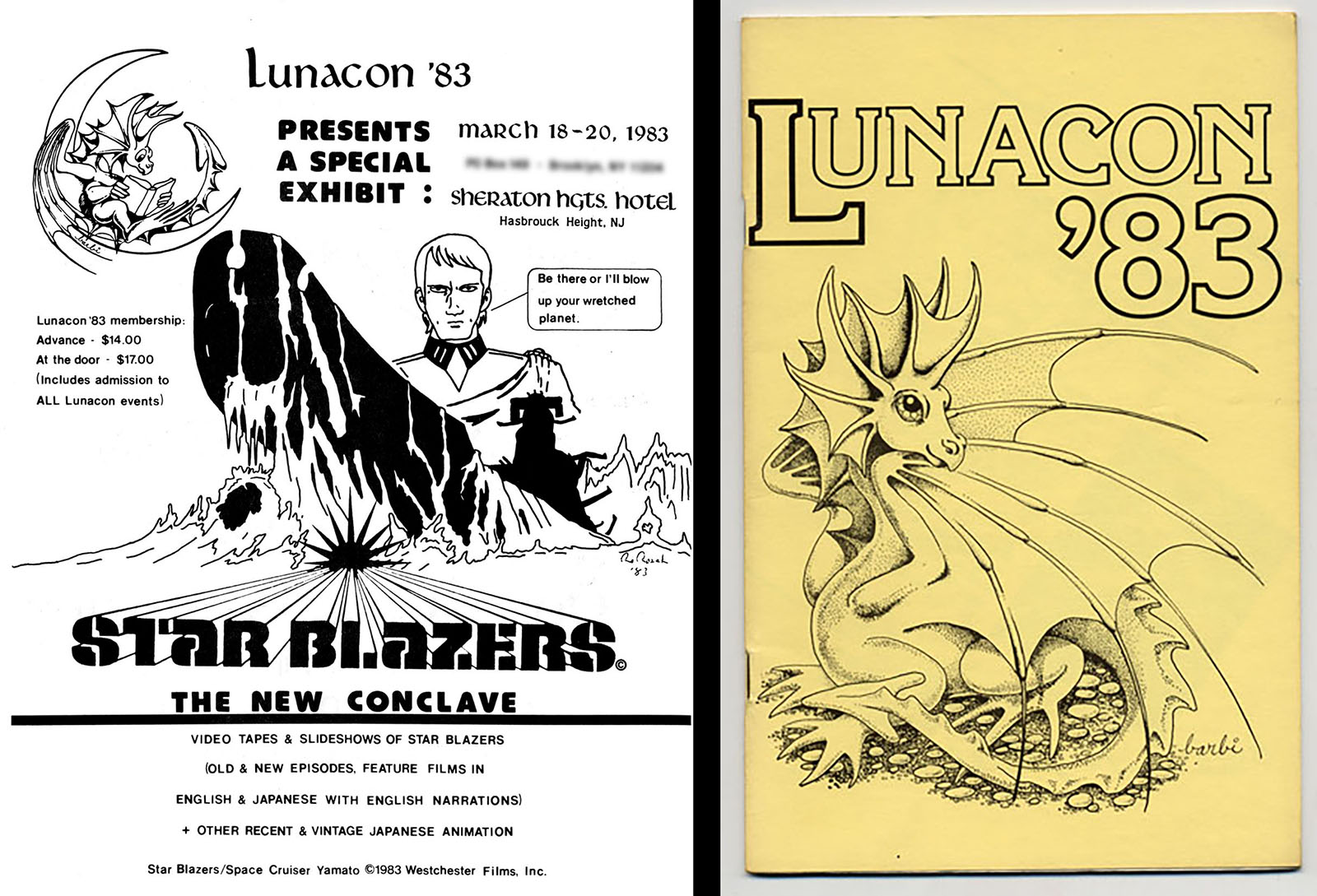
Michael Pinto, Brian Cirulnick, and Robert Fenelon set up a Star Blazers Room (video room) at the 1983 Lunacon in the New York City area. This starts an annual anime video room tradition that is still being run by Fenelon at the Lunacon. By this time, anime video programs at SF and comics-fan conventions are becoming a standard feature, often started by local anime fans with written permission from Claude Hill at Westchester Films to show Star Blazers episodes.
From the Star Blazers Fandom Report, April 1993:
Michael, Brian, and Robert lobby for and get an entire programming room from the New York Science-Fiction Society’s prestigious Lunacon convention, held in New Jersey. The small room was packed with over 75 people, and the large scale attendance of anime fans legitimized anime as a real force in fandom. This first room at a major convention set the standard by which all other rooms at all other conventions go by. The Star Blazers Room at Lunacon exists to this day, running every year since its inception to bigger and bigger audiences.
Michael Pinto’s comment:
In New York we were very lucky to hook up with the Lunarians, a literary science-fiction club that held meetings in New York City. Many of the Lunarians were also involved in running Star Trek cons in the 70s, so they were like big brothers and sisters to us in getting things started. It was because of this that we managed to place the first anime room at Lunacon (which was run by the Lunarians) back in 1983. The chair that year was Elyse Rosenstein, a longtime Star Trek fangurl who gave us our big break.
Read much more about early Star Blazers fandom here
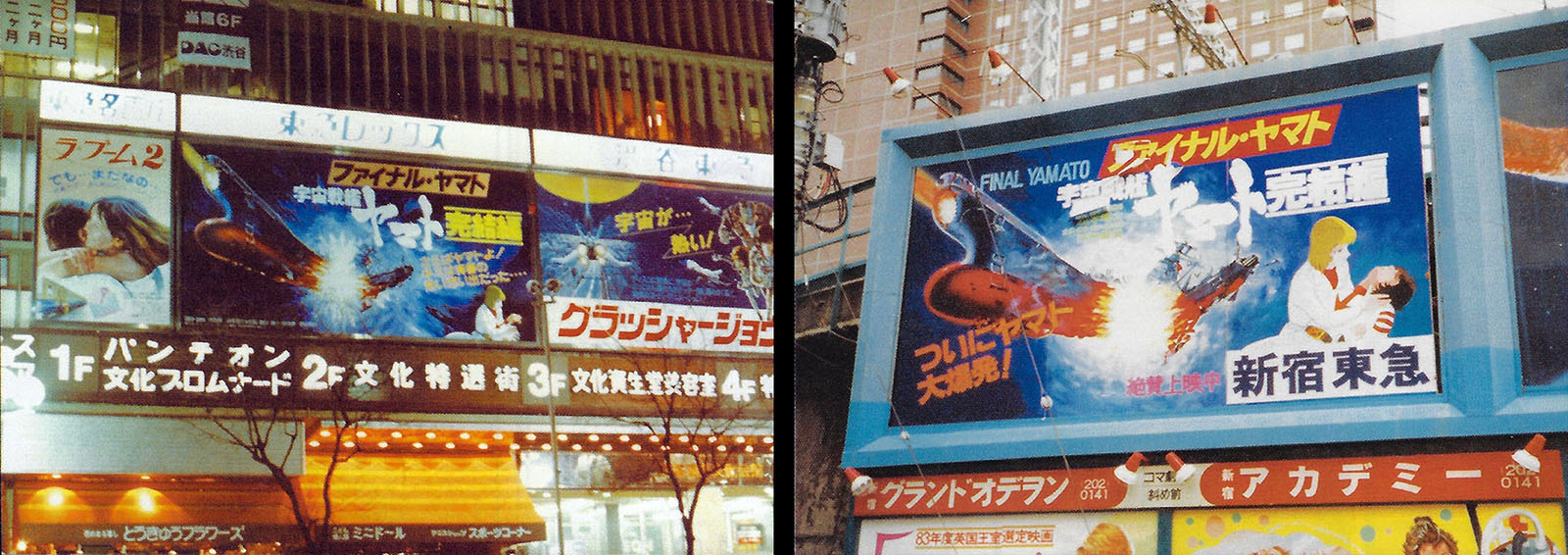
March 19: Final Yamato premiere
At long last, the waiting ended (at least for those in big cities) and the movie opened after multiple days of non-stop scrambling to nip and tuck the last pieces.
Yamato, The Final Chapter gets a good start
some theaters didn’t get it in time
Sankei Sports, March 19
The anime film Space Battleship Yamato, The Final Chapter (Toei) was to be released nationwide on the 19th, but two days prior to the screening 2,000 fans began lining up in front of the Tokyu Rex in Shibuya, Tokyo, one of the theaters where it was being shown. On the 18th, the number had swollen to 6,000. Toei and the theater handed out numbered tickets, but no one left and they stayed all night. For this reason, they decided to hold an early morning screening on the 19th, starting at 6:30am.
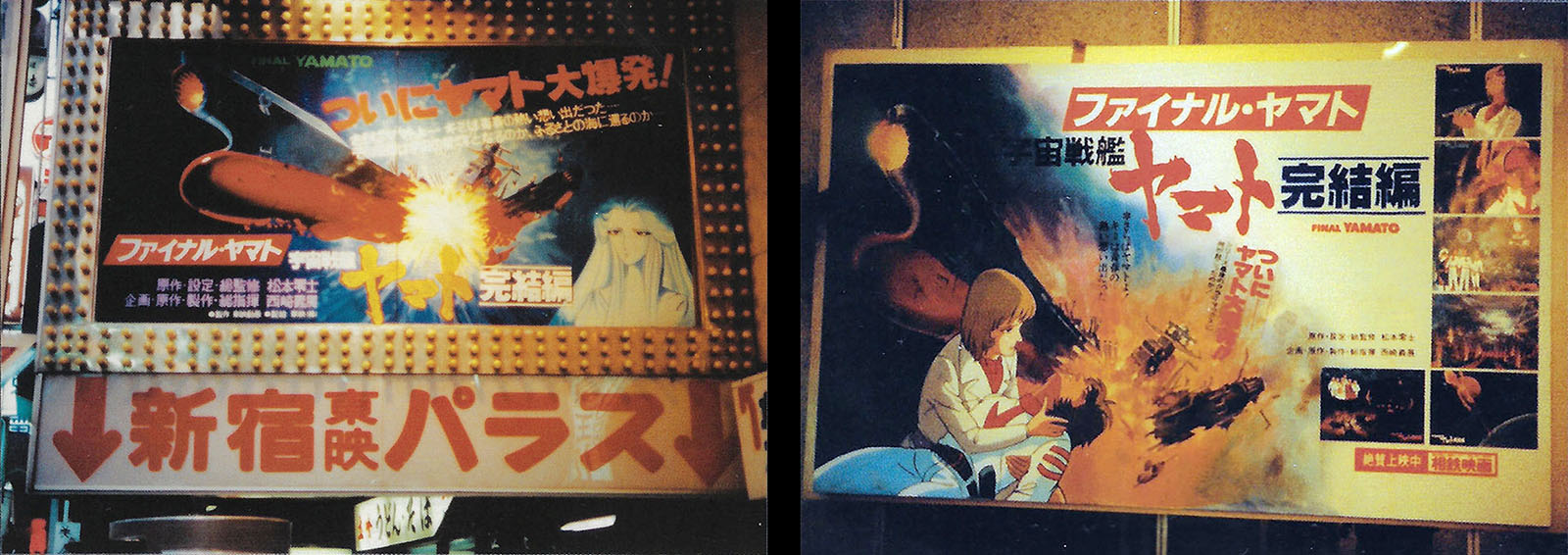
Hochi Shimbun, March 20
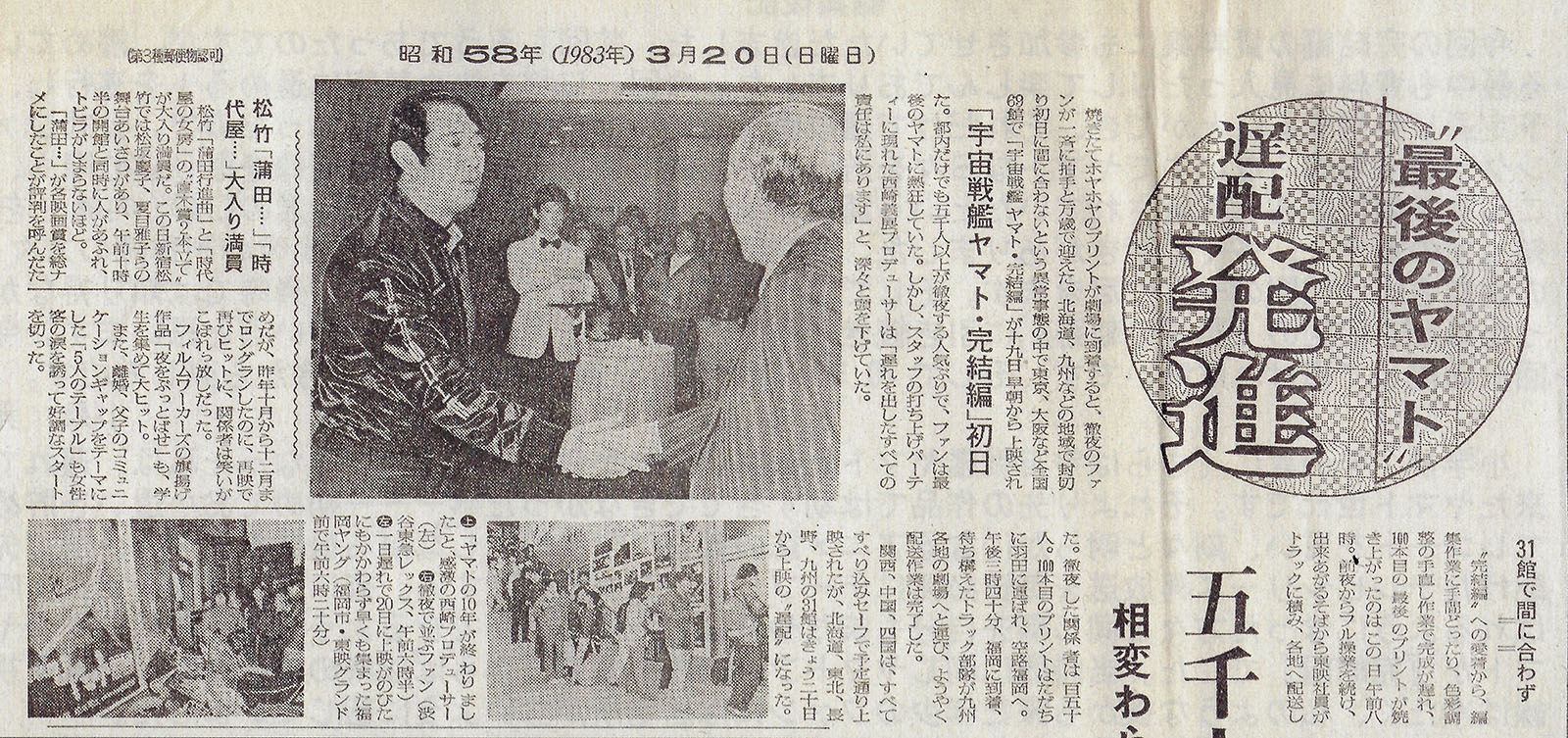
Toei’s Space Battleship Yamato, The Final Chapter was released on the 19th, marking the end of the “spring break anime battle.“ As of noon, the total audience number at seven theaters in Tokyo was over 50% higher than Shochiku‘s Crusher Joe and 15% higher than Toho/Towa’s Harmagedon. The final box office gross was ¥1 billion. “We’re confident that the final box office revenue will be ten times higher,” declared an enthusiastic Toei publicity department.
Due to production delays, the release of Yamato was originally scheduled for the 12th but was pushed back to this day. But the film arrived at Shinjuku Toei in Tokyo at 1am. The 1000+ people who stayed up all night, as is customary for anime premieres, raised their hands in cheers upon arrival. Of the 106 cinemas nationwide, about 30, including those in Hokkaido, Kyushu, and parts of Nagano prefecture, did not receive the film in time, so the release was further postponed until the 20th. Instead, audiences were shown Farewell to Yamato free of charge.
See a photo gallery of theater displays here

Final Yamato‘s epilogue has an interesting history all its own. It was cut together at the last minute following a lengthy development period. Thus, it was basically abandoned before it could be finished. When Nishizaki spot-checked it in theaters on opening day, he was so unhappy with it that he ordered it eliminated from all screenings. In other words, only viewers who caught the first screenings on day one got to see it.
However, thanks to the imminent approach of home video, this would later be remedied.

March 19: Final Yamato program book
As the first official Final Yamato publication direct from the home office, the program book (sold in theaters) was the most comprehensive so far, with slick color images packing its 46 pages. It contained many stills and paintings never seen before, along with ads for current and upcoming products.

This actually marked quite an important point in anime history, since it included the first ads anywhere for Yamato on home video.
See the program book cover to cover with translated text here
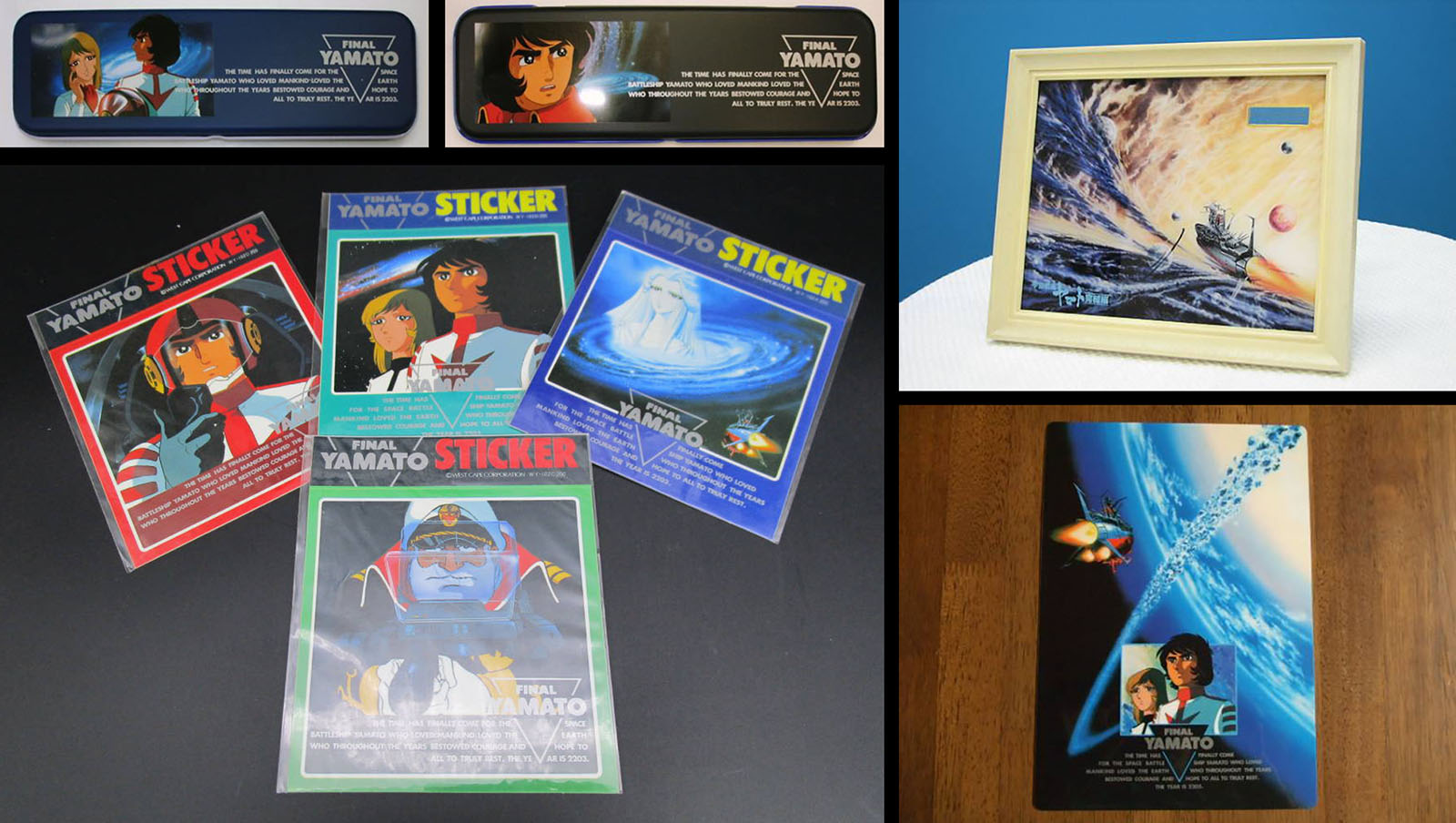
March 19: Final Yamato merch
The lineup of product merchandising for Final Yamato was the smallest out of all four movies for two basic reasons. First, the fans were getting older and second, many of the previous items were still available. This allowed the new product line to aim for a higher degree of sophistication since they would most likely appeal to older teens and adults.
Much attention was given to the “legacy” nature of these goods, which could for the first time commemorate 10 years of an anime series. Equal gravitas could be found in the English-language phrase that adorned many of the products in this wave:
The time has finally come for the Space Battleship Yamato, who loved mankind, loved the Earth, who throughout the years bestowed courage and hope to all, to truly rest. The year is 2203.
See a merch gallery here
See fan club merch here

March 19: Big Space Project: Yamato Launch
The premiere of the film was matched by a new exhibition at Family Land, a theme park in Takarazuka (near Osaka). It was converted into Takarazuka Garden Fields in 2003, but twenty years earlier it featured the “Big Space Project,” an examination of science fact and fiction. It ran from March 19 through June 5 as indicated on the flyer shown above.
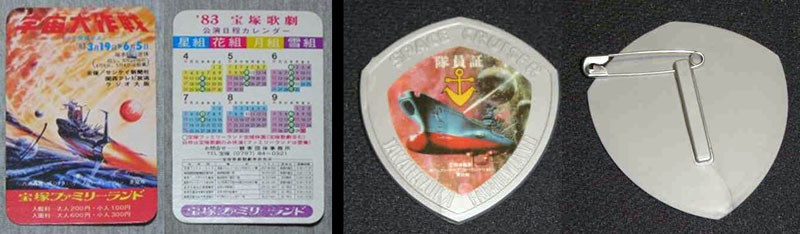
The highlight of the exhibition was a “three-dimension digest” of Final Yamato populated with model kits and video footage. Attendees could probably buy all sorts of Yamato loot at the park, but those specific to Family Land were a calendar card and a plastic badge.
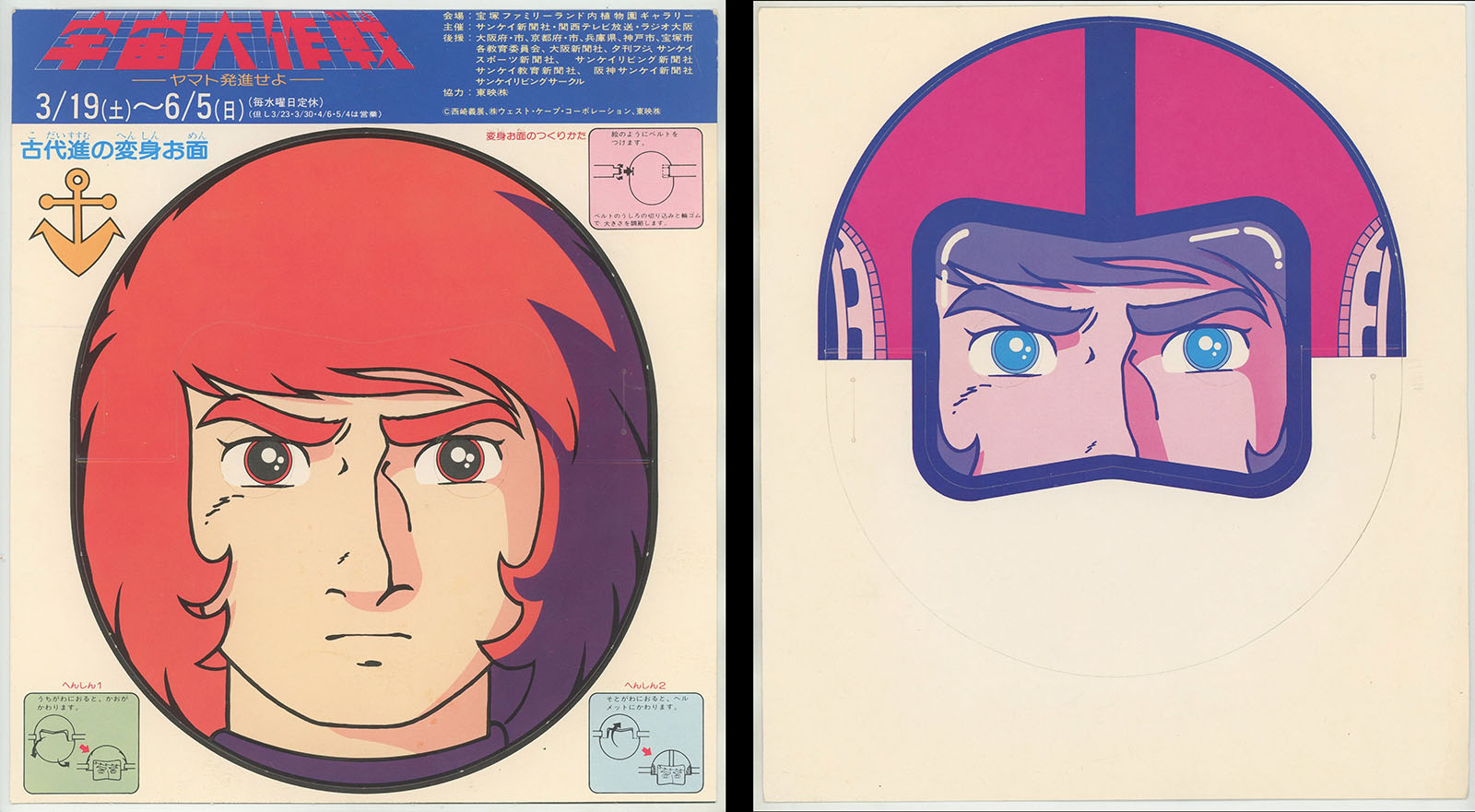
There was also a one-time-only item to be had, a full-size Kodai face mask with a half-face helmet version.
March 20: Newspaper coverage
After nearly three months of hype, the “Spring Break Anime Battle” was now over, and the winner was…anime fans! And also, Final Yamato prevailed at the box office.
Both Daily Sports and Sports Nippon published next-day coverage to share the details.
Read their articles here
March 20: Animedia special
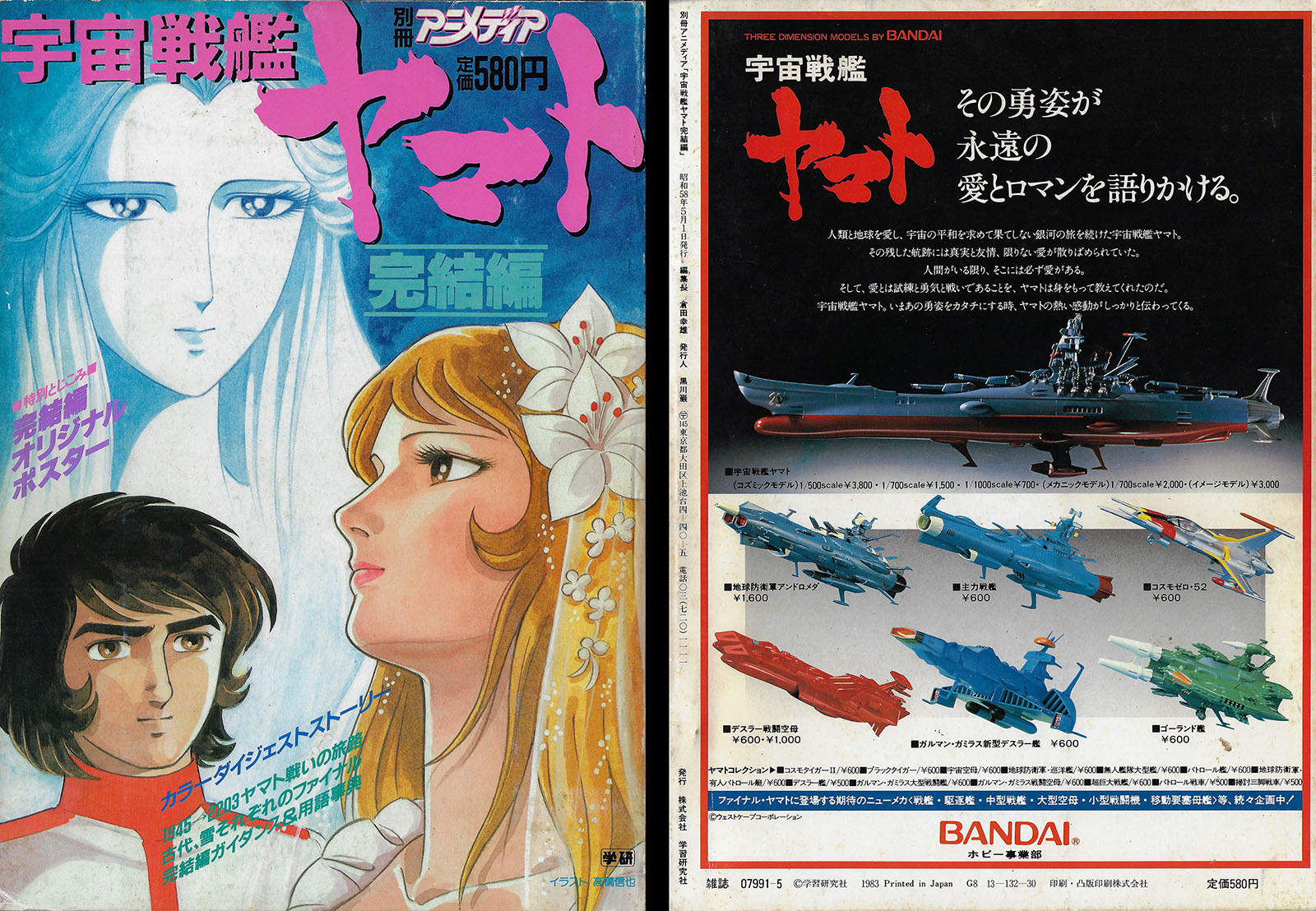
After the movie program book, the next publication after the premiere was the second Yamato special from Gakken’s Animedia magazine. It was an excellent companion to the first one with substantial coverage. After a character section with all names given in both Japanese and English, there was a handy timeline of Yamato‘s voyages from 1945 through 2203, a Final Yamato story guide with lots of rare production art, a black & white encyclopedia of characters and mecha, and a glossary of terms. The book concluded with a production and event history of the film.
The back cover ad promoted the newest Bandai model kit with this text:
That brave figure speaks of eternal love and romance
The Space Battleship Yamato loved humanity and the Earth and continued its endless journey across the galaxy in search of peace in the universe. The wake it left behind was littered with truth, friendship, and boundless love. As long as there are humans, there will always be love.
And Yamato taught us through its own example that love is a test, a courage, and a struggle. Space Battleship Yamato. When we recreate that heroic figure, the passionate emotion of Yamato really comes through.
March: 1/1000 Yamato model kit
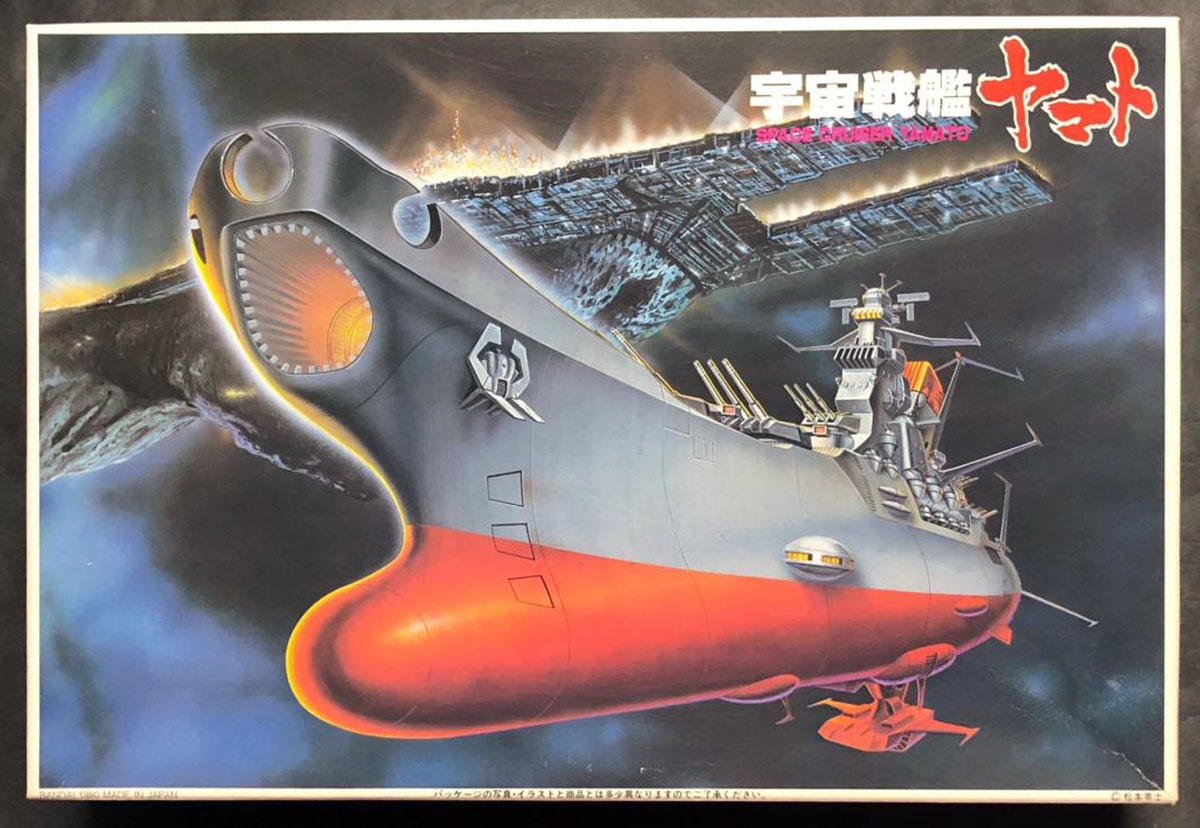
The new model in question was the only fresh offering from Bandai for the last movie, Yamato in 1/1000 scale.
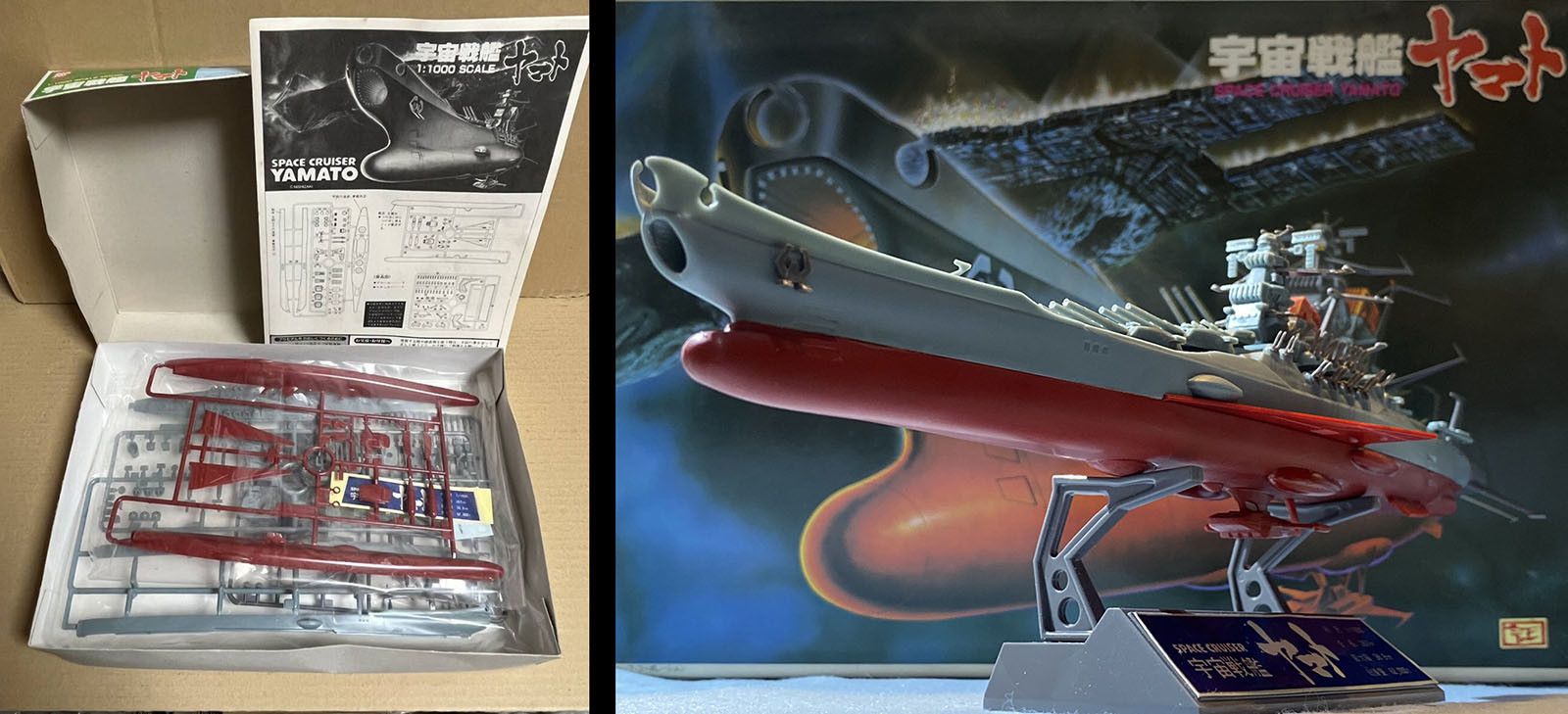
Measuring about 10″ long when finished, it distinguished itself with two-tone plastic for the upper and lower hull, so the red no longer had to be painted. The hull segments were still split down the middle, which yielded four hull pieces instead of the usual two.

March 21: Yamato 10 Year Tribute EP single
More a long-form poem than a song, 10 Year Tribute uses three movements to look back at the first voyage and trace the axis of friendships that emerged, especially the love between Kodai and Yuki. This departs from the structure of a theme song and brings a sense of closure to the saga, ending as it does with reference to a wedding. It was the last single from the original production years and Isao Sasaki’s last new contribution to the saga. The B-side contained two instrumental pieces, Great Uruk’s Theme and New Cosmo Zero. This song would remain vinyl-only until it appeared on the Eternal Edition CD series.
Read translated lyrics here

Text on front of jacket, by Yoshinobu Nishizaki:
In the ten years since its conception in 1973, Space Battleship Yamato has spawned many works and is loved by many people. Why was it a hit? Simply put, I think it’s because it honestly portrays the dreams of young boys and girls. A ship flying in the sky may seem like a fantastical idea, but it’s actually something I dreamed about as a boy.
However, rather than focusing on the subject of science-fiction, I focused on the story of the boys and girls who were on board. They wholeheartedly love the Earth, their parents, their teachers, and their friends. All of these emotions are lacking in today’s boys and girls. That is why the children who watched Yamato were so enthusiastic about it that they shed tears.
I was born in 1934, and belong to a generation that had a strong hold on old Japanese moral values. Social customs changed with the times, but I believe the Japanese heart remains the same. I believe the warm bonds between people, upheld by the Japanese family system, are valuable no matter the era. What on Earth was the meaning of postwar Japan when this was lost? I wanted to reexamine this question.
Another major factor in the success of Yamato is the music. I think it’s the visual quality in the fusion of sound and drama. The younger generation today has grown up with 8-beat and 16-beat rhythms. As a musical drama, Yamato was the one that best suited their sensibilities.
However, after ten years I thought it was time to step back from Yamato with The Final Chapter. Through Yamato, I have preached the importance of believing in humanity and fighting for the future. I hope people will understand the thoughts I have put into Yamato and apply them to their lives from now on.

March 21: Roadshow, May issue
There was no new coverage in this issue, but it did contain a full-page ad that made fans sit up and take note; Roadshow was just about to publish a Final Yamato special promising to “Deliver all of Yamato‘s passionate emotions and romance in one book!” One week later, everyone could judge that for themselves.
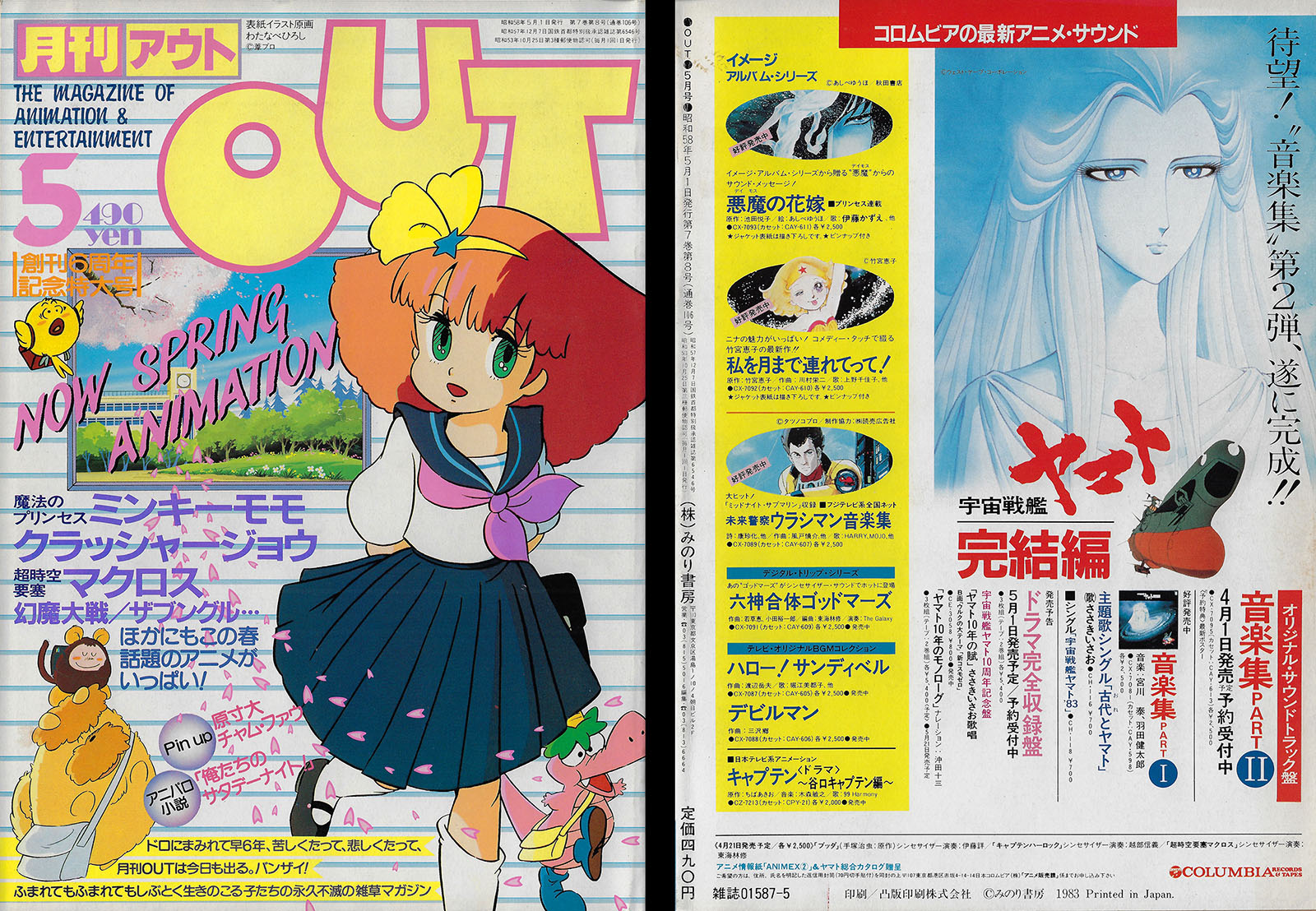
March 21: OUT, May issue
Like Roadshow, OUT did not carry a Final Yamato article this month, but the ongoing conversation in the reader’s page continued with a penetrating essay by a fan who sought to explain why Yamato‘s audience gradually declined over recent years.
Read that essay here
The back cover sported an ad from Nippon Columbia to promote the next Final Yamato music release on April 1. The headline reads: Long awaited! The second “Music Collection” volume is now complete!! It promoted Music Collection Part 2 for April release and the drama album for May.

March 25-31: All About Space Battleship Yamato Exhibition, Ueno, Tokyo
This was one of two events taking place simultaneously in Tokyo, set up in a Keisei Department Store in the Ueno ward. A 10-year history display and screenings of Series 1 TV episodes were the highlights. The other was a Yamato Fair at a Tokyu Department store in the Kichijoji ward, which featured live performances by Isao Sasaki, Tranzam, and Tomoko Kuwae.
Rather than hard data on the Ueno event, which was likely an echo of the widespread exhibitions of previous years, we have a personal anecdote. The images above and the text below were posted on Twitter by Yamato collector kanaeyokosuka:
When the final movie was released, the All About Yamato exhibition was held at Ueno Keisei Department Store. I happened to receive a cel painting. I went with a friend and we were happy for a short time. Mine was a character I didn’t know (Ageha). My friend said about his, “Analyzer is half cut off from behind.”
Memories of disappointment for both of us…
March 25: Anime Song Omnibus sheet music
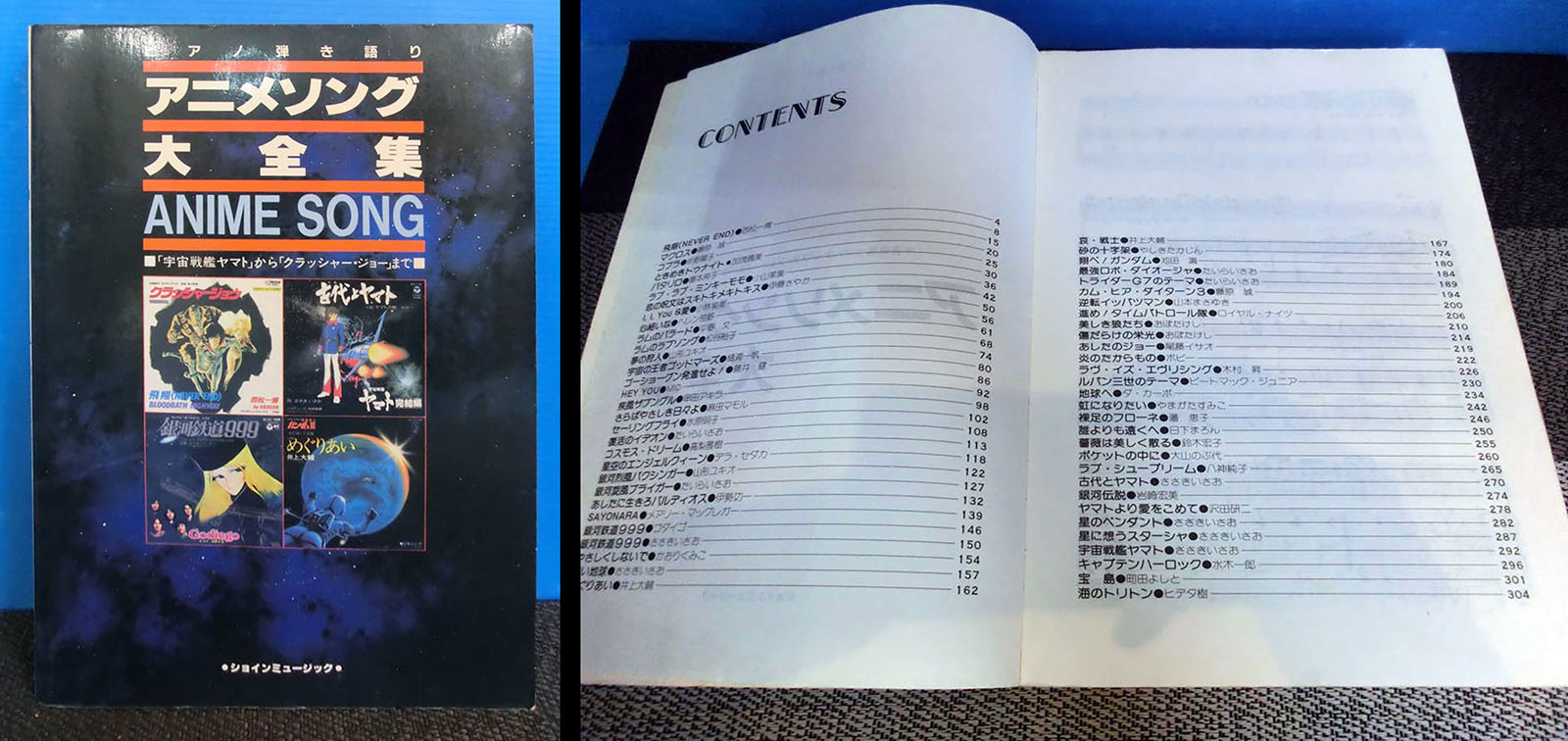
Published by Shoin Music, this thick volume brought together well known and more recent anime themes alike with compositions for piano. It included seven Yamato songs with the sheet music debut of Love Supreme and Kodai & Yamato.
March 28: Final Yamato, Roadshow Special Edition
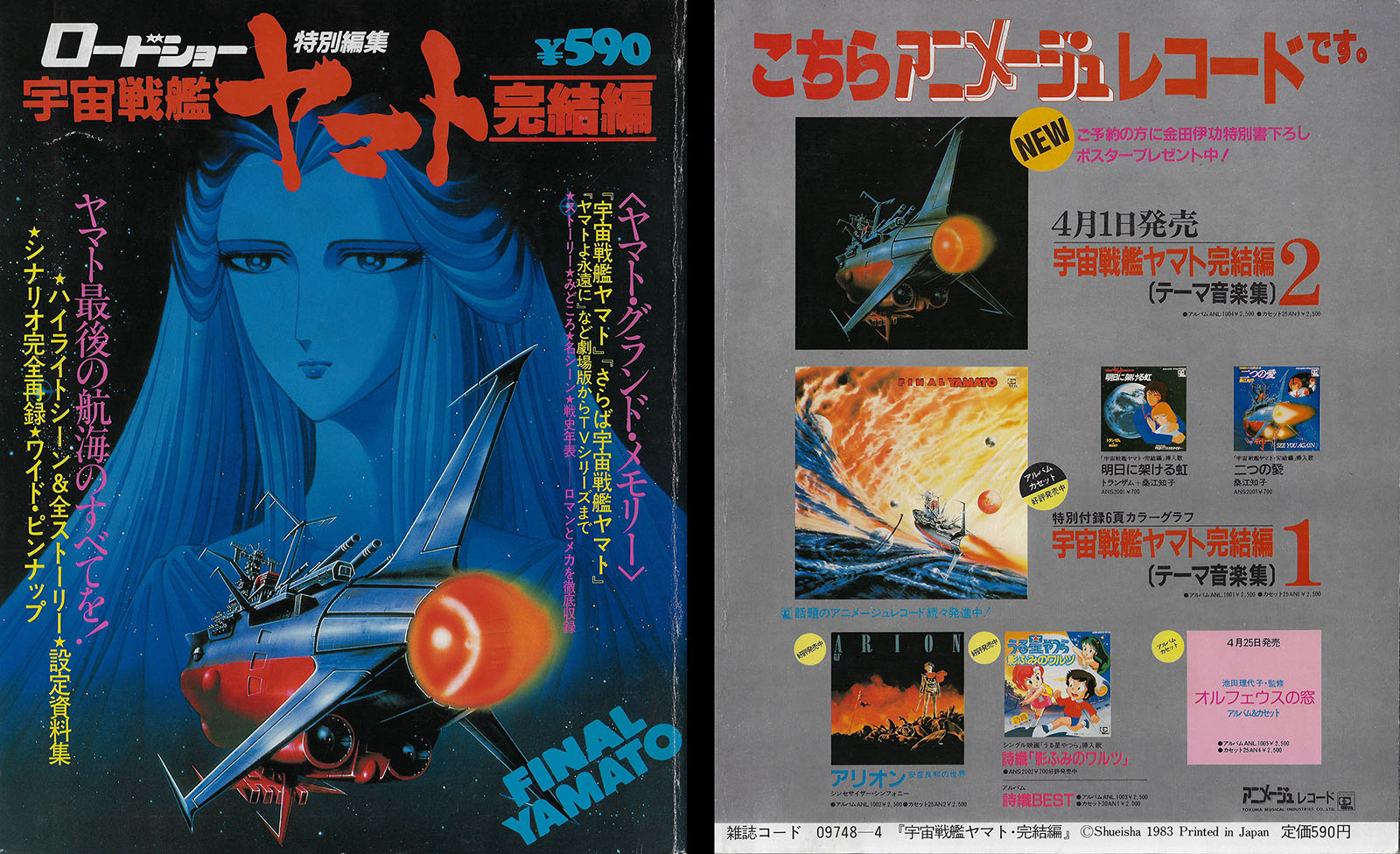
Shueisha’s fifth and final Roadshow special for the Yamato series was one of their finest. It contained a section of double-page highlight scenes, a character guide, photostory, song lyrics, the complete screenplay, model sheets, and a full-color retrospective of the entire saga.
The back cover was an ad for music on the Animage label; their second Final Yamato theme music collection would be released in just four more days, on April 1.
March 29: Final Cruises begin
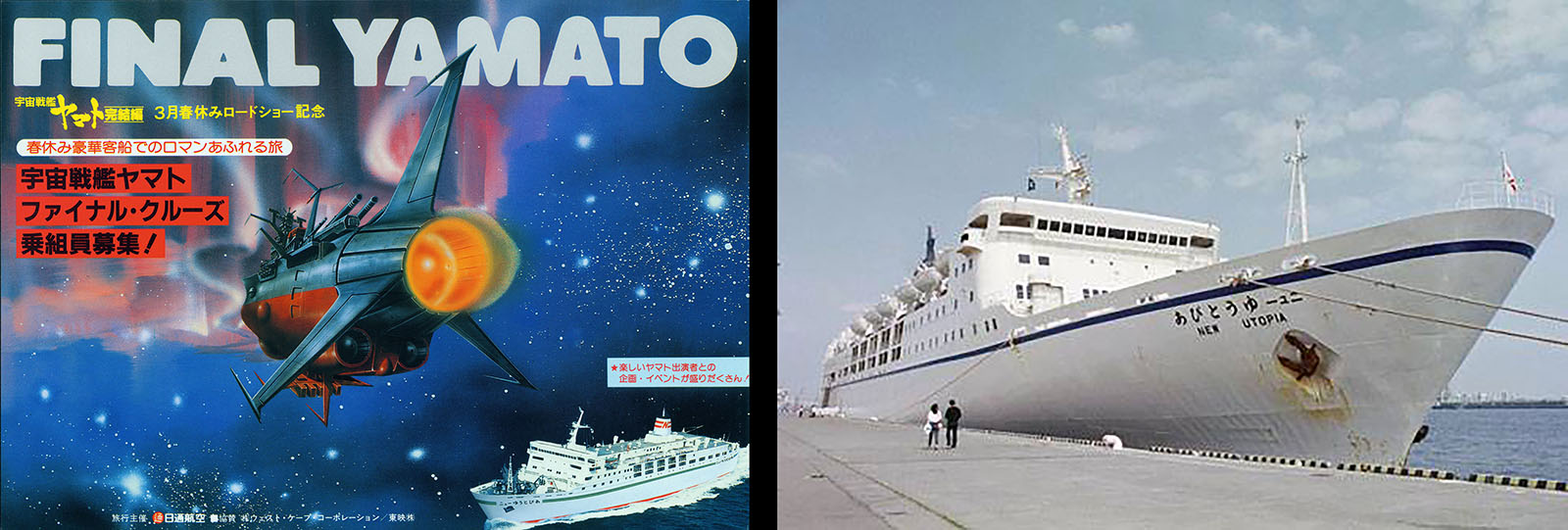
As covered in previous reports, three Yamato-themed leisure cruises took place over the course of a week: March 29-31, March 31-April 2, and April 2-4. Staff and cast members participated in onboard events with fans, but unlike the 1980 Be Forever cruise, no official coverage has emerged to give us a look at what went on.
On the other hand, we have a personal account from a fan who was there, and posted the following on Facebook under the name Hidemi Ishihara:
Back then, I was dead set on attending any Yamato event. That’s how obsessed I was during my junior high and high school years. For the previous Be Forever event, I did join the train trip, but I missed out on the Yamato cruise departing from Kawasaki to Miyazaki for two nights. The last chance came in 1983. Nippon Express Yotsuya planned a Yamato tour departing from Harumi Pier to the Izu area. It cost tens of thousands of yen so I had to beg my parents.
We departed Harumi Pier around 3pm. I shared a room with a friend from the old days, or rather, the same friend from the Be Forever days. It was a two-day itinerary aboard Kawasaki Kisen’s New Utopia, which they made to resemble Yamato. The guests on my tour were Leiji Matsumoto, Kei Tomiyama (Kodai), Kenichi Ogata (Analyzer), and Goro Naya (Okita).
Right after departure, there were welcome drinks in the hall where the organizer explained the itinerary. During the evening free time, we gathered in the lounge to watch TV. Some participants were already puking from seasickness. Dinner at 7 PM. Then came the long-awaited welcome show. The band was lame. They played mostly songs unrelated to Yamato. Then it was time for the guest talk show. Next, guest voice actors and some participants got to try voice acting. This and the next anime song experience involved recording your voice live onto a vinyl record as a souvenir.
I joined the anime song session. “Please do Kodai and Yamato!” We can’t play that. “Pendant of Stars, please.” Can’t play it. “Hey! What can you even play…any Space Battleship Yamato songs?” Seriously, tears. I couldn’t accept this. It was a Yamato event! There was even a boy singing Doraemon songs. The boy who sang Hattori-kun got backing vocals from Kenichi Ogata. Finally, after his greeting, Kei Tomiyama himself sang with a bright red scarf. Seriously? (LOL). After closing, fans lined up at the restaurant where Mr. Naya and Mr. Ogata were drinking. It turned into an autograph session.
I don’t remember the morning of Day 2, but we passed either Oshima or Niijima. The afternoon featured back-to-back screenings of Farewell and Be Forever. After dinner, the farewell party and finally the screening of Final Yamato; it was the legendary “long version” with the erotic scene between Kodai and Yuki.
But…a major problem had been going on since departure. Power outages throughout the ship. They happened every hour or two. With high-power stuff like movies and shows, the circuit breakers kept tripping. They happened relentlessly even during the movie’s climax, so the ship was filled with screams, curses, and seasick vomit before bed.
I got seasick and disembarked the next morning. Thank youuuu. I watched the movie again the next day at Marunouchi Toei theater.
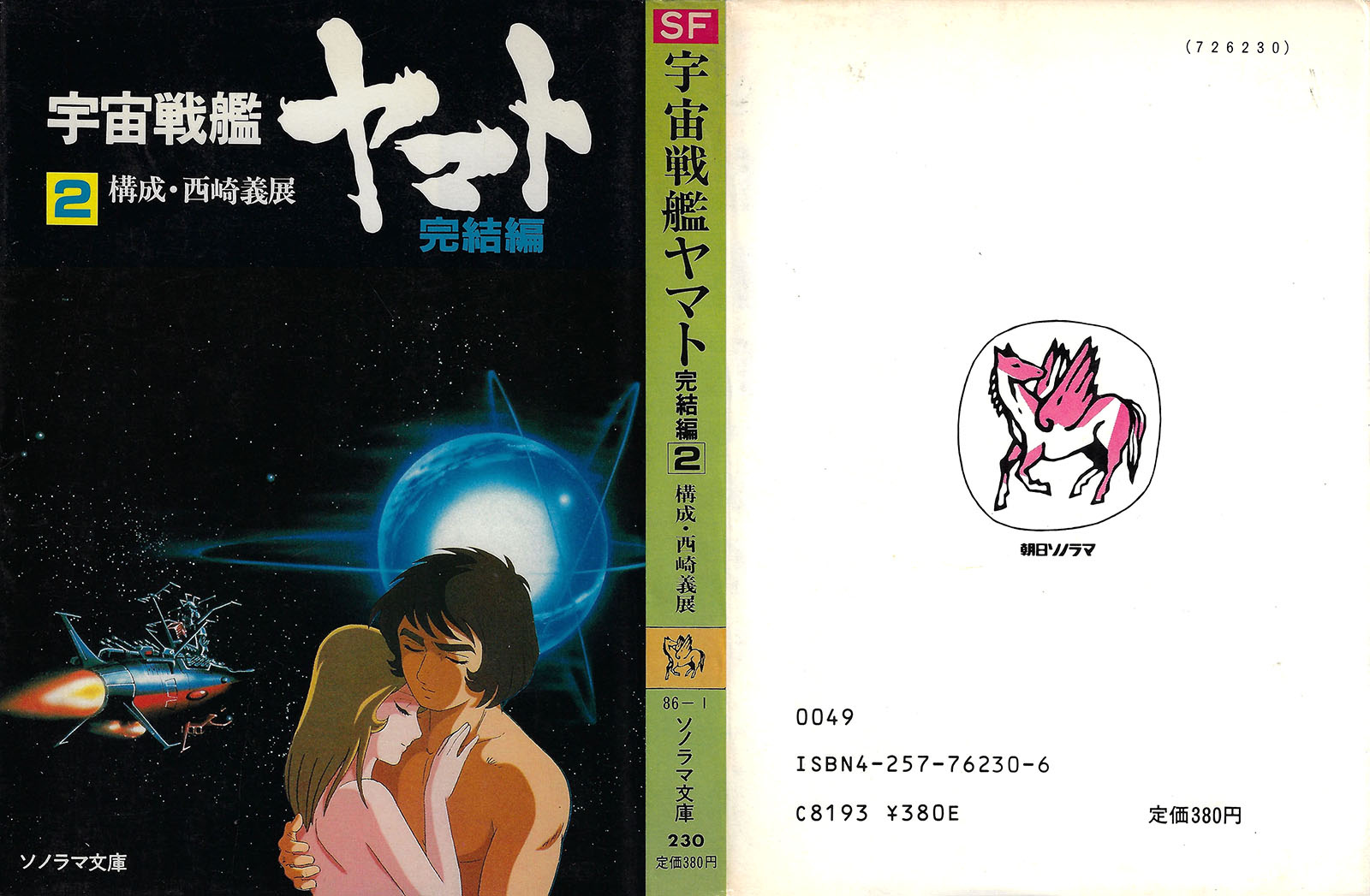
March 31: Final Yamato novel part 2, Asahi Sonorama
One more item managed to wedge itself into the schedule before the month ran out: the concluding volume of Asahi Sonorama’s novelization by “Yoshinobu Nishizaki.” (It was more likely handled by a ghost writer, since Mr. Nishizaki has never been touted as a novelist.)
Bracketed by 8 pages of color stills and 9 pages of black & white design art, the text opens with the attack on Uruk and goes past the Shueisha edition to include an original epilogue. Read it here.
Also spotted in March

Model kit reissues
In addition to their new 1/1000 Yamato, Bandai re-released three existing kits in March. The 1/72 Cosmo Zero and 1/700 Yamato (sans cutaway parts) both got new box art for the occasion. The 1/500 Cosmic Model Yamato was reissued as well, but kept its 1978 box art.
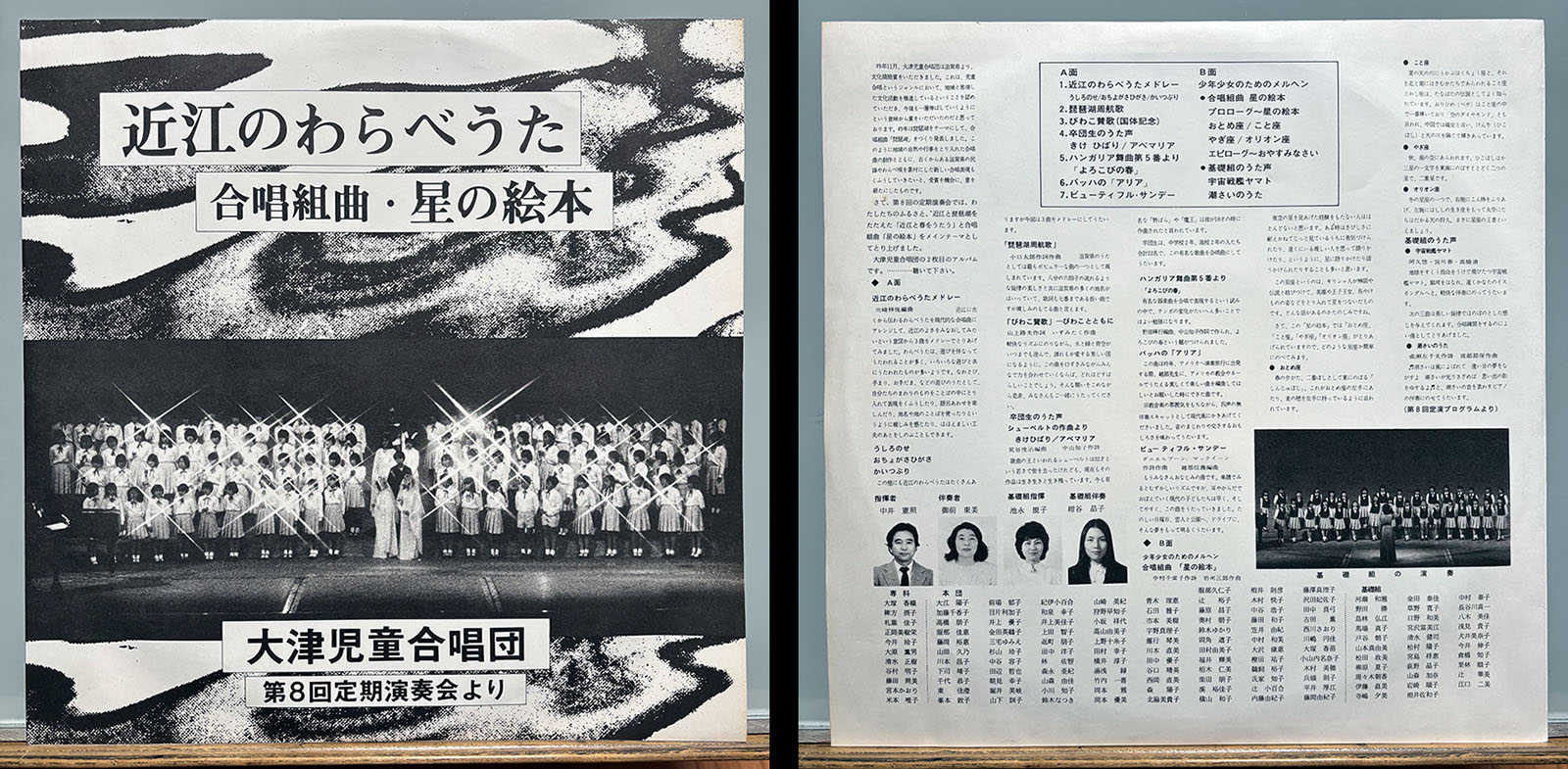
Omi Children’s Songs LP
Released on a private label, this concert by the Otsu Children’s Choir (also titled Choral Suite • Picture Book of Stars) contained a lineup of anthems, folk songs, fairy tale songs, and more, culminating with the Space Battleship Yamato theme as a closer. The choir went all the way back to 1953 and they performed a regular concert every March in collaboration with other groups. Yamato music history is peppered with hidden gems like this, and they’re always a delight to discover.

One new SF TV anime made its debut in March, a “super robot” series titled Lightspeed Electroid Albegas. Read more about it here.
Anime magazines published in March

One cover each for Urusei Yatsura and Final Yamato, one for the new TV series Aura Battler Dunbine.

Two more covers for Crusher Joe. (On My Anime and Animedia.)
What’s next
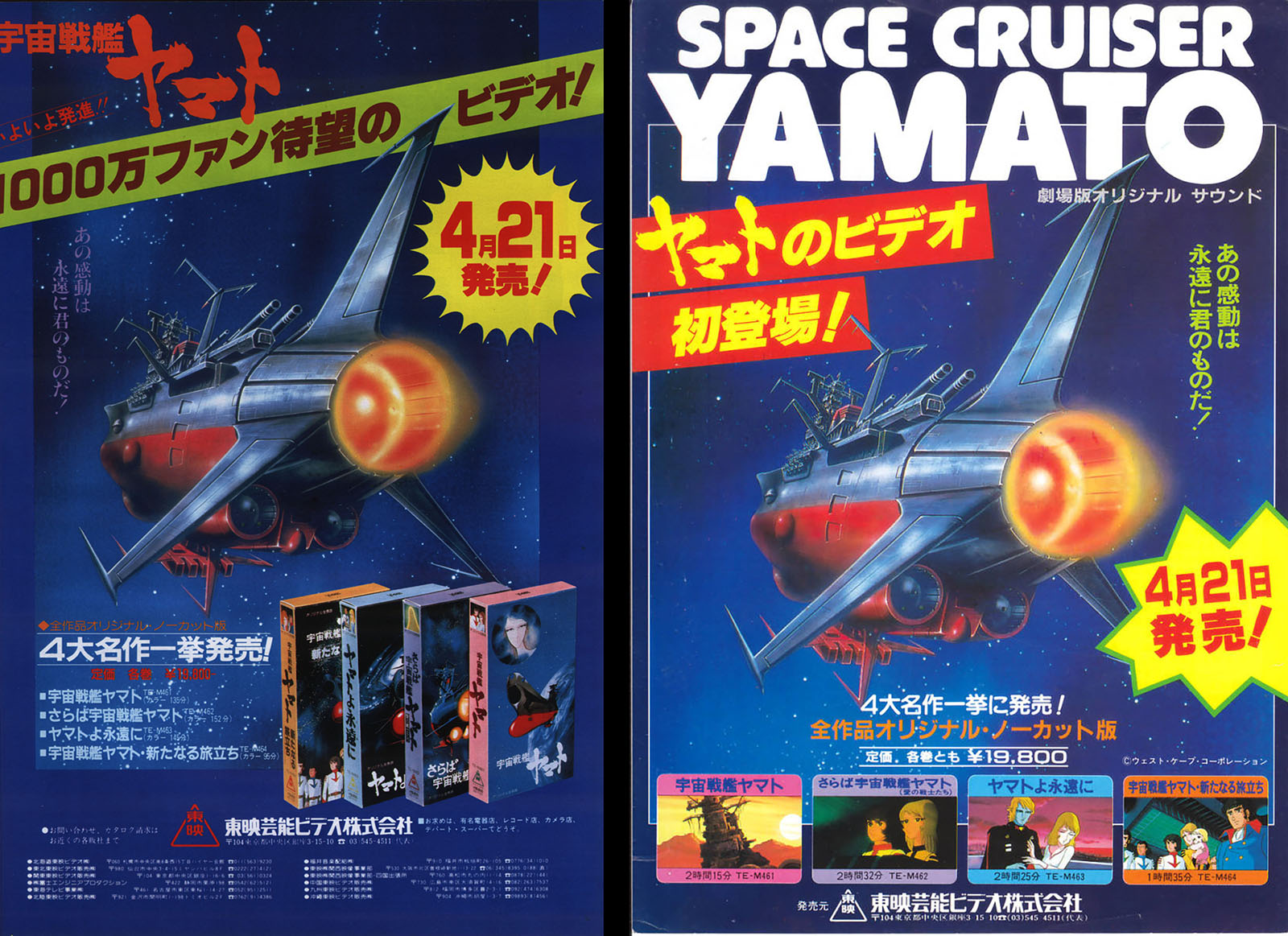
Many things ended in March ’83, but other things were waiting to begin as Yamato slowly transformed into a legacy. In the next report we’ll cover the second quarter of 1983 when, among other things, the last great publishing bonanza coincided with the dawn of home video. See it happen in Vintage Report 45!
oh wow, I still have that 1/1000 Yamato, battered and losing parts after all this time…