
From Yamato 2199 to REBEL 3199, a series explaining the mechanics of battleships and other vessels appearing in the Space Battleship Yamato remake series. Part 15 covers the Galman-Garmillas military’s Zerandal-class Attack-Type Dimensional Submarine, the Zerandal. We explore how far it evolved from the previously active UX-type and examine its performance.
Explanation: Yuka Minagawa
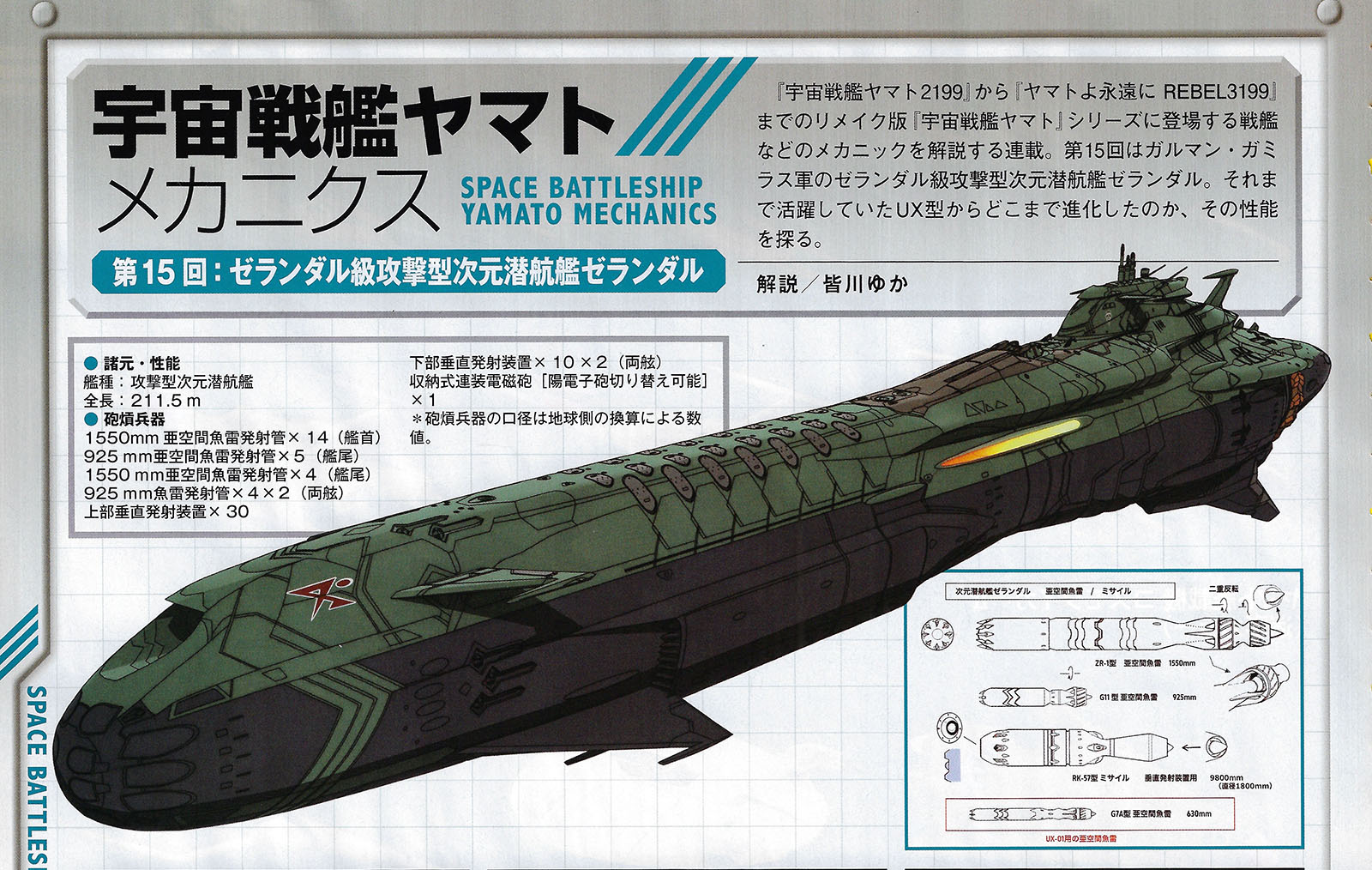
● Specifications & Performance
Class: Attack-type Dimensional Submarine
Length: 211.5 m
● Main Armament
1550mm Subspace Torpedo Tubes x14 (Bow)
925mm Subspace Torpedo Tubes x5 (Stern)
1550mm Subspace Torpedo Tubes x4 (Stern)
925mm Torpedo Tubes x4x2 (Both Sides)
Upper Vertical Launchers x30
Lower Vertical Launchers x10x2 (Both Sides)
Retractable Twin Electromagnetic Cannon [Positron Cannon Switchable] x1
*Weapon calibers are Earth-equivalent values.
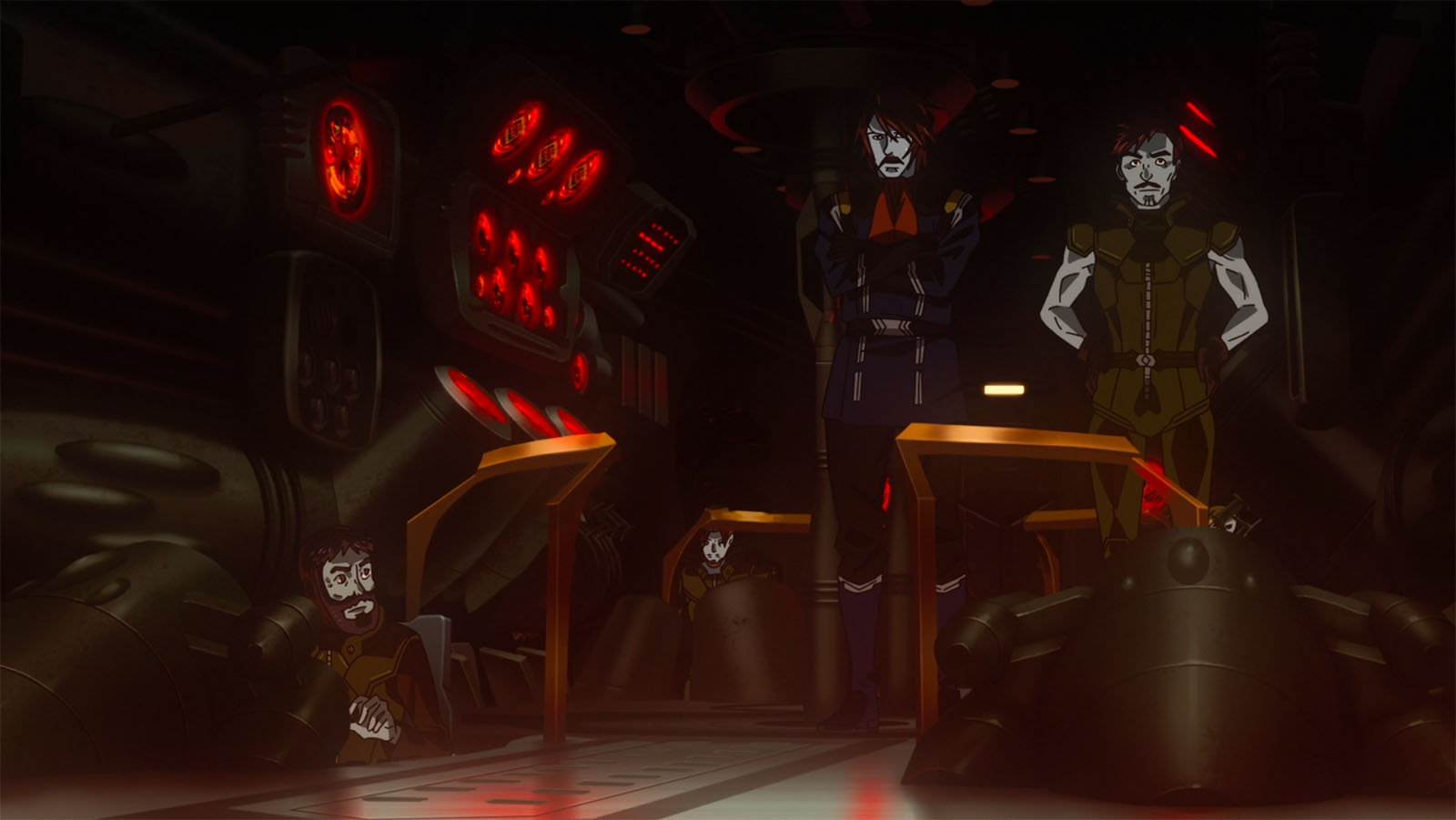
Bridge
Designed as the flagship of the dimensional submarine fleet, the Zerandal class features enhanced fleet command capabilities beyond those of the conventional UX type.
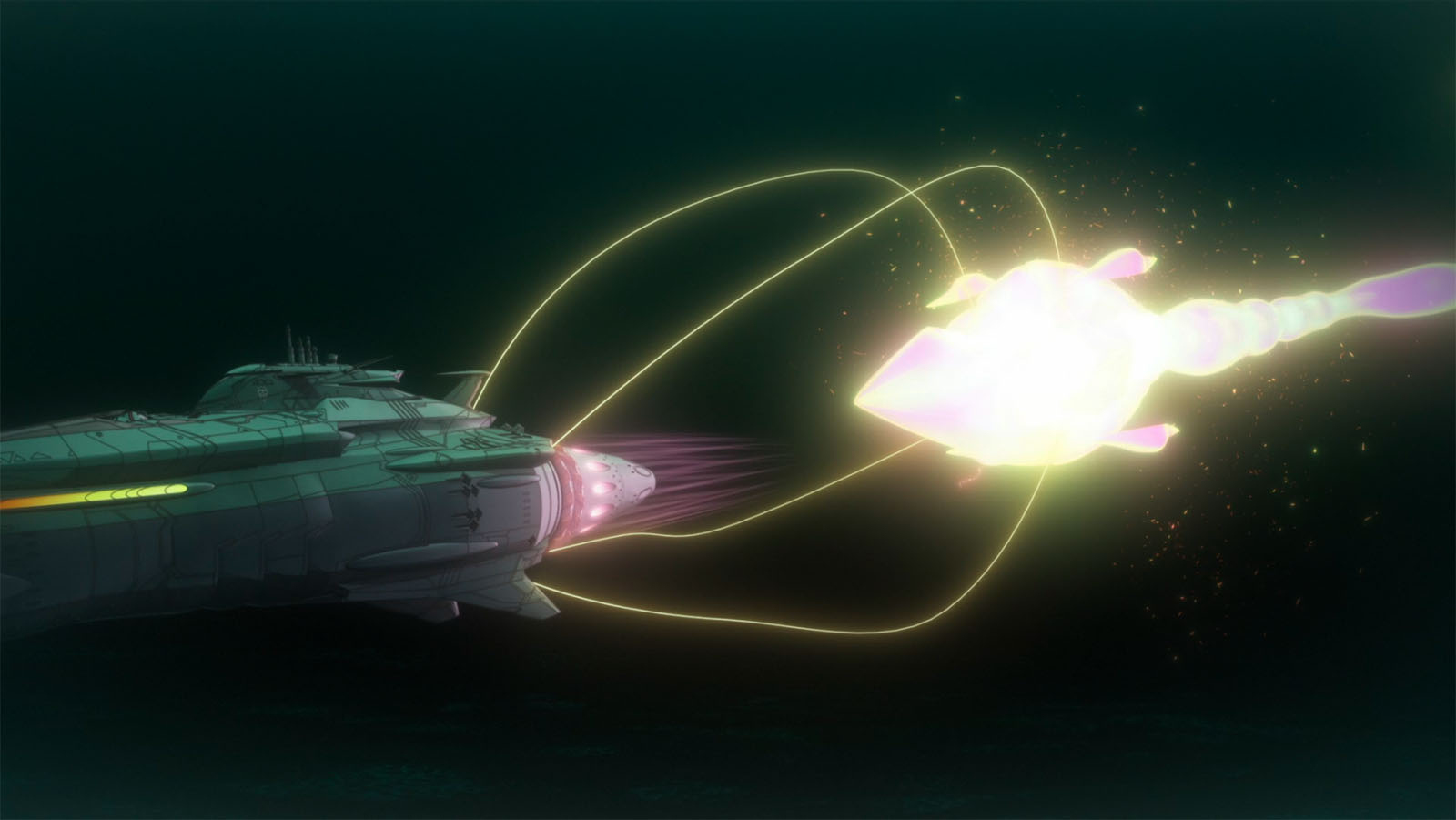
Towing beam wire
The hull incorporates towing beam wires for salvage operations within subspace. While the UX type’s towing equipment was limited to small craft, this vessel’s equipment supports full-scale fleet operations.
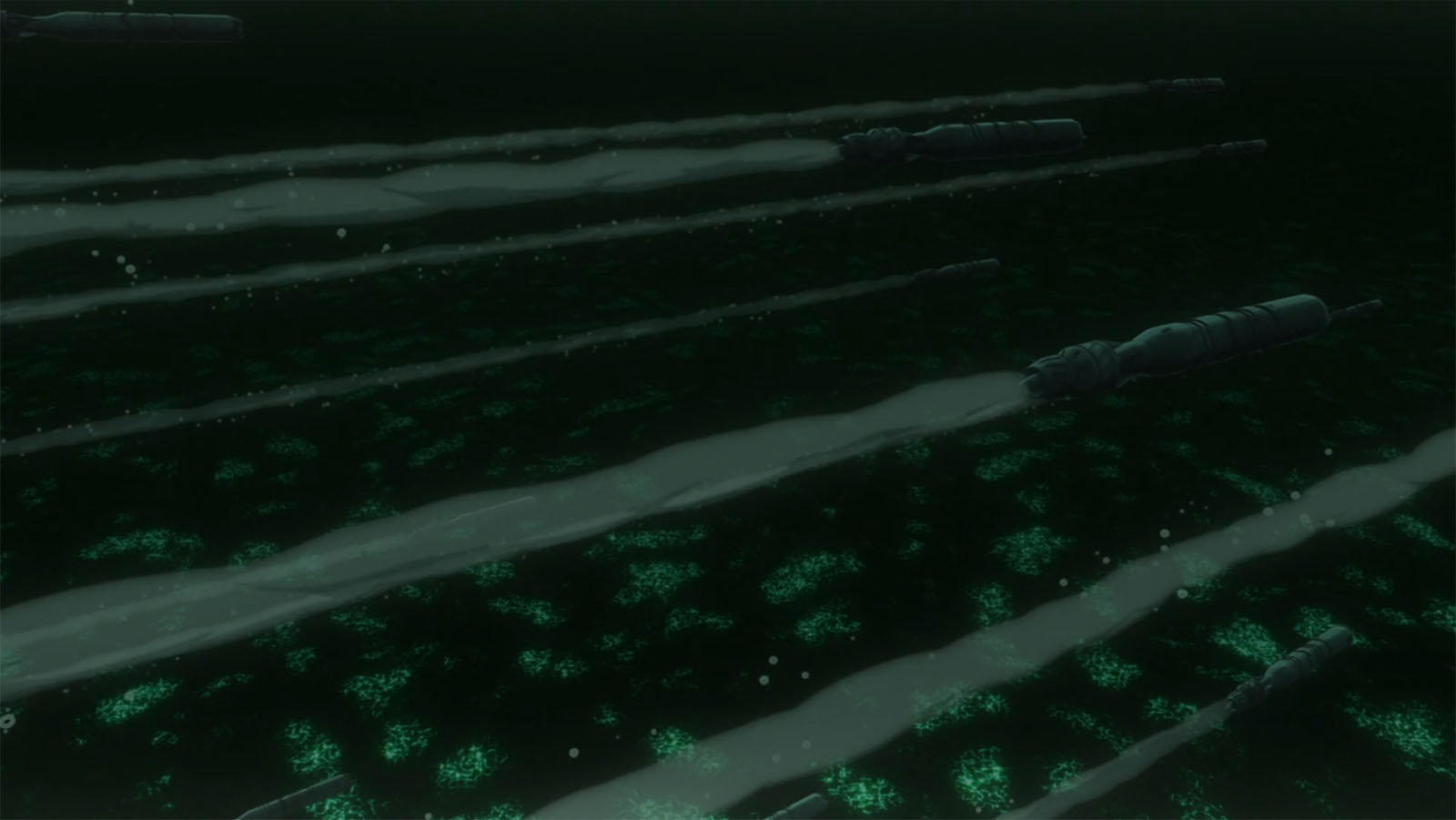
Subspace Torpedoes
These torpedoes have a larger caliber and more launch tubes than the UX-01 type. Equipped with a subspace propulsion turbine, they can cross dimensional boundaries after launch, similar to subspace missiles.
The Zerandal-class Attack Subspace Submarine, Zerandal, was constructed and commissioned under the Galman-Garmillas military’s subspace submarine fleet concept.
Garmillas relocated its base to the Galman system in the Sagittarius Dwarf Galaxy and founded the Galman-Garmillas Empire alongside the Galman people inhabiting this planet. However, lacking the military might of the Great Garmillas Empire era and having lost many colonies, it could not achieve the same scale of production capacity as in its heyday. Consequently, Galman-Garmillas prioritized the formation of a dimensional submarine fleet as its foremost strategic naval objective.
Assigned as the fleet flagship, this vessel was designed to navigate deeper sub-space dimensions than conventional craft, granting it superior stealth capabilities. If realized, it would be capable of longer-range travel than the UX-type, which was limited to shallow-depth navigation, and was expected to fulfill a more strategically important role. Furthermore, its overall length is greater than the conventional UX-type, approaching the size of a cruiser navigating normal space.
Alongside the increased output of the Gesh-vual engines used within hyperspace, the Zerandal-class propulsion system is larger than the UX-type, employing ring-shaped dual-reverse thrusters. Furthermore, the stern features a sub-nozzle. In addition to attitude control thrusters, deep-depth-rated thrusters capable of maintaining control even in high-dimensional-pressure sub-space are installed throughout the vessel.
Due to the nature of energy excitation in sub-space, solid projectiles hold an advantage over positron cannons. Consequently, while the UX-class primarily relied on sub-space torpedoes as its main armament, Zerandal is newly equipped with twin electromagnetic railguns. The electromagnetic cannon’s projectile is a flat-shaped armor-piercing high-explosive shell measuring 400mm long and 340mm wide, launched at an initial velocity exceeding 10,000 meters per second. This projectile contains no explosive charge; it penetrates the target using kinetic energy and achieves its explosive effect by imploding. The turret employs a retractable design, normally stowed to avoid prolonged exposure to extreme dimensional pressure at great depths, only extending externally during firing. It can also be operated as a positron cannon for firing in normal space.
Furthermore, the number of launchers for sub-space missiles and sub-space torpedoes is significantly increased compared to the UX-class. These are capable of breaking through the dimensional boundary from sub-space to attack targets in normal space.
Notable features of the Zerandal-class include the installation of electromagnetic cannons primarily intended for use in hyperspace, despite their ability to switch to positron cannon mode, and the inclusion of lower vertical launchers to target enemies located deeper than the ship itself. This indicates the ship was designed from the outset with full-scale combat within hyperspace in mind. This design philosophy was influenced by the Iscandar Incident, where UX-class ships were attacked and captured by Dezarium within hyperspace.
These points suggest that the Galman-Garmillas dimensional submarine fleet concept was not merely intended for stealth operations through subspace, but rather aimed to gain strategic advantage by controlling this domain. While the Zerandal-class’s official designation is “Attack-Type” Dimensional Submarine, within the Galman-Garmillas’ new strategy, it should be positioned as a Strategic-Type Dimensional Submarine.
How many of Yamato‘s Mecha Collection models can Sotou Sakurai build in a month? The Final Chapter
Fighter craft edition
We bring you the final installment of Sotou Sakurai’s Yamato Mecha Collection challenge. This time, the EDF fighters are gathered from the Yamato Mecha Collection Special Box set sold by Premium Bandai. The Cosmo Tiger has been modified to create variations, making this a major remodeling contest that goes beyond a simple kit review. Is Yamato a father, a brother, or a friend? Farewell, Yamato, this month is the last. See you again in the Resurrection Chapter! (HEY!)
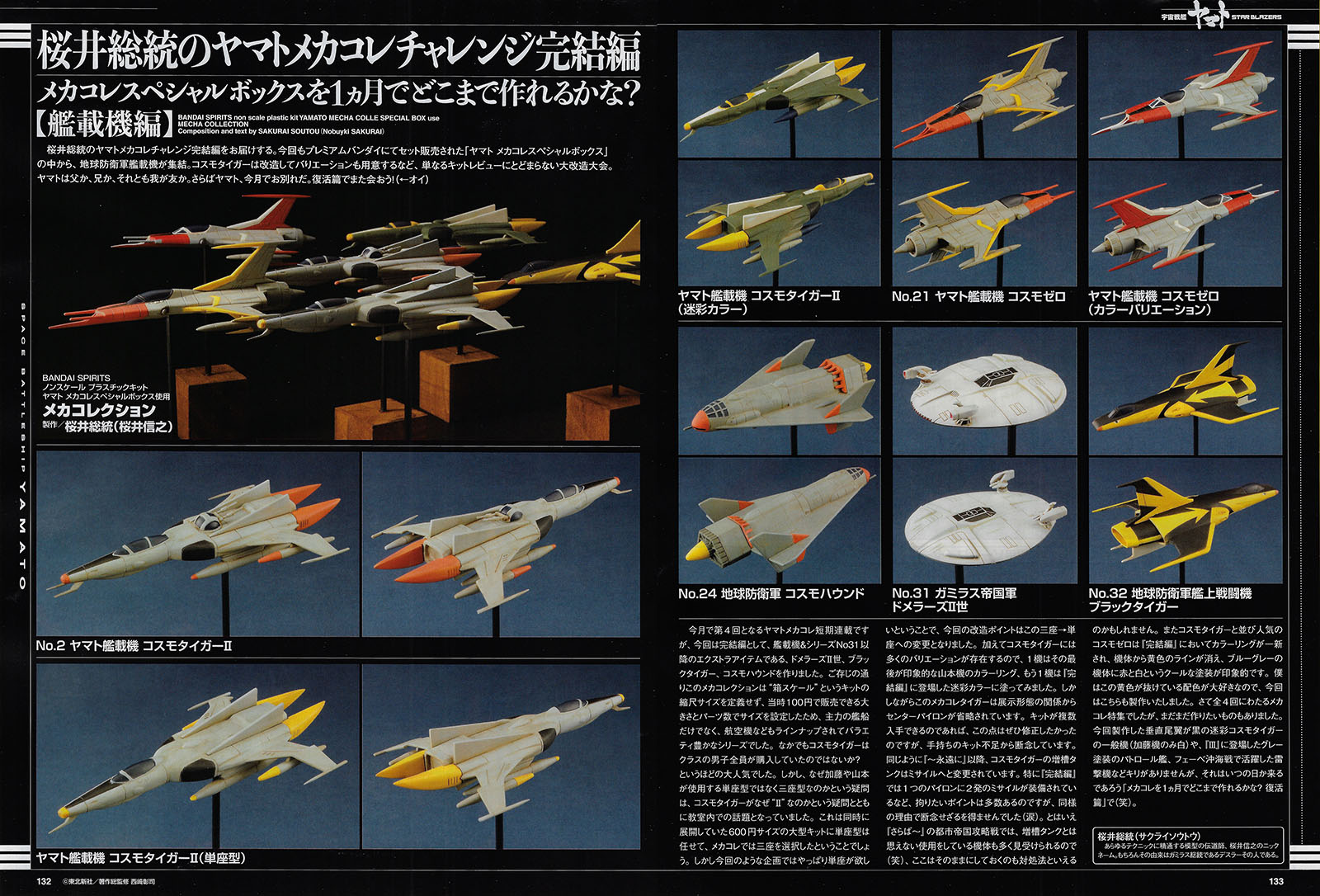
This month marks the fourth installment of the Yamato Mecha Collection short series, and this time I also built the Domelaze II and Black Tiger, which are extra items from the series, number 31 onward. As you know, the Mecha Collection did not define the scale of the kits as “box scale,” but instead set the size and number of parts based on what could be sold for 100 yen at the time. So it was a very diverse series, with not only the main ships but also fighter craft in the lineup.
The Cosmo Tiger was particularly popular, with every boy in my class buying one. However, the question of why it was a three-seater rather than the single-seater used by Kato and Yamamoto was a hot topic in the classroom, along with the question of why the Cosmo Tiger was numbered “II”. This probably meant that the single-seater was left to the large 600 yen kits being released at the same time, and a three-seater was chosen for the Mecha Collection. However, for a project like this I really wanted a single-seater, so I decided to go with that. Therefore, the main point of this modification was to change it from a three-seater to a single-seater.
Additionally, there are many variations of the Cosmo Tiger, so I painted one in the striking livery of Yamamoto’s craft, and the other in the green camouflage color that appeared in Final Yamato. However, due to the nature of the display format, this Mecha Colle Tiger has no center pylon. If I’d been able to obtain multiple kits, I would have loved to have corrected this point, but I gave up due to lack of kits on hand.
Similarly, from Be Forever onward, the Cosmo Tiger’s drop tanks were changed to missiles. There are many points I would have liked to fix, especially for Final Yamato where one pylon is equipped with two missiles, but I had to give up for the same reasons (sob). However, in the battle to conquer the city empire in Farewell, there are many aircraft that use drop tanks in a way you wouldn’t expect, so leaving this as is is also a good solution.
Cosmo Zero, which is just as popular as Cosmo Tiger, had its coloring completely changed in Final Yamato, with the yellow lines disappearing from the fuselage and a cool red and white paint job on a blue-grey body that leaves an impression. I love this color scheme with the yellow removed, so I made this one, too.
Although this was a 4-part Mecha Collection feature, there were still many more that I wanted to make: a standard Black Tiger with a black camouflage pattern (only Kato’s was white), the grey patrol ship that appeared in Yamato III, the torpedo bomber that played an active role in the Battle of Phoebe, and so on, but there’s no end to it. I’ll save that for the “How much of the Mecha Collection can I make in another month? Resurrection Edition” that will come someday. (Laughs)
Supreme Commander Sakurai (Sakurai Soto)
The nickname of Nobuyuki Sakurai, the model-making evangelist proficient in every technique. Its origin, of course, is Dessler himself, the Supreme Commander of Gamilas.