
From Yamato 2199 to REBEL 3199, a series explaining the mechanics of battleships and other vessels appearing in the Space Battleship Yamato remake series. Part 14 features the Garmillas dimensional submarine UX-01, also notable for its captain Wolf Frakken. We delve into the secrets of this special combat vessel capable of traveling to and navigating through alternate dimensions!
Explanation: Yuka Minagawa

● Specifications & Performance
Vessel Type: Dimensional Submarine
Length: 144m
● Main Armament
Bow Subspace Torpedo Tubes x 6
Stern Subspace Torpedo Tubes x 2
99mm Single-Barrel Positron Beam Turret x 1 (Forward Deck)
33mm Single-Barrel Laser Cannon x 1 (Sail Direction)
Missile Launchers x 8 (Fore Deck Upper Surface)
Space Mine Laying Devices x 5 (Aft Deck)
*Weapon calibers are Earth-equivalent measurements.
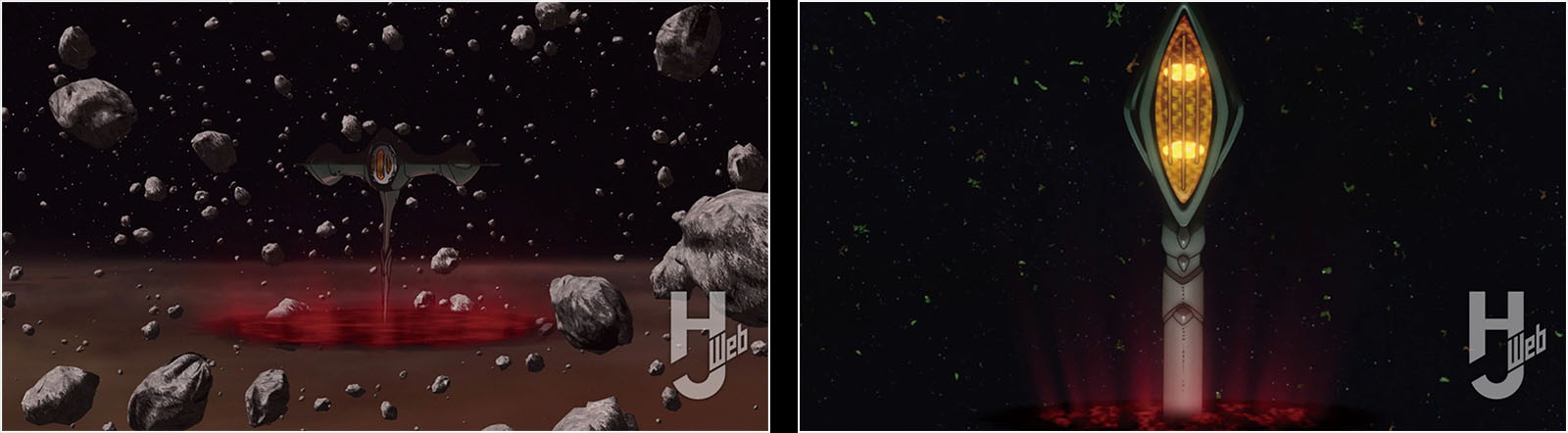
1. Probe
When diving into shallow subspace, a wired probe crossing the dimensional boundary is used. It captures visible light, X-rays, and other wavelengths, with range switching to visualize them.
2. Dimensional Periscope
To observe normal space near the dimensional boundary, a dimensional periscope mounted on the sail is used.
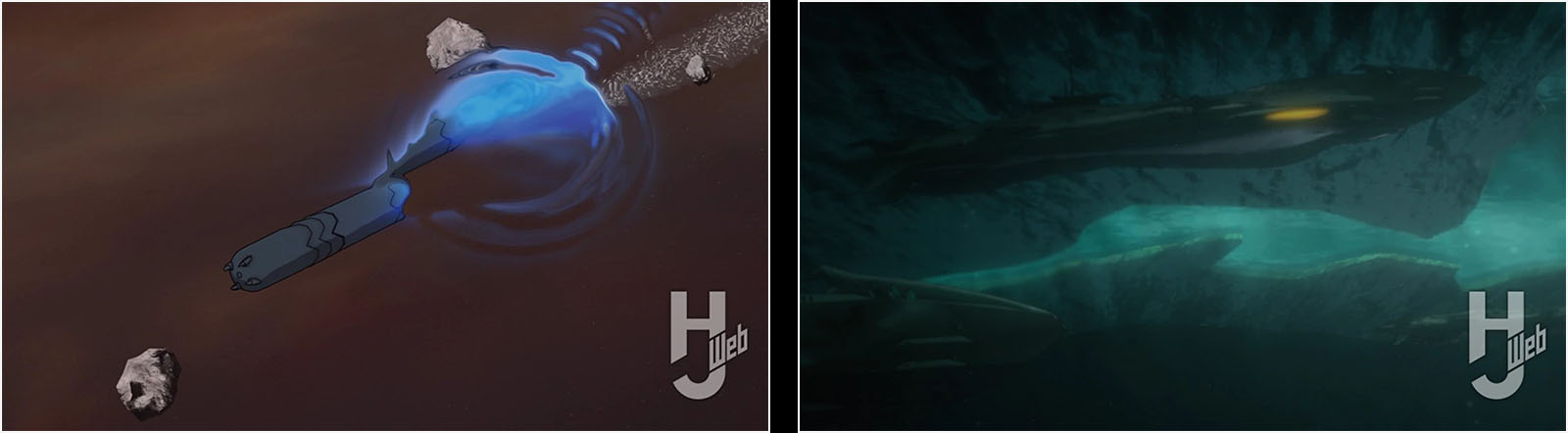
3. Subspace Torpedoes
A miniaturized Gesh-Vual engine with a subspace propulsion turbine is incorporated, allowing it to break through the dimensional boundary after launch.
4. Dimensional Submersion/Ascent
Unlike warping, ascent to planetary surfaces is possible without gravity damage, though ascent into regions with intense dimensional tremors is difficult.
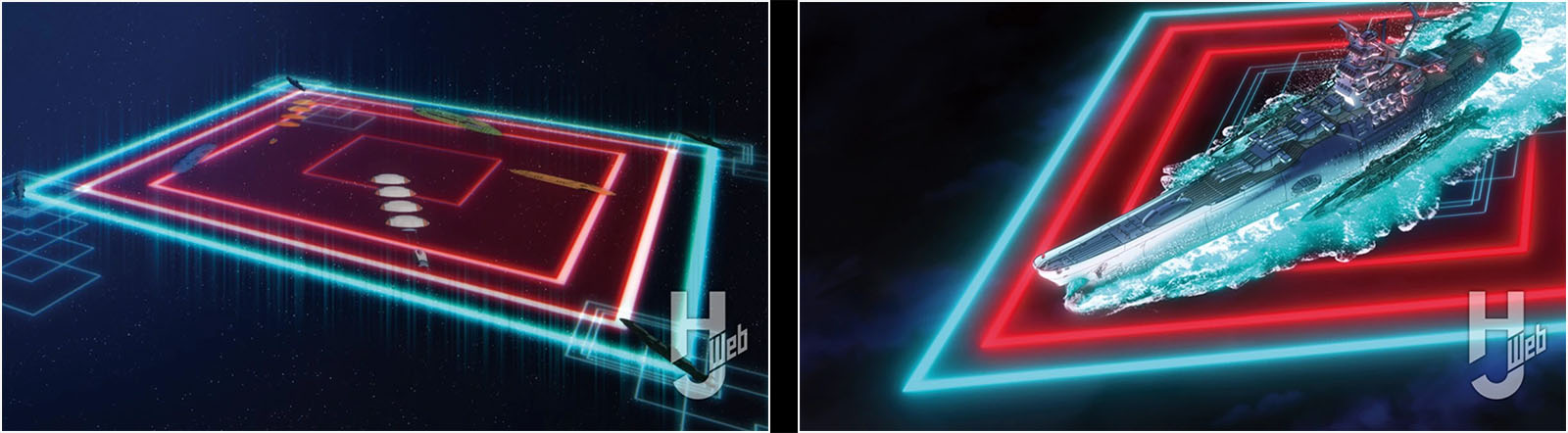
5. Multi-Dimensional Tremor Suppression Link
During the Gatlantis Campaign and the Iscandar Incident, four UX-class vessels were required, but improvements now allow operation with just two. They are being used for Yamato‘s exploration of the Gannell Nebula.
The Dimensional Submarine UX-01 was developed by Garmillas, possessing the ability to freely traverse between normal space (alpha space) and sub-space (beta space). However, development was fraught with difficulties. Initially, it could not surface from sub-space, and numerous prototypes went missing, earning it the nickname “coffin of another dimension.” After completion, its high stealth capabilities were greatly valued. It was initially operated as a special-purpose vessel under the direct command of President Dessler and was deployed in the Rainbow Star Cluster Sea Battle during the final stages of the Garmillas War.
Normal space and subspace are separated by a dimensional boundary. Subspace possesses a high-energy level and an unstable quantum energy field, making it denser than normal space. This boundary is maintained by the steady vibration of the extra dimension, known as a dimensional quake. The UX-01 temporarily lowers this vibration using a suppression wave resonance wave, locally opening the boundary. Consequently, energy from normal space is excited and drawn into the subspace quantum field, creating a reverse energy gradient phenomenon where energy flows from low to high energy. The ship “dives” along this gradient.
Conventional ships rapidly lose energy in subspace due to this phenomenon, eventually leading to engine shutdown. To avoid this problem, the UX-01 uses the Gesh-tam engine for normal space navigation and the Gesh-vual engine for subspace. The Gesh-vual engine confines energy and prevents its diffusion into subspace by placing the hull, which possesses normal space attributes, and the limited dimensional boundary surface at the subspace interface into a “topological insulating state.” This state insulates internally but allows conduction only at the surface (boundary). Additionally, it guides active wave resonance waves into multidimensional phase ballast tanks to generate wave energy fluid. By controlling the surrounding boundary strength through this fluid’s density, it adjusts submergence depth. Higher density strengthens the boundary surface, causing ascent, while lower density enables deeper submersion. However, exceeding the limit causes the energy containment to fail, leading to hull collapse.
The UX-class dimensional submersible was mass-produced, with four units confirmed deployed during the Gatlantis Campaign. Operating in groups, the UX-type also functioned as the core of the Multidimensional Suppression Link, transporting vessels lacking dimensional submersion capability into subspace. This system interferes with suppression wave resonance waves from multiple dimensional submersibles to form a steady-state field at the center, creating an environment equivalent to normal space within a virtual boundary layer.
Initially, maintaining the three-dimensional structure within the interference control field required at least four dimensional submersibles. By 2207, however, performance had improved, enabling two UX-type vessels to submerge and resurface with a 300-meter-class hull. However, due to the limited functional range of the interference control field, the dimensional submersible must approach the hull of the transport vessel as closely as possible (utilizing a TAG system employing gravity anchors).
Garmillas relocated to the Sagittarius Dwarf Galaxy and established the Galman-Garmillas Federation. Following their withdrawal from the Large Magellanic Cloud, where they lost many ships, and while reorganizing their forces, the formation of the dimensional submarine fleet was positioned as the core of their new strategy. The UX-type was reorganized as a fleet under the command of the Zerandal-class attack-type dimensional submarine, and construction and commissioning of ships of this type continues to this day.

Supreme Commander Sakurai’s Yamato Mecha Collection Challenge III
How many Mecha Collection models can you build in a month? (Earth Defense Force fleet edition)
We bring you the third installment of Leader Sakurai’s Mecha Collection challenge. This time, the Earth Defense Force fleet has been assembled from the Yamato Mecha Collection Special Box set sold by Premium Bandai. What’s more, the patrol ship was not made using a kit, but was reconstructed by transplanting various parts from the hull of a cruiser. “That makes you a worthy rival that I acknowledge, Sakurai-kun.” Please take a good look at this thoroughly-crafted fleet.
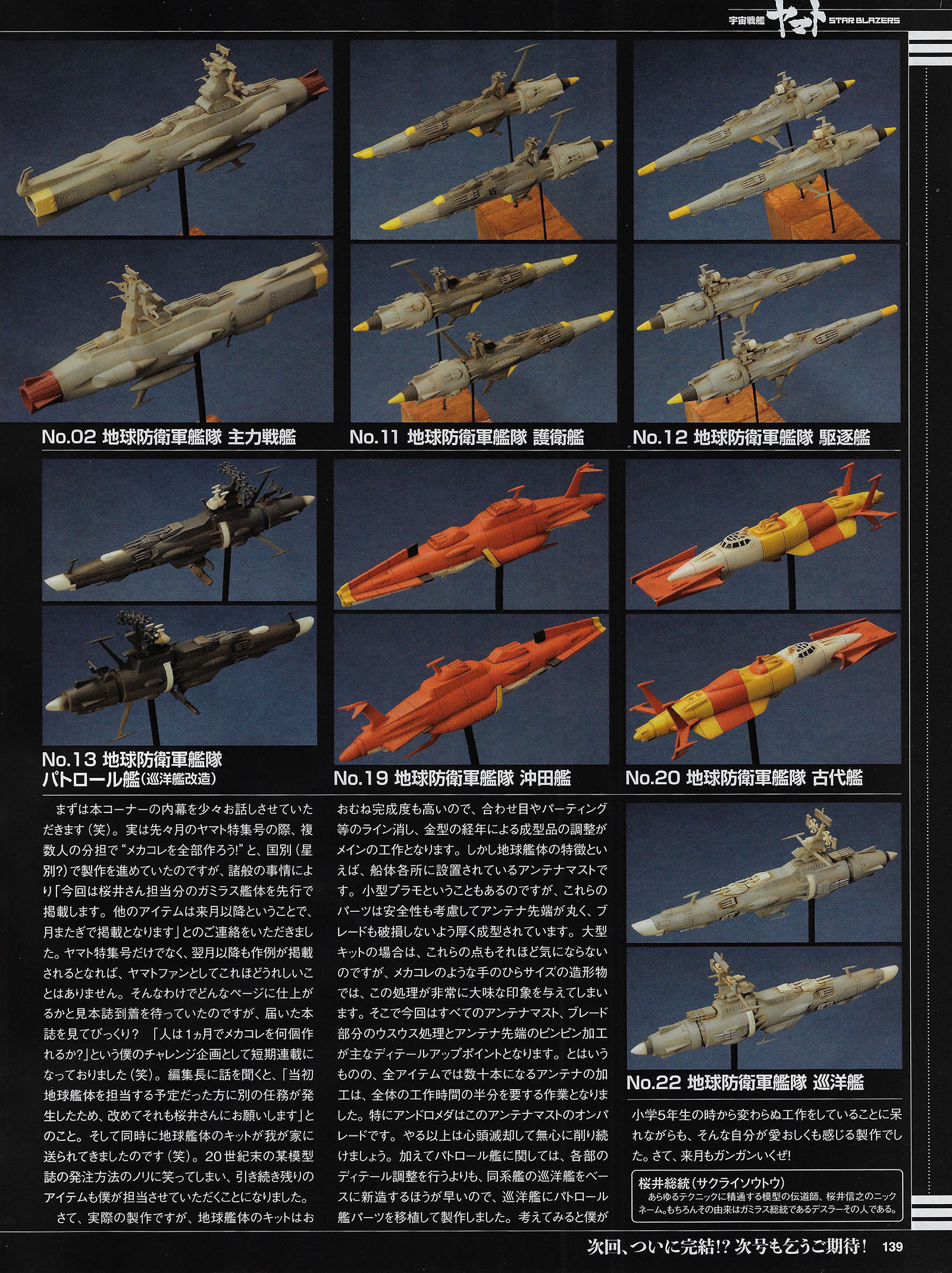
First, let me share a little behind-the-scenes info about this corner. (laughs) Actually, for the Yamato special issue two months ago, we had multiple people working together on “Let’s build the entire Mecha Collection!” organized by nation (or star system?). However, due to various circumstances, we received notice that “This time, we’ll publish the Gamilas hulls handled by Mr. Sakurai first. Other items will follow next month and beyond, so publication will span months.“
As a Yamato fan, nothing could make me happier than seeing my builds featured not just in the Yamato special issue, but also in subsequent months. So, I eagerly awaited the sample copy to see how the page would turn out. But when the actual magazine arrived, I was stunned. It had become a short-term serialized feature titled ”How Many Mecha Collection Kits Can One Build in a Month?” – my very own challenge project. (laugh)
When I asked the editor-in-chief about it, he explained, “The person originally assigned to handle the Earth-class ships had to take on another task, so we’ve asked you to handle that as well.” And at the same time, the Earth-class kits were sent to my home. I couldn’t help but laugh at the old-school model magazine ordering style reminiscent of the late 20th century, and it was decided that I would handle the remaining items as well.
Now, regarding the actual build: The Earth Ship kits are generally quite well-made, so the main work involves removing seam lines and parting lines, plus adjusting the molded parts due to aging. However, the defining feature of the Earth Ships is the antenna masts installed throughout the hull. Since it’s a small plastic model, these parts were molded with safety in mind. The antenna tips are rounded, and the blades are thick to prevent breakage. While these aspects aren’t as noticeable on larger kits, on palm-sized models like the Mecha Collection, this treatment gives a very crude impression.
Therefore, the main detail-up points this time is thinning all antenna masts and blade sections, and sharpening the antenna tips. That said, processing the dozens of antennas across all items ended up taking half the total work time. The Andromeda, in particular, is packed with these antenna masts. When you’re doing this, you just have to clear your mind and keep sanding away.
Additionally, for the patrol ships, rather than adjusting details on each individual ship, it was faster to build them from scratch using a cruiser of the same class as a base. So, I transplanted patrol ship parts onto a cruiser to build them. Thinking about it, it’s a bit mind-boggling that I’ve been doing the same kind of work since I was in fifth grade, but it was a build where I found myself fond of that very aspect of myself. Well then, next month, I’m going full throttle!
Supreme Commander Sakurai (Sakurai Soto)
The nickname of Nobuyuki Sakurai, the model-making evangelist proficient in every technique. Its origin, of course, is Dessler himself, the Supreme Commander of Gamilas.