
We thoroughly examine the performance of the ship that fought fiercely against Dezarium in Yamato 3199
This series explains the mechanics of battleships and other mecha appearing in the Space Battleship Yamato remake series, spanning from Yamato 2199 to REBEL 3199. Episode 13 features the Wave-Motion Experiment Ship Ginga [Galaxy], which also fought fiercely in 3199. Currently under Dezarium’s surveillance, we’ll explain this ship while anticipating its new exploits.
Explanation by Yuka Minagawa
See the original post at Hobby Japan Web here
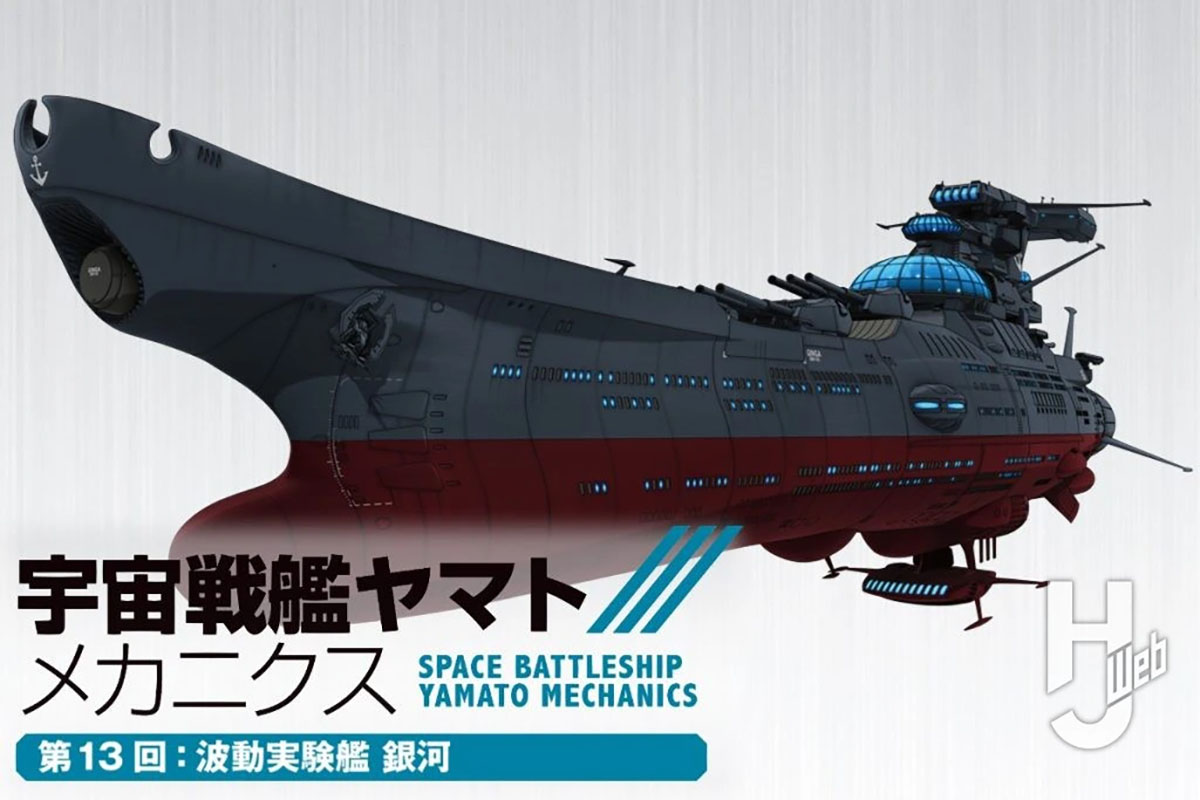
● Specifications & Performance
Ship Type: Wave-Motion Energy Research Ship
Identification Number: BBY-03
Overall Length: 333m
Aircraft Carried: Space Utility Transport SC97 Cosmo Seagull × 2
Carried Craft: Standard Internal Fireboat Type 5 × 2
(Aircraft and carried craft are as of October 2207)
● Artillery Weapons
(All are currently equipped but fundamentally unusable)
48-centimeter Triple Positron Shock Turrets × 3
Torpedo Tubes × 12 (Bow and Stern, Both Sides)
Torpedo tubes × 16 (both sides)
Concealed/Exposed Anti-Air System (various locations on hull)

Fire Control System
During lunar repair operations, magnetron probes were fired from the main guns to collect orbital debris. This led to speculation that the CRS detected the crew’s intent and locked the fire control system.
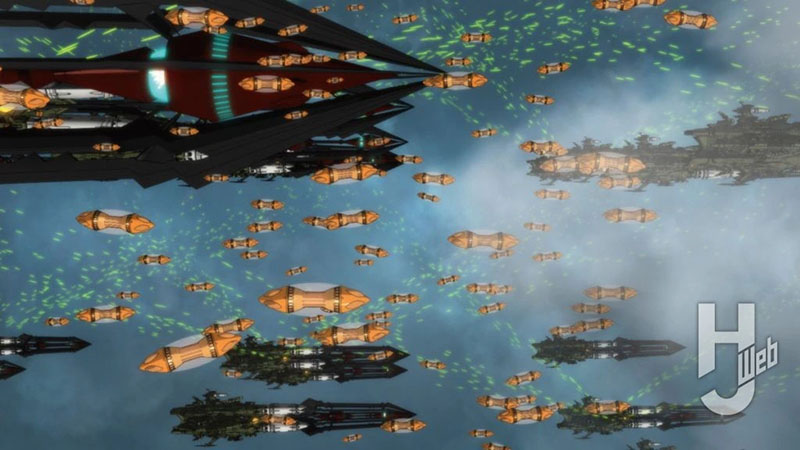
Operation Blackbird
The wave cores that propagated the suppressive wave resonance waves scattered on the Mars front were improved and mass-produced after the war. They were laid as wave resonance minefields throughout the solar system.
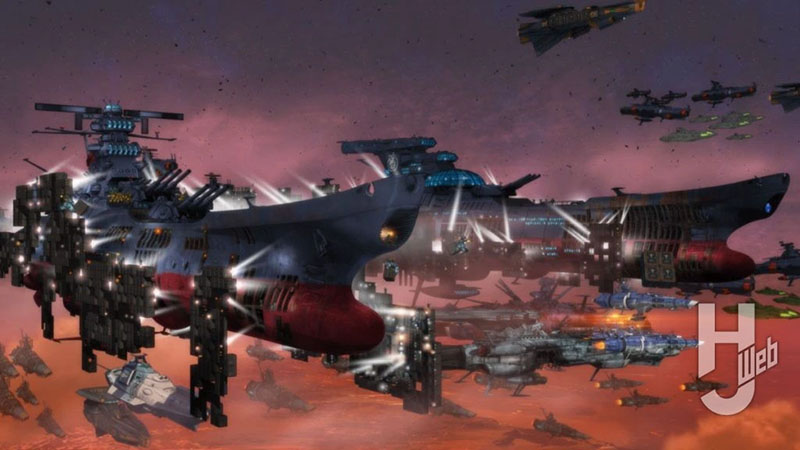
Providing Armaments for Yamato‘s Final Battle Specifications
Just before the final battle with Gatlantis, main armaments like the main guns were transferred from Ginga to Yamato, aiding its conversion to final battle specifications.
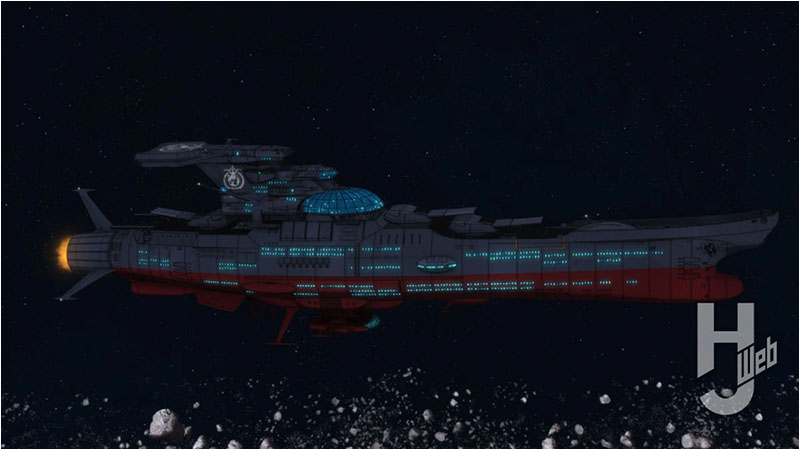
Formal Dress-Up
During the Gatlantis Campaign, like other vessels commissioned around the same time, Ginga extensively used emblems and decorative identification bands to demonstrate the power of the Wave-Motion Gun Fleet both internally and externally.
The Cosmo Reverse System (CRS) provided by Iscandar was designed to regenerate Earth’s environment, but its primary function was lost immediately after Yamato‘s return to Earth. However, Earth research institutions intended to study the CRS to expand dimensional wave theory through the structural manipulation of space and the control of wave energy, and to apply the technology.
Under this intention, construction of the wave experiment ship Ginga commenced. Since it was intended to relocate the CRS from Yamato and conduct various experiments, this vessel adopted Yamato‘s basic design and was designated the third Yamato-class ship.
Initially, the construction plan was led by First Space Captain Shiro Sanada. However, after the outbreak of the Gatlantis War, this ship was positioned as the core of the “G Plan” aimed at human survival and was completed within the time fault. It should be noted that while Yamato-class design plans suggest the existence of sister ships besides Ginga, details remain unknown (one theory posits that classified information was lost when the time fault was abandoned).
The hull design of this ship is common to Yamato, but the dome-shaped structure at its center houses dedicated research facilities. These are used for experiments amplifying the energy of the wave reactor core and developing new defensive fields utilizing dimensional interference.
Notably, it features a device called the “Wave Lens Deployment System.” This technology was conceived to spatially focus and expand wave energy, enabling energy transfer to specific areas and spatial interference. During Operation Blackbird on the Mars Front, the system emitted suppressive wave resonance waves that inhibited enemy ships’ excess dimensional deployment, inducing engine shutdowns.
Conversely, active wave resonance waves temporarily enhanced the fleet’s wave barrier deployment capability and contributed to amplifying Andromeda Kai‘s wave cannon output. However, excessive use during the final stages of the Gatlantis Campaign caused the Wave Lens Deployment System to malfunction, rendering it incapable of achieving its former performance levels.
During the Gatlantis War, this vessel was equipped with a command AI, intended to reduce manpower requirements and accelerate command execution. However, discrepancies between the AI’s tactical proposals and the on-site commander’s judgments became problematic. This led to Captain Saki Todo rejecting the AI’s proposals and seizing command authority. This incident was recorded as a significant command case during the Gatlantis War and greatly influenced the Defense Force’s AI operations after the war.
After the Gatlantis War concluded, Ginga utilized its CRS-derived advanced computational capabilities. Following support in the repair of the damaged moon, it became the core vessel of the repair fleet tasked with recovering and re-aggregating Saturn’s constituent materials in the Sea of Sorrows located in Saturn’s orbit.
Following the Dezarium invasion in October 2207, it headed for Earth as part of Operation DAD. However, it engaged the Dezarium fleet, crash-landed on the Third Valeras lunar surface, and remains stranded there.
The CRS also affected this ship’s control systems, disabling its fire control system. Although the main guns were confirmed to have been used during the engagement with Dezarium, one theory suggests this was due to First Lieutenant Megumi Kanzaki, then serving as Executive Officer, successfully establishing a symbiotic connection with the CRS.