
“Not Enough Content for Children”
Hideaki Anno and Takashi Yamazaki’s Concerns and the Future of Japanese Entertainment and Culture
Posted at Forbes Japan, December 24. See the original article here.
Fumiko Iwatsubo, Forbes Staff
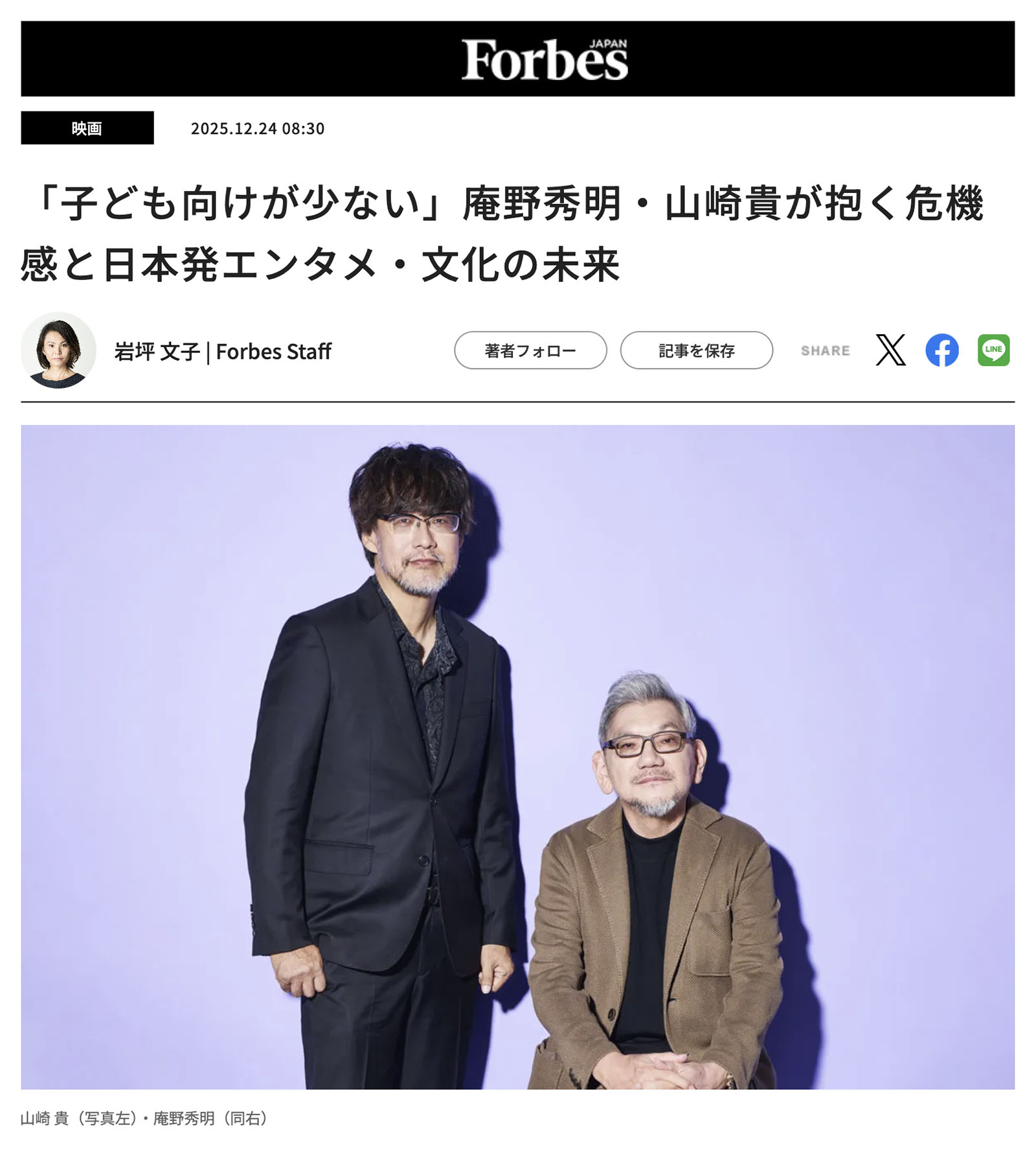
What is truly elevating Japan’s position in the world is its pop culture. In the Forbes Japan December 24th issue’s special report 2026 Total Forecast: 100 Questions to Understand the New Era, we asked two world-renowned directors at the forefront of Japanese IP about its future.
Interviewer: Overseas sales of Japanese content have tripled in the last 10 years, reaching 5.8 trillion yen in 2023, exceeding the export value of the semiconductor and steel industries. Also, with the spread of streaming services such as Netflix, what changes have you observed in the “delivery” and “creation” of content?
Hideaki Anno: The actual work hasn’t changed that much. Consciously, at least. The environment may have changed, though. I myself have never created works with an international audience in mind. I can only create things that are domestic. Film companies often immediately bring up the idea of “overseas,” but I’m not aiming for that. My basic approach is to focus on creating something that will be well-received and enjoyed in Japan, and if, by chance, people overseas enjoy it, that’s a bonus.
For Shin Evangelion: The Movie (released in 2021), I was the original creator, and we handled production, distribution, and promotion ourselves. I did this because I wanted to have complete control, to be able to take responsibility whether it was profitable or not, without anyone else interfering. Even when making that film, I wasn’t thinking about overseas audiences. I think Mr. Yamazaki is much more focused on that.
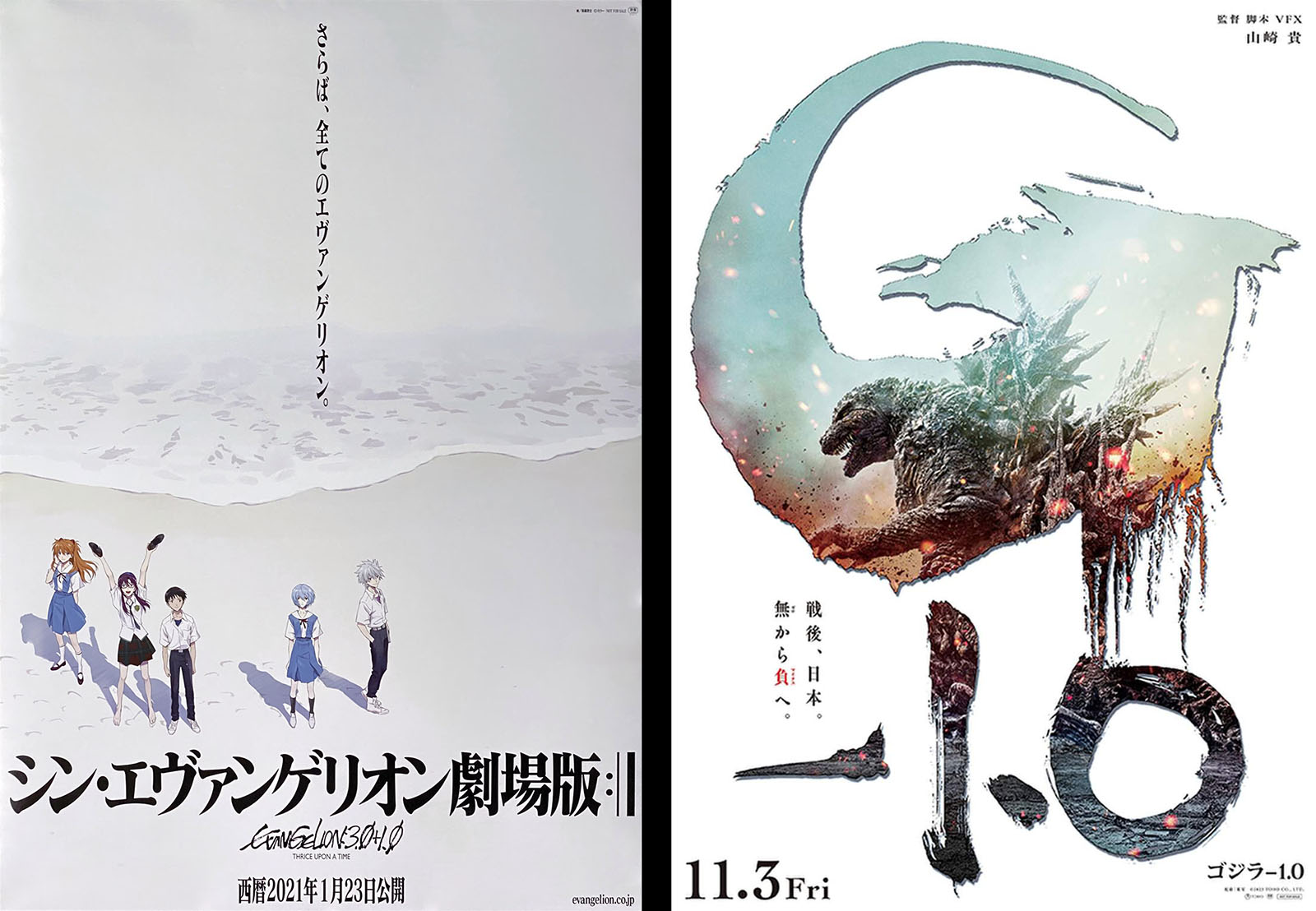
Takashi Yamazaki: When we were making Godzilla Minus One (released in 2023), I didn’t consider the international market at all. It was only when the film was nearing completion that Toho told me they would be distributing it internationally. But since they were going to use subtitles instead of dubbing, I initially thought, “They’re not serious about this.” However, during the Covid-19 pandemic, many people in North America were watching Japanese and Asian anime and dramas, and subtitles were considered cooler. It wasn’t so much that we did anything special, but rather that the times had changed, and the ground was fertile for acceptance. Breaking the record for the highest-grossing live-action Japanese film in the US was a huge surprise.
I think the greatest strength of a work aimed at an international audience is to completely disregard the international market and focus on being purely domestic. That’s how a work gains power. If you try to conform to global standards, there are probably many more skilled people in Hollywood. Instead, the strength of Japanese works released overseas lies in being unique, something a little strange but interesting. The biggest problem with Hollywood films lately is that they’ve become too formulaic, resulting in a lot of similar films. The question is how much we can create something truly domestic. Not in the sense of the content being Japanese, but something created with a Japanese sensibility. Isn’t that the most advantageous condition for us?
Anno: That’s right. At least for me, my thinking is in Japanese, and I can only manage basic greetings in English. Works created with Japanese thought processes are naturally difficult to understand without understanding Japanese. While visual media has fewer language barriers compared to other fields due to its visual and musical elements, the dialogue is still in Japanese, and the drama is driven by the emotions of people thinking in Japanese. While it might be accepted overseas by those who can understand it, we can’t adapt to them. I’m sorry, but the audience will have to adapt to us.
Games can be created with interactivity in mind, but visual media is one-way. The audience’s complaints don’t reach the creators. That’s just how it is. So, the creators have to trust their own judgment and believe, “This is interesting.” That’s why I think it’s fine to be domestically focused. Studio Ghibli also creates its works domestically, and I don’t think they consider the overseas market at all. They believe that can be handled later. I agree. Those who are focused on business can take the work, transform it into a product, and sell it.
One reason why Japanese works haven’t been successful overseas is that our marketing is poor. We’re trying, though. However, thanks to the many Korean and Chinese works that have gone overseas, the aversion to East Asian faces has decreased considerably. That’s a big deal. I think what Mr. Yamazaki said earlier is correct.
Yamazaki: Mr. Anno said, “The audience should adapt,” but I think the tuning has been completed in the last five or six years, not ten. That’s truly thanks to streaming and the works from China and Korea.
Anno: Even with the spread of streaming and subscription models, the production process hasn’t changed. In fact, it seems even more difficult with the increased number of projects, but the business model has changed. DVDs and other physical media are no longer selling well. In the industry, we call them “discs,” but instead of discs selling, streaming services are buying the content. The production costs are now recovered based on that premise. However, I think there are both advantages and disadvantages to this. If we rely entirely on streaming, it won’t become a “movement.” It won’t become a social phenomenon. Since people can watch it whenever they want individually, the shared experience is weak.
Yamazaki: I’m still committed to the theatrical experience for now. Streaming lacks that festive atmosphere. Recently, we’ve been trying to come up with creative ways to promote that festive feeling, but there’s still a sense that it’s just quickly consumed and forgotten. There’s not enough passion to warrant a theatrical release. I strive to create works that can be enjoyed 100% when people come to the theater. Part of it is simply because it’s more enjoyable, but I believe we need to create works that offer a true “experience” of watching on a big screen, otherwise, people won’t bother coming to the theater anymore. That’s the kind of work I think we need to create.
Anno: I think watching on smartphones and using subscription services are valid ways to enjoy films. After all, there are more people who don’t go to the movies than those who do. I think the ways of creating and distributing films will become more segmented in the future. However, even if you watch a movie on your smartphone, you won’t fully experience the enjoyment of a film, so I hope people will watch them in theaters if possible.
Yamazaki: When something like Demon Slayer becomes a hit, it’s really helpful. It’s frustrating, though. (Laughs) People who don’t usually go to the movies experience the fun of the theatrical experience and come back again. They realize that today’s theaters, compared to the past, have better sound systems and are really great places. When there’s a massive hit, it’s a moment when people realize that it’s completely different from watching on a smartphone. My films released after Ghibli films tend to be successful. I call it the “Ghibli slipstream”. (Laughs) When that kind of momentum is created, the entire industry benefits.
Interviewer: The Japanese government aims to boost the Japanese content industry, targeting 20 trillion yen in overseas sales by 2033. Japan is also one of the rare countries where domestic films hold more than half of the market share. What are your thoughts on the industry’s challenges and the role of government support?
Anno: I think what initially catches people’s attention is the money involved, like the fact that the export value is higher than that of steel, but I think it’s good that we’re focusing on the fact that we can disseminate Japanese culture to the world at a low cost, and I think the country should prioritize that. South Korea and China are doing it, and Hollywood originally did it, right?
Yamazaki: The perception of Americans among Japanese people changed drastically after the war, and that was clearly thanks to the dramas of that time. Watching American shows like Father Knows Best, people who had previously been told that Americans were “brutal and evil” suddenly thought, “Wow, Americans live such wonderful lives and are such nice people.”
I think South Korea’s national power has also increased significantly thanks to its content. Having people watch Japanese works and like Japanese people is equivalent to having them like Japanese products. It’s a powerful tool for making people like the country itself, and it requires relatively little investment. The government is finally starting to realize this.
Anno: It’s very cost-effective, and nobody gets hurt. As for the challenges, I think the biggest problem right now is the lack of animation for younger age groups, for children. There aren’t many good ones. When we were children, there was an abundance of them. Primetime was full of children’s programs. This includes anime, tokusatsu (special effects shows), and even educational science programs. I think our emotional development and other aspects were shaped by these programs.
The causes include the declining birthrate, but also the changing trends in television. It’s a complex problem. For a while, television became dominated by variety shows. Also, I’ll probably get criticized for saying this, but there aren’t many people who comprehensively summarize the history of anime, tokusatsu, and Japanese films and guide the industry. There are few insightful critics. Universities are finally starting to do this, and I’m focusing on archiving as one aspect of this. But I really wish the government would do it.
There are limits to what local governments and individual animation companies can do. By preserving materials and intermediate products of anime, tokusatsu, manga, and games, we can connect to the next generation. There will be discoveries and inspiration as people unravel how things were made. Ideally, the new generation will see it and think, “I want to create something like this too,” and we’ll continue to work toward that.
Also, tax credits are important. Taxes are quite high, after all. In terms of talent development, the apprenticeship system is largely collapsing now, so I’d be happy if we could receive support to help revive it. The industry is operating on a shoestring budget, so we can’t really afford to invest much money and effort in that area. We only manage to survive because of occasional hit films.
Yamazaki: In the industry, there’s a term called “tent pole,” referring to the supporting pillars of a tent. The film industry itself is constantly operating at a loss, but occasionally a blockbuster hit comes along to support it, and that’s how the industry manages to survive. It’s almost like gambling. When things are bad, they’re really bad.
Furthermore, this industry itself is actually supported by entertainment. But in Japan, there are schools that only teach art. In America, there are schools that teach entertainment, like California State University Long Beach, where Steven Spielberg graduated, and universities in New York that teach art, and they operate in tandem. But in Japan, teachers who teach art tend to look down on entertainment, considering it “commercial.” But that’s not how the industry will survive. I really hope they create schools that teach entertainment here in Japan. Not just about the works themselves, but also including design. If Japan doesn’t create such schools, I feel the industry itself will shrink.
Anno: It would be good to have them start from high school.
Yamazaki: That way, they would be immersed in entertainment, thoroughly exploring what’s interesting and what’s popular. Everyone gets on-the-job training in the field. If you’re hesitant, you’re thrown into the work. It’s fine if you have talent, but since the training involves digesting the work given to you, many people get left behind.
Anno: That’s right. Mr. Yamazaki, you should start a cram school. Yamazaki Cram School. In Matsumoto. With government funding.
Yamazaki: Uh, no, no, no. But I feel that many people who go to film schools inevitably end up focusing on art.
Interviewer: The topic of talent development came up, but looking back on your own careers, what kind of environment do you think fostered your growth the most? And do young people today have access to that kind of environment?
Anno: I’m from a rural area, so I had a great hunger for information. I had favorite works, and my basic information came from television, manga magazines, and collected manga, but even if I wanted to pursue it further, like wanting to watch the second episode of Space Battleship Yamato again, which I just watched, I couldn’t. We had to wait several years for reruns.
We had to be sitting in front of the TV when the broadcast started, so there was absolutely no time for club activities or anything like that. If we couldn’t make it home in time, we’d watch it at a friend’s house near the school. Because we thought it was a once-in-a-lifetime experience, the feeling of watching it was completely different. The effort required to obtain information was immense. That sense of longing fueled my energy as an otaku. I feel it’s directly connected to my motivation for things in general. It might be difficult to find that in Japan today, but I think there’s a possibility of finding such people overseas.
Yamazaki: I also experienced that hunger. There was a time when there were no videos or anything, and that experience is a very precious memory. Looking back, I might have been lucky to be born in the countryside, but it was tough back then. Movies would be released in Tokyo, and theaters would be packed, and information would be readily available, but in my hometown, it wouldn’t start for another month or so.
Anno: There was a time lag, and it would end quickly.
Yamazaki: At worst, it wouldn’t even come to our area.
Anno: The information gap between big cities like Tokyo and Osaka and the countryside was huge. In Tokyo, they were showing monster movies all night every week, and when I looked at Kinejun (a film magazine), there were ads for these showings, and I was so envious of Tokyo.
Yamazaki: In my case, I was into foreign films, so I was always thinking, “Why did I have to be born in Japan?” (Laughs) In Tokyo there were even cafes that showed foreign films that would never be shown in Japanese theaters. Anyway, I wanted to participate in filmmaking back then.
Also, when I was young, I wanted to work like I was possessed. In today’s terms, it was a self-imposed “black company” situation. Even when I was told to go home, I would stay at the company and secretly work. But I loved it, so I couldn’t help it. It might not be ideal according to today’s work standards, but there are times when sacrificing everything for work is important.
Anno: It’s difficult to put into words, but I think work-style reform is good. It’s not good to prevent people from working if they want to. I want to see reforms that cater to people who want to work.
Yamazaki: There are many instances where someone says, “I still want to work,” but then they’re told, “No, you’ll exceed the monthly overtime limit, so you can’t.” Ultimately, for people who love their work, it’s not just a job; it’s their most enjoyable time, the time they cherish most. I think this policy is taking away that most enjoyable time.
Anno: They have the energy, and that’s when they grow the most. The only way for animators to improve is by actually working. The growth potential up to age 30 is really about working hard and diligently. I don’t think society should forcibly cut short that period of growth. The Japanese working environment has been bad until now, so it’s good that it’s improving. But working styles aren’t uniform. I think we should be exploring the best approach. Right now, there’s no exploration. Once something is decided, that’s how it is. It’s good that an antithesis to the thesis emerges, but there’s no subsequent “synthesis.” I think we should be exploring a good compromise between the two.
Interviewer: In Hollywood, in 2023, the Writers Guild of America and the Screen Actors Guild went on strike over the appropriation of skills and image rights by generative AI. How do you view the impact of AI on the industry?
Anno: AI, like working styles, is a really difficult problem because people have completely different perspectives on it. However, since it already exists, I think we have to accept it and explore its possibilities. The problem with AI is that it’s too convenient as a tool. I think there will be fear that what you’re doing will be taken away in various ways. Probably, you wouldn’t be able to tell the difference between a script written by AI and one written by a human. Since humans are doing something similar to what AI does, perhaps it’s acceptable to have AI do human work.
As long as copyright exists, I think rules need to be established, but it should be used within the scope of what you can learn yourself. You can’t just do whatever you want. For example, if Toho trained an AI on footage from all the past Godzilla films and told it to create a new Godzilla film, no one would complain, right? Or rather, they couldn’t. It’s Toho’s copyright.
Yamazaki: I’d like to see that. What kind of Godzilla would it become?
Anno: I’d like to train the AI on things like the Godzilla films from the Toho Champion Festival (a film program that ran from 1969 to 1978) and see what kind of balance it comes up with.
Yamazaki: Godzilla, in particular, is a truly diverse piece of content, so it has an incredibly wide range of possibilities. I’d like to feed it everything and see what comes out. (Laughs)
When CG first appeared, the people working with miniatures said, “You’ve got to be kidding me!” They thought we were trying to make amazing things the easy way, that it was a cowardly trick, and it’s very similar to that situation now. But I have a hunch that good things won’t come so easily. The number of trial-and-error attempts will probably increase.
Even with CG, incredibly skilled people spend a lot of time refining things, and only then do we finally get something that everyone can see in reality. The shots that require a tremendous amount of effort are always the ones that get the best reviews. I call it “infused with resentment.” I think it requires that level of human effort, enough to be infused with resentment. But there’s also a fear of not knowing what will happen.
Anno: The one thing AI can’t manage, at least regarding visuals, is judgment. Through trial and error, I think it will eventually produce 300 or 400 patterns overnight, but the AI can’t choose which of those patterns is best. That’s the part that only humans can do. I think when AI evolves to the point where it can create all the visuals, only the producers and directors will remain. The people who fund the project and the people who can ultimately say, “This is good.” Only those two will remain.
Yamazaki: Only people who understand art can give good instructions, so judgment is exactly right. You can’t create a good work without good judgment from humans…or so I think (laughs).
Anno: If even the director becomes an AI, I’ll have to make a living as a producer. (Laughs) I think that’s quite difficult, but ultimately it comes down to “responsibility.” Both producers and directors are responsible for their work, so it’s just a matter of whether they can take responsibility for a work created by AI. If the audience were AI, there wouldn’t be a problem, but they’re human. Someone needs to take responsibility for the video content being viewed.
Even if AI does everything else, that one aspect will remain. As long as there are people involved, or rather, as long as there are viewers, there will always be a need for someone to take responsibility for the audience and for the investors.
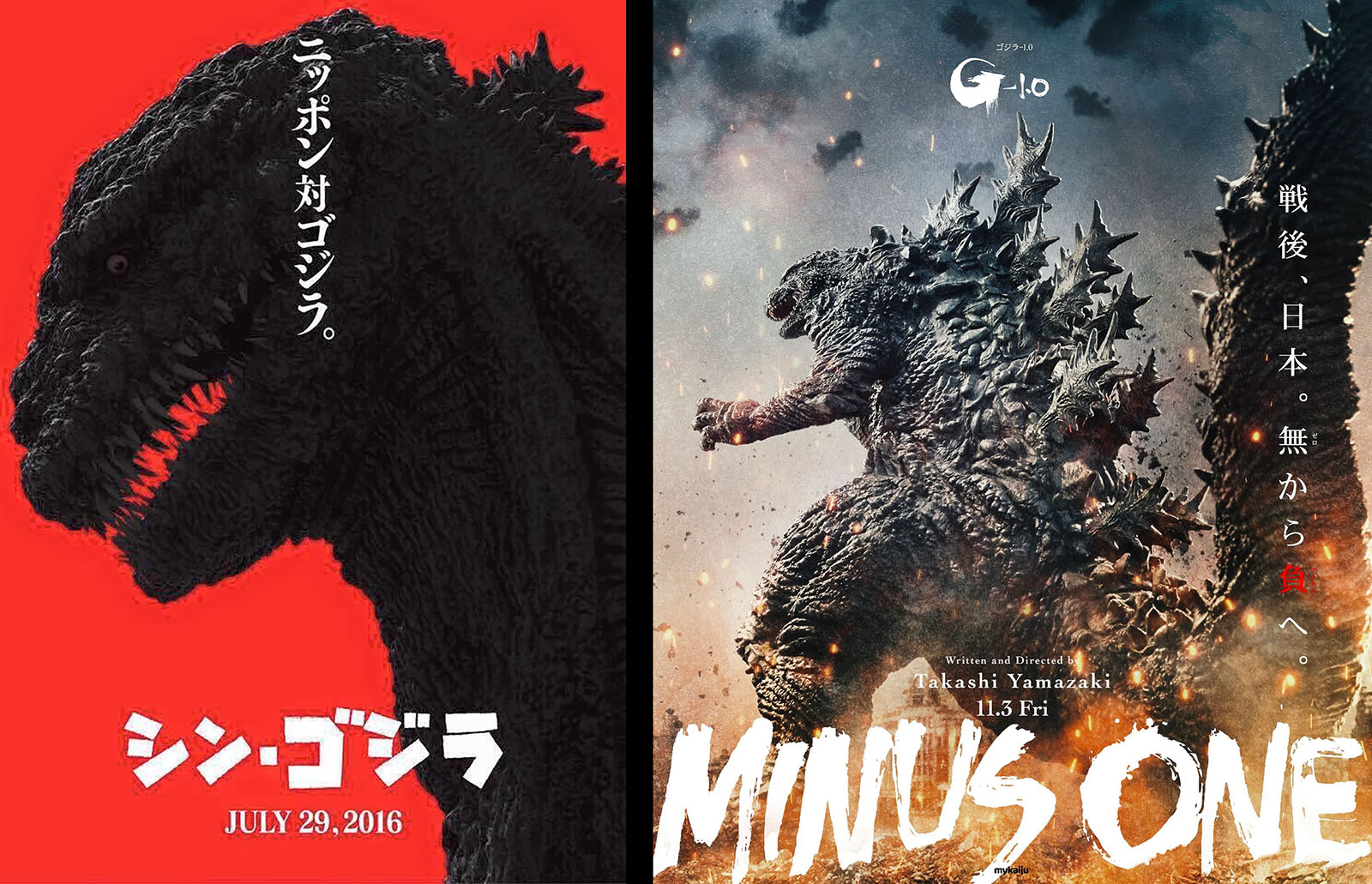
Interviewer: You two have often taken beloved legacy works, such as the Godzilla series, and reimagined them, finding new value in them. Could you tell us about the enjoyment and challenges of that process? Also, conversely, if you were to create a very minimalist work, what kind of work would you want to create?
Yamazaki: Mr. Anno is truly amazing because he works on both his own IP and that of others.
Anno: I’m grateful for that. Regarding other works, I feel like I’m simply inheriting what my predecessors created, what has become ingrained in our culture, and trying to pass it on. What I’m doing now is giving back and continuing the legacy of cultural works. I want to preserve works that should remain for many more decades.
Also, I think it’s good for the anime and film industries that such works continue to exist. I’m working on how to ensure they continue to be preserved. That’s something that’s not easily understood. Since I’m entrusted with other people’s IP, I’m simply working hard to ensure that the work takes shape both as a work of art and as a product, and that it becomes a legacy.
Yamazaki: That’s right. If we leave it as it is, it will disappear, so I hope that by creating new methods and new ways of presenting it, we can reach children and a wider audience, not just a select few. What I strongly believe is that I want today’s children to experience the same sense of excitement that we felt. If it’s a strong IP, we can do that.
At the same time, it’s incredibly daunting, because there are so many long-time fans, and getting them to accept it is very difficult and scary. But if we’re given that opportunity, of course we’ll do it. I want to tell my younger self, “You’re going to work on Godzilla!” Being involved with something I loved as a child is the greatest joy. And, if possible, I want to expand the project itself. Because it’s something of such value. I think that what excited me as a child will surely excite children in any era.
Anno: I want to avoid simply prolonging its life, but rather to truly reinvent it. I want to prove that it was something incredibly powerful to begin with. We felt that way when we were children, so we want to carry that on.
Yamazaki: I really like big projects. I want to create something that’s never been seen before. That’s the underlying motivation. And if it’s something that can be seen in theaters, it has to be spectacular. But there’s one story I’d like to do someday, about an old man who’s dying, and his dog. A really good story. I don’t have the time, and I probably won’t end up doing it, but…
Anno: Is the dog CG? Or a real dog?
Yamazaki: A real one.
Anno: It might not listen to you. (Laughs)
Yamazaki: That’s what’s good about it. It’ll listen better than a cat.
Anno: Well, better than a cat, yes.
Yamazaki: A movie that shows the reality of rescue dogs. Probably nobody would go to see it, though.
Anno: By the way, is Superman’s dog CG?
Yamazaki: No, they said they used a lot of live-action.
Anno: I thought so.
Yamazaki: They used CG too, but they apparently did a lot of research. The dog in the film was modeled after James Gunn’s dog. They filmed it on video, studying how to capture the kind of disobedient dog behavior they wanted to portray.
Anno: I see. Well, that dog was great.
Yamazaki: It’s practically a dog movie, isn’t it? But they’re going to market it with Supergirl from now on. The next film will be about what happens to Supergirl and the dog.
Anno: Hmm. As long as they have that dog, they’ll be fine. Super-Dog was great. There aren’t any proper figures of him, only some kind of cheap plush toys. If there were a proper figure, I would have wanted to buy it for the first time in a long time (laughs).
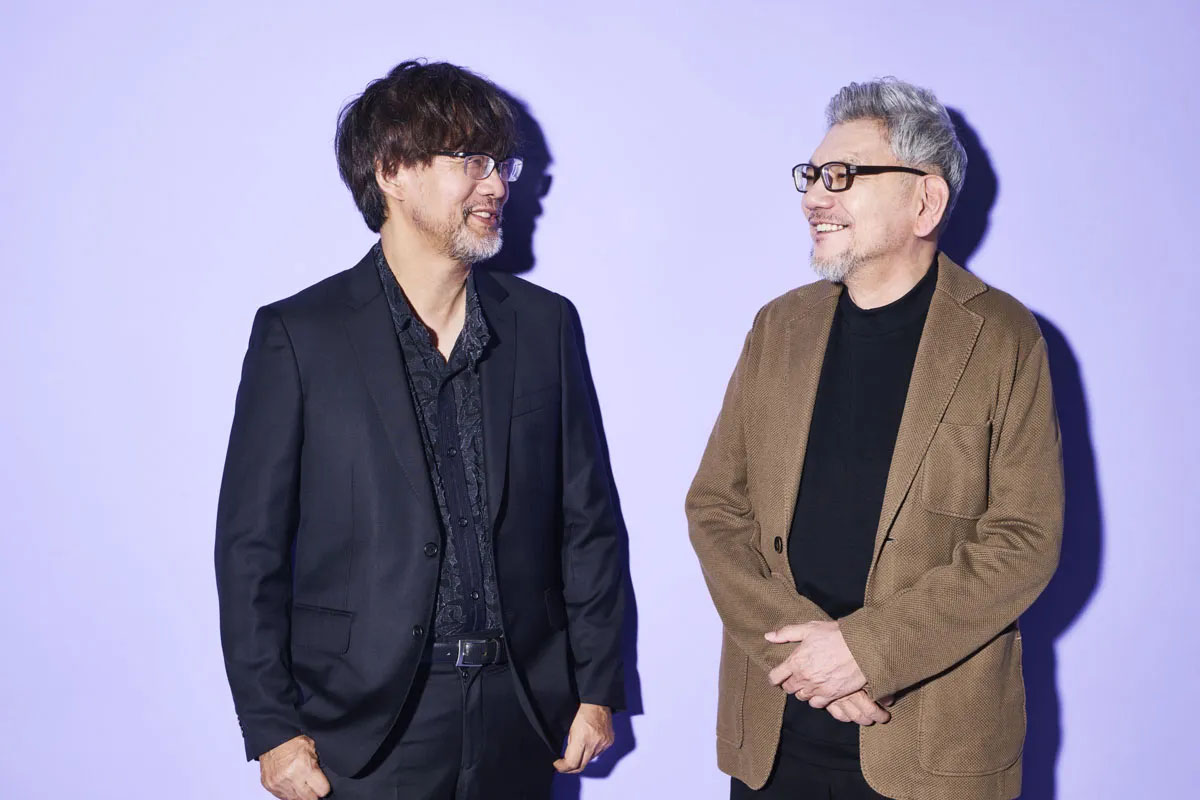
Hideaki Anno Profile
Director, producer. Born in 1960. From Ube City, Yamaguchi Prefecture. Representative Director of Studio Khara, and outside director of Production I.G. Made his directorial debut with Gunbuster in 1988. His representative work, the Evangelion series (1995-), which has passionate fans both domestically and internationally, celebrates its 30th anniversary this year. Its film box office revenue and related markets through media mix are said to be worth hundreds of billions of yen, making it a landmark in Japanese IP business. He received the Japan SF Grand Prize Special Award for Shin Godzilla (2016), the first Godzilla film produced in Japan in 12 years.
Takashi Yamazaki Profile
Film director, screenwriter, VFX producer. Born in 1964. From Matsumoto City, Nagano Prefecture. Belongs to Shirogumi, a comprehensive video production company. Made his directorial debut with Juvenile in 2000. Godzilla Minus One (2023) garnered attention both domestically and internationally for its high-quality VFX technology and human drama, and won the Academy Award® for Best Visual Effects at the 96th Academy Awards®, the first time an Asian film has received this award. Its final box office revenue in North America exceeded $56 million, setting a new record for the highest-grossing Japanese live-action film released in North America.