
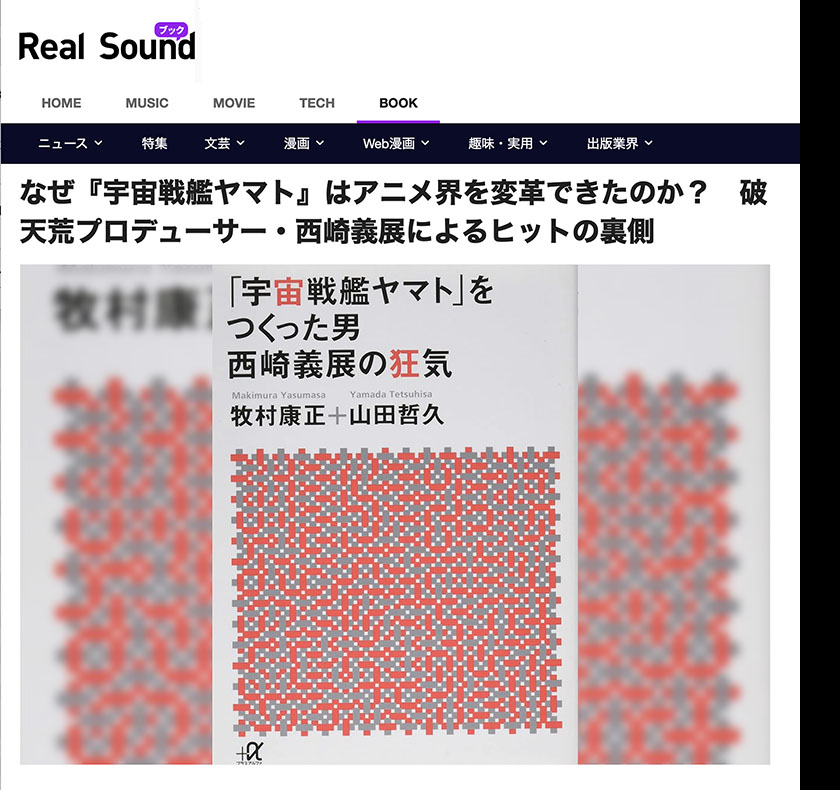
The Story Behind the Hit, Driven by Maverick Producer Yoshinobu Nishizaki
Text by Shigeru
Published at Realsound, October 13, 2026. See the original post here
The Resurgence of Yamato and the Impact on the “First Generation of Otaku”
There has been a renewed stir surrounding Space Battleship Yamato lately. It has been announced that Space Battleship Yamato √2199 is in production, with Hideaki Anno serving as director, planner, and executive producer, and Yutaka Izubuchi joining as co-director, along with a traveling exhibition titled “Space Battleship Yamato: The Complete Records Exhibition,” also planned and produced by Anno. The exhibition is set to reopen in December 2026 at the Marui department store in Kita-Senju, Tokyo, before moving on to the Yamato Museum in Kure, Hiroshima, the very site where the battleship Yamato was originally built.
In my personal view, Space Battleship Yamato is a rare work that leaves a vastly different impression depending on the generation of the viewer. For those in the so-called “Yamato Generation”, people who watched the series in real-time, likely around their middle school years, the show was an earth-shattering experience. Conversely, for those of us from later generations, the initial impact of the original Yamato can be somewhat difficult to grasp. Compared to Mobile Suit Gundam, another sci-fi anime from the 1970s that has maintained long-lasting popularity and whose appeal is quite easy to understand, Yamato is perhaps a work whose brilliance is harder to fully appreciate when encountered for the first time today.
As is often the case with truly groundbreaking works, the elements that were once revolutionary in Yamato have likely permeated countless subsequent titles, eventually becoming universal conventions. Nowadays, it is standard practice to produce anime that resonates with middle and high school students, and even older audiences, just as it is common for accurate scale models of the mecha featured in these shows to be released. In an era where “serious sci-fi anime” that appeals to teenagers is no longer a rarity, it is difficult to truly recapture the shock and impact that such works once delivered.
Then there is the question of themes and the spirit of the times. The notion of a “space battleship venturing into the vast cosmos to fight for the sake of humanity” might strike a modern viewer as somewhat grandiose or overblown. Yet, at the time, the very act of presenting such a grand, sweeping theme, a space battleship fighting for all of humanity, with complete, earnest sincerity must have felt remarkably fresh. In an era when anime was dismissed as mere “TV manga” for children, tackling such lofty, serious themes was, in itself, a radical innovation.
While works containing profound themes capable of impressing adults may have existed within the realm of children’s entertainment back then, Space Battleship Yamato took a different approach: it brought its core themes to the forefront, clear enough for middle and high schoolers to grasp, and embellished them with compelling mecha, characters, and world-building. By treating these grand, mature themes with such earnestness and on such a large scale, Yamato transformed the Japanese anime industry and, in turn, gave rise to the “first generation” of otaku. It is, without a doubt, a monumental work.
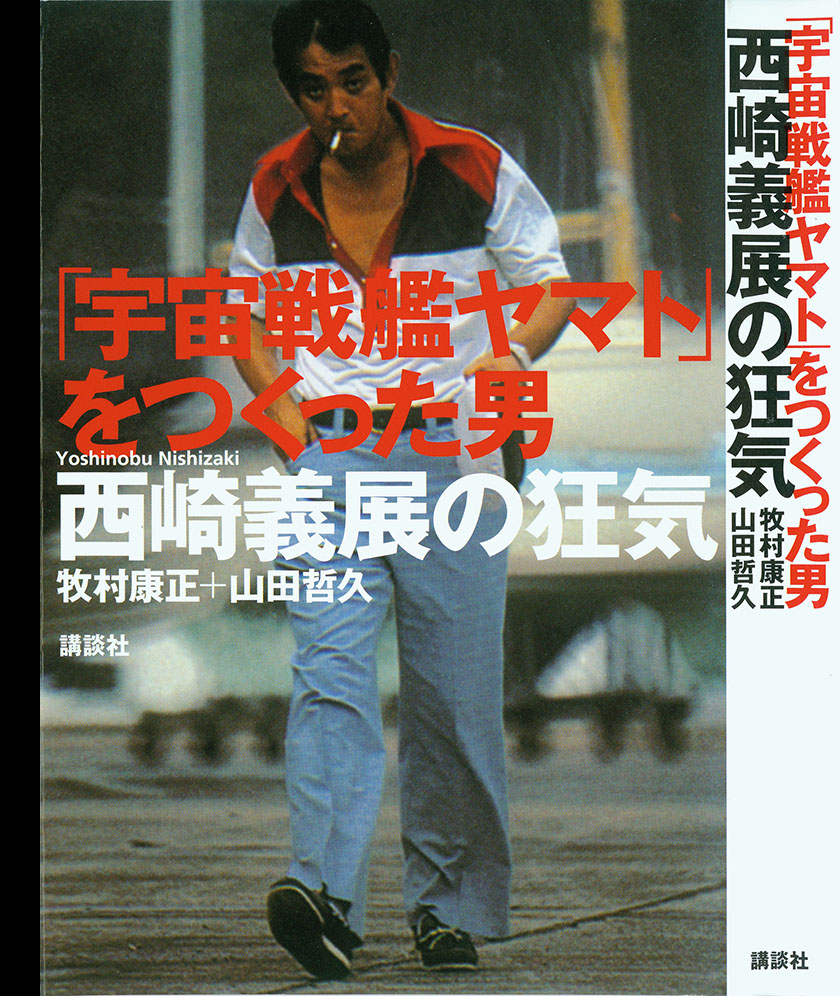
2015 edition
The Truth About an Unconventional Independent Producer
As is well known, the person who brought Yamato into existence did not originally come from the anime industry. To begin with, he was not even affiliated with any established organization. Yoshinobu Nishizaki, the man in question, had worked as an entertainment producer, managing acts like singers, long before he broke into the anime industry. A detailed account of his life can be found in the 2015 book, The Man Who Created Space Battleship Yamato: The Madness of Yoshinobu Nishizaki. With interest in Yamato surging once again, this book serves as an essential resource for understanding the origins of the series.
The portrait of Nishizaki presented in the book can only be described as staggering. Standing nearly 180 centimeters tall and always impeccably dressed in a suit, he possessed the handsome features of a man who had once aspired to be an actor. He was deeply embedded in the world of show business, with ties to the criminal underworld, and was a man of extreme contradictions: he could be recklessly extravagant with money, yet would haggle with relentless tenacity. He was profoundly suspicious of others and notoriously lecherous.
Despite amassing a vast fortune through the production of Yamato, he ended up buried in massive debt and served time in prison for the possession of narcotics and firearms. Ultimately, he met his end off the coast of Chichijima in the Ogasawara Islands, falling from a boat into the sea. To call him “unconventional” would be a gross understatement. he was a man of utter chaos.
In truth, the role of an independent producer is not something an ordinary person could handle. It requires an individual, relying solely on their own personal capacity rather than the backing of an organization, to assemble the massive capital and staff needed to create a work, and to oversee the entire process until completion. It is a high-stakes gamble: a hit brings paradise, while a failure leads to hell.
Especially during the latter part of the Showa era, a time when society was still somewhat rough around the edges, this profession was akin to that of a high-stakes speculator or a swashbuckling opportunist. The Man Who Created Space Battleship Yamato reveals that the work in question required an extraordinary level of thick-skinned audacity, an enigmatic personal charm, immense fortitude, and sheer, unadulterated guts, qualities that Nishizaki possessed in abundance.
The anecdotes about Nishizaki recounted in this book are, to put it mildly, intense. they leave the reader thinking, “Working with a man like this would, no joke, literally kill you.” Yet, at the same time, Nishizaki was clearly a man driven by grand romantic ideals. He would earnestly ask others, “Could you die for the person you love?” while simultaneously pushing his animators to capture the image of a space battleship traversing the vast cosmos, pouring every ounce of his energy into realizing his vision.
And yet, the very man who posed that question, “Could you die for the person you love?” maintained a multitude of mistresses. It is precisely because he could fully immerse himself in his own romantic vision, while simultaneously embodying such a glaring contradiction, that he was able to complete a work as unprecedented and monumental as Yamato.
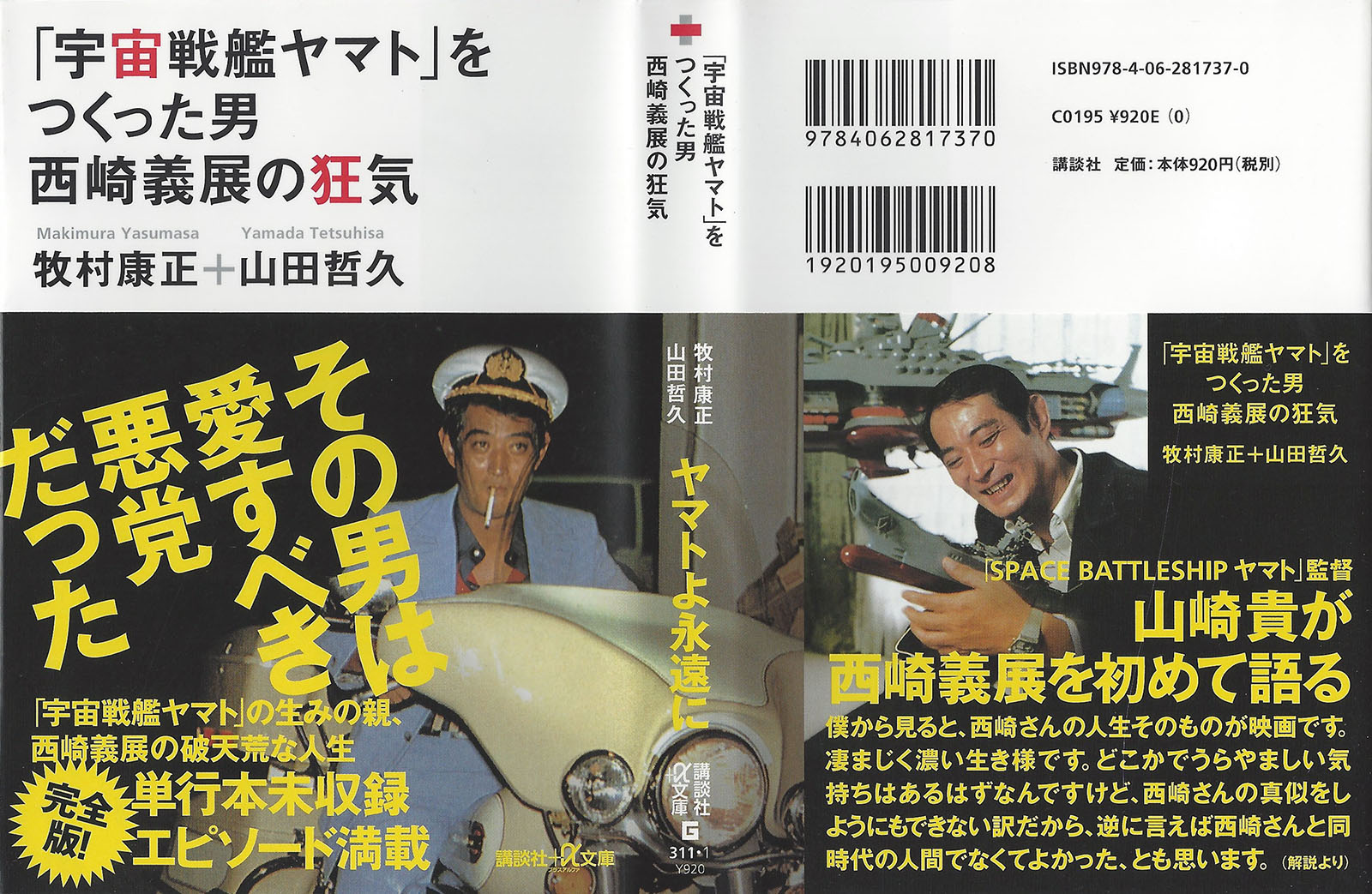
2017 edition
Innovative Promotion That Foreshadowed Modern “Otaku” Business
Nishizaki was, in every sense, an extraordinary individual, though one must read this book to truly grasp the extent of his brilliance. Another notable aspect of Space Battleship Yamato is the remarkably sophisticated promotional strategy employed by Nishizaki and his team.
As is well known, the original television series struggled with low viewership ratings. Yet, it struck a deep chord with middle and high school students across the country, leading to the formation of numerous fan clubs and a surge in popularity through reruns. Capitalizing on this momentum, Nishizaki moved to release a theatrical version of Yamato two years after the initial broadcast.
The book details the various promotional tactics used for this theatrical release, which was a re-edited version of the television series. There was the “Poster Operation,” where fans were given two posters each, one to keep for themselves, and one to display in a prominent public location. There was the “Request Operation,” in which fans were encouraged to send postcards to music programs requesting the Yamato opening and ending themes, ensuring the songs were played repeatedly.
There was also the “Giveaway Operation,” which included distributing original animation cels to the first arrivals at theaters and gifting soundtrack records to early attendees. Furthermore, Nishizaki explored every conceivable avenue, from publishing lavish books containing production materials to developing a wide range of merchandise.
Tactics such as distributing theater-exclusive perks, engaging fan clubs in promotional efforts, and releasing products tailored to enthusiasts have all persisted into the present day. For the youth of that era, the concept of an animated film that they could be truly passionate about, and one in which they could actively participate to build excitement, was entirely unprecedented. Being drawn into these promotional campaigns must have been an exhilarating, novel experience, one that might be difficult for us to fully comprehend today.
In other words, Nishizaki was not merely a consumer of the work. he was the architect of a form of fan engagement, what we might call “oshi-katsu” (supporting one’s favorite character or series) today, that actively bolsters the work itself.
Nishizaki himself was not an “otaku” with niche, obsessive interests. to put it bluntly, he could be described as a philistine, even a scoundrel. Yet, precisely because he was a strong-willed, independent producer who refused to conform to the conventions of the existing anime industry, insisting instead on realizing his own vision exactly as he pleased, he was undoubtedly able to lay the groundwork for the kind of “otaku consumption” we see today.
The Man Who Created Space Battleship Yamato serves as an essential resource for tracing the roots of the “otaku consumption” and the “oshi-katsu” economic activities that have now spread throughout Japan.
Read a chapter from the book here