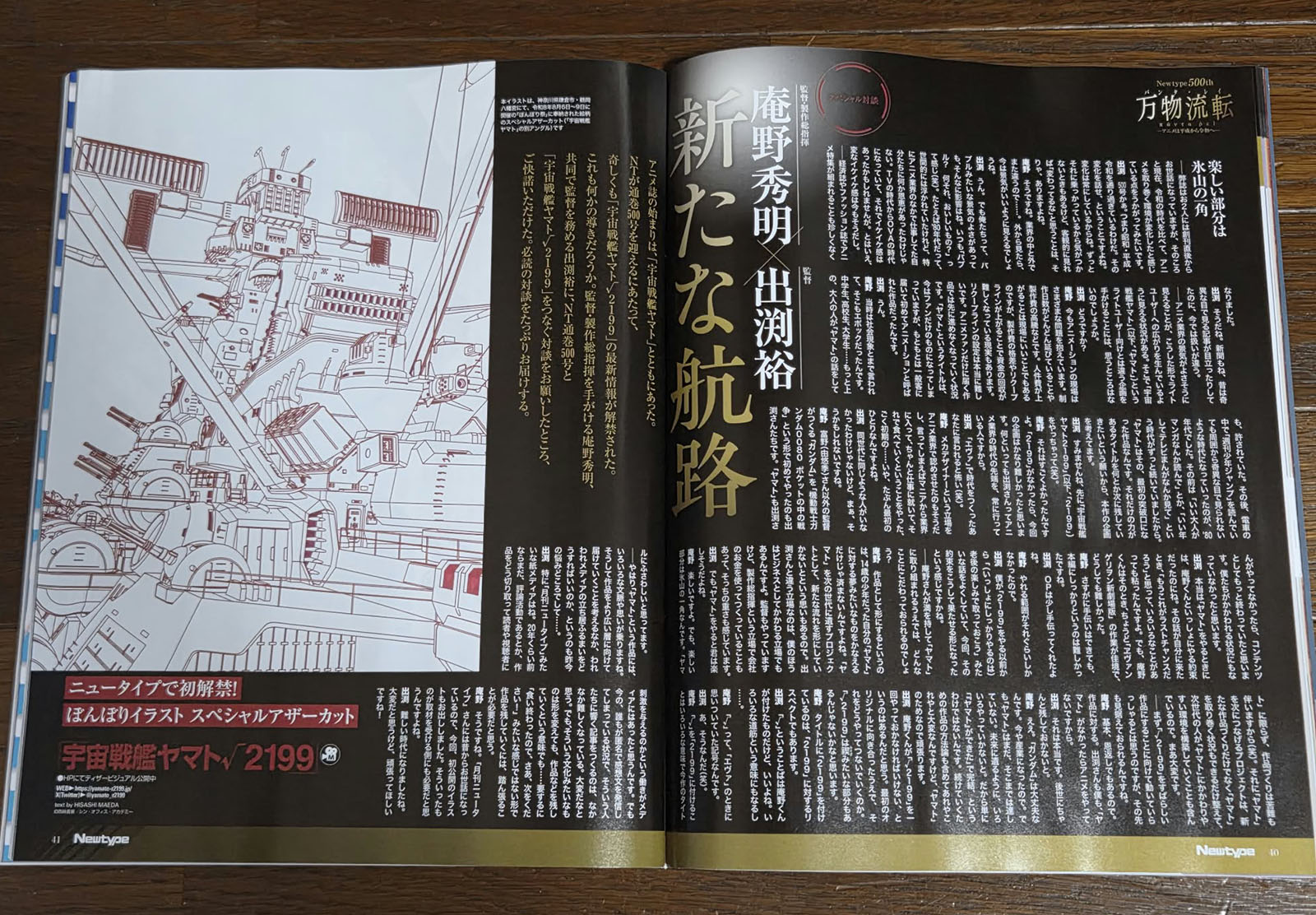
Hideaki Anno X Yutaka Izubuchi
NEW ROUTE
The origins of anime magazines can be traced back to Space Battleship Yamato. As NewType reaches its 500th issue, the latest information on Space Battleship Yamato √2199 has coincidentally just been released. Is this also some kind of guidance? Hideaki Anno, who is in charge of directing and executive producing, Yutaka Izubuchi, who is co-directing the film, and NewType issue number 500; when we asked them for a conversation that connects with Space Battleship Yamato √2199, they kindly agreed. Here we deliver a must-read interview in full.
Interview by Hisashi Maeda
Cooperation: Shin Office Academy
The fun part is just the tip of the iceberg
Interviewer: Our magazine has been indebted to you both since shortly after its founding. Comparing the environment surrounding anime from back then to now, in the Reiwa era, what aspects do you feel have changed?
Izubuchi: Number 500, huh? That means it’s gone through the Showa, Heisei, and Reiwa eras. I guess the question is, what were those changes? Change is always happening. Sometimes you don’t notice it because you’re always riding the wave of change, but if you look at it objectively, you’ll definitely notice that things have changed.
Anno: That’s right. Things are different inside and outside the industry. From the outside, it probably looks like the economy is doing well right now.
Izubuchi: Yeah. But even when we have a booming economy like the bubble, it doesn’t really affect us that much. We’re always like, “bubble? What’s that? Does it taste good?” (Laughs) For example, in the 80s, the world was excited, but it didn’t particularly benefit those of us working in the anime industry. It was the era of OVAa instead of TV, so there might’ve been a sense of excitement. But even so, there’s still that strange sense of excitement now.
Interviewer: We’ve reached a time when it’s not uncommon for business magazines and fashion magazines to feature anime.
Izubuchi: that’s right. In the past, newspapers tended to feature articles that viewed things with a skeptical eye, but now they treat them differently.
Interviewer: The anime industry appears to be thriving, which seems to be contributing to this expansion into casual audiences. Given this situation, do you have any thoughts on working on a project like Space Battleship Yamato, which is not aimed at casual audiences?
Anno: the animation industry is still facing various problems. These include the fact that production days are getting longer and longer, and production costs are soaring. While rising labor costs are good for the production side, there is also the reality that disparities in production cost and rising recoup lines are making it difficult to recover investments.
Setting a recoup line is really difficult. We’re stuck in a situation where we can’t move forward with a work that only appeals to anime fans. The title Yamato has now become something only fans possess, but originally it was a work that reached a general audience and was the first to be called anime.
Izubuchi: Yeah.
Anno: Back then it was even called a social phenomenon, so that was a pivotal moment. Middle school students, high school students, university students, and even older adults could talk about Yamato and it was acceptable. The 1980s were a time when reading Shonen Jump on the train wouldn’t draw strange looks from those around you. Before that, it was a long-standing era where people would say things like, “Why would a grown-up read manga?” Or “why would someone of that age watch TV manga?” Yamato was the first work to break through that barrier. We are planning this project with the desire to somehow preserve a title with that kind of power.
Izubuchi: sorry, I did Yamato 2199 first. (Laughs)
Anno: that was really great. If it wasn’t for 2199, this project would have been quite difficult. After all, you’re someone who is always at the forefront of the anime industry.
Izubuchi: It’s scary to hear that from you, who created an era with Evangelion. (Laugh)
Anno: you were instrumental in establishing the anime industry’s recognition of your position as a mecha designer. To put it simply, you were one of the very first people, or perhaps even the very first, to enter the industry as a fan, get a proper job, and make a living from it.
Izubuchi: There were people similar to me among my generation, but I guess that might be true.
Anno: It was you and your team who first created a Gundam series directed by someone other than Yoshiyuki Tomino, in the form of Gundam 0080: War in the Pocket. And you also directed Yamato. If you hadn’t done it, I think the content would’ve been a failure. I don’t think I would’ve been in a position to be involved, either.
Izubuchi: Actually, when we were going to do 2199, we had an agreement that I would work with Anno. When the offer came to me, I thought, “this must be my last chance,” so I persevered through various obstacles. But at the time, Anno was in the final stages of working on his Evangelion movie, so it was simply too hard for him.
Anno: I could help out, but it was difficult to contribute to the main story.
Izubuchi: You helped out a little with the opening, title sequence, didn’t you?
Anno: That was about the extent of what I could do.
Izubuchi: before I started working on 2199, I thought, “to work together properly, I’ll save it for my retirement years.” We often talked about that, and this is how I was able to fulfill my promise. That’s about it, I guess.
Interviewer: As you take on Yamato, after much preparation, what are some of the things you’re particularly focused on?
Anno: Bringing it to life as a movie isn’t just about fulfilling the dream I had for Yamato when I was a 14-year-old boy. I also feel that it’s a project to leave Yamato for the next generation, and that we need to create a new direction for it. What sets me apart from Izubuchi is that I’m also involved from a business perspective. I’m directing, but I’m also executive producer, so I’m using company money to make it, and I feel the weight of that responsibility as well.
Izubuchi: If you were just working on Yamato, you’d probably enjoy it.
Anno: It’s fun. But the fun part is just the tip of the iceberg. Creating a work of art, not just Yamato, is always accompanied by difficulties. Moreover, the project to carry on Yamato involves not only creating a new work, but also improving the surrounding circumstances as much as possible, and building an environment where the next generation can easily get involved with Yamato. So it’s quite a challenge.
Interviewer: I imagine you’re working toward making √2199 a great work, but you’re also looking beyond that, aren’t you?
Anno: Basically, it’s also a way of giving back. Regarding the work itself, neither Izubuchi nor I would be working in anime if it weren’t for Yamato.
Izubuchi: That’s true. We have to make sure to leave a record for future generations.
Anno: Yes. Gundam is doing fine. It has become an industry now. But Yamato hasn’t reached that point yet. We have to do a lot of things so that it will endure into the future. So it’s not simply a matter of “Yamato is finished” and that’s the end of it. There are a lot of challenges, including the methodology for continuing the work, but we will do our best for Yamato.
Izubuchi: I think Anno felt that he had to do √2199 at least once. He had to face the original work and then figure out how to connect it to the next one.
Interviewer: It seems this has the element of a purification ritual.
Anno: The reason we put “√” [Root] in the title is also a sign of respect for 2199.
Izubuchi: The term root was coined by Anno. It’s good, isn’t it? It can also mean various paths.
Anno: “√” is a symbol I came up with when I was working on Evangelion.
Izubuchi: Oh, really? (Laughs)
Anno: I think adding it to 2199 is fitting for this film’s title in many ways.
Interviewer: Indeed, Yamato is imbued with a variety of contexts and emotions. And in doing so, the work will reach a wider audience.
Anno: As we consider how to deliver it, we’re concerned about the conduct of the media. What should we do? That’s a question that’s been raised recently.
Interviewer: That’s the problem.
Izubuchi: Basically, about 20 years ago, paper media like NewType was still a critical point of activity for how to present a work to readers and viewers. The media used to have a role in providing stimulation. But now, with everyone anonymously posting their opinions, it’s becoming increasingly difficult to create articles that resonate with people. I think it’s tough. But even if that kind of culture changes form, it will still leave things to posterity. In short, I think it takes perseverance to leave behind a work that isn’t just, “I finished eating this, now give me the next one!”
Anno: That’s right. I’ve been indebted to NewType for a long time, so I offered a never-before-seen illustration here. I think that kind of thing is necessary for those being interviewed as well.
Izubuchi: These are difficult times, aren’t they?
Interviewer: I know it must be tough, but I hope you’ll do your best!
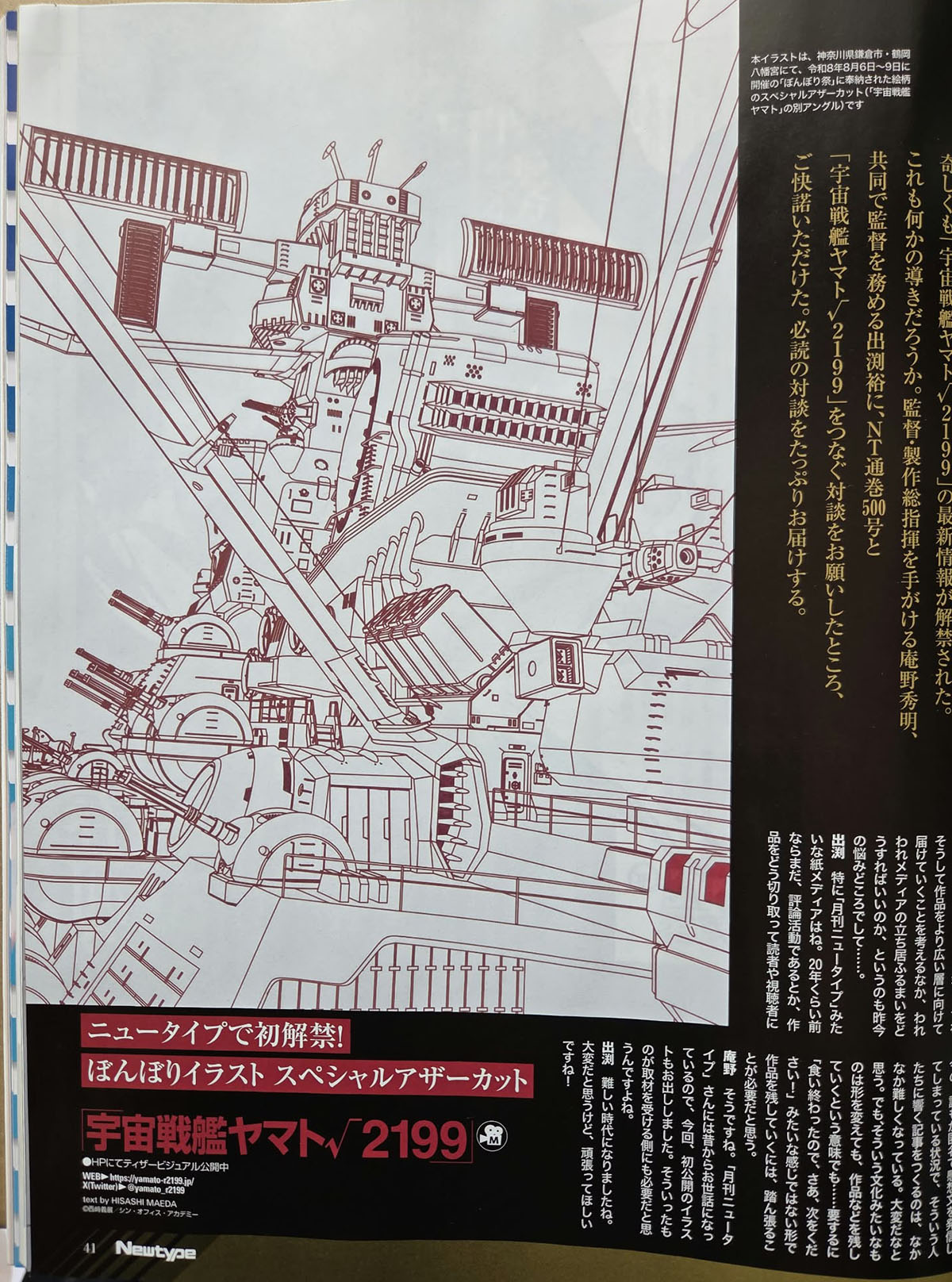
Revealed for the first time in NewType!
Bonbori illustration special alternate cut
This illustration is a special alternate version (nother angle of Yamato) of the artwork created for the Bonbori Festival held at Asaoka Hachimangu Shrine in Kamakura City, Kanagawa Prefecture, from August 6-9, 2026.
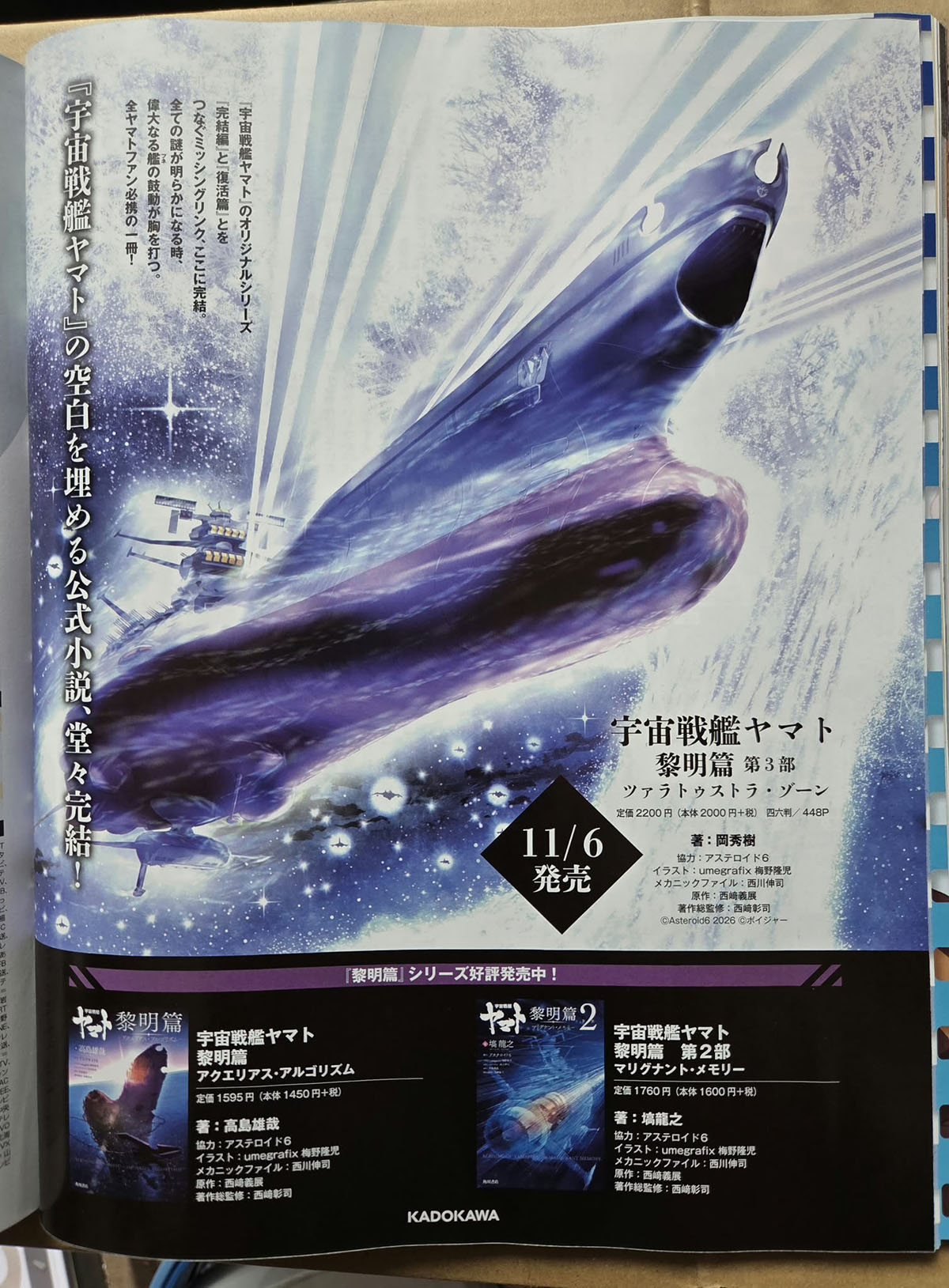
Also found in this issue: full-page ad for the third Dawn Chapter novel, “Zarathustra Zone.”