
What has Space Battleship Yamato been trying to depict? Something I finally realized after 50 years
See the original post here
About the author:
Located in Hachioji, Tokyo. We want to give a boost to shy people! It’s a welcoming spot for those who want to work on their conversation skills or for online streamers!
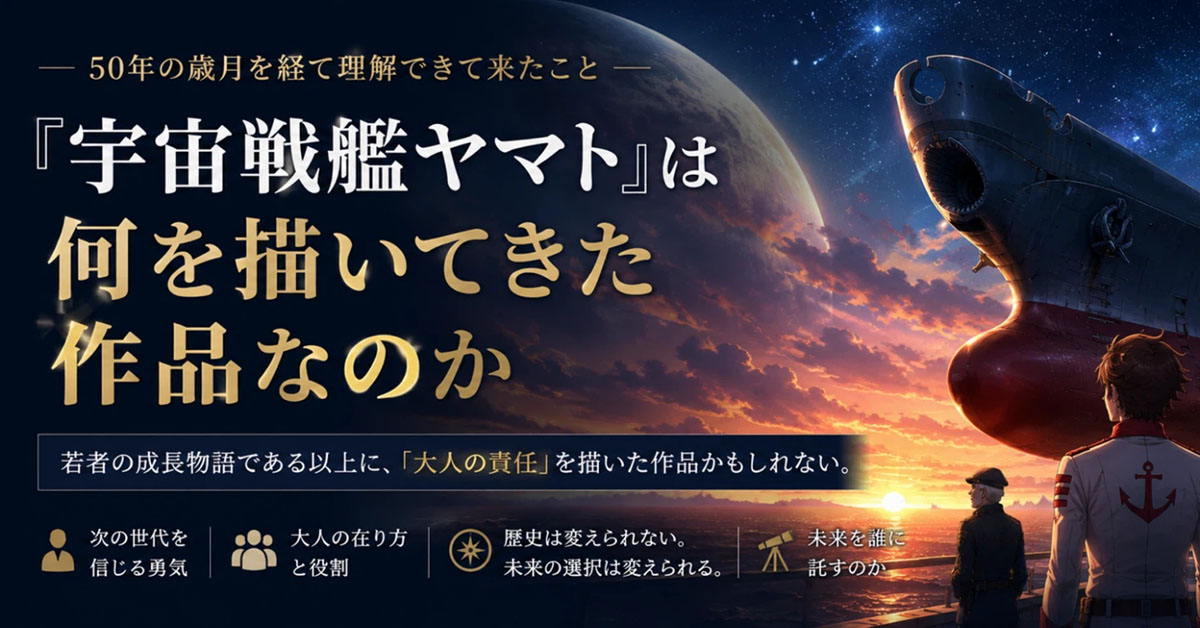
I’ve now become older than Captain Okita was in the remake version. Before I knew it, I had reached my late fifties, making me older than Captain Juzo Okita, whose age was raised in the remake series. As a child, I identified with Susumu Kodai, and even as a young man, I saw myself as being on his side.
However, just the other day, after finishing the latest animated film, REBEL 3199 Chapter 6, I realized something, albeit rather late in the game. Please allow me to share this realization.
Space Battleship Yamato may well be a work that depicts “adult responsibility” even more than it does the coming-of-age of young people. While it certainly features the “growth of youth” common to many anime from the Showa era, I would hypothesize that what it seeks to express above all else is the nature of “adult responsibility.”
The original TV series premiered in 1974. At the time, Captain Juzo Okita exuded great dignity and gravitas, demonstrating the profound weight of adult judgment. More than fifty years have passed since then, and I am now older than Captain Okita was. I do not claim to possess the same dignity or judgment as the captain. Nevertheless, my perspective has shifted, and I find myself with new feelings and questions.
What, then, was the original 1974 Space Battleship Yamato really about?
Was it the crisis of humanity’s extinction?
Was it an interstellar war?
Was it an anti-war message?
Was it about romance or love for humanity?
Was it a reflection on the history of the Pacific War?
Was it the appeal of the characters?
Was it the coolness of the mecha?
Of course, none of these answers are wrong; they are all major elements of the story.
However, now that I have surpassed the age of the remake’s Captain Okita, a theme that has become strikingly clear to me is: “The courage to trust the next generation.”
This strikes me as being of vital importance. I would like to outline the reasons for this below.
The creators themselves say, “The journey continues.”
On the official website for Yamato 2199, a remake of the original series, Chief Director Yutaka Izubuchi shared a comment marking the 40th anniversary that conveyed the following sentiments:
The children who first encountered Yamato forty years ago have now grown into adults.
Yet, Yamato has returned.
True to the promise “We will return,” the journey continues.
This is not merely a declaration of a remake; it reflects a conviction that the story of Yamato is something passed down across generations.
After watching the latest installment, I was struck once again by the themes that have persisted since the original Showa-era Space Battleship Yamato series, such as:
・The salvation of humanity
・Anti-war sentiment
・Reflections on the Pacific War
・Anti-nuclear sentiment
・Love
・The enemy’s perspective
・The growth of young people
While these elements are present, I felt that the latest work places particular emphasis on themes that were perhaps less visible in the past: “the passing on of sentiments” and “what is entrusted to the next generation.”
Without going into specific plot details, I believe this chapter vividly portrayed “how adults should conduct themselves in relation to the youth.”
Expressions regarding “generational succession” have appeared frequently since the original Yamato. This was explicitly addressed by Chief Director Yutaka Izubuchi in his comments regarding the remake’s spin-off film, Ark of the Stars.
The remake is not a mere “rehash,” but a “reinterpretation for the modern era.”
In recent interviews, Harutoshi Fukui, who serves as the series composer and chief director, has repeatedly articulated his stance: rather than simply replicating the Showa-era work, the goal is to reconstruct it for a modern audience. In other words, the goal isn’t simply to copy the 1974 Yamato, it is to create a Yamato that resonates with the society of the 2020s.
Indeed, while the remake series inherits much of the story and setting from the original Showa-era Yamato, it offers a distinctly different experience.
The audience has changed since 1974
Back in 1974, the core viewership consisted of young people, just like the protagonist, Susumu Kodai.
Today, however, the people who once identified with Kodai have aged. They have moved past the age of Captain Juzo Okita and are now even older than that.
In short, even though the broad strokes of the story remain the same, the viewers’ positions and perspectives have shifted. The audience includes both today’s youth and those who were young fifty years ago.
I feel that this phenomenon, viewers spanning such a wide generational gap, is part of what makes Yamato so compelling. After screenings of the theatrical films (starting with 2199), I have often seen people who appear to be in their sixties, seventies, or older, an older demographic than myself, leaving their seats in tears.
It is designed so that today’s young people can watch it. At the same time, it allows those who spent their childhood or youth in the Showa era to watch it with the perspective gained from nearly half a century of life experience in society.
There is certainly the joy of nostalgia, but for me, the greatest appeal of the Yamato remake series lies in the fact that it offers so much more than just that.
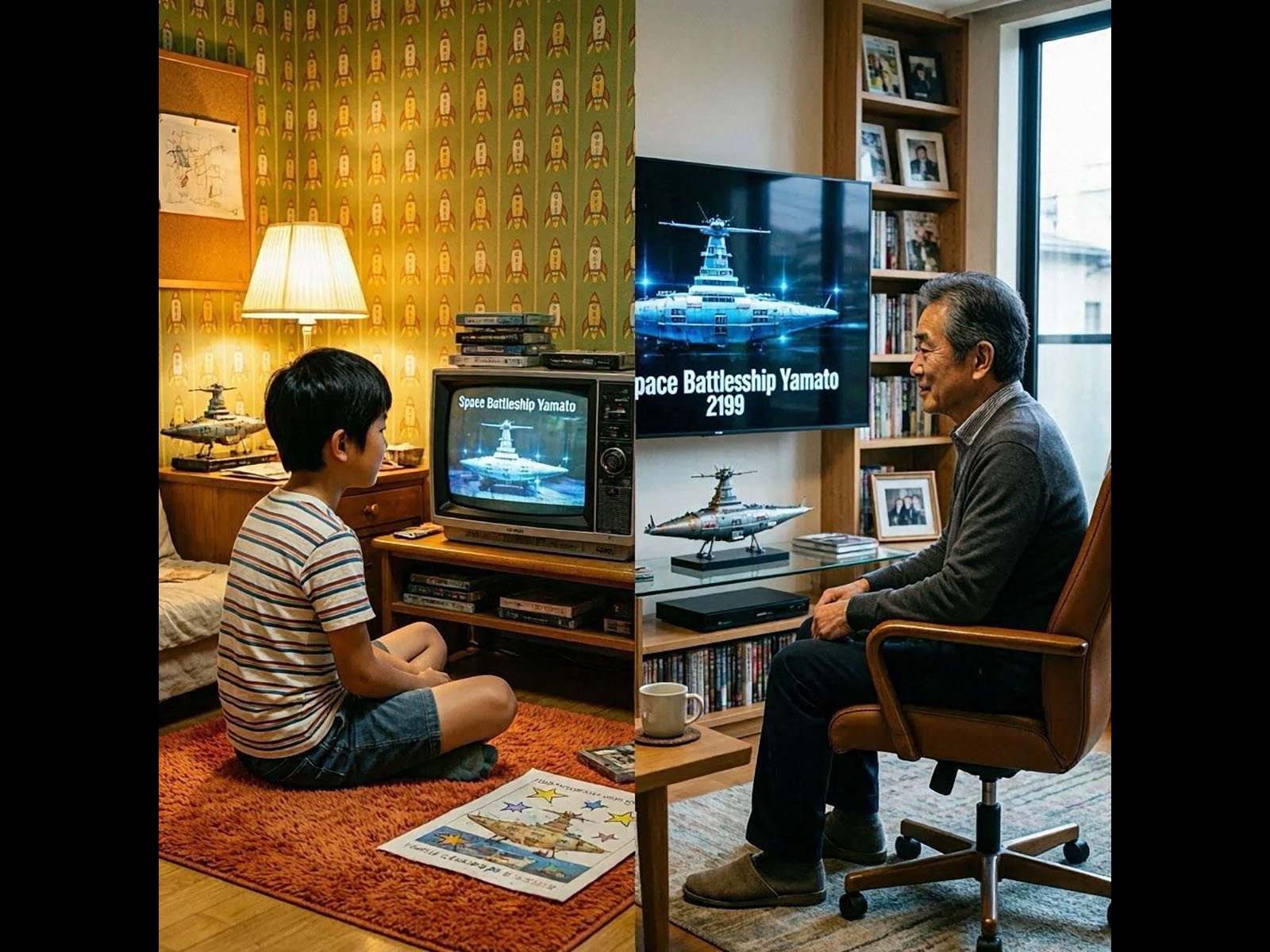
The remake series places significant emphasis on the portrayal of “adults”
This is a crucial point.
The adults were impressive in the original Showa-era version as well. I particularly remember the greatness of Captain Okita standing out vividly.
However, in the remake series that began with 2199, the differences in philosophy among the adults, such as Okita, Sanada, Tokugawa, Sado, Yasuo Nanbu’s father, Dessler, Domel, and various enemy military officers, are depicted with great care and detail.
Speaking personally, regarding REBEL 3199, it felt as though the clash of opinions among the adults was the very essence the creators wanted to showcase.
“Responsibility” is a central theme in REBEL 3199 as well. In recent interviews, Chief Director Harutoshi Fukui has described the protagonist, Susumu Kodai, as a figure who “bears the weight of the story.” This suggests that the narrative is not merely about a protagonist fighting, but about “bearing responsibility.”
Furthermore, in the latest installment, I felt that the decisions made by Kodai were depicted with a strong, deliberate intent.
History cannot be changed. But the choices we make for the future can be
People are imperfect. Young people, in particular, are immature. They fail. They make mistakes. Yet, Juzo Okita believes in Susumu Kodai. Shiro Sanada sends Kodai off on his mission. Ryu Hijikata, too, entrusts the future to the youth.
And in the series starting with 2199, the image of these adults who “entrust the future to others” has been portrayed with even greater care.
Susumu Kodai makes crucial decisions, and he never dismisses the judgments made by the younger generation. It is not about right or wrong, success or failure; it is about not depriving young people of the opportunity to take on challenges. The work itself conveys, through a grand narrative device, the message that “history cannot be changed, but the choices we make for the future can.”
I am simply filled with admiration for the extraordinary feat achieved here: taking a story from half a century ago and transforming it into a modern animated feature film. It addresses those who were children or young people back then, now adults who are as prone to failure as anyone else, using the motif of “correcting history,” while simultaneously creating entertainment that today’s youth can also enjoy.
If there is any merit to this hypothesis, then perhaps Space Battleship Yamato has been, for over fifty years, not only a “story about saving humanity” but also a series of works that consistently asks the question: “To whom shall we entrust the future?”
In Closing
Captain Okita believed in the young. Many other adults believed in the young, too.
What about us?
Needless to say, I am still immature. I make plenty of mistakes. That is why I want to talk to people more. I want to learn more. I am a far cry from Juzo Okita.
But…
The desire to become an adult who can believe in the next generation remains within me. Believing in the next generation is something we can start doing right now. I feel that this is the message I have received from Yamato over the course of nearly fifty years.
Let us grow together.
Perhaps this very attitude is the greatest gift we can offer to the younger generation.