
Thoughts after watching Episode 21
See the original blog post here
In this analysis we explore the weight of this episode, which transcends simple “good vs. evil” narratives, through the eyes of a former field engineer. We examine the intricate strategy devised by the brilliant commander Domel prior to the decisive Battle of the Rainbow Star Cluster, as well as the “declaration of victory” Captain Okita entrusts to his parting cup of water.
Highlights of this episode:
Even the enemy has a homeland; the moment the “good vs. evil” dynamic quietly crumbles
Reading Domel’s fleet strategy like a blueprint, through the eyes of a planner
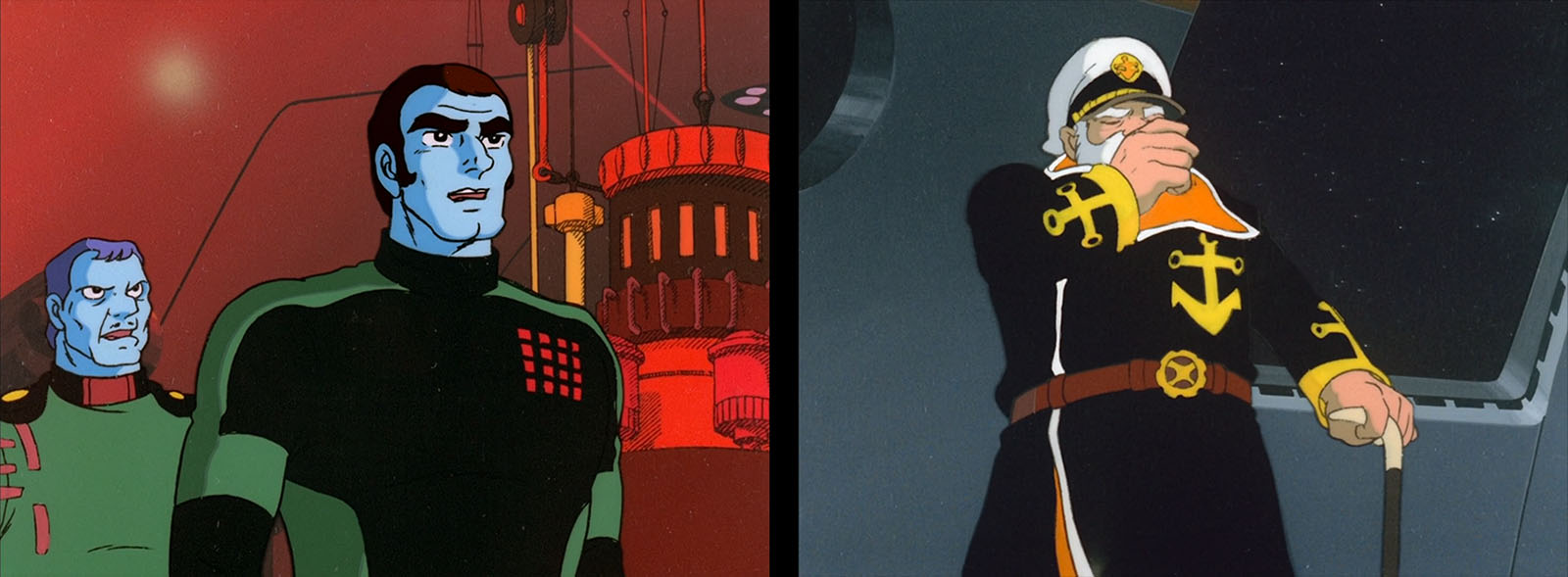
Domel as a warrior: The sight of him returning to the battlefield with the weight of his homeland on his shoulders transcends the role of a mere soldier. It is a moving portrayal of a man shouldering profound responsibility.
The setup for the Battle of the Rainbow Star Cluster: A head-on clash in a sector where radar is useless. The highlight is seeing how Domel orchestrates the decisive move entrusted to him by Leader Dessler.
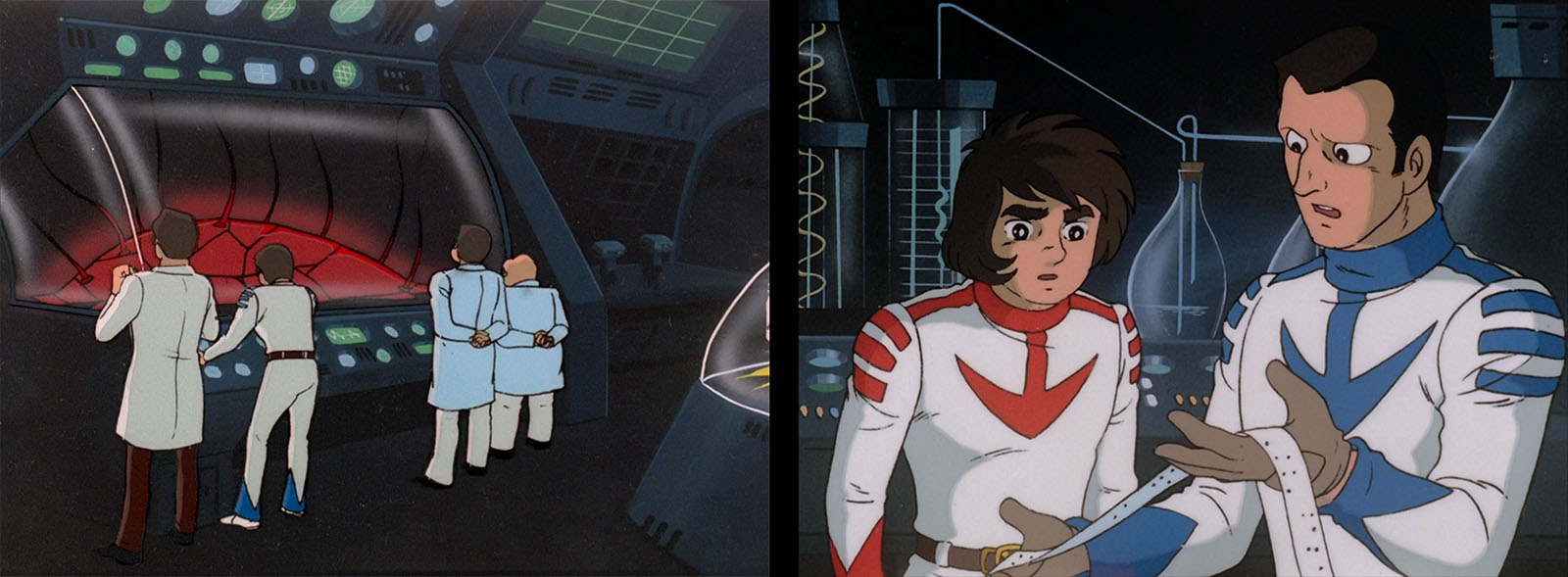
Chief Engineer Sanada’s deduction: A moment where the story’s center of gravity quietly shifts, revealing that the Gamilas side, too, is driven by desperate circumstances and a fight for survival.
Captain Okita’s memorable quote: The scene on the eve of battle where, sharing a parting cup of water with his crew, he declares, “This is not a prelude to death, but a declaration of victory.” It is the episode’s most iconic moment.
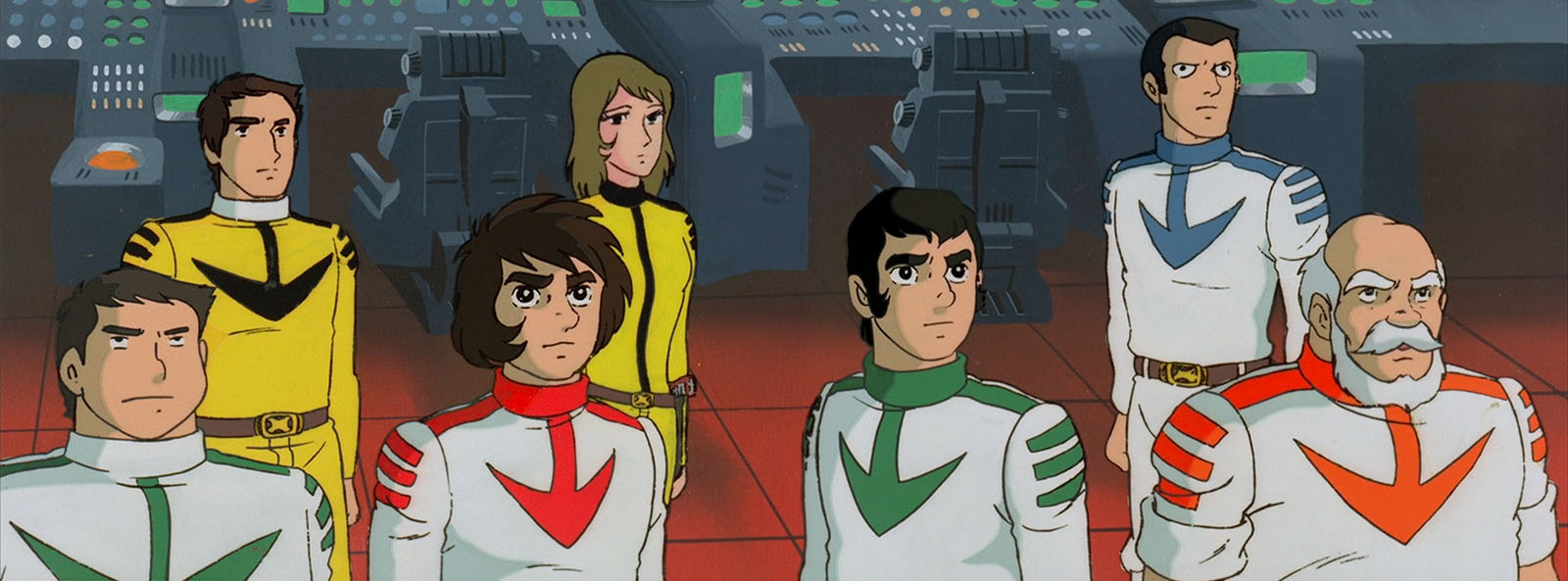
From here, I will break down these highlights one by one, offering the perspective of a viewer who has stepped back from the front lines of production. A summary of the plot details is provided later on, so please relax, perhaps with a cup of tea in hand, as you read.
Episode 21 marks the quiet opening of a decisive battle upon which the very survival of both Yamato and Gamilas hinges. Many fans regard this as a “legendary episode,” and it is easy to see why; the execution is truly substantial and compelling. I believe the profound reason why this episode continues to resonate with adults, and remains a staple of analytical discussions, lies in the moment when the simple “good versus evil” narrative quietly begins to unravel.
The enemy has a homeland, too – the moment the “good versus evil” framework quietly collapses
Inside the ship, Chief Engineer Sanada conducts a thorough analysis of data obtained at Planet Balan and articulates a crucial deduction, suggesting that Gamilas has a plan to relocate to Earth. The Gamilans, seemingly mere invaders, are actually fighting desperately for their race’s survival, bearing the fate of their beloved homeland and families on their shoulders.
The moment this weighty fact is revealed, the story transforms from a simple battle between good and evil into a magnificent drama where both sides fight for their own justice and survival.
The clear-cut narrative of an enemy threatening Earth crumbles at its very foundation with the revelation that Gamilas, too, has a home planet to return to. Having frequently dealt with people holding different positions in the workplace, I am struck anew by the profound depth of a script that matter-of-factly presents the weight of the reasons driving even the enemy.
Viewing the same blueprint from a different angle changes how dimensions and light appear, a common occurrence in the field. Yet, I find myself bowing in respect once more to the fact that an anime from the Showa era, often dismissed as mere children’s entertainment, depicted this reality without hesitation.
Had the story followed a simple “good versus evil” formula, Gamilas could have remained a mere villain. Instead, this episode unflinchingly portrays the enemy commander Domel returning to the battlefield with the fate of his homeland on his shoulders, alongside the resolve of his subordinates as they leave their families behind to face certain death.
There is no one in this universe who can be dismissed with the single word “enemy.” That quiet, uncompromising assertion is, I believe, a major reason why this episode has not lost its luster after nearly half a century.
Domel’s Warrior Resolve: Why a Renowned General, Spared from Execution, Returns to the Battlefield
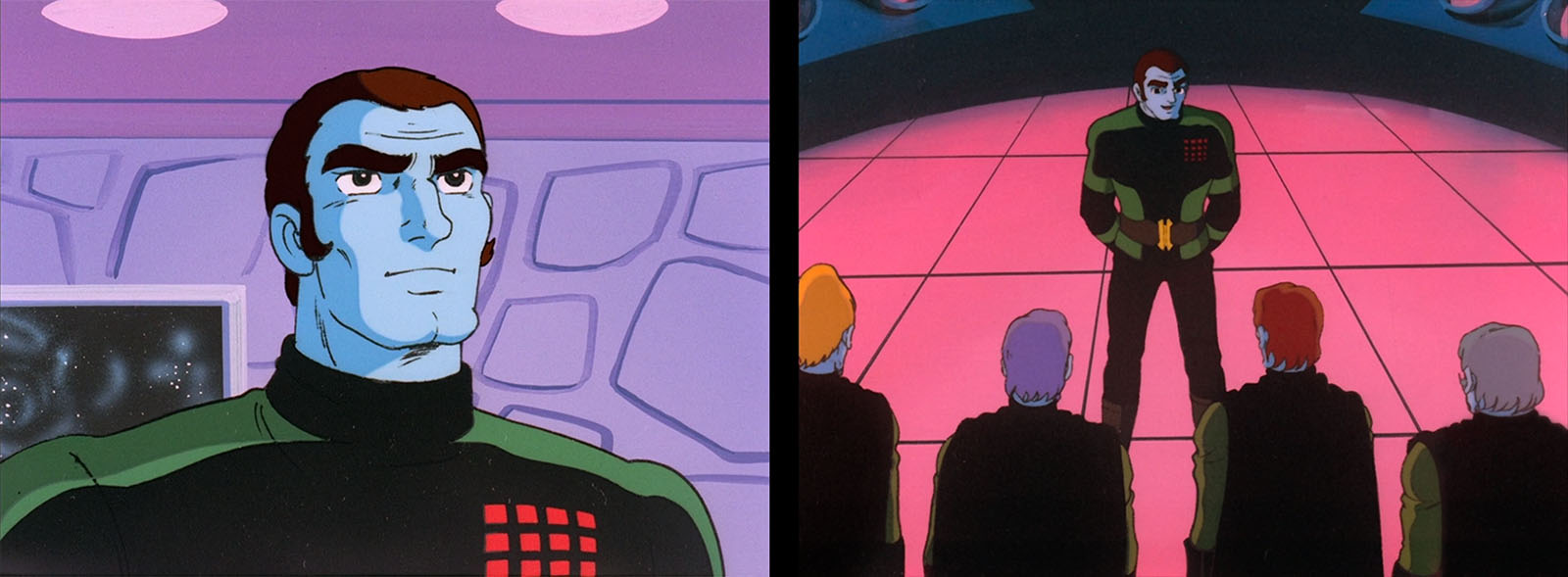
In this episode, the renowned Commander Domel is portrayed as a man who, having nearly lost everything, rises once more to fight for his country. While I leave the detailed backstory to the synopsis later in this article, anyone who has held a position of responsibility in the field can painfully understand Domel’s loyalty to his homeland and his tenacious commitment to his duty at that moment.
I know the weight of that night, having failed in a major operation, yet being sent back to the front lines regardless. The resolve to steel oneself, to dedicate a life one nearly lost back to one’s country, is not something to be taken lightly. Having spent a long career in a job where even a single mistake in tightening a valve could keep me up at night, I can feel the immense weight of the burden Domel carries, even through the screen.
Furthermore, Domel refuses to resort to underhanded sneak attacks against his enemy. Instead, he chooses to challenge them to a head-on confrontation. This surely serves as the ultimate expression of a warrior’s respect for Yamato and Captain Okita, men who have survived countless brushes with death.
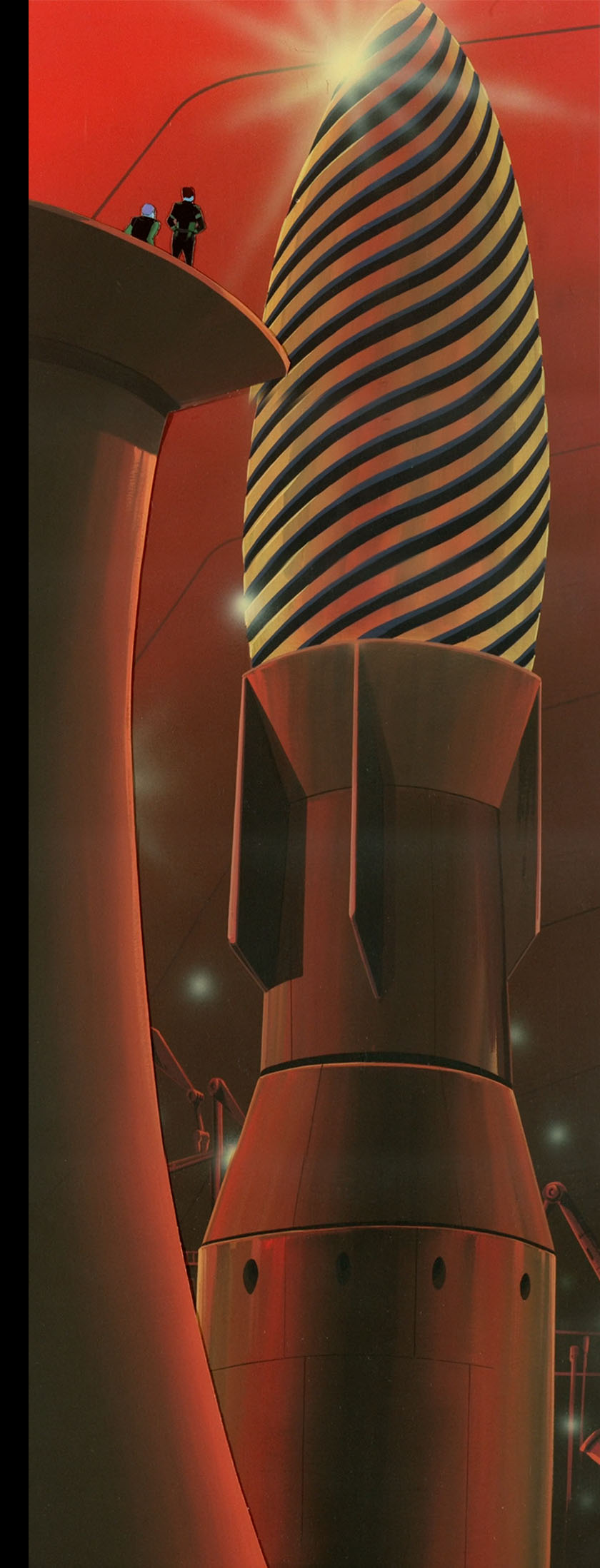
His noble pride as a warrior, the quiet words of loyalty spoken to his adjutant, and the pre-sortie briefing delivered to his troops; all of these moments possess a sternness and a human warmth that command respect, even from an enemy. They remind us that, despite being on the opposing side, he is a man who bears the weight of responsibility. Looking back at the series as an adult, I am simply awestruck by the depth and richness with which this warrior figure is portrayed.
Viewing the Domel Fleet’s operation as a “blueprint”, through the eyes of a logistics planner
One of the reasons this series has long been hailed as a monumental achievement in sci-fi anime is a fascination with the logical, intricate tactics devised by Domel.
While the specific mechanics of the weaponry and the details of the battle formations are best explored in the synopsis, here I would like to share, as a viewer with practical field experience, my admiration for the very way the operation is constructed.
He skillfully exploits Yamato’s weaknesses and turns its strengths against it to neutralize the ship. Even to an eye accustomed to years of handling hoses and setting up valve sequences on-site, this meticulously calculated encirclement is a brilliant maneuver without a single wasted movement. Despite the anime being nearly half a century old, it hasn’t lost an ounce of its luster.
Due to my history of studying blueprints, verifying dimensions on-site, and mentally tracing the opening and closing of valves, perhaps I can’t shake the habits of a job planner. Domel’s battle plan struck me as being as orderly and precise as a technical drawing. Construction sequence, demarcation of responsibilities, contingencies for the unexpected, every aspect bears the unmistakable mark of a veteran’s craftsmanship.
A job site cannot function on knowledge alone. It is a world where a single mistake in the sequence, who stands where, or which valve is opened in what order, can ruin everything.
That is precisely why Domel’s chosen battlefield, the deployment of his elite forces, and his final decisive move all exude the tangible touch of a man who truly understands the realities of the job. Even acknowledging the artistic license inherent in anime, there is something about this portrayal that makes you sit up straight and think, “This enemy commander was created by someone who really knows the work.”
That’s why, when it’s over, what remains isn’t a sense of victory or defeat, but a peculiar satisfaction at having witnessed a job well done. The fact that one feels this way about an enemy commander speaks to the truly high quality of the script and visual direction in this episode.
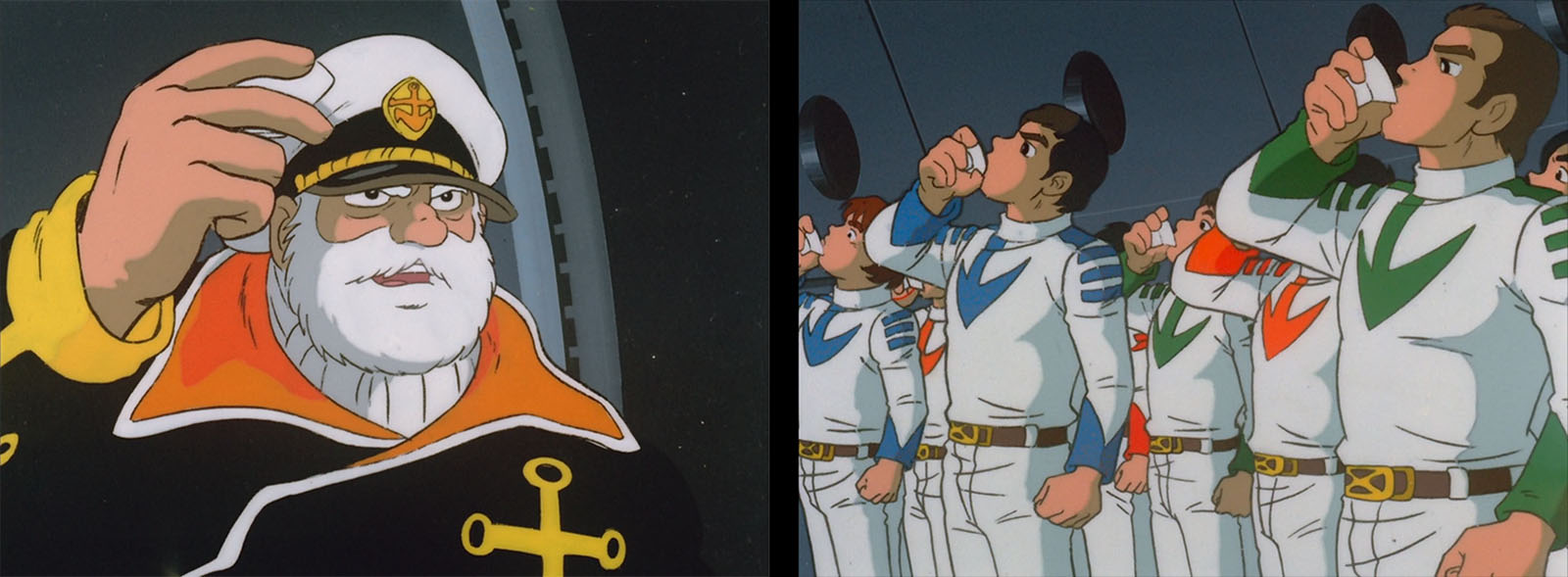
Captain Okita’s “farewell cup”, “This is not death; it is a declaration of victory” – the power of a single phrase
If I were asked to name the most moving moment in this tumultuous episode, I would unhesitatingly point to Captain Okita’s decision and conduct.
Faced with a challenge from Domel, the crew engages in a heated debate: should they take a detour, knowing it is likely a trap, or should they accept the challenge? Captain Okita, however, recognizes this decisive battle as an unavoidable trial on the path to Iscandar and makes the weighty decision to meet the challenge head-on.
On the eve of the decisive battle, the captain gathers his key crew members to share a ceremonial cup of water, a final farewell. Traditionally, this ritual signifies a grim resolve, a pledge to face a mission from which one will never return alive. Yet, Captain Okita speaks in a voice that is quiet, steady, and unwavering:
“Listen, everyone. This is not a cup to seal a resolve to die. It is a cup to pledge that we will stand here together once more and declare our victory.”
No matter how many times I watch this scene and hear those words, they stir a deep, burning emotion within me. He transforms that same “cup of resolve” from a symbol of despair into a signal of hope. With just a subtle shift in phrasing, he completely alters the atmosphere aboard the ship.
As a leader bearing the heavy burden of his subordinates’ lives, he ensures that they keep looking forward, refusing to let the light of hope be extinguished. Having spent years working on the front lines and leading young artisans, I am deeply moved by words that embody both profound kindness and unfathomable strength.
Anyone can scold. Anyone can issue orders on paper. But to look at comrades heading into a deadly situation and reframe that death not as an end, but as a “declaration of victory”…
Just think of the depth of resolve and the years of observing human nature packed into that single turn of phrase. Illness is quietly ravaging Captain Okita’s body. Yet, fully aware of this, he reveals none of his own anxiety, offering only warmth and encouragement to his crew.
Even now, long after retiring from my own work, if I could leave just one message for a young artisan, I would choose words like these. That’s the kind of scene this is. There is a profound weight dwelling in that cup of water, a significance that only becomes visible when you watch it again after growing older.
Synopsis: The Eve of the Mortal Combat at the Rainbow Star Cluster, the Decisions of Two Heroes, and the Fate of Humanity
For those who haven’t watched the episode yet, or those who wish to revisit the story from the beginning, here is an overview of the episode’s events. Reading this alongside the earlier analysis will help bring out the full weight and significance of each scene.
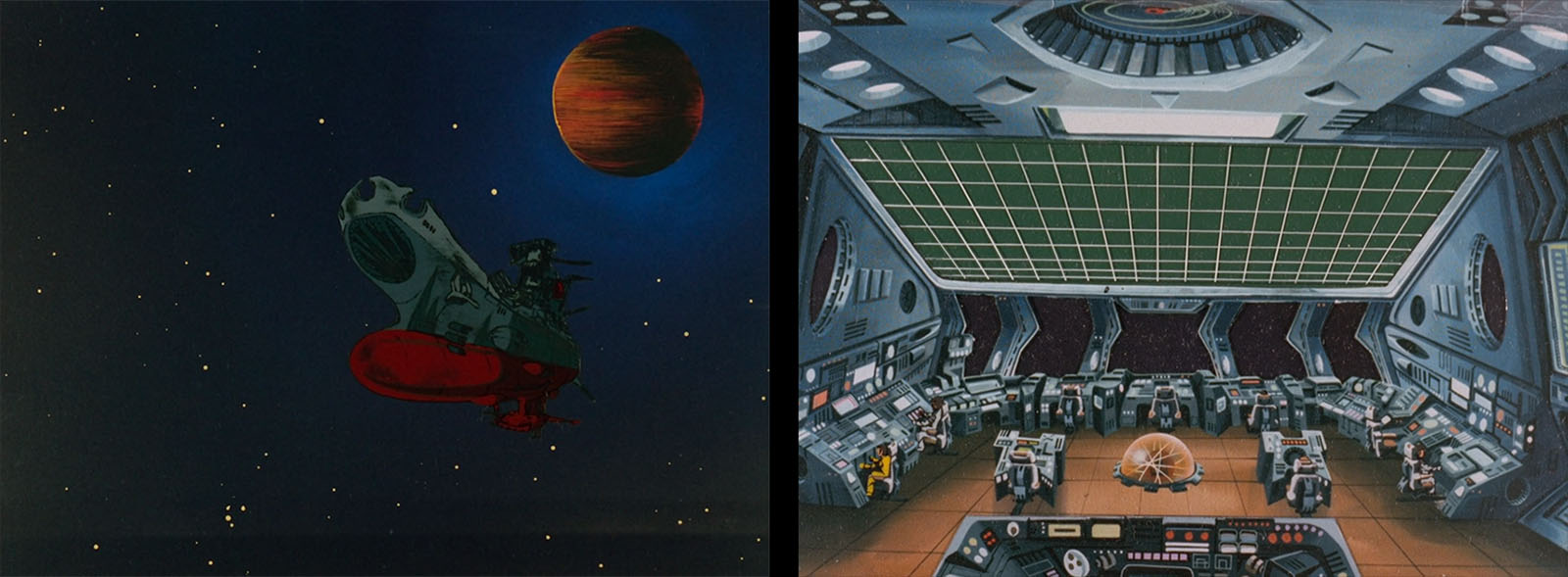
Prologue: The Fall of Planet Balan and Gamilas’ Miscalculation
February, 2200 AD. More than six months had passed since the Space Battleship Yamato departed in 2199, constantly shadowed by death, on a perilous voyage to Iscandar, located 148,000 light-years away, in a bid to save Earth from extinction.
Deep in space, 78,000 light-years from the Solar System, lay Planet Balan. It served as the midpoint of Yamato‘s long journey and was a beacon in the vast cosmos. In reality, however, it was a massive forward supply base for the Gamilas Empire’s campaign to conquer Earth.
General Domel, the brilliant commander of the Solar System campaign, orchestrated a meticulous and large-scale stratagem intended to make Planet Balan the graveyard of Yamato. Yet, Yamato managed to shatter Domel’s ambitions, escaping a desperate, near-fatal situation.
Furthermore, the ship dealt a devastating blow to Gamilas by completely destroying the Balan base, a critical strategic hub that was the lifeline of their Earth invasion plan. Having lost Planet Balan, a vital strategic stronghold, the Gamilas forces are plunged into unprecedented disarray and turmoil. Naturally, fierce criticism erupts within the military ranks against General Domel, who had directly commanded the massive operation.
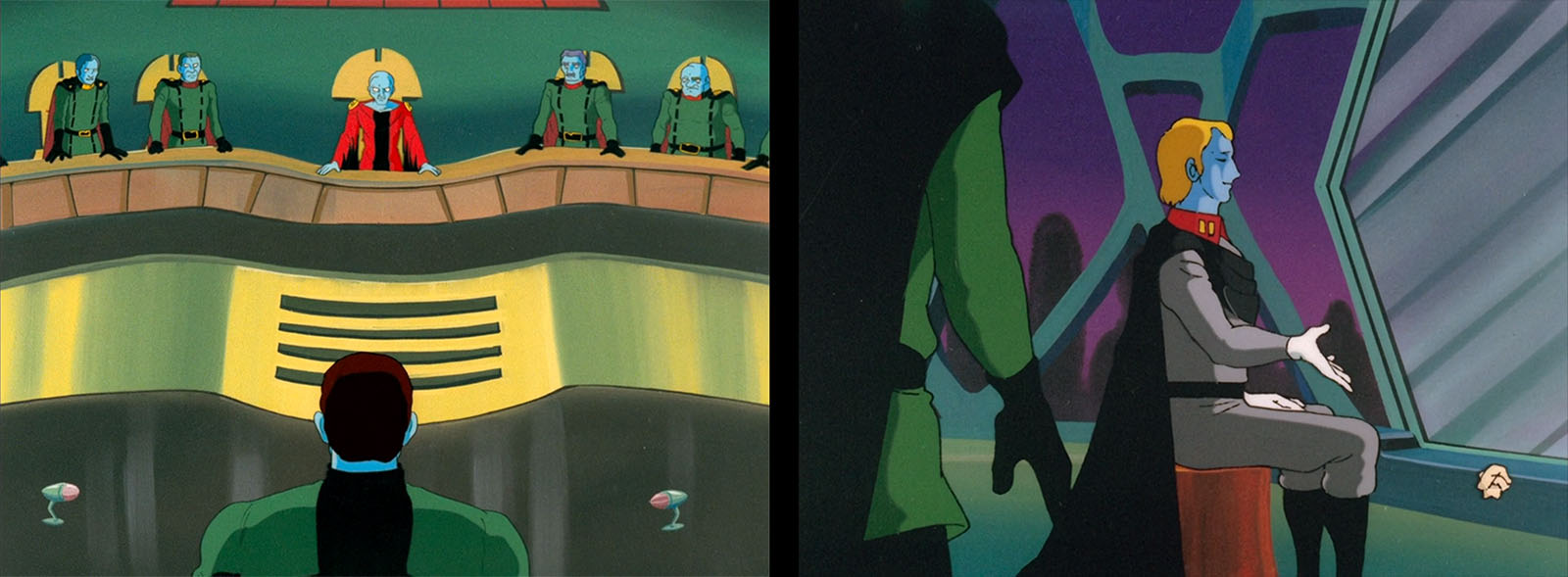
The Court-Martial and Dessler’s Pardon, Domel’s Last Stand
A solemn court-martial is underway on the Gamilas home planet. Commander Domel asserts the validity of his actions:
“There was no flaw in my strategy. The disastrous outcome was caused entirely by the petty tattling of my adjutant, Goer.”
However, Goer attempts to evade responsibility by hiding behind his loyalty to the Leader. Domel’s anger remains unquelled:
“That misplaced loyalty is what caused a perfect operation to fail. Even if it meant sacrificing the base, had we simply destroyed Yamato, our objective would have been all but achieved!”
Yet, the cold reality offers no quarter for Domel’s arguments. For the Gamilas military, now effectively deprived of a vital limb following the loss of the Balan base, the operation’s failure is an unforgivable crime. Calls for the death penalty echo through the chamber, and ultimately, a unanimous decision is reached to execute Domel, the Commander-in-Chief of the Solar System Campaign.
The official verdict from the court-martial is delivered to Leader Dessler, the absolute ruler of Gamilas. However, Dessler’s judgment is both cold and rational.
“What he did is unforgivable. Yet, if I were to execute Domel now, who else could possibly crush that hated Yamato?”
Dessler recognizes the warrior’s pride and tenacity in Domel, a man who would never simply retreat after a failure. With a single decisive decree, Dessler grants Domel a pardon: “Destroy Yamato before it enters the Greater Magellanic Cloud.”
It is an absolute order from the Leader, marking the start of a final, decisive battle for Domel, in which he will stake both his life and his honor.
“I accept the challenge. I shall stake my very being on this fight.”
The renowned commander Domel resolves to stand once more in Yamato‘s path, fully prepared for a do-or-die confrontation.
Before the sortie, when his adjutant Goer asks, “What will you do if the operation fails?”, Domel quietly vows, “My loyalty as a soldier to Leader Dessler is my ultimate weapon.” In those words lie the unwavering resolve of a man who refuses to abandon his warrior’s pride until the very end.
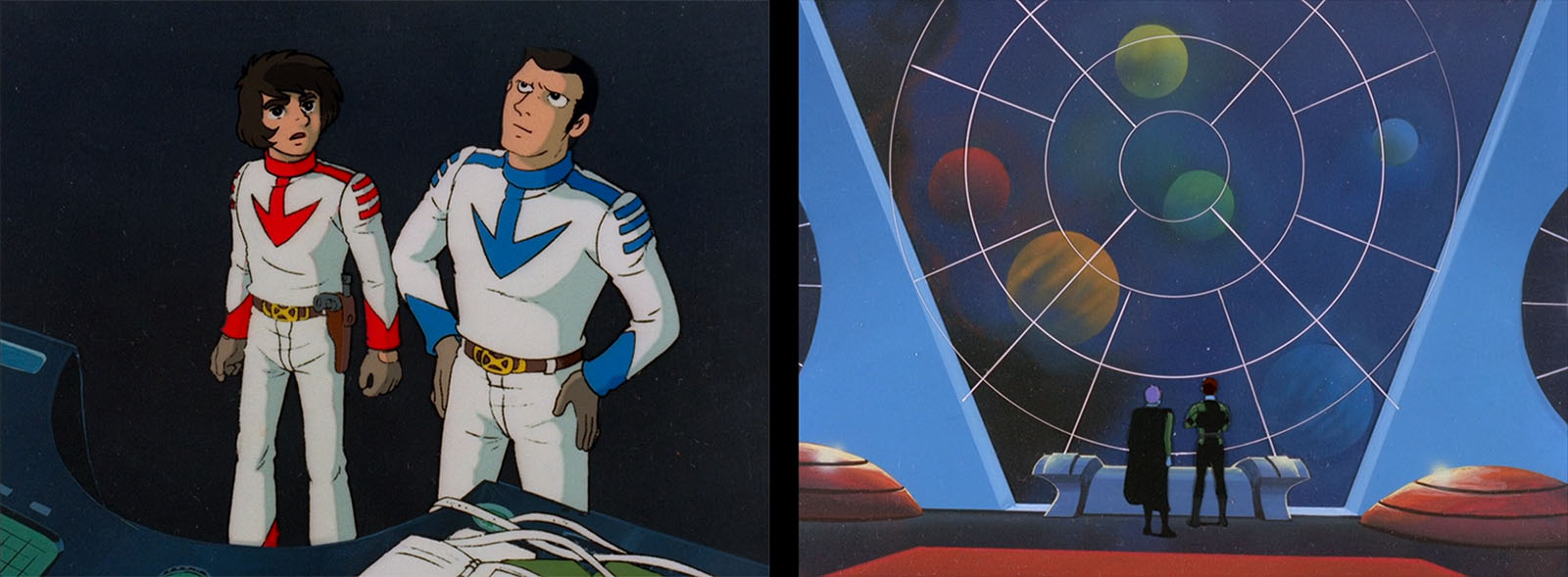
Chief Engineer Sanada’s Deduction; Why Gamilas Covets Earth
Meanwhile, aboard Yamato, the crew works at a feverish pace to analyze the vast amount of data and materials recovered from the destroyed base on Balan. Evidence has been discovered showing that Gamilas has been reporting detailed data on Earth’s changing pollution levels back to their home world. Chief Engineer Sanada arrives at a terrifying conclusion:
“The Gamilans might be planning to migrate to Earth.”
If this is their true objective, then Planet Balan would have served as a crucial strategic base for that purpose. Having lost that base, Gamilas is unlikely to simply back down without a fight. Another clash is inevitable. Yamato‘s crew stares breathlessly at a star chart, wondering from where and by what means Gamilas would launch its next attack.
The radiation levels in the Galmarius trinary star system are too intense. The gravity cluster controlled by the Pol regime offers no cover for a fleet to hide. Through a process of elimination, a specific region known as the “Rainbow Star Cluster” emerges as the likely location.
It is a complex, mixed star cluster consisting of six stars, each emitting beautiful light based on distinct spectral lines from elements like potassium and sodium, and gaseous dark nebulae. Just as Yamato‘s crew has anticipated, Domel has also selected the Rainbow Star Cluster as the perfect “death trap” in which to intercept Yamato.
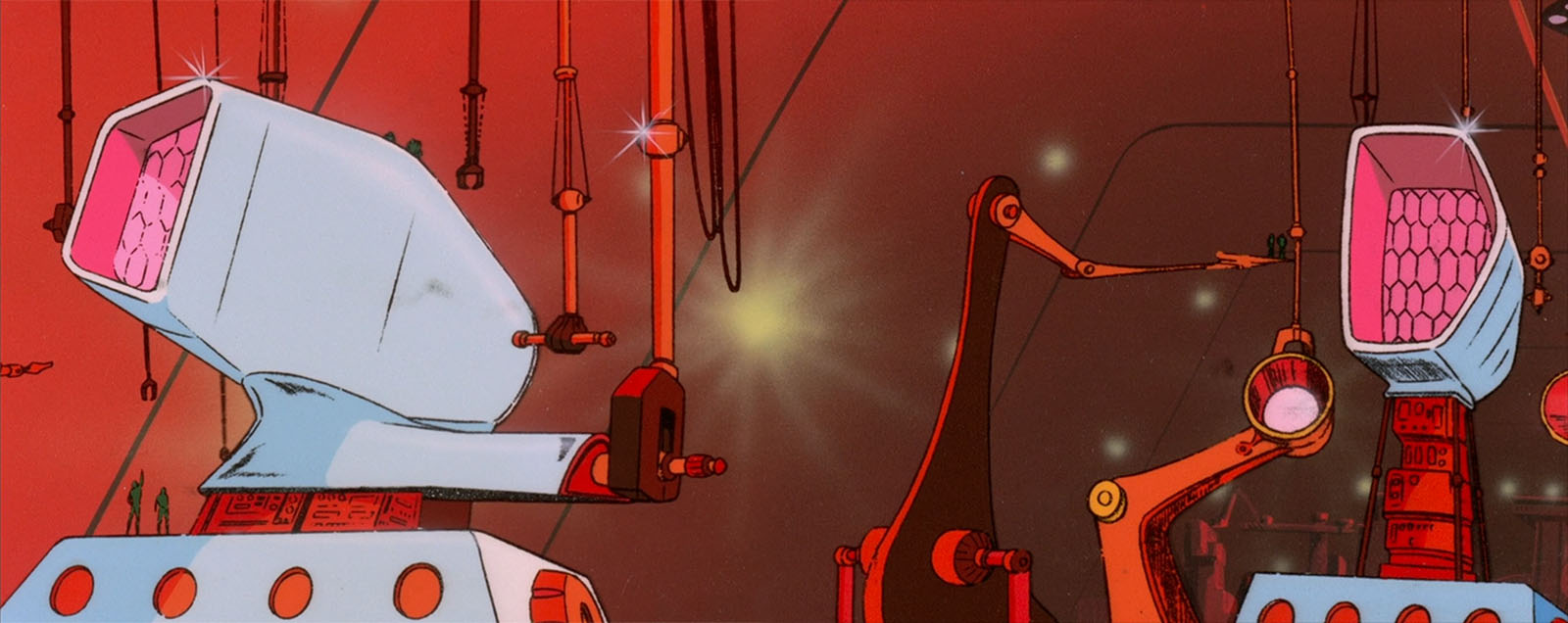
The Rainbow Star Cluster; the Traps of the Instantaneous Material Transport System and Drill Missiles
Domel’s strategy is formidable and meticulously planned, moreso than any before it. The Rainbow Star Cluster, chosen as the site for the decisive battle, is a unique region of space swirling with colorful cosmic currents and gaseous dark nebulae. Venturing carelessly into this area will completely cripple radar capabilities, forcing the crew into a grueling close-range battle relying solely on visual contact.
After years of meticulous planning, Domel has, in collaboration with the Gamilas weapons development division, perfected a terrifying new weapon” the “Instantaneous Material Transporter.”
It is a diabolical weapon capable of literally creating a spatial conduit for matter transport. It can instantly warp his fleet’s carrier-based aircraft right in front of Yamato, launching an unpredictable surprise attack. It is his primary trump card, enabling an unavoidable ambush in a situation where radar is rendered useless.
However, Yamato possesses its own ultimate trump card: the Wave-Motion Gun. Domel has factored even that into his calculations. He has prepared a special weapon, the “Drill Missile”, specifically designed to neutralize the Wave-Motion Gun.
By firing this directly into the muzzle of Yamato‘s Wave-Motion Gun, the energy will backflow, causing the ship to explode from within and deliver the final, fatal blow. It is a masterstroke that exploits Yamato‘s vulnerability (its reliance on radar) while turning its greatest strength (the Wave-Motion Gun) against it to render it useless. There is no longer any escape for Yamato.
Convinced of total victory, Domel sends a proud “challenge” to Yamato and issues a rousing call to battle across all fronts.
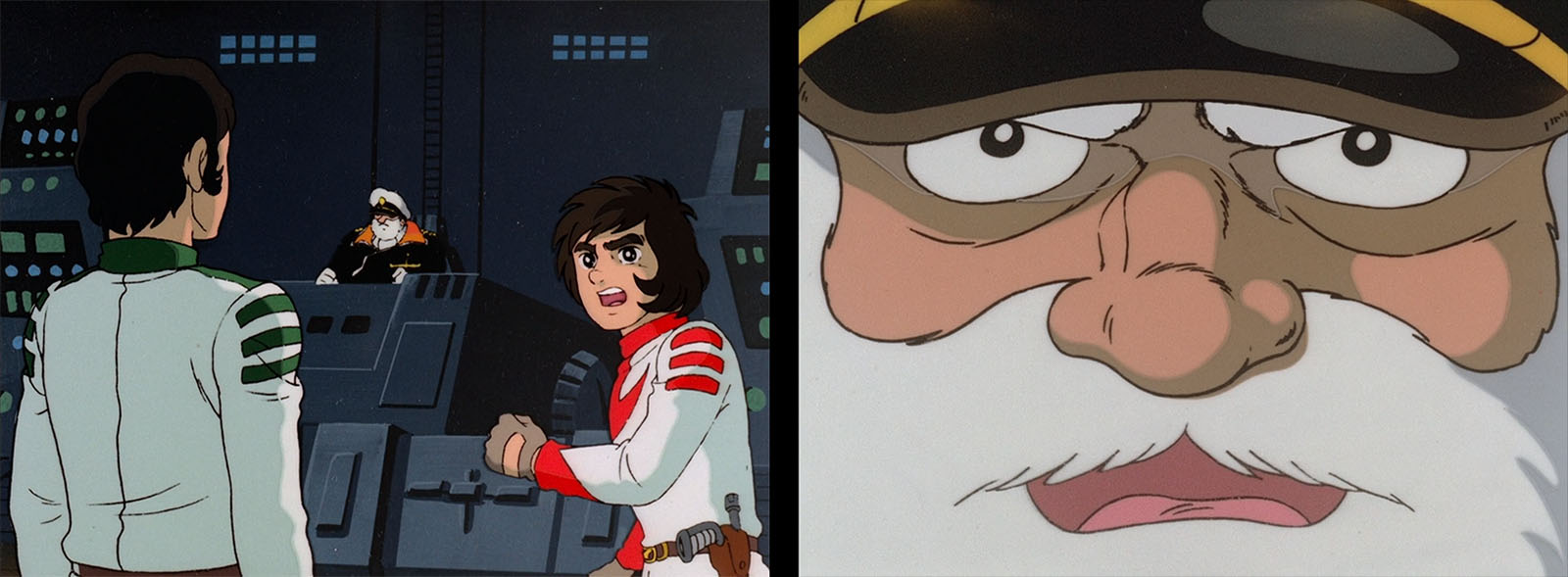
Domel’s Challenge and Captain Okita’s Decision
A transmission from Domel echoes throughout Yamato.
“It seems the time has come for us to settle this once and for all. Just as you seek to reach Iscandar, we desire Earth. If you are determined to proceed, you must defeat our forces in a direct confrontation. I hereby challenge you to a decisive fleet battle in the Rainbow Star Cluster within seven days.”
It is a formal challenge from a fierce Gamilas commander, one that cannot be refused, even knowing it is a trap. A wave of unease sweeps through the ship. Navigation officer Daisuke Shima voices his anxiety: “We still don’t know the full extent of Gamilas’ capabilities. A head-on confrontation puts us at a disadvantage.”
However, Deputy captain Susumu Kodai counters: “Are you telling us to tuck tail and run? A decisive battle is about winning or losing. If we lose, it’s the end, but if we win, it opens up every possibility!”
Amidst this clash of opinions, Captain Okita appears before the crew, despite his failing health. He speaks to them quietly, yet with great strength. “This is a trial we must face and overcome. We must win at all costs and reach Iscandar.”
Acting on Captain Okita’s decision, Yamato resolves to venture into the deadly trap of the Rainbow Star Cluster.
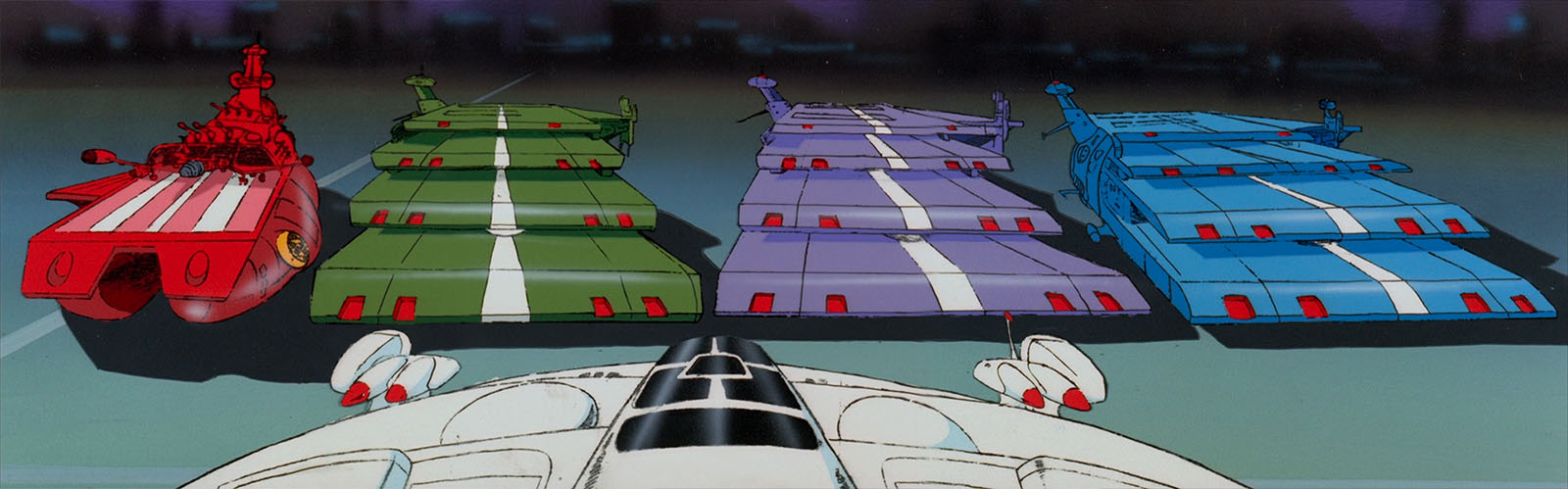
The Gathering of Gamilas’ Elite, Warriors from Various Fronts
Meanwhile, within Domel’s camp, preparations for the showdown are steadily underway. In addition to the surviving forces from Planet Balan, elite airborne units, handpicked from various battlefronts, are gathering.
The sight of the First, Second, and Third Aircraft Carriers touching down at their designated points, with the massive combat carrier bearing Domel himself looming majestically beside them, is a truly spectacular display of Gamilas’ combined power.
One by one, battle-hardened warriors step forward to answer the call: Getto from the Ruby Front, Berger from the Sapphire Front, Kroitz from the Diamond Front, and Haidern from the Omega Front.
Even amidst the tension of heading into a death trap, they trade banter and wear fearless smiles. Facing the harsh conditions of the Rainbow Star Cluster, where the gaseous dark nebula renders radar useless, they boast boldly: “If it comes down to a visual dogfight, that’s exactly what I want,” or “I’ll blow ’em away with a single snort.”
Underlying their bravado is absolute trust in General Domel and their deep pride as warriors. Domel surveys the assembled warriors and delivers an address in a voice that is quiet yet stirs the soul.
“Gentlemen, the time has finally come to stake the fate of Gamilas on a battle against Yamato. We entrust everything to the shoulders of the brave warriors gathered here. Fight with all your might. I pray for your success!”
“All ships, launch immediately!” At Domel’s command, the massive fleet destined to sink Yamato weighs anchor and sets course for the Rainbow Star Cluster.
The Parting Cup and the “Declaration of Victory”, The Decisive Battle Looms
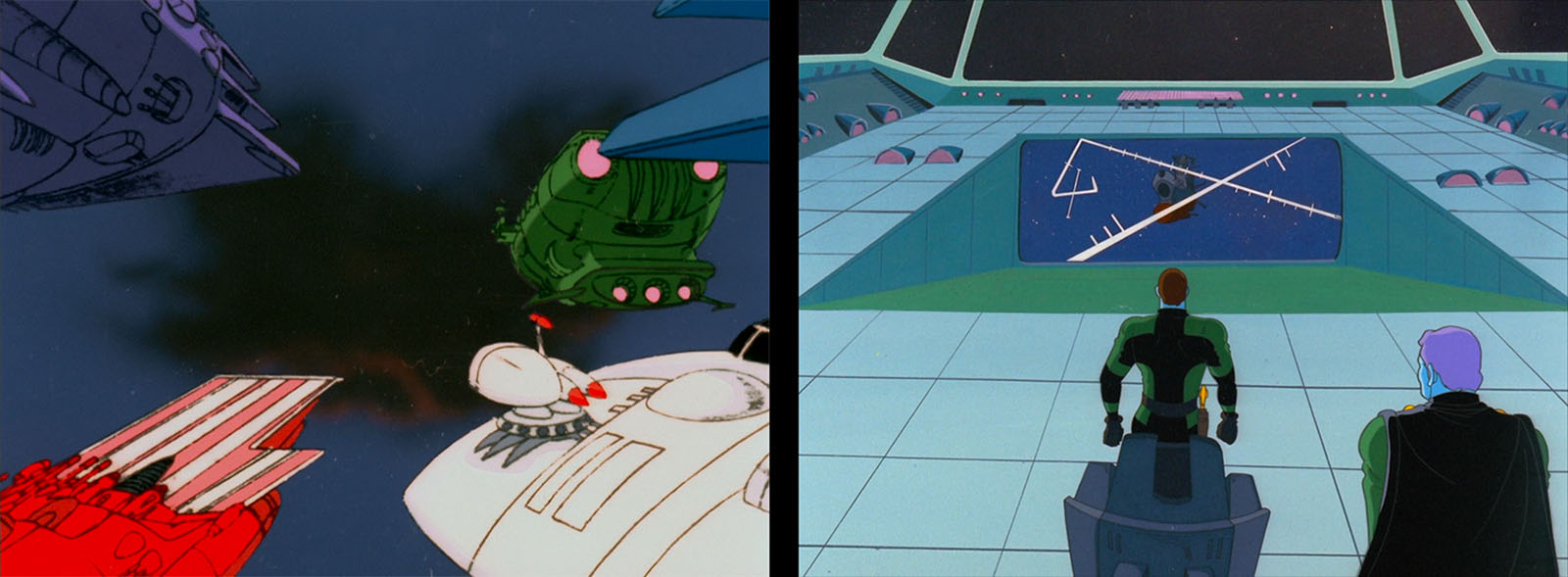
Domel’s strategy is poised to unfold flawlessly. He will use the unique electromagnetic waves of the Rainbow Star Cluster to jam Yamato’s radar, allowing the first wave of attackers to completely destroy its sensors. While Yamato is thrown into confusion, unable to pinpoint the enemy’s location, a drill missile will be fired to seal off its Wave-Motion Gun. Finally, a massive internal explosion will reduce the ship to cosmic dust.
“Okita, the captain of Yamato, is no ordinary man. We cannot afford to let our guard down.”
Domel awaits this unseen adversary with the utmost respect and vigilance.
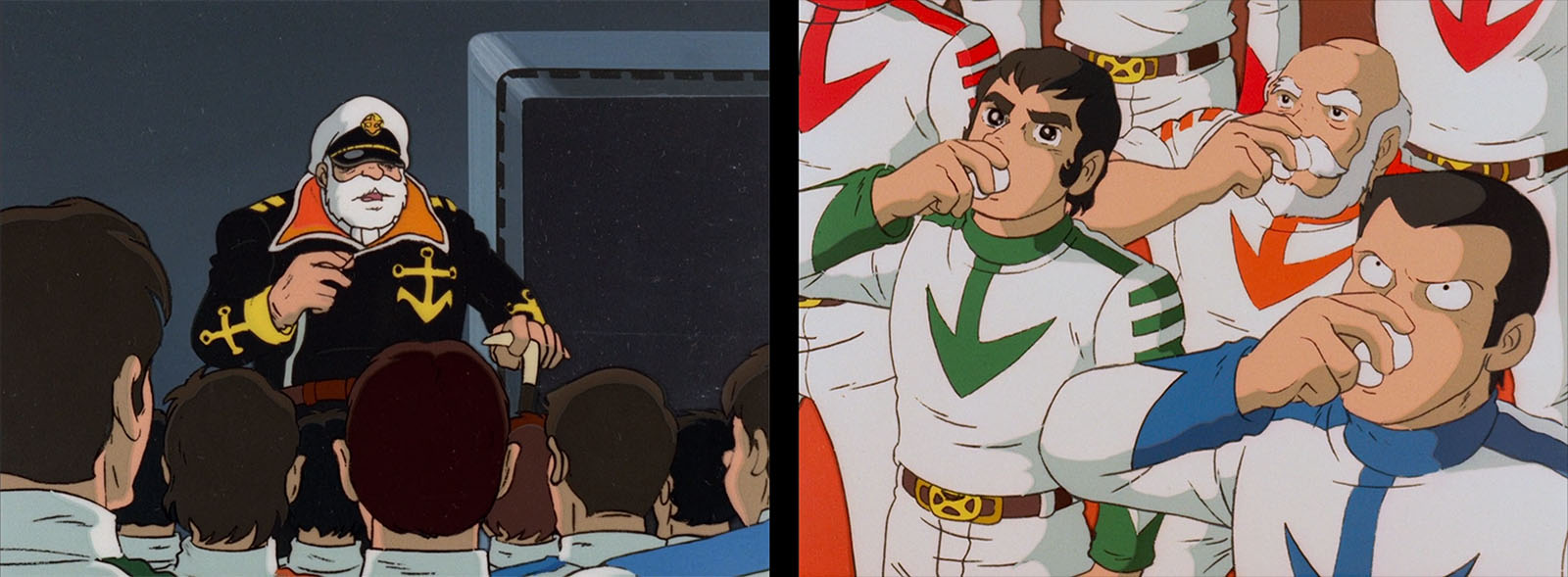
Meanwhile, aboard Yamato, Captain Okita has gathered the entire crew in the observation deck ahead of the decisive battle. A life-or-death struggle against Domel’s fleet is imminent. Everyone senses the fragility of their own lives.
“The decisive battle with Domel’s fleet is almost upon us. They, too, are approaching this fight with extraordinary resolve.”
Captain Okita raises a glass toward his crew. “I wish to share a parting cup of water with you all.” A wave of tension sweeps through the ship at these words. Yet, Okita smiles powerfully.
“But this is not a toast to seal a resolve to die. Listen well, everyone: this is a toast to the moment we shall declare victory together once more!”
“The fate of humanity hangs in the balance of this battle! All hands to combat stations!”
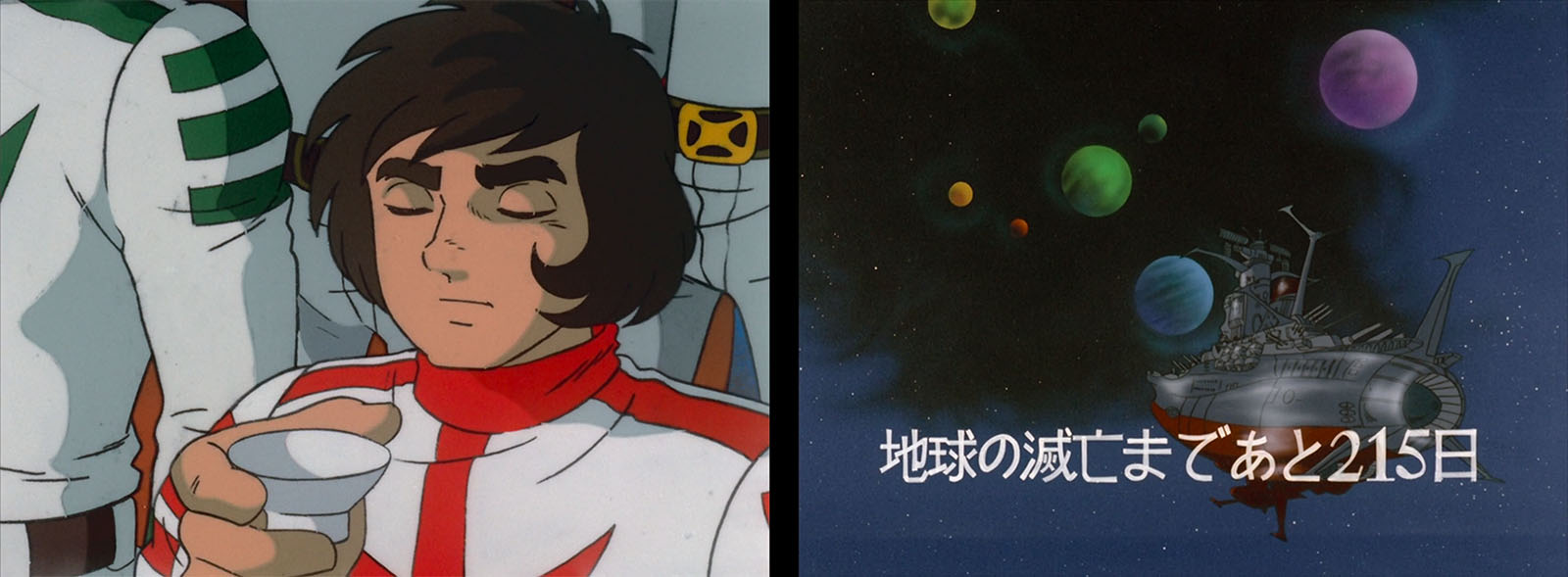
In the vastness of space, the stars of the Rainbow Star Cluster shimmer with an eerie yet beautiful radiance. Only 215 days remained until the day of humanity’s extinction. To secure a future for their homeland and peace for the entire universe, Yamato and Domel’s fleet are finally approaching an unavoidable, fateful clash.
Summary: Why Episode 21 Still Moves Us After Half a Century
There are 215 days left until humanity’s extinction. In the Rainbow Star Cluster, a region of space that is as beautiful as it is unforgiving, where radar systems fail, Yamato and Domel’s fleet are poised to clash, staking the futures of their respective homelands on the outcome.
There is a raw, gritty human tenacity that can never be measured by the efficient, data-driven “correct answers” alone. There are decisions born of genuine care for one’s subordinates, decisions made with warm, living blood. Perhaps it’s because this intense passion radiates from every corner of the screen that we remain captivated by this work, even after nearly half a century.
As I re-watch this episode by a window in Sapporo, holding a steaming teacup, words I likely glossed over in my youth now resonate with a different kind of weight in ears that have aged and gathered the wisdom of the years. This is, indeed, the ultimate luxury: the experience of rediscovering a classic masterpiece.
Which words left the deepest impression on you?
What I want to convey through this episode is not merely the outcome of the battle itself. Captain Okita possesses a deeply human warmth, the kind that allows him to steel himself to send his subordinates into the jaws of death, yet speak with that same voice the words, “Let us declare victory once more.”
Meanwhile, the proud challenge issued by the enemy commander Domel, despite their opposing sides, quietly teaches us what it truly means to live.
Perhaps there is a spring where one might encounter this story anew, treading through the mud left by the melting snow. In the brief moments it takes for the steam from a teacup to dissipate, what burdens do I carry, and what do I wish to convey to whom? If this piece has prompted you to quietly hold such questions close to your heart, then I, as the writer, could ask for no greater joy.
Whether you have never seen it before or are revisiting it with a sense of nostalgia, I urge you to witness this masterpiece episode, and the fierce battle at the Rainbow Star Cluster that follows, with your own eyes.
After reading this article, which words have stayed with you?
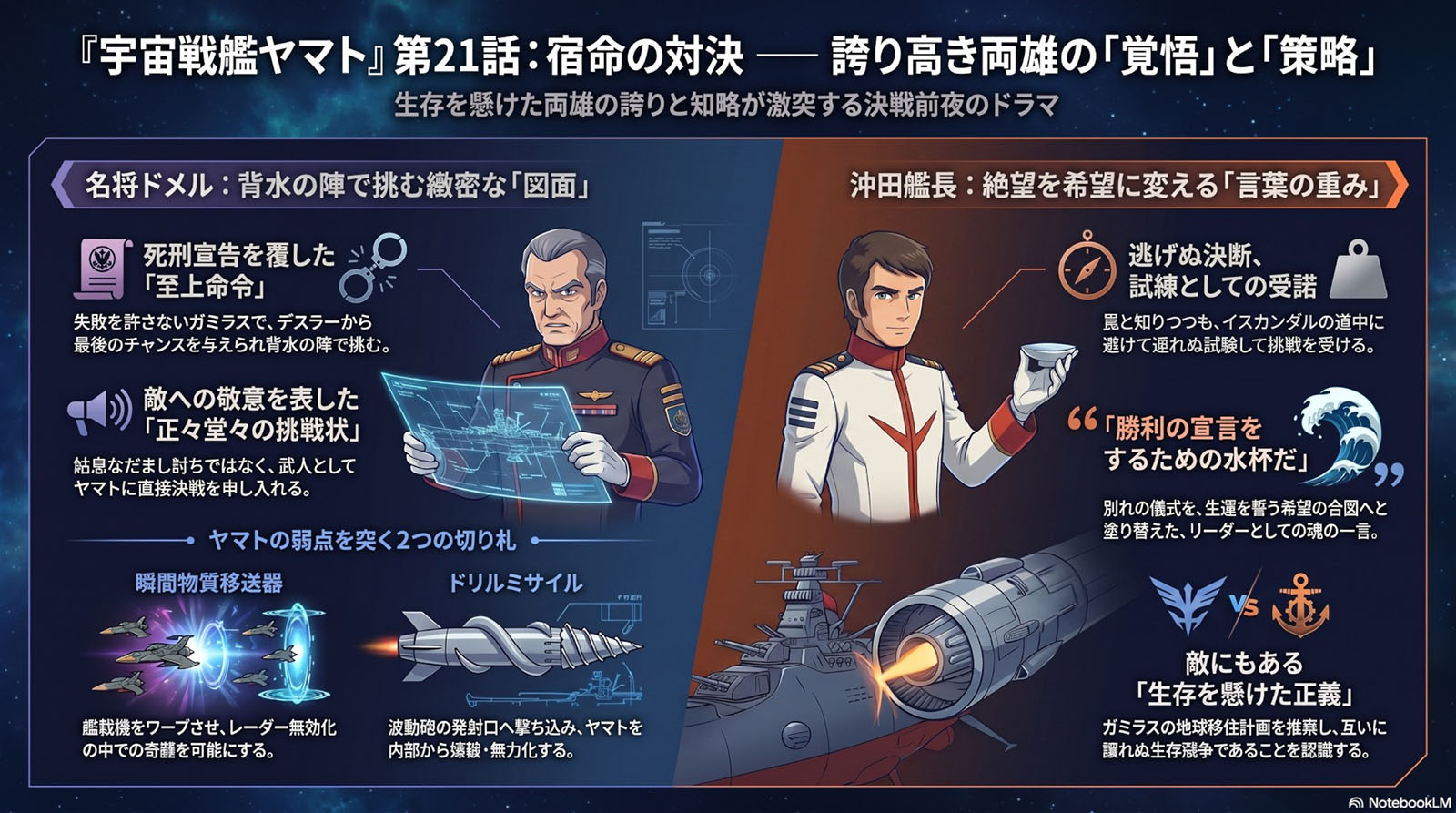
An infographic presenting a symmetrical comparison between the strategies of the brilliant commander Domel and the decisions of Captain Okita, while illustrating tactical elements such as the Instantaneous Material Transporter and the Drill Missile.
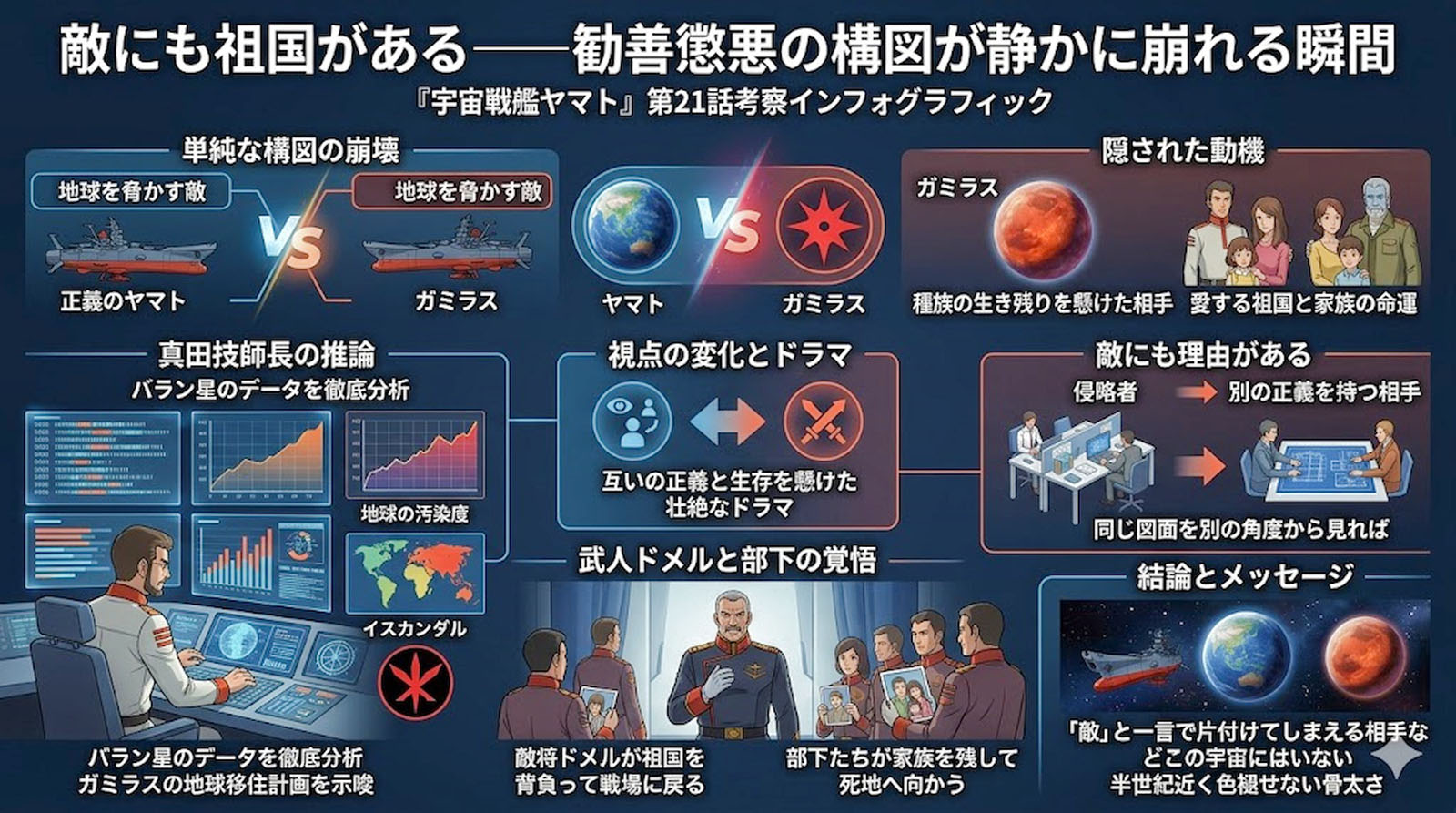
An analytical infographic that illustrates the conflict between Yamato and Gamilas, Chief Engineer Sanada’s analysis, the enemy’s families and homeland, and the reinterpretation of good and evil through a shift in perspective.
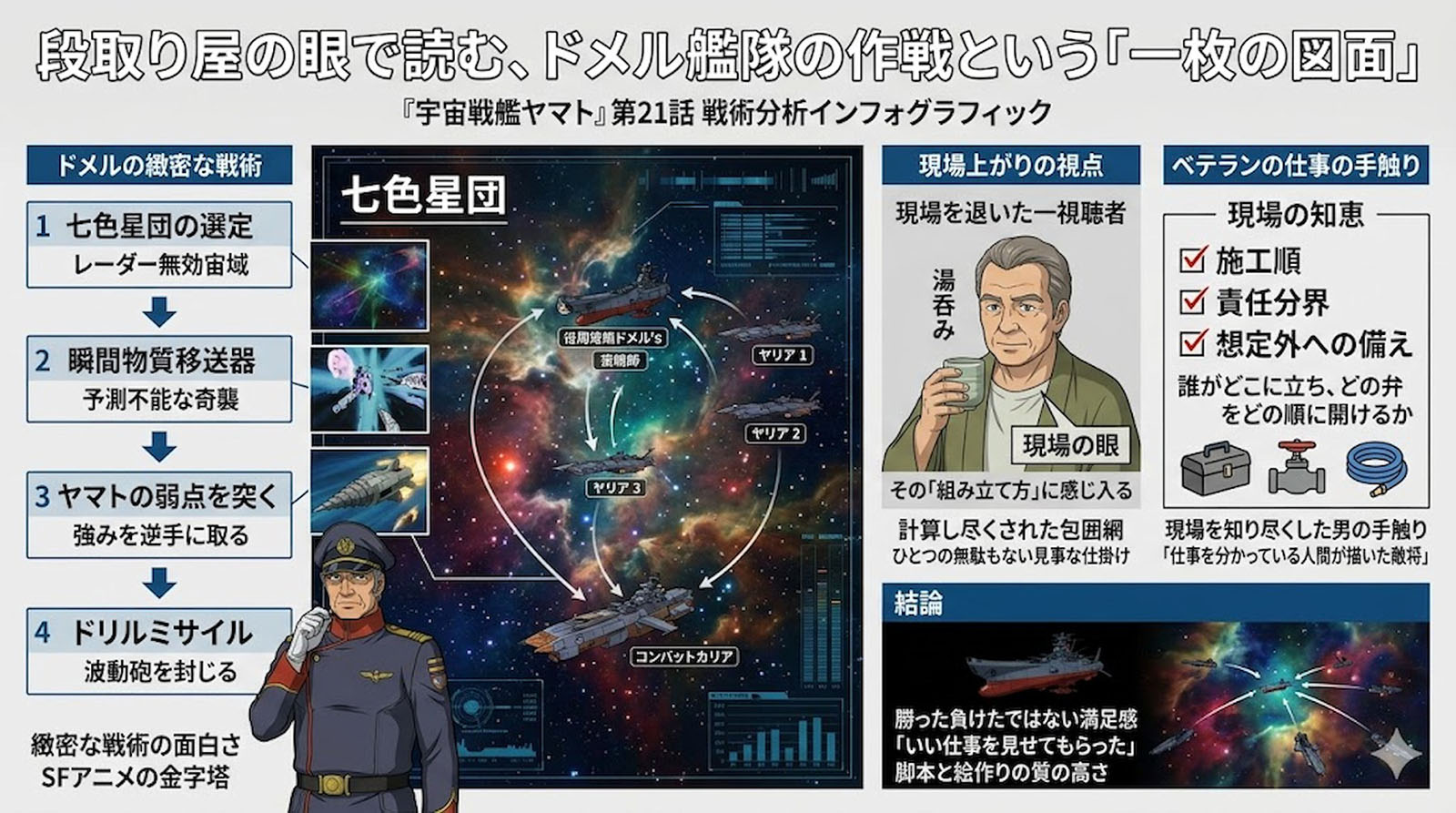
A tactical analysis that illustrates the flow of the Domel Fleet’s “Operation Rainbow Star Cluster,” explaining tactical elements, such as the use of radar-nullifying space, the Instantaneous Material Transporter, and drill missiles, while highlighting the ingenuity of the operational planning from the perspective of someone with hands-on field experience.
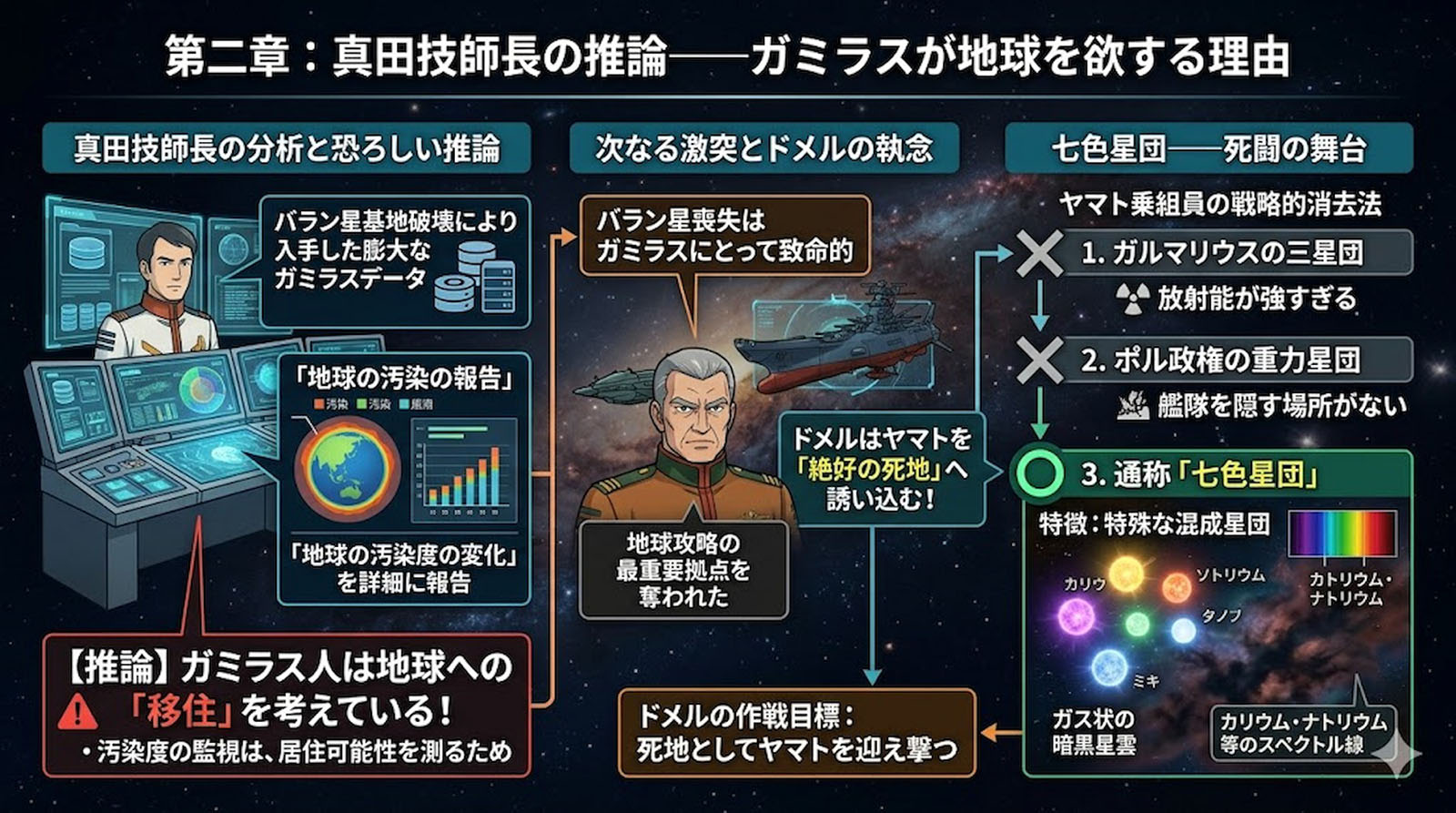
Diagrams to explain Chief Engineer Sanada’s analysis of Gamilas, the theory regarding their migration to Earth, Domel’s strategic intent, and the strategic importance of the Rainbow Star Cluster. Is Gamilas an invading force, or a people seeking a new home? Chief Engineer Sanada’s deductions transform the way we view the story.
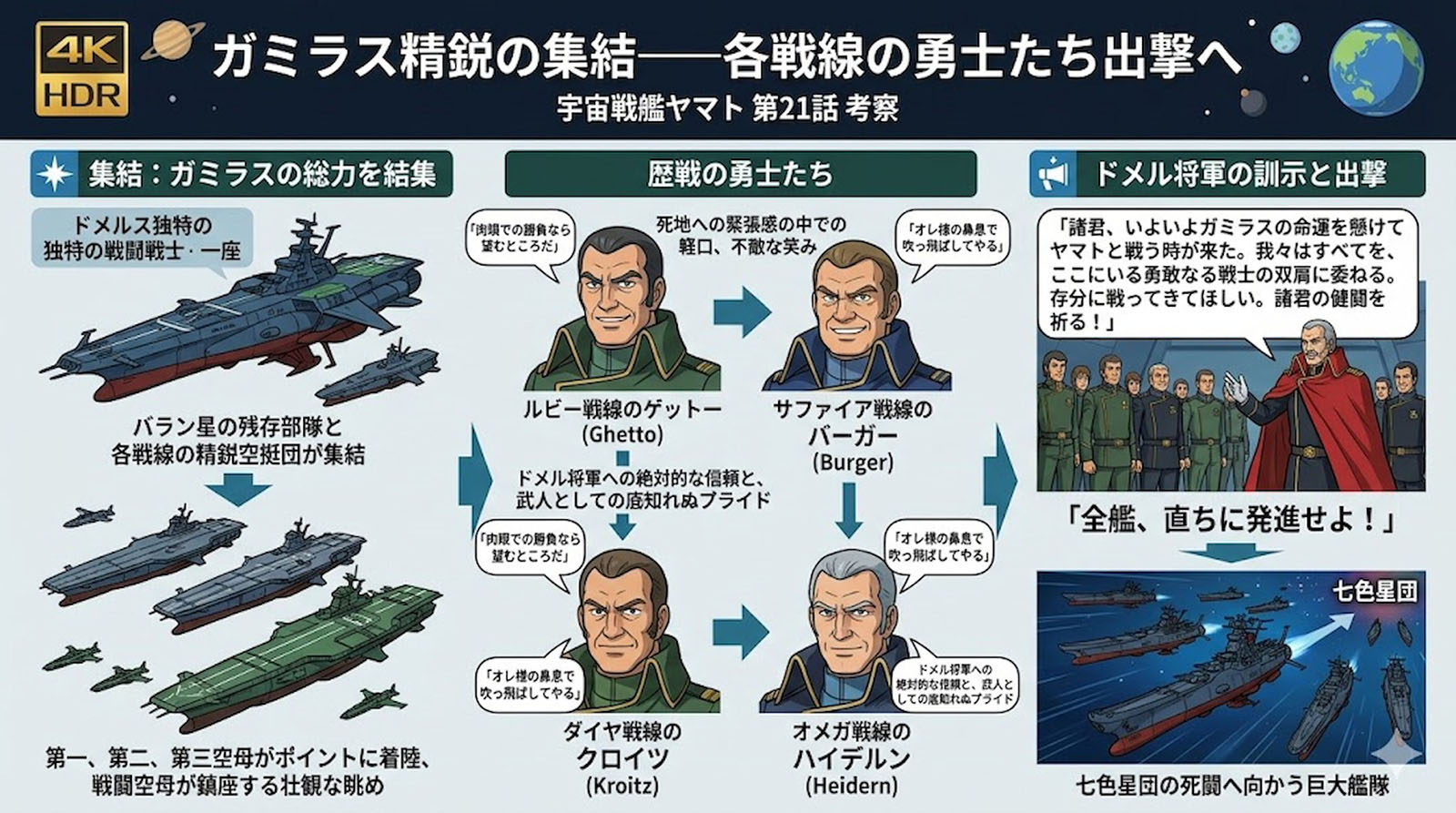
This inforgraphic illustrates the elite units assembling for the Domel Fleet, introduces the battle-hardened commanders, and outlines the flow of events leading from the sortie order to the decisive battle at the Rainbow Star Cluster.
Thank you for reading to the end.