
Behind-the-scenes details of the shocking plot developments!!
Published at Hobby Japan Web, June 29, 2026. See the original post here
With the theatrical release of REBEL 3199 Chapter 6, a film that picks up from the shocking climax of Chapter 5, we spoke with Tasuku Hatanaka (voice of Ryusuke Domon) and Tomo Muranaka (voice of Miyako Kyozuka) about the story.
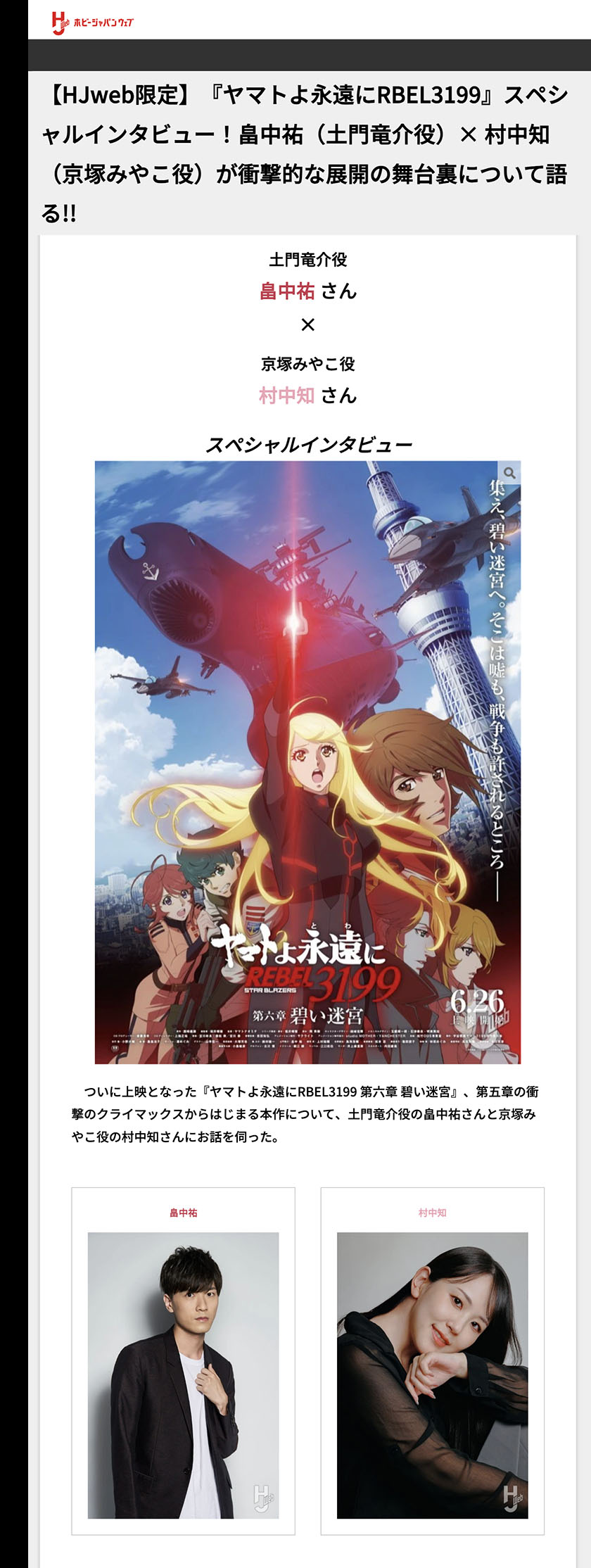
What goes on behind the scenes of these shocking developments?
Interviewer: Chapter 6 has finally been released, and the climax is drawing near. How are you feeling at this stage?
Hatanaka: As we head toward the finale, the story keeps taking wild, unpredictable turns, to the point where I find myself wondering, “How are they going to wrap this all up!?” Yet, I feel that unpredictability is one of the work’s greatest charms. In fact, I was constantly surprised myself while reading the scripts.
Muranaka: Chapter 6 alone is packed with so many highlights that you might think, “Is this the climax?” It’s amazing to see the wide-ranging drama unfold not just aboard Yamato, but also on Earth, in space, and across the various factions. Even in parts where my character doesn’t appear, I imagine the staff is pouring their all into creating this work, and I’m really looking forward to the moment it all concludes.
Interviewer: The ending of Chapter 5 came as a huge shock to fans. What were your impressions when you saw Yamato appear in Shinjuku?
Hatanaka: There was hardly any dialogue in that scene, so I only realized what was happening after my own lines were finished. I thought, “Wait…is something there?” After all, it’s the sky over Shinjuku in the modern era, the same time period we live in. Just imagining Yamato appearing in a place like that makes it feel like a major incident is about to unfold. How would the Self-Defense Forces respond? How would the ship interact with the people of this era? It really is a “close encounter of the unknown.”
Muranaka: The Yamato story originally began with the premise of setting out for Iscandar in search of hope to save Earth, didn’t it? I had a strong impression of it being a story about the future or outer space, but seeing it in modern-day Shinjuku, especially with depictions of everyone holding up their smartphones, made it feel like a world directly connected to our own reality.
Interviewer: What kind of explanation were you given regarding Chapter 6 as a whole?
Hatanaka: I didn’t receive any specific explanation. Domon is the type of character who believes that “what happens right in front of you is everything.” Within a single chapter, the crew gets scattered and then regroups. It really made me wonder, “What on earth is going to happen next?” I was so curious about the continuation that I couldn’t wait to read the next script.
Muranaka: [General Director] Harutoshi Fukui had told me vaguely that “Miyako is going to go through a really tough time.” However, rather than Miyako herself facing a crisis, the situation was more like “chaos erupting all around her and her getting caught in the crossfire”. (Laughs) Miyako isn’t the type of person who usually vents her feelings or thoughts to others. She isn’t in a position to participate in strategy meetings or combat situations. But perhaps that’s exactly why she’s able to speak so boldly to Domon. Her lines carry the poignancy of her position, yet I also felt, “It’s okay for her to say things this directly.”
Interviewer: I felt this episode really showcased the growth of the new-generation Yamato crew, particularly in terms of the solidarity among the 38th Class.
Hatanaka: I’m struck by how much they’ve learned to open up to one another. In the beginning, they were suspicious of their comrades, and just as they were finally starting to bond, Ageha arrived. There were even fistfights, after all.
Muranaka: Miyako acts as a sort of glue holding the 38th Class together. She’s someone who really keeps a close eye on those around her and thinks deeply about things. At the same time, she’s the type to charge straight ahead once she believes in something. I think the Yamato story has reached this point through a series of choices made along the way. Whether it’s the people of Earth, the Garmillans, or the Yamato crew, where will their respective choices lead? That kind of drama is depicted with great care. It’s a highly satisfying work packed with elements that I personally love.
Hatanaka: Sakamoto and Raiden were reassuring presences, too, they were always the first to charge into battle. I really feel the strength of the 38th Class as a unified team.
Interviewer: The sequence of events leading up to Domon’s decision to stage a mutiny was incredibly intense. What kind of mindset did you adopt while playing him?
Hatanaka: When I received the script, I naturally gave a lot of thought to Domon’s emotional shifts and his internal thought process. However, his lines, especially the one asking, “Is there a place for Yamato on Earth today?” carried such immense power that I felt I could simply let that intensity carry me through the performance.
Take the scene where he confronts Captain Yamanami, demanding, “You gathered us young recruits because you wanted to entrust the future to us, didn’t you?” I felt that the words spoken there were Domon’s raw, honest feelings. 3199 is a work that isn’t afraid to get down and dirty to explore its themes. Yet, we live in an era that demands clarity and style above all else. Amidst that, I sometimes feel a vague anxiety that there might no longer be a place for this kind of story.
That’s exactly why I resonated so strongly with Domon’s lines. It felt as though his sentiments as a character were overlapping with my own feelings as a person. I felt that the question, “Is there a place for Yamato on Earth today?” encapsulated all of those emotions.
Interviewer: The sense of tension felt incredibly real.
Hatanaka: Thank you. We actually used the test take for that scene. I recorded it without pausing for breath, so by the end, I was practically gasping for air. Perhaps that rawness actually added to the sense of immediacy.
Muranaka: There’s a scene where Domon tells Shima, “Those with a family to protect cannot maintain an impartial perspective.” That moment made me wonder about Miyako’s own position. Her background hasn’t been revealed yet, but there are scenes that touch upon the sanctity of life and the feelings of those left behind. Seeing her like that, I feel she’s the kind of person who can understand the perspectives and feelings of both sides, rather than just one.
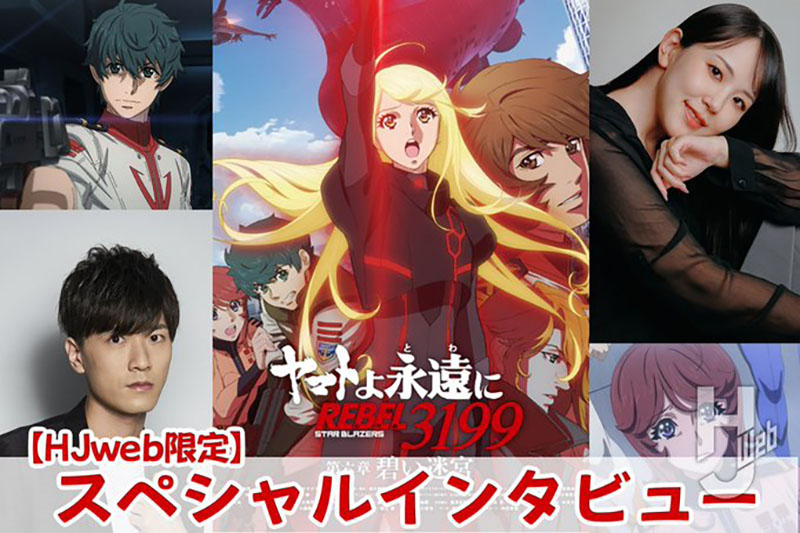
The New Era for the Yamato Crew Brought About by the Mutiny
Interviewer: Miyako didn’t support her fellow crew members’ mutiny, but I feel that choice of hers was a brave one, too.
Muranaka: I can understand where Domon is coming from. But Miyako is someone who, no matter what happened in the past, accepts it positively and embraces it as a precious part of herself. She also deeply values her connections with others. She cherishes the relationships she’s built, whether they are horizontal (peer-to-peer) or vertical (hierarchical).
That’s likely why she felt such conflict regarding the choice to “rewrite the past.” She wondered if it was right to simply erase the bonds we’ve built in the present. There was a certain poignancy to it, too, as if the relationship Domon and Miyako had cultivated up to that point was being dismissed as something that “didn’t matter if it vanished.” It was a scene where so many emotions were swirling together. I remember the recording session being quite a challenge.
Interviewer: Dr. Sado’s description of it as the “worst kind of confession” really resonated.
Muranaka: If the situation had been, say, “Our lives are in danger, so let’s join hands and face it together,” I might have understood. But when someone barges in with a gun and says, “We can just meet again,” you can’t accept that. That’s why I’m glad she came back in the end.
Hatanaka: Yeah. It was moving to be able to portray that kind of romance, something you don’t often get to experience, as part of the younger crew.
Muranaka: The official website’s character profile for Miyako mentions that she “secretly admires the relationship between Kodai and Yuki,” and I heard that the scene where they embrace in space after the mutiny was actually inspired by Kodai and Yuki from 2199. However, while performing, I felt anew that I still have a long way to go before I can match them.
Hatanaka: We’ve still got some digging to do. The bond between the Captain and Yuki is incredibly deep, after all.
Interviewer: During the mutiny, Domon holds a gun to Kodai, yet Kodai seeks to fulfill his role of watching over the young crew. What are your impressions of Kodai in this instance?
Hatanaka: In that scene, when Captain Kodai, despite having a gun pointed at him, says, “I’m coming too,” I felt like the Captain Kodai we all know had finally returned. It really moved me during the recording session. I almost teared up, whether as Domon or as myself, I’m not sure.
To me, Captain Kodai is the kind of person who fully acknowledges the crew’s feelings and then gives them a push, saying, “I’ll take responsibility until the very end, so you guys go ahead and do it.” He has a steady, reassuring presence that makes everyone feel safe and embraced. Seeing him like that made me appreciate his appeal all over again. I thought, “Captain Kodai really is cool.” That’s why, on a personal level, that scene made me want to say, “Welcome back.” It’s a scene I truly love.
Muranaka: In 3199, Captain Kodai started off showing a somewhat cute side, like when he was practicing his proposal to Yuki over the ship-wide intercom. Of course, his coolness has always been depicted, but I also see him as someone who has grown through numerous failures.
That’s precisely why the moment he decided, “I’m coming too,” during the mutiny was so striking. Because he had experienced so many failures himself, he was now in a position to give the younger generation a chance to take on challenges and to accept their failures as well. I think it was a scene that symbolized the passing of the torch among the Yamato crew.
Interviewer: What do you feel when listening to the performance of Daisuke Ono, who plays Susumu Kodai?
Hatanaka: Since working on 3199, I’ve had more opportunities to record alongside Ono-san. We’ve engaged in various discussions, and he’s taught me so much. What’s more, he doesn’t just use words, he leads by example. It felt like passing the baton. Simply saying a line like “Wave-Motion Gun, fire!” would really get my adrenaline pumping. For the back-and-forth dialogue scenes, we wanted to preserve that sense of immediacy, so we decided to record together, even though scenes like that are usually recorded separately. Thanks to that, I think the scenes have much more tension.
Muranaka: I was watching the two of you act from right next to you in the studio. However, I didn’t want to break the atmosphere of that moment, so I kept my gaze lowered as much as possible while still feeling the exchange between you. I had lines of my own coming up after that, so I watched with the mindset that I had to fully absorb the intensity of your clash. It was a tense session, and one that left a deep impression on me.
Hatanaka: Right, that was the session for the scene where there’s a confrontation between Domon and Miyako, too. We recorded it in one continuous flow, so the emotions came out so strongly that, watching the final cut, I found myself thinking, “Isn’t Domon a bit too intense here?” or “He’s really going all out, is he okay?” (Laughs) But it felt like Miyako was there to catch and accept all of that energy.
Interviewer: Finally, please share a message with the fans.
Hatanaka: I really want people to feel the significance of the characters setting foot in Shinjuku. I feel that 3199, and not just Chapter 6, is a story that speaks directly to us in the present day. Take the “Com-Medal,” for instance; if you view it through the lens of modern times, it makes you reflect on things like, “What does it say about us that we’ve become so dependent on it?” or “Why can’t we seem to break free from it?”
It’s a story that’s entertaining in its own right, but I think it also offers new discoveries when you relate it back to our own reality. The question of “Does Yamato have a place where it belongs?” is also a question of, “Do we have a place where we belong?” I believe this is a work that I would particularly like our generation to see.
Muranaka: In 3199, I feel that both the Yamato crew and the people of Earth are constantly faced with having to make choices. Personally, I feel that this is the chapter where those choices are depicted most frequently. Some choose to fight, while others choose to rewrite the past. There are decisions made as part of a military operation, but there are also choices to reveal one’s true feelings or to live in a way that one can be proud of.
Each of these choices might seem very small on its own. Yet, as they accumulate, they eventually become a powerful force that drives the story forward. I believe that this chain of human wills is one of the major highlights of Chapter 6.