
Published in Zero no. 1, January 1978
[Translator’s note: “Yattaran” is a penname. The author borrows the name of the endearingly plump little nerd on the Arcadia in Space Pirate Captain Harlock.]Special thanks to friend-of-the-website Minoru Itgaki for translation support.
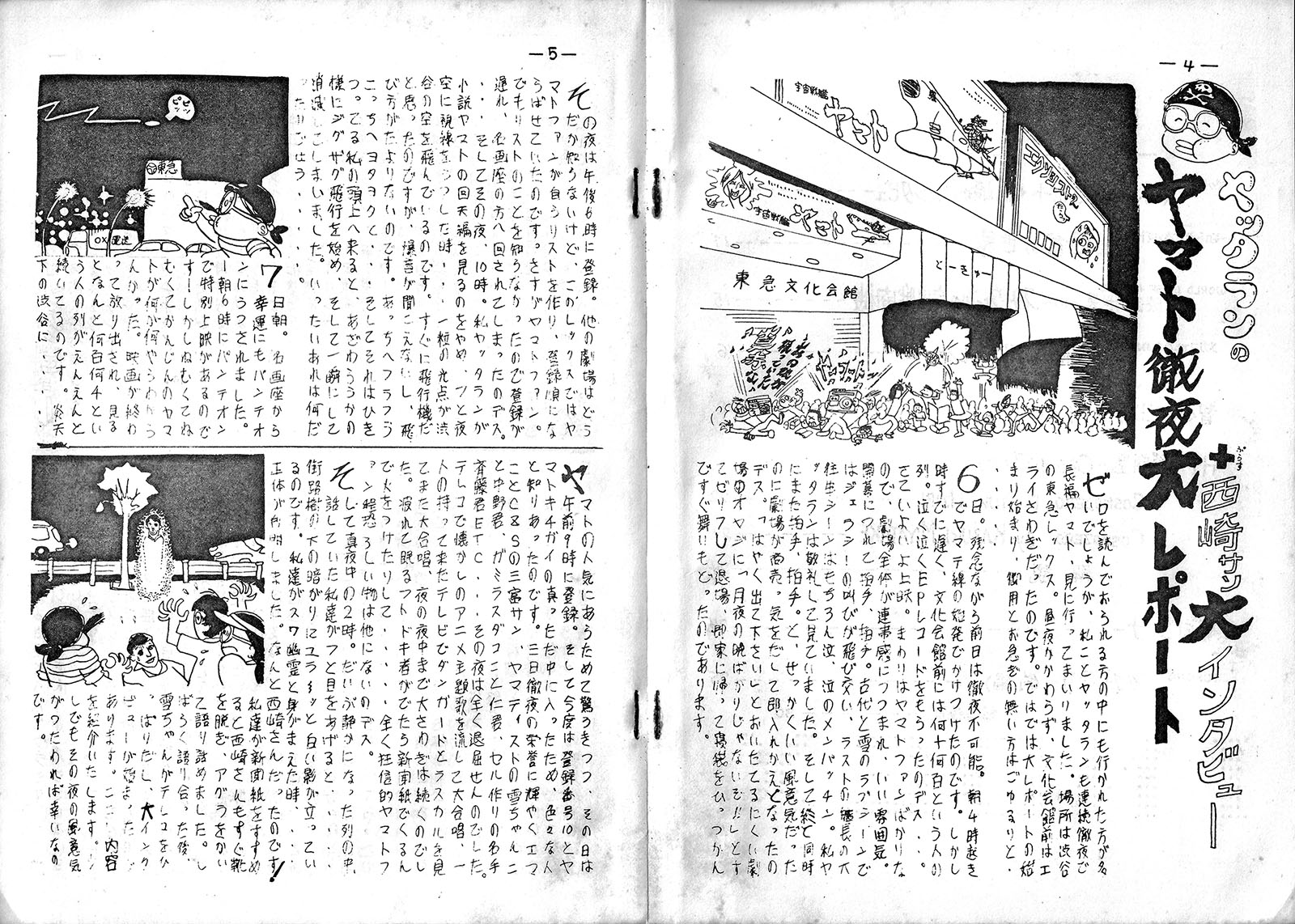
Some of you reading this may have also gone, but I, Yattaran, stayed up all night to go see the full-length Yamato movie. The location was Tokyu Rex in Shibuya [Tokyo]. Day and night, the area out front was incredibly crowded. So, let the grand report begin! Those of you with no business or urgency, please take your time…
On the 6th
Unfortunately, staying up all night the day before was impossible. I woke up at 4am and rushed there on the first train. However, it was already too late. There was a line of dozens or hundreds of people out front. And so the excitement began. Everyone around me was a Yamato fan, so the whole theater was filled with a sense of solidarity, creating a great atmosphere.
As the screening began, there was a lot of applause. During the love scene between Kodai and Yuki, cheers echoed. And of course, the final scene of Okita’s death had everyone crying. I saluted. As soon as it ended, there was more applause. But just when the mood was settling, the theater immediately started changing out the audience. The annoying guy in charge urged us to leave quickly and we headed home.
I registered [for a place to wait] at 6pm that night. Other theaters had their own lists created by Yamato fans, and the registrations were being processed in order. Typical Yamato fans! I didn’t know about the list, so my registration was late and I ended up being directed to an art-house cinema.
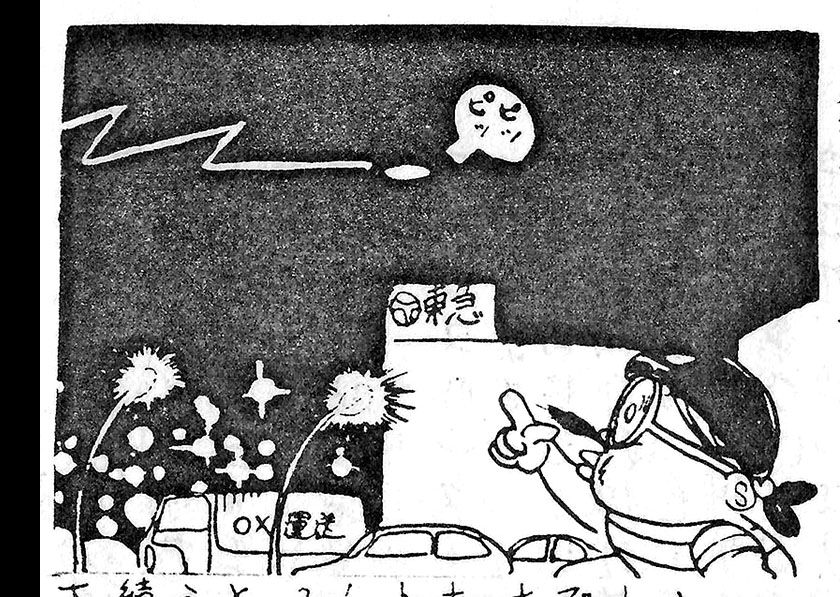
At 10pm that night, I stopped reading a chapter of the Yamato novel and suddenly shifted my gaze to the night sky to see a single point of light flying overhead. I immediately thought it was an airplane, but I couldn’t hear any noise. It wandered aimlessly. It came toward me, then pulled away. As it went overhead, it began to fly in a zigzag pattern, and then vanished in an instant. What on Earth was it?
The morning of the 7th
There was a special screening at the Shibuya Pantheon at 6am, so I went. But I was so sleepy. Yamato was there, but I couldn’t see what was going on. When the movie ended and I was let out, I saw a line stretching on and on, hundreds or thousands of people in the scorching heat of Shibuya.
Surprised by the popularity of Yamato, I registered again at 9am that day. And then, because I couldn’t get a registration number, I ended up right in the middle of a fanatical Yamato crowd. That’s how we met: Emma, also known as Santomi-san of [fan club] CZS, who had stayed up for three days straight. Also, Yuki-chan, Nakano-kun, Gamilas Dakoni, Jin-kun, and Saito-kun the master of cell-making.
That night was anything but boring. We played nostalgic anime theme songs on a tape recorder and sang along together. Watching Danguard Ace and Rascal on a TV someone brought, we started singing along again, and the commotion went on late into the night.
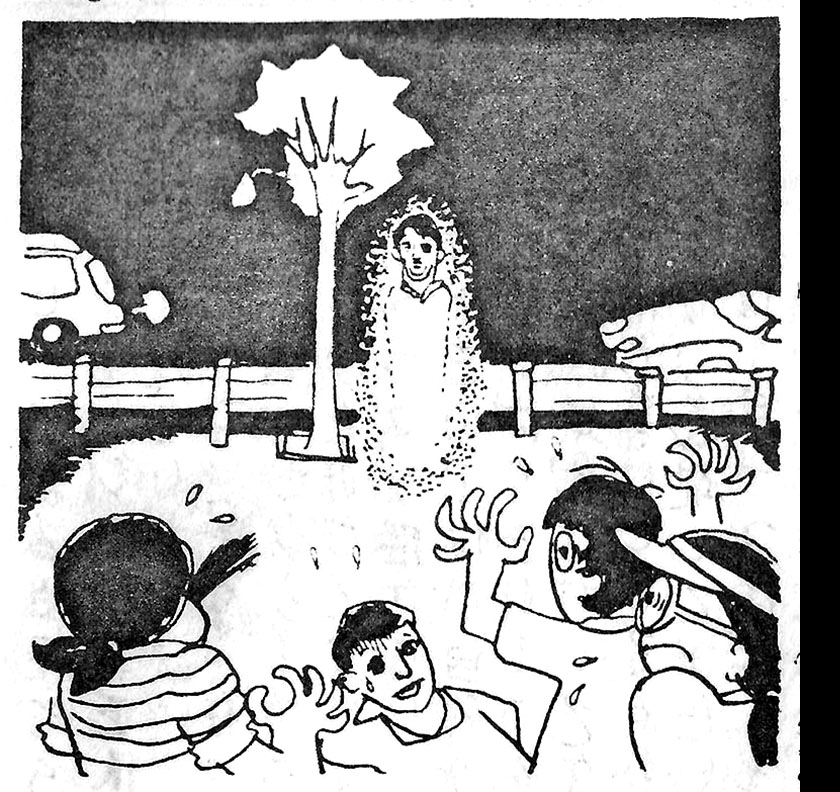
At 2 am, the buzz of insects became quiet. As we looked up, we suddenly saw a shimmering white shadow standing in the darkness between trees on the street. We braced ourselves, expecting a ghost…but his true identity was revealed. It was none other than Mr. Yoshinobu Nishizaki. We offered him a newspaper to sit on. He took off his shoes, sat cross-legged, and we chatted. After a while, Yuki-chan remembered her tape recorder, so I can share the contents.
Big Interview, Nishizaki-san
Nishizaki: Tape recorder, switch on!
Yuki: Yes, it’s running. Going back to the meat of the topic, when did you first start thinking about the name Yamato? I read in a book or somewhere that you’d been thinking about it since you were a child.
Nishizaki: As a child? No, not at all, it was just a subconscious idea. I guess there might be things like wanting a ship to fly and such, but I really came up with this idea about four years ago. That is, about a year and a half before it aired. The reason I came up with the idea was, as it’s been said in various places, my business was making children’s animation, and it got boring. In other words, when targeting elementary students, all you can do is ask questions like, “Why does that happen, and why does it happen this way?” and in that case, you can’t create a real drama. Like in Heidi or something.
Ryoko: (Laughs)
Yuki: Is that revenge for being beaten by a competing program?
Nishizaki: No, I don’t have any grudges or anything like that.
Yuki: No grudges. You also produced and directed Rocky Chuck.
Nishizaki: Rocky Chuck was also produced by Shigehito Takahashi, after all. So, even though I don’t hold a grudge, it’s hard to portray that kind of dynamic in a story, isn’t it? The thing I most want to convey, not to younger children, but to your generation, is what I cherish. I want to express something, whether it will be understood or not. Another reason is that I’ve always liked science-fiction. And in contrast, there were a lot of shoddy things back then. You know, robot shows and monster shows like Ultraman and others. I had a strong aversion to them. And I thought, if that’s how it is, I’ll just make the ultimate outrageous thing.
Yuki: So that was your motivation after all.
Nishizaki: That’s right. I was wondering what to do and I thought, well then, I have a great dream. It has to be a romantic adventure…with love and all. And then it suddenly occurred to me, Japan is a small place now, isn’t it? We can go abroad. No matter how many times you travel, there’s no limit to how far you can go.
With that in mind, I thought I’d like to make a space opera…but how should I go about it? While I was thinking about that, the idea of a ship flying through the sky came to me. I think that with humans, the idea of flying something through the sky is in our latent consciousness, even when we’re kids. There was a novel titled Flying Destroyer. You guys probably don’t know about it, but images like that, visions of the future…I imagined destroyers with wings attached to them.
It’s not like I pulled it out of a book or anything. It was probably just something that was naturally inside me. It was a very simple idea. So I was thinking, what kind of thing would fly through the sky? A sailing ship wouldn’t be interesting. Of course, it would be a spaceship. So why not a battleship? And if it’s a battleship, then it has to be Yamato.
You can think of machines as so-called tools of war in the post-war period, cruisers and submarines and tanks and such. But when you consider Yamato in terms of its mechanics, it’s definitely one of the finest works of art.
Ryoko: That’s right.
Yuki: Even now, Yamato still looks amazing, doesn’t it?
Ryoko: The old Yamato is cool…
Nishizaki: You guys, for example, or rather the younger generation, you like supercars and new models. And there are people who go to jet air shows. It’s the same thing. When we were kids, we were really into Zero fighters and airplanes like that. The things kids get engrossed in are the same no matter what generation you are. There are some people who say stupid things, like it glorifies war, but they need to read the script properly. So we boldly used the “Battleship March” in the flashback scene. That’s when Mr. Matsumoto went totally pale.
Yuki: Why?!
Nishizaki: He likes it too, but he was really afraid that if people interpreted that kind of thing as glorifying war, it would reflect negatively on him as an artist. So I told him, “I’ll take full responsibility as the producer, so just use it.” If the old battleship Yamato were to sail out to the tune of a school sports day march, it just wouldn’t make any sense, would it?
Ryoko: Right.
Yuki: I thought it was good to put it together that way. That’s the real Yamato.
Ryoko: Combining the old music with the old Yamato.
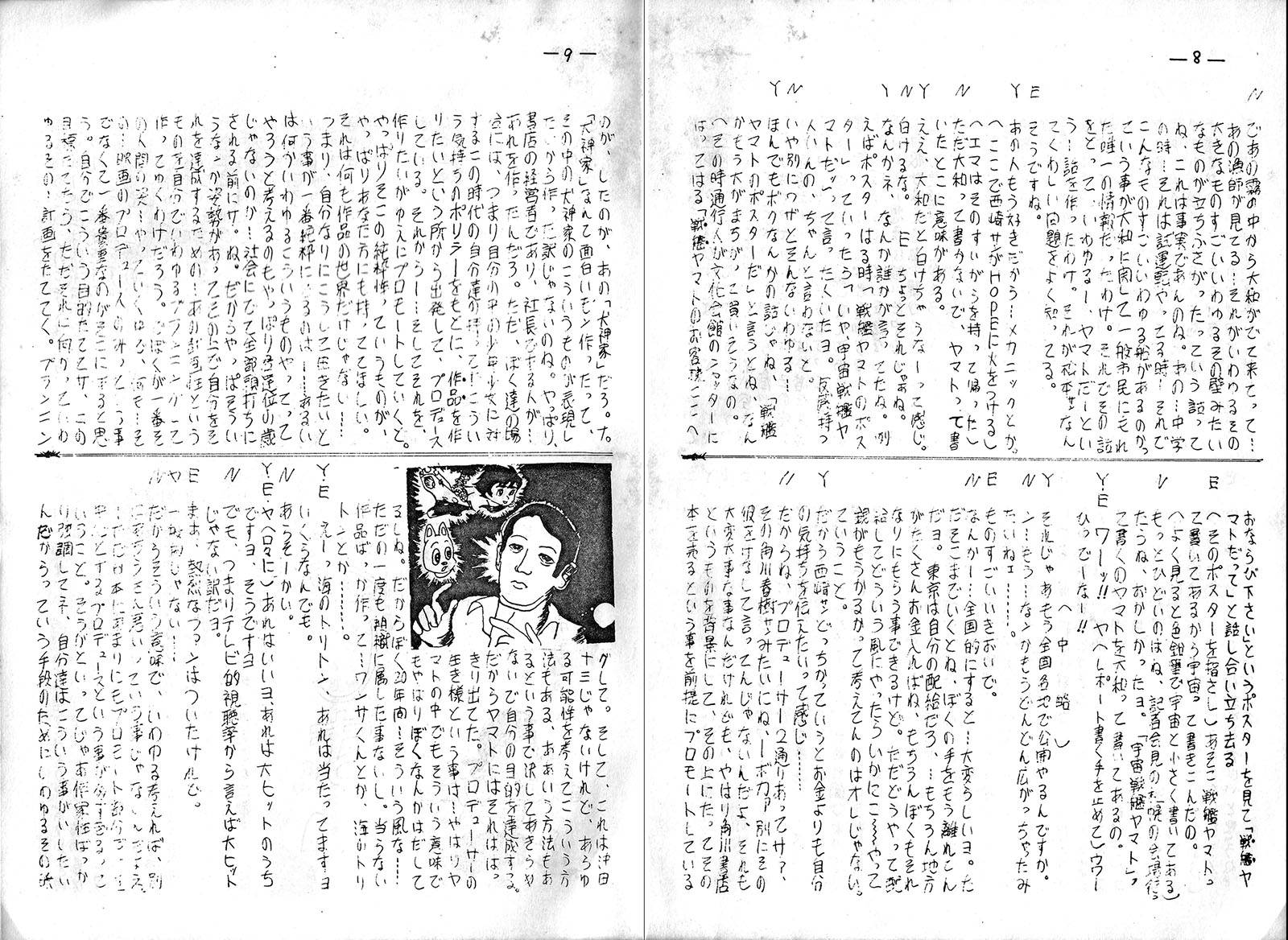
Nishizaki: It was said that Yamato emerged from the mist and fishermen saw it, and it was a huge, intimidating, wall-like structure, and that’s actually true. I was in junior high school during its test run. So the only information about Yamato that leaked to the public was that it had such an incredible shape. So we took that and created a story that says, “This is Yamato!” Matsumoto-san knows the problems.
Ryoko: I agree.
Yuki: I already like that person…mechanic or something.
Nishizaki: And the fact that we wrote Yamato‘s name in katakana rather than kanji is significant.
Yuki: Yeah, using kanji kind of kills the mood.
Nishizaki: You’d lose interest.
Ryoko: Well, it just wouldn’t do.
Yuki: I remember someone saying something like that. For example, when putting up a poster, someone said, “A poster for Battleship Yamato,” and someone else said, “No, it’s Space Battleship Yamato.” Since some people might take offense, we need to be clear about this.
Nishizaki: I didn’t do that on purpose.
Yuki: In my case, if I say, “This is a poster for Battleship Yamato,” my big brother will probably buy it.
(A Passersby saw a poster that read, “Passengers for the Battleship Yamato, please line up here,” and said, “The Battleship Yamato, huh?” before walking away.)
Ryoko: She pointed to the poster and said, “It says ‘Battleship Yamato,’ so I added ‘Space.'”
(It says “Space” in small letters written in colored pencils)
Nishizaki: What’s even worse is that the word “Yamato” from Space Battleship Yamato was written in kanji (大和) at the venue for the press conference.
Yuki/Ryoko: Whoa!!
Yattaran: Stop the report and say, “That’s terrible!”
Yuki: So, are you going to release it nationwide?
Nishizaki:It looks like it’s spreading rapidly.
Ryoko: With tremendous force.
Nishizaki: I hear it’s really tough to expand nationwide. But if it spreads that far, it’ll be beyond my control. I handle distribution in Tokyo, but if significant profits are made in other regions, I’ll naturally stand to earn a fair share.
However, it’s not my place to figure out how to make money from this.
Yuki: Are you more interested in conveying your feelings than making money?
Nishizaki: There are two types of producers, right? Like Haruki Kadokawa. Surely, The Inugami Curse is the one that’s being promoted with the explicit intention of selling books, backed by Kadokawa Shoten. Right? They made it because they thought it was interesting, not because they wanted to express some particular aspect of it. After all, it was made by the owner and president of the publishing company.
My starting point was that I wanted to create a work based on the feelings I had about boys and girls in this era and produced something based on that sentiment. I’m promoting it because I want to create it. I really want you all to have that same sincerity. Not just in the world of fiction, but the purest idea of living. The most important thing is that you start thinking about it at a certain age, because once you enter society everything runs into a wall. So you need to have that kind of attitude toward planning to achieve your goals.
I only made works that didn’t become hits, like Wansa-kun and Triton of the Sea.
Yuki/Ryoko: Triton of the Sea! No way! That’s a huge hit!
Nishizaki: Oh, really?
Yuki/Ryoko: That’s one of the big hits! That’s right, that’s right!
Nishizaki: But based on the TV ratings, it wasn’t exactly a huge hit.
Ryoko: It has gained a very passionate fan base.
Yattaran: That’s not the same as the general public.
Nishizaki: When you think about it, it’s not like they’re in the wrong. It’s just that in Japan, there are simply too many projects that focus too heavily on promotion. That said, I hate it when people focus solely on artistic vision and use film merely as a means to an end, just to say, “This is what we want to do.”
On the contrary, movies should be entertainment, after all. In other words, this isn’t really the place to give a speech. That should be done in an essay or in public speaking. That’s why I hate social dramas. They often put a person in charge and say, “This is what I want to say,” and when it’s viewed as a movie it’s completely boring.
There are people who make social dramas, right? I’m not one of them. Those kinds of works are probably fine, but I would never do it. Basically, things like that are about entrusting money. I don’t think you’re going to listen to someone’s opinions in some bland way. Another thing is that visual arts aren’t really for that kind of thing, but they’re about how you can combine music and sound effects and dialogue to convey something wonderful.
And I think it would be good for me to leave it there. Well, that wraps up the speech. It’s over.
Yuki: But–
Just then, Nishizaki’s finger pressed the stop button a split second too soon.
What did you think? The interviewers seemed excited and didn’t quite get to the point, but I think this long interview was somewhat helpful. Nishizaki then drove away in his car.
We Yamato fanatics kept the party going, and at daybreak we formed a social group called “Group NAMEKUZI” and vowed to each other that we would definitely start up again.
Once again, seeing Yamato [in a theater] was completely bewildering. I tried my hardest to hold on, but I lost consciousness somewhere around Alpha Centauri. When I came to, I was going on about, “It’s Earth!! I can see Earth!”
What on earth was I doing!?