

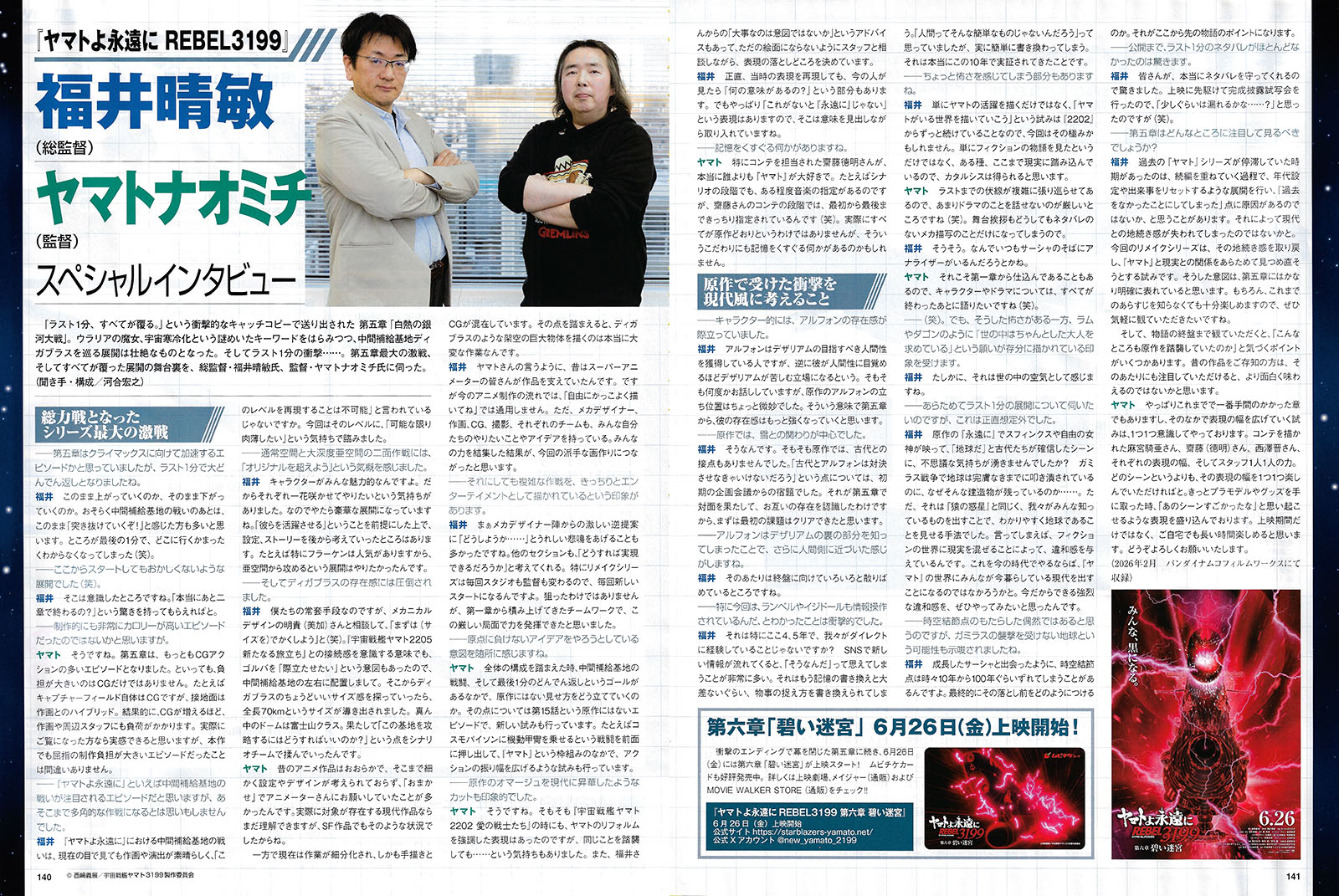
General Director Harutoshi Fukui and Director Naomichi Yamato
Special Interview
REBEL 3199 Chapter 5 was launched with the shocking tagline: “In the last minute, everything changes.” With mysterious keywords, such as The Witch of Uralia and space cooling, the events surrounding the intermediate supply base Digablas unfold in a spectacular fashion. And then comes the shock of the last minute. We spoke with general Director Harutoshi Fukui and Director Naomichi Yamato about the behind-the-scenes story of the most intense battle in Chapter 5, and the events that changed everything.
Interview by Hiroyuki Kawai
The most intense battle of the series, a total war
Interviewer: I thought Chapter 5 would accelerate toward the climax, but there’s a huge twist in the last minute.
Fukui: Will we keep going up, or will we keep going down? After the battle at the intermediate supply base, I think many people felt like we were going to “break through!” But in the last minute, it becomes completely unclear where we’re going. (Laughs)
Interviewer: It was the kind of development where everything could have easily restarted from there. (Laughs)
Fukui: That was something we were conscious of. We wanted readers to be surprised and think, “is it really going to end in just two more chapters?”
Interviewer: I imagine this was a very demanding episode from a production standpoint.
Yamato: that’s right. Chapter 5 became the episode with the most CG action. That said, it wasn’t just the CG that was a heavy burden. For example, the capture field itself was CG, but the contact surface was a hybrid of CG and hand drawn animation. As a result, the more CG there was, the greater the burden on the hand-drawn animation and the surrounding staff. As anyone who’s seen it will understand, it was undoubtedly one of the most production-intensive chapters in the series.
Interviewer: In Be Forever Yamato, the battle at the supply base is probably the moment that gets the most attention, but I never imagined it would turn into such a multifaceted operation.
Fukui: That battle in Be Forever is still considered to have amazing animation and direction even by today’s standards, and it’s been said that, “it’s impossible to re-create this level.” This time, we approached it with the desire to come as close as possible to that level.
Interviewer: The two-pronged strategy involving both normal space and deep sub space conveyed a strong determination to surpass the original.
Fukui: All the characters are appealing, so I wanted to give each of them a chance to shine. That’s why the story has become so extravagant. We started with the premise of letting them play an active role, and then developed the concept and story afterward. For example, Frakken is particularly popular, so I wanted to have him attack from sub space.
Interviewer: And I was overwhelmed by Digablas’ presence.
Fukui: It’s our usual method, but after consulting with mecha designer Mika Akitaka, our first decision was to “make it bigger.” (Laughs) We also wanted to make Goruba stand out in order to maintain a sense of connection with Yamato 2205, so we placed them on either side of the intermediate supply base. From there, we explored what size would be just right for Digablas, and we arrived at a total length of 70km. The dome in the middle is about the size of Mount Fuji. The script team then pondered the question, “How can we possibly conquer this base?”
Yamato: Older anime productions were more relaxed. The concepts and designs weren’t thought out in such detail, and often the animators were given free rein. I can understand that if it’s a modern work based on a real world subject, but that used to be the case even with SF works.
On the other hand, the work is now highly specialized, and a mix of hand drawn and CG is used. Consider, considering this, drawing a gigantic, fictional object like Diablo is an incredibly difficult task.
Fukui: In the past, the animators were the ones who supported the production. However, given today’s anime trends, simply saying, “Draw whatever you want and make it look cool” doesn’t work. But the mecha designers, animators, CG artists, and cinematographers each have their own ideas and things they want to do. I think the result of combining everyone’s strengths led to the spectacular visuals we got this time.
Interviewer: Nevertheless, I get the impression that they’ve managed to portray such a complex operation as thoroughly entertaining.
Fukui: Well, we received some fierce Counter proposals from the mecha designers. There were many times when I would let out a happy cry of, “What should we do?” Other departments would also think about, “How can we make this happen?” With the remake series, the studio and director change each time, so it’s always a fresh start. It wasn’t intentional, but I think the teamwork we’ve built up since the first chapter allowed us to show our strength in this tough situation.
Interviewer: I can sense your intention to create ideas that are just as good as the original.
Yamato: Considering the overall structure of Yamato, with the battle at the intermediate supply base and the twist in the last minute as the goal, how do we create a presentation that wasn’t in the original work? In that regard, we tried something new in Episode 15. For example, we put the manuever of mounting a mobile armor on a Cosmo Python at the forefront, and we’re trying to broaden the range of action within the framework of Yamato.
Interviewer: The scenes that seem to elevate an homage into modern context are also impressive.
Yamato: That’s right. In Yamato 2202, there was an emphasis on the redesigned form of the ship, but I felt that we shouldn’t just repeat the same thing. Also, Mr. Fukui advised us that the important thing is the intention, so we consulted with the staff to decide on the right balance of expressions to make sure it wouldn’t just be a visual spectacle.
Fukui: even if we re-create the expressions used back then, there are parts that people today might look at and think, “What’s the point?” But it wouldn’t feel like Be Forever if we left some of them out. So we incorporate those while finding meaning in them.
Interviewer: There’s something about it that tickles the memory.
Yamato: Tokuaki Saito, who was in charge of the storyboards, truly loves Yamato more than anyone else. For example, even at the script stage, there were some specifications for the music, but in his storyboard, the music was specified from beginning to end. (Laughs) In reality, not everything is exactly the same as the original, but there may be something about that kind of attention to detail that tickles the memory.
Rethinking the impact of the original work in a modern context
Interviewer: In terms of characters, Alphon‘s presence really stands out.
Fukui: Alphon is someone who embodies the humanity that Dezarium aspires to, but conversely, the more he awakens to his humanity, the more Dezarium suffers. As I’ve mentioned several times before, Alphon’s position in the original story was a bit ambiguous. In that sense, I think his presence will become even stronger from Chapter 5 onward.
Interviewer: In the original story, the focus was on his relationship with Yuki.
Fukui: That’s right. In the original, there was no connection between Kodai and Alphon at all. The idea that “they must face off” was on the agenda since the early planning meetings. They finally did it in Chapter 5, and acknowledged each other‘s existence, so I think we’ve cleared the first hurdle.
Interviewer: Now that Alphon has learned about the dark side of Dezarium, it feels like he’s become even closer to the human side.
Fukui: That’s where we were scattering various elements toward the end of the game.
Interviewer: In particular, it was shocking to learn that Ranbel and Isidore were also being manipulated.
Fukui: Isn’t that something we’ve all directly experienced, especially in the last four or five years? When new information comes in on social media, we often find ourselves thinking, “Oh, really?” It’s almost as if our memories have been rewritten. Our perception of things has been completely altered. I used to think, “Humans aren’t that simple,” but they really are easily rewritten. That’s something that’s been truly proven over the last ten years.
Interviewer: Some parts that are a little scary, aren’t they?
Fukui: Rather than simply depicting the exploits of Yamato, the attempt to depict the world in which Yamato exists has been ongoing since 2202, so this might be the culmination of that. It’s not like just watching a fictional story. It delves into reality to this extent, so I think viewers will experience a catharsis.
Yamato: The plot is so intricately interwoven with foreshadowing leading up to the end that it’s difficult to talk too much about the story. (Laughs) Even at stage greetings, we inevitably end up talking only about the mecha to avoid any spoilers.
Fukui: that’s right. Like, why is Analyzer always by Sasha’s side?
Yamato: Well, some of that has been planned since the very first chapter, so I’d like to talk about the characters in the story after everything is over. (Laughs)
Interviewer: I get the impression that the wish that “the world needs proper adults” is fully depicted, as seen in characters like Ram and Dagon.
Fukui: I definitely feel that’s the general atmosphere in society.
Interviewer: I’d like to ask you again about what happens in the last minute. To be honest, it was completely unexpected.
Fukui: in the original Be Forever, when the sphinx and the Statue of Liberty are shown, and Kodai and the others are convinced that it’s earth, didn’t you feel a strange sensation? Earth was utterly destroyed in the Gamilas war, so how are those structures still standing? However, just like in Planet of the Apes, it was a technique to show that it was Earth in an easy to understand way, by showing things that we all know. To put it simply, it creates a sense of incongruity by mixing reality into a fictional world. If we were to do this in the present day, wouldn’t it be like showing the modern world, that everyone lives in now, in the world of Yamato? I really wanted to try creating an intense sense of incongruity that’s only possible in this day and age.
Interviewer: I think it’s a coincidence brought about by the space-time node, but it also suggests the possibility of an Earth that was not attacked by Gamilas.
Fukui: just like when we met the grown-up Sasha, the space time node can sometimes shift by as much as 10 to 100 years. How will we ultimately resolve that? That will be the key point of the story from here on out.
Interviewer: I’m surprised there were almost no spoilers for the last minute, leading up to the release.
Fukui: I was surprised at how well everyone kept the spoilers a secret. We held a preview screening before the general release, so I thought, “Maybe a few spoilers will leak out…” (Laughs)
Interviewer: What other aspects of Chapter 5 should we pay attention to?
Fukui: I sometimes think that the reason the previous Yamato series went through a period of stagnation was that, in the process of creating sequels, it reset the timeline and events, essentially erasing the past. I think this caused it to lose its sense of continuity with the present. This remake series is an attempt to restore that sense of continuity and to re-examine the relationship between Yamato and reality. I think that intention is quite clearly expressed in Chapter 5. Of course, you can fully enjoy it, even if you don’t know the previous storylines, so I hope you’ll feel free to watch it.
And as you watch the story toward the end, you’ll notice several points that you wouldn’t have thought were faithful to the original. If you’re familiar with the older works, I think you’ll enjoy it even more if you pay attention to those details.
Yamato: This was definitely the most time-consuming chapter we’ve worked on so far, and we’ve consciously tried to broaden the range of expression in each and every aspect of it. The range of expression is all thanks to storyboard artists Kia Asamiya, Tokuaki Saito, and Susumu Nishizawa, as well as the efforts of each and every staff member. Rather than focusing on any particular scene, I hope you’ll enjoy the range of expression in each and every detail. We’ve incorporated expressions that will surely make you think, “That scene was amazing,” when you pick up a model kit or merchandise. I believe you’ll be able to enjoy it for a long time, not just during the theatrical run, but also at home. Thank you very much.
Recorded at Bandai Namco Filmworks in February 2026