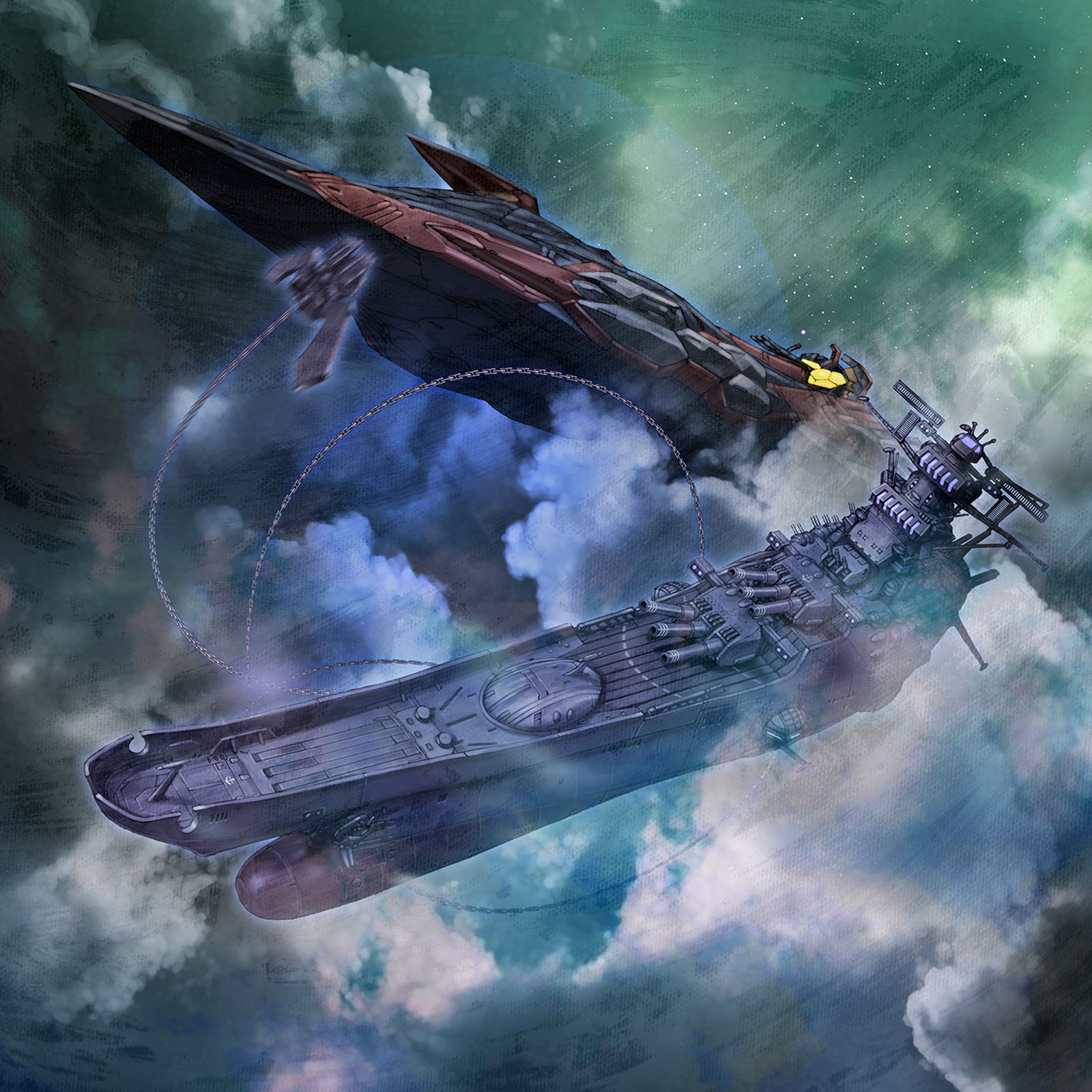
One of the greatest parts of being a Yamato fan is adding a new dimension to your music collection, giving us all a way to immerse ourselves in this world at almost any time and place. The first OST for REBEL 3199 offered that supreme pleasure again when it was released on February 20, 2026. These notes are meant to expand and increase your enjoyment.
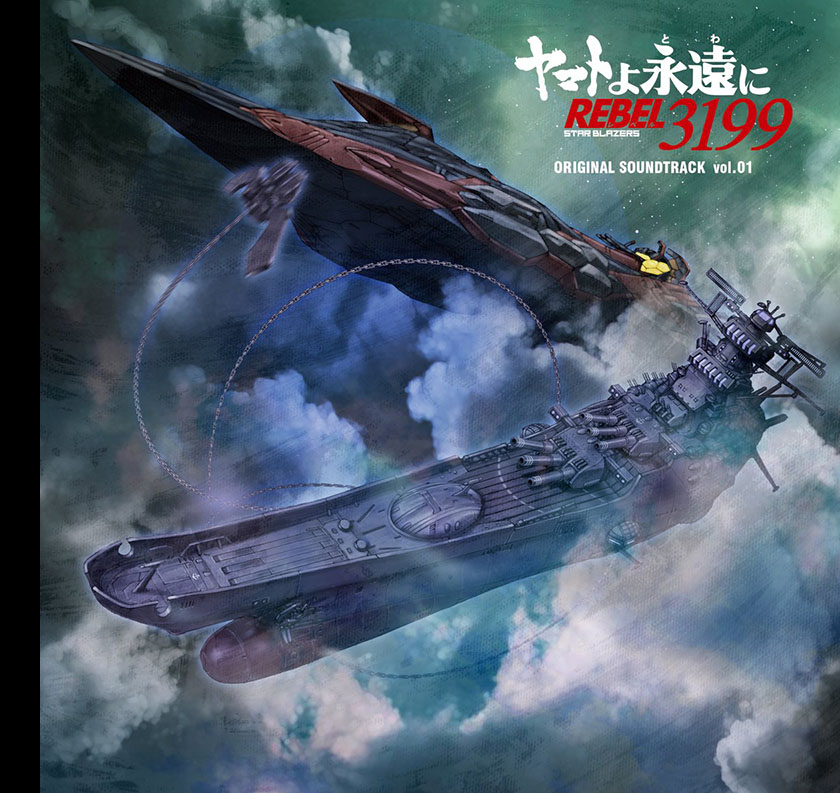
Cover art by Kia Asamiya; see it larger at the end of this page
Introduction by
Sound Director Tomohiro Yoshida
Since production of space battleship Yamato 2199 began in 2011, Akira Miyagawa has been the sole composer of the background music. But this time, a new member named Shu Kanematsu has joined the team to compose and arrange the music. He is a highly active composer who not only creates background music for live-action films and anime, but also writes music for documentaries, musicals, and numerous artists. For 3199, Kanematsu is mainly in charge of the music related to Dezarium.
I started by reading the 26 episode scripts several times and making a list of the tracks that I heard in my head, along with the songs that were requested, and then divided them into three groups.
The first group is a re-recording of tracks from Be Forever Yamato. The second is a re-recording of songs from Yamato 2 and Yamato III, since 3199 continues to incorporate elements from those works. The third category is new tracks by Akira Miyagawa, and Shu Kanematsu.
The background music for 3199 was recorded in two sessions, and this volume one soundtrack mainly includes the background music from the first session, which took place in October and November 2023.
I personally want to mention that since 2199, we have been using Sound Inn Studio in Ichigo for recording background music. In fact, this studio was used for recording the previous works Be Forever and Yamato III in 1980. It was quite moving to record a soundtrack in the same space after more than 40 years.
Since I’m running out of space to write, I’ll skip the familiar older tracks and just briefly introduce the 11 new pieces by Akira Miyagawa and Shu Kanematsu.
First up, our five background music tracks, composed and arranged by Miyagawa
1000 Years of Darkness is used in the scene where Skaldart tells the story of Dezarium’s thousand year history, and is a sad piano concerto that accompanies a magnificent historical picture scroll.
Welcoming Ceremony is a ceremonial march to welcome the settlers from Dezarium.
Domon and Ageha (piano solo) is a sad piano piece used in the scene where Yamamoto tells Kodai about their past.
Domon and Ageha is used in the scene where they set off in the Cosmo hound, and the tension created by the pizzicato strings is impressive.
And then there is the theme of Sasha, the film’s greatest heroine: Sasha Iscandar Kodai, in which a sad yet beautiful ensemble of piano, woodwinds, and strings portrays Sasha’s various expressions.
Next are four background music tracks composed and arranged by Kanematsu
The Dezarium people go through the process of growing into adults while changing the size of their artificial bodies. Maxim’s daughter Fleur meets Tsubasa Kato and builds her own identity through various experiences. The two pieces that depict this are Fleur (piano strings) and Fleur (woodwind harp).
Time Paradox was used in the scene where the Nanbu father and son faced off at the party. It relentlessly increases the tension between the two.
The Dezarium people perform the Dezarium String Quartet as a token of appreciation for their settlement, but having lost their culture, the piece they play is a dissonant sound reminiscent of modern music.
Finally, there are two pieces composed by Miyagawa and arranged by Kanematsu
Major Alphon (piano solo): in fact, several versions of Alphon’s theme were recorded as piano solos for the original film, but they ended up not being used. They have finally seen the light of day on this album.
Mother Dezarium is a piano solo piece with the Dark Nebula Empire melody. The mysterious atmosphere of Mother Dezarium is quietly played.
Since this Volume 1 contains many background pieces used in the early part of the story, it is a good counterpart to the first Be Forever album. Like that one, it may seem a little plain, but we hope you’ll continue to look forward to volume 2.
Click here to listen to the entire album on Youtube
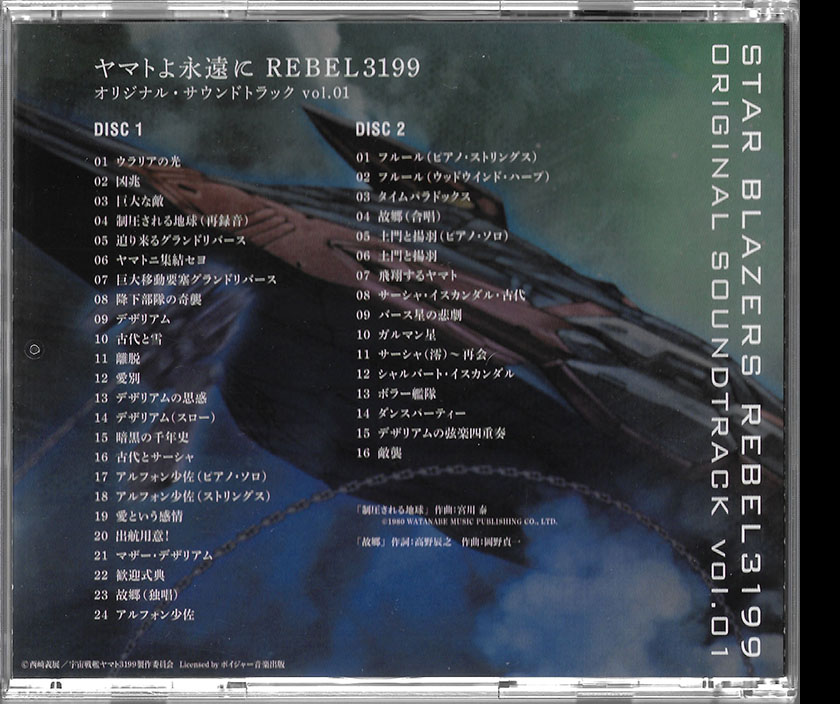
Track Listing
Translation by Anton Mei Brandt
Many of these tracks are new recordings of music from Be Forever or Yamato III. Use the bracketed information to find it on a Sound Almanac (SA) CD.
An asterisk ( * ) indicates a new composition for 3199
01. (The) Light of Uralia [SA-1980-IV: tr. 01]
02. Evil Omen [SA-1980-IV: tr. 02]
03. Giant Enemy [SA-1980-IV: tr. 24]
04. Earth Under Siege [SA-1980-I: tr. 06]
05. The Grand Reverse Approaches [SA-1980-IV: tr. 04]
06. Assemble at Yamato! [SA-1980-IV: tr. 10]
07. Gigantic Mobile Fortress / Grand Reverse [SA-1980-IV: tr. 03]
08. Paratrooper Ambush [SA-1980-IV: tr. 05]
09. Dezarium [SA-1980-IV: tr. 06 / SA-1980-I: tr. 08]
(Appears to be a mix of both versions listed, with synth-heavy sections interlinked with chorus-heavy portions)
10. Kodai & Yuki [SA-1980-IV: tr. 15]
11. Breakaway / Withdrawal [SA-1980-IV: tr. 08]
12. Parting in Love.
(愛別 is the original name, very tricky. After some research, it appears Fukui and Co. borrowed this rare kanji construction from the Buddhist “Eight-Sufferings,” the one in question referring to “The pain of being separated from those one loves.”)
13. The Dezarium Agenda [SA-1980-IV: tr. 20]
14. Dezarium (Slow) [SA-1980-IV: tr. 07]
15. A Thousand Years of Darkness *
16. Kodai & Sasha [SA-1980-IV: tr. 12]
17. Major Alphon (Piano Solo) *
(This track is listed in the recording sessions for the original Be Forever, but was either never released or saved.)
18. Major Alphon (Strings) [SA-1980-IV: tr. 23]
19. A Feeling Called Love [SA-1980-IV: tr. 22]
20. Prepare for Departure! [SA-1980-IV: tr. 11]
21. Mother Dezarium *
22. Welcome Ceremony *
23. Furusato / Hometown (Vocal Solo) *
(This is the folk song that plays in episode 5. The literal translation would be “Hometown,” or “Town of Old,” but since it’s attached contextually to Dezarium, it would be fair to translate it as “Homeland,” or “Motherland” if one wishes to imbue the “Mother Dezarium” connection in the name.)
24. Major Alphon [SA-1980-IV: 26]
DISC 2
01. Fleur (Piano & Strings) *
02. Fleur (Woodwind Harps) *
03. Time Paradox *
04. Furusato/Hometown (Chorus) *
05. Domon & Ageha (Piano Solo) *
06. Domon & Ageha *
07. Soaring Yamato [SA-1980-IV: tr. 37]
08. Sasha Iscandar Kodai *
09. The Tragedy of Planet Berth [SA-1981-II: tr. 06]
10. Planet Galman [SA-1981-II: tr. 21]
11. Sasha (Mio) ~ Reunion [SA 1974-1983-Disc 3, tr. 16]
12. Shalbart Iscandar [SA-1981-I: tr. 07]
13. Bolar Fleet [SA-1981-III: tr. 18]
14. Dance Party [SA-1981-III: tr. 11]
15. Dezarium String Quartet *
16. Enemy Raid [SA-1981-II: tr. 20]
Liner notes by
Sound Director Tomohiro Yoshida
Beginning February 7 2026, samples of 14 tracks were released as Youtube shorts every day up until the release on February 20. They were accompanied by Yoshida’s notes. Click on the name of each track to hear them for yourself.
A battle arrangement of Dark Nebula Empire. At the beginning of the original Be Forever Yamato, it was used for interceptor missiles being launched against the Hyperon Bomb and also when the giant battleship Grodez aims for Yamato after it leaves the enemy’s home planet.
2. The Approaching Grand Reverse
In the original work, this was used for the scene where the Hyperon Bomb begins to descend to Earth and lands on the surface where it is surrounded by the Earth Defense Force. Using the motif of Dark Nebula Empire, the heavy rhythm creates a sense of tension.
This piece is known as Dark Nebula Empire in the original work. It’s a masterpiece that embodies the quiet invasion at the beginning of the film. The most difficult part of re-recording it was recreating the synthesizer tones. The cutting edge synth sound source of the time is now a thing of the past, so a vintage synthesizer was brought into the studio to produce the same sound. Everyone in the room, including Akira Miyagawa, was left wondering, “Is this the one?” Thanks to that, I think we were able to create a profound piece that colors the atmosphere of the early part of 3199.
4. A Thousand Years of Darkness
A new piece created for 3199. It is a grand and lyrical piece, reminiscent of Smetana’s The Moldau. When we talked about the plot, this was the first melody that came to Akira’s head. My first impression was that it was a little too mellow, but it fit perfectly with Skaldart’s speech. It is used in an impressive way in Chapter 4 as well, and is a good example of how the piece expands the world beyond your expectations.
In Be Forever Yamato, this theme was used in the scene where Alphon, held in Yuki’s lap, explains how to defuse the Hyperon Bomb, then he falls into eternal sleep. It is performed by strings and a rhythm section. The first half of this piece was used in Chapter 2.
A new piece by Shu Kanematsu. This was new blood being poured into Yamato‘s musical world, so I went into the recording session feeling half excited and half anxious, but I remember breathing a sigh of relief when I heard this. It contains the insight and expressiveness that embodies everything about the girl named Fleur. They may be young, but Kanematsu’s kind are not ordinary people.
A new piece created specifically for 3199. This is truly the work of the “new blood” of Kanematsu. The time paradox, a science-fiction theme never before encountered in Yamato films, brings an unprecedented atmosphere to the story. In the world of Yamato music, which is primarily melodic, there aren’t many pieces that explain situations like this, so I’ve found it useful in other places besides Chapter 3, where it was first heard.
There are actually two versions of this piece, and the ones included on the soundtrack album are the ones used in the film. Domon and Ageha, the world of male friendship…however, the way “men” and “friendship” are perceived and portrayed has changed considerably since the original Yamato III was released. We used this version, which also has an air of suspense, to express the frustration of not being able to truly hold hands even though they are looking in the same direction, and the subtle distance that exists between them.
In the original Yamato III, many pieces were created using this motif as the theme for the planet Shalbart, which pursues peace. In Chapter 4, a version of Shalbart Iscandar’s theme was used, without scat or synthesizers.
10. The Tragedy of Planet Berth
The original version of this piece was used in Yamato III Episode 6, when Captain Ram communicates with Yamato from the damaged Rajendora. A sad arrangement of Bolar Federation with strings. Ram’s feelings for Planet Berth are expressed in Chapter 4.
In Yamato III, this piece was used with narration at the beginning of Episodes 16 and 17. Beautiful strings and harp invite you to hope. In Chapter 4, it was used to depict Yamato heading toward Planet Galman, just like in the original work.
I asked Shu Kanematsu to write a song that would be painful to listen to, and this is what he came back with. It’s exactly as requested, but also somehow consistent, and it’s the work of a musician that makes you want to listen to it. It has a feel somewhat like the soundtrack of an avant-garde Japanese film from the 1960s, which I like.
This is one of the themes of 3199. Sasha’s theme from the original Be Forever is also good, and we used it in the series, but it’s a piece that looks at Sasha from the perspective of an adult man, and takes into account the fact that “inside, she’s a 2-year old child.” 3199 also depicts the “world seen from Sasha’s perspective,” so we asked for a piece specifically to support that, and this lovely composition was born. This melody will be repeated in subsequent chapters to create and incredibly dramatic piece, so please look forward to it.
In the original Be Forever (monaural version), this was used in the scene where the Cosmo Tigers attack the enemy’s intermediate supply base. A heavy battle song from Yamato, characterized by fast tambourines and a synthesizer in the middle.