
Thoughts after watching Episode 2
See the original blog post here
It’s winter in Sapporo, and the snow is falling outside. The smell of the kerosene dwindling from the kerosene stove somehow overlaps with the smell of oil in that ship’s engine room.
I’ve reorganized this review a bit. You can decide if it’s easier to read.
Episode 2 isn’t a flashy battle, but a tale of “technology and rebirth,” depicting the moment humanity rises from despair through the down-to-earth steps of “auxiliary engine → tilt recovery → main engine ignition.”
Why is an engineer in his 60s talking about an anime from 50 years ago? It’s because I feel that the strength to rise from hopeless situations is needed now more than ever.
In this article, I hope to evoke nostalgia for longtime fans and convey the charm of the original to the younger generation who first encountered the remake. I hope to share with you the “miracle of engineering” and “leadership’s decision” seen through the eyes of an engineer, as well as the beauty of the moment humanity rises to its feet.

Summary of highlights
Space Battleship Yamato Episode 2 depicts “starting from despair”
Technical highlights from Episode 2’s iconic scenes, from “Wave-Motion Engine Ignition” to “Launch”
The aesthetic of procedural and down-to-earth restoration embodied in the famous line, “Right the ship!”
Captain Okita’s resolve: The transformation from “escape ship” to “ship that fights to reclaim”
The rusty camouflage: The moment of shedding as it peels off, revealing silver hope
An engineer’s perspective: The tension of “ignition,” where theory transforms into physical force
The Aesthetics of “Procedure” That Awakens a Sleeping Lion
As the night deepened, the stove’s kerosene meter was red. Too lazy to refill it, I just went straight into Episode 2.
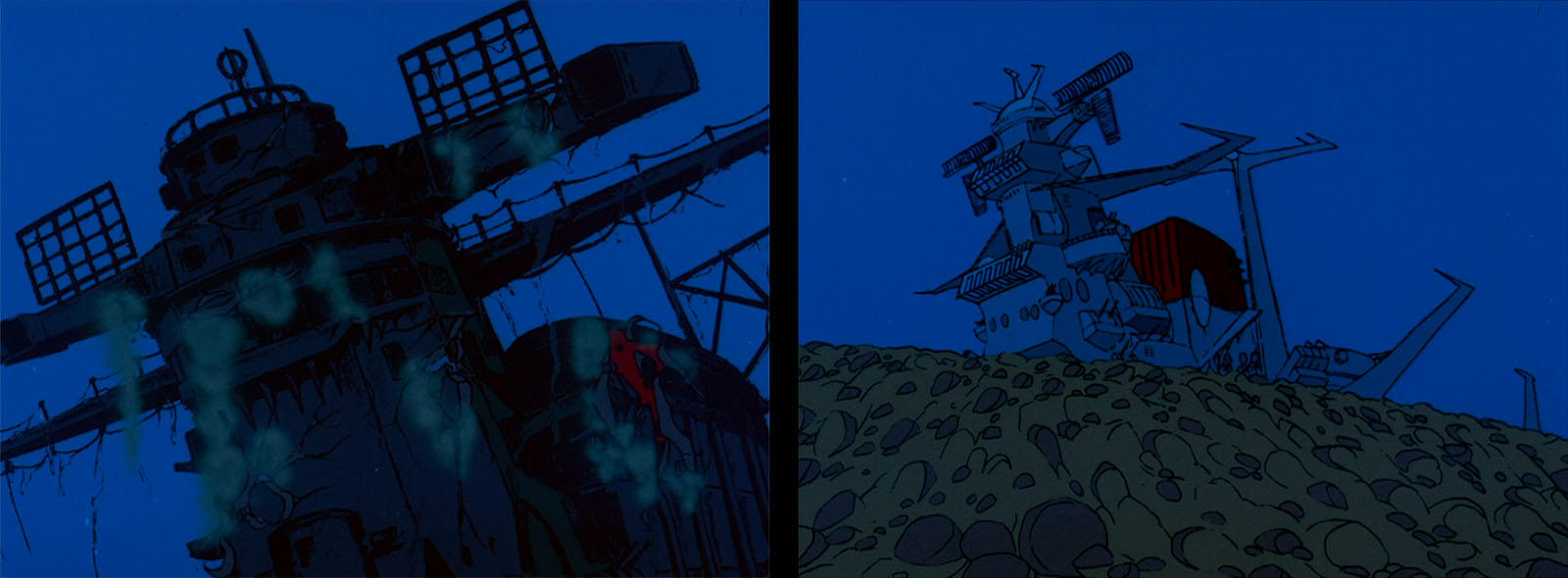
This is one of the most technically intensive episodes in the entire series. The setting is off the coast of Bougasaki, Kyushu. The former Imperial Japanese Navy battleship Yamato lies buried beneath the dried-up ocean floor. In fact, beneath (or perhaps within) this wreckage, a space battleship is being constructed in utmost secrecy. Watching the camouflage peel away brought tears to my eyes.
The young crew members are assembled: protagonist Susumu Kodai, his partner and navigator Daisuke Shima, and the hard-drinking but skilled military surgeon Dr. Sado. With them aboard, the ship awaits its awakening.

1. The Wave Engine’s “Ignition”: From Theory to Reality
The ignition of the Wave Engine in Episode 2 isn’t a sci-fi production; it’s a scene depicting the “initial firing” that transforms theory into reality, much like the test run of a large-scale machine in real life. Even from an engineer’s perspective, it’s a very realistic depiction.
The scene in which Chief Engineer Tokugawa approaches the main console encapsulates the tension of operating a new machine.
Even though it was assembled according to the blueprints from Iscandar, it’s still a technology never before seen by mankind.
“Energy injection, pressure rising…connect!”
The needle on the gauge fluctuates, and a low vibration is felt throughout the ship.
This isn’t just a simple switch being turned on. It’s the moment when theory is transformed into physical force. I had a similar experience during the test run of a large turbine during my active duty days, and that feeling of a “sleeping behemoth beginning to breathe” is something that can’t be replaced by anything else.
2. The Importance of the Auxiliary Engines: The Famous Scene “Right the Ship!”
The essence of Captain Okita’s command, “Right the Ship!”, lies in his choice of a “regeneration procedure” using the auxiliary engines to restore balance, rather than immediately launching using the main engines.
The climax of Yamato‘s launch doesn’t come from immediately using the main engines. The steps preceding that are crucial.
As Gamilas’ high-speed aircraft carrier approaches and fires a missile attack, Captain Okita first orders the auxiliary engines to start.
Situation: The ship is buried in mud and is heavily tilted. Launch is impossible if this continues.
Countermeasure: Using only the thrust of the auxiliary engines, the ship is forced to a horizontal position (righting the tilt).
With Shima at the controls, the massive ship pushes through the mud and rights itself, creaking and screaming.
“Right the ship!”
This command not only physically raises the ship, but also serves as a cry to awaken the souls of humanity, which has fallen into despair.

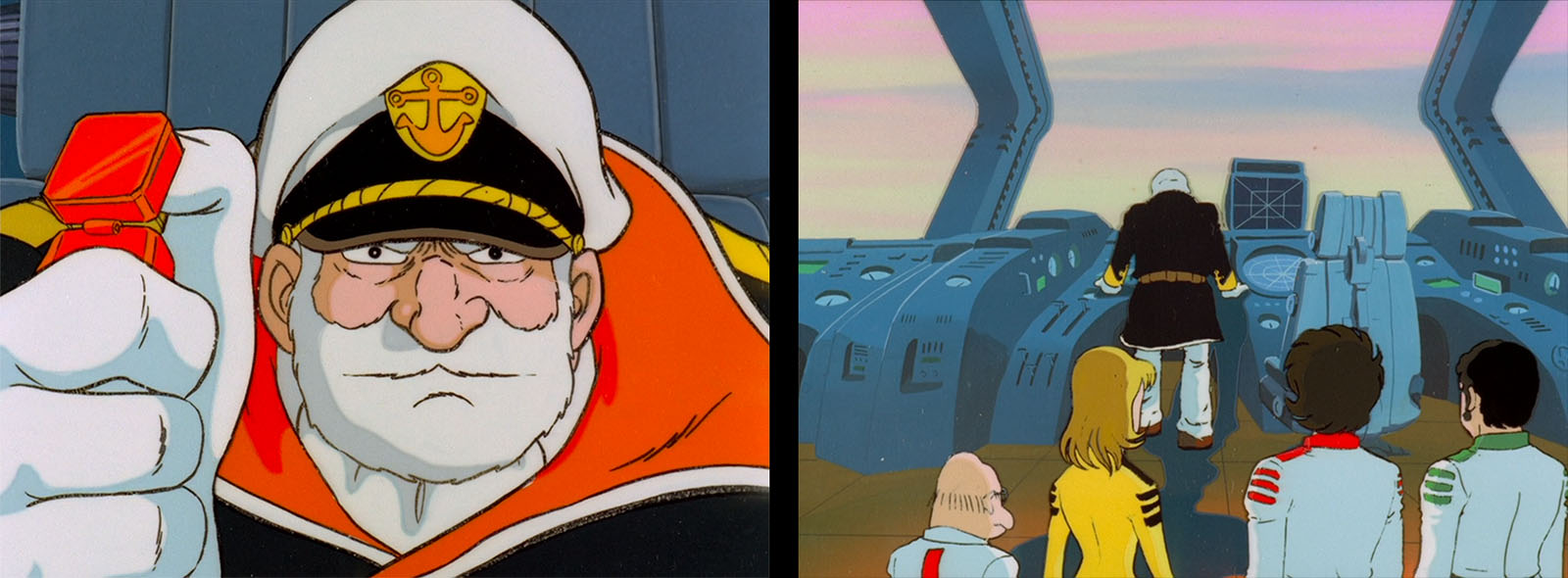
A close-up of Okita, sporting his trademark white beard and his captain’s cap pulled down low. His piercing eyes evoke a powerful expression, suggesting his resolve for the arduous journey ahead.

3. Peeling Off the Camouflage: Shedding the Past for the Future
The scene in which the rusted outer shell of the battleship Yamato peels off, revealing its silver hull, serves as a narrative metaphor not for “discarding past defeats” but for “moving into the future while still clinging to them.”
After the ship returns to a horizontal position, the Wave-Motion Engine (main engine) is finally ignited. As the ship rises under its overwhelming thrust, rust and mud covering Yamato‘s hull peels off in pieces.
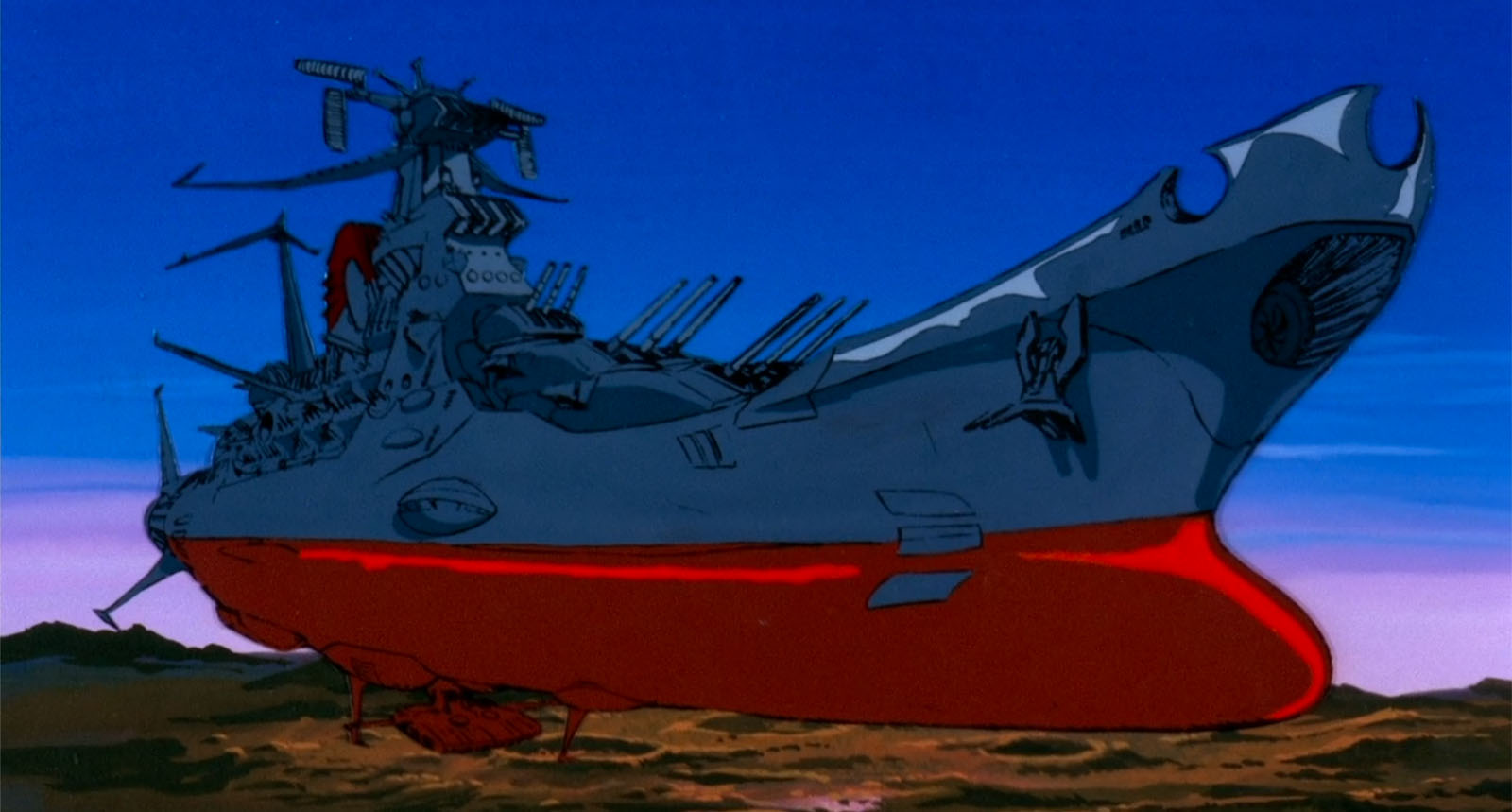
Emerging from within is a gleaming silver hull made of cemented carbide. While it carries the burden of its rusty past, its interior is state-of-the-art. This is perhaps a metaphor for breaking free from the shell of past tragedy and being reborn as hope for the future.
I’ve been studying AI recently, and I’m sure that AI would be able to filter out this intensity as “unnecessary noise.” However, this noise is precisely what human memory is.
And so, Yamato soars into the air and fires its main guns (shock cannons) at the pursuing enemy aircraft carrier. The cathartic sequence in Episode 2, from “restoring” to “launch” to “first hit,” is one of the most memorable scenes in anime history.

Core Considerations of the Story: Why Did It Have to Be Yamato?
1. A Shift from the “Escape Plan”
The original plan proposed by the United Nations Agency for Outer Space Affairs was to evacuate only a select few humans and animals from Earth and relocate them elsewhere. However, Captain Okita and Kodai chose not to.
“We will not abandon Earth. We will definitely save it.”
They set off to retrieve the radiation removal device (Cosmo Cleaner D). A 148,000 light-year round trip. This shift in purpose transforms Yamato from a ship for “escape” to one for “fighting and reclaiming.” It was this shift in purpose that elevates Yamato from a mere sci-fi mecha to a “savior.”
2. Juzo Okita: The Image of a Leader
Captain Okita has contracted space radiation sickness and has only a short time left to live. According to Dr. Sado’s diagnosis, his body is in ruins. He knows he may not survive until Iscandar. Still, he stands on the bridge to guide the young people.
“I will definitely return.”
These words are not a lie. Even if his body perishes, his soul and the young people he raises will return to Earth. That is his “return.” Is there a more profound and gentle resolve for someone at the head of an organization?
Helpful Guide for Future Viewers
Finally, I’d like to leave you with my own guide for those experiencing the world of Yamato for the first time, or those returning after a long time.
Viewing Order: Start with the “Origin”
There are many Yamato series and remakes, but if you’re not sure which one to watch, I recommend the following.
◆ Space Battleship Yamato (1974 TV series)
The beginning of it all. While the animation is a bit rough, the passion and direction are top-notch. The sense of tension from the first and second episodes can only be experienced here.
◆ Space Battleship Yamato 2199 (2012 remake)
Yamato is reborn with modern technology. The setting is consistent (for example, the distance to Iscandar has been revised to 168,000 light-years based on the latest astronomy), and the visuals are stunning. It also pays deep respect to the original, making this a more accessible experience for younger generations.
◆ Farewell to Space Battleship Yamato (1978 film)
A legendary work that sparked a social phenomenon. It’s impossible to watch without shedding a tear.
The Power of Music, Lyrics, and Voice Actors
Music is essential when discussing Yamato. The tranquil opening (overture), The Infinitely Expanding Universe featuring only scat singing, expresses the loneliness of space. And the lyrics of the theme song, sung by Isao Sasaki, begin with “Farewell, Earth, the departing ship…” — a song of encouragement for our generation.
The brilliant performances by legendary voice actors like Goro Naya (Captain Okita) and Kei Tomiyama (Susumu Kodai) still move the soul.
Streaming and Overseas Reactions
While in the past you could only wait for reruns, now you can easily watch it on various streaming services. It’s also aired overseas under the title Star Blazers, and is well-known for its devoted fan base. Watching overseas reaction videos, it’s heartwarming to see how the themes of “self-sacrifice” and “hope” have resonated across borders.
Plastic Models and Sculptural Beauty
Bandai’s plastic model technology has evolved alongside Yamato. The currently available 1/1000 scale series requires no glue and boasts perfect color coding. Even those of us with advanced vision loss can enjoy the beautiful form simply by assembling it. After watching Episode 2, you’ll definitely want to make one.

Dad’s nagging
(To you, buried in mud and unable to move)
Sapporo’s snow is a pain. If left unchecked, even the sturdiest roofs will buckle under the weight. The only solution is to remove the snow little by little every day.
In Episode 2, there’s a scene where Yamato sheds its mud and rust and takes off. When you see that, don’t you think it’s just “cool”? As an engineer, I’d say it’s a ritual of “rebirth.”
If we live long enough, our bodies and minds will rust. I’m over 60, and while I’m taking care of my sister and maintaining my old family home, there are nights when I suddenly feel like my heart is buried in mud. When I look in the mirror, all I see is a tired, middle-aged man.
But look at Yamato. That rust isn’t just deterioration. It was a camouflage that had withstood fierce battles, a shell to protect the Wave-Motion Engine inside. The fatigue you feel now, the rust known as memories of failure, are actually proof that they have been protecting you.
Captain Okita didn’t suddenly start the main engine. He ordered, “Start the auxiliary engines, right the ship.” This is important. When trying to get out of a quagmire, people often panic and try to use all their power all at once, only to end up spinning out in vain. Start with auxiliary power first. Slowly return your tilted center of gravity to a horizontal position.
For me, an auxiliary engine might be putting kerosene in the stove and brewing a hot coffee every morning. It’s small steps like these that awaken my rusty body.
There’s nothing to be ashamed of about rust. Just peel it off. Beneath it, your shining silver soul is still sleeping, unscathed.

Conclusion: In Search of an Unrusting Soul
Episode 2 of “Space Battleship Yamato” isn’t a spectacular battle, but rather a tale of technology and rebirth that will remain in anime history. It depicts the process of a gigantic structure rebooting through proper procedures and judgment.
At the end of Episode 3, Yamato leaves Earth’s atmosphere and departs for the unknown. “Goodbye, Earth.” The crew’s parting words aren’t ones of sadness, but rather a promise that they will definitely return.
My own active career as an engineer is over. My body is broken in many places. But just as the rusted Yamato managed to stand up using its auxiliary engines, people can always take on new challenges as long as there is the will. This is what gives me courage.
The snow outside the window still hasn’t stopped. But deep in my heart, I can hear the warm heartbeat of the Wave-Motion Engine. I hope this heartbeat reaches you too. The strength to rise even in despair, the courage to break out of your rusty shell and move forward. That’s why Yamato is still beloved 50 years later.
Whenever life seems to stall, I always remember the launch of Yamato: Don’t suddenly start the main engine, start with the auxiliary engine.
Thank you for reading to the end.