
Published August 7, 1983


Yamato Series 1
Text by Osamu Kobayashi
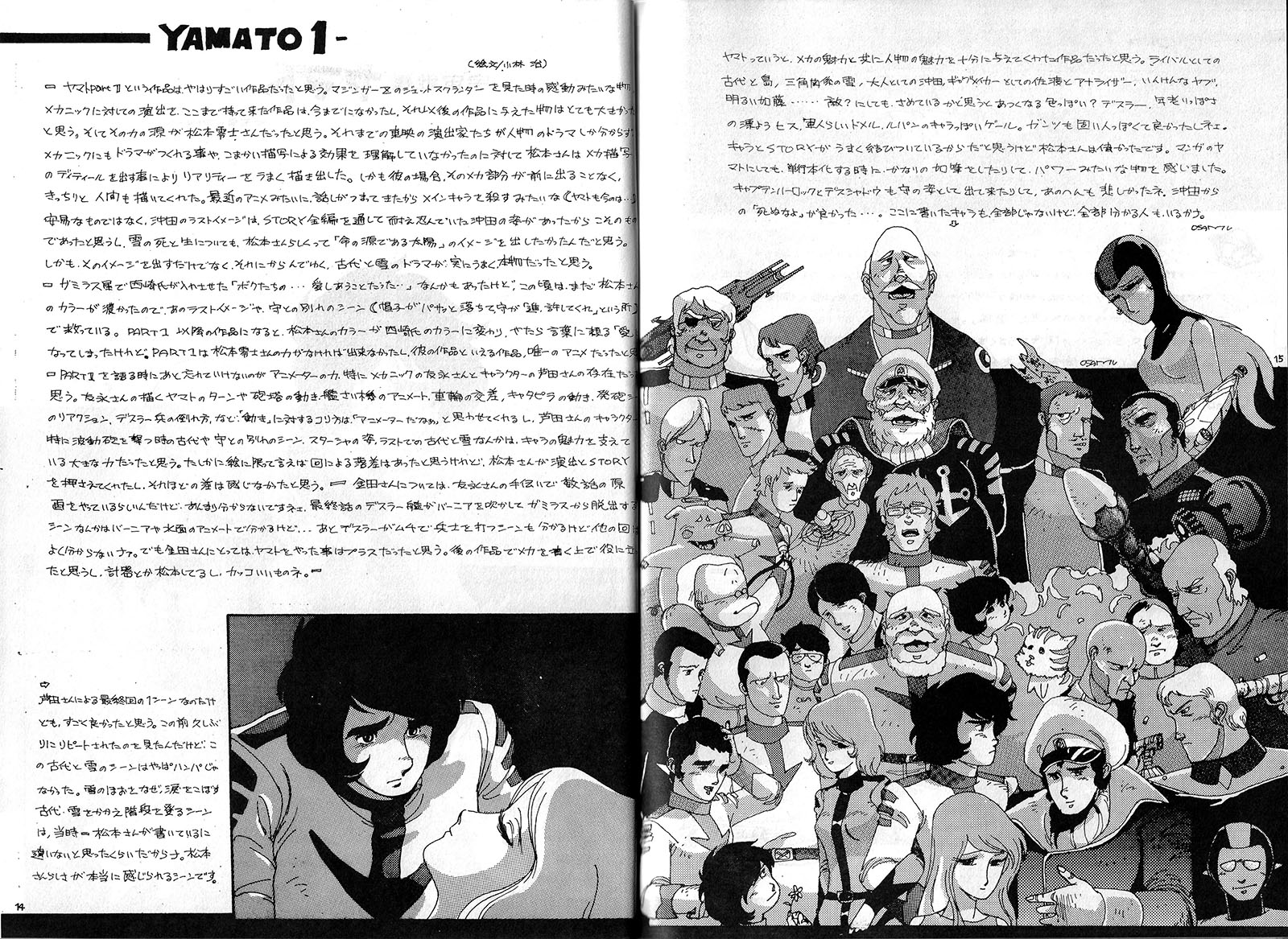
I think Yamato part 1 was an amazing work. There had never been a work before it that brought the same kind of excitement I felt when I saw the Jet Scrander from Mazinger Z. No other work had ever taken the direction of mecha to this level, and I believe the impact it had on subsequent works was enormous. I believe the source of that power was Leiji Matsumoto. Up until then, Toei’s directors only understood character elements. They didn’t understand that mecha could also create drama, or the impact of detailed depictions.
Matsumoto, on the other hand, skillfully portrayed realism by bringing out the details of the mecha. Moreover, he didn’t let the mechanical aspects take center stage, but instead focused on portraying the humans. It wasn’t like recent anime where the main character is killed off because the story is getting boring (like in Yamato now). Okita‘s final image was only possible because of his endurance throughout the entire story. Regarding Yuki‘s life and death, I believe Matsumoto wanted to convey the image of “the sun, the source of life,“ which is typical of him. Moreover, not only did he convey that image, but the intertwining story between Kodai and Yuki was very well done and authentic.
There was also the “we should have loved each other“ line that Nishizaki included at Gamilas, but at that time, the Matsumoto tone was still strong, so the final image, the parting scene where Mamoru’s hat flies off and he says “Susumu, please forgive me,“ is what saves it. From part 1 onward, Matsumoto‘s tone changed into Nishizaki‘s tone, and it became a “love“ story that relied excessively on words. Part 1 would not have been possible without Leiji Matsumoto‘s efforts, and it is the only anime that can be called his work.
When talking about part 1, we must not forget the skills of the animators, particularly mecha director Kazuhide Tomonaga and character director Tomo Ashida. Tomonaga‘s attention to movement; the way he drew Yamato‘s turns and turrets, the animation of the aircraft carriers, the crossing of the wheels, the movement of the caterpillar tracks, the reactions to gunfire, the way Dessler‘s soldiers fall, and other aspects make you think “he’s an animator.“ And Ashida’s characters; the farewell scene with Kodai and Mamaru, firing the Wave-Motion Gun, Starsha’s appearance, and Kodai and Yuki at the end, were a major force in supporting the appeal of the characters.
Certainly there were differences in the art depending on the episode, but Matsumoto controlled the direction of the story, so I don’t think it felt that different. As for Kanada, he worked on several episodes with Tomonaga‘s help, but I don’t really understand how many. I know one was the scene in the final episode where Dessler escapes from Gamilas, because of the animation of the jets and the water surface. I also know it was the scene where Dessler hits the soldier with his whip, but I don’t really know about the other episodes. But I think working on Yamato was a plus for Kanada. I think it was useful for him when depicting power in his later works, and the instruments and other things were really cool.
Speaking of Yamato, I think it was a work that gave us plenty of the charm of the characters as well as the mecha. Kodai and Shima as rivals, Yuki in a love triangle, Okita s the adult, Dr. Sado and analyzer as comic relief, the nasty Yabu, the cheerful Kato…and the enemy? Even Dessler seems cool, but then he gets hot and sexy? Hyss with an old man vibe, Domel with a military feel, and Gael (who seems like a Lupin character) was also good as a tough guy. I think it’s because the characters in the story are well connected thanks to Matsumoto. Even the Yamato manga was heavily revised when it was collected into a book, and I felt like it had a power up effect. Captain Harlock and Death Shadow appeared as Mamoru, and that was sad too. Okita saying “don’t die“ was good. I’m sure there are people who understand all of the characters I’ve written about here, though maybe not everyone.
Left side bottom:
This is a really good scene from the final episode, drawn by Ashida. I recently saw it for the first time in a while, and this scene between Kodai and Yuki was just amazing. I thought the scene where Kodai carries her up the stairs with tears streaming down his cheeks must have been done by Matsumoto back then. It’s a scene that really captures his style.
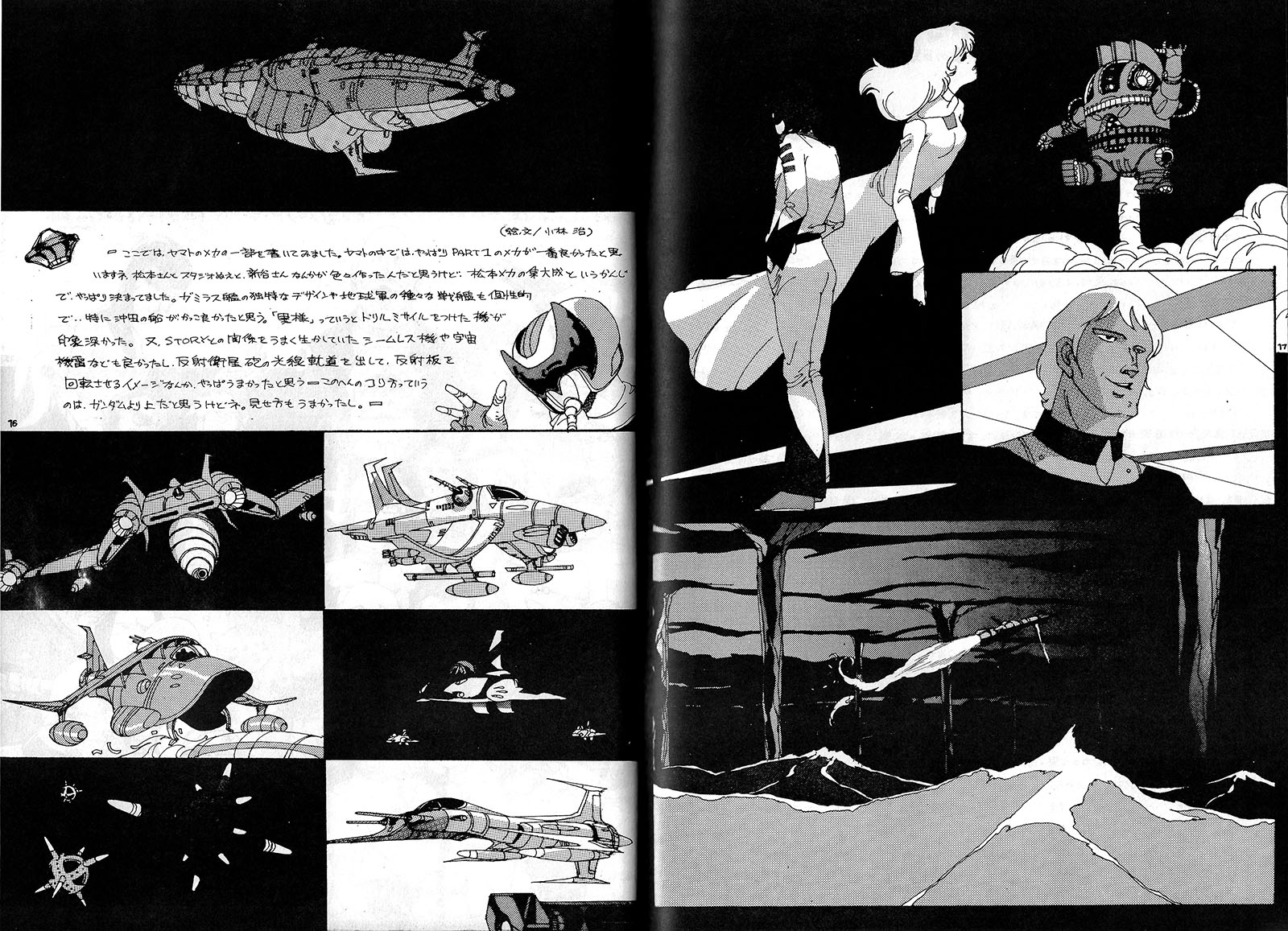
Here I’ve drawn some of the mecha from Yamato part 1. I think the mecha in part 1 was the best. I think Matsumoto, Studio Nue, Kaoru Shintani, and others created a lot of things, but it felt like a combination of Matsumoto‘s mecha skills, and it was definitely a good choice. The designs of the Gamilas ships and the various battleships of the Earth forces were also unique. I thought Okita’s ship was especially cool. And the plane equipped with the drill missile left a strong impression. The seamless plane and other space mecha made good use of their relationship with the story, and the image of the reflection satellite cannon’s beam, trajectory, and rotating reflectors was really great. I think these were done way better than in Gundam. Great presentation.

Farewell to Yamato
Text by Mitsushi Shimoyama
There are many thoughts about Farewell to Yamato. While part 1 has generally been well received, Farewell is not as highly rated. I wonder why. In my opinion, Farewell is also excellent. It can be called a highly polished work of entertainment. I think the trajectory of Yamato after Farewell is what gave rise to fans’ obsession, thinking that it should have ended there. Also, even if they say “the theme is love“ was anyone at the time not moved after watching it? Were there really any people who were left feeling disappointed? If you ignore the obsessions we had with with Yamato after Farewell, I don’t think there are many anime that delighted audiences like this. Everything from the animation, script, composition, setting, mecha, design, and background music is incredibly well-rounded, and the high quality of the entertainment is simply astonishing.
Compared to works like Harmagedon, which get by simply by assembling a stellar staff, or the dizzying action in Crusher Joe by outstanding artists, it’s easy to see how cohesive Farewell is. I think it’s amazing how it shows a variety of battle scenes, supported in some way by logic, without ever wearing you out, and they draw you into the story. Also, many renowned artists were involved in the animation, and if it were made today, it would surely be a riot of individuality.
Even so, it’s surprising how consistent the artwork is, considering how talented these people were back then. Thanks to this, Kanada’s work is clearly more restrained than in other works from the same period. Speaking of Tomonori Kogawa‘s character art, it’s amazing, but it still feels unfinished. Perhaps because of the difficulty he faced later on in Ideon, he made a big leap toward the unique characters he draws today. The same can be said for Yasuhiko.
In any case, whether it was staged or due to his youth, I don’t want to forget that it was the only experience I had of seeing a movie in the cinema three times in one day and hearing applause break out at the end each time. For me, Farewell is an anime that honestly surprised and seriously moved me.
Text by Osamu Kobayashi
For me, Farewell was an interesting piece. Kodai supporting Yuki‘s fallen body, and Sanada and Saito risking their lives to help Kodai escape, overlapped with Sanada in part 1. I think this is because Yasuhiko was involved in both works. As for the animation, I didn’t know much about it at the time, but I thought it was good, and Kodai looked a little creepy, but the movement was interesting. I also liked the sharpness of Kanada’s and Tomonaga‘s explosions, and the high contrast processing. But I still thought the last scene was contrived, and I didn’t like what Okita said. I thought it was cruel. I thought Teresa was a nasty person, too. She even took Kodai with her. I think the final scene is the negative factor that drags the film down. I think it’s human instinct to not want to die, and the idea of a cool death is just fiction. This work has that fake scene. Matsumoto‘s image of men collapsing in pain, misery, and emptiness is not there. It’s just takes on the image of the kamikaze pilots, smiling and acting like cool heroes for their country. Kogawa’s editing and Yasuhiko‘s direction are both part of the final scene. But I think it ruined everything. I think the reason for this was the true nature of producer Nishizaki.
Yamato 2
Text by Osamu Kobayashi
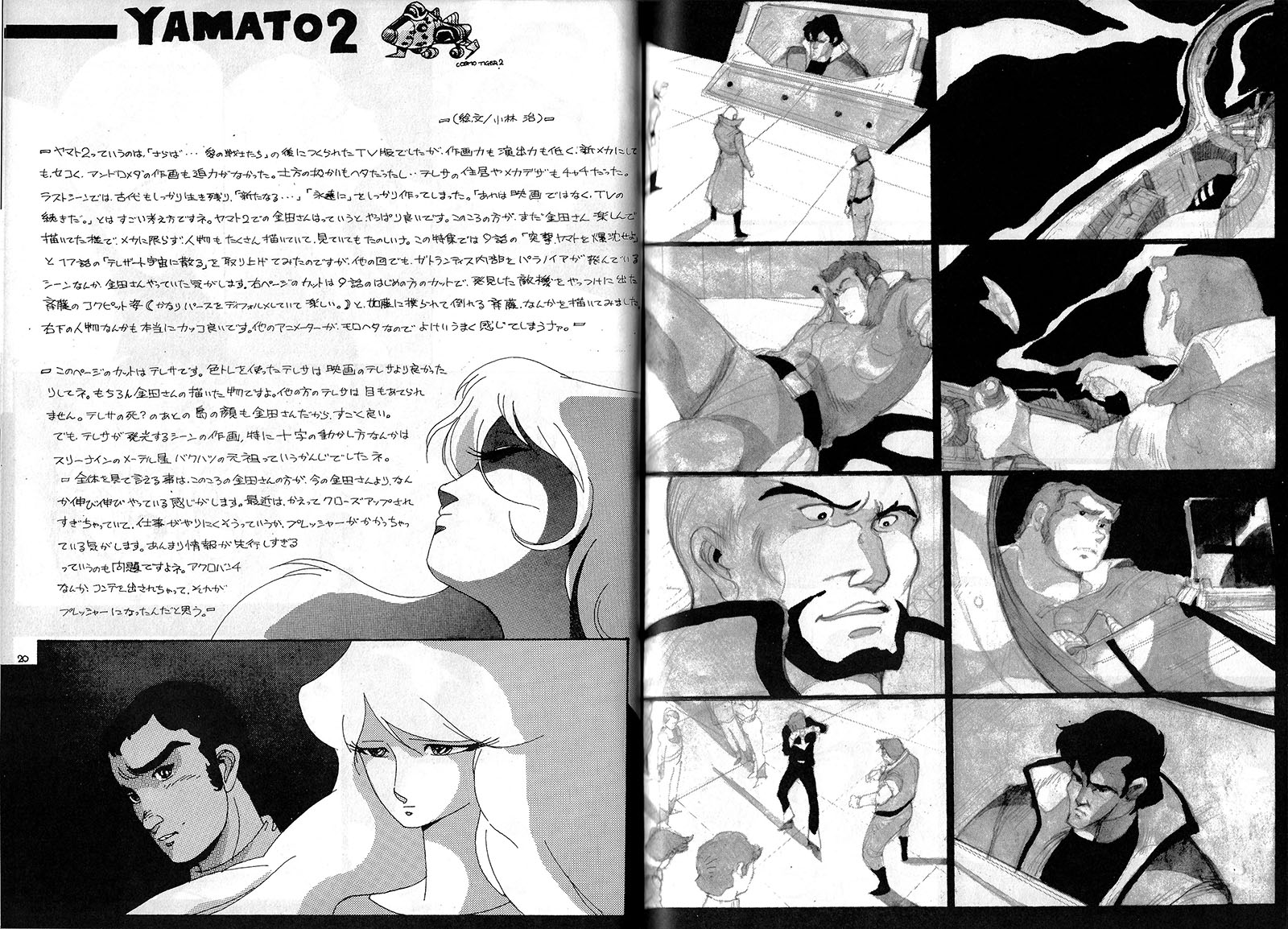
Yamato 2 was a TV adaptation made after Farewell, but its drawing and directing skills were poor. Even the new mecha was shoddy, and Andromeda‘s art lacked impact. Hijikata was also poorly done, and Teresa’s residence and mecha design were terrible. In the final scene, Kodai survived, setting the stage for New Voyage and Be Forever. Instead of a movie, it’s better to think of them as a continuation of the TV series.
Speaking of Kanada’s work in Yamato 2, he was still good. It seems he was enjoying drawing at this time, and he drew a lot of characters, not just mecha, which made it a joy to watch. This feature focuses on Episode 9 and 17, but even in other episodes, like the scene where a Paranoia flies through the interior of Gatlantis, I really love Kanada’s work.
The scenes to the right are from the beginning of Episode 9 and show Saito in the cockpit at high altitude as he hastily takes down the enemy plane he has spotted. The perspective is quite deformed, which is fun. And Saito falling to the ground after being punched by Kato. The person at the bottom right is also really cool. The other animators are so bad that this feels even better.
The shot on this page is Teresa. This Teresa is better than the Teresa in the movie. Of course, it was drawn by Kanada. Other Teresas are unbearable to look at. The face of Shima after Teresa‘s death is also by Kanada, so it’s really good. However, the animation of the scene where Teresa glows, especially the way the cross moves, felt like the precursor of the Planet Maetel exploding in Galaxy Express 999.
Looking at the whole picture, I can say that Kanada at the time seemed to be more relaxed than Kanada now. Recently, he’s been in the spotlight too much, which makes it seem like it’s difficult for him to do his job, or that he’s under a lot of pressure. There’s too much information going on. That’s also a problem. For example, he was doing story boards for Acrobunch [in 1982], and I think that put pressure on him.

The illustrations on the left page show the scene where a Gatlantis soldier is captured and examined, a rehash of an episode from part 1. I was surprised to see it was the same plot, including “He’s just like an Earthling,” but part 1 was much better. The art is authentically Kanada’s, and it’s great! His Dr. Sado is the most Matsumoto-like, and the enemy soldier is really good. Sub characters and crowds are hard to design. The expression in the scene where the soldiers are hit is amazing, especially with the added blur effect.
The right page shows the Gatlantis Empire being damaged by Teresa‘s suicide attack at Telezart. The strength of the top image, the high contrast figure, Sabera screaming, and the explosion in the hallway are impressive. The two consecutive images on the bottom right were drawn before Galaxy Express. After these two images, there’s a sudden, turbulent scene. Even as I’m reviewing this collection of scenes, I’m amazed at the low level of the animators other than Kanada. They can’t even draw a normal perspective. It’s a problem.

Be Forever Yamato
Art by Akira Kanda
Text by Osamu Kobayashi
Regarding the attack on the intermediate base scene in this film, Kanada drew the art, but I think it can also be said that the basic directing isn’t very good. Kanada himself said that just going back and forth makes you think, “they should’ve just fired the main gun from the beginning.“ But I think he did a great job. In the storyboards, the enemy is coming from the right, the allies are coming from the left…it’s hard for an animator to bring that level of detail.
In this Yamato, the scene where the Cosmo Tigers take off was extended. The images of the formations, changing the angle when the Cosmo Tigers penetrate the gap in the base, including the view from the pilot’s eyes, and seeing the explosion of a Cosmo Tiger from inside the cockpit, were all Kanada’s ideas, and I think it’s his power that made the scene last so long. Anyone else would have made it last only a few seconds.
In fact, I slept through other scenes, but when I saw this for the first time with my friend, I was like, “wow, that’s amazing!“ When I saw the Cosmo Tiger catapult rising from the bottom of the screen, I thought, “Like Zambot 3!” I don’t get that excited when I watch it now, but I’m sure I was surprised when I first saw it. However, making a shot interesting was the limit of what Kanada could do, and the rest of it was boring. That’s the problem. Maybe I, Who watched Yamato just because of Kanada, was fooled by Nishizaki.

Yamato III
Text by Gonen Honda
Honestly, Yamato III was the worst. When it aired, I was saying, “are you kidding me, Yamato?“ But I watched it solely for Kanada‘s animation. The story was so awful it was beyond redemption, and the script was so ridiculously written that it almost seemed like a joke. Kanada’s animation looked amazing in a work that could hardly be called professional. But even he wasn’t at his usual high level. I wondered if he was cutting corners. It’s understandable, but Yamato itself was still pretty good, and Kanada‘s art of the Cosmo Tigers was really cool. Watching the Cosmo Tiger fire missiles against the space background was satisfying. But I still don’t think Yamato III was worthy of Kanada.
Text by Osamu Kobayashi
I’d like to add a few things to Honda’s opinion about Yamato III. Kanada didn’t put his all into the work this time. He was like, “I don’t really want to work on Yamato, but the money is good.“ He was all about the mecha, and considering that the director didn’t really prioritize mecha in the storyline, perhaps this was to be expected. But personally, I wish Kanada had shown enough energy to confront the director rather than just going by the numbers.
Also, some fans seem to say,“the animation for Yamato III was good,“ but frankly, I think it’s at the bottom of the list. It’s on the same level as Yamato 2 and The New Voyage. And it’s all down to the incompetence of the animators at the top, like Udagawa and Takahashi. With people like them as directors, there’s no way they could produce something good. Among the animation directors was Toyo Ashita, who was really good on Yamato, but his art style had changed drastically, and his previous “goodness“ was gone. But with this story and direction, even if Kazuhide Tomonaga was in charge, there’s no way it could’ve turned out well.

Text by Gonen Honda
TOP:
In Yamato III, Episode 10 and 17 were quite good, since Kanada worked on them. Since it was Yamato, he only did battle scenes. I think he’s very good at depicting people with explosions. The picture at left is a scene from Episode 10, and the death looks very painful. There was also a scene like this in episode two of Daitarn 3.
LOWER RIGHT:
But overall, Kanada’s work on Yamato III seems to lack a sense of speed and explosions. It would be amazing if they had pursued something like what we saw in the movies, but I guess that doesn’t work on TV. But the Cosmo Tiger was cool, and the way it flew while the missiles were whipping around was truly amazing.
LOWER LEFT:
The image at right is of Yamato‘s chimney missiles from Episode 17, and there was something powerful about the way the fire billows as the missiles come out. Nowadays, there isn’t much TV anime by Kanada, but I have high hopes for his future.
Final Yamato
Text by Osamu Kobayashi
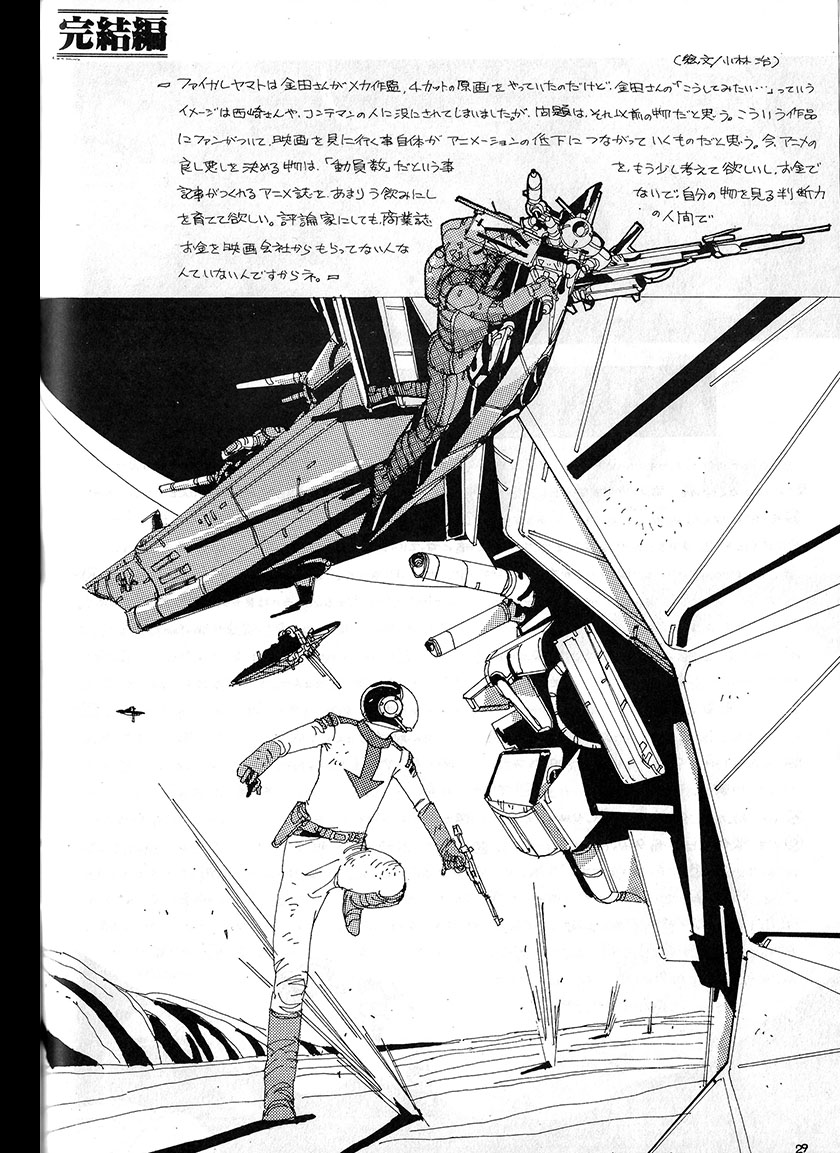
For Final Yamato, Kanada was the mecha animation director, and did key animation, but his idea of, “I want it to be like this…“ was rejected by Nishizaki and the storyboard artists. I think the problem goes back even farther than that. I think the fact that fans are drawn to these kinds of works and go to see the movies is what leads to a decline in animation. Nowadays, what determines the quality of anime is the number of people who attend, so I would like to see more anime magazines write articles that say this. There is no critic, even in commercial magazines, who doesn’t receive money from film companies. I would like them to think about this a little more, and be people who can judge things for themselves, not based on money.