
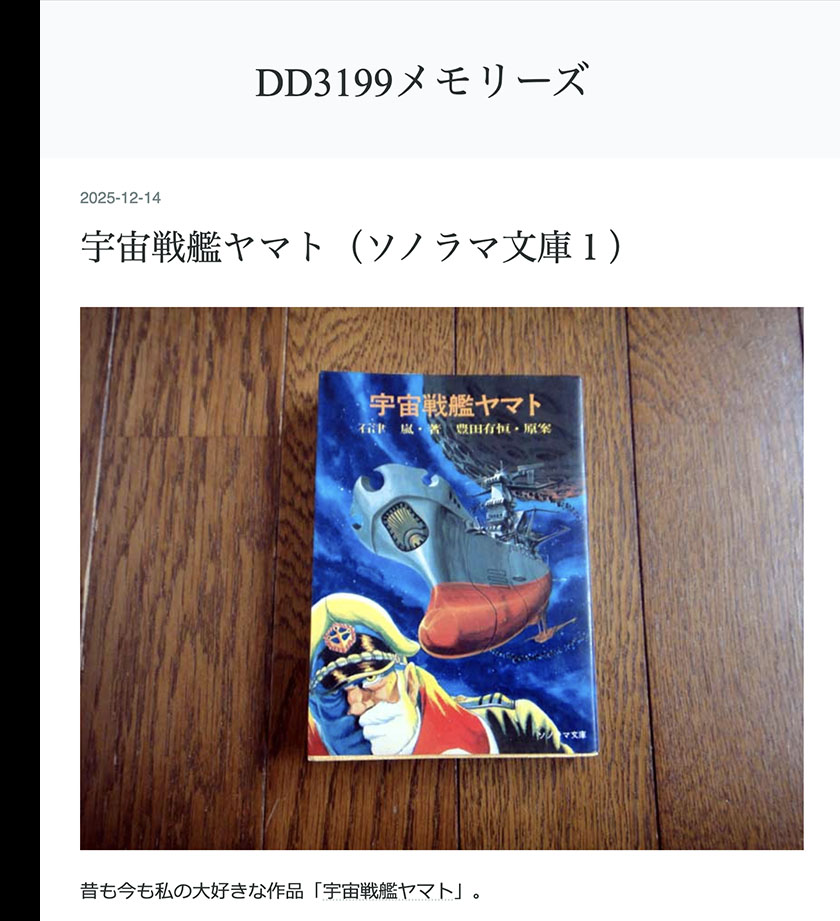
Space Battleship Yamato novelization (Sonorama edition)
See the original post here
Space Battleship Yamato is a work I’ve loved both in the past and present.
I encountered this book when I was in elementary or junior high school. My first encounter wasn’t with the paperback shown in the image, but with a two-volume hardcover edition. It’s a novel written by Arashi Ishizu, based on a story by Aritsune Toyota. The paperback is clearly a single volume combining what was originally two books, structured into “Earth Destruction Arc” and “Earth Restoration Arc.”
The story is broadly similar to the anime, but in my personal opinion, it has a stronger science-fiction feel. Starsha still sends Sasha to save Earth, but she only sends the method for removing the radiation. Sasha also loses her life, and the Earthlings, using their own abilities, predict that Iscandar is 148,000 light-years away. They then analyze Sasha’s spaceship and create a warp engine. Hikozaemon Tokugawa’s words at that moment are quite remarkable:
“The structure of the engine itself wasn’t all that complicated. Well, we could build an exact replica in about a week,” which is incredibly impressive. I read it quickly at the time, but perhaps Sanada was involved here too? Incidentally, in this novel, his name is Sasuke Sanada.
The other crew members are Captain Juzo Okita, Daisuke Shima, Sakuzo Sado, and Yuki Mori, but Kodai’s name is written in katakana as Susumu Kodai. Also, unlike the anime, Gamilas is revealed from the beginning, through Starsha’s message, to be the companion planet of Iscandar. However, an even more terrifying truth awaits.
Another interesting point is that while Leiji Matsumoto’s name doesn’t appear anywhere, Captain Harlock is among the characters, as the captain of the Phantom.
This is quite a spoiler, but the Earth’s revival also has a surprising development. The final scene provides a resolution that far surpasses that of Farewell. But I can say for sure that this final scene made me love the Space Battleship Yamato series even more.
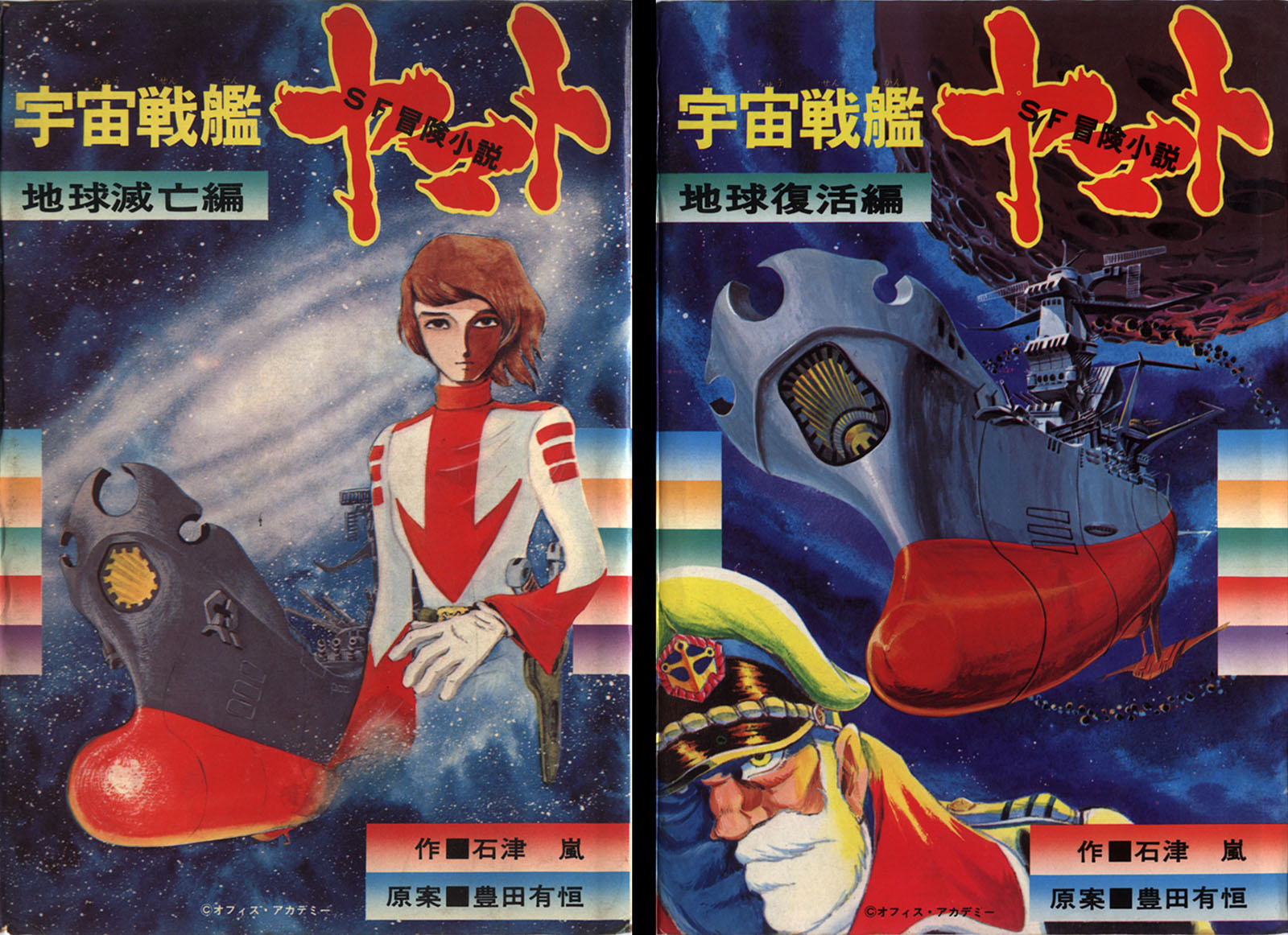
2-Volume hardcover edition, 1974/1975 (Sonorama Publishing)
Even so, I wonder how I managed to read through this novel version. I couldn’t afford to buy it myself. I can still vaguely picture the place where I encountered this book. It was in a bookstore directly in front of me after I went up an escalator to the third floor. The bookshelf was there.
After that, I wonder how I managed to finish reading this book. Around the time the Yamato TV anime became famous through reruns and theatrical releases, I saved up my allowance and bought a hardcover version. At first, I was surprised that it was a three-volume series, but when I read it, it was the so-called TV anime version, completely different from the version I had expected. Even when I talked about my memories of this novel to friends who also liked Yamato at that time, they all said they didn’t know that version.

3-Volume TV series adaptation, 1977 (Sonorama Publishing)
One day, I think it was in a bookstore in Jimbocho or Ochanomizu [Tokyo], I casually picked up this paperback and flipped through it, and when I read the sentences that jumped out at me, I was truly deeply moved. Ah, so this version of Space Battleship Yamato really did exist. I finally found it. I was so happy at that time. Even now, that feeling of emotion comes back to me.
Since then, I’ve continued to be moved by many Yamato works, including the theatrical versions like Farewell, Be Forever, Resurrection, and the live-action version, as well as the manga version, and the remake series starting with 2199. But this novel version of Space Battleship Yamato is also a very important work for me.
Intrigued by this endorsement? Read the entire first novelization here.