
From the REBEL 3199 Chapter 4 program book: Mecha Designer Arashi Ishizu discusses his work for the Galman-Garmillas side of the story, specifically the new developments seen in Episodes 11-14. With the arrival of long-dormant Iscandarian ships adding a new layer to the story, there’s a lot to talk about.
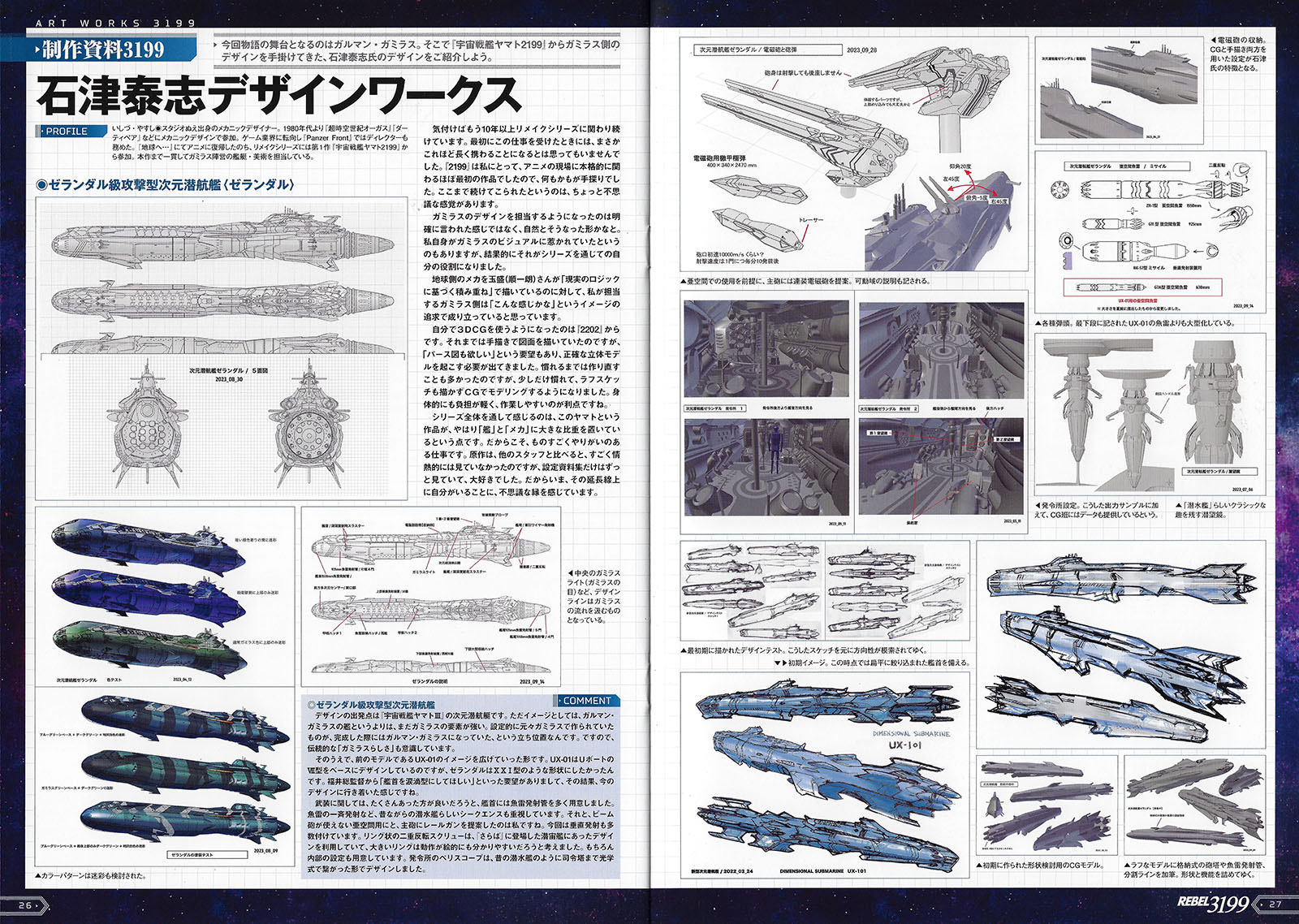
The setting for this story is Galman-Garmillas. Here, we introduce the designs by Yasushi Ishizu, who has handled the Garmillas side designs since Yamato 2199.
Yasushi Ishizu design works
Yasushi Ishizu Profile
A mechanic designer originating from Studio Nue. Since the 1980s, he has contributed mechanic designs to works like Orguss and Dirty Pair. He transitioned to the game industry, also serving as director for Panzer Fron. After returning to anime with Toward the Terra, he joined the remake series starting with the first installment, Yamato 2199. He has consistently handled the Garmillas fleet and art design up to now.
Before I knew it, I’d been involved with the remake series for over ten years. When I first took this job, I never imagined I’d be involved for this long. 2199 was practically my first serious project in anime production, so everything was a learning experience. It feels a bit strange that I’ve been able to continue this long.
Taking charge of Garmillas design wasn’t explicitly assigned, it just naturally evolved that way. While I was personally drawn to the Garmillas visual aesthetic, it ultimately became my role throughout the series. Whereas Junichiro Tamamori designs Earth-side mecha based on “realistic logic and layering,” I believe the Garmillas side I handle is built on pursuing an image of “this is how it feels.”
I started using 3DCG myself with 2202. Before that, I drew blueprints by hand, but requests like “We need pass diagrams too” meant I needed to create accurate 3D models. I had to redo things a lot until I got used to it, but once I got more comfortable, I started modeling directly in CG without even doing rough sketches. The physical strain is lighter, and it’s easier to work with. That’s the advantage.
What I feel throughout the entire series is that this work, Yamato, places significant emphasis on the “ship” and “mecha” elements. That’s precisely why it’s such incredibly rewarding work. Compared to other staff members, I wasn’t passionately invested in the original, but I always kept looking at the design materials and loved them. So now, finding myself on that same path feels like a strange sense of destiny.
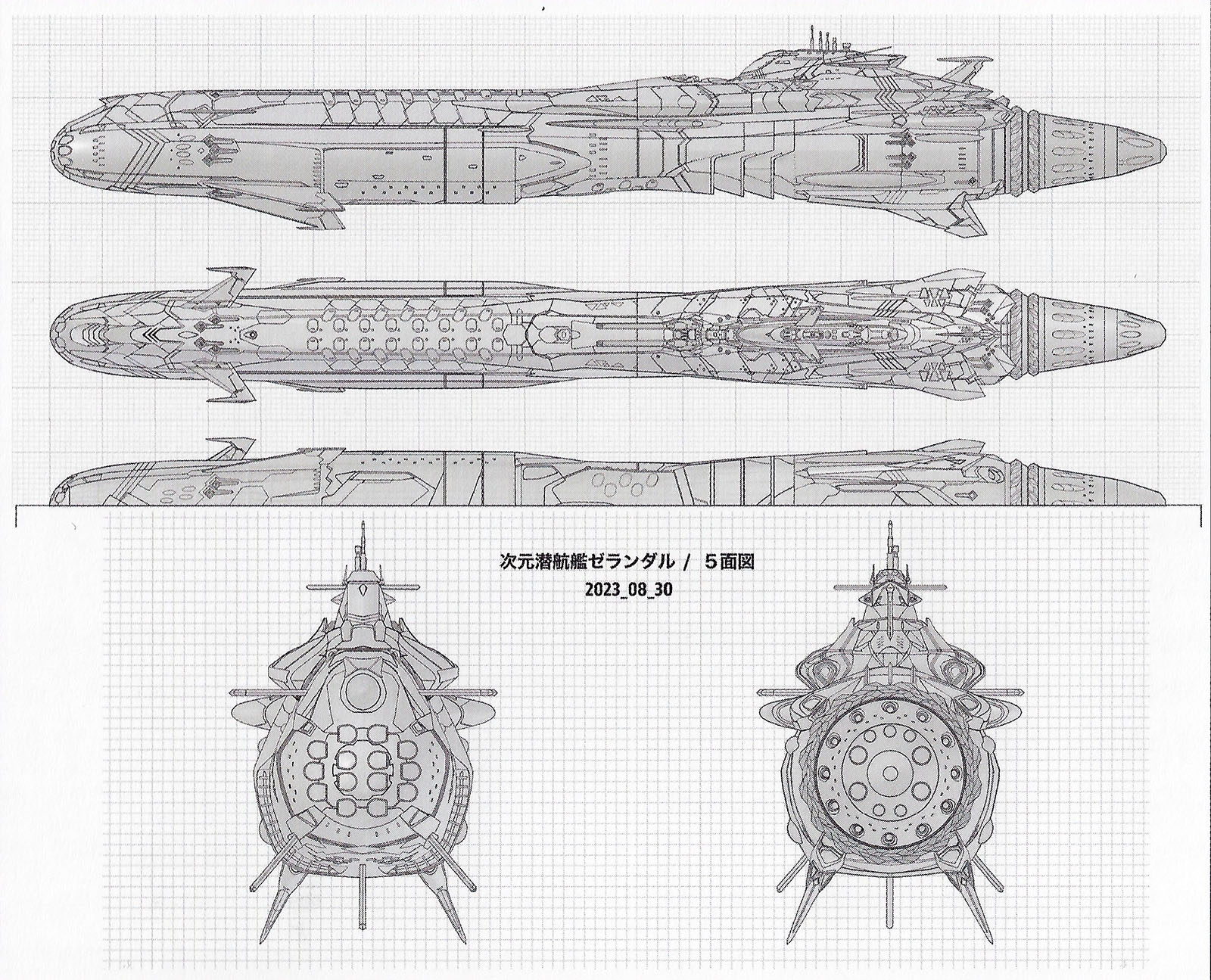
Zerandal-class Attack Dimensional Submarine Zerandal
ISHIZU’S COMMENT:
The design originates from the Yamato III dimensional submarine. However, visually, it leans more heavily toward Garmillas elements than Galman-Garmillas. Conceptually, it was originally built by Garmillas but completed under Galman-Garmillas control. Thus, traditional “Garmillas characteristics” are also considered.
Building on that, we expanded the image of its predecessor, the UX-01. While the UX-01 was designed based on the U-boat Type VII, we wanted the Zerandal to have a shape reminiscent of the Type XXI. Chief Director Fukui requested “a teardrop-shaped bow,” and that led us to the current design.
Regarding armament, we figured more is better, so we packed the bow with numerous torpedo tubes. We also prioritized classic submarine sequences like simultaneous torpedo launches. Additionally, I proposed the railgun as the main armament for use in sub-space, where beam cannons are ineffective. This time, we’ve also included numerous vertical launchers.
The ring-shaped double-reverse screw utilizes a design from the Gatlantis sub-space submarine featured in Farewell. We thought the large ring would make the operation visually clear. Of course, we’ve prepared internal designs as well. The periscope in the command center was designed to connect optically all the way to the conning tower, like in old submarines.
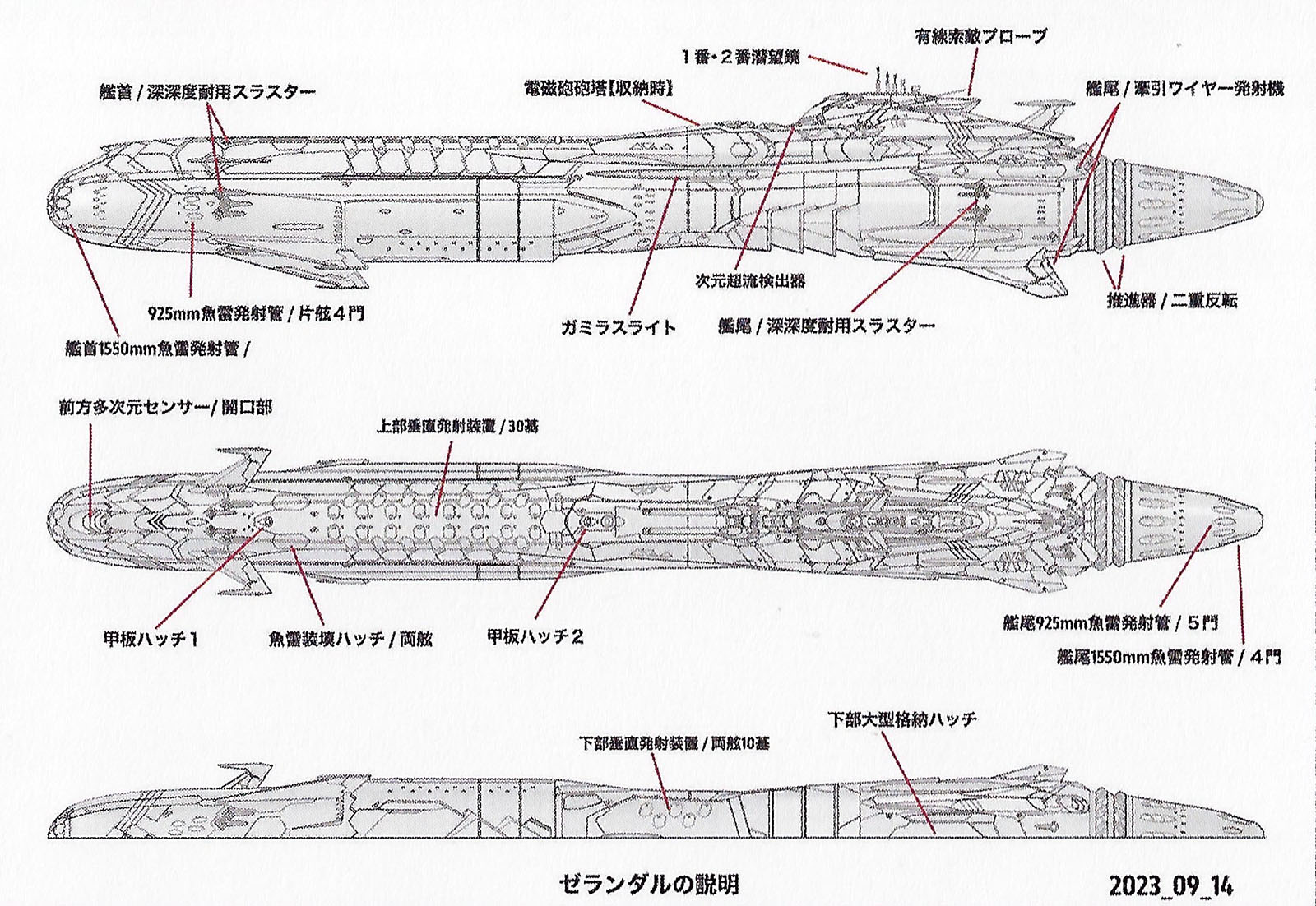
The design line, such as the central Garmillaslight (Garmillas’ Eye), follows the Garmillas lineage.
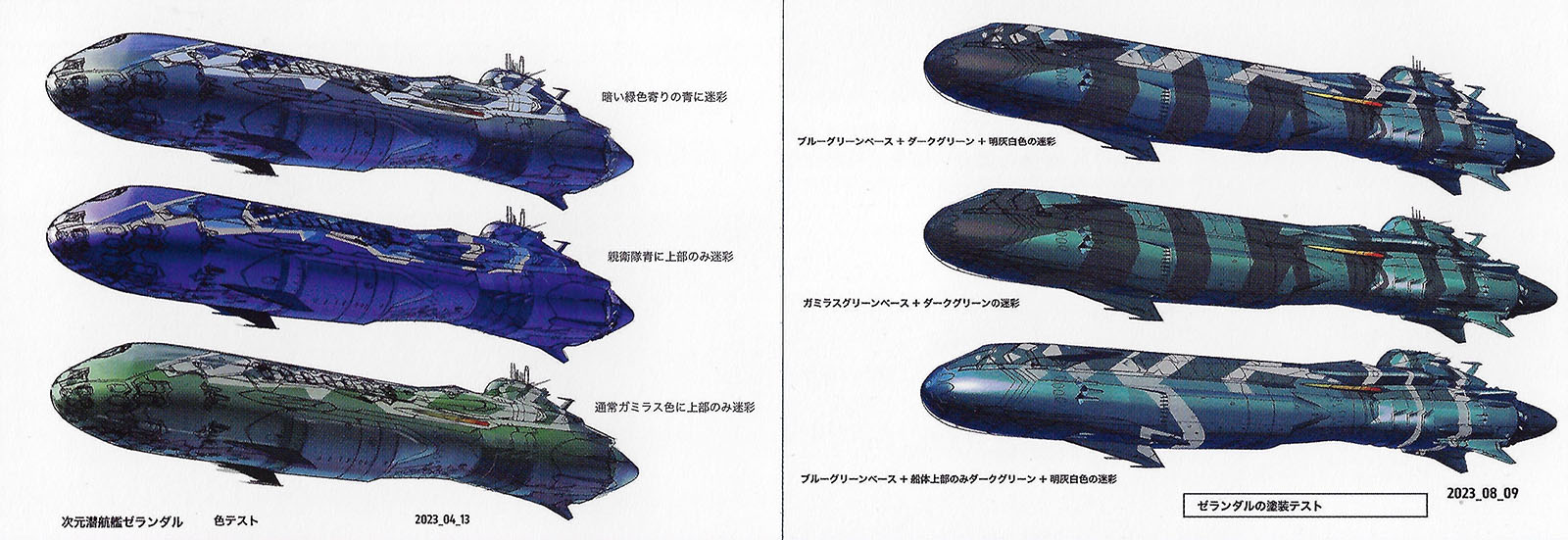
Camouflage was also considered for the color pattern.
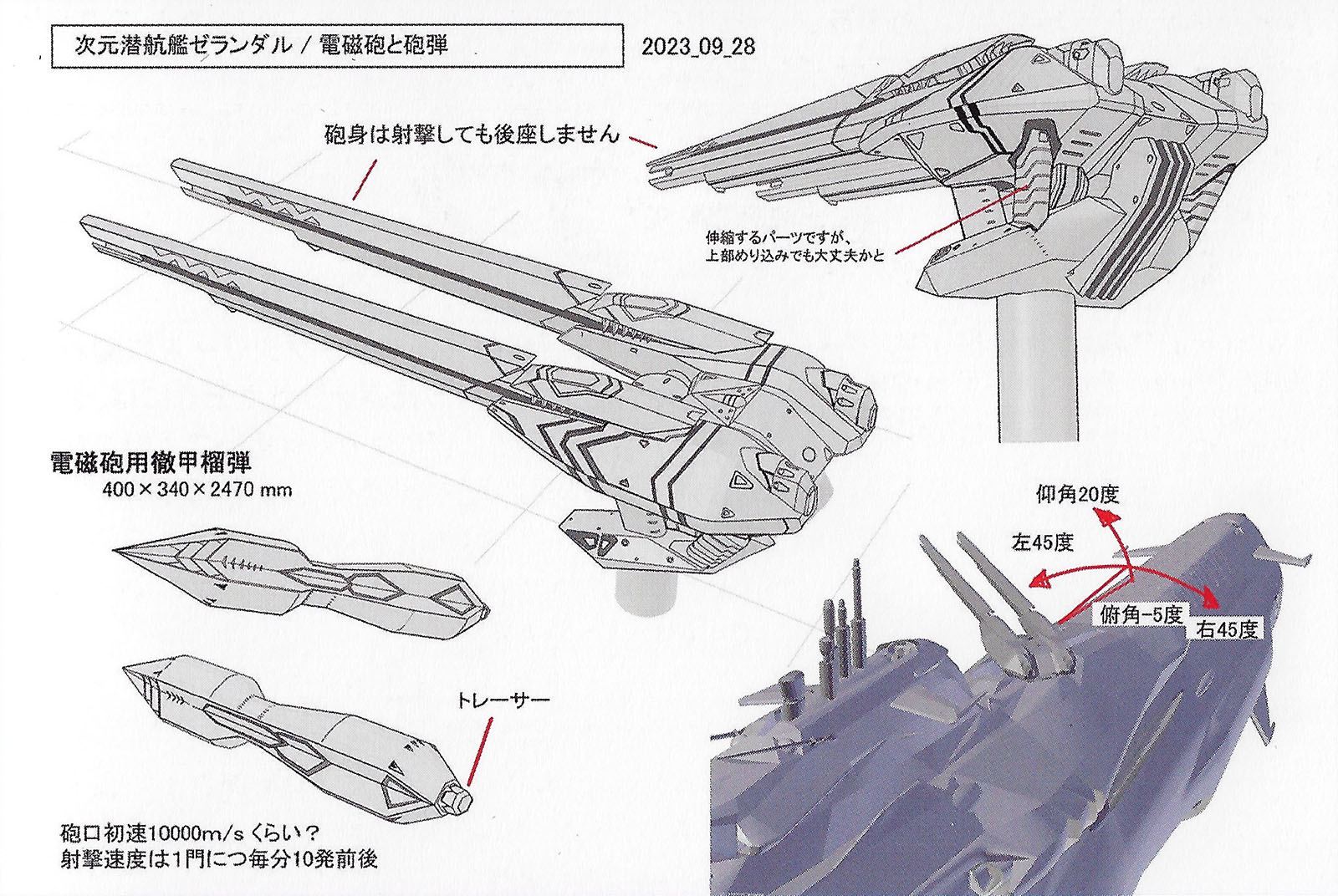
Proposing twin electromagnetic cannons for the main guns, assuming use in subspace. The range of motion is also explained.
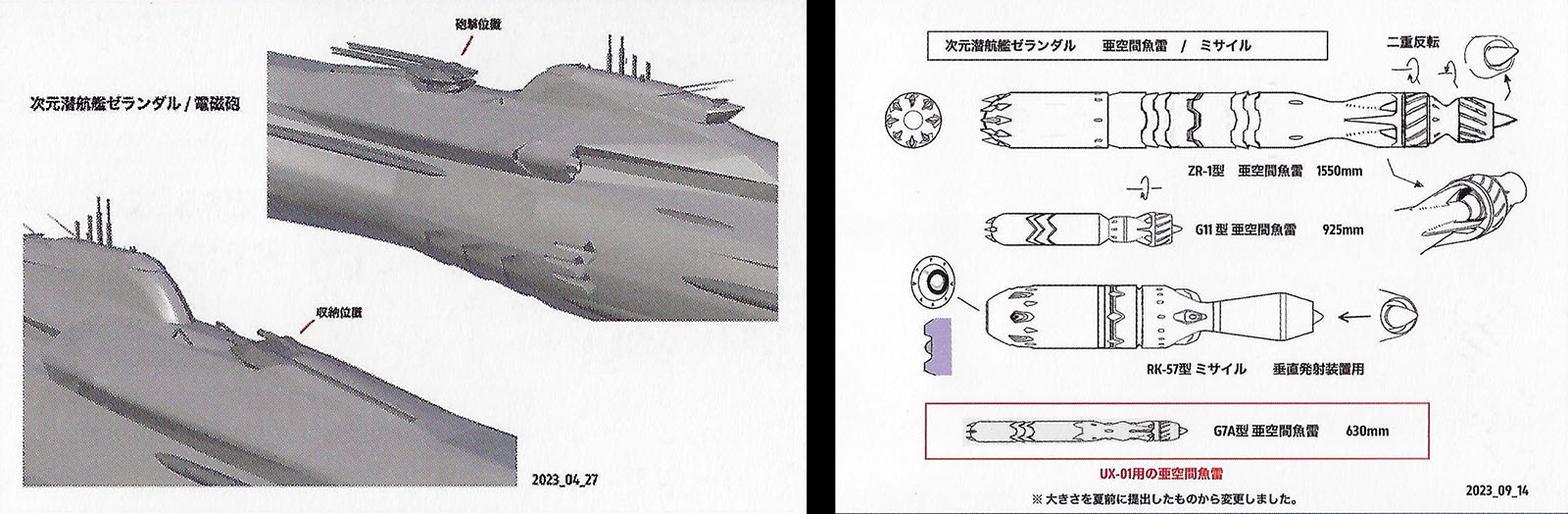
LEFT: Electromagnetic cannon stowage. Using both CG and hand-drawn art is characteristic of Mr. Ishizu.
RIGHT: Various warheads. These are larger than the UX-01 torpedo shown at the bottom.
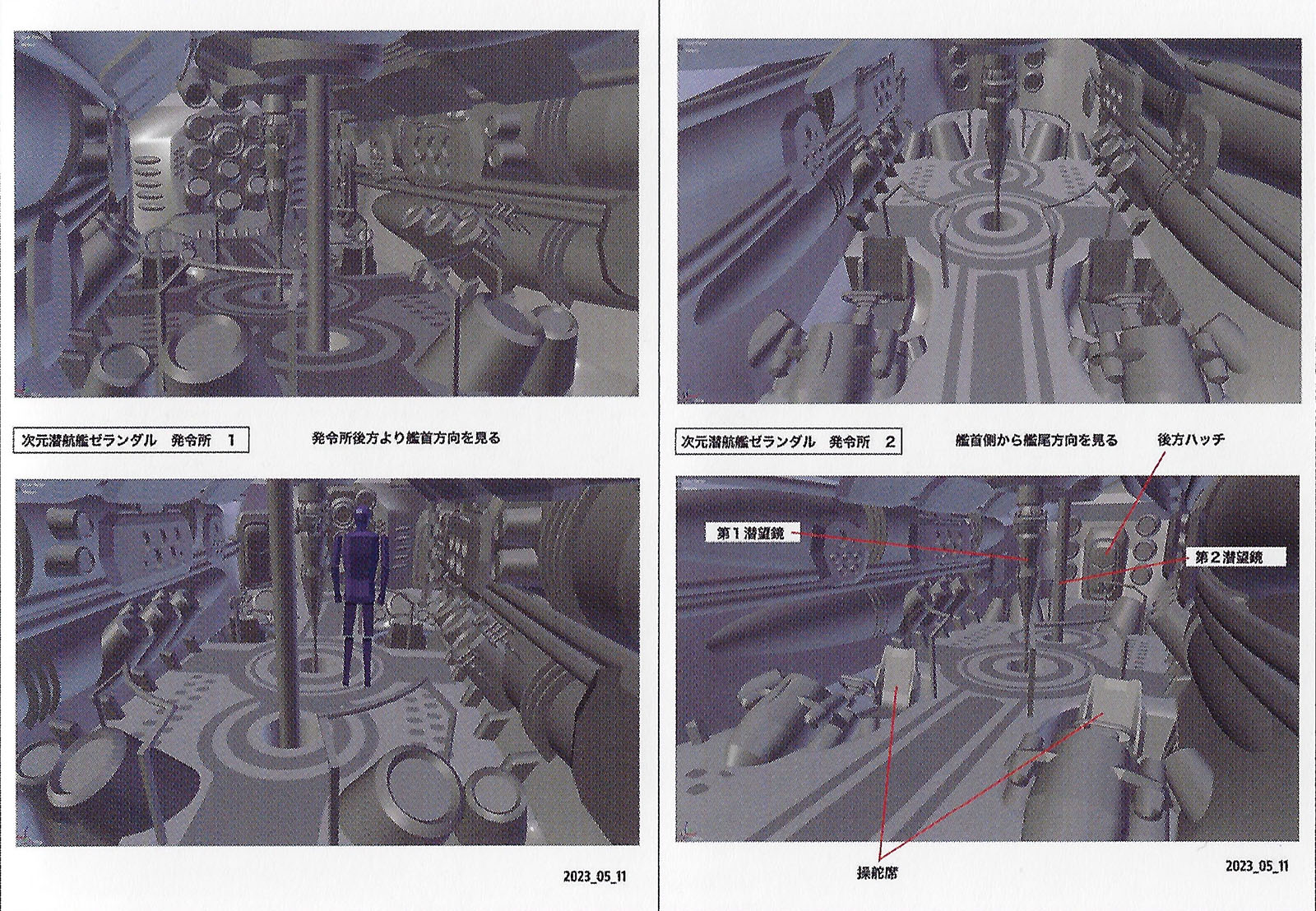
Command center design. In addition to these output samples, data was also provided to the CG team.
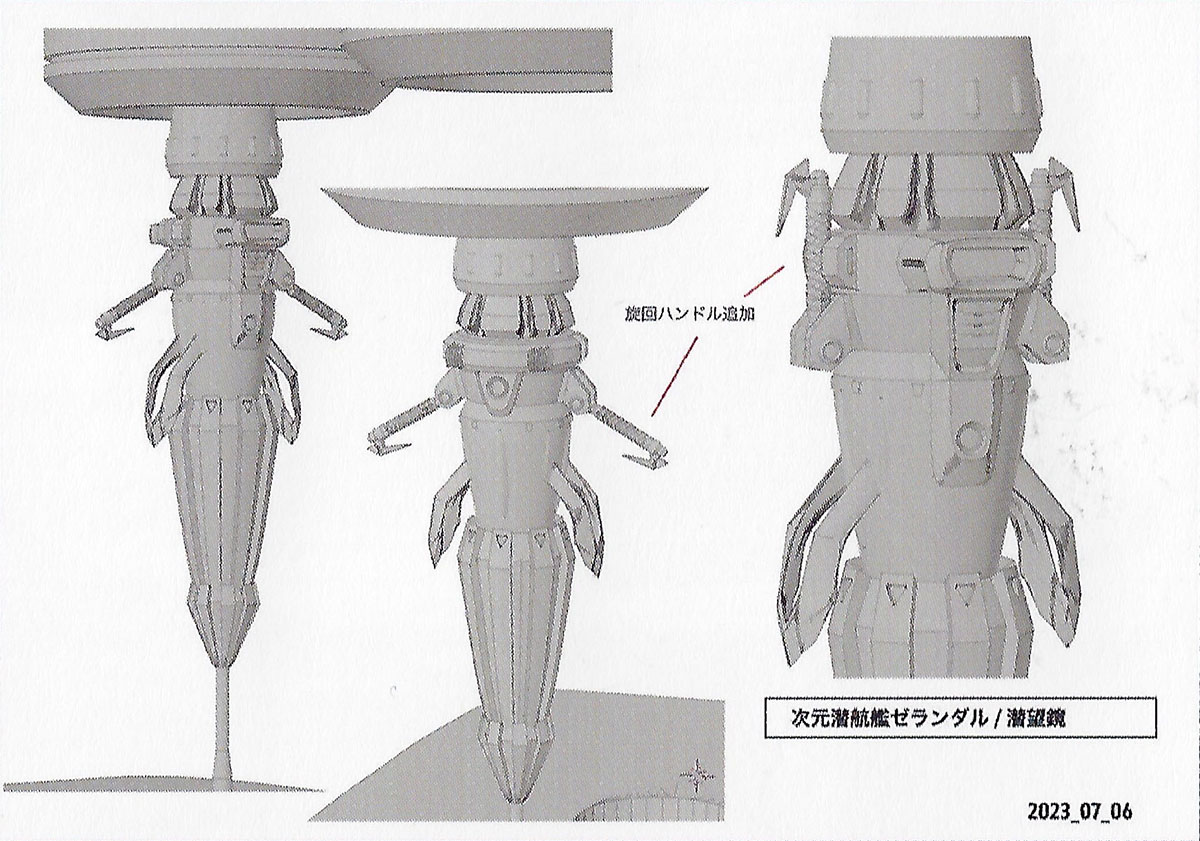
A periscope retaining a classic, “submarine-like” feel.
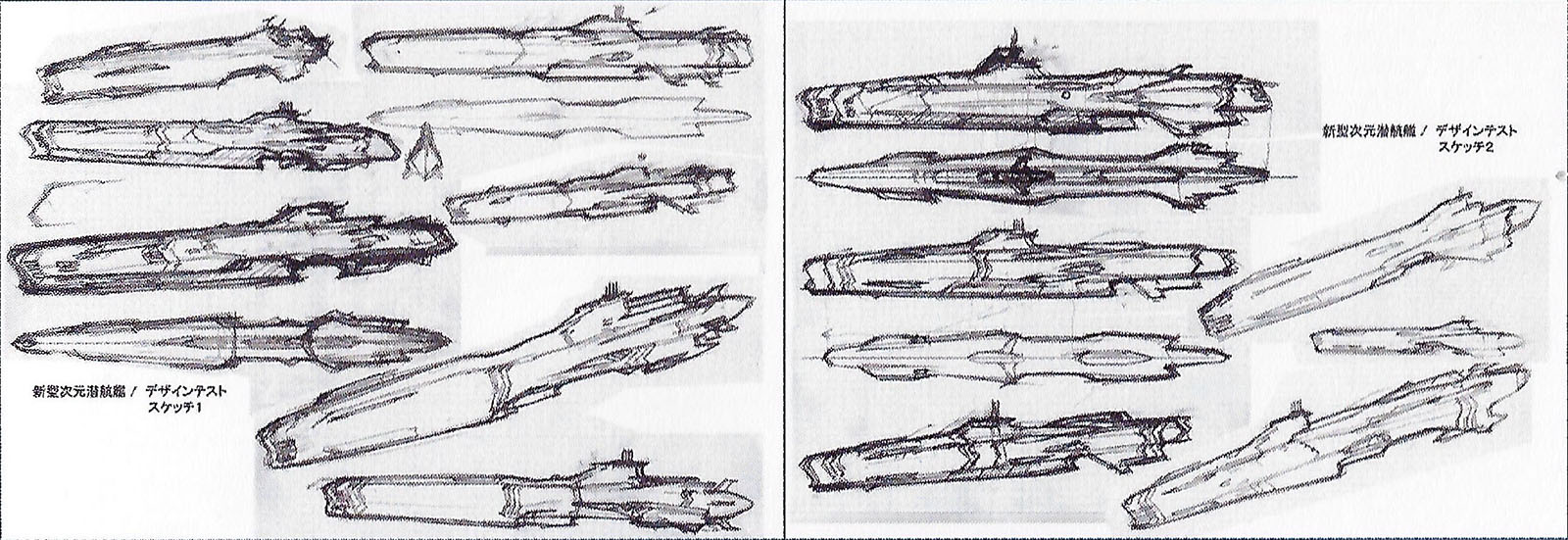
Early design test sketches. Direction was explored based on these drafts.
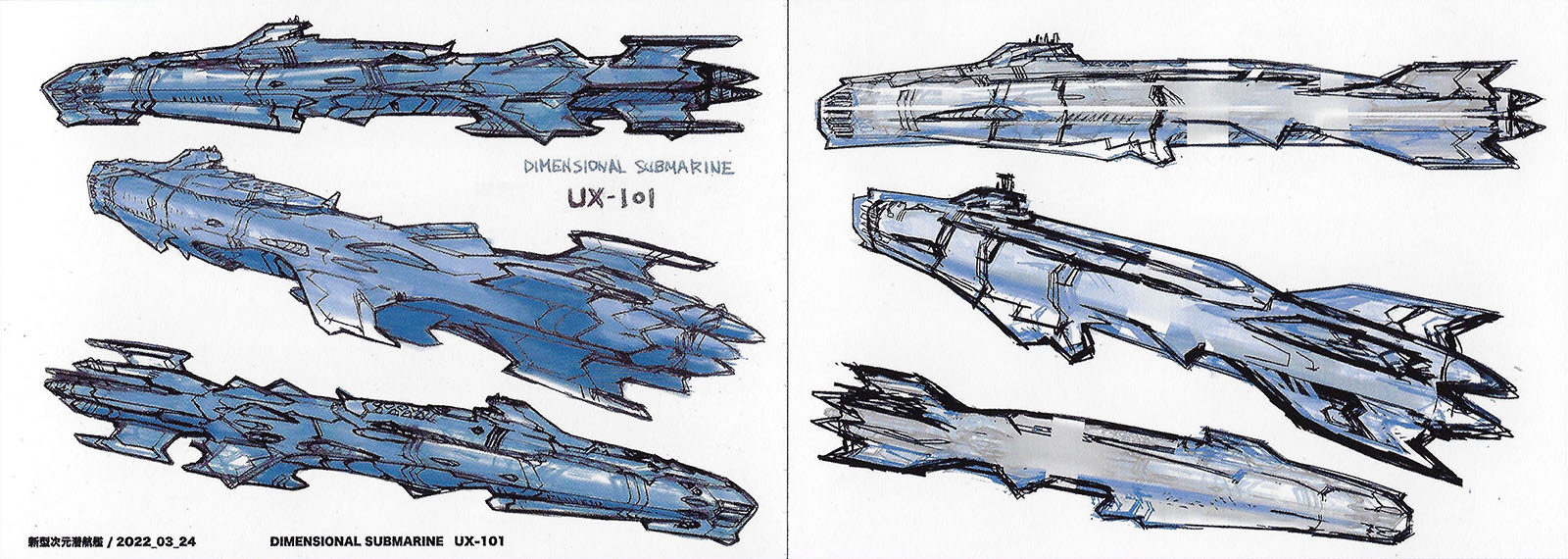
Initial concept image. At this stage, it featured a flattened, tapered bow.
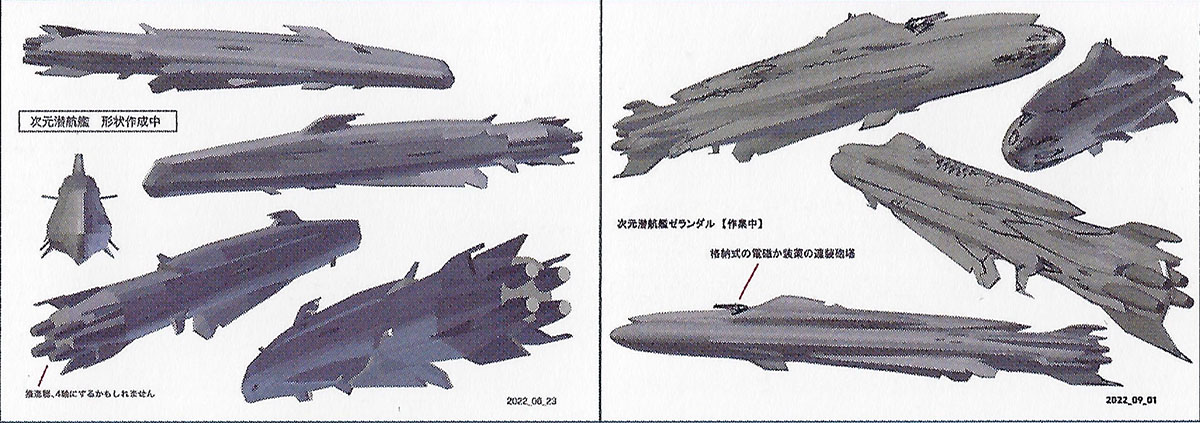
LEFT: Early CG model for shape evaluation.
RIGHT: Rough model with added retractable turrets, torpedo tubes, and section lines. Shape and function are refined.
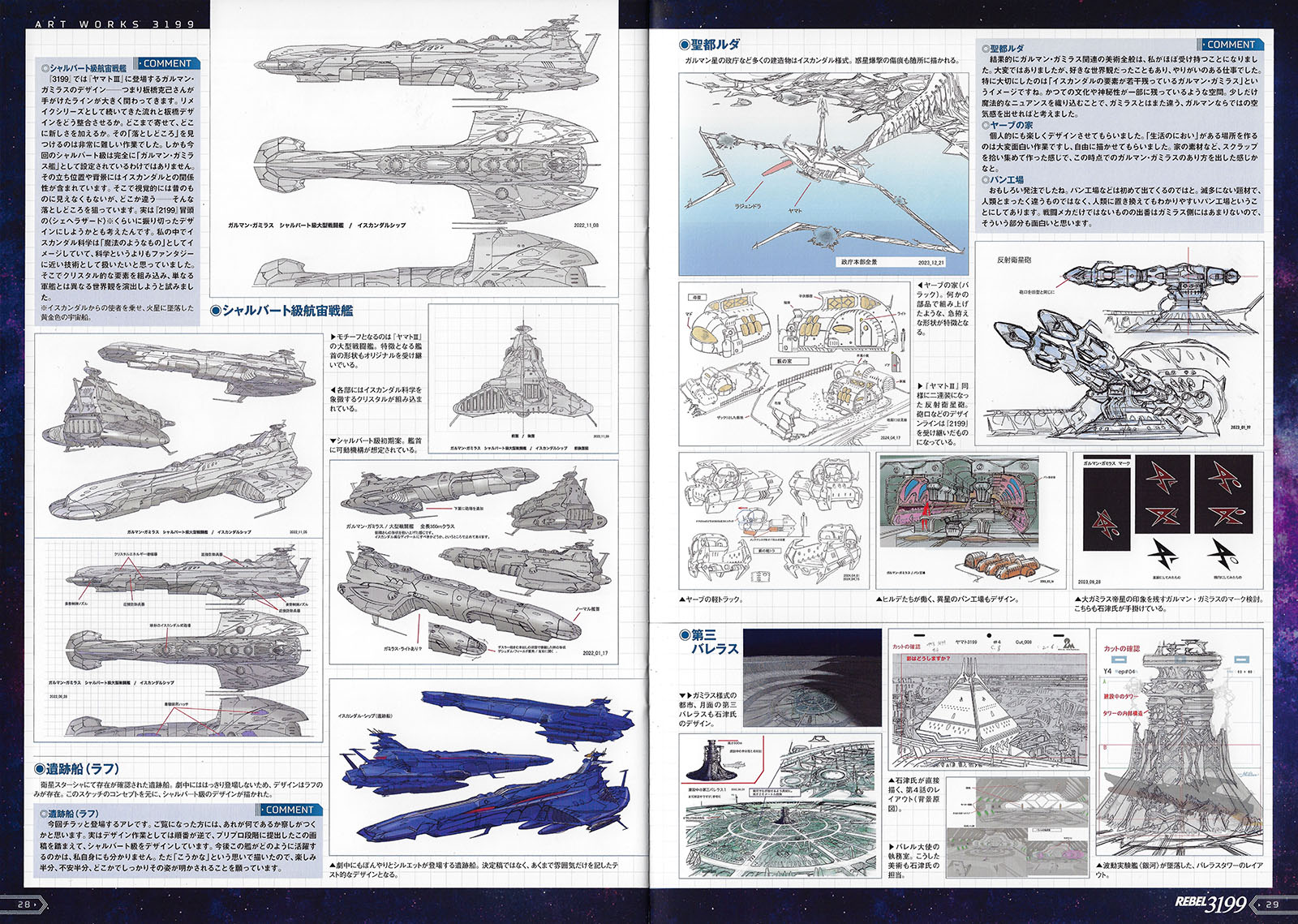
Shalbart-class Space Battleship
ISHIZU’S COMMENT:
In 3199, the Galman-Garmillas design featured in Yamato III — specifically the lines crafted by Katsumi Itabashi — plays a significant role. The challenge was reconciling the continuity of the remake series with Itabashi’s design. How much to align with it, and where to introduce new elements? Finding that “balance point” was an extremely difficult task.
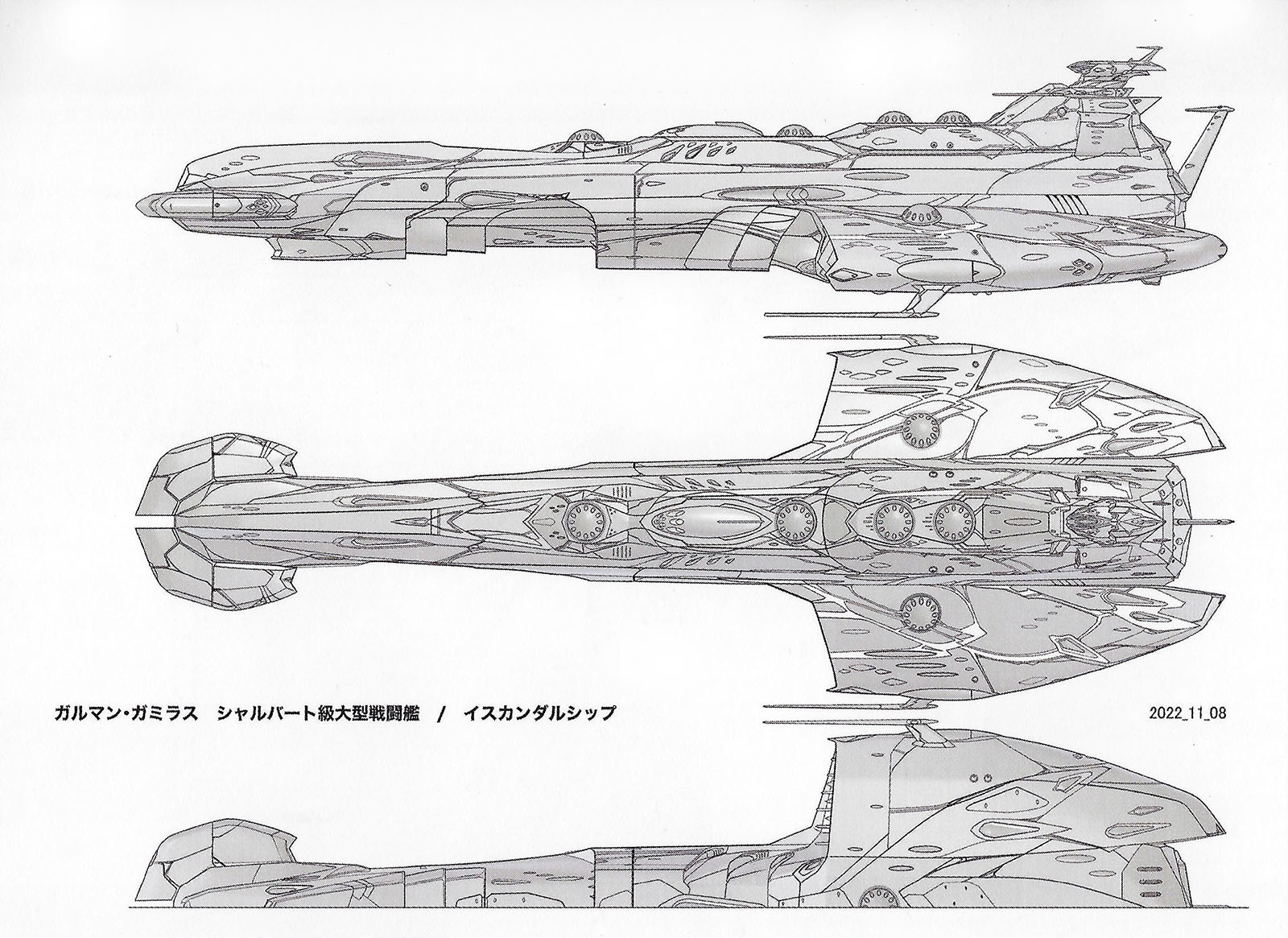
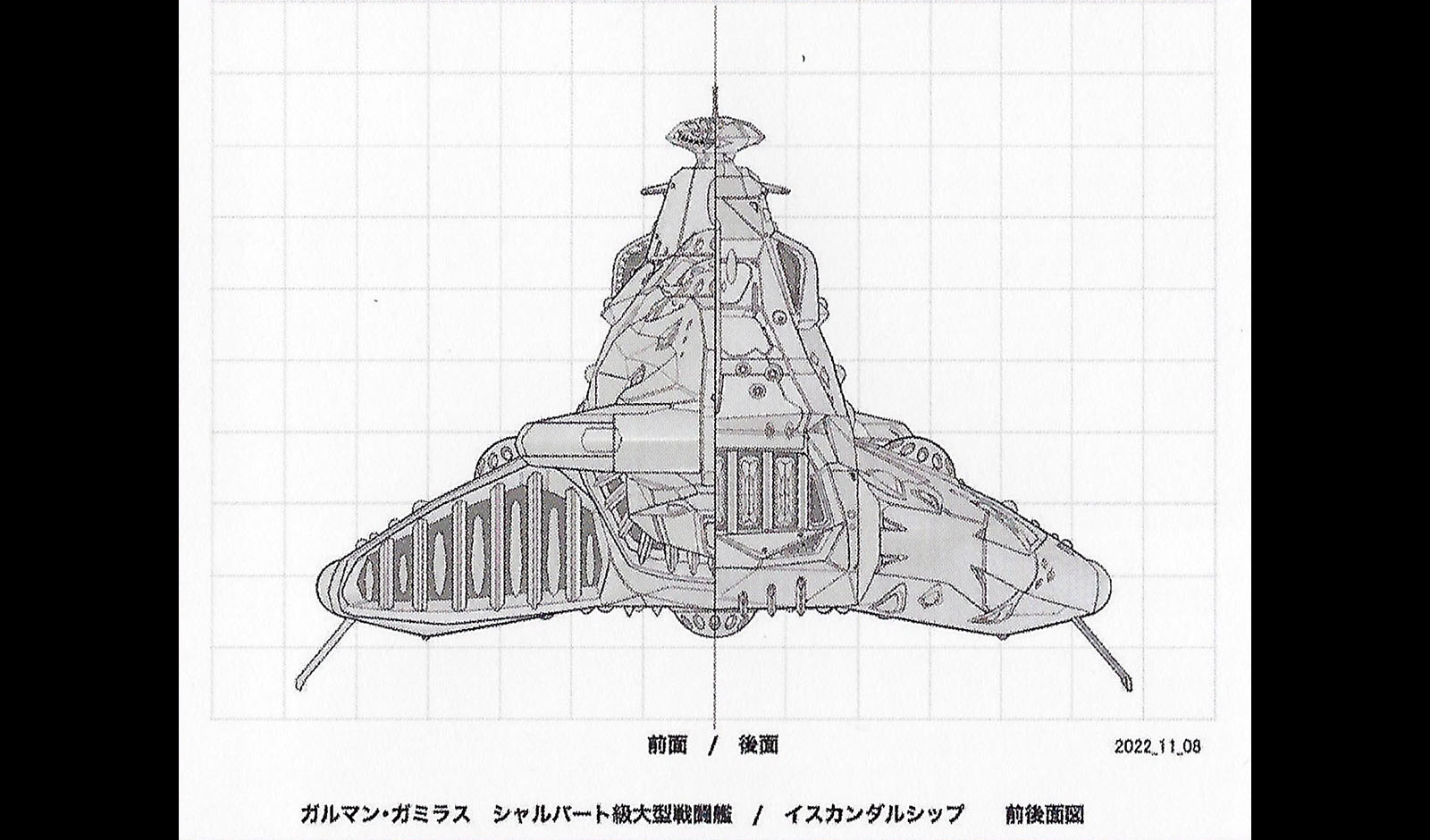
Moreover, this Shalbart-class isn’t entirely a Galman-Garmillas ship. Its positioning and background include its relationship with Iscandar. So visually, we aimed for a balance where it could be seen as reminiscent of the old designs, yet distinctly different. Honestly, I even considered going as far as the design of the Sheherazade from the opening of 2199 (the golden spaceship that crashed on Mars, carrying the envoy from Iscandar).
In my mind, Iscandar science is “magical,” and I wanted to treat it less as science and more as a fantasy-like technology. So I incorporated crystal-like elements, attempting to create a worldview distinct from that of a mere warship.
The motif is the large combat ship from Yamato III. The distinctive bow shape also inherits the original design.
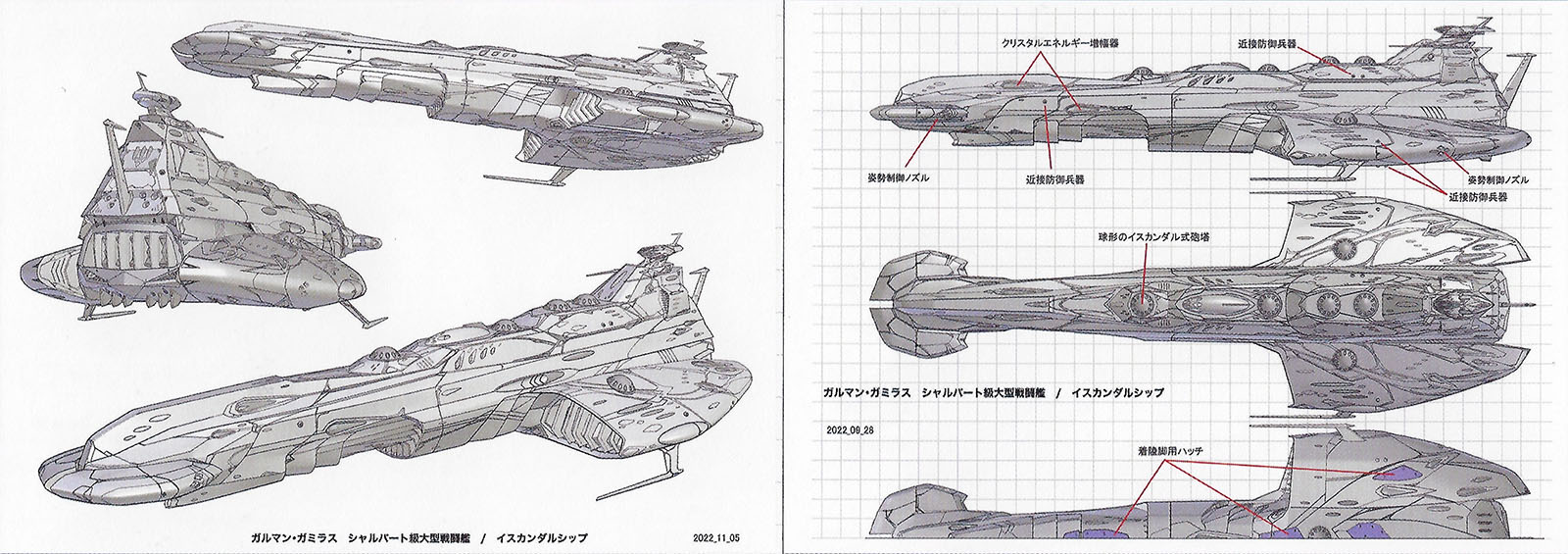
Crystals symbolizing Iscandar science are incorporated into various sections.
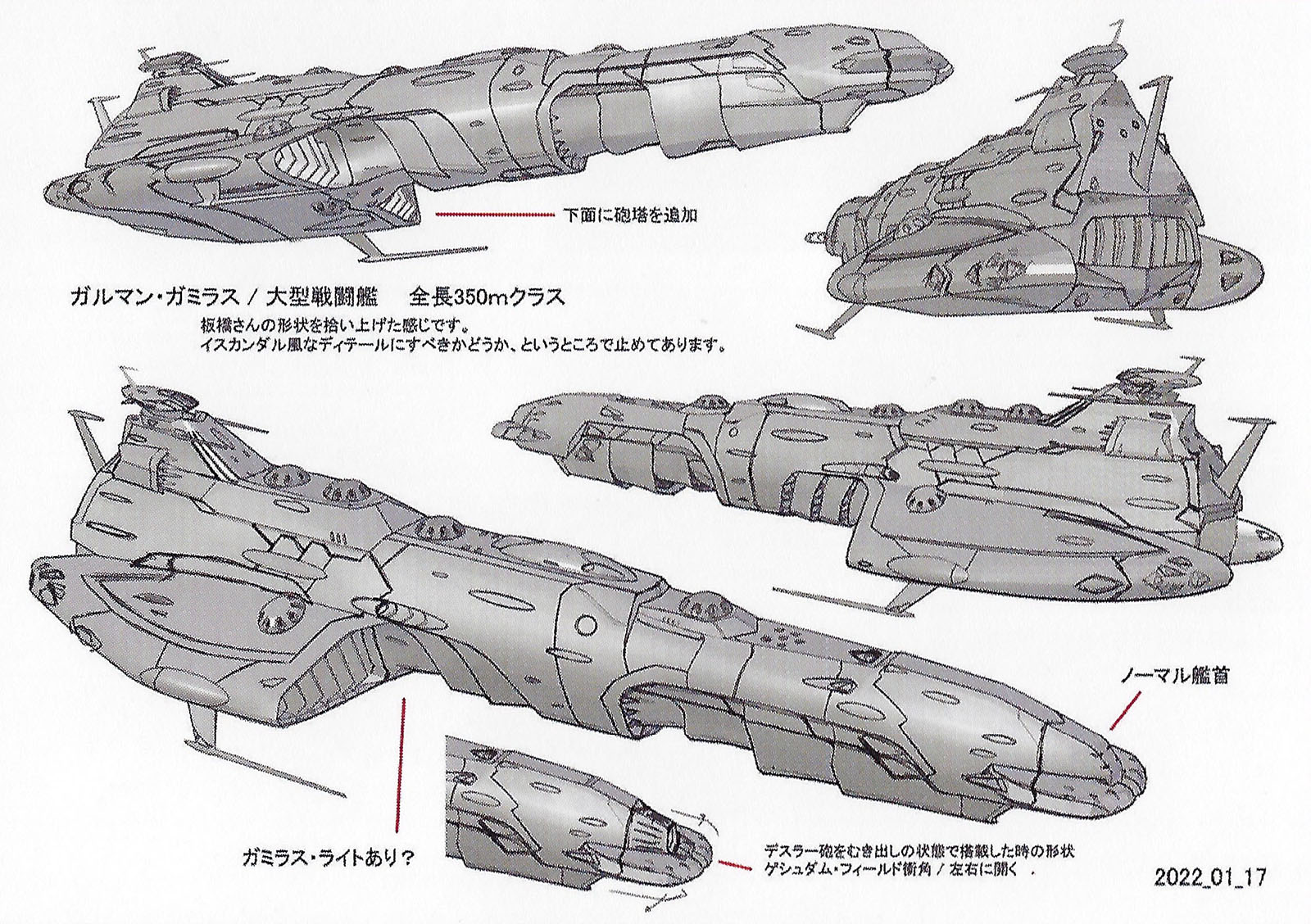
Initial concept for the Shalbart-class. A movable mechanism is envisioned at the bow.
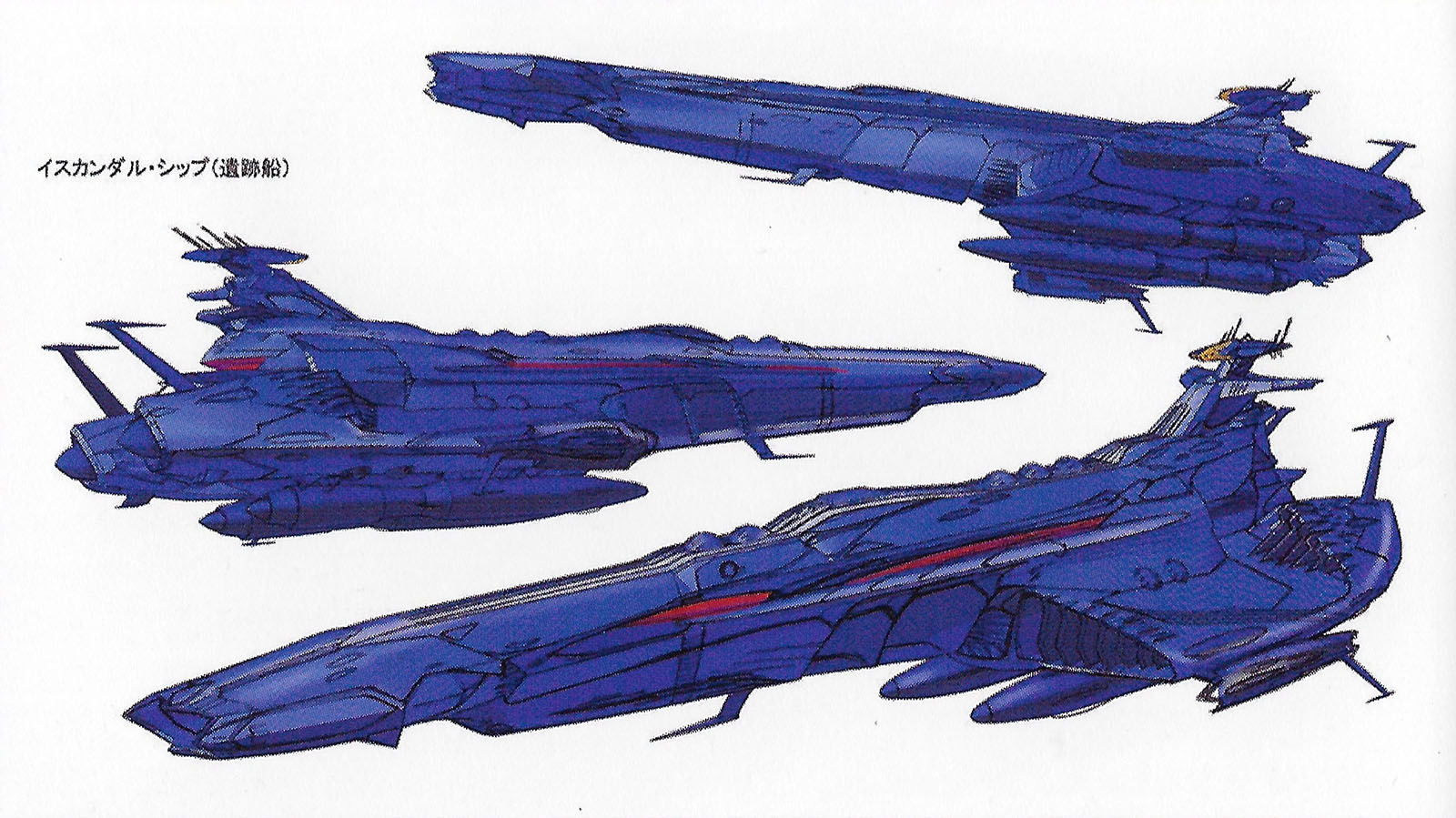
Ruined Ship (rough)
A ruined ship confirmed to exist on the satellite Starsha. Since it appears as a mere silhouette in the story, this is not the final design, but rather a test design meant solely to capture the atmosphere. The Shalbart-class was created based on the concept of this sketch.
ISHIZU’S COMMENT:
This is the thing that makes a brief appearance this time. Those who’ve seen it might guess what it is. Actually, the design process was reversed: the Shalbart-class was designed based on this artwork submitted during pre-production. I myself don’t know how this ship will be utilized going forward. I drew it thinking “maybe like this,” so I’m half excited, half anxious, hoping its true form will be properly revealed somewhere.
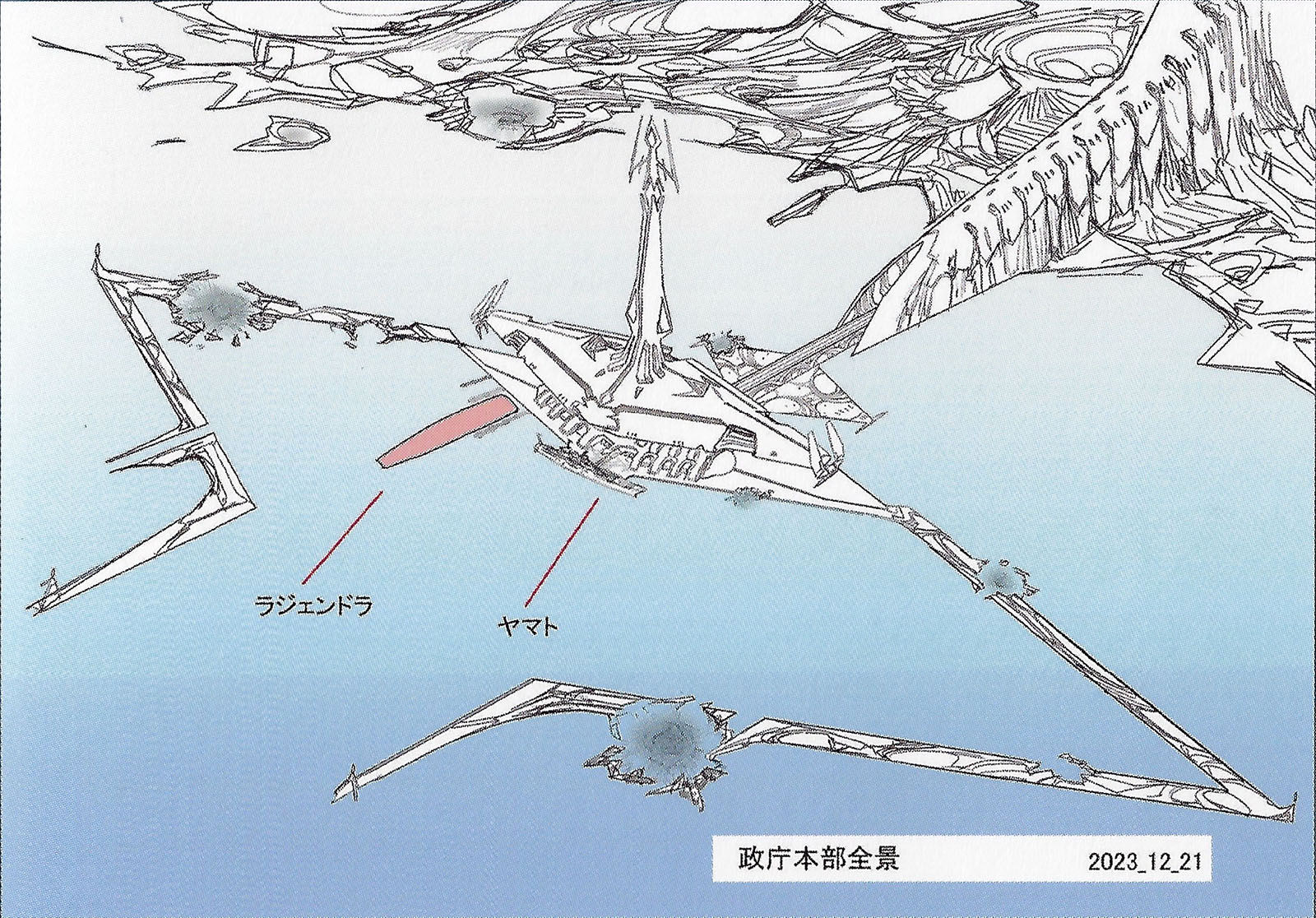
Holy City Ruda
Many structures on Galman, such as the government complex, are built in the Iscandar style. Scars from the planetary bombardment are depicted throughout.
ISHIZU’S COMMENT:
Holy City
Ultimately, I ended up handling nearly all the Galman-Garmillas related art. It was demanding work, but since it was a world I loved, it felt rewarding. What I particularly focused on was the image of “Galman-Garmillas retaining some elements of Iscandar.” Spaces where traces of the former culture and mystique linger. By weaving in just a hint of magical nuance, I aimed to create an atmosphere distinct from Garmillas, uniquely Galman.
Yabu’s House
Personally, I really enjoyed designing this. Creating a place with a “scent of daily life” is incredibly interesting work, and I was given free rein to draw it. The house materials, for instance, have a feel of being cobbled together from scraps, which I think captures the essence of Galman-Garmillas at this stage.
Bakery
This was an interesting request. I believe a bakery is a first for us. It’s a rare subject, but we designed it as a bakery that isn’t entirely alien to humans and would be easily understandable if humans were substituted. While it’s not just combat mecha, such elements don’t get much screen time on the Garmillas side, which I think adds to the appeal.
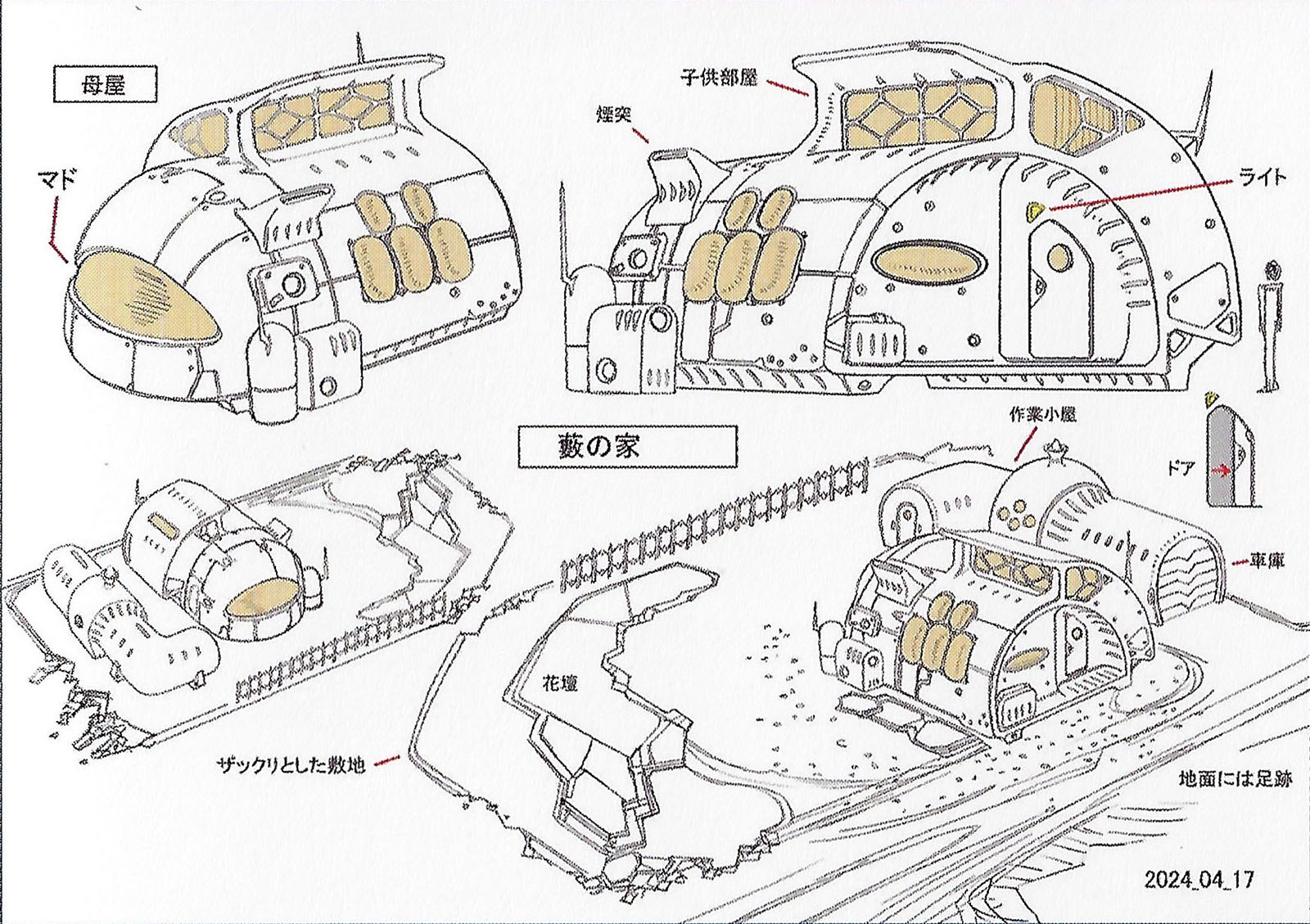
Yabu’s house (barracks). Characterized by its hastily assembled, makeshift appearance, seemingly cobbled together from random parts.
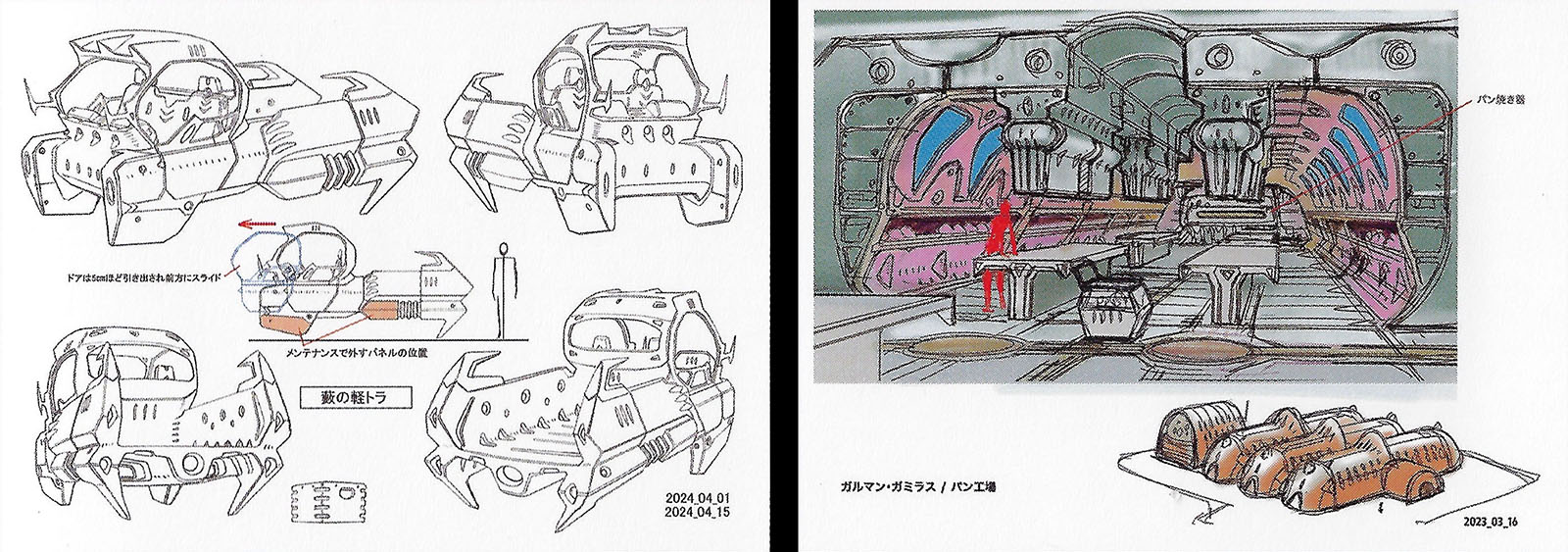
LEFT: Yabu’s light truck.
RIGHT: Design of the alien bakery where Hilde and the others work.
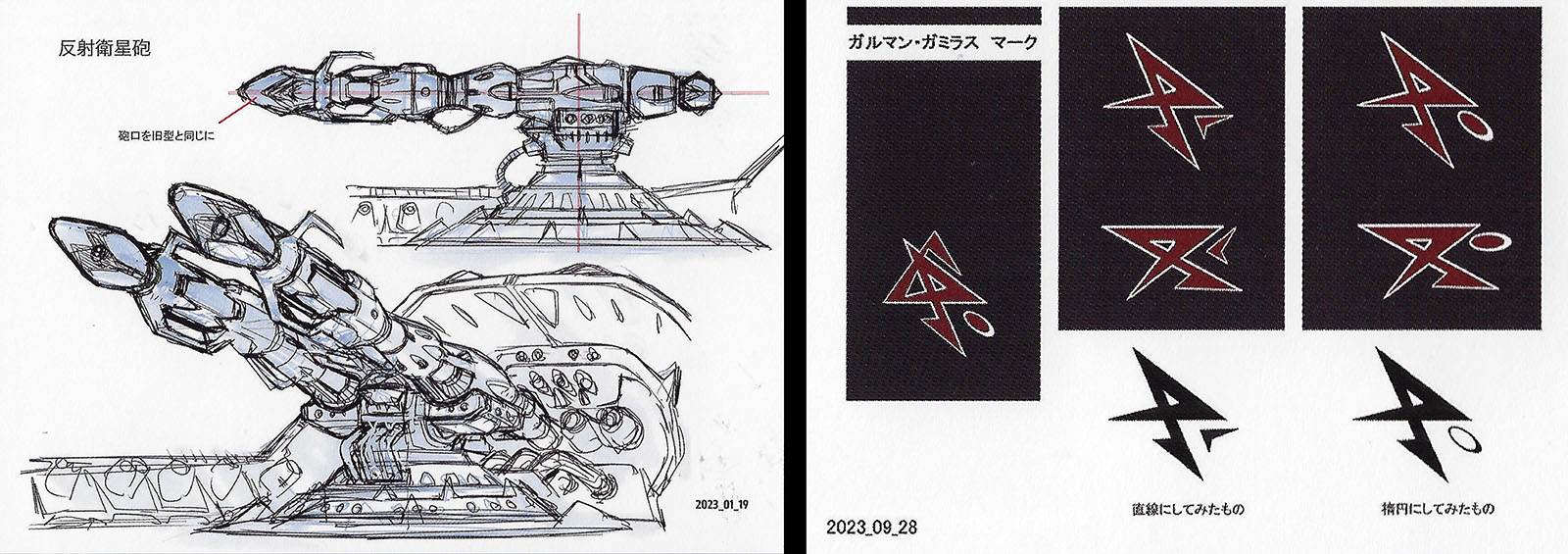
LEFT: Twin-barreled reflection satellite cannon, similar to those in Yamato III. The design lines for the muzzles and such inherit elements from 2199.
RIGHT: Marking design studies for Galman-Garmillas, retaining the impression of the great Garmillas Imperial Star. Also handled by Mr. Ishizu.
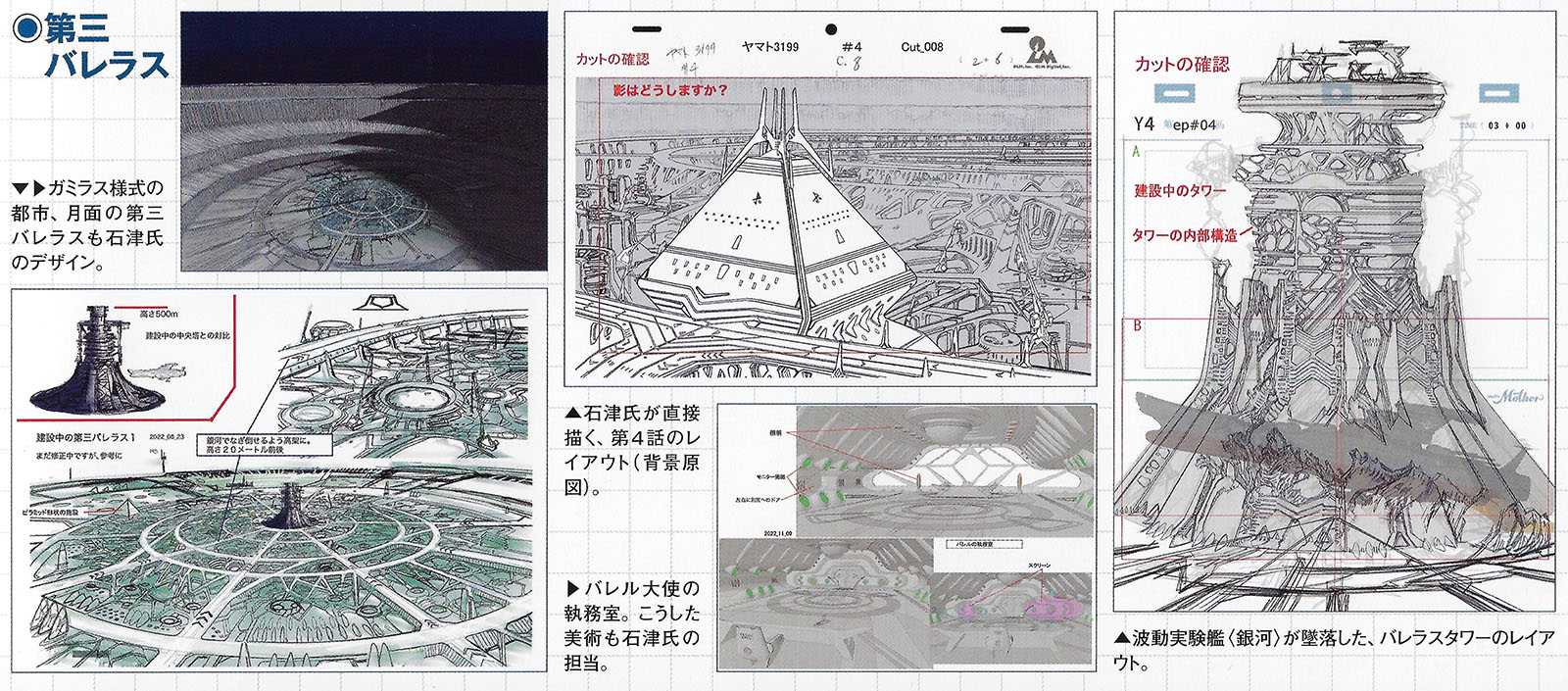
Third Valeras
LEFT: Layout (background artwork) for Episode 4, drawn directly by Mr. Ishizu.
CENTER: Ambassador Varel’s office. This art was also handled by Mr. Ishizu.
RIGHT: Layout of Valeras Tower, where the Wave-Motion experimental ship Ginga crashed.
I love the Shalbart Class
Tim, seriously, this is the best website EVER
No charge, buddy!
The Shalbart and “Ruined Ship” are the greatest thing I’ve seen all year!