
The opening of the Space Battleship Yamato movie in August 1977 was the biggest thing that had ever hit Japanese cinema. The opening of Farewell to Yamato a year later made it look like a warmup.
On August 5, 1978, (actually, the night before) fans stood in fantastically long lines at Toei theaters, easily outnumbering those who had done the same a year earlier. This was especially true for theaters at Shibuya, Shinjuku, and Yokohama, where there were more moviegoers than seats, and theatre owners scrambled to rent out other theatres to use as waiting rooms. Animage, a new anime magazine published by Tokuma Shoten, appropriately declared it the “Summer of Yamato Fever”.
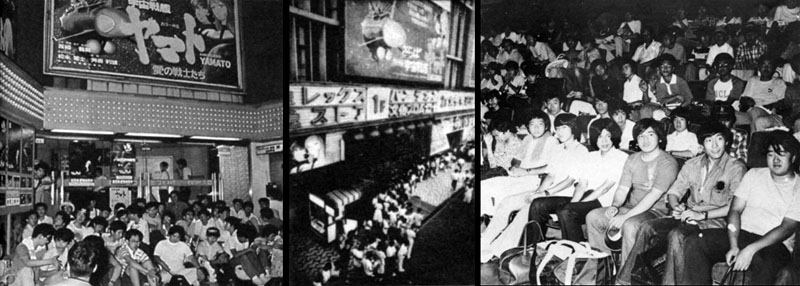
Some audience members teared as soon as the film started rolling, probably anticipating the tragic ending suggested by the title. Every time Kodai, Shima, Sanada, and all the other beloved characters appeared onscreen, sighs and sobs swept through the audience. The movie simply flew by and reached its final scene. The theater was filled with tears for Kodai, who alone steered Yamato against the menacing “Gatlantis” to fight for peace in the universe. Makoto Watanabe, one fan who later turned pro as a model designer, had this to say about the experience:
“My tears wouldn’t stop flowing after watching the movie. I recall sitting in the movie theater, totally embarrassed, and unable to leave until my tears had dried. Looking at the others around me, I noticed that they all appeared to have cried as well. That’s how powerful Yamato was.”
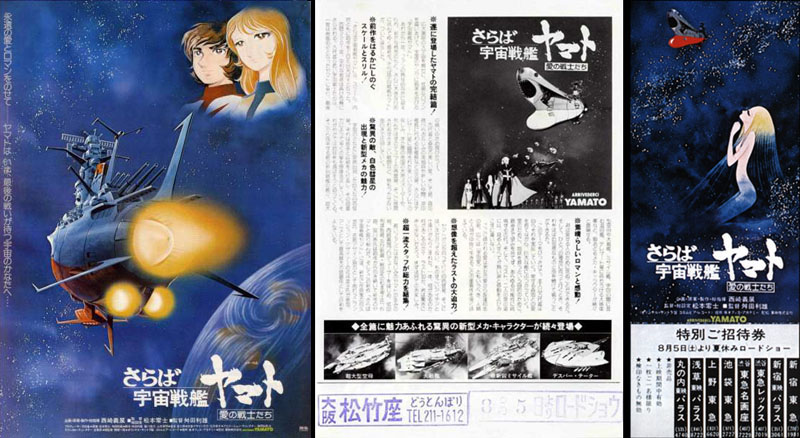
Above: original movie flyer and ticket, circa 1978
Some fans returned to theaters again and again, creating the groundswell for entirely new fan clubs. Interestingly, even some of the most devoted fans shared the opinion that the Yamato series should have ended here, which further attested to the huge success of the movie. Of course, this was not to be. But even now, there is still a vocal minority that wished Yamato had not gone any farther. Farewell was so good, so emotionally satisfying, that it must have seemed like more Yamato would have only diminished its greatness.
None of this seemed to hurt video sales, since Farewell has been released just as frequently as each of the other films. One could suppose that fans who seriously wanted it to end the saga restrained themselves from buying the later material. As if anyone could resist.
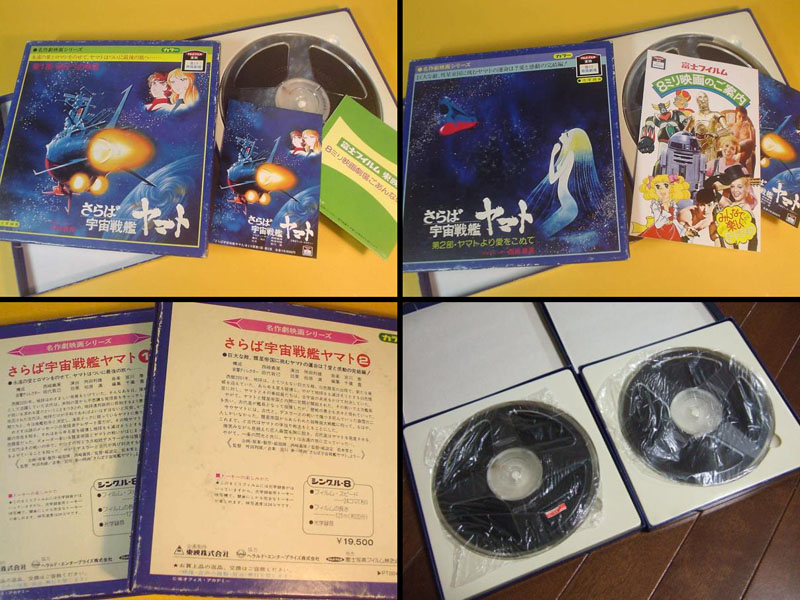
Prior to the video boom of 1983, there were actually two ways you could watch Farewell at home on demand, both on 8mm film. Toei teamed up with Herald Enterprise, who had manufactured similar reels for the first movie, to release the two 20-minute reels shown above. Both included sound and color. Part 1 was titled “Hope for Tomorrow,” and Part 2 was “From Yamato with Love,” named after the ending song. At 19800yen apiece, this was an incredibly expensive way to watch only one quarter of the movie.
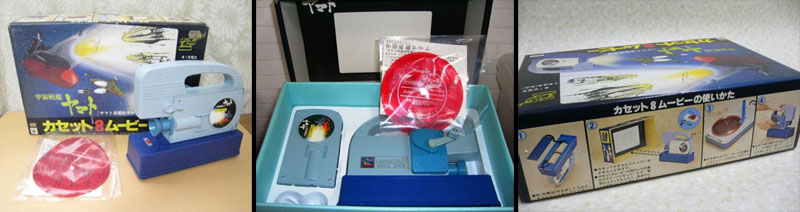
Priced a little more friendly was the Yamato “Cassette 8 Movie,” released in October 1978 by the Nomura Toy company. The all-in-one set came with a projector, a film cassette with a running time of just two minutes, a flexidisc soundtrack, and a script to follow along. By the time Farewell eventually made it to home video, countless fans would have had every frame of those two minutes committed to memory. (Read more about Nomura’s Yamato products here.)
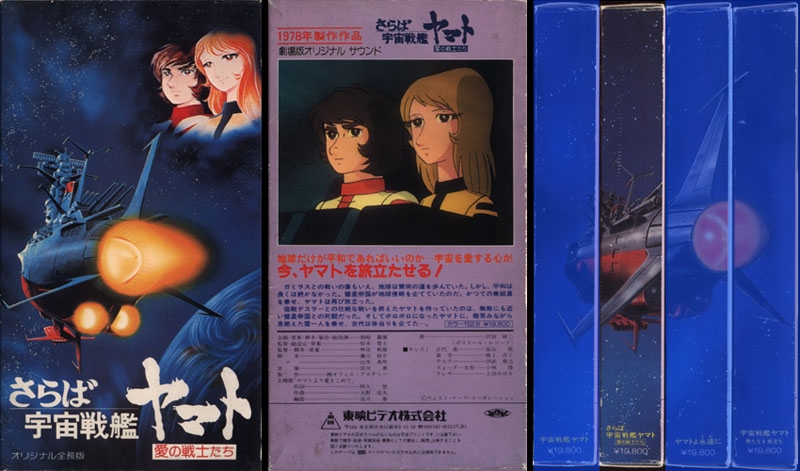
Toei VHS and Beta tapes, 1983
The first chance everyone had to see all of Farewell at home was with the Toei release (on both VHS and Beta) of the four movies that preceded Final Yamato. Released together on April 21, each tape box had part of an image on its spine (above right) that combined into a painting done for Final Yamato‘s release.


Victor VHD Video Discs, 1983
Advertised in the Final Yamato movie program book, Victor’s VHDs also hit the market on April 21, introducing the VHD format for the first time. They were more durable than tapes but still susceptible to the same sort of damage that could afflict LP records. Their packaging was more impressive, especially when a long-running movie was spread out over two discs.
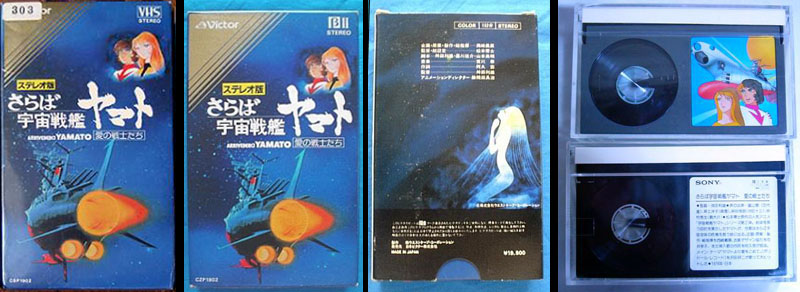
Victor VHS and Beta Tapes, 1984
Victor’s VHS/Beta release occurred in 1984, presumably after deals with Toei and Nippon Columbia had expired.

Farewell to Yamato MV (Music Video)
Laserdisc and VHS, Nippon Columbia, 1984
True home video connoisseurs lavished their time and money on visually superior and theoretically indestructible LDs by the mid 1980s. Nippon Columbia, long the home label for Yamato music, was the natural choice to release the MV series, an innovative set of programs that combined re-edited footage with symphonic scores. Read more about the MV series here.
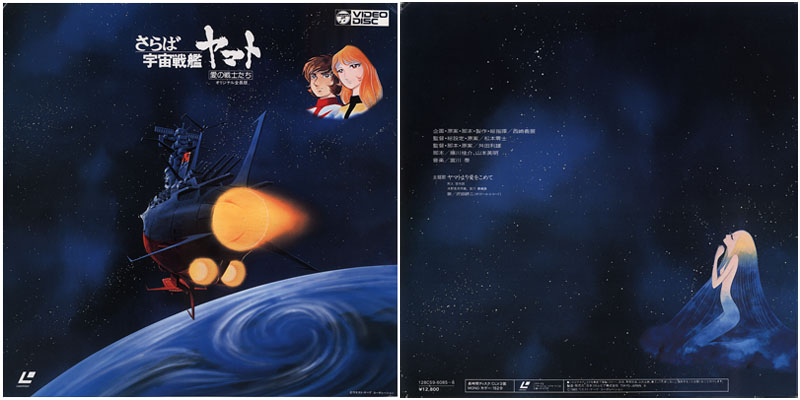
Nippon Columbia Laserdisc, 1985
A year after the MVs made their debut, Nippon Columbia followed up with their own handsome edition of Farewell to Yamato on LD. Outer sleeve shown above, inner sleeve shown below.
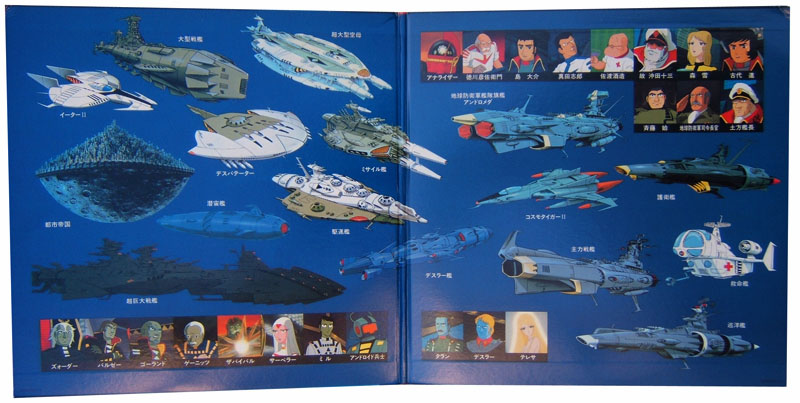

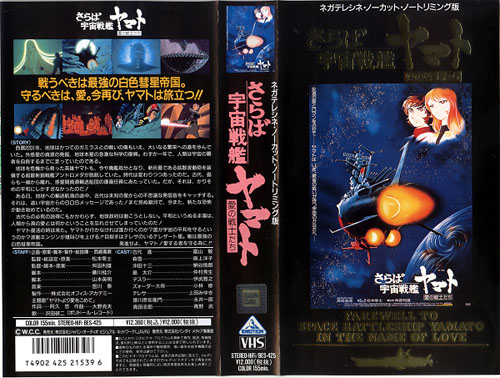
Emotion “Perfect Collection”
Laserdisc, 1989 (above)
Emotion VHS Tape, 1990 (left)
The entire Yamato video catalog found a permanent home with Bandai’s Emotion label in 1989 and got a repackaging on both of the now-standard formats. The LD was part of the first Yamato box set, called the “Perfect Collection.” Containing all five movies and a bonus disc of trailers and other artifacts, it also firmly established Farewell to Yamato as the official English translation, laying to rest the previous international title of Arrivederci Yamato. Both the LD box and the VHS sleeve featured gold-stamped logos.
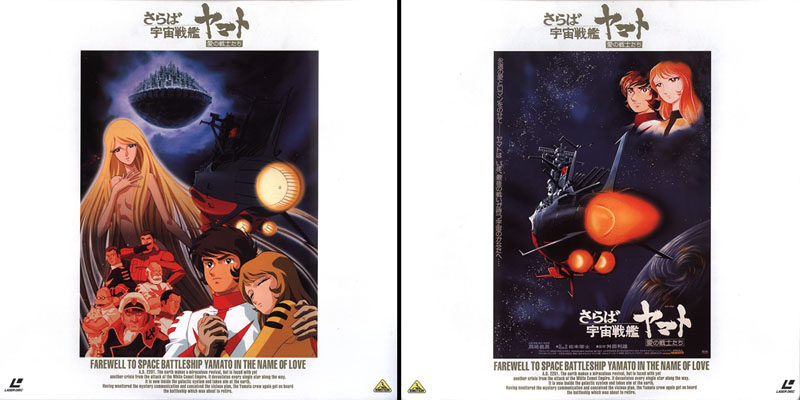
Emotion Laserdisc, 1993
Since their first Yamato LDs were all limited to pricey box sets, Emotion addressed the need for individual releases in 1993, a year before Yamato‘s 20th anniversary. They sweetened the deal with stunning new jackets by anime designer Hiroyuki Kitazume (above) and extended liner notes on the inner sleeve (below). Also included was the original theatrical trailer. These were timed to promote the forthcoming Yamato 2520, which made its debut in 1995.
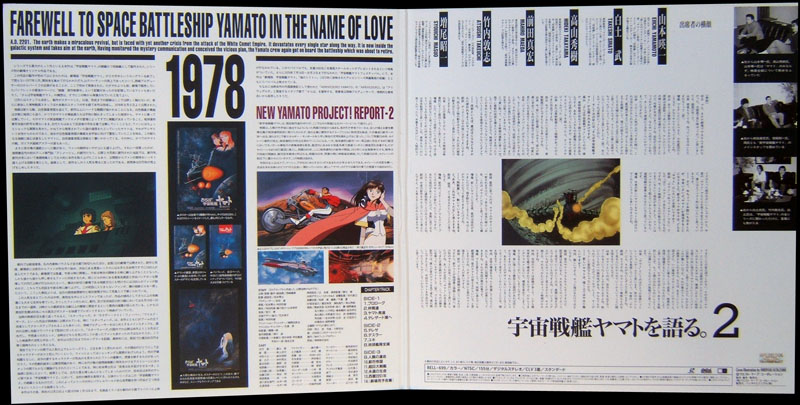

Voyager Entertainment VHS tapes, 1994 & 95
Farewell made its home video debut in the US after a brief theatrical appearance by an English-dubbed version that caught everyone by surprise. The dub had been made years earlier for an international marketing campaign in 1988, which is when the Farewell name first appeared to replace Arrivederci. Approximately 30 minutes shorter, the dub was a curious hybrid of Yamato and Star Blazers, combining character names from each. However, it did not feature the original Star Blazers voice cast. Voyager’s release of this edition (above left) in 1994 was followed a year later by the full-length subtitled version (above right).
Click on the image at right to see Voyager’s promotional flyer for this film.
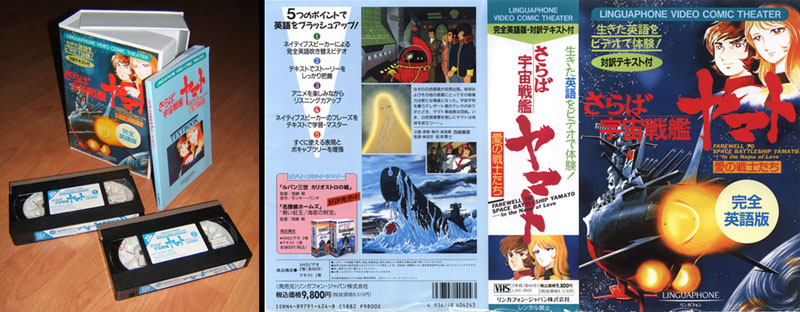
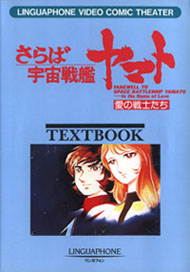
Linguaphone Video Comic Theater Edition, 1995
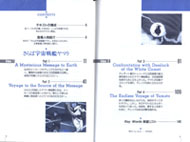
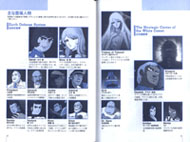
The Japanese release of the English dub followed the US release by one year. Production on the dub had actually been completed in 1989, most likely by Streamline Pictures (though the movie is credited only to Voyager Entertainment) whose dubs of Cagliostro Castle and Sherlock Hound were also released in Japan by Linguaphone. Packaged as an English teaching tool, the set came with a bilingual textbook (shown at left) with the complete script. Click on the images below to see some of the interior pages.

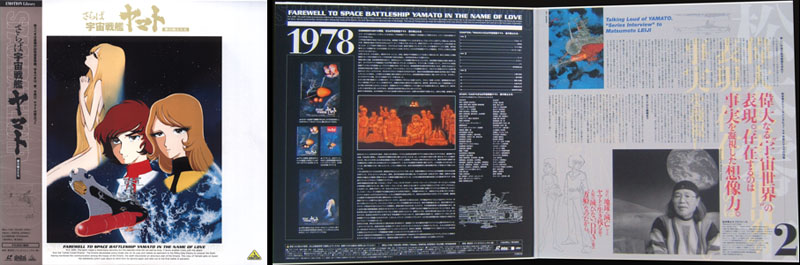
Emotion Laserdisc, 1998 (above)
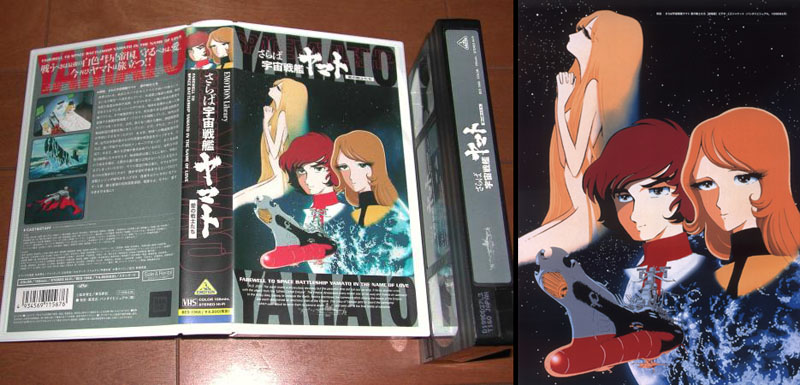
Emotion VHS Tape, 1998 (below)
The last hurrah for LD and VHS came a year in advance of Yamato‘s 25th anniversary when Emotion revised the packaging to reflect their new partnership with Leiji Matsumoto, the beginning of a renaissance that would re-open the floodgates of Yamato merchandising. The the new jacket artwork was created by anime designer Toshihiro Kawamoto in the vintage Matsumoto style.
Read Matsumoto’s liner note essay here.
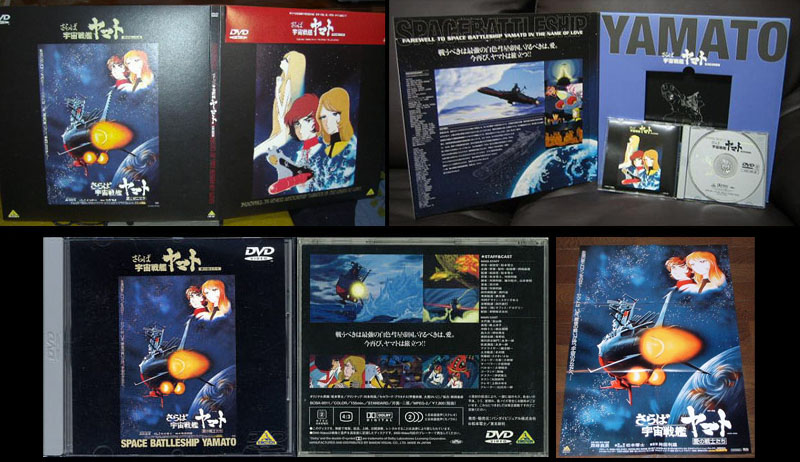
Emotion deluxe DVD, 1998
To commemorate the 20th anniversary of Farewell, it became the very first Yamato film ever released on DVD in an unusual package that was not to be repeated with the others. The exterior sleeve was the size and shape of a laserdisc, but the DVD was contained in a nested jewel case with a mini-poster tucked inside. A standard-format DVD (below) followed in 1999 in packaging that matched that of the four other films. In addition to the theatrical trailer, one new bonus feature was a second audio track re-engineered to play the music in stereo.
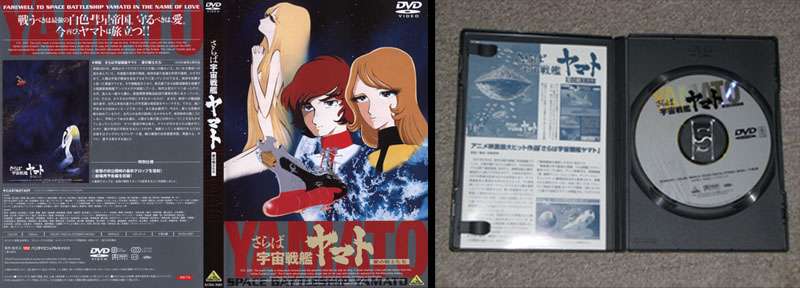
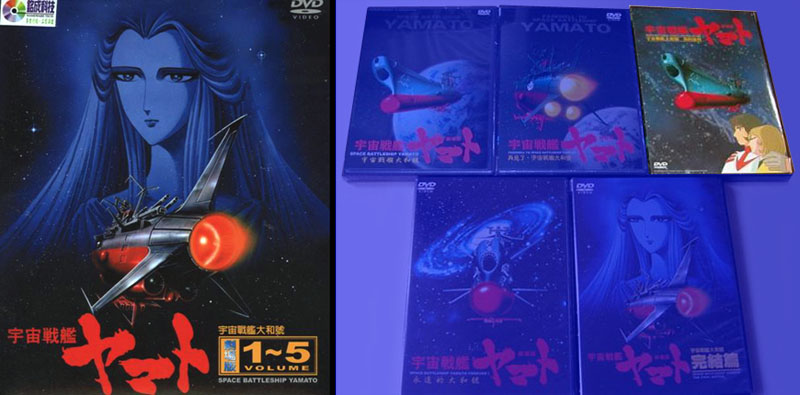
Emotion/PW Region 3 DVD (date unknown)
Emotion teamed up with Asian distributor PW to release all five movies in a box set. The region 3 edition of Farewell to Yamato is highlighted above right.
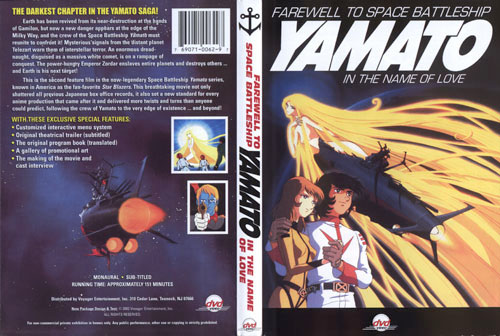
Voyager Entertainment DVD
2002
Voyager followed suit with its subtitled DVD release three years later, which included a host of extra features: the original theatrical trailer, a fully-translated video representation of the Japanese movie program book, an art gallery, and historical material. The movie is also part of Voyager’s Yamato Collection DVD box, released in March 2003.
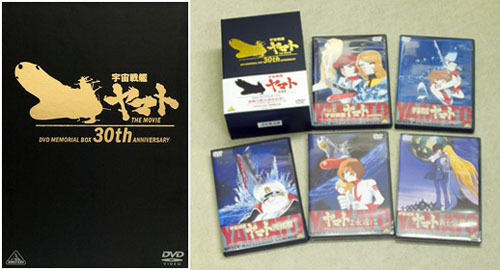
Emotion DVD Memorial Box
2007
Farewell and the other films were released in this box set to commemorate the first Yamato movie’s 30th anniversary in August, 2007. In a very real sense, the first movie had been the ignition spark for the entire engine of anime commerce that made it possible for Bandai (and many other companies) to thrive. It would have been unthinkable for a product like this not to have been made.
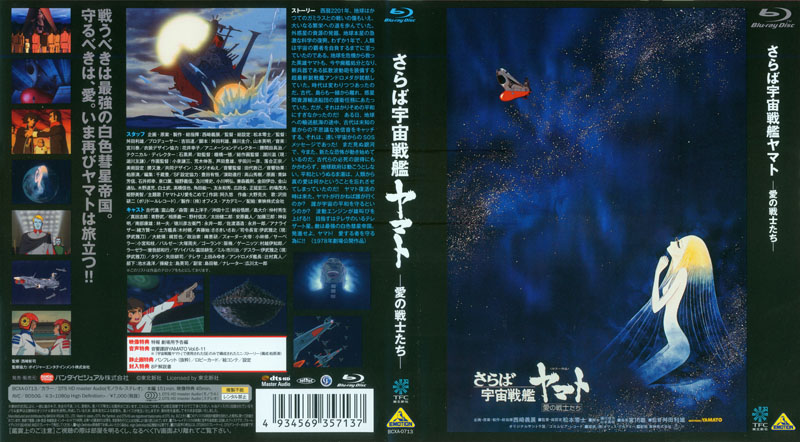
Farewell to Yamato Blu-ray disc
Bandai Emotion, BCXA-0713
April 24, 2013
When the classic Yamato movies finally came to Blu-ray in 2013, Farewell was once again the first to arrive. It is gorgeous to behold, sharper even than its original theatrical release, and even had one of its most infamous mistakes corrected – Yamamoto’s elbow no longer pops out of his Cosmo Tiger cockpit during his final salute.
Bonus features were extra special on this one: the original trailer was included, along with the sound clips from the ’92 Yamato 2 LD box set, a digital version of the 1978 program book and lobby cards, and – best of all – the complete storyboard of the film by Yasuhiko Yoshikazu (never before published in any format).
It can be ordered from Amazon.co.jp or CD Japan.
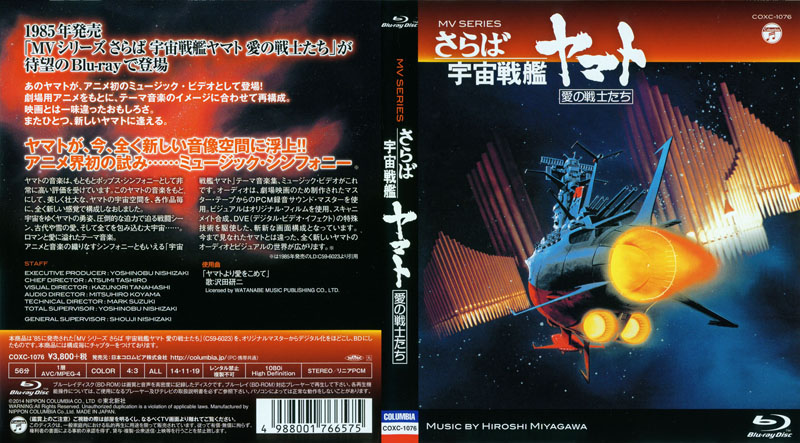
Farewell to Yamato MV [Music Video]
Columbia, COXC-1076
November 19, 2014
Seemingly lost in time since its first release in 1984, the MV series gots its long-awaited revival thanks to the momentum of Yamato 2199. The Yamato movie MV and a new one devoted to 2199 came out together in July 2013. The others all followed in 2014 on both Blu-ray and DVD.
Order it from Amazon or CD Japan

Farewell to Yamato 4K Blu-ray, limited edition
Emotion, BCQA-0018
January 5, 2024
The 4K remaster of the film kicked off Yamato‘s 50th year when it played in theaters for three weeks. It contained the film on both standard and 4K discs along with an internal booklet. This constituted the regular edition, which went on sale in March 2024. (Order it at Amazon.co.jp here or CD Japan here.)
Bonus features included a complete collection of teasers and trailers and mono/stereo options.

Photos posted on Twitter by X0_BR and capsule_agila
But the real prize for dedicated fans was the bonus item that made it a limited edition: a 300-page book containing the complete storyboard by Yasuhiko Yoshikazu (the first time in print).
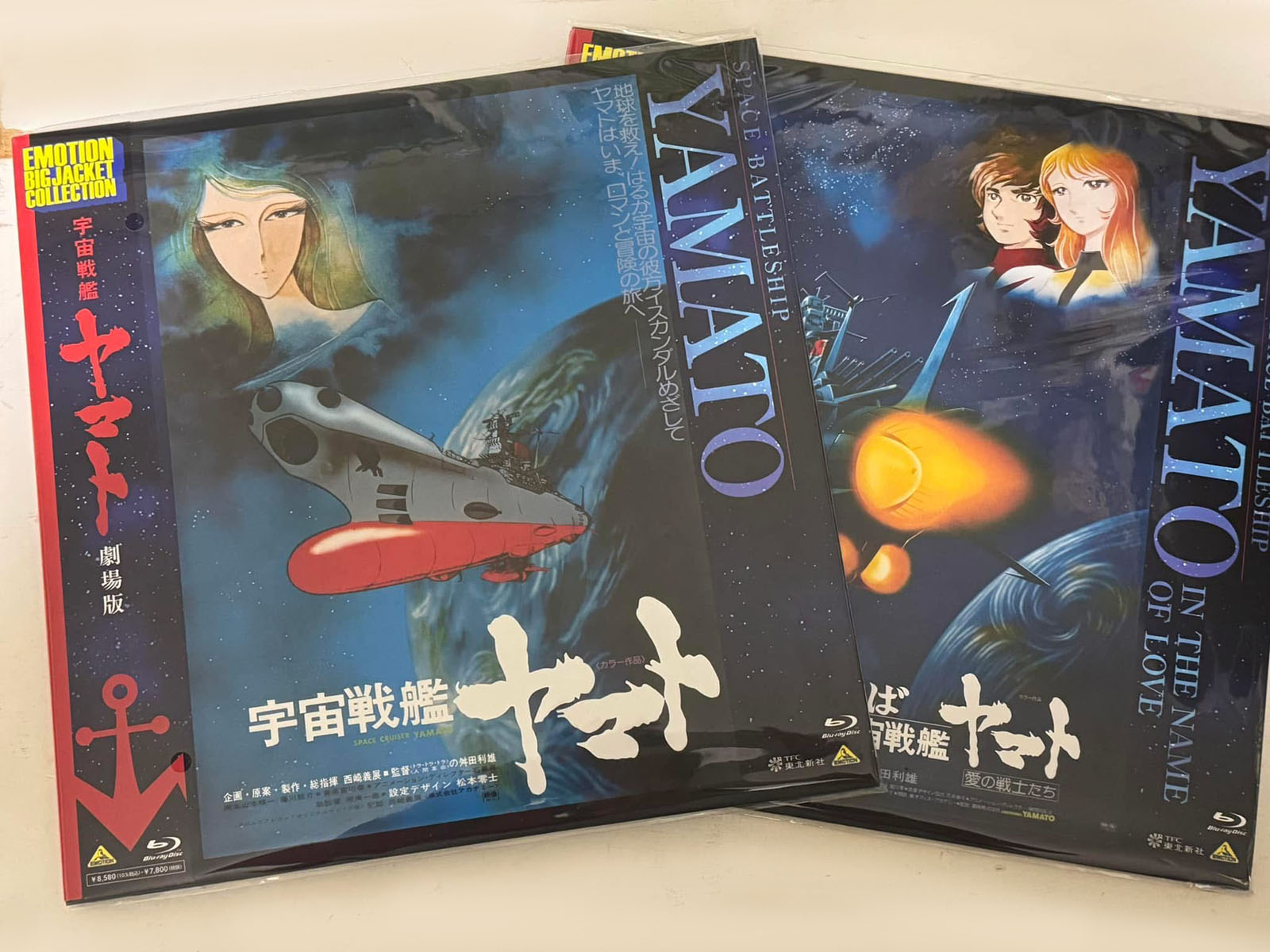
“Big Jacket Collection” Blu-rays
January 28, 2026
Bandai Emotion released the first two of the five original Yamato films in a special deluxe format called “Big Jacket Collection.” They contain the same Blu-rays released in 2024, the 4K upgrades of Space Battleship Yamato and Farewell to Yamato, now in an LP-size package.
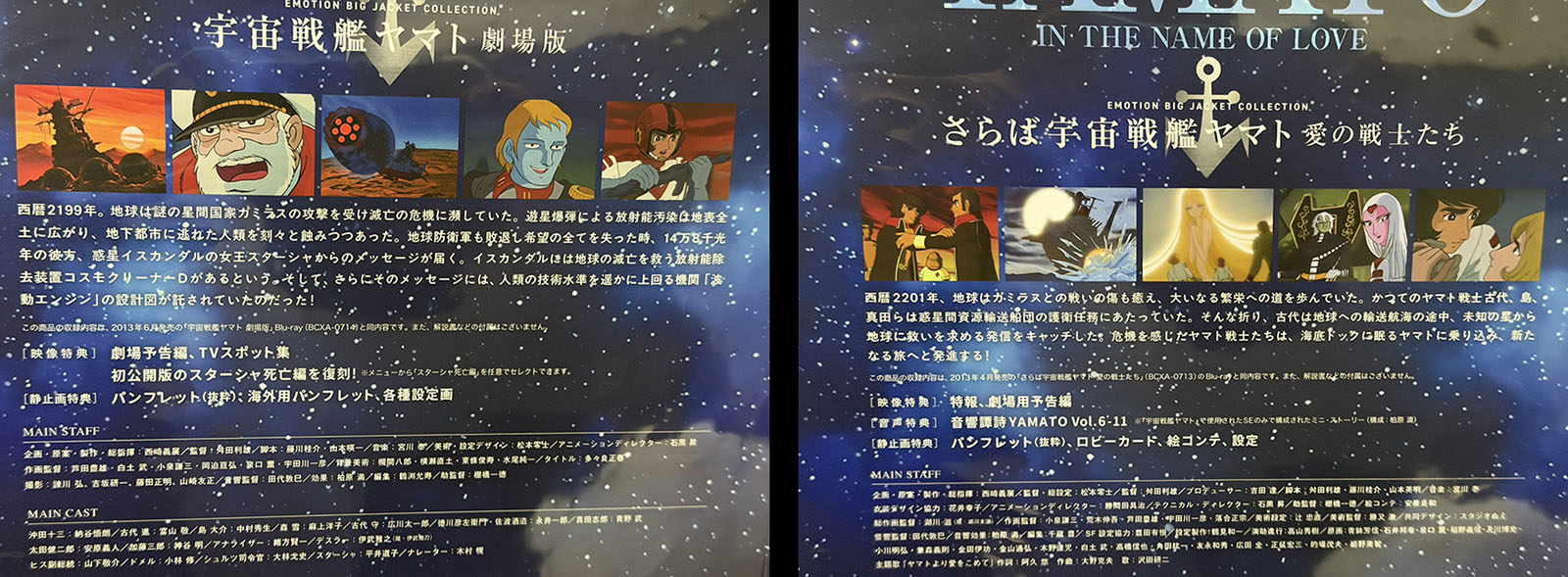
Kia Asamiya posted these photos on Twitter, saying that Bandai had sent him courtesy copies. He said, “At first I was like, Laser Disc?!”
Order these editions here:
Space Battleship Yamato Amazon.co.jp | CD Japan
Farewell to Yamato Amazon.co.jp | CD Japan
I’m seeking Space Battleship Yamato music that were never posted on CD. I understood they may be still circulating on 45rpm records or cassette tapes. The music or songs I’m seeking are from THE FINAL YAMATO and ARRIVEDERCHI YAMATO movies.
It’s all available on CD. The most recent release was the Sound Almanac series.
You can learn all about it at the album index here:
https://www.ourstarblazers.com/vault/259/
Is the current consensus correct that the version of ‘Yamato Yori Ai wo Komete’ used in the actual film during its August 1978 theatrical release is the one that first appeared on the album MR3170 (which features a more prominent electric guitar and no oboe mixed into the second verse)?
Given that the release order was DR6235 and MR3130 in August ’78, FL1001 in December of that same year, and MR3170 in April ’79, this established theory seems illogical. It strikes me as a misunderstanding based on later home video releases where the audio was replaced (such as the 1983 Victor VHD, which is a stereo version)…
I’m not up to date on the “current concensus,” but since you’re conversant with the two different vinyl versions of the song, it should be simple enough to listen and compare. Please share your findings here when you do.
I’m only aware of one release of the song in Dec 78, and that’s the Isao Sasaki version on an EP. And I don’t see anything in the record for April 79. Can you expand on your info?
Since I am Japanese, my question may not have been conveyed accurately, so I will restate it.
“Yamato Yori Ai wo Komete” (a.k.a. “From Yamato with Love”) is a song sung by Kenji Sawada that was used as the ending theme for *Farewell to Space Battleship Yamato*. There are two different mix versions of the backing track in the commercially released recordings.
The first version is the one included on the single DR6235 and the album MR3130 (released in August 1978); this version features an oboe in the second verse. The second version is the one included on the album MR3170 (released in April 1979); this version generally emphasizes electric guitar and does not include the oboe. Both were released by Polydor.
In the ending of currently distributed video releases of *Farewell to Space Battleship Yamato*, the MR3170 version is used. For example, the Japanese Wikipedia states that this version was also used at the time of the film’s theatrical release in August 1978.
However, judging from the release chronology above, it seems unnatural that the MR3170 version (released in April 1979) would have been used at the time of the August 1978 theatrical release. Furthermore, the karaoke track included on Tokuma Musical Industries’ FL1001 (released in December 1978 for core fans) is also the DR6235 version. Based on this, I infer that the version used for the film’s ending at the time of its August 1978 release was the DR6235 version.
To verify whether this inference is correct, one possible method would be to check a release explicitly labeled as containing the “original theatrical soundtrack,” such as the 1983 Toei Video TE-M462 (mono audio). However, I do not own this video.
I would appreciate any advice you may have.
P.S. For reference, I have included links to the two versions mentioned above:
* Single DR6235 / album MR3130 version (August 1978 release; oboe appears in the second verse)
https://www.youtube.com/watch?v=3klSn6fWnbk
* Album MR3170 version (April 1979 release; no oboe in the second verse)
https://www.youtube.com/watch?v=KcwzwaqOESo
Your points are clear, but the single DR6235 and album MR3130 contain different mixes of the song.
I don’t have data that agrees with your information on FL1001 or MR3170. Can you please tell me the title of those discs so I can research them?
First, the single record is:
DR6235
https://www.discogs.com/release/7478274
For this, there are the early injection-molded type (1) and the later pressed type (2), but Discogs does not distinguish these two. Even in Japan, these two are often confused.
Next, the albums are these two:
(3) MR3130
https://www.discogs.com/release/12252089
(4) MR3170
https://www.discogs.com/release/5532982
And, the flexi disc (a.k.a. phono sheet) is:
(5) FL1001
https://www.discogs.com/release/11319746
The audio sources of “Yamato Yori Ai wo Komete” included are:
(1)=(3) and (2)=(4),
but for (4), the intro starts from a fade-in. And, (5) is a combination of SE and the karaoke of (1)=(3).
The current established theory in Japan is that the audio source of (2)=(4) is the version that was used in the 1978 movie itself.
You have given me some new information, so thank you very much!
Is the Linguaphone dub the same as the Voyager Entertainment release?
Yes, it’s still the only dub anyone has ever done for that movie.