The line between wanting to be a good person and wanting to be seen as a good person
“Bieshuna, Yamato” Now, heading beyond unknown space…
Introduction by General Director Harutoshi Fukui
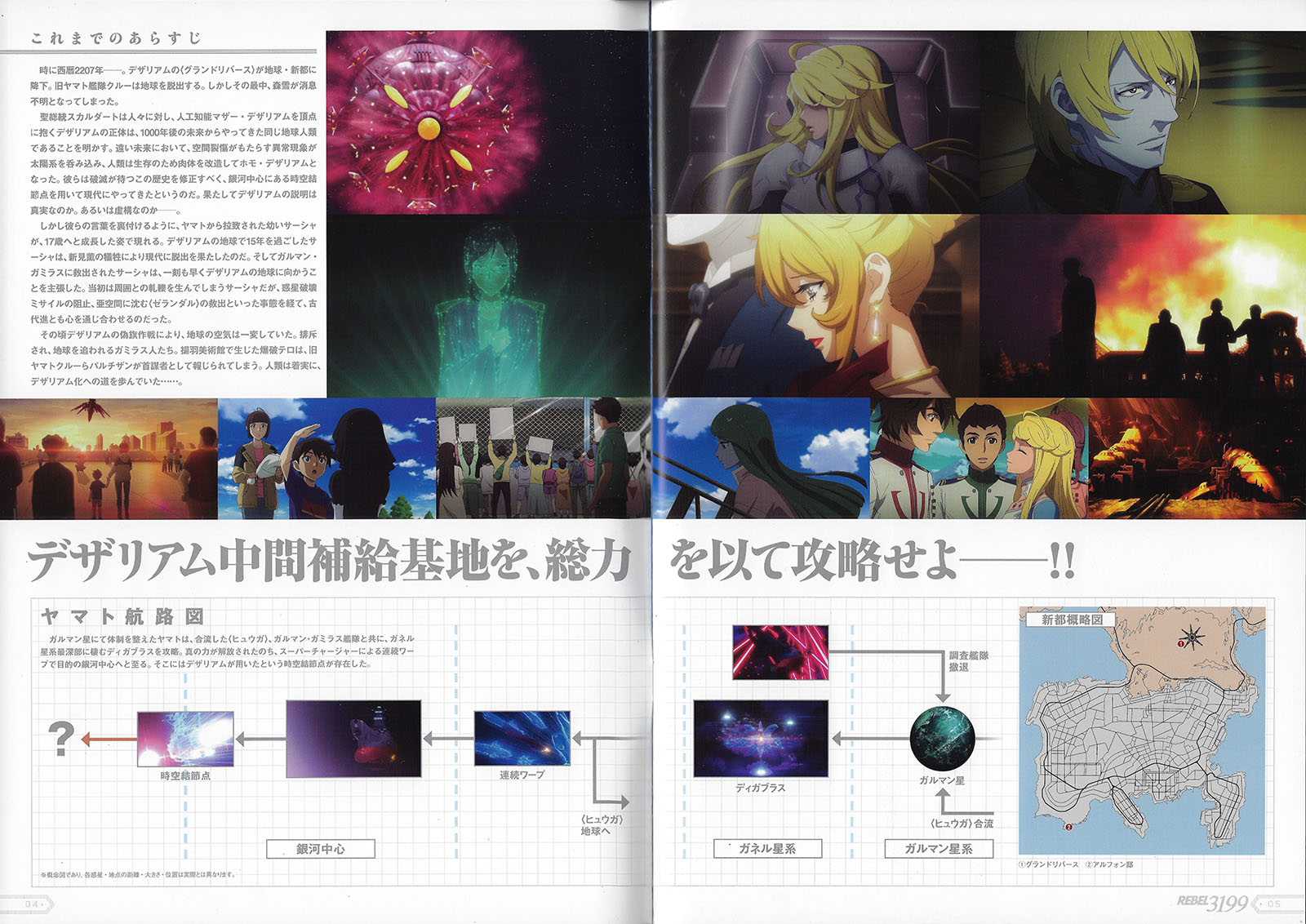
“Thanks to this, Earth has become a society of informants. Dezarium is justice, and the partisans are terrorists who refuse to accept reality. The only way to prove you’re a sensible person is to wear a comm badge. You didn’t even need to use the Grand Reverse. With just one bomb, you turned Earthlings into Dezarians!”
This is a line from Yuki in the main story. As I mentioned before, the concept for 3199 began around 2018, but I wrote this line around 2023. I remember being hesitant at the time, thinking it might be a little too graphic.
The COVID-19 pandemic is still fresh in our minds, and with the impact of the Ukraine war, we hear terms like “false flag” and “fake news” every day. The atmosphere of things we only knew from textbooks, like pre-war Germany being consumed by Nazi furor, or wartime Japan being engulfed in the pressure to conform to the “100 million deaths” campaign, is slowly creeping up on us.
The things I swore I’d never do again, the foolish deeds I was so confident I’d never do again, are already starting to turn. When I realized we were living in an era that may be described in future textbooks as “the prologue to catastrophe,” I wondered if I should refrain from incorporating too much of the atmosphere of the times into my fiction. In the end, not only did I have Yuki say the line, I also assigned the same line to Skaldart.
“Partisans will eventually be wiped out by their own kind. Rather than freedom, humans seek the security of being part of a greater being. This is a pattern that history has repeated many times before.”
Then, on the screen, we see a man without a comm badge (who is by no means handsome and looks like the kind of guy who wouldn’t follow the rules, which makes him even more realistic) being taken away by Kosaka and the security police. That’s right. It’s annoying to have to accept Skaldar’s argument, but it seems that humans have been repeating this kind of thing over and over again in the past, present, and probably into the future.
So, as a writer who happens to live in such an era, I would like to explain the mechanism by which human society destroys itself. Even if that is impossible, I would like to at least leave behind, through my fictional works, the process by which such a situation is reached. Why does a group of people, who essentially want to resonate with and lift each other up, somehow end up trapped in such self-imposed shackles? I am determined to explain this, since the role of fiction is to mirror reality, and as I have continued to weave a socially conscious drama behind the exploits of Yamato and engage in a dialogue with reality, certain words have somehow solidified for me.
Most people want to be good people. However, this statement or, rather this realization, suggests that there are two types of people: those who want to be good people, and those who want to be seen as good people.
Humans are creatures that cannot survive without forming groups. Inevitably, those who harm the group are eliminated and destined to starve to death. The desire to be seen as a good person is therefore a human instinct. It is like a passport for living in a group. It is nothing to be ashamed of.
However, there are some people who want to move forward and change the world, even if it means breaking the rules of society. I don’t mean people who turn to crime out of greed or circumstances. I mean people who abide by the bare minimum rules of society while prioritizing their own impulses. For them, this is what a “good person” is: someone who “forgets self preservation and lives life to the fullest,” and the opinions of others only come later.
It is these people who often leave their mark on history for future generations. For those who are not content with the status quo, and instead aim for uncharted territory, the rules of the present can sometimes become obstacles that prevent them from moving forward. Of course, not everyone succeeds. Many simply rush headlong into their youthful folly and end up becoming ordinary adults. But a truly prosperous society is open-minded enough to accept and incorporate such traits, calling them adventurous and ambitious. Perhaps the reason the post-war Showa era is looked back on as Japan’s youthful age is because it was filled with such an upbeat atmosphere.
However, prolonged economic stagnation, poverty, international unrest, and unexpected disasters like earthquakes and the COVID-19 pandemic rob society of this psychological richness. Everyone is enduring hardship. I follow the rules and live modestly, but what about that other guy? He seems to have more freedom than me. He seems to be having more fun than me. I don’t like that celebrity I saw on the news, either. There are criminals over there who have done terrible things, but haven’t received the death penalty. People like that are the enemy of society. If the law won’t punish them, then I’ll expose their family’s home addresses on the Internet…
This is a dark human psychology that exists in every era. However, with the spread of social media, petty malice and jealousy are now accumulating at an incredible rate, and being shared in a society that values safety and security. The structure in which people post the “unpleasant things” they see every day on social media, seek sympathy, and then online news outlets broadcast them to society as articles, seems more childish than abnormal. After all, it’s just the behavior of a child, like the one kid in every elementary school class who tells the teacher everything. “I want to be seen as a good person!”
It is no coincidence that mother Dezarium is not the leader or the queen, but a “mother.” In an intolerant society that has lost sight of the definition of a “good person,” people lose their independent spirit and become infantile, seeking a “parent” to mediate. What parents say is absolute. Their “existence,” the doctrine they preach, the ideas they communicate, are laws to cling to, the rules that govern society. This is how instigators incite. The people, by becoming part of something greater, are freed from loneliness and commit horrific atrocities as ordered by the instigators. The entire country commits acts that will leave future generations in disbelief, wondering how one person could do such a thing to another. Guided by their instinct to “be seen as a good person.”
Yes, what is depicted in 3199 happened in the past, and is also something that is about to happen again right now. Everyone will have a different answer to the question of whether this is a story that should be told in Yamato. However, based on the original spirit of the story, which depicts war while disguising itself as a science-fiction story of good triumphing over evil, and which also denounces competitive society and entrance exam wars that are its breeding ground, we have trusted Space Battleship Yamato with what needs to be said now.
The destination is likely to be difficult, as embodied by Yamato, which has literally broken through the barriers of time and space and arrived in the “present.” Aiming for horizons that no one can predict, the ship of those who wished to be “good people” soars through the disguise of the Reiwa era.