
Thoughts after watching Episode 1
See the original blog post here
Revisiting a Showa-Era Masterpiece
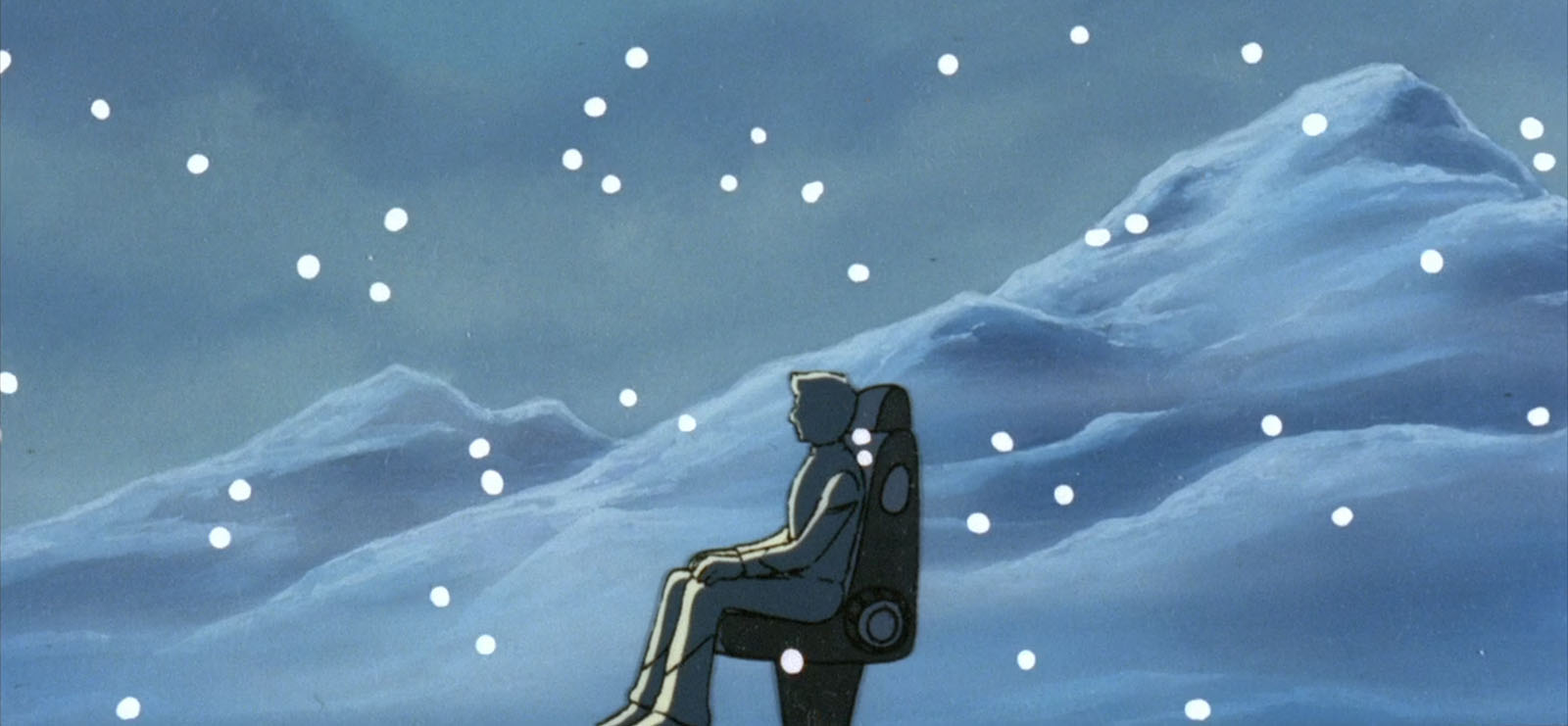
The nights in Sapporo are so quiet you can hear the sound of snow falling. The cold air fogs up the windowpanes, and the distinctive smell of burning kerosene in the stove is a delight. I don’t dislike that smell. Suddenly, I felt like revisiting a Showa-era masterpiece. It’s the anime Space Battleship Yamato, which first aired in 1974 (Showa 49).
At the time, the original broadcast ratings were poor, due in part to competing programs like Heidi, Girl of the Alps. However, reruns ignited the popularity and it became a part of the soul of our generation. Today, I’d like to take a closer look at the first episode, SOS Earth!! Resurrect Space Battleship Yamato, from the perspective of a former engineer.
Summary of highlights
The shocking story development of Yamato‘s first episode, which begins in the year 2199, with humanity facing a desperate situation with only one year left until its extinction.
The warrior’s pride contained in Captain Okita’s famous line, “Idiot!”, and the truth behind the fierce retreat battle at Pluto.
The reason Iscandar sent “blueprints” instead of “actual equipment,” and the difficulties of developing a Wave Engine from the perspective of a former engineer.
The message of “rebirth” symbolized by the battleship Yamato‘s resurrection from rusty “scrap iron.”
Streaming information, viewing order, plastic models, overseas reactions, etc. A Practical Guide to Enjoying Yamato in the Reiwa Era

The Red Earth of 2199 and the Pressure of “One More Year”
The premise of the story was shocking. The deep voice of the narrator (the great actor Goro Naya, we’ll never hear that voice again…) described the Earth of 2199. In contrast to the beautiful white snowy scenery outside my window, the Earth on screen was burned red, the oceans dried up, and it had become a dead planet.
An indiscriminate attack by a mysterious, unidentified space fleet (Gamilas) using planetary bombs. Just the mere mention of “planetary bombs” evoked a mysterious fear in us children at the time. The Earth’s surface was contaminated with high levels of radiation, and humanity had fled to underground cities.
The reality thrust upon us at the beginning of the first episode is truly brutal.
“There’s only one year left until all life on Earth will be wiped out by radiation.”
Even in cities built deep underground, contaminated materials seep from the ceilings, and people are collapsing. Back in my days, I used to struggle with tight deadlines and trouble-shooting on-site (I couldn’t let go of my indigestion medicine back then), but the ultimate deadline of “365 days until the extinction of humanity” leaves me speechless. This sense of urgency is surely the true nature of the tension that underlies the story of Yamato.

The deadly battle on Pluto: Captain Okita’s “Idiot!” embodies the warrior’s pride
The highlight of the opening is the fleet battle at Pluto, the edge of the solar system. The Earth Defense Force fleet is sunk helplessly by the overwhelming maneuverability and firepower of Gamilas. The depiction of this battle is excellent. It has a sense of gravity, like a World War II naval battle set in space, and it exudes a distinct “steel and oil” scent, unlike the whirring lasers and beams of modern anime.
As the Earth fleet is on the brink of annihilation, the Gamilas fleet sends out an arrogant message:
“Surrender immediately!”
The response of Captain Okita Juzo, seated aboard his flagship, is a scene worthy of being passed down to the present day.
When asked by the radio operator, “How will you respond?” Captain Okita speaks without changing his expression.
“Tell them they’re idiots.”
When the radio operator replies, “Huh?”, Okita responds even more forcefully and briefly.
“Idiots!”
Even in the most hopeless of circumstances, their determination to not succumb to the enemy is no mere insult. It’s perhaps their last act of pride as warriors. But the price of their retreat is immense. The missile ship Yukikaze, commanded by Mamoru Kodai, the older brother of our protagonist Susumu Kodai, holds his ground to allow Captain Okita to escape.
“As a man, I cannot endure such humiliation and return alive!” cries Mamoru. Okita reassures him, “A man must endure today’s humiliation for the sake of tomorrow.” However, Mamoru launches a suicide-like attack with his damaged ship and disappears.
Would you call this a “wasteful death” or a move for the future? I never saw my brother’s ship fall via monitor, but I wonder what Captain Okita must have been feeling. I too have lost subordinates in the field. The feeling of helplessness I felt at that time still pains me when I recall it.

A Bet on the Envoy from Iscandar and the “Blueprints”
Meanwhile, while training on Mars, two young men, Susumu Kodai and Daisuke Shima, witness an unidentified spaceship crash on the red planet. There, they discover the beautiful yet tragic corpse of an alien woman named Sasha, clutching a communication capsule in her hand.
The capsule contains a message of hope from the planet Iscandar, 148,000 light-years away. It is from Sasha’s older sister, Starsha. She calls on humanity to retrieve the Cosmo Cleaner D, a device capable of removing radiation from Earth, and entrusts them with the blueprints for the “Wave-Motion Engine” needed for the mission.
As a former engineer, what bothers me here is that what was sent to them was not the actual object (the engine itself), but rather blueprints (technical data).
The “Wave-Motion Engine” is an unknown technology that must be understood, manufactured, and implemented with an industrial power on the verge of extinction, and with only a short time left. The difficulty of this project is beyond imagination. It’s a real problem. Of course, it may have been physically impossible for the sender to send the actual device.
While the cabinet ministers waver, wondering if they should believe him, Captain Okita and the other adults on the front lines are resolved, saying, “We have no choice but to believe now.” This development, in which humanity is betting everything on a single blueprint or piece of data, deeply stirs the spirit of engineers. It’s the “determination” of the people on the front lines that makes the impossible possible, no matter the era.
After learning of his brother’s death and returning to Earth, Susumu Kodai lashes out at Captain Okita in the hospital. “Why did you let him die?” he asks. The passion of youth and the silence of veteran general Okita, who bears that pain. This generational conflict is also one of the important themes of this series.

The remains of the battleship Yamato lie decaying on the former ocean floor, now a reddish-brown expanse dried up by radiation. The scene, illuminated by the setting sun, exudes melancholy.
Scrap metal? The true nature of Yamato, awakened from a 200-year slumber
And then there’s the final scene of Episode 1. A huge wreck lies on the dried-up seabed off Cape Bono, Kyushu. A Gamilas reconnaissance plane looks down on it and spits out words of contempt.
“It’s really just scrap metal.”
Covered in red rust and bathed in the setting sun, the former battleship Yamato lies silent as death. But we know. Inside this “scrap metal,” a major renovation is taking place to carry humanity’s last hope.
Yamato is waking up from a 200-year slumber. Though its exterior may appear to be tattered wreckage, its interior is about to house a state-of-the-art “Wave-Motion Engine.” This seems like a powerful message of encouragement to our generation, who have reached retirement age and withdrawn from the front lines of society.
“Even if you look withered, your soul is not rusted away.”
From Episode 2 onward, a unique cast of companions, including a hard-drinking, renowned doctor named Sakezo Sado (who’s also a great character) and the lovable robot Analyzer, join the cast. This first episode is the prologue to the journey leading up to this lump of iron becoming a spaceship and saying “farewell, Earth.”

The Psychology of the Young Man Susumu Kodai as Seen by a Father in His 60s
I’d like to digress a bit here and discuss the psychology of the protagonist, Susumu Kodai, as I see it now that I’m over 60.
Frankly, Susumu Kodai in episode one is quite immature. The scene where he confronts Captain Okita after learning of his brother’s death is the epitome of youthful emotional outbursts.
“Why did you let my brother die?”
I sympathized with him as a child back then, but looking back now, I think, “You have no understanding of the harshness of the battlefield.”
Captain Okita issues the order to retreat. As a commander, it’s a difficult decision to make in order to protect the remaining forces. Mamoru Kodai disobeyed those orders and chose to commit a suicide attack of his own accord. This is often told as a heroic tale, but to be honest, it was problematic behavior for an organization member.
However, I cannot deny Mamoru’s choice. This is because there is a logic to each situation. There is human dignity and pride that cannot be explained by data or logic alone.
When I was younger, I would have simply thought, “Mamoru is so cool!” As I grew older, I understood that “Captain Okita’s decision was correct.” Now, at over 60, I understand that “both were right, and both suffered.”
The process by which Susumu Kodai ultimately grows as a crew member of Yamato is truly the story of a young man coming of age. You can’t survive on emotion alone. But if you lose your emotions, you’re no longer human. How to strike that balance? I’ve only just realized that this is the deep theme of the Yamato series.

Story Guide for Episode 1
Here, we’ll take a detailed look at the story of Episode 1 in chronological order.
A Red Earth Stained with Despair
The year is 2199. Earth, once a shining blue, has been transformed into a dead, reddish-brown planet, unrecognizable as a shadow. The mysterious alien civilization, Gamilas, has launched indiscriminate planetary bomb attacks, scorching the surface, drying up the oceans, and driving humanity underground with the invisible, deadly fallout of radiation.
Only one year remains until the extinction of humanity. In this extreme situation, where even hope seems like a luxury, the Earth Defense Fleet engages the Gamilas fleet near Pluto. However, faced with the overwhelming difference in scientific power, Earth is annihilated. Only the flagship, commanded by Admiral Juzo Okita, returns to Earth, albeit in tatters. During this battle, the young officer, Mamoru Kodai, acts as the rear guard to allow Captain Okita to escape, disappearing into the depths of space.
A “Beautiful Messenger” Descends on Mars
Despair reigns in the solar system. Yet, in one corner of it, an unidentified flying object crashes near the polar ice caps on Mars. Trainees Susumu Kodai and Daisuke Shima head to investigate, discovering the remains of a spaceship suggestive of an advanced civilization, neither Earth nor Gamilas.
There, they discover the remains of a woman and a communications capsule. The woman is Sasha, a native of Iscandar, a planet in the Large Magellanic Galaxy. Despite her life, she delivers a “gift” to Earth.
A Message from Iscandar
The capsule returned to Earth Command contains a message from Iscandar’s Queen, Starsha.
“Come to Iscandar. Here you will find the radiation removal device, Cosmo Cleaner D.”
She presents the only means of saving Earth, and also entrusts them with the blueprints for a “Wave-Motion Engine” capable of traveling the mind-boggling distance of 148,000 light-years.
There was no time for doubt. Humanity’s only option was to trust in the goodwill of this unknown alien race and journey to the depths of space.
A Brother’s Death and a Fateful Encounter
Meanwhile, Susumu Kodai, returning from Mars, learned that his brother, Mamoru, had been killed in battle. Susumu was furious at Captain Okita for leaving his brother behind and surviving. However, Okita was also seriously injured, and those around him, including military doctor Sado, quietly watch as he makes the difficult decision, shouldering the future of humanity.
“Go into space to avenge your brother.”
Okita’s words, along with Starsha’s message, would dramatically change the fate of the lonely young Susumu Kodai.
A Giant Ship Awakens from 200 Years of Slumber
Meanwhile, the Gamilans are on guard against Earth’s “potential counterattack.” Their attention is drawn to the wreckage of the battleship Yamato, a symbol of a past tragedy, sunk off the coast of Cape Bono, Kyushu. As Gamilas reconnaissance planes circle the area, they discover that what lies there is more than just scrap metal.
Using the wreckage of Yamato, which had long since sunk at sea, as camouflage, a space battleship carrying humanity’s last hope is being constructed in utmost secrecy.
A huge silhouette remains silent in the setting sun. However, within its womb, a mysterious power source, a “Wave-Motion Engine” brought from Iscandar, is beginning to beat.
Awakened from a 200-year slumber, and resurrected to save humanity’s future, the name of this ship is Space Battleship Yamato.
Now, from the brink of despair, humanity is about to begin an epic journey spanning 148,000 light-years one way.

Dad’s Nagging
(To Susumu and all the men who continue to protect the “pipes” from the brink of despair)
It’s especially chilly in Sapporo tonight. The cool air seeping in through the cracks in the windows makes the warmth of the kerosene stove feel even more precious.
Watching the first episode of Yamato, I was suddenly reminded of something. It was during my time on-site, in a frigid plant, when I was faced with frozen pipes and lost feeling in my fingers as I gripped my tools. The boiler’s exterior was covered in red rust, and it was clear to everyone that it had reached the end of its lifespan. Even so, I continued to crawl around, trying to keep the fire inside from going out. The image of Yamato, once called “scrap iron,” is a perfect example of our retired generation and the souls that lie dormant within old machinery.
Starsha, too, is quite a strict person. Delivering only the “blueprints” is a challenge to the on-site engineers: “Now show us your determination.” The deadline was only a year, and there were not enough parts. It’s a stomach-churning pressure, but therein lies the pride of a craftsman who “makes the impossible a reality.”
Captain Okita’s word, “Idiot!” isn’t an insult directed at the enemy. It’s a final human resistance against an unjust fate. Protecting my schizophrenic sister from the public eye and washing my elderly mother’s back every day, sometimes I felt like I was just scrap metal, left behind on the battlefield known as society. But the gaze of that veteran warlord seems to teach me that we mustn’t let the “Wave-Motion Engine” inside us rust.
Young people, it doesn’t matter if you’re a worn-out piece of scrap metal now. It doesn’t matter if you’re buried in snow. Don’t let the fire burning inside of you go out. As long as you have a spark, one day you’ll surely be able to take to the sky. Believing in that, I’ll add more kerosene to the stove tonight.
Energy for Tomorrow
If you’re feeling a little tired of your daily life, or facing an unreasonable situation, I highly recommend rewatching this first episode. It tells the story of the strength to laugh off despair and rise from the ashes of “scrap metal” to rise again. Now, I’ll add more kerosene to the stove and get some energy for tomorrow. The snow outside doesn’t seem to be stopping anytime soon, but I feel like a small “Wave Engine” has been lit in my heart.

Postscript: How to Enjoy Yamato in the Reiwa Era
Finally, for those new to the world of Space Battleship Yamato or returning after a long time, here are some additional tips.
Recommended Viewing Order
The standard viewing order is generally “broadcast order.”
– The original anime (1974): The origin of it all
– Farewell to Space Battleship Yamato, Soldiers of Love (1978): Highly regarded as a masterpiece
– Space Battleship Yamato 2: A TV series that follows a different route from Farewell to Yamato
For those looking for a more modern visual experience, the easiest way to start is with Yamato 2199, a remake of the first film. Personally, I recommend starting with the original, though.
The World of Plastic Models
When you think of Yamato, you think of plastic models. Bandai has released everything from the affordable palm-sized Mecha Collection series to detailed 1/1000-scale models. After watching the first episode, you’ll want to assemble Yamato‘s form with your own hands. I remember building it myself back in the day, getting my fingers all sticky with glue…
Reactions from Overseas
The series was broadcast in the United States and other countries under the title Star Blazers, and has a passionate fan base. The name Yamato is becoming global lingo, and on YouTube, you can find popular reaction videos of overseas fans in amazement at the firing scene of the Wave-Motion Gun. This is why Japanese anime is a source of pride for the world.
Yamato is beloved across the ages. Next time, I’d like to discuss the legendary launch scene from Episode 2 without any fuss about fluid dynamics.

Major Characters Appearing in Episode 1
Susumu Kodai
The protagonist of this work. A young man training on Mars, he learns of his brother’s death in battle and vents his grief and anger on Captain Okita. He may be immature, but he’s a man with a burning passion inside.
Juzo Okita
Fleet commander of the Earth Defense Force. He possesses the indomitable spirit to declare “Idiot!” even in the most hopeless of situations. He shoulders all the responsibility for his work on the front lines, making him the ideal leader our generation aspires to.
Mamoru Kodai
Susumu’s older brother. Captain of the missile ship Yukikaze. He serves as the rear guard to allow Captain Okita to escape Pluto, and is killed in space. His “will to fight on the front lines” is truly moving.
Daisuke Shima
Susumu’s best friend; they trained together on Mars. His calm and collected personality makes him a great support for the reckless Susumu.
Sasha
An emissary from Iscandar. She dies aboard a spaceship that crashes on Mars, clutching a communications capsule. Without her sacrifice, humanity would have had no future.
Starsha
Queen of Iscandar and Sasha’s older sister. She informs Earth of the existence of the “radiation removal device” and entrusts the Wave-Motion Engine blueprints to Sasha, making her a “sender of hope,” so to speak.
Sakezo Sado
Military surgeon for the Earth Defense Force. He’s a wild old man with a penchant for alcohol, but he’s also a good friend who understands Captain Okita’s physical and mental health better than anyone else. I wish I had a drinking buddy like him.
Analyzer
A high-performance robot assigned to the Living Unit. While only briefly introduced in the first episode, his human-like interactions add warmth to the story.
Gamilas Empire
The mysterious enemy that contaminated Earth with radiation using planetary bombs. They possess overwhelming scientific power and arrogance, looking down on Earthers as “scrap.”

Conclusion
Through this article, I hope to leave you with the hope that “recovery” is possible, regardless of age or position. Even what looks like rusted scrap metal can have a new engine inside. Captain Okita’s “Idiot!” embodied the strength to maintain dignity even in the most desperate of circumstances.
I’m sure you too would feel something while gazing at the snowy landscape of Sapporo. I hope that this will become a small “Wave-Motion Engine” that will illuminate your steps toward tomorrow.
What words remained with you after reading this article?
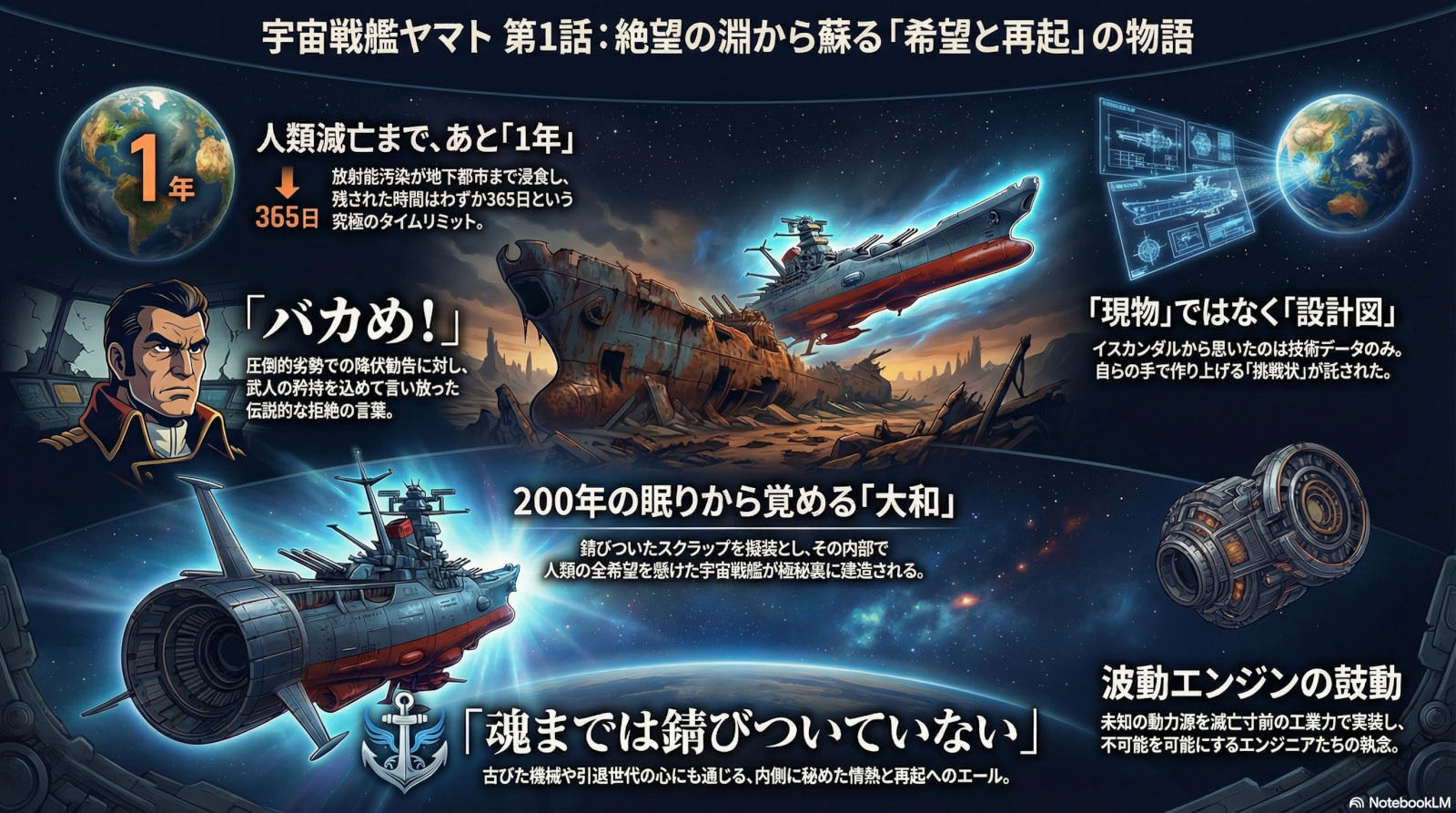
My infographic for the contents of Episode 1.
Thank you for reading to the end.