
This material was originally published in Space Battleship Yamato 1974 Complete Episode Commentary by Ryusuke Hikawa under the penname “Roto-san.” This Cosmo DNA translation appears by kind permission of the author.
Back up to part 3 here
Chapter 4: Ikebukuro Community College Lecture, Part 3
September 28, 2019
Episode 16
Beemela, Planet of Condemned Criminals!
January 19, 1975
Gamilas Wolves
Since Domel is nicknamed the “Wolf of Space,” wolves definitely exist on Gamilas. The Rainbow Star Cluster arc also uses the expression “rats running into a trap,” confirming mice exist on Gamilas too. (Laughs)

Analyzer and Yuki Story
This episode is unique even among Yamato‘s standalone stories. Analyzer has consistently acted in a rather sexually harassing manner, but this episode has a dramatic quality that questions his true intentions. Can a robot created by humans, or a cyborg whose body has been replaced by machinery, achieve romantic love with a human? This is a story that has occasionally been explored in manga and anime since the 1960s. Mythology also features many “heterogeneous marriage” tales, suggesting a certain universality. While it stands out a bit from the overall Yamato series, this episode powerfully posed the question: Can the artificial lifeform Analyzer feel love? And if so, what happens then?
Redrawing the Arm
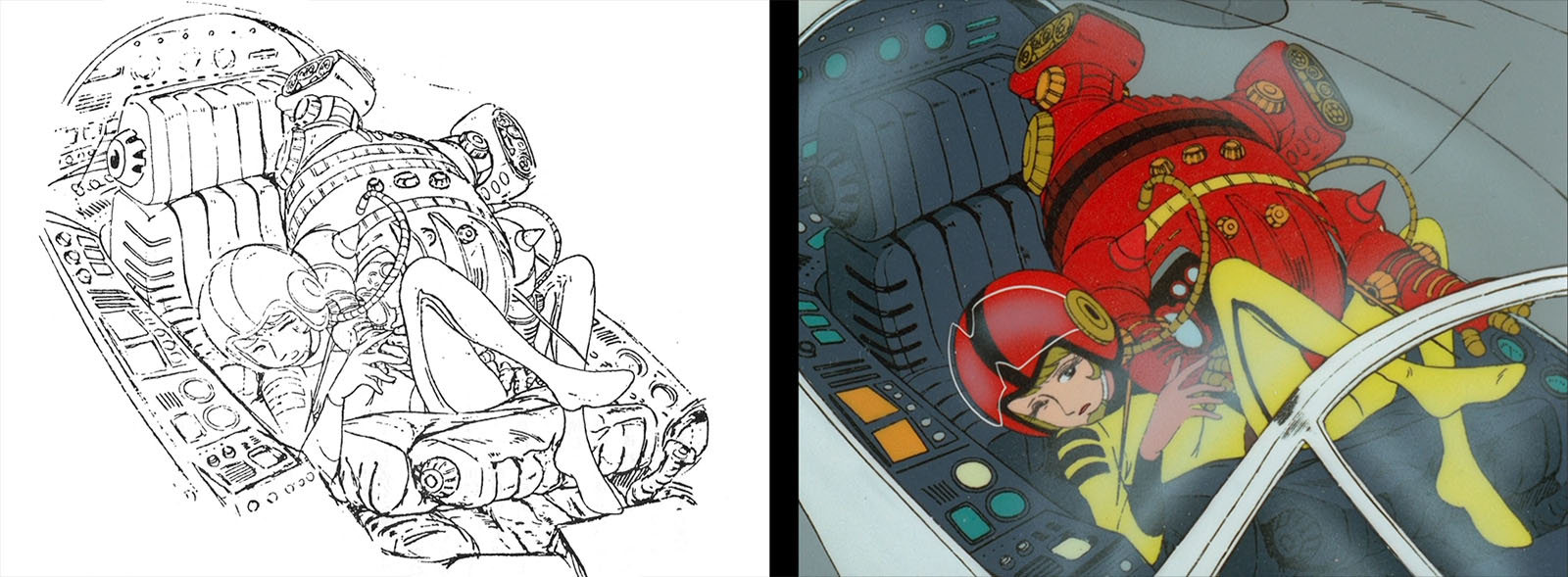
The studio distributed copies of the original artwork for the shot where Analyzer is tangled with Yuki inside the crashed exploration craft. It had blank spaces to add speech bubbles. I recently acquired the animation and cels for this exact shot, so I compared them and figured out why it was done that way. Analyzer’s arm was touching Yuki’s crotch in the original artwork. That artwork was revised, and in the final scene, the hand is moved away.
But it was funny, so they copied it and probably did a “write a line here” gag contest at the studio. So, I brought in a doujinshi showing this comparison to Tiger Pro (after Yamato had wrapped), partly to thank them for the reference material. When Takeshi Shirato looked at it, he suddenly exclaimed, “Ah!” and burst out laughing. “If it were on paper, you’d flip through and see the arm moving, so you’d notice right away,” he said. By chance, Masami Iseda, who drew that original artwork, was present for the Getter Robo G animation checks at the time, so I felt quite embarrassed. I heard him say things like, “Well, I thought I drew it perfectly seriously.”
Mr. Iseda’s comment was also insightful. He caught a glimpse of Marshal Hidler’s gloves, pulled out the character reference sheet, and compared them. He noticed the base of the gloves actually had triple lines, so he went back and added those lines to every animation frame. It’s a tiny difference, but if that line was missing and the coloring was done, it would have been a disaster. I realized how deep the craft really is.
Mystery Reused Music
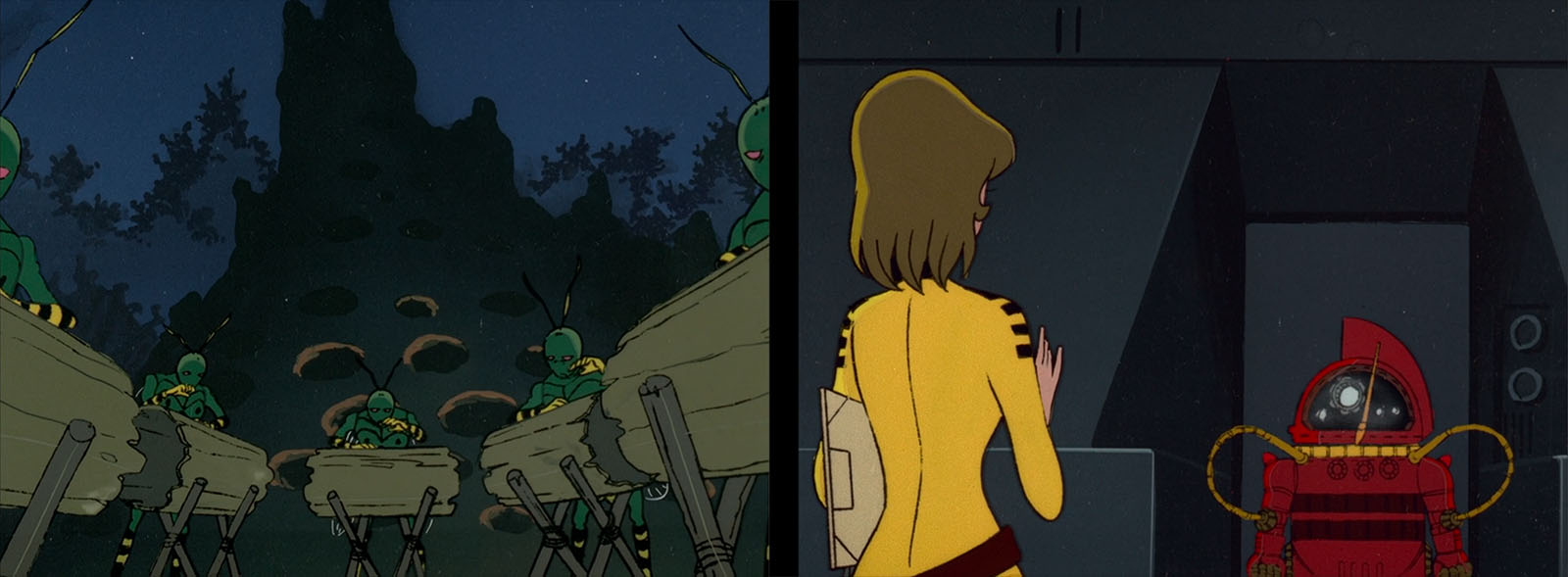
On Beemela, a repetitive tune is heard, reminiscent of indigenous music. This seems to be reused from another work. A friend who attended a Theatre Echo stage performance mentioned, “That song was playing.” So it must have been a recording possessed by [development company] Group Tac.
Animation
This episode’s animation director was Nobuhiro Okasako. He was originally the main animator, but after drawing the character designs, he was hospitalized. This was his first episode back after recovery. He later handled episodes 19 and 25. These two episodes featured key animation by Anime Room, and also included Kazuhiko Udagawa, who later became the main animator for Be Forever. The key animation for Episode 16 seems to have been a special arrangement. Besides the previously mentioned Mr. Iseda, Kaoru Izumiguchi, who drew many mecha, handled a lot of the Analyzer scenes. Izumiguchi’s key animation still exists for scenes like when Kodai and the others come to the rescue and the final turn-around shot.
Episode 17
Charge!! Balanodon Special Attack Unit
January 26, 1975
Kaiju Episode
My first contribution to Kaiju Club, edited by Hiroshi Takeuchi was an article titled The Kaiju of Space Battleship Yamato. Takeuchi-san thoughtfully assigned it to me. Among the inhabitants of Pluto, the gas lifeforms, and the natives of Beemela, only the Balanodon had a proper name that screamed “kaiju.”
The transformation from individual to collective, then to a spherical form, is surely instinctual. Gael uses an image projector to shape this collective into the form of a kaiju. Since it’s anime, they could have just designed and drawn a giant kaiju, but the critique that a creature that size couldn’t support its own weight was even featured in educational magazines back then. That’s why I think it’s great that they deliberately considered the logic behind it.
This one-shot story features Domel executing a seemingly spiteful strategy, but this time it’s actually Gael’s plan to get revenge after being stripped of his command position. From today’s perspective, Domel is a brutal power-harassing boss, right? (Laughs) The fact that the enemy side isn’t united, each harboring their own ambitions, leading to bad blood and sabotaging each other until they self-destruct, is a classic development. The Wave-Motion Gun, used only five times in Part 1, is deployed again this time because the crisis involves supernatural forces.
Dummy Yamato
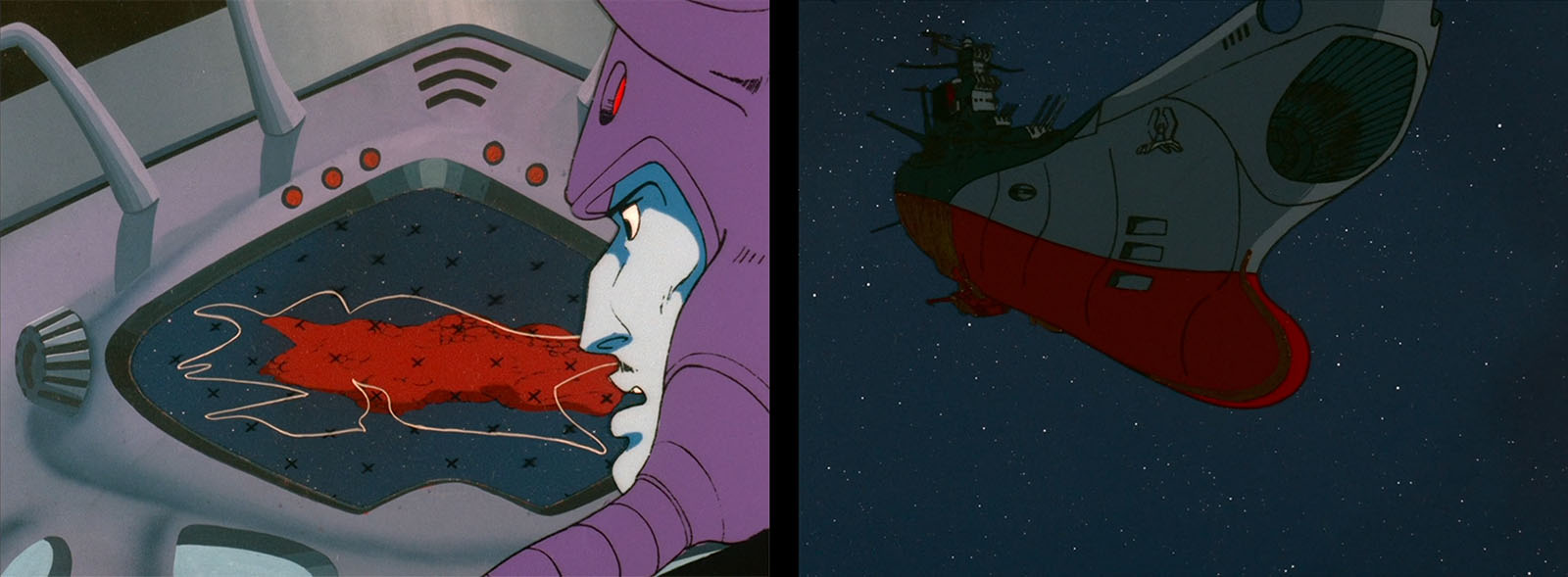
The Yamato destroyed first is prepared by Gamilas. It was created by tracing part of the usual passing bank [stock] scene, and since carbon was applied to the surface, it was a cel that didn’t deteriorate. I had that one for a while, but unfortunately it got lost.
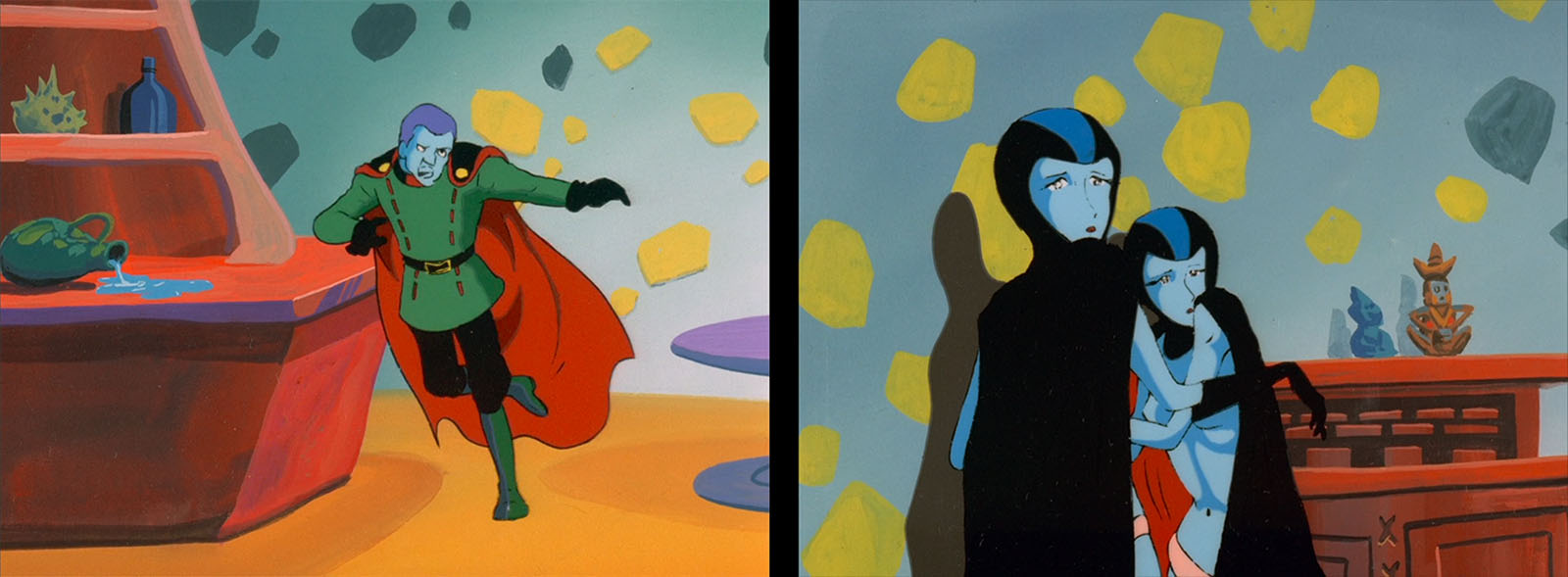
Drunken Gael
This was animated by Kazuhide Tomonaga. The timing of Gael’s staggering gait and the way his gaze becomes unsteady are absolutely perfect, making you think, “This is exactly what being dead drunk looks like.” The Gamilas women watching him became a talking point because they appear to be wearing nothing under their capes. Truly, “anime made by adults.”
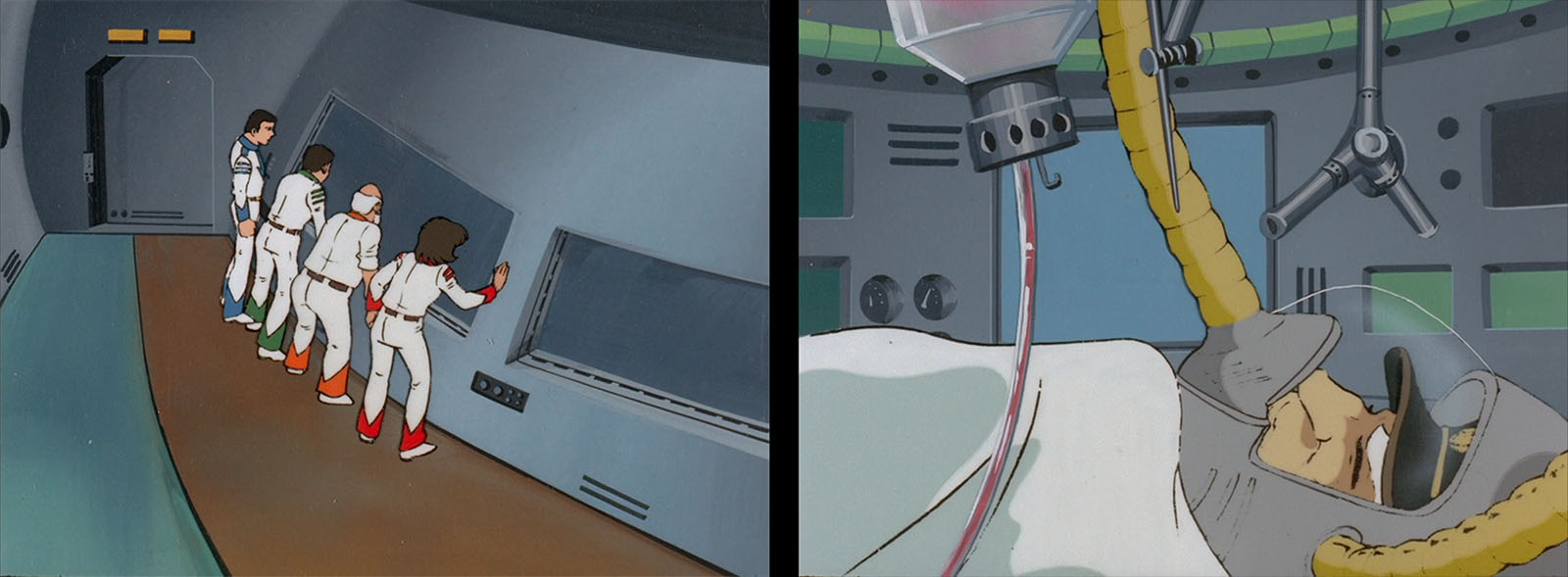
Captain Okita’s Surgery
As he stated in Episode 2, “Yamato‘s voyage may shorten my life,” he likely had symptoms even before departure. Following Episode 12, his condition worsened, leading to emergency surgery. Checking this episode reveals quite a few scenes in the operating room. The existence of a room for spectators is a mystery, though. (Laughs)
Captain Okita wears a hat under his oxygen supply helmet. He also wore one under his spacesuit in Episode 22, sparking discussion like, “But he took it off in the hospital room in Episode 1!” One reason is likely that no design exists for him without the hat. This episode also sets up Kodai’s promotion to acting captain in Episode 20.
Episode 18
The Floating Fortress Island!! Two Men Brave Death!!
February 2, 1975
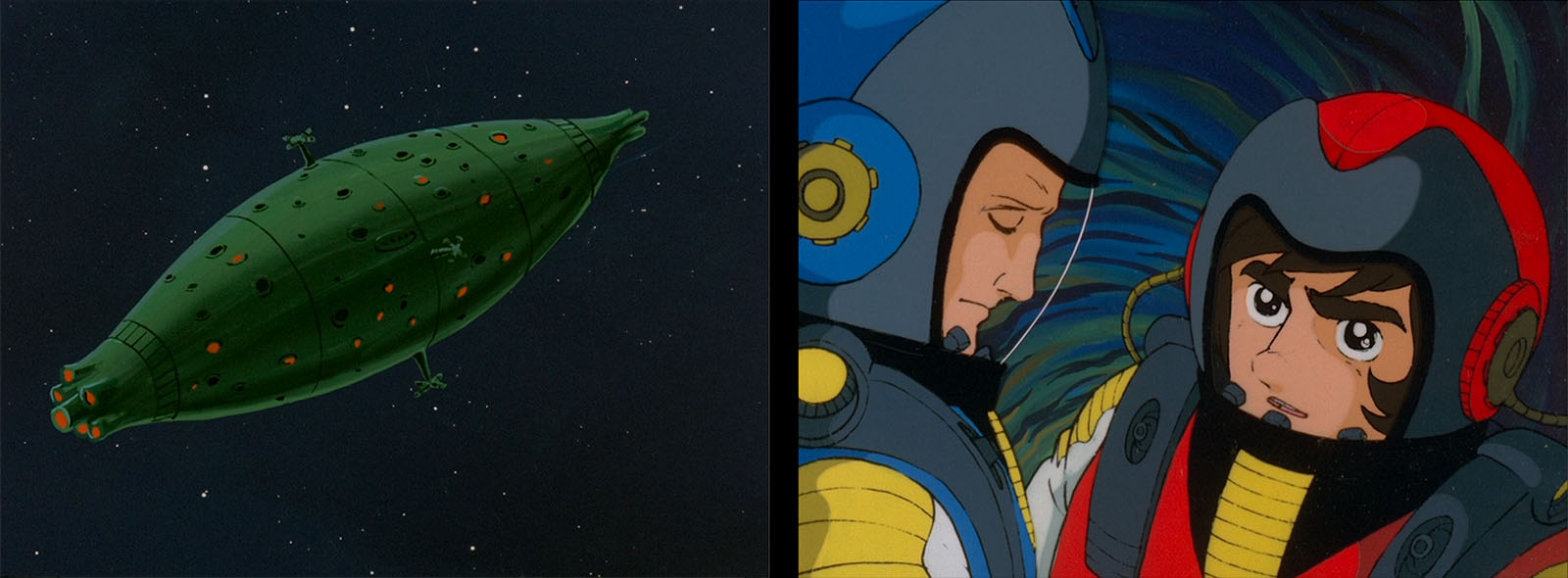
Space Fortress Island
This episode, with animation direction by Toyoo Ashida from the in-house team, is highly regarded by fans and often cited as a masterpiece. One doujinshi even dedicated an entire issue solely to this story (see it here).
A space fortress emitting a terrifying electromagnetic weapon called the “magnetron wave,” capable of disintegrating mecha, was rigged to pursue Yamato, making evasion via warp difficult. Consequently, Sanada and Kodai boarded a seamless fighter together to destroy the enemy space fortress. As with the next episode (19), Domel sends a trap for Yamato. He’s surprisingly devious, isn’t he? (Laughs)
The mission to take down the fortress and the depiction of the past relationship between Mamoru Kodai and Sanada work well together. The sense of understanding that comes from them being “just the two of them” is satisfying. Later, in Farewell, Sanada says he thought of Kodai “like a younger brother,” but if you’ve only seen the theatrical version, it’s hard to understand why he came to feel that way, right?
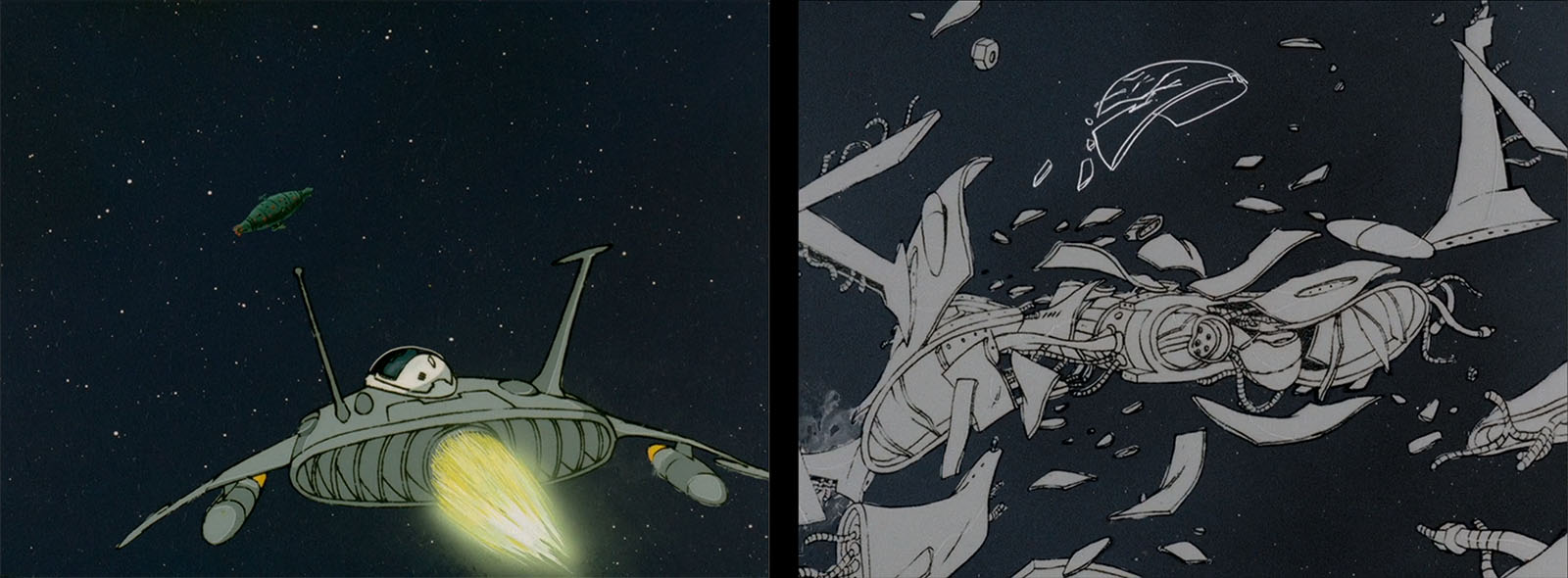
The destroyed Type 100 scout plane is especially memorable. That’s because I saw the original artwork when I finally visited the studio alone in 1975 for a proper tour. It must have been around the 20th of January. Why do I remember it so clearly? Because the in-house team animating this had a U-matic VCR playing the just-aired episode about the Beemela (Episode 16). It was rare, so I ended up watching the whole thing. My home didn’t get a Beta recorder until the fall of 1978.
There, I greeted the animator and had a fairly long conversation. I think it was Mr. Ashida, but I haven’t confirmed it. On a nearby desk lay the partially drawn shot of the destruction I mentioned earlier. Being a high schooler who knew nothing, I asked, “What episode are you drawing now?” He replied, “Episode 18.” I blurted out, “Huh?” in surprise, which was probably rude.
This was just days before Episode 17 was scheduled to air, and Episode 18’s shots were still unfinished. Seeing my reaction, he shared an incredibly earnest ideal: “This really shouldn’t be how things are.” I’m still deeply grateful he took the time to speak with me so sincerely. I deeply regret not confirming this with Mr. Ashida while he was alive and expressing my gratitude if it was true. Mr. Ashida’s character animation is truly impressive. I feel this episode in particular is filled with emotion.
Incidentally, I believe it was the week after Episode 18 aired, but the shot of the Type 100 was still sitting on the desk. Since it wasn’t skipped in the broadcast, there might have been some deeper reason. Maybe someone called in sick, so the key animation was pulled and the in-betweening was reassigned to someone else. We’ll never know for sure. But it gives us a glimpse into the immense challenges of producing Yamato.
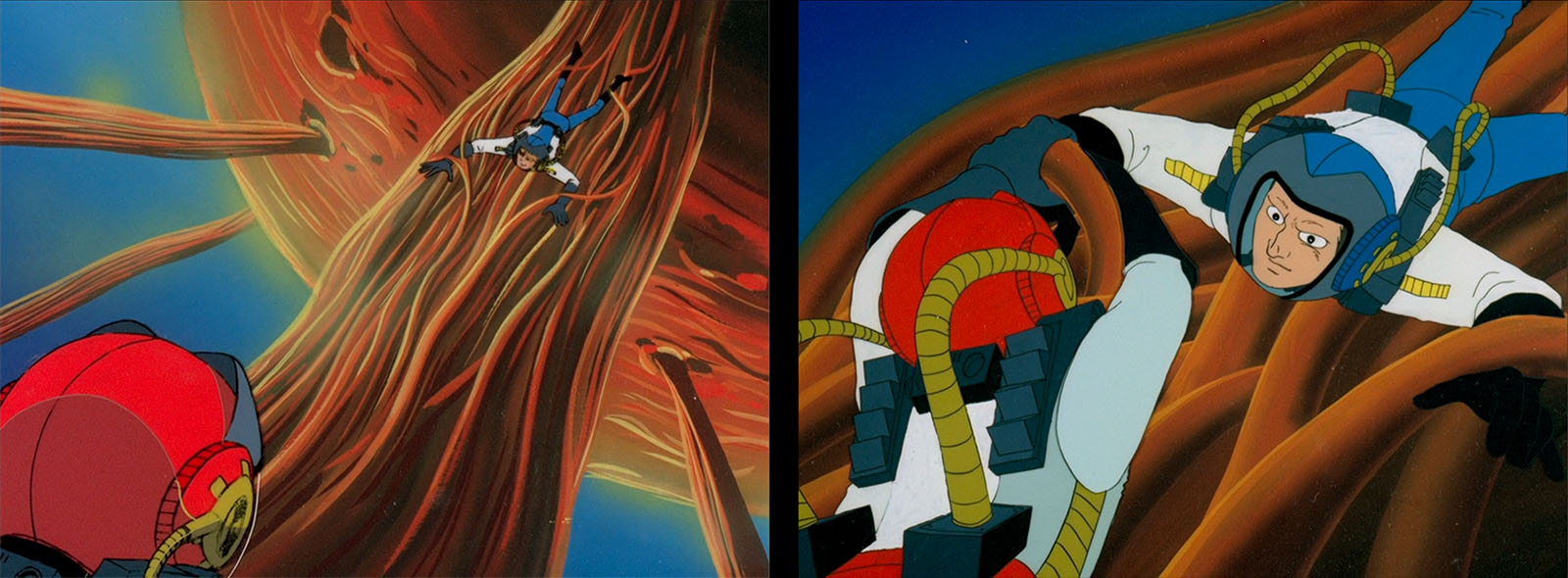
Sanada with limbs locked by tentacles
The biological computer was a large-format shot, including the background. I received many cels for Episode 18, and I recall the shot of Sanada being entangled by tentacles used hand-tracing cutouts. It might have been a long cell or large-format shot, so it couldn’t pass through the tracing machine. The lines are smooth, as you can probably tell from the Blu-ray.
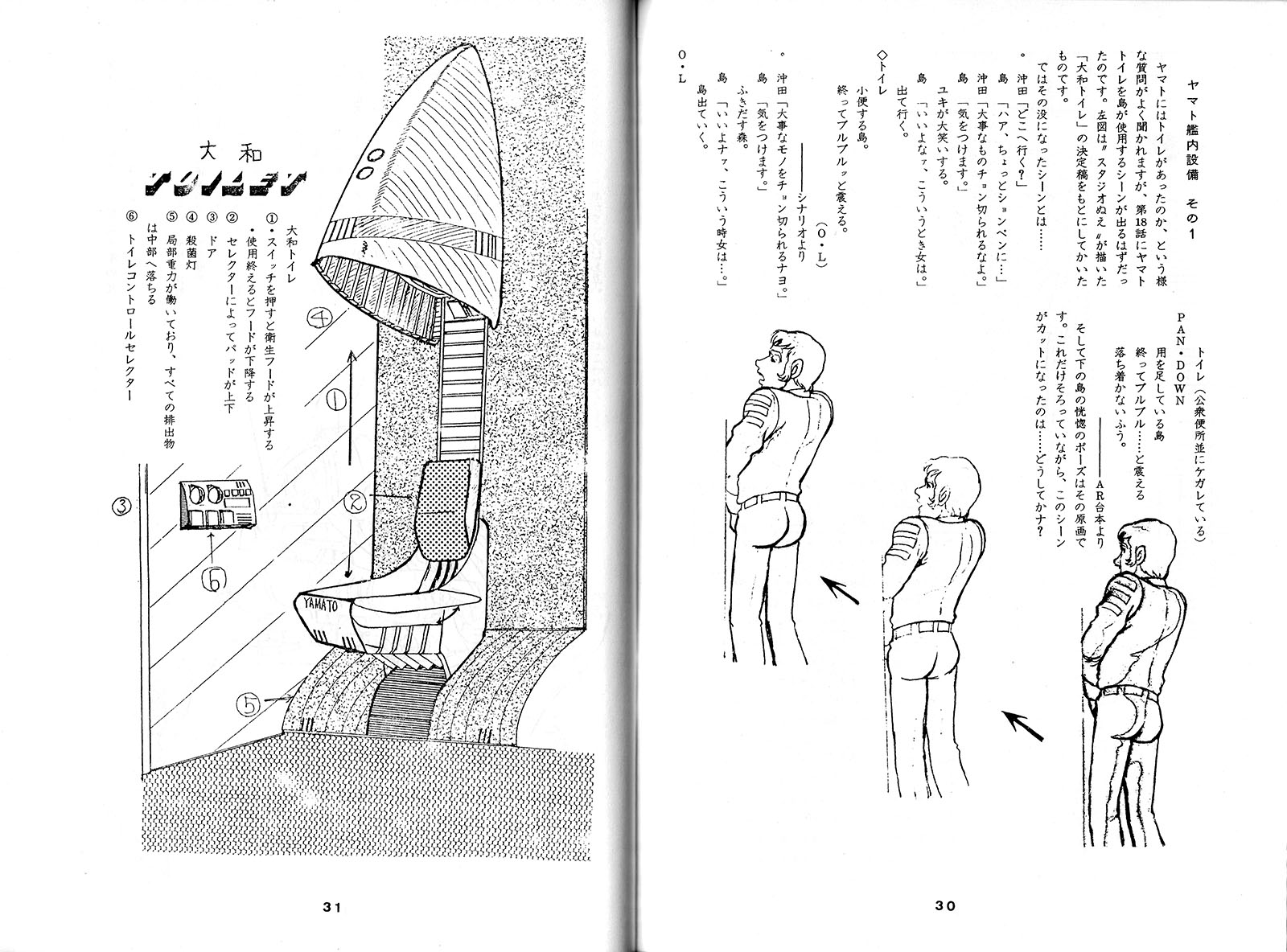
Space Toilet
This is a shot that was scrapped. Among the various materials I received, there was a toilet design and rough animation of Shima relieving himself, which made it into a doujinshi. Since there was a layout and the animation was completed, it seems they got as far as just needing to paint and shoot. It might have been a scene meant to lighten the mood with humor.
As for “why a Space Toilet?” there’s a shot in the Orion in 2001: A Space Odyssey called the “Zero Gravity Toilet.” It was famous because the explanation panel was reproduced in a making-of book. I think it was also translated in the SF visual doujinshi Monolith. They probably wanted to pay homage to that. Back then, 2001 was a “phantom film” only known to those who saw it during its 1968 release. Even among the founding members of Studio Nue, it was highly revered.
Episode 19
Homesickness in Space!! My Mother’s Tears Are My Tears
February 9, 1975
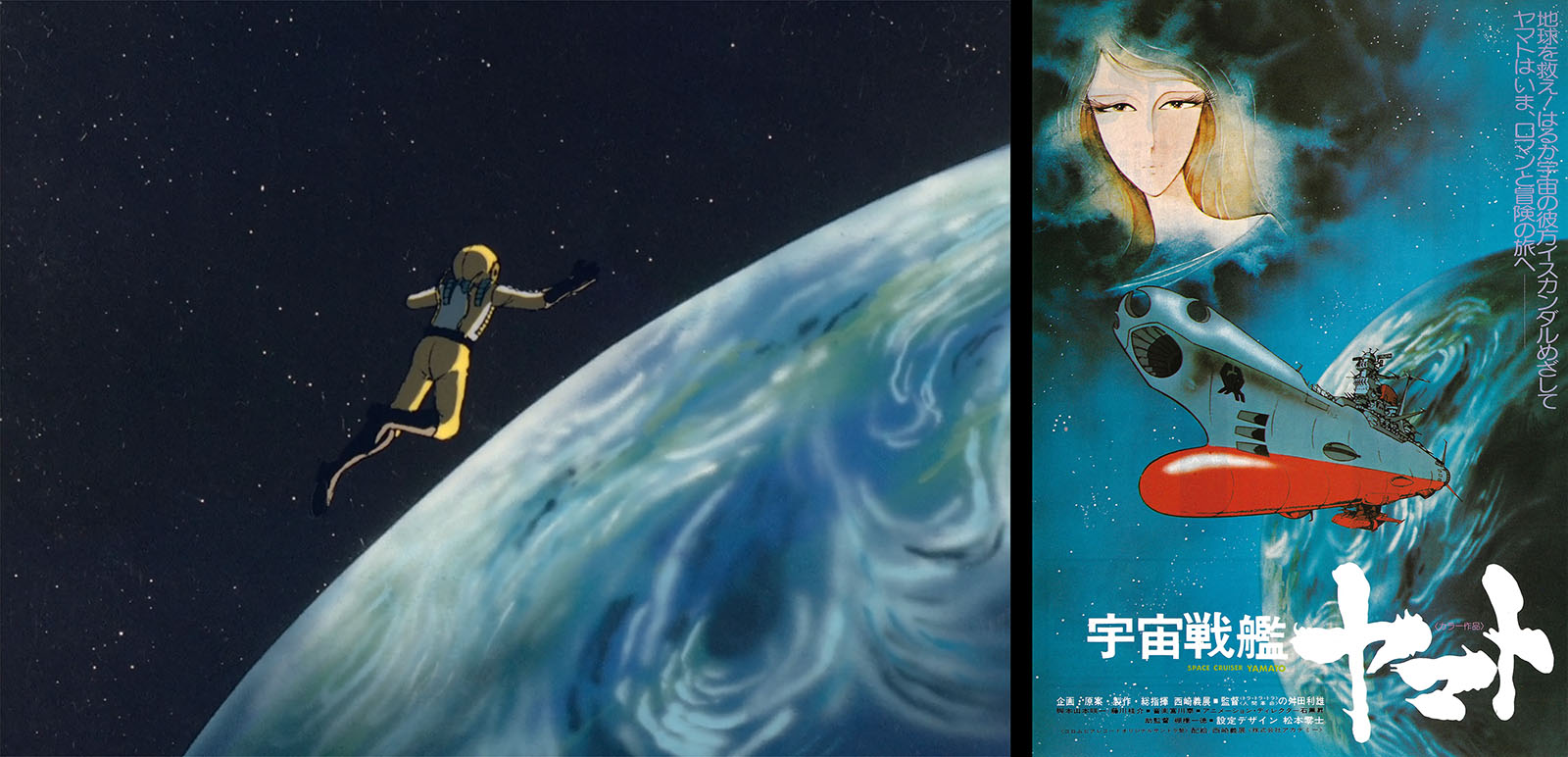
The Secret of the Blue Earth
Among episodes emphasizing the drama, this is one of my absolute favorites. The highlight is the “phantom Earth” Aihara sees. Take Earth when it was blue, flip it horizontally, and tilt it 90 degrees…
That’s right. It’s the same Earth used in the background of the theatrical poster. Did you spot it? It’s used in what’s commonly called the “A Poster.” After this, Studio Nue created the B Poster for Playcomic magazine, and later the C Poster, which further collaged cels like the Rainbow Star Cluster fleet and Kodai.
Producer Yoshinobu Nishizaki apparently thought the A Poster was just a temporary teaser, and the fully detailed B Poster was the real deal. He believed fans would be thrilled when it came out. But the reaction wasn’t great. So, during a fan club meeting, when he asked, “Which one do you like?” an overwhelming majority raised their hands saying, “We like the A Poster!” That’s how it was promoted to become the key visual.
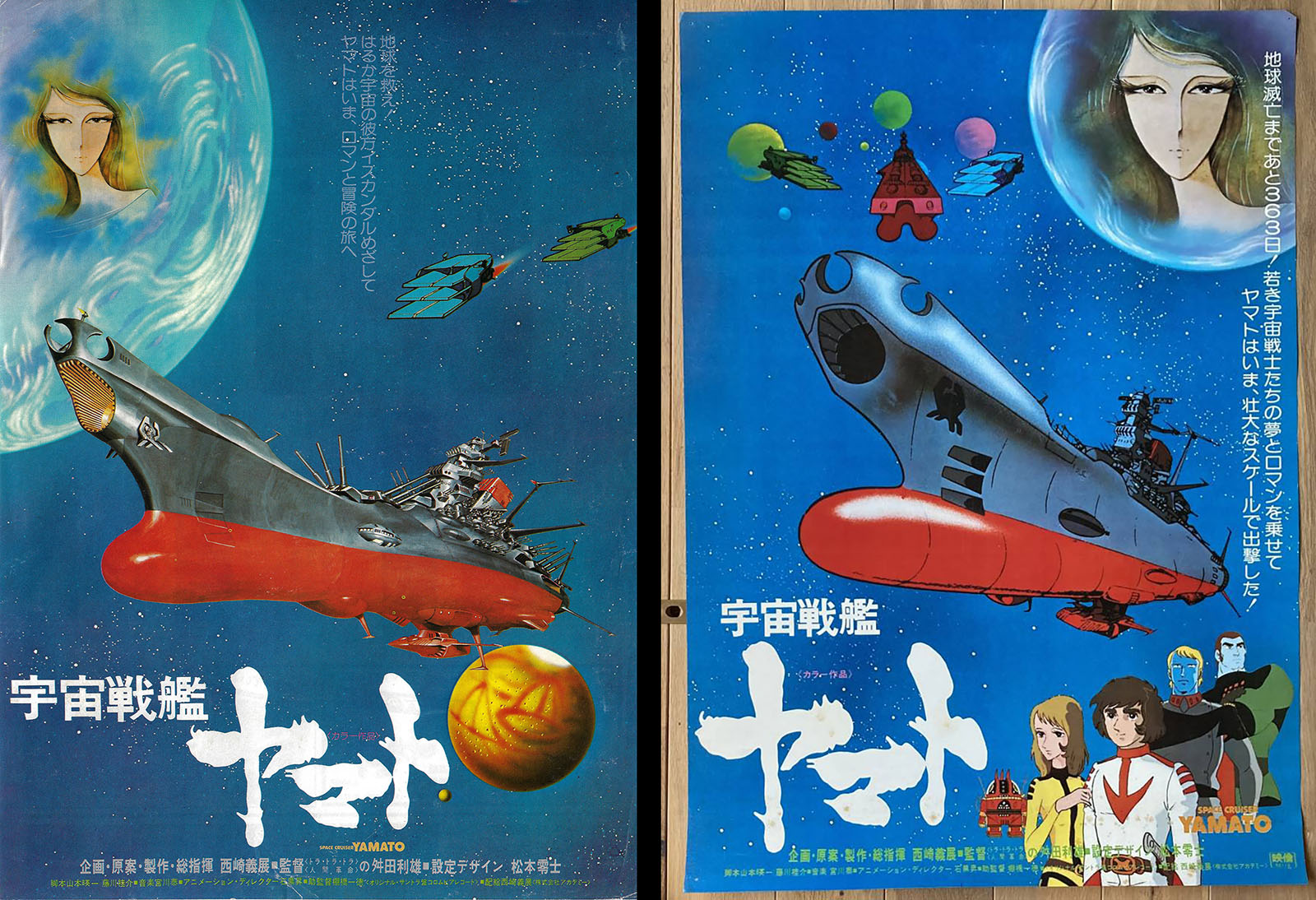
Personally, though, I thought, “This is the phantom Earth from Episode 19. It’s not the red Earth, and the Yamato is just reused. For one thing, there’s a big airbrush mark peeling off under the Wave-Motion Gun, the torpedo tube placement is wrong, there’s a railing in a place it shouldn’t be, and Yamato‘s overall shape is different. I had an inner conflict: “Is this really okay as the main one?” (Laughs)
But layout-wise and design-wise, Poster A was definitely the most polished. I remember thinking, “Well, if we interpret it as ‘Guided by the goddess, Yamato launches to reclaim the blue Earth,’ then maybe it’s okay.”
Reason for Flipped Printing
The designer may have specified inversion during plate making. I once saw the original artwork for the C poster; there’s an intermediate plate-making draft where a paper print was cut out and pasted. Noboru Ishiguro also commented during the theater run, “I hear they call it ‘hair removal,’ but I didn’t know printing could achieve that kind of compositing.” It really shows someone who was particular about compositing on film.
Later, when roughs are given to the designer, they called it “kirinuki.” There was a technique for meticulously cutting out even the fine details of a character’s hair, and since Yamato has quite a few extremely thin and pointed parts, they might have applied that technique.
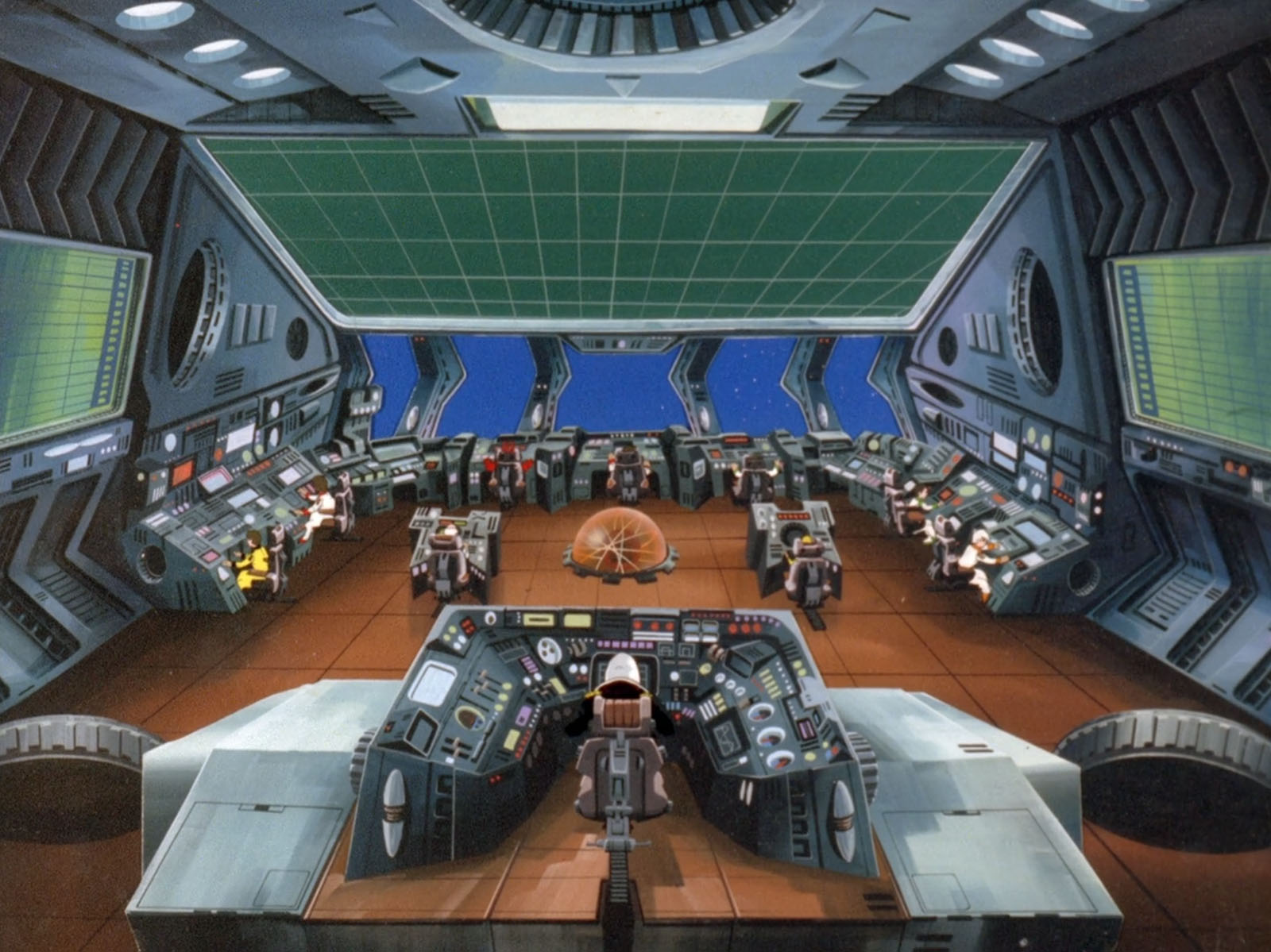
Regarding the blue Earth, photographs might have existed. I heard from Mr. Ishiguro that important shots like Starsha or the full view of the first bridge were photographed in large format and used that way. The first bridge is a massive background spanning 240 frames. There was apparently a proposal to zoom in on the specific sections where each crew member sits and shoot those. However, since the background deteriorates after 3-4 shoots, they switched to taking photographs instead.
Indeed, when I looked at the shot bags for around Episode 25, there was a small photo of the first bridge, equivalent to about 100 frames, and the crew members were drawn on cels to match it. The windows were cut out to show space outside. I didn’t take it because the final episode was still pending, but it was probably shot on large format film. If the original negative or positive of that photo existed, couldn’t we restore the incredibly beautiful first bridge background as a full-size digital photo? If we could unearth it, it would be a tremendous treasure.
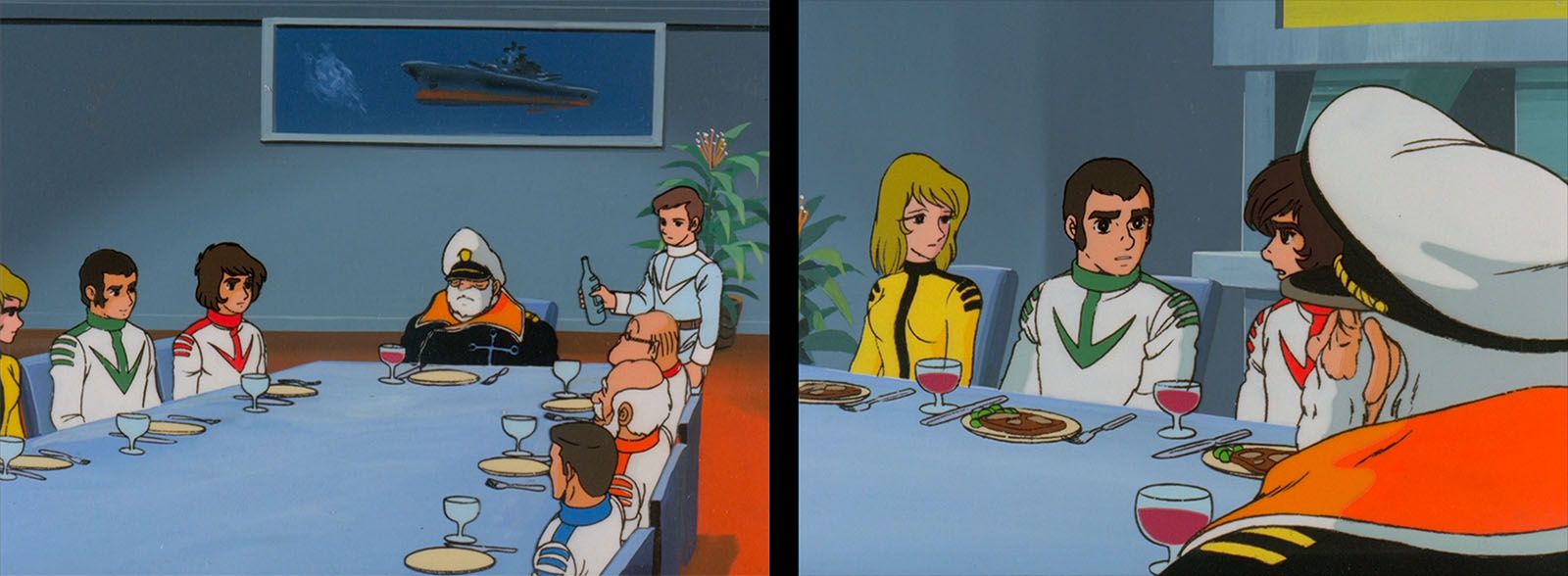
Officers’ Dinner
This gathering was held after Captain Okita proposed, “Let’s have some wine and a meal together tonight.” I believe this scene is one of the most important in Yamato.
When Chief Navigator Shima voices his anxiety, “Is Iscandar really out there?” Captain Okita gently counsels him. No one knows what lies ahead. Accepting that having anxiety and overcoming it is what travel is, what life is. I’ve added that interpretation to it myself, and it’s become a kind of life lesson I recall during tough times. I think the overall impression changes significantly depending on whether this lesson is present or not. Eiichi Yamamoto’s scripts often carry this mood of adults speaking after overcoming something difficult.
You can sense a similar philosophy in director Osamu Dezaki’s “travel stories,” also from Mushi Pro. Perhaps it’s a feeling gained from overcoming the uncharted territory of the TV anime Astro Boy by any means necessary.
Drunken Kodai
A missing storyboard page, which we forgot to include on the Blu-ray, has been found. It seems it was mentioned in the Complete Record Collection and Screenplay Collection. When I showed it to a friend, they were thrilled. Apparently, after drinking too much at a dinner party, Kodai gets completely drunk and witnesses Aihara’s actions. This scene was drawn by Noboru Ishiguro. Since he also did storyboards for Gutsy Frog, his comedic art style has a distinct flavor. (Laughs)
What’s important is that romantic comedy elements are present here too. Yuki Mori, who escorts Kodai back to his room, murmurs, “I can only imagine what’s to come.” It’s not the nicest way to put it, but she’s acting like his wife. Rereading it all, I’m impressed by how many of these romantic comedy elements between Kodai and Yuki were actually depicted. It’s precisely because of these that the finale feels so alive. When it aired, I thought the finale felt a bit abrupt, but maybe I just wasn’t interested back then. My apologies. I’ve reconsidered and realized it’s the result of all these layers of characterization.
Shipboard Phone
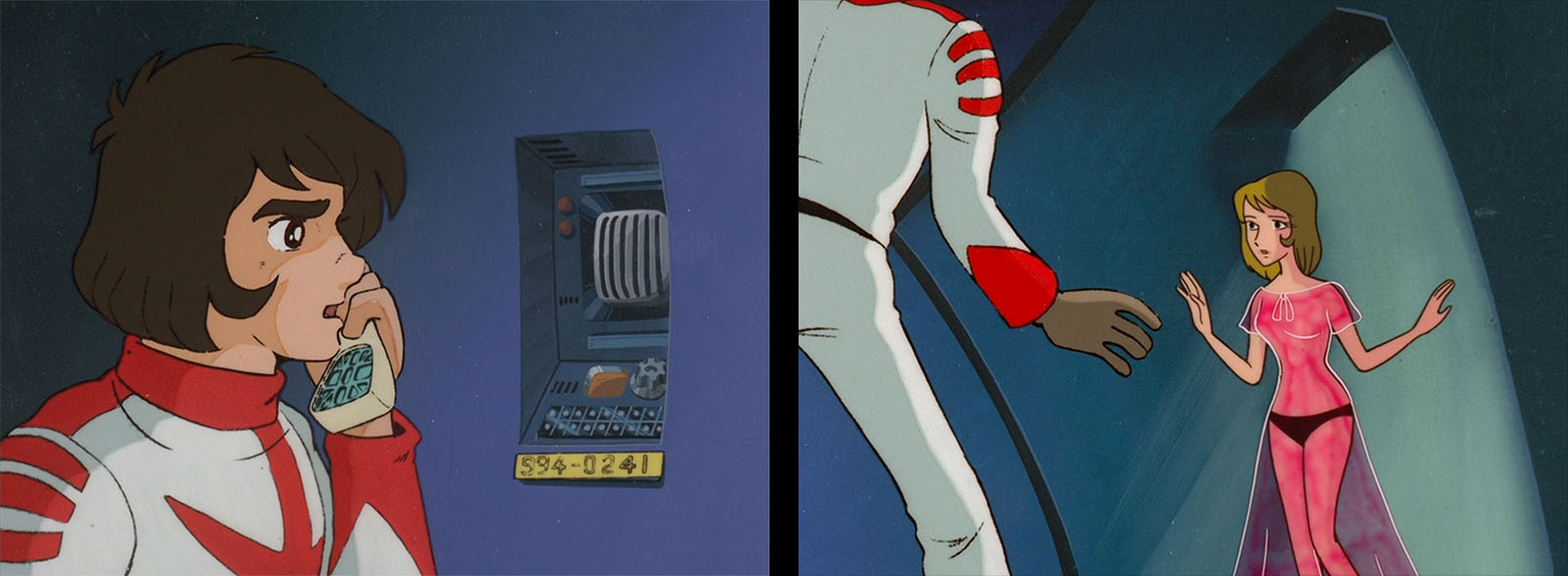
It’s just a handset. It might seem natural in the cell phone era, but back then it was still the era of black phones with round dials that went “click-click.” There’s a technical term for this: “cordless handset.” The number is shown, but it was for the Office Academy’s Sakuradai studio back then. (Laughs) I remember it because I called many times to apply for studio tours. Tokyo numbers were still only 7 digits then. Even though home video hadn’t really caught on yet, did the studio ever get prank calls? It’s hard to imagine that happening now.
Yuki Mori’s Negligee
No matter how many times I see it, it’s quite the outfit, isn’t it? (Laughs) Apparently, they spent hours debating what color to make her panties (scanties?) – red or white, and it was quite the ordeal (laughs). This is anime made by adults. It’s also foreshadowing for the Rainbow Star Cluster we’ll talk about later.
This cel was published in the second issue of OUT, but it was actually partially a fake. The late Thunderbirds researcher Hideaki Ito (nicknamed Kettaman-san) started saying things like “B-area” (Tsuruko’s All Night Nippon was popular back then) and ran the image through a trace machine to detail it up. The negligee was on B-cell and used the same transparent paint as the Pluto inhabitants, so that part is genuine. It seems they wanted it to be subtly translucent. Only a handful of people in Japan know these behind-the-scenes details now, so I’m describing them as best I can recall.
Storyboards
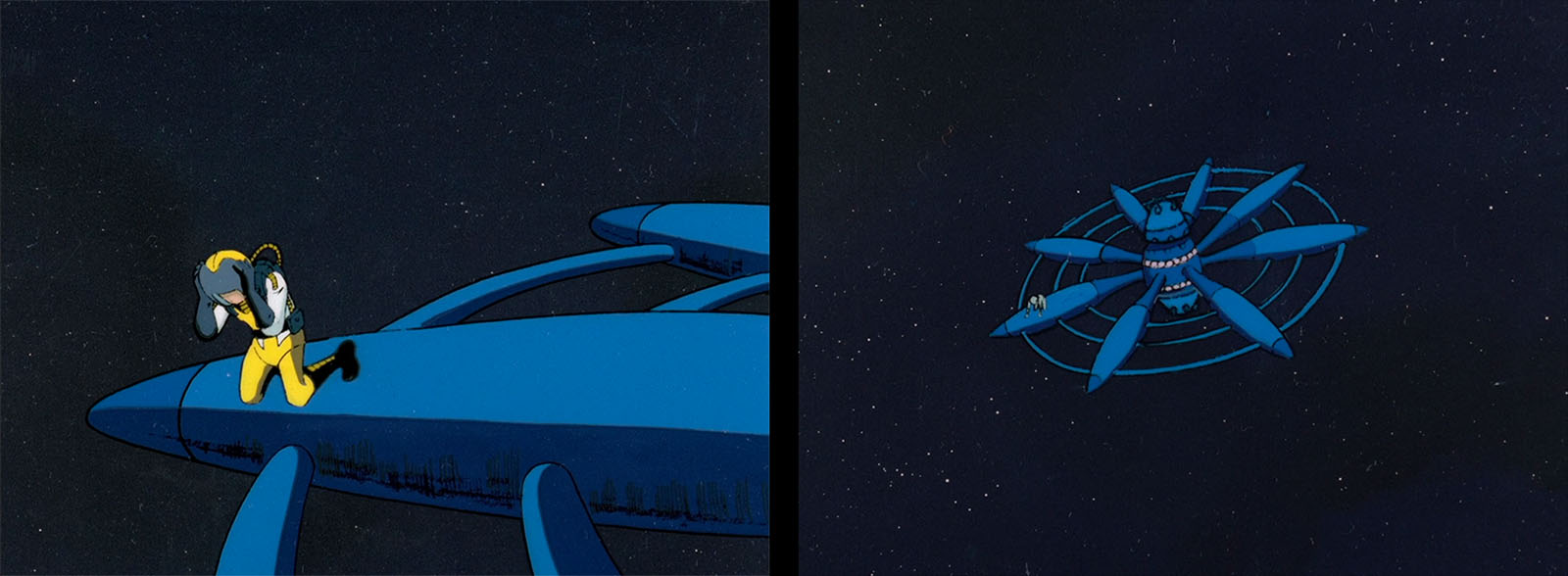
Episode 19 was storyboarded by Noboru Ishiguro himself. Having graduated from Nihon University’s College of Art, Film Department, his storyboards are highly cinematic. Especially the shot where Aihara, clinging to the relay satellite, suddenly turns around to find nothing around him…just space. That shot composition is incredible.
I believe this scene captures the greatest sense of scale throughout the entire series. This sense of distance, desolation, emptiness, and loneliness layers with Aihara’s regret over being deceived, evoking an indescribable emotional depth. Moreover, this feeling belongs not just to Aihara but to the entire crew and the viewers themselves, a layer that emerges through the accumulation of scenes like the meal gathering. Watching it now, the fact that such a shot would be considered a broadcast accident and should have been problematic shows his desire to “make it cinematic.” This is the brilliance of Episode 19.
Episode 20
The Day Balan’s Sun Fell!!
February 16, 1975
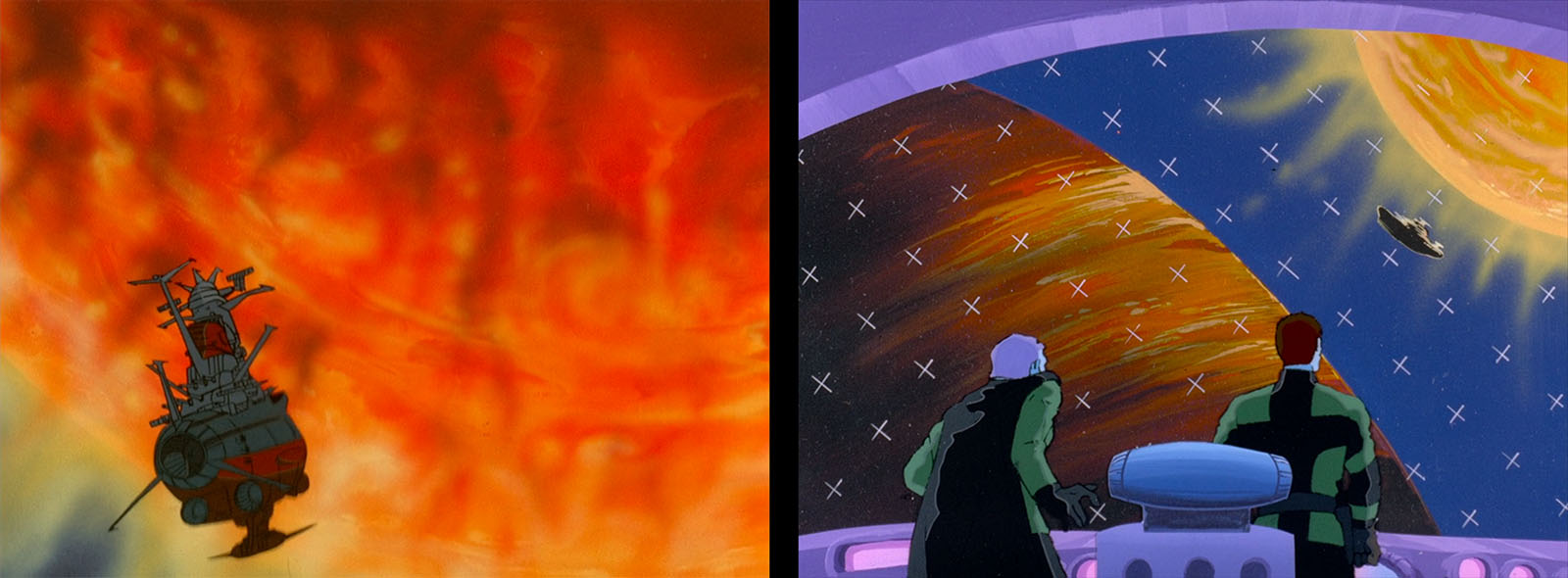
Yasuhiko Storyboard
I have a slightly unpleasant memory associated with this episode. In Yoshiyuki Tomino’s Principles of Animation, it states, “Storyboard drawings should not be drawn skillfully,” and this episode reminded me of that. Storyboards are ultimately meant to inspire the animators, so drawing storyboards that look like miniature versions of the finished frames is technically wrong. Imagining the film based on the storyboard art isn’t good either.
By this time, I was getting the storyboards before the broadcast. So, based on Mr. Yasuhiko’s beautiful drawings, I ended up seeing Episode 20 in my mind first. Doing that meant the actual on-air version felt like a letdown, like, “This isn’t how it should be.”
As a story, it looked incredibly exciting. The artificial sun was closing in, putting Yamato in a huge pinch. Back then, I didn’t fully understand how ratings sampling worked, so I tried to hype up Yamato by promoting it at school with my high school friends. It was basically evangelism. For this episode especially, I got really fired up, writing things like “Next time is this amazing story, you absolutely have to watch it!” on the classroom blackboard.
But…when I actually watched the broadcast, it felt like it was spinning its wheels. It was seriously bad. Right after that, when I went back to the studio, rumors were flying that Producer Nishizaki was furious and said something like “You’ll be fined!” The animation was all over the place (the Black Tiger looked like a fish cake, for instance) and there were problems with the visual design too.
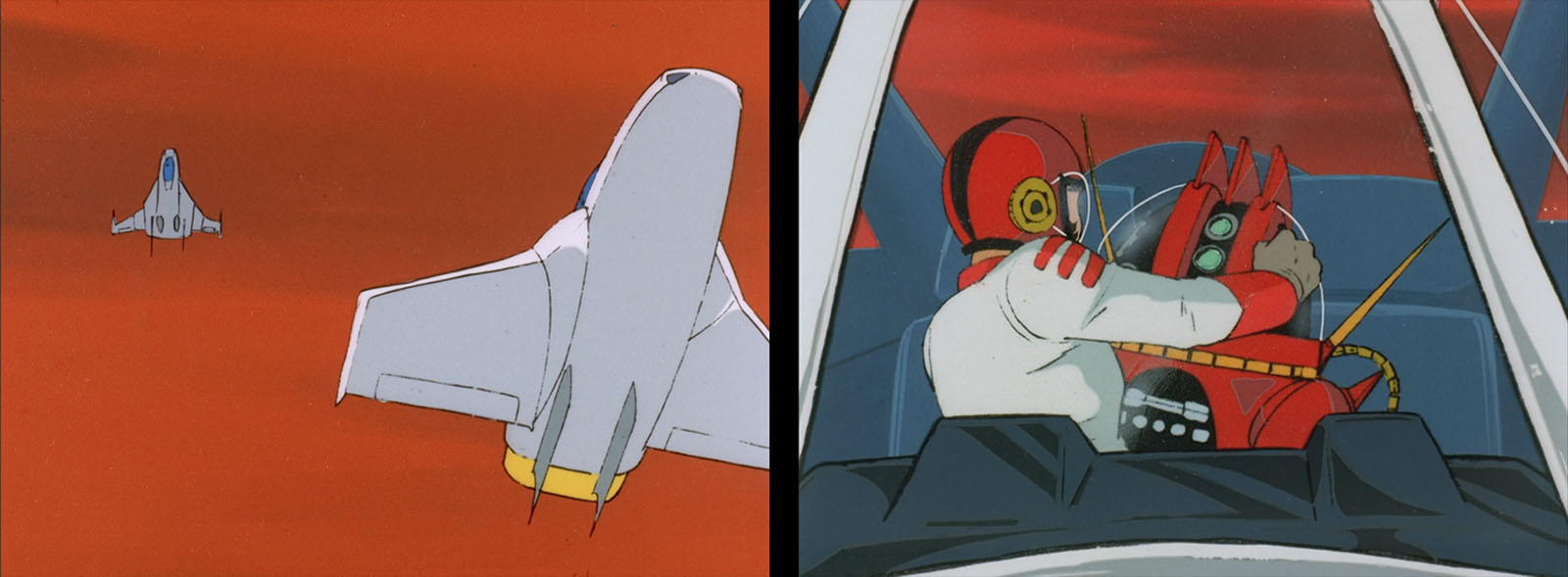
For example, the storyboard notes: “For dramatic purposes, this Type 100 Exploration Craft has a side-by-side cockpit.” It was made wider solely for Analyzer and the pilot to switch seats. But when you see the finished scene, it just looks off. This kind of thing should have been meticulously checked before, but with the Rainbow Star Cluster episode looming, it seems this one just slipped through the cracks.
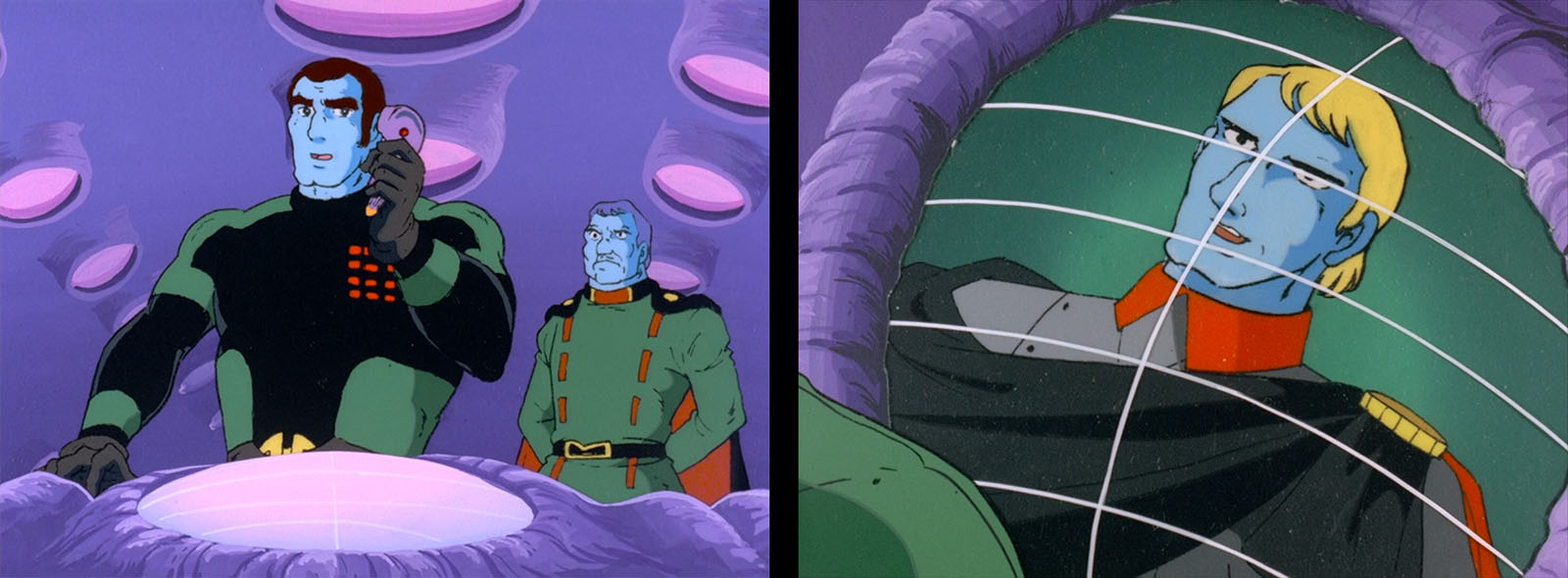
President Dessler’s Phone Call
It was corrected in the final scene, so you wouldn’t notice unless you saw the original artwork. But Domel’s phone receiver was initially drawn as an Earth model. I used to be a phone engineer, so I can even estimate the model number; it was the K-type handset for the 600-type phone used by the public corporation (Nippon Telegraph and Telephone Public Corporation). They even drew the curly cord, but it was later changed to the pipe-like Gamilas-style wireless phone. I thought it was included on the Blu-ray, but it never came up, which is disappointing.
The Biggest Issue
Domel’s strategy is unrealistic. Sacrificing the base while attacking from below with missiles and crushing it from above with an artificial sun. The sacrifice is too great, and Gael and Dessler’s criticism is understandable. Normally, if losses of this scale are anticipated, you’d lay the groundwork beforehand, so it looks like a communication problem.
Yamato‘s counter-strategy also has issues. Kodai, sent on reconnaissance, notices the trap because he’s obsessed with Balanodon and the plant growth suggests geothermal activity. Yet, this doesn’t actually thwart the plan. The decisive factor in averting the crisis being Dessler’s phone call feels inconsistent with the realism established throughout the series.
Episode 21
Deadly Challenge from the Domel Fleet!!
February 23, 1975
Sunrise Episode
“The next episode will be done by the company that made Zerotester,” we were told beforehand. That’s right, it’s a Sunrise episode (then known as Soeisha Sunrise Studio). Zerotester ended in December 1974, and starting the following April, the Tomino/Yasuhiko duo’s Brave Raideen began. They probably needed to keep the staff busy for three months. So, through connections among former Mushi Pro staff, they likely took on “Rainbow Star Cluster Part 1” as a subcontractor. Saburo Sakamoto, who would later often handle final episodes for Sunrise works, joined as animation director.
Brush Finishing
At the time, it was a talking point that “it’s got so many brush strokes because it’s a Sunrise episode.” The mecha had massive amounts of airbrush special effects applied, making them excessively glittery, smooth, and shiny. This was the opposite of Yamato, which aimed for a “dirty realism.” The early episodes of the subsequent Raideen also featured glossy brushwork on the fossil beasts and mecha. Back then, the impression was “Sunrise means airbrush.”
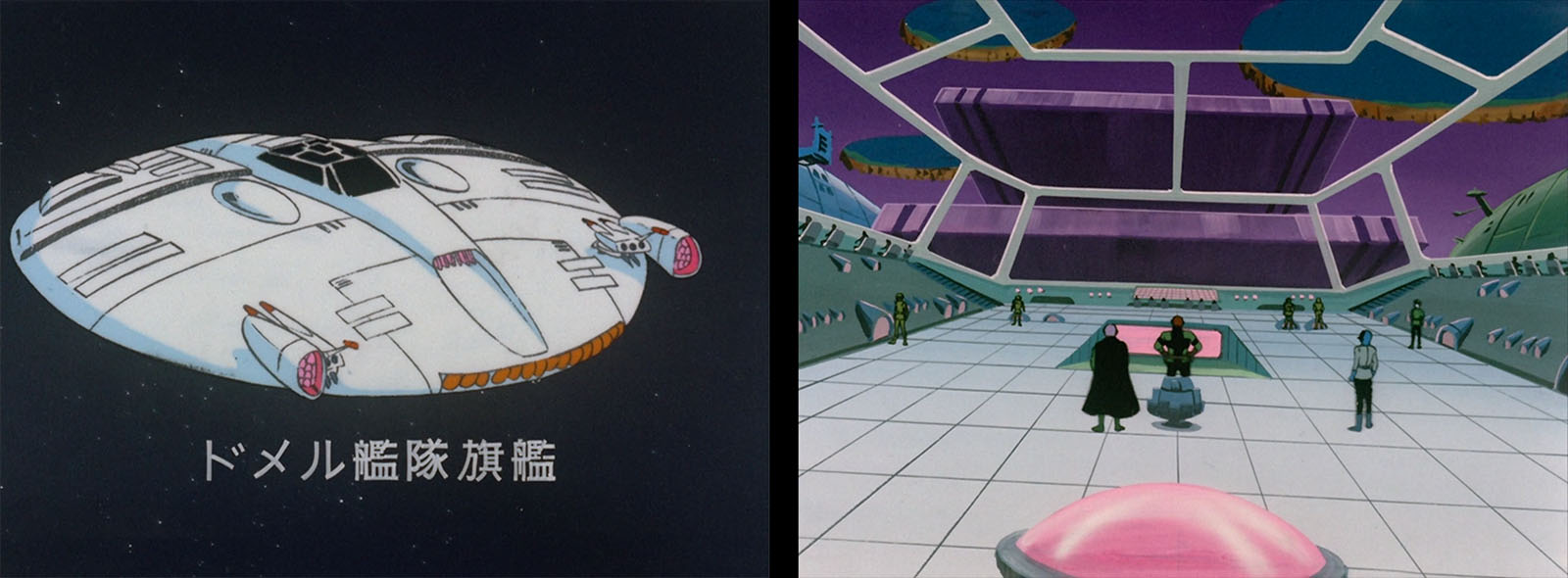
Domel Fleet Flagship
The subtitles read “Domel Fleet Flagship.” The rough model sheet called it “Domel’s Disk-Shaped Carrier,” and the final design was listed as “Domel’s Disk-Shaped Flagship.” However, the Complete Record Collection mistakenly wrote “Also known as Domelaze II (Domel II),” and this name has stuck in some circles. As far as I know, this name doesn’t appear anywhere else, so I find it hard to accept. It’s possible a writer just made it up on a whim. Until clear evidence is provided, I decline to use this name.
Don’t you think the size of this disc-shaped flagship is a bit off? Compared to the window size seen from the outside of the bridge section, the interior is surprisingly spacious. The moment you attach it to Yamato‘s third bridge, the contrast makes it look significantly smaller.
One reason is that “this was also an aircraft carrier.” It started out as an aircraft carrier with the bridge flanked by flight decks on either side. A text-only memo outlining ideas for the climactic battle still exists. Among those ideas is something like a “300-meter diameter disc-shaped aircraft carrier.” Even at that size, it’s thin as a cracker, since lying flat makes it harder to hit. That kind of thinking seems to have evolved into the disc shape.
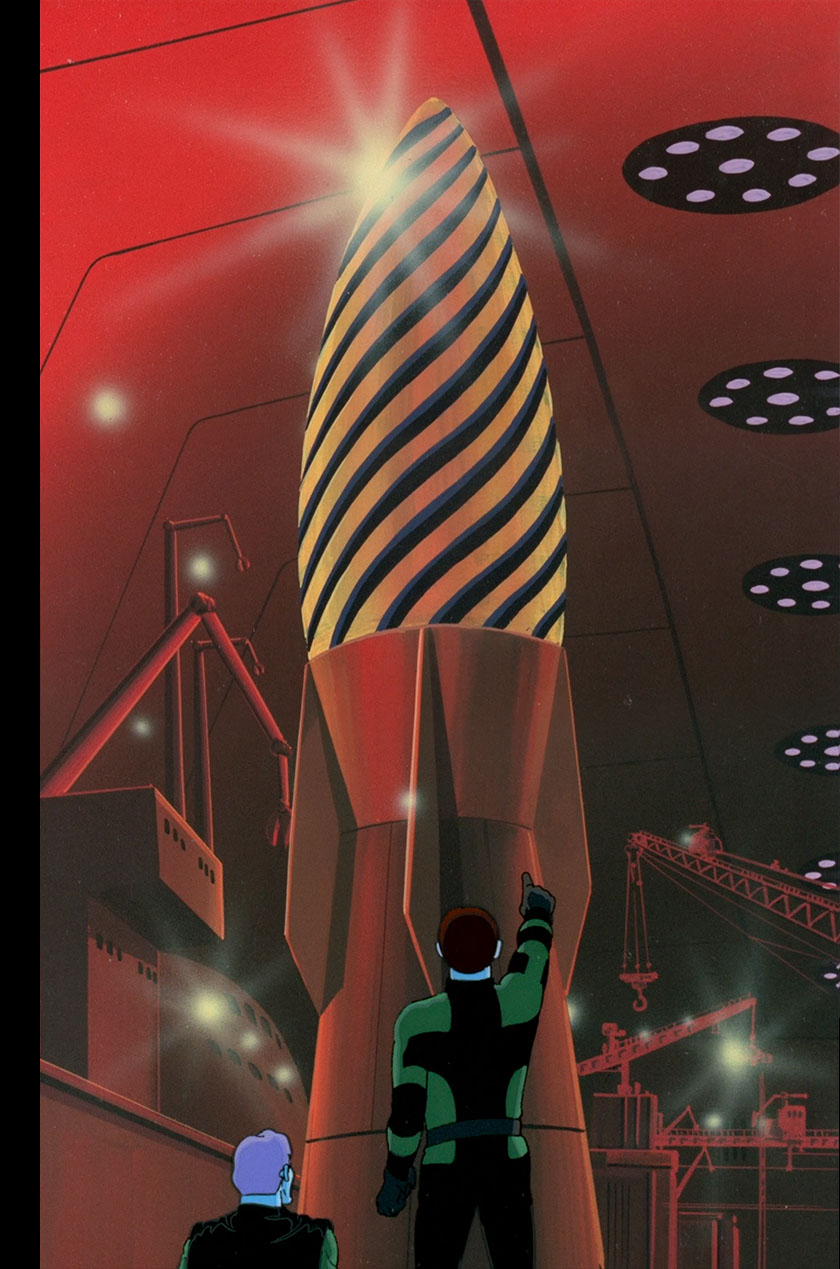
Despite being roughly the same size as Yamato, it seems to have gradually shrunk for narrative convenience. After The New Voyage, it became the bridge of a combat carrier, and 2199 followed that design.
Flying Saucer Boom
1975 was the year of UFO Robo Grendizer, and by the time of Yamato, Japan was already on the verge of an occult boom. Pollution and the oil crisis had eroded faith in science’s omnipotence. The “UFO boom” emerged as part of that trend. The movie Japan Sinks was also a New Year’s release in 1975 (though filmed the previous year). The movement of Domel’s flying saucer pursuing Yamato was also directed to be “like a UFO flies.” It doesn’t fly straight but moves in a zigzag pattern, making sudden jumps mid-flight.
Drill missile
Another striking idea from the aforementioned notes on the climax’s decisive weapon was the “Kamabom.” In car accidents, people colloquially say they’ve been “digging a ditch” (oka-bame). The Kamabom detects the heat source at Yamato‘s rear exhaust port and charges straight for it, essentially a “bomb that digs a hole” (okama), hence “Kamabom.” My hypothesis is that this Kamabom evolved into the “drill missile.” The process of changing its target from the rear to the front hole (wave gun port) also carries a hint of “adult innuendo” in its conception.
Mr. Ishiguro also said, “Things like the Reflection Satellite Cannon or drill missile have a certain eroticism to them, don’t they? Could that be the hidden secret behind its popularity with women?” So I don’t think I’m entirely off base.
On Sundays at 7:00 PM, Great Mazinger aired following Mazinger Z. Yamato aired at 7:30 PM on the same day. Since screenwriter Keisuke Fujikawa wrote scripts for both, it was essentially the “Keisuke Fujikawa Hour.” I was surprised that Mazinger Z‘s Kouji Kabuto shouting “Iron Cutter!” and “drill missile!” coincided with Yamato‘s “drill missile” appearing around the same time.
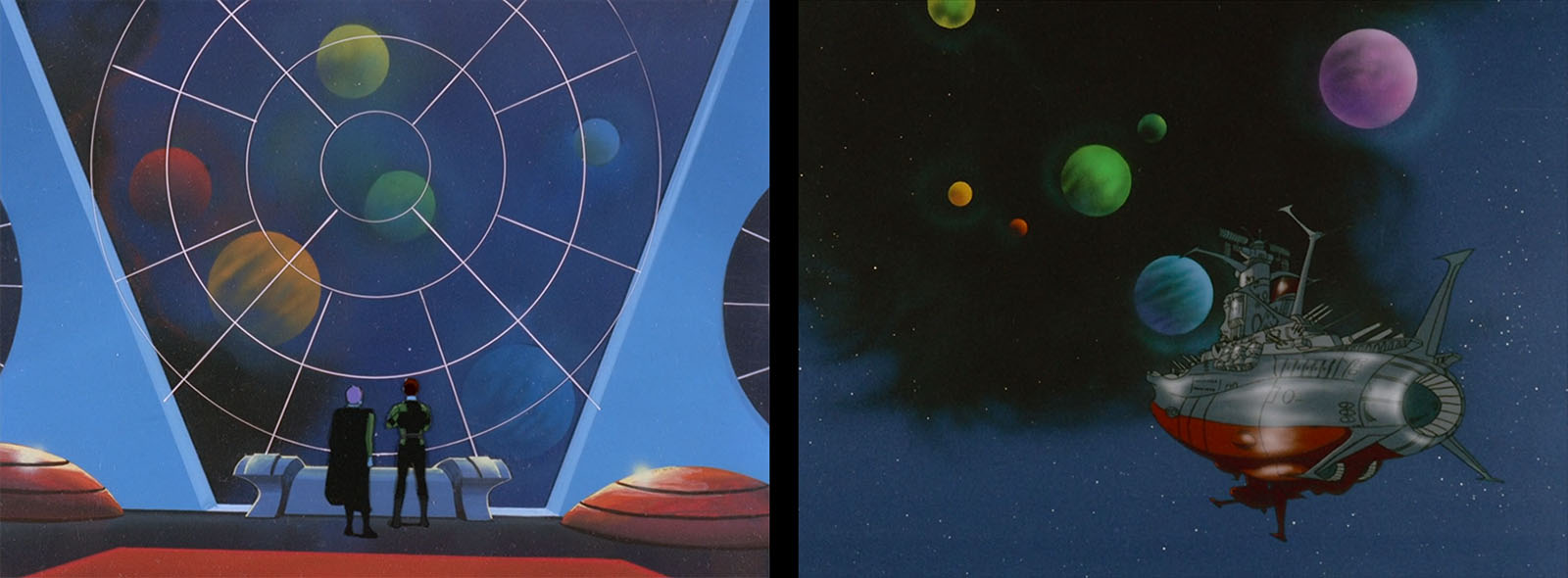
The Name “Rainbow Star Cluster”
Apparently, there was an ad in an adult magazine at the time for something called “Rainbow Panties,” and that’s where the name came from. It was a rather racy product where a woman would change her panty color every day of the week and seductively say, “You…” When I heard about it, I was a minor and thought, “Adults are amazing.” (Laughs) In that sense too, there’s an underlying mood that’s not exactly “for kids.”
I also remember SF fans back then mocking the Rainbow Star Cluster, saying things like “Is this some kind of flame test?” But looking back now, they never actually said that. Given the origin mentioned earlier, I wish they’d made a more legitimate criticism…
Episode 22
The Decisive Battle!! The Rainbow Star Cluster War!!
March 2, 1975
The Decisive Episode
After the new year, my family moved from Mitaka to Yokohama. By train, it was a distant location requiring a bus ride from Hodogaya Station, making my commute nearly two hours each way. Yet, why did I still visit the studio so many times and hear such a vast amount of stories…? Even now, it remains a mystery. The production team must have been extremely busy, so I feel deeply apologetic. Still, I believe that sharing these stories is the least I can do to repay them.
Right after Episode 16, as I mentioned earlier (probably during my longest visit to the studio) I saw the Rainbow Star Cluster designs posted in the directing room, and they were adding missing scenes. I also heard about Yamato‘s average animation cel count. I believe Episode 1 used 5,000 or 6,000 cels, while Episodes 2 and 3 used 4,000 to 5,000 each, all meticulously drawn. The lowest count was around Episode 10, which was in the 2,000s. The others should have been around 3,000. My memory is quite fuzzy now; I should have written this down sooner.
Hearing then that the planned three story arcs had been cut down to two was a huge shock. But Mr. Ishiguro explained, “We’re going back to the spirit of Episode 1, using 7,000 frames, and making a proper space battle anime again.” Even though the series was “cancelled,” I was incredibly moved that the staff weren’t just giving up. Because of this, even the monthly Sunday meetings of the Kaiju Club held at Tsuburaya Productions ended early on Yamato broadcast days. Yuji Kaida and Tomio Haraguchi still remember it vividly to this day.

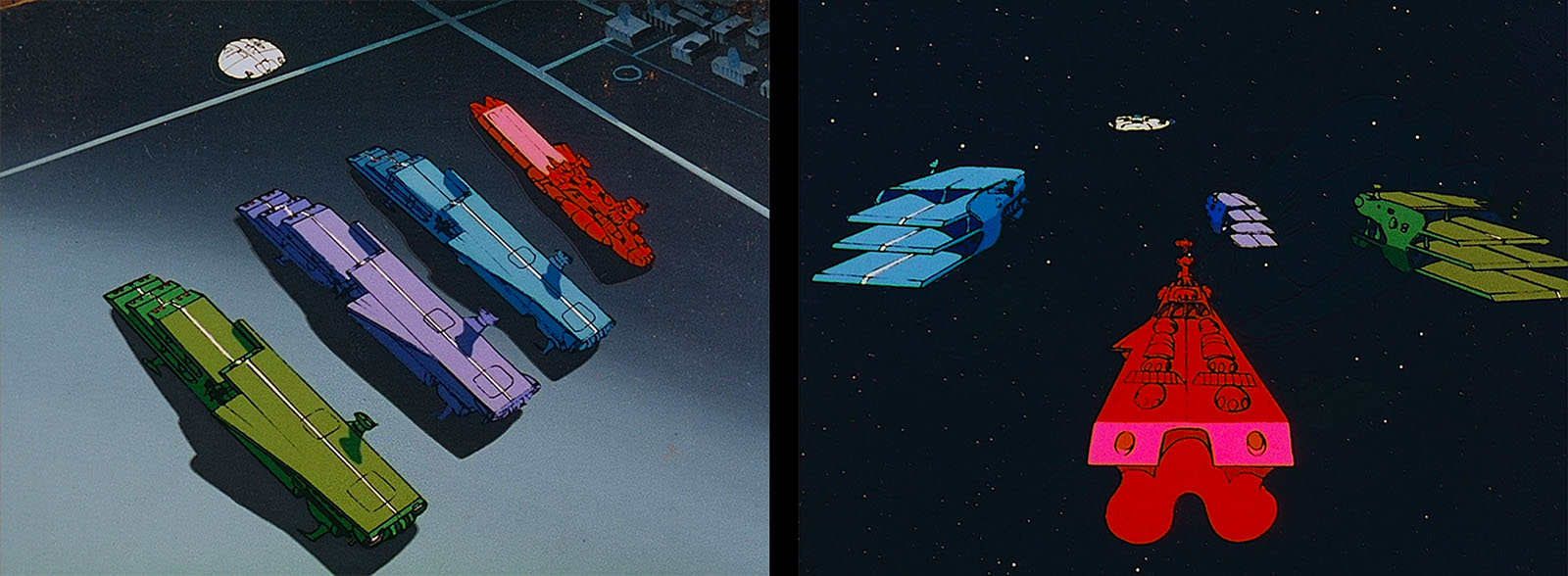
Original rough designs for the three different Gamilas carriers

Only the second design was refined to represent all three
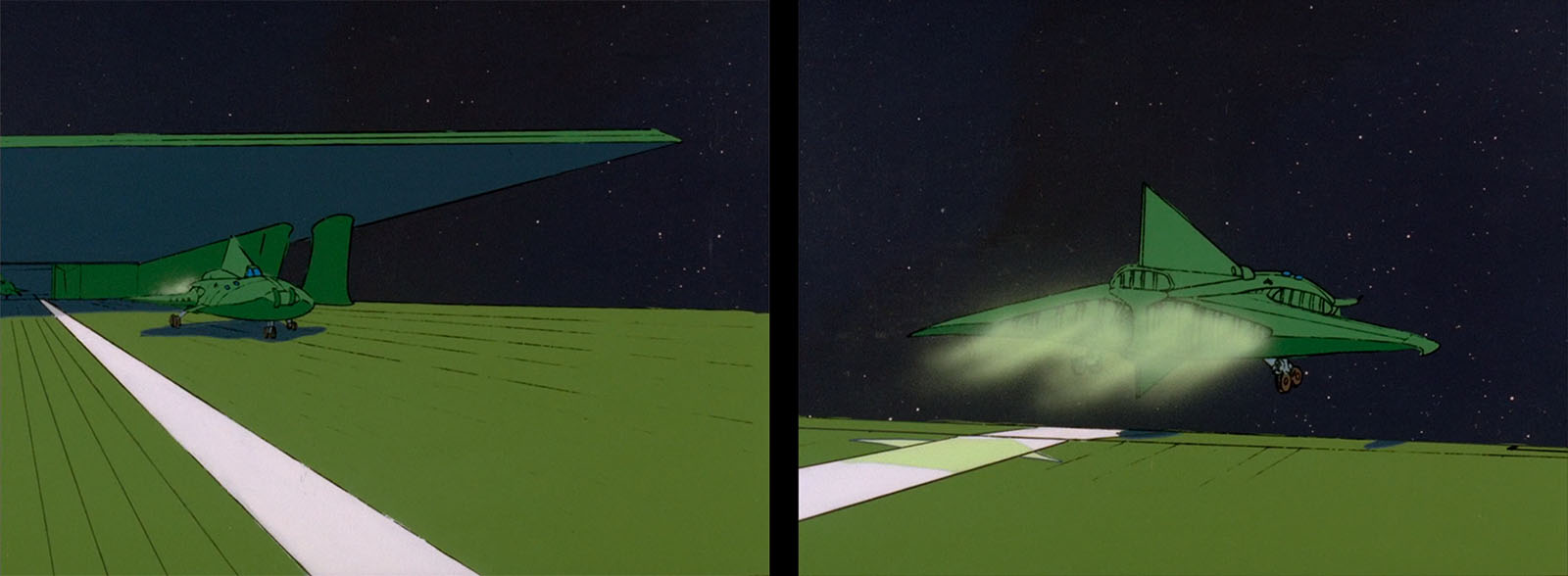
Looking back after it was completed, it might seem “obvious” that the climax is here, but I absolutely don’t think that’s the case. In the rough draft stage, the designs for the First Carrier, Second Carrier, and Third Carrier were all completely different. Among the carrier-based aircraft with different purposes, the Gamilas Fighter was a sharp and incredibly cool rough design. However the final version ended up looking like a gourd, and that design made it into the anime.
So, back in the fan club days, I showed it to Yutaka Izubuchi, saying, “See? The Gamilas Fighter is actually this cool!” and tried to spread the word. Then, in Yamato III, a version closer to the original shape appeared, and finally, in 2199, the ideal launch scene was realized using CG. I was thrilled at the preview screening. It made me realize that if you keep pushing, even after an incredibly long time, dreams can come true. I am deeply grateful to Chief Director Yutaka Izubuchi.
The Fleet Battle with the Carriers
For takeoffs and landings, they used background animation with three-dimensional depictions of the deck and such. It wasn’t just about using a lot of frames; they went to the trouble of doing things that were labor-intensive to really build up the spectacle. Even though it’s outer space, during landings, the fighters bounce a bit. That was one thing sci-fi fans used to mock, saying things like, “For safety on the deck, there must be artificial gravity or something.”
Gamilas Carrier Fleet
The instant annihilation of four carriers is a parody of the Battle of Midway, right? The large-scale combat scenes were handled by animators skilled in military action, like Kazuhide Tomonaga. Takeshi Shirato reportedly screamed, “Tiger Pro [studio] is on fire!” Shots that fell through due to resource constraints were assisted by internal teams. The shot where the dive bomber pilot points, the torpedo bomber drops torpedoes, and the long shot of Yamato being torpedoed were all mecha animation by Kaoru Izumiguchi. The final coffin scene was also drawn by Toyoo Ashida.
While it’s questionable whether the in-house team had that much spare capacity for the next episode (Episode 23), the fact that “Episode 18 was still being animated as Episode 17’s broadcast approached” suggests that must have been the situation.
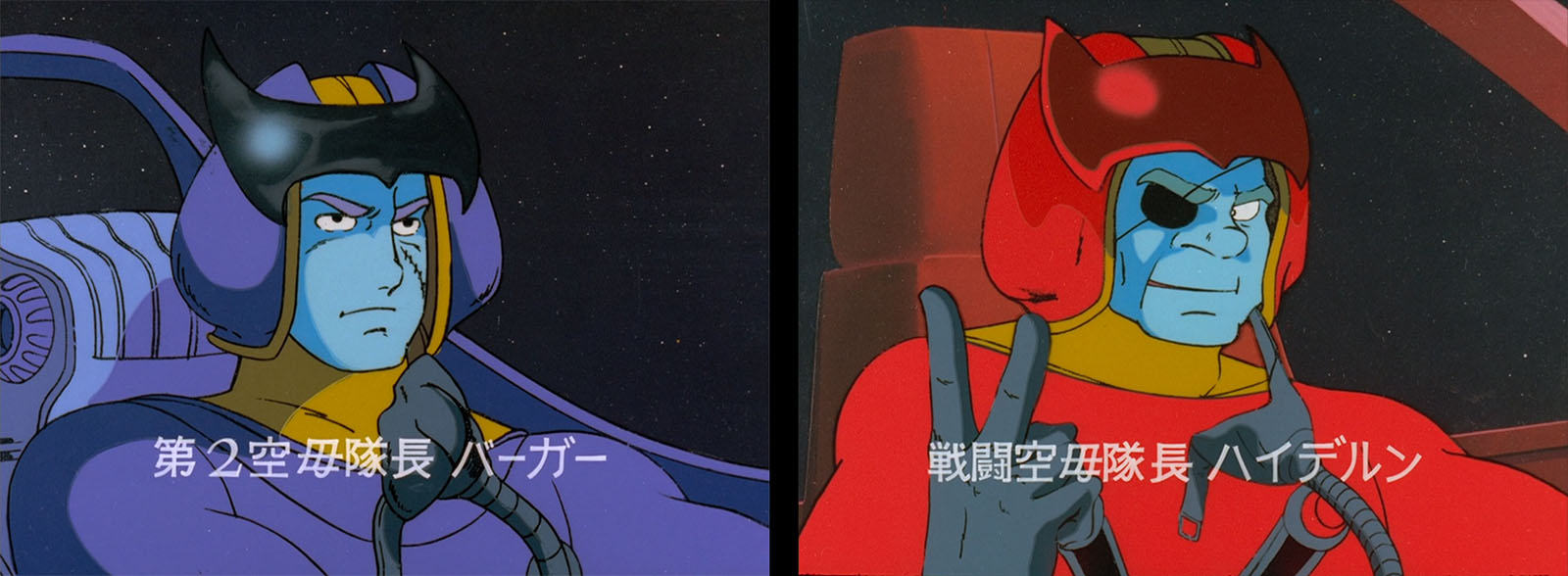
Carrier Aircraft Cockpits
For some reason, there were no designs. Since it only appeared in one shot, it was probably left up to the animator. I collected all the original drawings and also had a large number of copies of the animation cels for color specification. I gathered all four aircraft and organized them using line art. I managed to include them on the Blu-ray and archived them for posterity. Due to various circumstances, I couldn’t add an explanation, so it seems no one has noticed yet (Laughs), but maybe in ten or twenty years, someone will thank me.
In all cockpit shots, the carrier’s captain is flying it himself. While it would be more natural for it to be the air group commander, like in 2199, it was probably dramatically important to have a prominent guest character clash with Yamato.
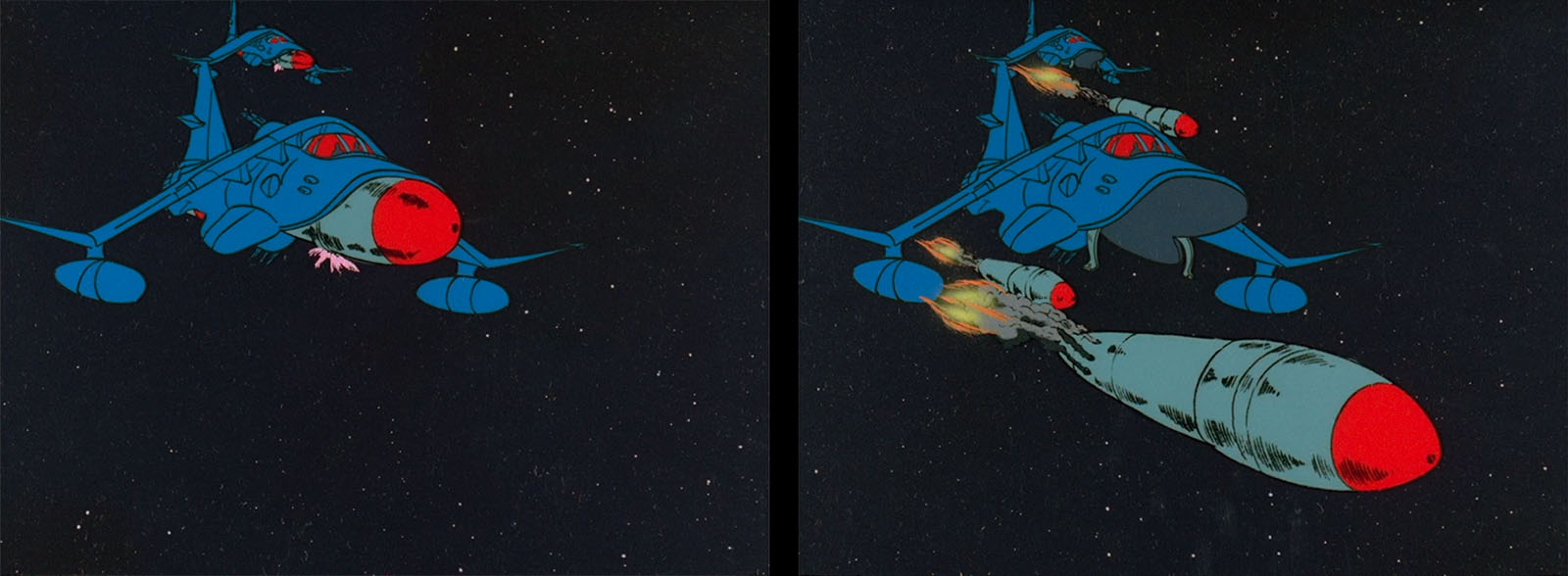
Torpedo Bomber
This is a special aircraft carrying two torpedoes. The design includes “explosive bolts,” and the animation depicts a mechanism where explosives shatter the fasteners, releasing the torpedoes. Firing both simultaneously would likely cause them to collide, but as expected of Kaoru Izumiguchi, it’s handled in a “characteristic way.” Historically, the job title “Mechanical Animation Supervisor” (Mecha Sakugan) first appeared in 1980, when Yoshinori “Iko” Kaneda was credited for “Mecha Correction” on Moby Dick. Kaoru Izumiguchi declared his desire to draw mecha long before that, and Mr. Ishiguro highly praised his work, saying, “his mecha designs have real character.”

Drill Missile Hits
The drill spins and penetrates inside. But that wouldn’t actually happen. The drill bit would lock and the base would just spin around. (Laughs) I hear there was similar debate in the UK when the Thunderbirds‘ Jet Mole Tank adopted that design, inspired by Submarine Warship. It’s purely image-driven.
To begin with, why would they develop a weapon specifically designed to penetrate the Wave-Motion Gun when they weren’t even concerned about Yamato? Or why would the tip have a hole like “Enter here to reverse course”? I recall discussing such things often. Yamato was the “original nitpicking anime.”
Conversely, that means the realism had become so high that people started noticing those holes. So, in Director Izubuchi’s Yamato 2199, they explained things meticulously, like how the thrusters fire in the opposite direction to maintain attitude the moment the drill starts rotating, or the origins of the missile and the purpose of the hole at the tip. At the preview screening, I broke out in a cold sweat thinking, “Is this my fault?” (Laughs)

Yuki Slumps Down
For the Part 1 Blu-ray audio commentary with Mr. Izubuchi, the “Yuki slumps down scene” came up again. “G.P.” refers to Mr. Nishizaki, short for “General Producer.” Mr. Ishiguro was “Chief Director,” hence “C.D.” He said things like, “Being the Earth Director, he’s weak against the Gamilas Producer.” Because of that GP’s obsession, it was redrawn over and over, and that artifact still exists. There are even rough drafts of Ishiguro’s director corrections, showing moments where it seemed like her legs gave out. Amazing notes left by the GP remain, so please check them out on the Blu-ray. Every time Yuki Mori, the sole heroine, made an appearance, it caused quite a stir.
Carrier Chain Reaction Explosion
The highlight of the Rainbow Star Cluster is the sudden chain reaction explosion that wipes out the carriers after the drill missile reverses course. Ishiguro-san himself drew the effects keyframes and did the animation for this part, but he grumbled, “I forgot to bill for that work.”
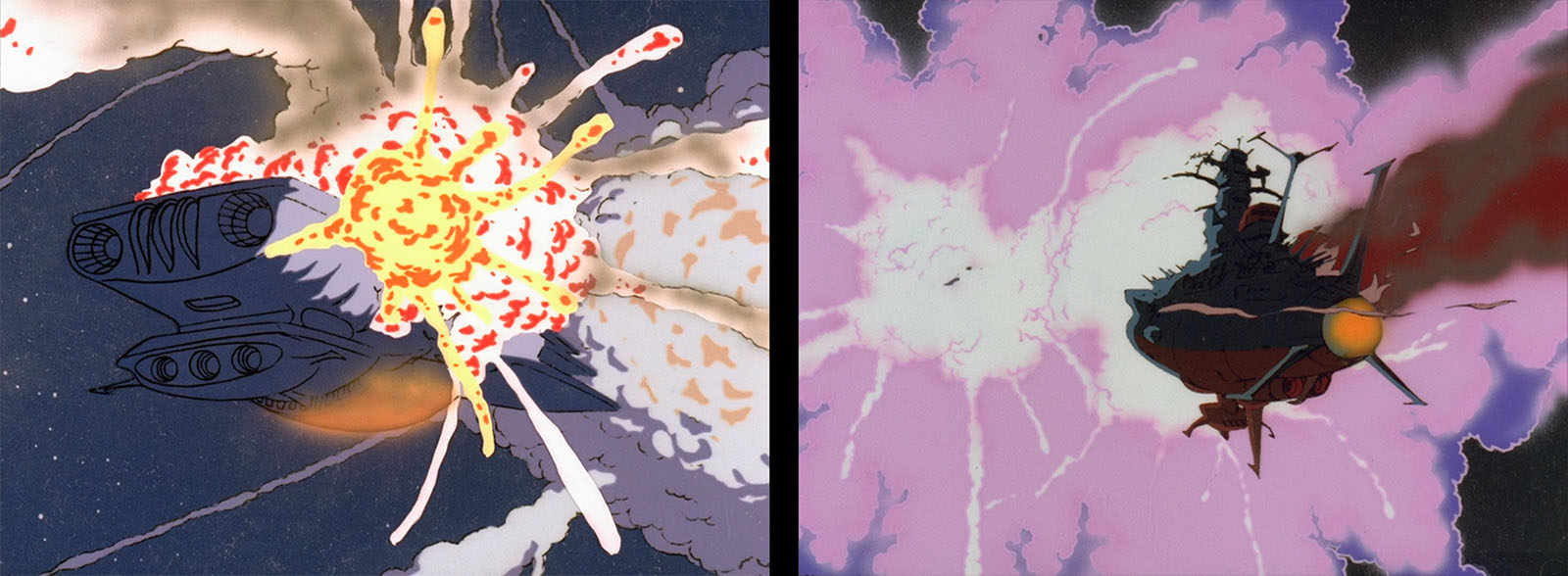
What’s incredible is how the news footage of the 1986 Space Shuttle Challenger explosion looks almost identical to the explosion of the third carrier. It might be inappropriate, but it gave me chills. Even if it was the result of studying footage and burning it into his brain, pursuing realism like that can lead to such prophetic coincidences.
What order does the combustion of an explosion occur in? What mechanism creates the “horns” (in film-making terminology)? How do the debris called “gara” behave? Ishiguro must have done extensive research, even in an era before VCRs. I believe that his scientific analysis of these effects, his quest for truth, and his mindset were passed down to Ichiro Itano, Hideaki Anno, and others, spreading throughout the industry and continuing to this day.
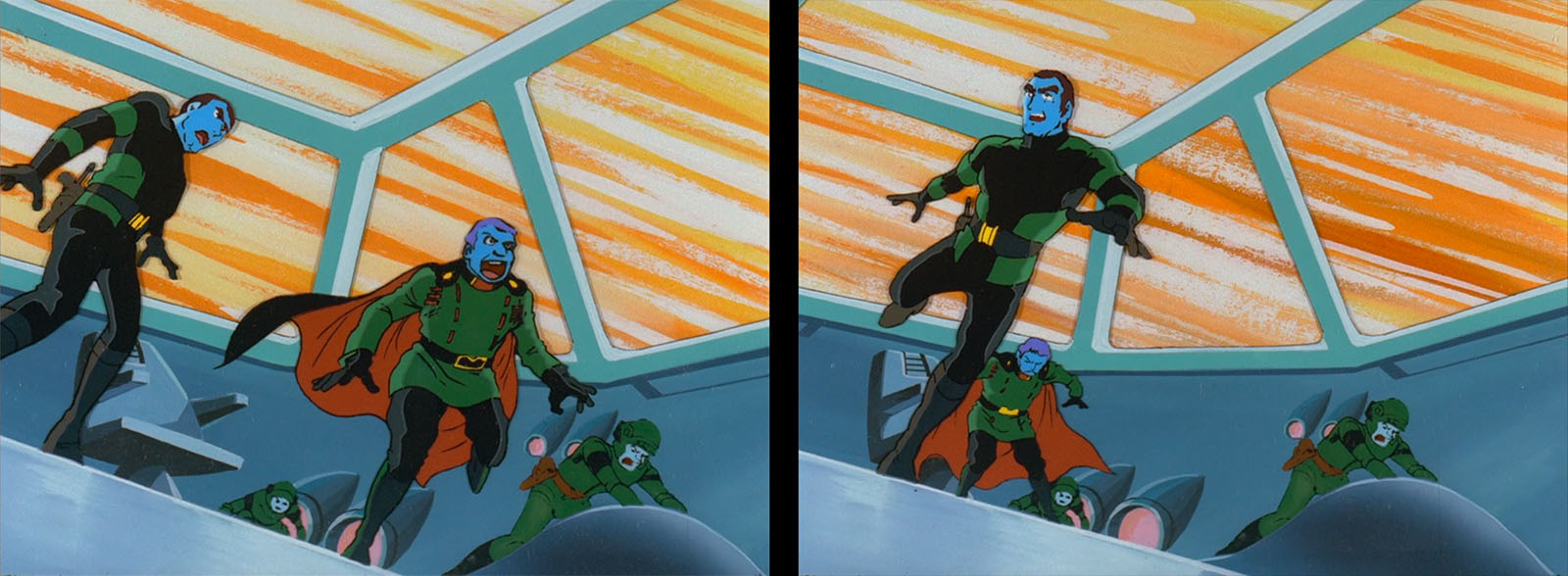
The Mystery of the “jump” poses
Before 2199 got fully underway, I once had a gag request battle with friends at a bar, to tell Mr. Izubuchi things like, “Please include this scene!” I turned to him and said, “You’re going to remake that weird two-pose scene too, aren’t you?” something that couldn’t possibly be done, and affectionately harassed him with a smile.
Regarding the poses jumping around, if everyone had just stayed still as seen in the first cel, it probably wouldn’t have looked that strange, since that technique was often used in anime. But when they jump back and forth without in-between frames, it looks unnatural. Why they opted for this, and didn’t retake it after the first broadcast, leaves many mysteries.
And so, at the banquet,
Episode 23
Finally Arrived!! Crest of the Magellanic Clouds Wave!!
March 9, 1975
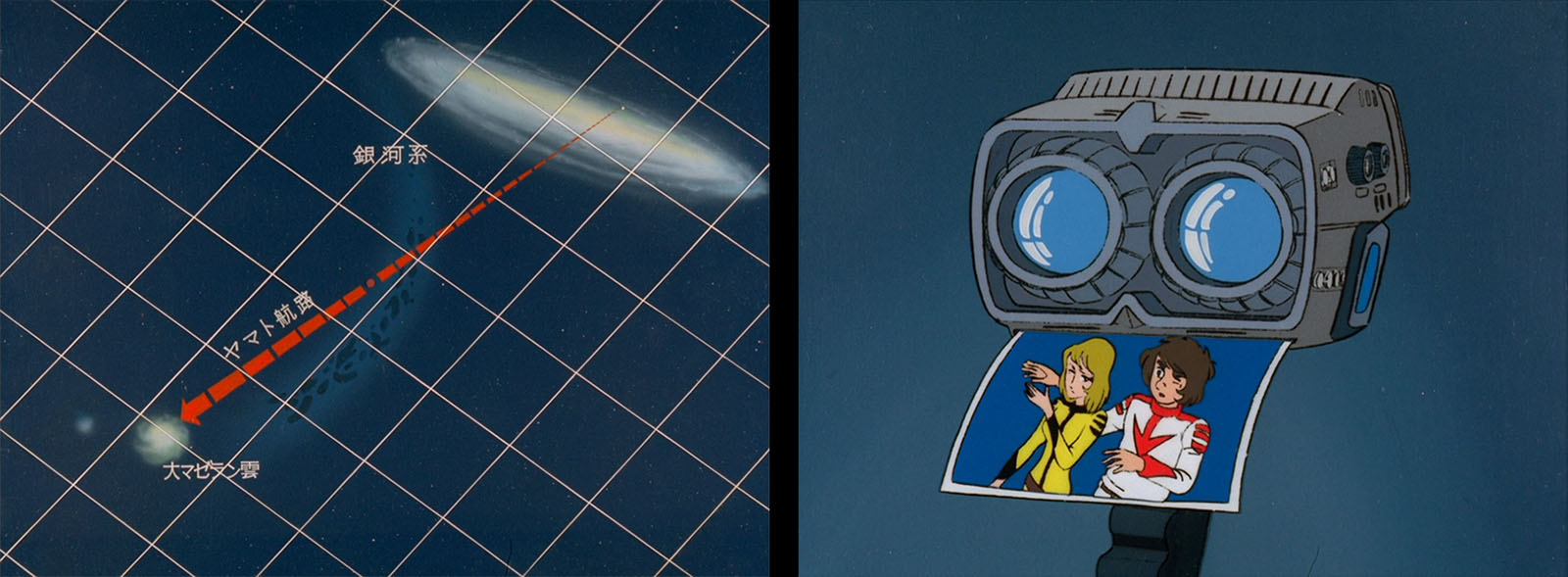
Reaching the Large Magellanic Cloud
Yamato‘s celestial terminology is a bit unique. It uses “heliosphere” instead of “solar system,” and “Large Magellanic Cloud” instead of “Large Magellanic Nebula.” The source isn’t entirely clear. The caption reads “Magellanic Nebula,” showing some inconsistency.
Commemorative Photo
A romantic comedy-esque scene is included here too. Taking a commemorative photo with a self-timer mirrors the situation in Gundam where they take a photo with Matilda. Perhaps taking photos in tense situations serves to ease the tension? This camera was designed by Kenichi Matsuzaki of Studio Nue.
While famous as a Gundam screenwriter and SF concept designer, he also attended Yamato meetings as a consultant. When something like “we need this” came up, he’d apparently design it on the spot. Younger viewers probably won’t recognize the spring-winding sound of the self-timer or the instant photo printout.
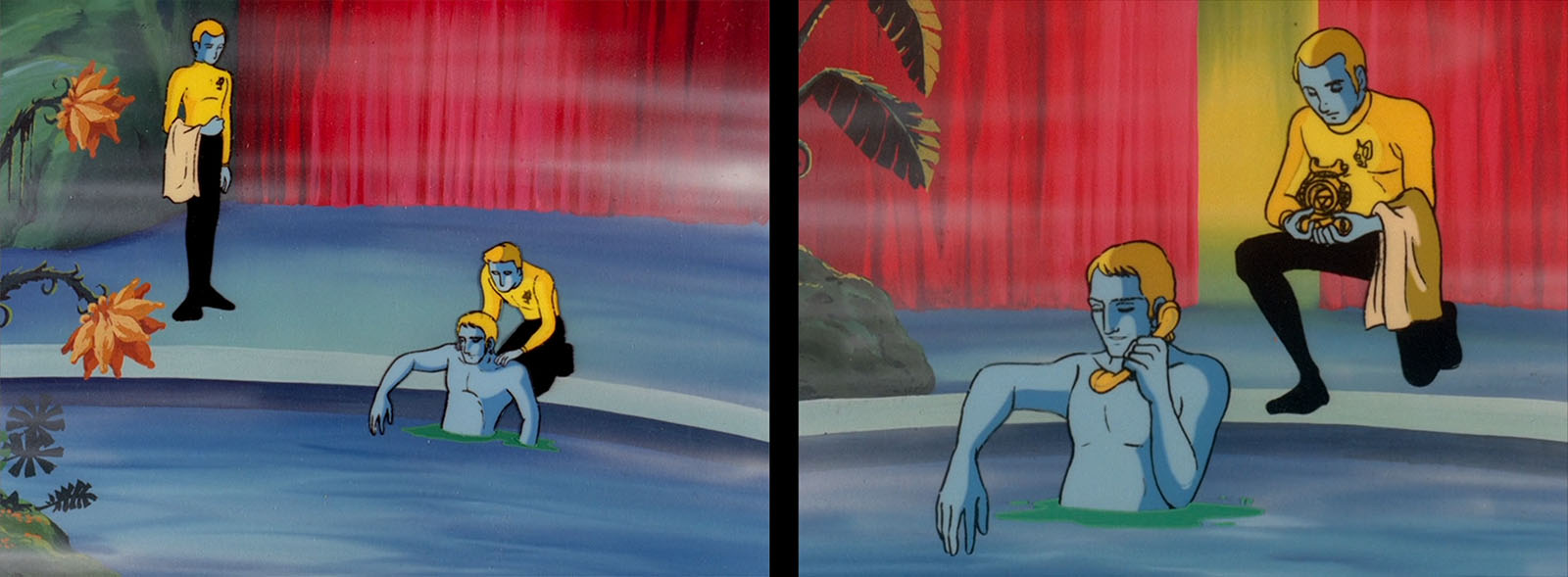
Dessler Bathing
Following Episode 13, he’s bathing again. It’s definitely the Roman Empire, not Nazi Germany. After the hit [Japanese] movie Thermae Romae, the current interpretation might be easier to understand.
I recall how difficult it was to obtain the design for the “page” character, as it was strangely absent from the master design drafts. The design for the “telephone” appearing in the same shot was also hard to get. Even though it was revised in Episode 20, aside from being a cordless phone (which didn’t exist back then), it’s actually a fairly ordinary telephone. Gamilas has that kind of thing. It connects to the mystery where the ordinary soldiers’ guns have an alien design, but Dessler’s gun is Earth-style…
The rock bath setting has the date “January 24, 1975” written on it, giving a glimpse into the tight schedule. This episode marked the last time Toyoo Ashida drew Dessler. The shadowing for emotional expression follows his expression collection from Episode 11.
Episode 24
Death Struggle!! God, Weep for the Gamilas!!
March 16, 1975
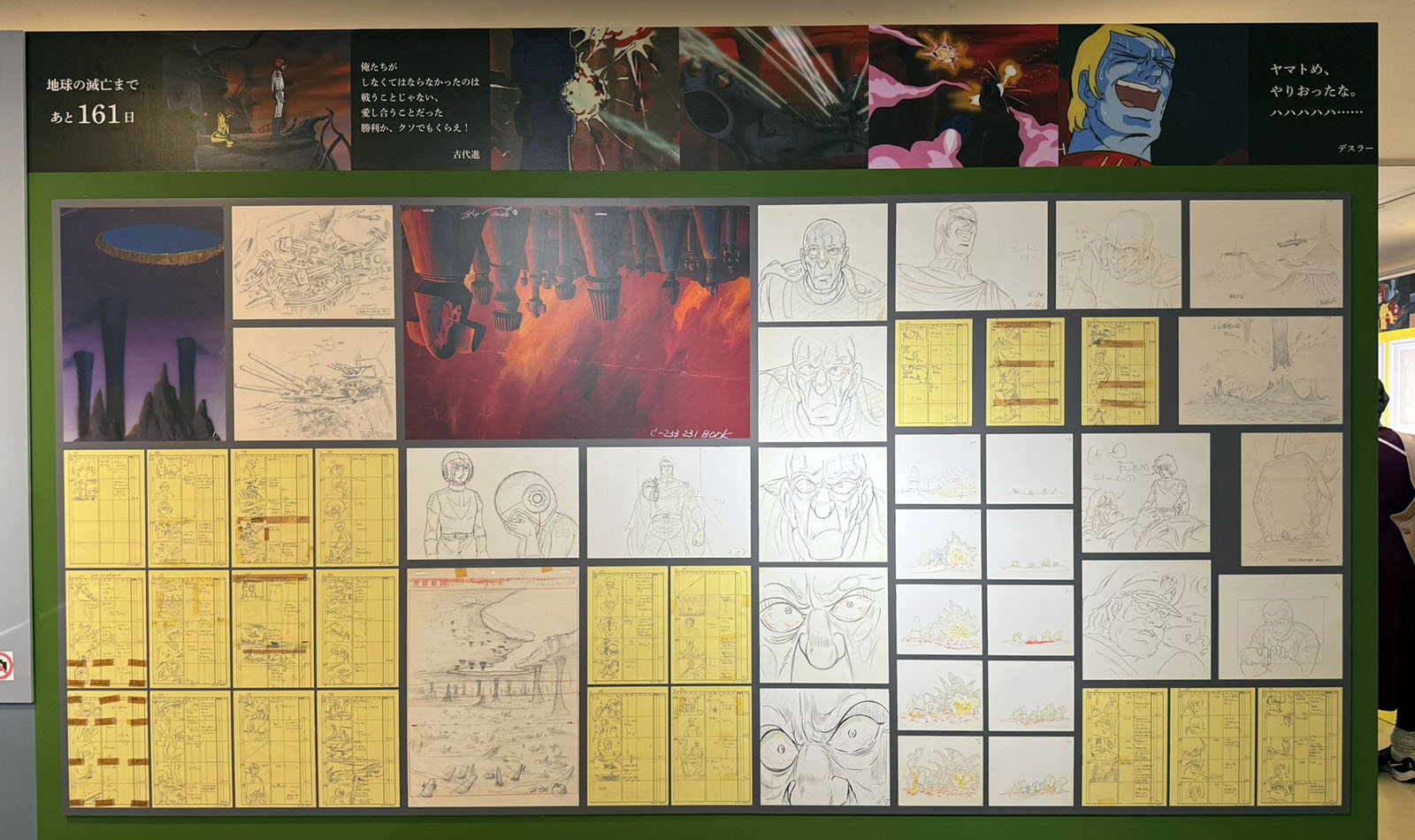
Episode 24 materials displayed at the 50th Anniversary Exhibition, March 2025
Director’s Revised Storyboard
Fortunately, the storyboard for Episode 24, marked with revision notes likely from director/supervisor Eiichi Yamamoto, still exists. We previously dedicated an entire session to analyzing it in Community College. This material was what made my high school self think, “So this is what visual direction is all about,” and sparked my deep interest in the field.
For example, it’s packed with checks like: “The depth charges falling from above are meant to pin down Yamato‘s bow and force it into the sea of sulfuric acid, so they must not hit the sea. They must explode above Yamato‘s flight path.” In other words, if the essence of “drama” is “conflict” and the “premonition of change,” then we should sandwich the obstacles – “ascend and you’ll hit depth charges, descend and it’s the sea of sulfuric acid” – and show the “omen of a fatal change” to drive the audience’s emotions. And the essence of ‘direction’ is the act of visually suggesting or explicitly showing this to guide such change. I render definitions in my own words in order to conduct new analyses without being bound by the limitations of existing terms.
For instance, if we reduce “drama” solely to “conflict,” we’re confined to a narrow interpretation that prioritizes the unseen turmoil within characters. Yet, what actually happens in the directing is entirely different. Managing to secure such top-tier reference material makes me want to give my high school self a pat on the back.
Beyond the effects, Yamato is packed with meticulous details that are hard to grasp just by watching the finished product. I suspect other episodes are similarly dense with such things. It’s precisely because these resonate deep within the heart that it became such a beloved work. I want to spend my remaining years carving out more time to decipher these truths.
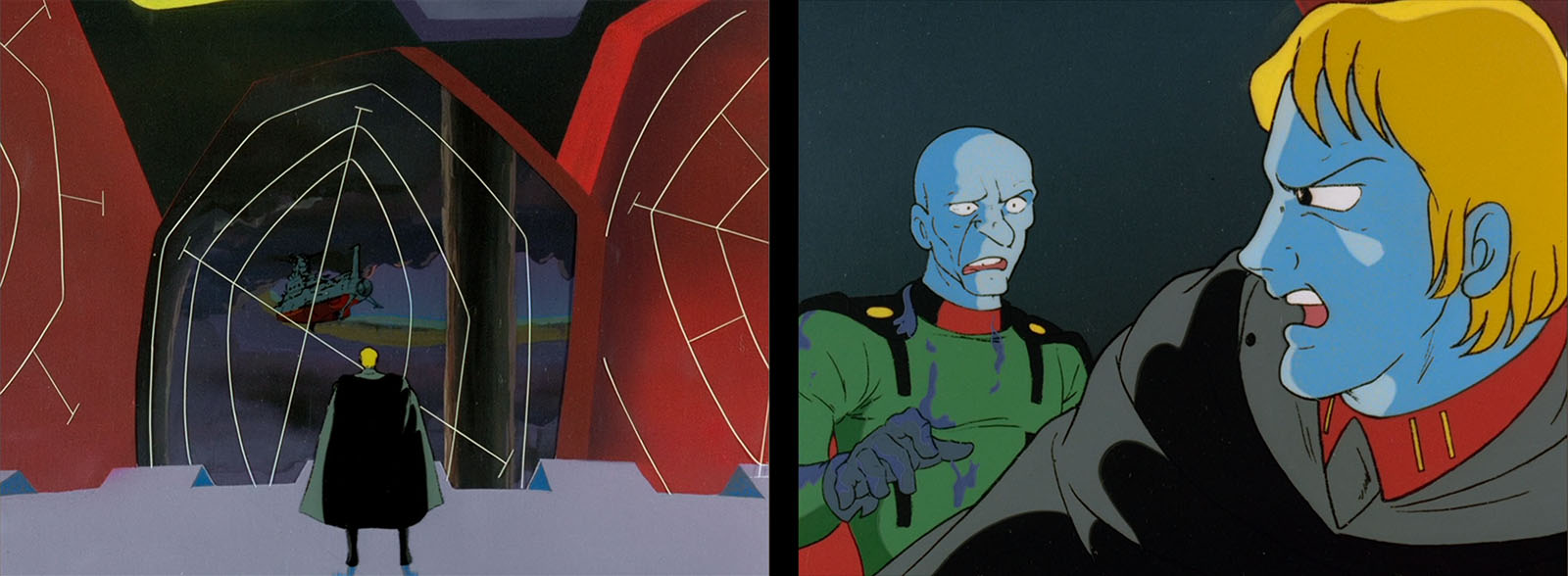
Director’s Notes
Fortunately, many concept and direction notes by Chief Director Noboru Ishiguro still exist for this episode. In the settings, the sequence where Kodai descends from the destroyed bridge to speak with Yuki, and the screens surrounding Dessler, elements closer to stage design than art settings, were drawn by Mr. Ishiguro. For the key animation, the pose changes for Dessler delivering his speech, “Gentlemen, one more push! Let’s do this!” are specified in the direction notes. Scenes like the shock when Dessler refuses a drink or is nearly crushed by rocks also have director notes on the original artwork.
The depiction and principles of explosions under gravity proved incredibly useful. It’s articulated: “First, flames erupt, then the temperature drops and it becomes smoke.” Luckily, I obtained these primary sources. With my young, flexible mind, I studied them intensely, thinking and analyzing on my own without anyone teaching me. That was pure luck and became a lifelong asset.
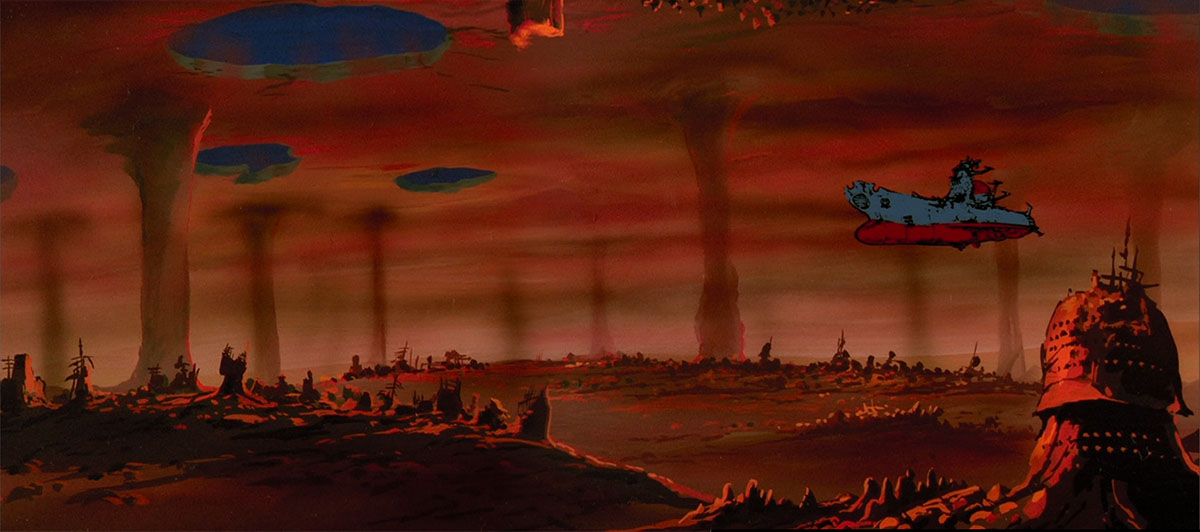
Yamato Floating in Air
This was the most surprising point in the earlier storyboard revisions. Doesn’t something seem off about Yamato‘s state after Gamilas’s destruction? It’s floating in mid-air, right? But its engines aren’t running, and Yamato has no hovering capability. This is clearly visual imagery meant to show something “abnormal.”
At the stage when Mr. Ishiguro reviewed Mr. Yasuhiko’s storyboards, Yamato had lost power and was lying on the ground. That was canceled. Yamato was constantly at a disadvantage, sandwiched between missiles from above and the sulfuric acid sea below. By visually conveying the “danger above, danger below” situation, the decision to “dive into the sulfuric acid sea” becomes cathartic. It brings change and leads to the next development. Once submerged, a new crisis arises (the “risk of melting”), creating time-suspense. Firing the Wave-Motion Gun precisely there heightens the catharsis of reversal.
However, while a reversal alone would have sufficed, the volcanic eruption causes catastrophic damage to Gamilas itself. While a spectacular showpiece, the “destruction of Gamilas” is a disaster vastly exceeding Yamato‘s expectations. Yet Gamilas doesn’t cease its attack. They escalate by converting depth charges into missiles, forcing Yamato into a defensive stance…
This chain reaction of cause and effect, this rolling forward of events, is precisely what makes drama and playwriting. The pinpointed “conflict” is only one part of it. Visually demonstrating this is the director’s job; for example, deciding on visual direction and placement like “danger above, danger below” and explicitly showing it to the audience. It’s at the end of this flow that “layout” has come to be so highly valued today. The sheer brilliance of this kind of direction gradually dawned on me as I reread it over and over, sending a chill down my spine. It wasn’t decided on a whim; it was logically “engineered.” Just like electronic circuits or programs.
This is the brilliance of “direction,” existing between the realms of scriptwriting and animation.
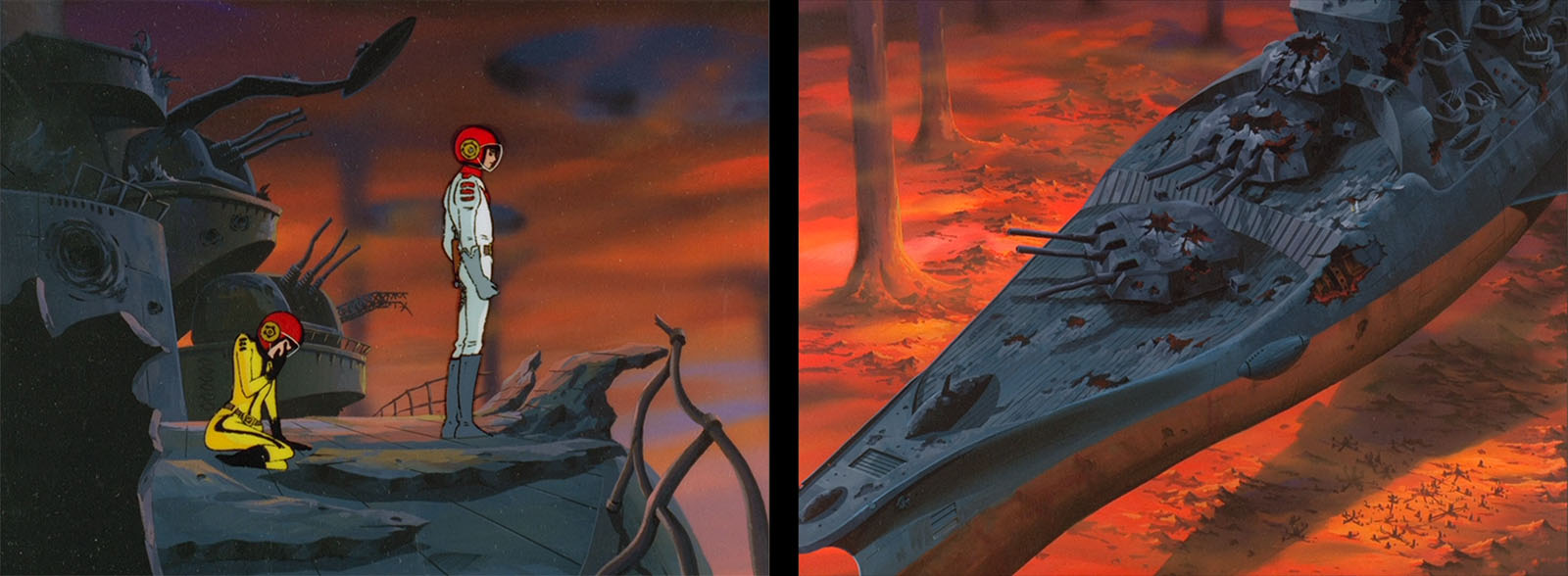
The victim, Yamato, went too far and became the perpetrator. This is an unparalleled, massive shift within the series. So, is there catharsis in this reversal? No, there isn’t. Facing the ruins, Kodai and Yuki are overcome with guilt. They ask, “What if?” and by moving forward again, the next drama begins.
This “transition” is the very essence of drama. Based on that principle, it’s clear that Yamato lying motionless on the ground for no apparent reason is unacceptable. To avoid overcommitting to one side, Yamato in that scene had to hover in mid-air for no reason, placed in that ambiguous position. Of course, it’s scientifically implausible, but dramatically, it was the correct choice.
To be honest, I’m not particularly fond of the reflective drama where they gaze down on the destroyed Gamilas planet and say, “We should have loved each other.” That said, I understand it only works precisely because it’s set at the peak of that conflict, being caught between two sides. It was around my second or third year of high school that I gradually began to see this essence and thought, “Anime is amazing.”
My serialized column Yamato: Lessons from the Past in Newtype Ace, triggered by director Noboru Ishiguro’s sudden passing and the start of Yamato 2199, was interrupted when the magazine ceased publication. Originally, it was planned to culminate with this very topic. If the opportunity arises, I’d like to compile and publish this kind of research based on primary sources someday. There’s still so much more material like this. (Read all of Hikawa’s columns from Newtype Ace here.)

Animation by Tomonori Kogawa
In Episode 24, many shots were animated anonymously by Tomonori Kogawa (then known as Shigeru), who was working at Studio Mates at the time. This includes the entire sequence where Captain Okita and Kodai discuss diving into the sulfuric acid sea, and the whole “We should have loved each other!” scene. During the production of Farewell to Yamato, a calendar featuring this scene was posted on set. Kogawa apparently confided to Ishiguro, “Actually, I drew this part.”
Hearing that, I immediately dug out the original drawings and thought, “These skilled drawings with such soft lines…” (Laughs) They should be included on the Blu-ray too. Some of them have incredible angled shots. In the final animation, Kenzo Koizumi made corrections, so it’s not as obvious. You can tell how fast Mr. Kogawa was drawing just by the flow of his lines. It’s the same with Mr. Yasuhiko’s original drawings for Gundam. Skilled artists have such a solid image in their minds that their lines show no hesitation.
Episode 25
Iscandar!! Dying Planet of Love!
March 23, 1975
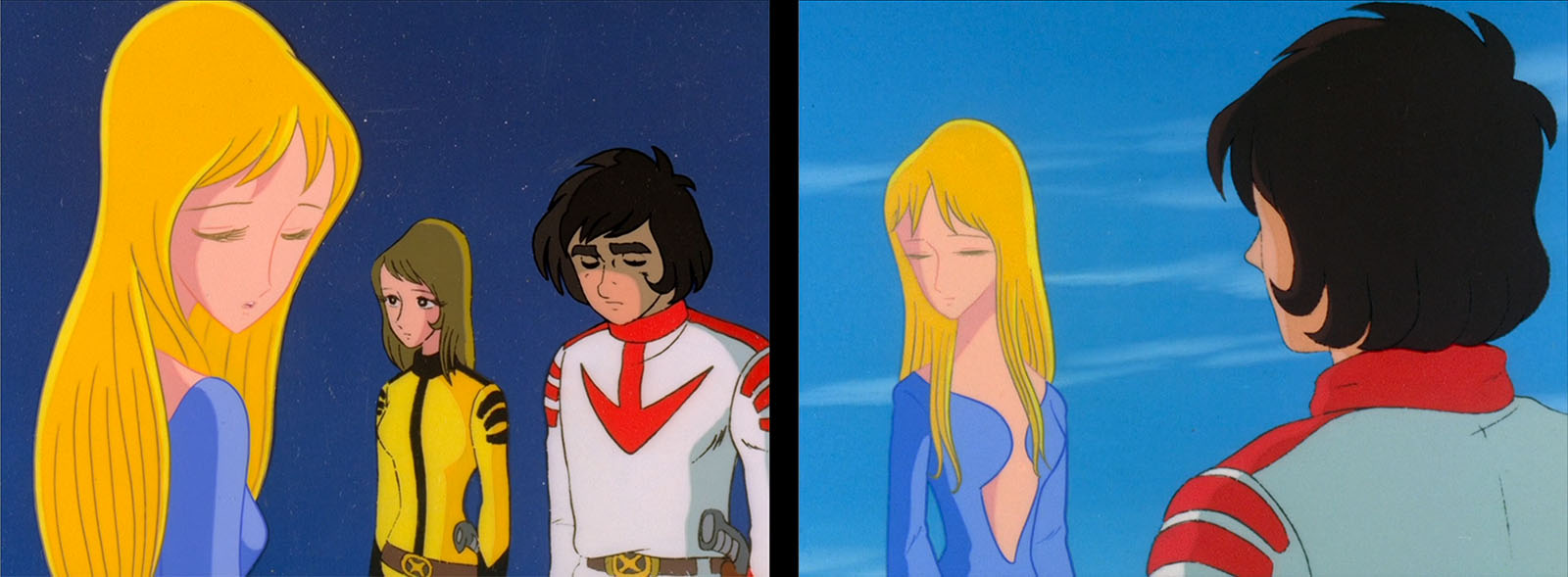
Direction Mistake
I’m terribly sorry to nitpick, but this is an episode where mistakes immediately come to mind. For example, in the sequence where Starsha and the crew talk, after the flashback scene ends and the camera cuts, it suddenly becomes night. The next shot is back to daytime. A similar phenomenon occurred in the on-air version of The New Voyage.

Double Planet Depiction
The shot showing Gamilas visible from Iscandar’s horizon was very well done. Even if it’s a binary planet, I don’t think it would appear like this, but as an image-driven scene where Gamilas emerges from beyond the graveyard spreading across the barren Iscandar, it worked well. However, after smoothly sliding upward on the slide, Gamilas then stops abruptly above the graveyard in the next shot. (Laughs)
When I pointed this out to Mr. Ishiguro, he said, “That was the assistant director’s mistake.” Shots come in separately during production, so if you focus only on the shot content and don’t consider the continuity in the storyboard when doing the “shooting call” (the process of gathering materials and giving instructions for filming), this kind of thing happens. If there’s time, you can do a retake to avoid a fatal flaw, but since it was the penultimate scene, that was probably difficult too.
Yabu the Engineer’s Rebellion
Since the foreshadowing that “a rebellion will break out in the engine room” had already been laid, Yabu ended up being made the scapegoat and designated as the rebellion’s ringleader. His line, “Don’t worry, I have a bride,” has a mature, dark edge to it, but I always felt sorry for Yabu. They couldn’t just shoot him, and if he returned to Yamato, it would lead to a whole side drama. So an earthquake was the perfect way to dispose of him. In 2199, they picked up on Yabu’s “aftermath,” and it felt like a weight had finally been lifted off my chest.

The End
The sequence where Mamoru Kodai decides to stay on Iscandar is often featured as a famous scene in photos. Like Episode 22, Toyoo Ashida drew the key animation for this one, too. It bears a strong resemblance to the earlier Mamoru Kodai. Since the in-house team was effectively removed from the main work in Episode 23, he was probably assisting another team or working on animation.
Episode 26
Earth!! Yamato Has Returned!!
March 30, 1975
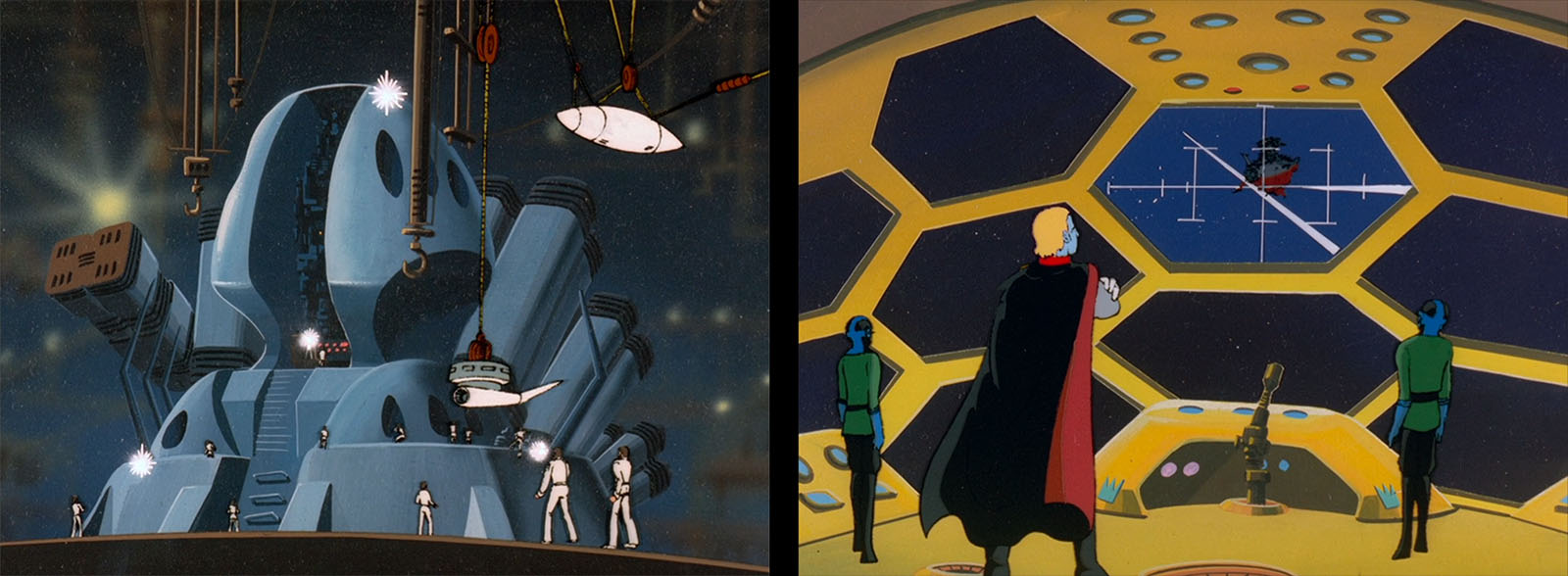
Final Episode
At last, the final episode. As Mr. Ishiguro passionately recounted in his first interview right after broadcast, it truly seems to have been the most chaotic of chaotic situations. Producer Nishizaki, obsessed with meetings, demanded a story worthy of Yamato‘s finale. He repeatedly rejected the script, causing long delays. The final draft emerged well past the deadline. They couldn’t order designs or start key animation. This final episode was truly made under the most extreme time pressure.
It seems they managed to produce it in about three weeks starting in March. However, most of the production staff were already working on April’s new programs. Studio Nue was already assigned to Brave Raideen. While Naoyuki Kato had designed the radiation removal device, it was only partially sketched, so it was likely “pulled” (taken over mid-production by the next studio).
The interior of Dessler’s bridge and the close-combat tubes were, out of necessity, designed by Noboru Ishiguro himself. Tiger Pro, originally slated for animation, was also assigned to Toei Animation’s spring program Shonen Tokugawa Ieyasu, so they must have been turned away once. Somehow, they managed to get the key animation for Part A only, but even the fast-working Kazuhide Tomonaga couldn’t seem to make it in time. It appears his friend, Yoshinori Kanada, stepped in as a helper to assist with the animation.

The opening sequence was probably drawn by the directing team (though a book once mistakenly credited it to Kanada), but from the start of the main story, up to the point where Dessler’s ship crashes and Kodai and the others see it from the window, it was Kanada’s work. After that, Tomonaga handled the animation. Perhaps because it was rushed, it has a touch reminiscent of A Productions. Especially the shot of Sanada climbing up the removal device. “Whoa! Sanada turned into Lupin III!” (Laughs)
For Part B, key animation was handled by a team assembled primarily from directors across various studios. Toyoo Ashida, Nobuhiro Okasako, Kazuhiko Udagawa, and Hiromitsu Morita are credited and participated. Kenzo Koizumi might have helped too. Takeshi Shirato made corrections as animation director, but it seems he couldn’t finish everything before being pulled off the project. This resulted in a diverse mix of art styles, like a grand cast of characters. In its own way, it feels fitting for a finale.
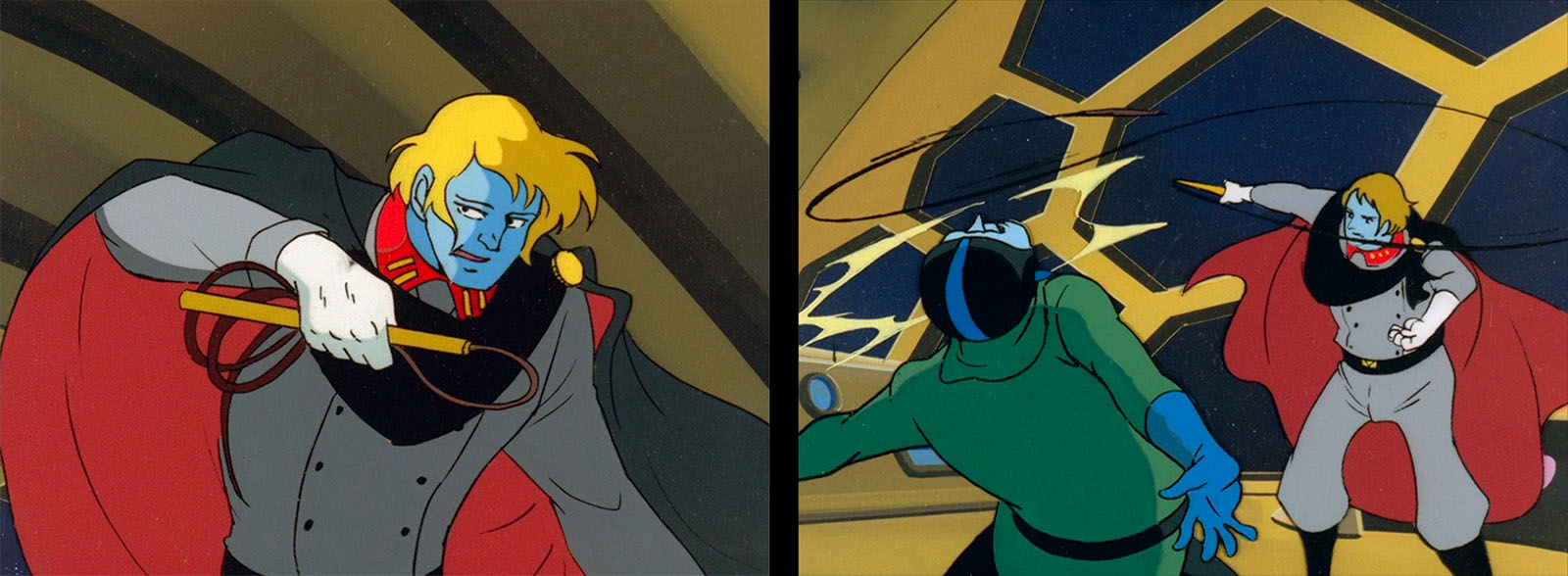
Dessler’s Animation
I once heard Mr. Kaneda himself laughingly say, “That battered Dessler was funny, wasn’t it?” He called the scene where he wields the whip “Dessler’s Iron Fist of Rage.” Looking at Dessler’s ship, you can tell he used a ruler to draw it even back then. There’s a line: “Dessler cannon firing ready! I’ll show you Dessler’s power!” Doesn’t ‘power’ seem odd? Judging by the characters, it’s probably a typo for “true strength.”
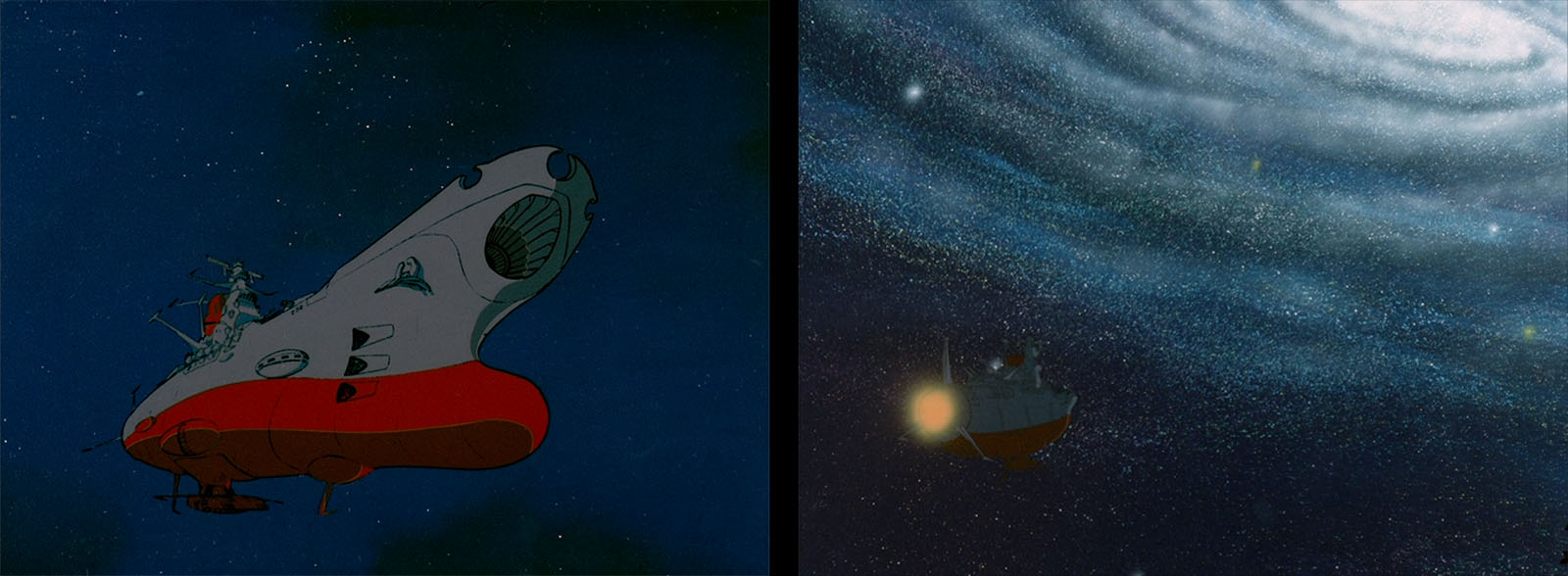
Yamato‘s Orientation
This is the episode where they return from Iscandar. The highlight is that, uniquely in this episode, Yamato is drawn facing entirely to the right. On the way out, the protagonist Yamato flows from stage right (upper) to stage left (lower). On the return, it’s reversed. This follows the same theory as director Yoshiyuki Tomino’s “Principles of Visual Composition.” Ishiguro-san, also a graduate of Nihon University’s College of Art, directed according to the same principle.
…Or so I thought, but I recently realized there’s also the “concept of the imaginary line” at play here. On Yamato‘s route map, there’s a large arrow drawn from Earth to Iscandar, right? That’s the imaginary line. Since an imaginary line connects two points of view, it naturally appears when looking from Earth toward Iscandar. The camera cannot cross that line (it would confuse the audience). That’s the principle behind why Yamato appears to be returning from left to right. I don’t think it’s simply a matter of “stage left” or “stage right.”

Production materials displayed at the 50th Anniversary Exhibition
Yuki Mori’s Revival
Noboru Ishiguro’s rough layout still exists. Come to think of it, there was a parody where Captain Okita dies, Yuki is revived, and when she opens her mouth, she starts speaking in Goro Naya’s voice. In our silly banter among friends, we used that as a gag, like “You gentlemen must recognize this voice…” But then someone pointed out, “Wait, that’s the final episode of Kamen Rider Stronger…” (Laughs)

Last Shot
The ending shows Yamato returning to Earth, but due to schedule constraints, they ran out of time to reverse Yamato‘s stock shot, meaning they couldn’t trace it going the other way and recolor it. So what they did was create a mirrored version of the Earth background, overlay Yamato‘s stock shot on top, shoot it in reverse, and then flip it using an optical printer. They then overlaid subtitles on top (probably done by the lab’s super processing), which was a crazy thing to do, so the horizontally scrolling text looks slightly blurred, right?
They ended up reusing the red Earth background drawn for this scene in new shots for the theatrical version. That’s why Yamato in the theatrical version returns to an “inverted Earth.” (Laughs)

In the movie SOS: Space Ship in the Deadly Zone by the staff of Mystery UFO, there was a concept where, on the exact opposite side of Earth’s orbit from the sun (a place normally unseen) there was another Earth. It had evolved identically, with the same humans, but everything was reversed, making it a mirror image Earth. We thought it somehow felt like that.
Summary
I thought I’d forgotten a lot, but looking back after over 40 years, many memories suddenly came flooding back. Back then, I was deeply immersed while watching it with that “only one chance to see it” intensity, so I really feel how strongly I remember the visuals. Once the video era arrived, it became more like “I can always check it again later,” and I don’t think the images burned themselves into my memory as vividly. In that sense, the deterioration is definitely there.
And now, being in a position to promote archiving and to guide “research” at the graduate school level, I’ve become firmly convinced that having the actual physical items, like the original drawings and storyboards, is incredibly powerful.
Thanks to Yutaka Izubuchi making Yamato 2199 a success, many opportunities opened up for Yamato as well. Considering how around 2006 we said, “No one will look back on this anymore, so we should at least do it ourselves,” this is a huge development. That revival period has passed, and with 2202 and what comes next, it seems the new Yamato will continue. I’ll keep following that too. But for now, it’s more like, “Let’s see how you handle The New Voyage,” right?
As for Be Forever, as I mentioned at a recent talk event, “Sasha is the victory condition,” so I’m secretly looking forward to this. It’s that classic light novel trope: “My niece is two years old, has a great figure, and is head over heels for me.” (Laughs) I’m actually hoping it combines with the romantic comedy elements that have been sprinkled in since the first work to create a powerful combo.
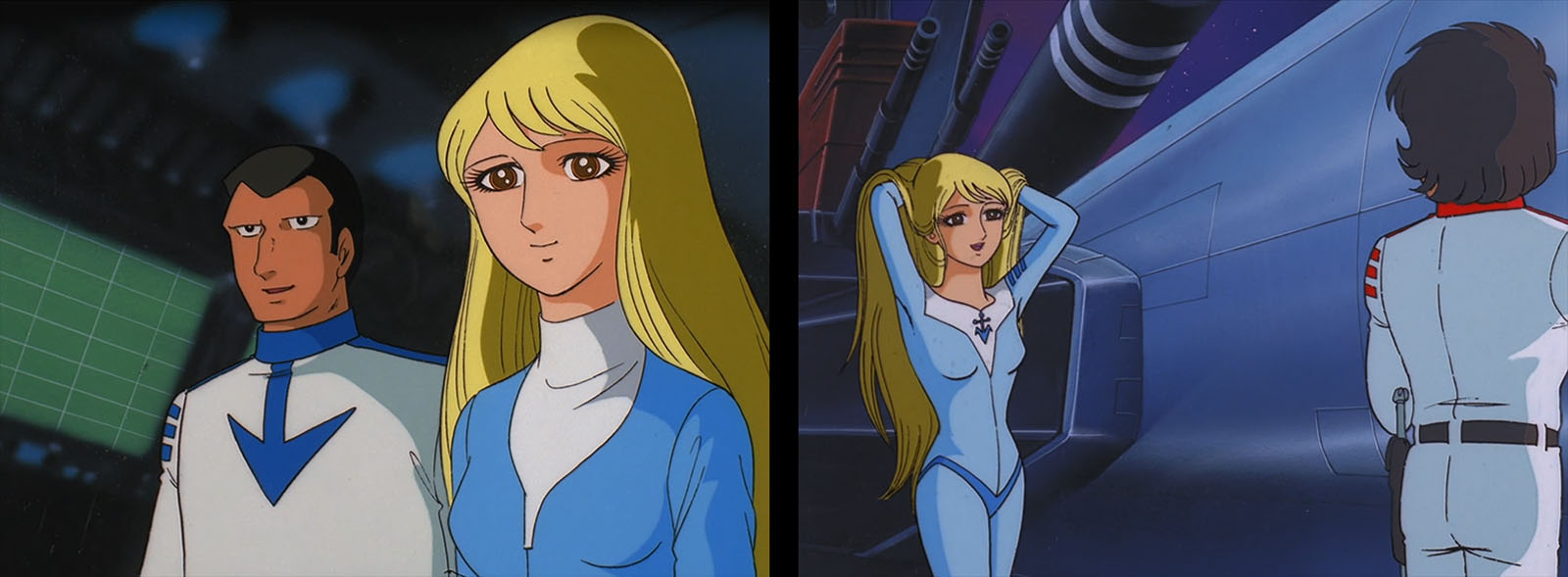
As the new staff creates a “new Yamato,” I sincerely hope the original gains new brilliance too, so we can deeply love both old and new. Maybe it’s because I’m older now, but back then, I resented Kodai’s reckless actions since we were close in age. Now, I think I understand the mature perspective of entrusting Yamato to him.
With deep gratitude for all Mr. Noboru Ishiguro has done for me, I quoted extensively from his lectures here. Like the earlier Aihara scene, the cinematic scale and sense of desolation achieved through frequent long shots – despite the low resolution and ghosting typical of small home TVs back then (around 14 to 16 inches; 20 inches was considered large) – deserves far more recognition.
There is also a particular power in the large-format cels and backgrounds in Yamato, shot at 240 frame size like movie posters. There’s definitely an effect where filming large things makes them appear larger. When I visited the studio to organize cels, the shock of seeing those large-format shots piled high in the bathroom is unforgettable. Now that image quality has improved, you can tell which shots are large-format, so I’m thinking of doing some research by diligently counting the number of shots.
This is a work that advanced Japanese animation. I want to continue examining it from multiple angles. I hope this serves as an opportunity for everyone to rediscover the joy of it. Thank you very much for reading.
Next: the afterword, a tribute to Noboru Ishiguro